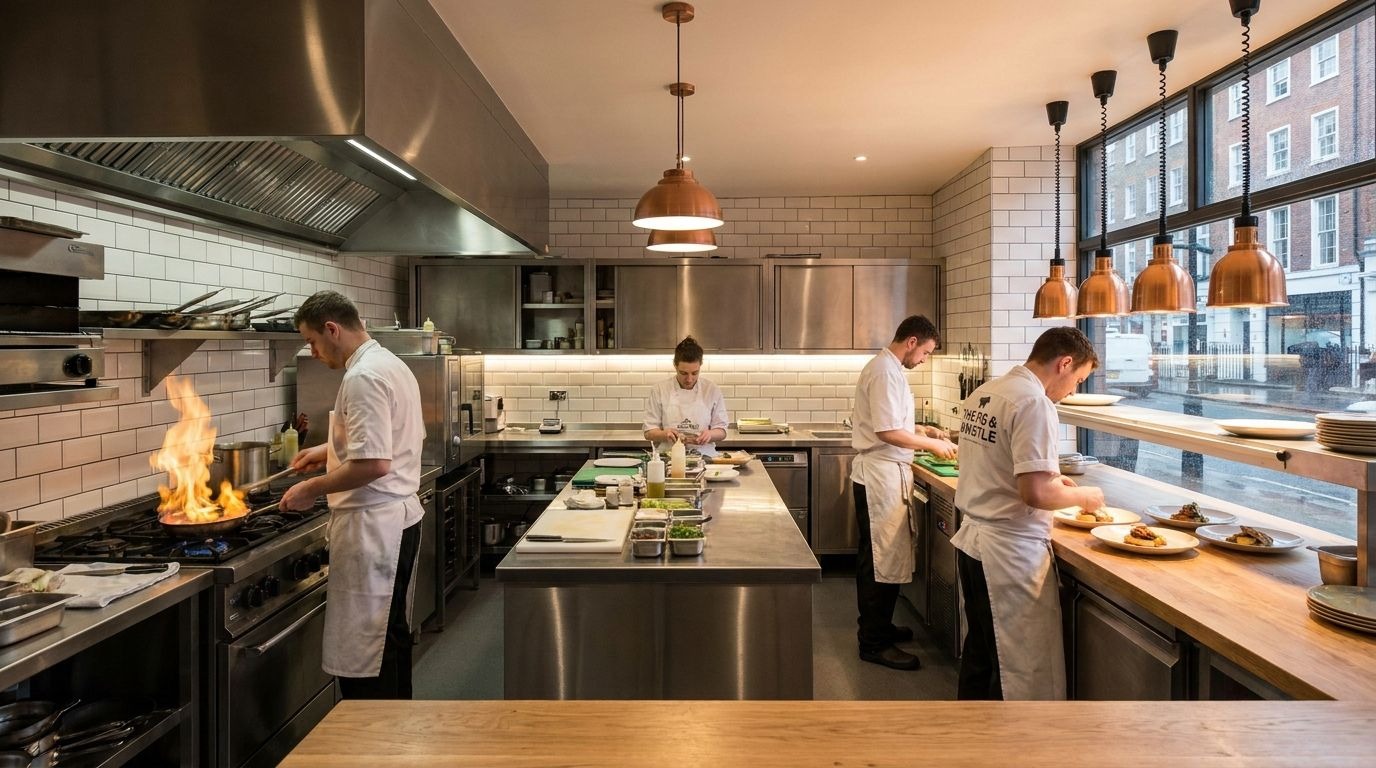
Quick View
“Catering supplies for UK restaurants and cafés span six core categories: commercial kitchen equipment, tableware and cutlery, disposables and packaging, bar equipment, hygiene and cleaning supplies, and catering consumables. Choosing correctly across these categories determines your margins, compliance, and customer experience. This guide covers every category, including the legal requirements, cost comparisons, and practical checklists you need, whether you are setting up from scratch or looking to reduce existing supply costs.”
Sourcing the right catering supplies is one of the most consequential and most underestimated decisions a UK food business makes. Whether you are opening a new restaurant in Manchester, refitting a café kitchen in Bristol, or scaling a catering company that serves corporate events across London, the quality, suitability, and cost of your supplies will shape your margins, your compliance, and your reputation every single day.
This guide covers everything you need to know: from the core categories of catering supplies and how to choose between them, to food hygiene law, the disposables versus reusables debate, bulk buying strategy, and exactly what you need when catering for events of any scale. It is written for working hospitality professionals who need clear, practical answers, not generic advice.
What Are Catering Supplies? Understanding the Full Scope
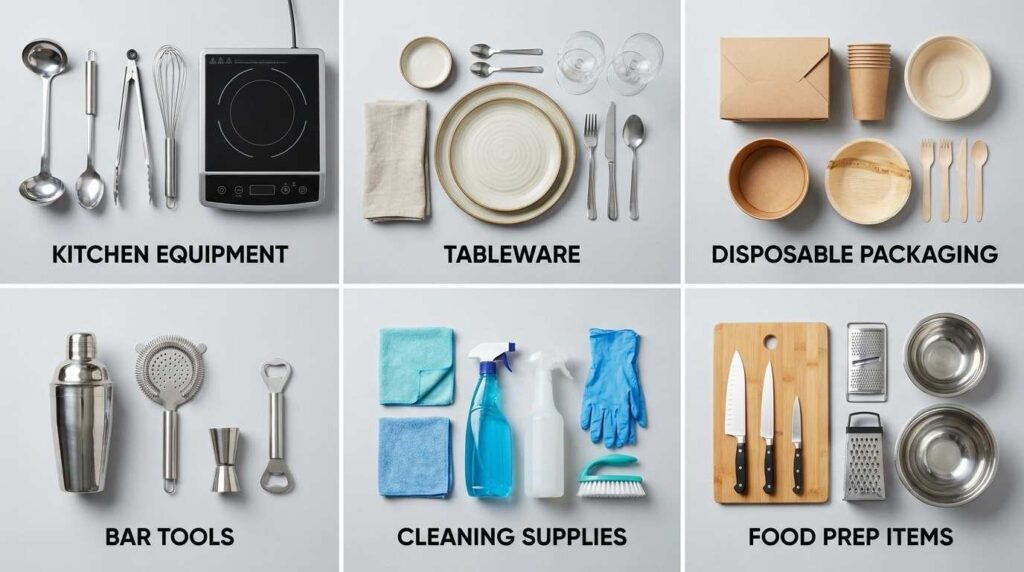
Before diving into specifics, it helps to be clear about what the term actually covers. In the UK hospitality industry, catering supplies refer to every non-food item a food business needs to operate, from the pans on the stove and the containers on the pass, to the napkins on the table, the chemicals in the cleaning cupboard, and the gloves on a kitchen porter’s hands.
Most operators think of catering supplies in terms of what runs out. That framing works for day-to-day purchasing, but it misses the strategic picture. Your supplies define your workflow, your hygiene standards, your service speed, and how your venue looks and feels to customers.
A restaurant that corners on crockery quality soon finds its return visit rate suffering. A café that buys cheap coffee cups discovers them leaking within a week. A takeaway that ignores compostable packaging requirements may face fines under the UK’s expanding extended producer responsibility (EPR) framework.
Catering supplies broadly fall into six categories:
- ▸ Commercial kitchen equipment and cookware: ovens, pans, preparation tools, appliances
- ▸ Tableware and cutlery: crockery, glassware, serving dishes, knives, and forks
- ▸ Disposables and packaging: food containers, cups, bags, foil trays, napkins
- ▸ Bar equipment and beverage supplies: cocktail tools, measures, ice equipment, drinkware
- ▸ Hygiene and cleaning supplies: chemicals, PPE, washroom hardware, colour-coded tools
- ▸ Catering consumables: date labels, cling film, piping bags, parchment, food wraps
Understanding which category is causing you problems or which is being underinvested in is the first step to making smarter purchasing decisions.
Commercial Catering Equipment for UK Restaurants: What You Actually Need
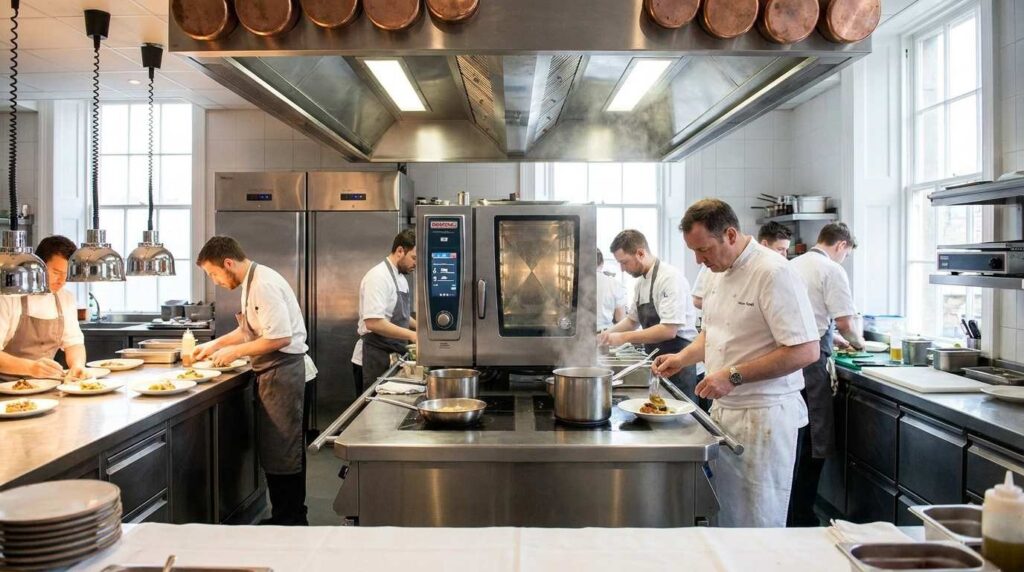
The biggest mistake new restaurant owners make is treating commercial kitchen equipment like a domestic purchase. The two categories are not interchangeable. A domestic oven used in a commercial setting will fail faster, produce inconsistent results, and, in many cases, invalidate your public liability insurance. More critically, it may not meet the standards required by your local Environmental Health Officer during inspection.
Commercial catering equipment is engineered for continuous, high-volume use. A commercial combi oven runs for twelve hours a day without breaking down. A commercial refrigerator maintains stable temperatures during service rush, even with doors opening and closing every thirty seconds. These are not incremental improvements over domestic equivalents; they are fundamentally different products.
Domestic vs Commercial — The Key Legal Point:
“Using domestic appliances in a commercial food setting can invalidate your public liability insurance and may lead to a hygiene inspection failure. Environmental Health Officers specifically look for equipment appropriate to the scale and type of food operation. Commercial-grade is a legal expectation, not a luxury.”
The Core Equipment Every Professional Kitchen Needs
Cooking equipment forms the backbone of any kitchen. For most UK restaurants and cafés, this means a commercial oven. Combi ovens are the most versatile choice for mid-sized operations, handling convection, steam, and combined cooking in one unit. A commercial hob or range, a grill or griddle suited to your menu, and a deep fryer for pub and quick-service menus complete the core cooking set.
Refrigeration is not optional. UK food safety law requires chilled foods to be stored at or below 8°C, with best practice recommending below 5°C. Commercial refrigerators maintain stable temperatures under the conditions of a working kitchen; domestic units do not. A blast chiller, which rapidly reduces food from service temperature to safe storage temperature, is standard for cook-chill operations and increasingly common in volume catering.
Food preparation equipment includes the tools that determine how efficiently your kitchen runs: high-capacity food processors, stand mixers for bakeries and pastry sections, commercial blenders, and stainless steel preparation tables that meet food-contact hygiene standards.
Cookware: gastronorm containers, baking sheets, stock pots, and woks need to be commercial grade. Thin domestic pans warp quickly under high heat. Gastronorm-compatible containers standardise your workflow and integrate with your refrigeration and holding equipment.
How to Choose Equipment for a Small Restaurant or Café
Small hospitality businesses rarely need the largest or most powerful version of every piece of equipment. The key is to match capacity to your realistic peak service volume, not your aspirational one. A more productive approach:
- ▸ Start with what produces revenue first. If you are a café, your espresso machine and refrigeration matter more on day one than your food processor.
- ▸ Buy used for large equipment where the condition can be verified. Commercial catering equipment holds its value well and is routinely resold when restaurants close or refit. A verified second-hand combi oven at half the list price is often the right call for a new business managing cash flow.
- ▸ Factor in installation costs. Gas equipment requires Gas Safe-registered engineers. Three-phase electrical equipment requires a qualified electrician. Extraction canopies must meet building regulations.
| Equipment Type | Typical Cost Range (New) | Priority for New Restaurants |
|---|---|---|
| Commercial combi oven | £2,000–£12,000 | Essential |
| Commercial refrigerator | £800–£3,500 | Essential |
| Induction hob (4-zone) | £600–£2,500 | Essential |
| Commercial dishwasher | £1,200–£5,000 | High |
| Blast chiller | £1,500–£6,000 | Medium–High |
| Stand mixer | £400–£2,000 | Situational |
| Food processor (commercial) | £300–£1,500 | Situational |
How to Stock a Professional Kitchen from Scratch
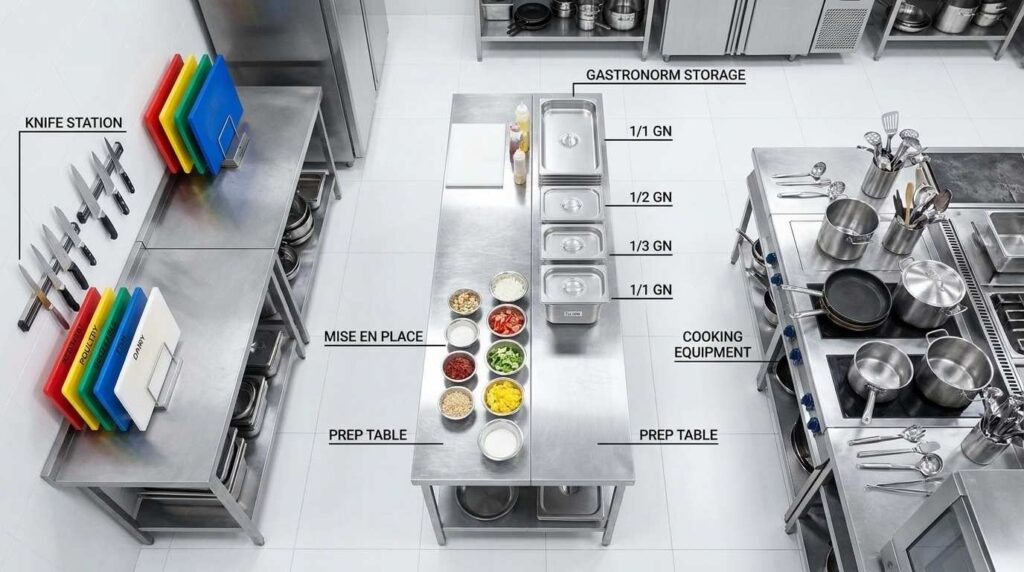
Setting up a kitchen from scratch is one of those tasks where the gaps only become visible under service pressure, which is exactly the wrong time to discover them. A methodical approach by category prevents the common situation of opening week orders being placed at panic prices from the nearest cash-and-carry.
Kitchen Equipment and Cookware Checklist
- ▸ Commercial oven, sized to your menu and covers
- ▸ Commercial hob – gas or induction, minimum 4 zones for most restaurants
- ▸ Commercial refrigerator and freezer
- ▸ Preparation tables – stainless steel, wall-mounted where space is limited
- ▸ Colour-coded chopping boards – red (raw meat), blue (raw fish), yellow (cooked meat), green (salad/fruit), white (bakery), brown (vegetables)
- ▸ Gastronorm containers – 1/1, 1/2, and 1/3 sizes as a minimum starting set
- ▸ Stock pots in multiple sizes, mixing bowls in graduated sizes (minimum 6)
- ▸ Baking sheets, roasting trays, and chef’s knives (at least 3 per section)
- ▸ Calibrated kitchen thermometer probes – minimum 2
- ▸ Digital scales with tare function (minimum 5kg capacity)
Tableware, Glassware, and Service Equipment
The rule of thumb for cover quantities: buy 2.5 times your seated capacity for crockery to allow for dishwasher turnaround time, and 3 times for cutlery, given the frequency of loss and damage.
- ▸ Main course plates – quantity = 2.5 × seated covers
- ▸ Side plates and soup bowls – quantity = 2 × seated covers
- ▸ Cutlery sets (dinner fork, knife, dessert spoon, teaspoon) – quantity = 3 × covers
- ▸ Glassware – wine, water, and tumblers – quantity = 2.5 × covers
- ▸ Salt and pepper sets – 1 per table, or 1 per 4 covers at a buffet
- ▸ Serving dishes, platters, and sharing boards if your concept requires them
Disposables and Consumables
- ▸ Paper napkins – budget a minimum of 3 per cover per service
- ▸ Food date labels – dissolvable labels for refrigerated prep, freezer labels for frozen stock
- ▸ Cling film (commercial roll, 300mm or 450mm) and aluminium foil
- ▸ Baking parchment and portion bags with twist ties
- ▸ Piping bags and nozzles (essential for bakeries and pastry-heavy menus)
- ▸ Takeaway containers if you offer delivery or collection
Cleaning and Hygiene Supplies
- ▸ Surface sanitiser spray – EN1276 certified as a minimum
- ▸ Oven and grill degreaser – commercial strength
- ▸ Colour-coded cleaning cloths and mops matching your chopping board system
- ▸ Disposable gloves – nitrile (latex-free) for food handling
- ▸ Hand soap and hand sanitiser for front-of-house
- ▸ Waste bins with pedal lids – separate for food waste, recycling, and general waste
Supplier tip:
“Buying all categories from a single specialist supplier, rather than splitting across a cash-and-carry, an online marketplace, and multiple trade accounts, typically reduces per-unit costs and simplifies stock management considerably. We Can Source It covers all of the above categories from one account.”
Disposable vs Reusable Catering Supplies: A Straight Comparison
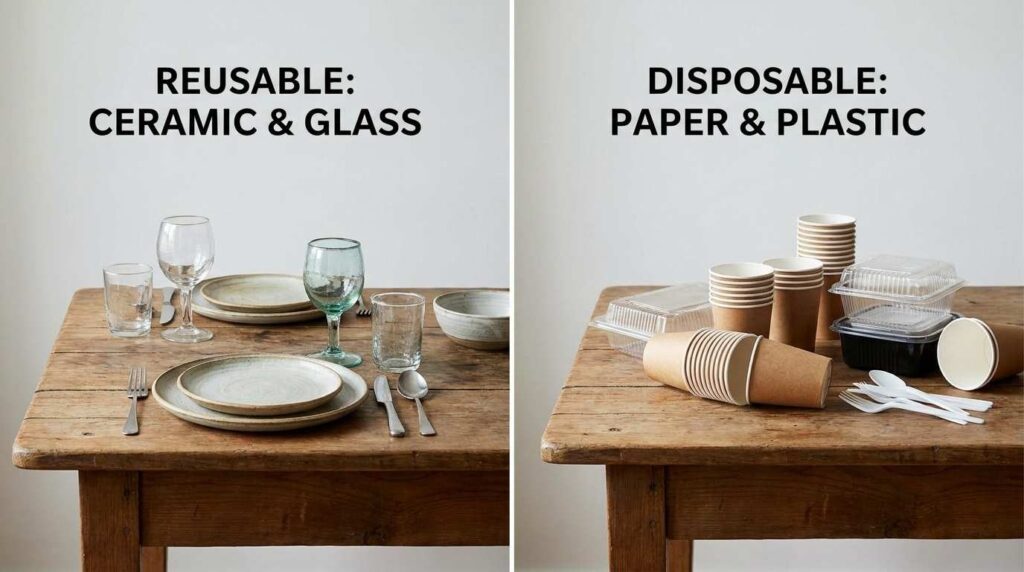
This is one of the most practically significant questions facing UK food businesses in 2026, and it does not have a single right answer. The correct choice depends on your operation type, your volume, your customer expectations, and increasingly, your legal obligations.
The Core Trade-Off
Reusable catering supplies: crockery, glassware, stainless steel cutlery, carry a higher upfront cost but a lower long-term cost per use. Over hundreds of services, the per-use cost of a ceramic plate drops to fractions of a penny. The catch is that reusables require commercial dishwashing capability, labour for washing and handling, storage space, and ongoing replacement as breakages accumulate.
Disposables have a lower upfront cost and near-zero post-service labour. There is no washing-up, no sorting, no risk of glassware breakage. The trade-off is an ongoing consumable cost that never decreases, and in high-volume operations, this compounds quickly. A medium-sized café going through 400 disposable coffee cups per day is spending £8,000–£12,000 per year on cups alone.
The UK regulatory environment is also shifting the calculus. Under the Plastic Packaging Tax (currently £228.82 per tonne for packaging with less than 30% recycled content) and the UK’s extended producer responsibility framework, the cost of non-compliant disposables is rising. Single-use plastic items, including plastic cutlery, stirrers, and plates, have already been banned in England. Businesses that have not transitioned to paper, wood, or certified compostable alternatives are already non-compliant.
| Operation Type | Recommended Approach | Reason |
|---|---|---|
| Full-service restaurant (dine-in) | Reusable crockery, cutlery, glassware | Margin protection, brand presentation, and sustainability |
| Café (mixed dine-in and takeaway) | Reusable for dine-in; compostable for takeaway | The hybrid approach suits the mixed service model |
| Takeaway / dark kitchen | Compostable or high-recycled-content disposables | No dishwashing capability; volume purchasing power |
| Events caterer | Disposables or hire, depending on event type | Logistics, practicality,y and return transport costs |
| Pub or bar (outdoor areas) | Polycarbonate reusables | Licensing requirements mandate non-glass in many areas |
| Contract caterer (office or school) | Reusable where facilities allow | Depends on the site’s washing-up capability entirely |
Hidden Costs That Change the Calculation
The most common mistake when comparing reusables and disposables is focusing only on purchase price. There are several costs that are frequently overlooked:
- ▸ Breakage rate: Most commercial operations lose 15–25% of their crockery and glassware to breakage annually. A restaurant with 100 covers replacing 75 plates per year at £2–£5 each adds £150–£375 to annual costs before anything else.
- ▸ Dishwashing costs: A commercial pass-through dishwasher costs roughly £0.08–£0.15 per cycle in utilities and chemicals alone, not counting labour. High-volume operations run hundreds of cycles a week.
- ▸ Storage: Reusables require shelving, storage crates, and organised systems. In a compact city-centre kitchen, storage space is itself a high cost.
- ▸ Disposal compliance: For disposables, the cost of proper waste disposal and compliance with UK packaging regulations is increasingly material. Businesses using non-compliant packaging face fines from local authorities and reputational risk.
When all costs are modelled over a 3-year horizon, reusables are almost always cheaper for full-service restaurants doing consistent volume. Disposables remain more economical for high-variability operations like event catering and delivery-only models.
Food Date Labels: UK Law, Best Practice, and Why It Matters
Food date labelling is one of those compliance requirements that gets treated as administrative housekeeping until an Environmental Health Officer arrives and finds unlabelled prep in the walk-in fridge. At that point, it becomes very significant indeed.
What the Law Actually Requires
UK food safety law, principally the Food Safety Act 1990, the Food Hygiene (England) Regulations 2006, and Natasha’s Law (the Food Information Amendment Regulations 2021), places clear requirements on food businesses regarding the labelling of food items.
- ▸ Use-by and best-before dates: Pre-packaged foods sold to consumers must carry either a use-by date (a safety marker) or a best-before date (a quality marker). These are legally distinct, a use-by date means the food must not be eaten after that date; a best-before date means quality may decline.
- ▸ Date labelling of prepared and stored food: Internally prepared food – portioned sauces, marinated proteins, pre-made desserts, must be dated when placed into storage. This is integral to your HACCP food safety management system, which is itself a legal requirement for all UK food businesses under Regulation (EC) No 852/2004, retained in UK law.
- ▸ Allergen labelling under Natasha’s Law: Food prepacked for direct sale on your premises must display the full ingredient list and clearly emphasise all 14 designated allergens. This applies to sandwiches, salads, cakes, and similar items displayed for direct selection by customers.
The Practical System: What Labels You Need and When
- ▸ Dissolvable day-dot labels: The workhorse of commercial kitchens. Colour-coded by day of the week, they dissolve completely in the dishwasher. Used for all refrigerated prep with a short life, typically up to 3 days.
- ▸ Extended-life labels: For items stored longer – stock, sauces, marinated items – a label showing the product name, date of preparation, and use-by date provides clearer tracking and cleaner HACCP records.
- ▸ Freezer labels. Frozen products require labels with permanent adhesive that hold at sub-zero temperatures. Standard labels peel off in a freezer environment.
- ▸ Allergen alert labels. For Natasha’s Law compliance, pre-printed allergen declaration labels support both legal compliance and clear communication for front-of-house staff.
Cost perspective:
“A full dissolvable label system for a small restaurant, labels, dispensers, and holders typically run to £30–£80 per month, depending on volume. The cost of a hygiene rating downgrade from unlabelled food, measured in lost trade and remediation time, is far higher.”
Where to Buy Catering Supplies in Bulk in the UK
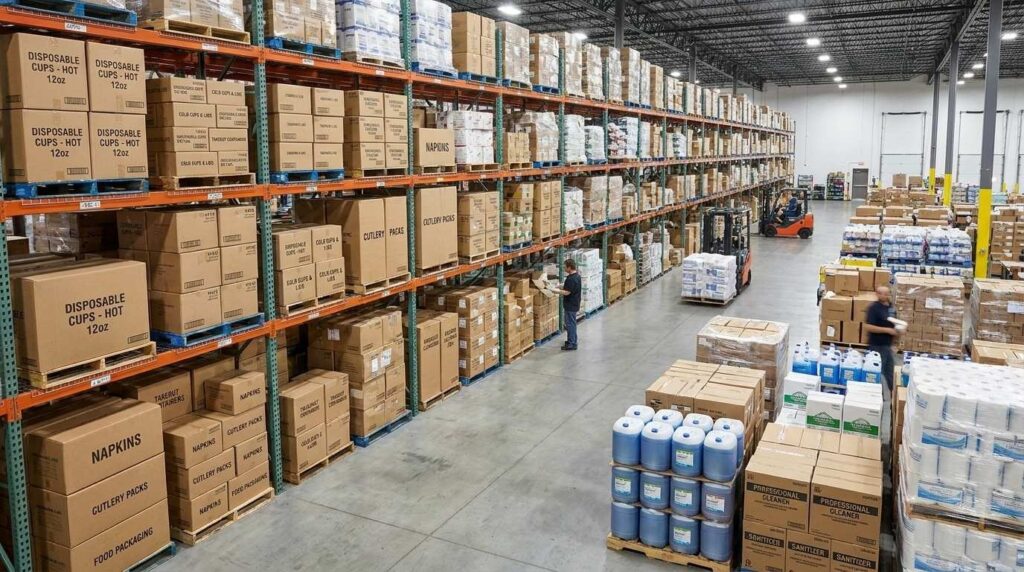
Bulk purchasing is the most reliable way for UK food businesses to reduce their supply costs, but it requires more planning than simply ordering more of the same thing. Getting bulk procurement right involves understanding your actual consumption rates, your storage capacity, and which product categories actually reward bulk buying.
The Main Channels for Buying Catering Supplies in the UK
- ▸ Specialist online suppliers like We Can Source It offer the broadest range with account pricing, reliable UK delivery, and expert support. For the majority of catering supplies, disposables, glassware, bar equipment, hygiene products, and packaging, a dedicated trade supplier will offer better pricing and range than a general retailer.
- ▸ Cash-and-carry wholesalers Booker, Bestway, and regional equivalents offer immediate availability and the ability to assess products before purchasing. The trade-off is that you absorb transport costs and labour time, and their range of specialist hospitality supplies is typically narrower than that of dedicated catering suppliers.
- ▸ Restaurant buying groups and co-operatives are underused by independent operators. Groups of independent restaurants or cafés can aggregate purchasing to access volume pricing otherwise reserved for chains.
What Actually Saves Money in Bulk Buying
Not all catering supplies reward bulk purchasing equally. The categories where bulk buying produces the most meaningful savings:
- ▸ Disposables and packaging. Coffee cups, food containers, napkins, and carrier bags. Buying a 6-month supply of a core cup size can reduce per-unit cost by 25–35% compared to fortnightly ordering.
- ▸ Cleaning chemicals. Concentrated commercial cleaners in 5-litre or 20-litre quantities cost a fraction of the equivalent in smaller bottles. A surface sanitiser costing £4 per litre in 750ml bottles often costs £1.20–£1.80 per litre in 5-litre containers.
- ▸ Napkins and paper products. High-volume, non-perishable, and easy to store. The unit-cost reduction from case buying versus sleeve buying is typically 20–30%.
Where bulk buying does NOT pay:
“Equipment and durable items (no benefit in buying two ovens when you need one), seasonal items with unpredictable demand, and perishable disposables affected by moisture or heat damage in storage. Match order volumes to your storage reality. A common mistake is over-ordering and finding products damaged before use.”
Practical Buying Guidance
Calculate your actual monthly consumption before ordering. Review purchase history over 3–6 months and identify your top 10 most-used consumable items. Use that data to project 3-month quantities with a 15% buffer. Place one order rather than twelve. Review quarterly and renegotiate annually, pricing tiers change, and a supplier who knows you review pricing will offer better terms proactively.
Catering Supplies for Events: Planning by Guest Numbers

Event catering is a distinct discipline within the broader field of food service, and the supply requirements differ meaningfully from a fixed restaurant operation. The key differences: you cannot restock during service, transportation and portability matter, and the quantity calculations need to be right the first time.
Core Principles of Event Supply Planning
- ▸ Over-order on consumables, under-order on nothing. A restaurant can send a team member to the cash-and-carry if napkins run low. An event caterer 40 miles from the nearest supplier cannot. Build a 20% buffer into every consumable category.
- ▸ Think of service stations. Divide your event into zones: food prep, holding, service, drinks, and cleanup. Plan supplies for each zone separately. This prevents the common error of having plenty of serving spoons but no container lids.
- ▸ Plan your heat and cold chain first. Hot food must be held above 63°C; cold food must stay below 8°C. Plan chafing dishes, fuel canisters, insulated carriers, and cool boxes before you plan your menu, not after.
Quantity Guide by Event Size
| Category | 50 Guests | 100 Guests | 250 Guests | 500 Guests |
|---|---|---|---|---|
| Main course plates/containers | 60 | 120 | 300 | 600 |
| Napkins (paper) | 200 | 400 | 1,000 | 2,000 |
| Serving spoons/tongs | 8–10 | 12–16 | 20–30 | 40–60 |
| Coffee cups (if applicable) | 80 | 160 | 400 | 800 |
| Waste bags (large) | 10 | 20 | 40 | 80 |
| Disposable gloves (staff pairs) | 20 | 30 | 60 | 100 |
| Sanitiser spray bottles | 4 | 6 | 10 | 16 |
| Foil containers for hot holding | 20 | 40 | 100 | 200 |
Equipment Specific to Event Catering
- ▸ Chafing dishes and fuel canisters – the essential items for hot buffet service. Plan 1 chafing dish per 2–3 menu items.
- ▸ Insulated food carriers (hot boxes) – for transporting hot food to the venue and holding it safely pre-service.
- ▸ Cold boxes and ice – for chilled food transport and beverage service.
- ▸ Portable hand-washing station, legally required at many outdoor and off-site events under UK food safety guidelines.
- ▸ Folding serving tables – for buffet setup and service stations.
What Event Caterers Most Commonly Run Short Of
Based on operational experience, events most often underestimate napkins (plan for 4 per person at a buffet, not 2), trash bags and waste stations, serving utensils (once one is dropped, it can’t be used), zip ties and tape for setup fixes, and a first aid kit, which is legally required for any food business at a public event.
Common Mistakes UK Food Businesses Make with Catering Supplies
- ▸ Buying on price alone. The cheapest supplies are often not the least expensive in practice. Thin containers that leak, glasses that cloud after 20 washes, or clothes that shred within a week all carry a real replacement cost. A slightly higher-quality product at a modestly higher price frequently works out cheaper over 12 months.
- ▸ Failing to standardise. Kitchens that accumulate equipment from multiple suppliers often find that gastronorm sizes do not align, container lids do not fit trays, and replacement parts are unavailable. Standardising on a supplier, particularly for storage solutions and cookware, reduces friction significantly.
- ▸ Ignoring storage constraints when bulk ordering. Ordering 6 months of napkins when you have space for 6 weeks creates a logistics problem. Match order volumes to your storage reality.
- ▸ Not reviewing supplier accounts. Many food businesses stay with a supplier out of habit and miss pricing reviews. Trade pricing tiers change regularly. A 10-minute call to an account manager often yields immediate savings.
- ▸ Treating hygiene supplies as secondary. A kitchen that runs out of surface sanitiser mid-service has a compliance problem. A chef who cannot find clean gloves is a food safety risk. Hygiene supplies deserve the same stock management rigour as food.
UK Catering Supplies in 2026: What Is Changing
- ▸ Sustainability regulation is tightening. The UK’s extended producer responsibility regulations are extending financial liability for packaging waste. Businesses that have not reviewed their packaging against current EPR requirements should do so; the compliance window is narrowing, and enforcement activity is increasing.
- ▸ Energy efficiency is a genuine purchasing criterion. With commercial energy costs remaining elevated, the running cost of commercial equipment matters as much as the purchase price. Induction hobs, A-rated refrigeration, and energy-efficient dishwashers now offer payback periods measured in months.
- ▸ Allergen compliance requirements continue to evolve. Natasha’s Law came into force in 2021, but enforcement is intensifying. The reputational and legal consequences of an allergen incident are severe. Allergen labelling systems are not an area where responsible businesses cut corners.
- ▸ UK sourcing is gaining commercial value. Post-Brexit supply chain disruption has led many UK operators to prefer UK-based suppliers, faster delivery, simpler returns, and no customs complications. Suppliers with UK-based stock and logistics are better positioned to serve this demand consistently.
Getting Your Catering Supplies Strategy Right
The businesses that get catering supplies right treat it as a strategic function, not an administrative one. They know their consumption figures, they have relationships with reliable suppliers, they plan their buying to match their storage capacity, and they review costs regularly rather than accepting the status quo.
For most UK restaurants and cafés, the biggest opportunity is consolidation. Sourcing catering supplies across three or four different suppliers creates unnecessary complexity, dilutes purchasing power, and increases administrative overhead. A trusted specialist supplier or small group of specialists covering your full range of needs typically delivers better pricing, more consistent availability, and faster resolution when something goes wrong.
We Can Source It stocks a comprehensive range of catering and hospitality supplies across all the categories covered in this guide, from bar equipment and glassware to food packaging, cleaning products, disposables, and kitchen accessories. Every order is dispatched from the UK, and the product range is built specifically for the needs of UK food businesses operating across the hospitality sector.
Browse Catering Supplies at We Can Source It
Visit wecansourceit.co.uk to browse the full range, including catering supplies, bar equipment, glassware, disposables, hygiene products, and more. UK delivery. Trade pricing. No minimum order.
Frequently Asked Questions
What catering supplies do I legally need in the UK?
All UK food businesses must have a documented food safety management system based on HACCP principles. In practice, this means calibrated food temperature probes, food date labels, colour-coded preparation equipment, food-safe surface cleaners, and adequate hand-washing facilities. These are checked by Environmental Health Officers and are not optional.
Is there a difference between catering supplies and catering equipment?
Yes, though the terms are often used interchangeably. Equipment typically refers to large, durable items — ovens, refrigerators, dishwashers. Supplies refer to the consumable and smaller durable items: disposables, tableware, hygiene products, and consumables. Some suppliers cover one category; specialist suppliers, such as We Can Source It, cover both.
Can I use domestic kitchen equipment in a commercial setting?
No. Domestic appliances are not designed for the continuous use of a professional kitchen and typically do not meet the food safety standards required for commercial food preparation. Using domestic equipment commercially may also invalidate your public liability insurance.
What is the best way to reduce catering supply costs?
The most effective strategies: consolidate purchasing with fewer suppliers to increase volume and improve pricing tier; buy consumables in larger quantities where storage allows; review supplier accounts annually and renegotiate; and switch to reusable alternatives in service areas where the volume justifies the upfront cost. Never buy on price alone.
Do I need to label food in my restaurant kitchen?
Yes. All food prepared and stored in a professional kitchen should be labelled with the product name, date of preparation, and use-by date. This is a core requirement of your HACCP food safety management system. Failure to maintain adequate date labelling is one of the most common findings during food hygiene inspections.
What eco-friendly catering supplies do I need to comply with UK law?
Single-use plastic cutlery, plates, straws, and polystyrene food containers and cups are banned in England. Compliant alternatives include paper, card, wood, and certified compostable materials. The UK Plastic Packaging Tax (£228.82 per tonne as of 2026) applies to packaging with less than 30% recycled content, incentivising a move to recycled and compostable options.
Supporting Articles in This Series
- ▸ Best commercial catering equipment for small restaurants
-
▸ How to Stock a Professional Kitchen from Scratch: The Complete Checklist
- ▸ Disposable vs reusable catering supplies: which saves money long-term?
- ▸ Food Date Labels Explained: UK Hygiene Laws Every Caterer Must Know (2026)
- ▸ Where to buy bulk catering supplies in the UK (cost comparison)
- ▸ Catering supplies for events: what you need for 50, 100, 500 guests