The verdict first, because most guides bury it at the end.
Commercial-grade lead-free crystal is the right choice for UK restaurants operating at above £40 per head, with fewer than 300 covers per week, and with a glasswasher running at or below 60 degrees Celsius. For every other restaurant category, busy casual dining, pub restaurants, high-volume bistros, and any venue prioritising operational simplicity over presentation, commercial toughened soda-lime glass delivers better value, lower annual cost, and significantly less operational complexity.
The reason most UK restaurants get this decision wrong is not that they choose the wrong material. It is that they buy consumer-grade crystal instead of commercial-grade crystal, put it through a standard commercial glasswasher, and watch it cloud, etch, and crack within weeks. Consumer crystal and commercial crystal are not the same product. That distinction is the single most important piece of buying information in this topic, and it is absent from every competitor guide in this SERP.
This article covers the full crystalware vs standard glassware decision for UK restaurants: glasswasher compatibility, material comparison with UK sterling pricing, a five-variable decision framework by restaurant type, handling and polishing differences, and where to buy at UK trade prices.
Quick Decision Guide
| If Your Restaurant Is… | Choose… |
| Fine dining, under 200 covers per week | Commercial-grade lead-free crystal |
| Premium casual dining, 200 to 400 covers per week | Commercial crystal or high-quality soda-lime |
| Casual dining or pub restaurant, above 400 covers per week | Toughened soda-lime |
| Hotel bar or lounge with premium positioning | Either, depending on the cover volume |
| Event or banqueting operation at high volume | Toughened soda-lime or polycarbonate |
The full decision logic behind each row is in Section 6. Read on for the reasoning.
The Verdict at a Glance: Decision Matrix by Restaurant Type
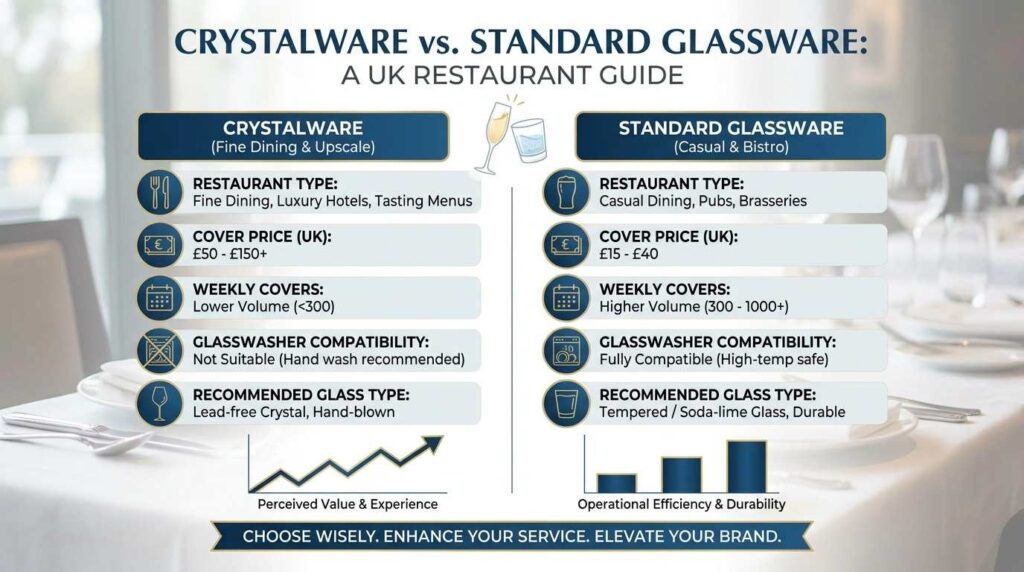
| Restaurant Type | Cover Price | Weekly Covers | Recommended Material | Reason |
| Fine dining | £60 and above | Under 200 | Commercial-grade lead-free crystal | Crystal justified at this price point; breakage is manageable at this volume |
| Premium casual dining | £40 to £60 | 200 to 400 | Commercial crystal or high-quality soda-lime | Depends on glasswasher temperature and cover volume |
| Casual restaurant/bistro | £25 to £40 | 300 to 600 | Toughened commercial soda-lime | Breakage rate at volume makes crystal expensive; operational simplicity wins |
| Pub restaurant | £15 to £30 | 400 and above | Toughened soda-lime | Crystal adds cost and complexity with no measurable customer benefit at this price point |
| Hotel bar/lounge | £30 to £60 | Under 300 | Commercial crystal or toughened soda-lime | Hotel F&B positioning usually justifies crystal; volume determines which |
| Event and banqueting | Variable | High volume | Toughened soda-lime or polycarbonate | Breakage and logistics favour durability over presentation |
Use this table as your starting point. The five-variable framework in Section 6 provides the full reasoning behind each recommendation.
What Is Crystal Glass? Consumer vs Commercial Grade Explained
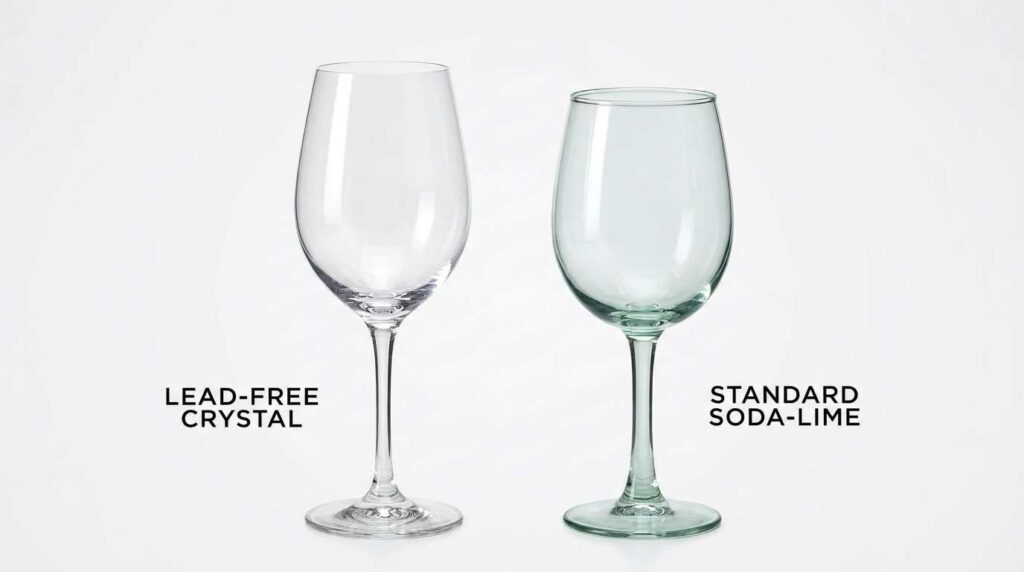
Crystal glass contains a mineral additive that raises its refractive index above that of standard soda-lime glass. Traditional lead crystal used lead oxide. Modern lead-free crystal uses barium oxide, zinc oxide, or potassium oxide as the lead replacement. The higher refractive index is why crystals sparkle: light bends at a different angle as it passes through, creating the brilliance associated with premium tableware.
This is where most guides stop. For restaurant buyers, the more important distinction is between two categories that are marketed similarly but perform very differently in commercial service.
Consumer-Grade Crystal
Consumer-grade crystal is designed for domestic use: occasional hand washing, careful storage, and gentle handling. It is sold in retail packs, gift sets, and on online marketplaces, and it includes most well-known crystal brands sold through department stores and lifestyle retailers.
What happens when consumer crystal enters a commercial glasswasher:
- ▸ High-alkaline commercial detergents etch the surface within weeks
- ▸ Clouding and haziness appear after 20 to 30 cycles, often irreversibly
- ▸ The thinner walls fracture under thermal shock from fast commercial wash cycles
- ▸ Rapid replacement follows on a cost schedule that quickly exceeds that of toughened soda-lime
Consumer-grade crystal is not suitable for commercial restaurant use. Buying it for a restaurant reliably costs more than toughened soda-lime while delivering worse operational results.
Key takeaway: Consumer crystal fails in commercial glasswashers because it is designed for domestic washing conditions. Commercial-grade crystal survives because titanium or zirconium reinforcement is specifically engineered for hospitality wash cycles. These are not the same product.
Commercial-Grade Lead-Free Crystal
Commercial-grade lead-free crystal is manufactured specifically for hospitality use. The defining characteristic is titanium or zirconium reinforcement of the glass matrix, producing a glass that is simultaneously crystal-clear and commercial-glasswasher compatible.
The benchmark brands in this category that UK restaurants actually use include Schott Zwiesel Tritan, Riedel Restaurant series, and Stolzle. These are engineered to withstand commercial glasswasher cycles at temperatures up to 60 degrees Celsius, high-alkaline detergents, and the mechanical stress of commercial racking.
Commercial-grade lead-free crystal is the correct category for any restaurant considering crystal. It is also significantly more expensive per unit than consumer crystal, typically £8 to £20 per glass at trade prices versus £3 to £8 for consumer formats at retail.
Our crystalware stemware collection includes commercial-grade lead-free crystal wine glasses suitable for restaurant service, with glasswasher-safe specifications confirmed on product listings.
What Is Standard Commercial Glassware?
Standard commercial glassware for restaurants falls into two subcategories.
Toughened Soda-Lime Glass
Toughened (also called tempered) soda-lime glass is the standard format for commercial hospitality glassware. It is heat-treated during manufacture to be approximately four to five times stronger than standard annealed glass and to break into smaller, less dangerous fragments.
Toughened soda-lime is:
- ▸ Fully compatible with commercial glasswashers at operating temperature
- ▸ Available in a wide range of shapes and capacities
- ▸ Priced at £2 to £8 per glass at trade prices, depending on format
- ▸ Suitable for all licensing compliance requirements, including government stamp formats
For the vast majority of UK restaurants, toughened soda-lime is the correct choice. It is not a compromise. At the right price point and volume, it outperforms crystal on every operational metric except light refraction and perceived prestige.
High-Quality Soda-Lime (Fine Non-Toughened Glass)
Some restaurant glassware, particularly thin-walled universal wine glasses from brands like Riedel Overture or Schott Zwiesel Pure, is manufactured from high-quality soda-lime without the full toughening treatment. This category offers significantly better clarity and a thinner rim than standard toughened glass, at a lower price than commercial crystal.
The trade-off is durability. These glasses are more fragile than toughened formats and require more careful handling and storage. They suit restaurants where presentation matters but full commercial crystal is not yet justified.
Browse our Seine Wine Glass 15.75oz for an elegant, crystal-clear soda-lime format and our Nile red wine glass for a 100% lead-free crystal option that is glasswasher safe and available at hospitality trade pricing.
Key takeaway: Toughened soda-lime is the operationally safe default for most UK restaurants. The step up to commercial-grade crystal is justified by cover price and volume, not simply by wanting better-looking glasses.
Glasswasher Compatibility: The Decision Most Buyers Get Wrong
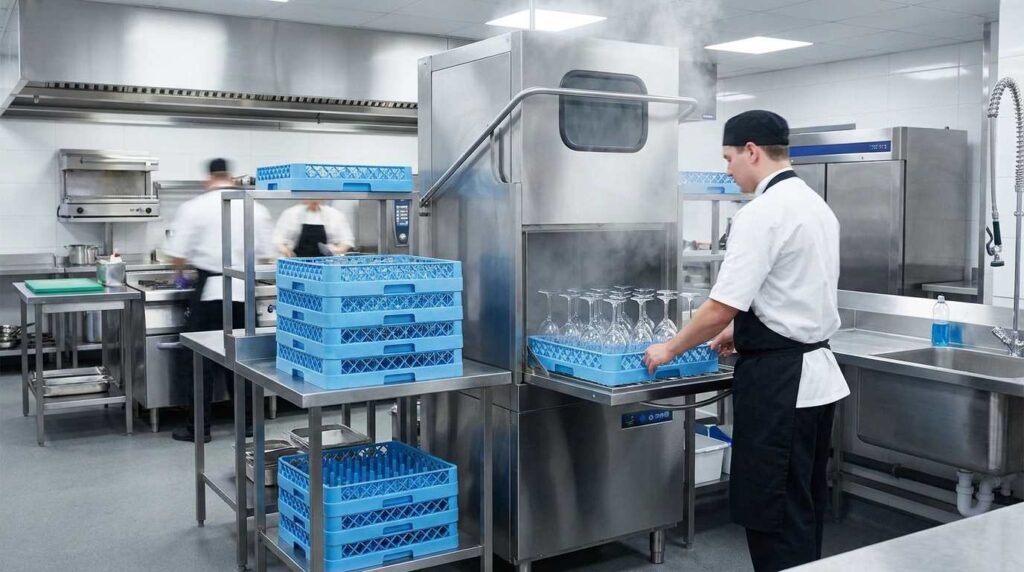
This is the most consequential piece of information for any UK restaurant making the crystalware vs standard glassware decision, and it is absent from every competitor guide in this space.
How Commercial Glasswashers Work
A standard commercial undercounter or passthrough glasswasher operates on a 90-second to 3-minute cycle with:
- ▸ Wash temperature: 55 to 65 degrees Celsius
- ▸ Rinse temperature: 80 to 85 degrees Celsius
- ▸ Detergent: high-alkaline commercial formulation at concentrations far higher than domestic dishwasher detergent
- ▸ Wash action: high-pressure rotating spray arms.
These conditions are significantly more aggressive than domestic dishwashers. Glass that survives domestic washing for years will etch, cloud, or fracture within weeks under commercial conditions.
Many operators discover too late that their pass-through machine runs above the temperature rating of their new crystal programme. Checking the operating temperature of your specific machine before committing to crystal is not optional. It is the first step.
The Glasswasher Compatibility Matrix
| Glass Type | Commercially Glasswasher Safe? | Typical Cycle Tolerance | Primary Risk |
| Toughened soda-lime | Yes, fully compatible | Unlimited cycles | Gradual etching if detergent overdosed |
| Consumer crystal | No | 10 to 30 cycles before visible damage | Rapid etching, clouding, fracture |
| Commercial-grade lead-free crystal (Tritan, titanium-reinforced) | Yes, with conditions | 500 to 2,000 cycles | Etching if detergent overdosed or hard water is unmanaged |
| High-quality non-toughened soda-lime | Partial | 200 to 500 cycles | More fragile; thermal shock risk |
The Three Conditions for Commercial Crystal Compatibility
If you are using commercial-grade crystal in a restaurant glasswasher, three conditions determine whether it survives.
Detergent concentration. High-alkaline detergents etch crystal faster than soda-lime. Correct dosing at the manufacturer’s recommended concentration is essential. Overdosing by 20% will visibly damage commercial crystal within a season.
Water softener. Hard water accelerates etching on all glass but is particularly destructive for crystal. Most of England is a hard water area. A fitted water softener on the glasswasher supply is a prerequisite for a crystal programme, not an optional extra.
Temperature management. Most commercial-grade crystal is rated to a 60-degree Celsius wash temperature. Some passthrough machines run at 65 degrees or above. Check your machine’s operating temperature against the glass manufacturer’s specification before purchasing.
Key takeaway: Commercial-grade crystal is glasswasher-compatible when these three conditions are met. Consumer crystal is not glasswasher compatible under any commercial conditions. This single distinction determines whether a crystal investment succeeds or fails within the first month.
For the full guide on glasswasher compatibility across all glass types, see our complete hospitality glassware guide for UK venues.
Material and Cost Comparison: UK Sterling Pricing
The table below uses UK trade pricing. It does not exist in sterling anywhere in the current SERP for this topic.
| Material | Trade Price Per Glass (GBP) | Annual Breakage Rate | Annual Replacement Cost Per 100 Glasses | Glasswasher Safe? |
| Commercial toughened soda-lime | £2 to £5 | 10 to 15% | £30 to £75 | Yes, fully |
| High-quality soda-lime (fine glass) | £4 to £8 | 12 to 18% | £58 to £144 | Partial |
| Consumer crystal | £3 to £8 (retail) | 20 to 40% in commercial use | £72 to £320 | No |
| Commercial-grade lead-free crystal | £8 to £20 | 8 to 12% with correct handling | £77 to £240 | Yes, with conditions |
| Premium crystal (Riedel Sommeliers, etc.) | £20 to £60 | 10 to 15% | £240 to £900 | Partial only |
Reading this table correctly:
Consumer crystal has a lower unit cost but a higher annual replacement cost than commercial-grade crystal, because it fails faster in commercial environments. The lifetime cost of buying cheap consumer crystal for a restaurant is consistently worse than buying commercial-grade crystal at a higher unit price.
At 100 covers per week with a 10% annual breakage rate, a 60-glass wine programme in commercial-grade crystal at £8 to £12 per glass costs approximately £48 to £72 per year in replacements. The same programme in consumer crystal costs £96 to £192 per year in replacements at a lower unit price, because the failure rate is double and the cycles to failure are a fraction of the commercial-grade alternative.
Key takeaway: Commercial-grade crystal is more expensive to buy but cheaper to run than consumer crystal in a restaurant environment. The economics only work if you buy the right category.
The Five-Variable Decision Framework for UK Restaurants
The crystalware vs standard glassware decision comes down to five variables. Work through each one in order.
Variable 1: Cover Price Point
Crystal is financially defensible when the cover price justifies the glass experience.
- ▸ Above £50 per head: commercial-grade crystal is the expected standard
- ▸ £35 to £50 per head: high-quality soda-lime or entry-level commercial crystal; either is defensible
- ▸ Below £35 per head: toughened soda-lime; customers at this price point are not paying for crystal, and the operational cost is not justified
Variable 2: Weekly Cover Volume
Breakage rate matters more at higher volume. At 100 covers per week, a 10% annual breakage rate on a 60-glass crystal programme costs less than £100 per year in replacements. At 500 covers per week on the same programme, the same breakage rate costs five times as much, and the operational management of a crystal programme becomes a significant staff training burden.
Most casual restaurants underestimate how quickly stemware breakage rises during weekend service. A busy Saturday night shift can easily account for 30 to 40% of a week’s breakage on its own.
| Weekly Covers | Crystal Recommendation |
| Under 200 | Commercial-grade crystal is viable if the price point justifies it |
| 200 to 400 | High-quality soda-lime or entry-level commercial crystal |
| Above 400 | Toughened soda-lime; crystal breakage cost becomes significant |
Variable 3: Glasswasher Temperature and Setup
Check your glasswasher’s operating temperature and whether a water softener is fitted before buying crystal. If the wash temperature exceeds 60 degrees Celsius or no water softener is fitted, commercial crystal will not survive long enough to justify the cost. Fit the softener first, confirm the temperature programme is within spec, then introduce the crystal.
Variable 4: Storage and Staff Handling Capability
Crystal requires rim-down storage on padded racks, steam polishing, and carrying by the base or stem with no rim contact. These are achievable protocols in a staffed fine dining environment. In a high-turnover casual restaurant with a large part-time team and variable handling standards, the breakage rate on crystal will exceed the financial case for using it.
Ask honestly: does your team have the training, the time, and the physical storage setup to maintain a crystal programme? If the answer is uncertain, start with high-quality soda-lime and introduce crystal selectively.
Variable 5: Brand Positioning and Photography
Crystal’s light refraction properties are visible in food photography and professional imagery in ways that standard glass is not. For restaurants that photograph their table settings for social media, press submissions, or award entries, crystal adds visible value that soda-lime cannot replicate. For restaurants where photography is not a significant part of the brand strategy, this variable does not change the decision.
Key takeaway: Cover price determines whether the crystal is justified. Cover volume determines whether it is sustainable. The glasswasher setup determines whether it will survive. Staff training determines whether it will pay back. Photography relevance is the one genuinely optional variable.
Planning a crystal programme for your restaurant? Reviewing glasswasher compatibility and annual replacement costs before ordering prevents expensive mistakes.
Breakage Cost Modelling: What Crystal Actually Costs Per Year
A worked cost model for two restaurant types, both operating a 60-glass wine programme.
Scenario A: 80-Cover Fine Dining Restaurant (150 covers per week)
| Item | Toughened Soda-Lime | Commercial-Grade Crystal |
| Unit cost per glass | £4 | £12 |
| Initial stock (150 glasses at 2.5x multiplier) | £600 | £1,800 |
| Annual breakage rate | 10% | 10% |
| Annual replacement (15 glasses) | £60 | £180 |
| 3-year total cost | £780 | £2,340 |
| 3-year cost premium for crystal | £1,560 |
At £60 per head and 150 covers per week, the crystal premium works out at approximately £3.47 per cover per year. At that price point, the crystal experience is commercially justified.
Scenario B: 120-Cover Casual Restaurant (400 covers per week)
| Item | Toughened Soda-Lime | Commercial-Grade Crystal |
| Unit cost per glass | £4 | £12 |
| Initial stock (225 glasses at 2.5x multiplier) | £900 | £2,700 |
| Annual breakage rate | 12% | 15% (higher at this volume) |
| Annual replacement cost | £108 | £404 |
| 3-year total cost | £1,224 | £3,912 |
| 3-year cost premium for crystal | £2,688 |
At £28 per head and 400 covers per week, the crystal premium of £896 per year is difficult to justify. Customers at this price point are not receiving a dining experience where glass quality is a meaningful differentiator.
Key takeaway: The financial case for crystal strengthens as cover price rises and cover volume falls. The financial case against it strengthens in the opposite direction. The cost model above shows why high-volume casual restaurants consistently find toughened soda-lime the better operational choice.
Polishing, Handling, and Storage: The Operational Differences
Crystal and standard glass require different operational protocols. Getting these wrong with crystal accelerates breakage and eliminates the visual benefit the material is chosen for.
Polishing
Standard commercial glass can be polished with a dry, lint-free cloth. For most commercial formats, a clean, dry cloth is sufficient between services.
Commercial crystal requires steam polishing. The process:
- Hold the glass over a steam source such as a kettle or dedicated polishing steamer
- Allow the bowl to fill with steam
- Polish with a lint-free cloth in a circular motion while the glass is warm
The warmth opens the surface slightly, allowing the cloth to remove water spots and detergent residue without leaving lint deposits. Polishing cold crystal with a dry cloth leaves lint visible under dining room lighting and entirely negates the visual benefit of using crystal.
Carrying and Handling
Crystal should be carried by the base or stem only. Carrying multiple crystal glasses by inserting fingers inside the rim, common in high-volume service, chips the rim at a rate that is not acceptable in a fine dining context. For volume carrying at any service level, the correct tool is a glass rack or tray.
Storage
Crystal stemware: Store rim-down on a padded rack designed for stemware. Rim-up storage allows contamination inside the bowl and creates a chip risk from overhead contact. A crystal stored rim-up in a standard wire glass rack without padding will chip at the contact points within a season.
Standard glass: Can be stacked (tumblers) or stored rim-down on standard glass racks. Less sensitive to storage conditions than a crystal.
For a complete guide to glass storage, handling, and staff training to reduce breakage costs across all formats, see our article on how to prevent glass breakage in bars and restaurants.
Key takeaway: Crystal polishing, handling, and storage require specific protocols that standard glass does not. The operational overhead is manageable in a fine dining context with a trained team. In a high-turnover environment, the same protocols are difficult to sustain consistently enough to protect the investment.
2026 Trends: Where UK Restaurants Are Moving
Lead-Free Crystal as the Default Standard
Lead crystal is now uncommon in UK restaurant procurement. Modern commercial-grade lead-free crystal delivers comparable optical performance without the environmental and health considerations associated with lead content. All major commercial glass brands supplying the UK hospitality market have moved to lead-free crystal formulations as their default specification.
Universal Crystal Programmes in Fine Dining
Premium UK restaurants are increasingly adopting single-glass crystal programmes: one crystal format for all still wine, one for sparkling, one for spirits. The operational benefit is fewer SKUs to stock, wash, and manage. The customer experience benefit is a consistent, premium presentation across all drink categories without the complexity of a full varietal programme.
The No and Low Alcohol Glassware Challenge
Premium non-alcoholic and low-alcohol serves priced at £8 to £14 need crystal or high-quality soda-lime to justify their price point. Serving a £12 non-alcoholic botanical in a standard toughened tumbler undermines the perceived value of the serve. Fine dining venues are applying the same crystal standard to their no and low-programme as to their wine service, and the approach is now visible across award-level UK restaurants.
Sustainability and Crystal Lifetime Value
The environmental argument for commercial-grade crystal is strengthening. A crystal glass that survives 1,500 commercial wash cycles has a per-use carbon footprint that is lower than a succession of cheaper soda-lime glasses replaced every 12 months. For restaurants building a sustainability narrative, long-lifespan commercial crystal is a more defensible position than frequent replacement of standard glass.
Choosing a Commercial Glassware Supplier in the UK
The supplier decision matters as much as the glass specification for a commercial crystal programme. Delivery consistency, replacement availability, and the ability to confirm glasswasher-compatible specifications in writing are the three criteria that separate a reliable commercial supplier from a generic trade wholesaler.
What to Confirm Before Ordering Crystal for a Restaurant
Before placing any commercial crystal order, get written answers to these questions from your supplier:
- ▸ Is the crystal commercial-grade (titanium or zirconium reinforced) or consumer-grade?
- ▸ What is the maximum wash temperature for commercial glasswasher compatibility?
- ▸ Is a water softener required for the glasswasher compatibility guarantee to hold?
- ▸ What is the lead content (should be zero for any modern commercial crystal)?
- ▸ What are the minimum order quantities and standard lead times?
- ▸ Is consistent replacement stock available for the same specification at a future date?
UK Hospitality Glass Suppliers
| Supplier | Strength | Best For |
| We Can Source It (wecansourceit.co.uk) | Commercial lead-free crystal, standard glassware, trade pricing | Glasswasher-safe specifications confirmed on listings; 3 to 5-day delivery |
| Nisbets | A wide range of standard glassware, fast delivery | High-volume toughened soda-lime programmes |
| Ascot Wholesale | Design-led crystal and premium formats | Trend-forward ranges, higher price point |
| Steelite International | Fine dining crystal and premium specification | Trade accounts, premium hotel and restaurant positioning |
| Alliance Online | Broad commercial range across formats | Mixed orders across glass types |
Browse our full crystalware collection for commercial-grade lead-free crystal wine glasses, tumblers, and stemware with UK trade pricing and glasswasher-safe documentation. Our crystalware tumblers and crystal stemware ranges carry 3 to 5 working days for standard delivery.
For bulk ordering, storage, and stock management decisions, see our guide to bulk glassware for UK restaurants.
FAQs
Is crystal glass better than standard glass for a restaurant?
It depends on the restaurant type. Commercial-grade lead-free crystal is the right choice for fine dining venues above £40 per head with fewer than 300 covers per week and a correctly configured glasswasher. For higher-volume operations at lower price points, toughened soda-lime delivers better operational performance at lower annual cost.
Can crystal glass go in a commercial glasswasher?
Commercial-grade lead-free crystal (Tritan, titanium-reinforced) is glasswasher compatible at temperatures up to 60 degrees Celsius with correct detergent dosing and a water softener on the supply. Consumer-grade crystal is not suitable for commercial glasswashers and will cloud and etch rapidly under commercial wash conditions.
What is the best crystal brand for restaurants?
The benchmark brands for UK commercial restaurant use are Schott Zwiesel Tritan, Riedel Restaurant series, and Stolzle. All three are manufactured specifically for commercial glasswasher compatibility and are available at UK trade prices. The right brand depends on your cover price point and preferred stem design rather than brand prestige alone.
Is Schott Zwiesel worth it for restaurants?
For fine dining venues above £40 per head with a correctly configured glasswasher, yes. Schott Zwiesel Tritan is titanium-reinforced, genuinely glasswasher safe at commercial temperatures, and has one of the strongest long-term replacement availability records in the UK hospitality market. It is meaningfully more expensive than standard glass but delivers a 3-year total cost that is competitive once breakage and replacement economics are calculated correctly.
How long does restaurant crystalware last?
Commercial-grade crystal with correct glasswasher setup, correct detergent dosing, a fitted water softener, and trained staff handling survives 1,000 to 2,000 commercial wash cycles. With poor detergent control or no water softener, failure can begin within 30 to 50 cycles. Lifespan is determined almost entirely by operating conditions rather than the glass itself.
Can restaurants use domestic crystal glasses?
No. Domestic crystal is not designed for commercial glasswasher conditions and will etch, cloud, and fracture rapidly under commercial wash temperatures and high-alkaline detergent concentrations. Buying domestic crystal for a restaurant costs more in annual replacements than commercial-grade crystal at a higher unit price.
What is the most durable wine glass for restaurants?
For maximum durability, commercial toughened soda-lime glass is the most resilient option for high-volume restaurant use. For premium presentation with strong durability, commercial-grade titanium-reinforced lead-free crystal (Schott Zwiesel Tritan or equivalent) is the most durable option in the crystal category under commercial wash conditions.
What is the difference between lead crystal and lead-free crystal?
Lead crystal contains lead oxide as the mineral additive that raises optical clarity. Lead-free crystal uses barium oxide, zinc oxide, potassium oxide, or titanium as an alternative. Modern commercial-grade crystal is lead-free. The optical performance of high-quality lead-free commercial crystal is comparable to lead crystal, with the added benefit of commercial glasswasher compatibility in titanium-reinforced formats.
Why are my crystal glasses going cloudy?
Clouding in commercial crystal is almost always caused by one of three things: detergent overdosing, hard water without a fitted softener, or wash temperature above the glass’s rated maximum. In all three cases, the etching is chemical and irreversible. Preventing it requires correct detergent dosing, a fitted water softener in hard water areas, and glasswasher temperature at or below 60 degrees Celsius.
How much does commercial-grade crystal cost in the UK?
Commercial-grade lead-free crystal for restaurant use typically costs £8 to £20 per glass at UK trade prices. Premium hand-blown crystal from brands like Riedel Sommeliers runs £20 to £60 per glass. Consumer-grade crystal is available at £3 to £8 at retail but is not suitable for commercial use.
At what cover price does crystal glassware become worth it?
Crystal is commercially defensible at cover prices above £40 per head. Below £30 per head, the operational cost and complexity of a crystal programme are difficult to justify, and customers at this price point are not purchasing an experience where glass quality is a meaningful differentiator.
How do you polish crystal glasses in a restaurant?
Steam polish. Hold the glass over a steam source, allow the bowl to fill with steam, then polish with a lint-free cloth in a circular motion while the glass is warm. Polishing cold crystal with a dry cloth deposits lint that is visible under dining room lighting and negates the visual benefit of using crystal.
References
- ▸ Weights and Measures Act 1985 via legislation.gov.uk
- ▸ Managing Risk in Catering and Hospitality (CAIS25) via hse.gov.uk
- ▸ UKCA marking guidance via gov.uk