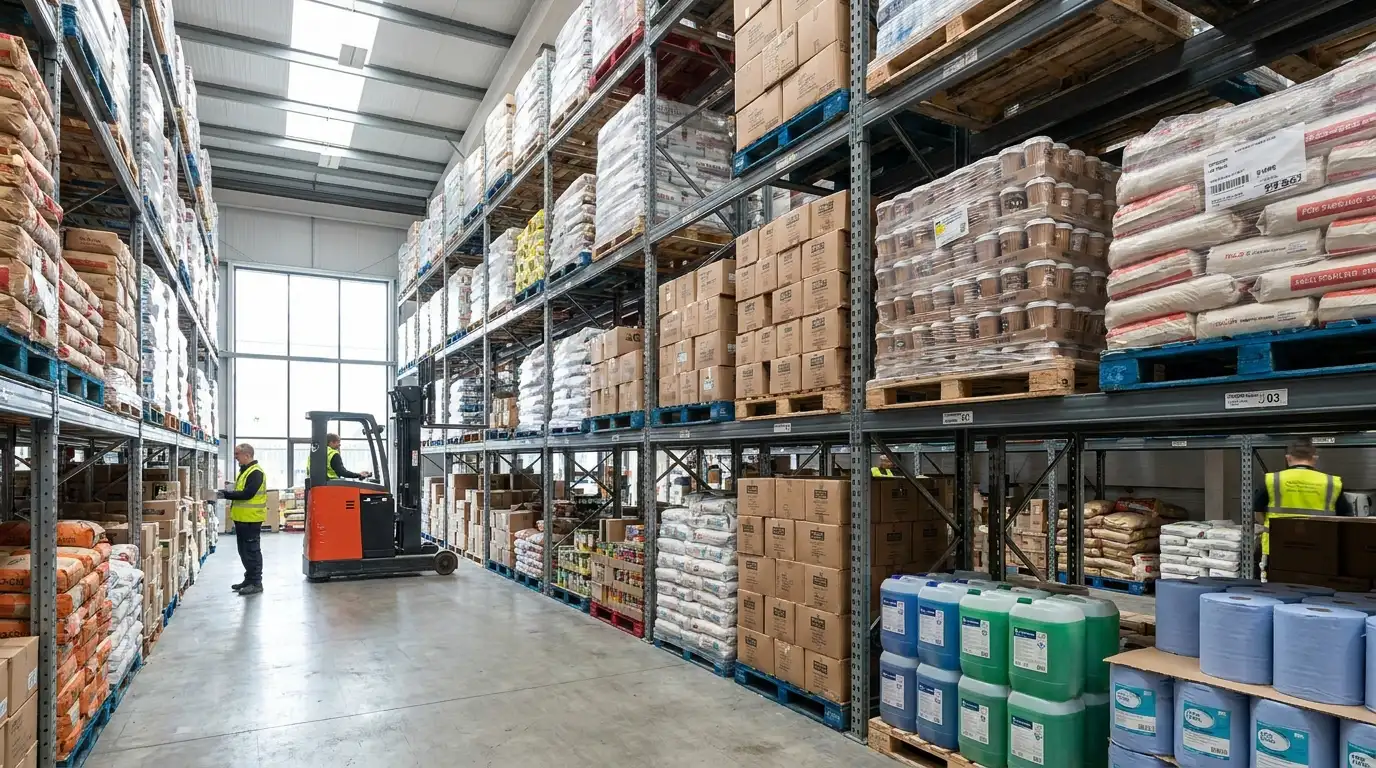
Buying catering supplies in bulk is one of the simplest ways to reduce operating costs for a UK food business. The challenge is that many operators buy reactively rather than strategically. They reorder when stock runs low, occasionally hit a volume discount tier, but never build a purchasing system that consistently lowers their overall unit cost.
This guide explains where to buy bulk catering supplies in the UK, how the main purchasing channels compare on cost and practicality, and which product categories genuinely deliver savings when ordered in volume.
Why Buying Bulk Catering Supplies in the UK Saves Real Money
Lower unit pricing is one of the biggest advantages of bulk purchasing. Most catering suppliers use tiered pricing structures, where larger order quantities reduce the cost per item. Across many high-volume consumable categories, the difference can be significant.
A practical example is paper napkins, one of the most frequently used consumables in UK cafés, takeaways, and restaurants:
- ▸ Sleeve of 100 napkins: approximately £1.80 to £2.20 per 100
- ▸ Case of 2,000 napkins: approximately £0.70 to £0.90 per 100
- ▸ Typical saving: around 55 to 65 percent depending on supplier pricing and order volume
For a café using roughly 300 napkins per day across 300 trading days, annual usage reaches around 90,000 napkins. The difference between buying small sleeves and full cases can reduce yearly costs by approximately £900 to £1,100 on that single product line alone.
The same principle applies across other high-volume categories such as coffee cups, takeaway containers, disposable gloves, cleaning chemicals, and paper products. For many medium-sized food businesses, a structured bulk purchasing system can reduce annual consumables spending by several thousand pounds.
That said, bulk buying only works when it is supported by proper storage space, realistic usage forecasting, and stable product demand. Without those factors, over-ordering can create waste rather than savings. When managed correctly, however, bulk purchasing delivers consistent long-term cost control.
The Main Channels for Buying Bulk Catering Supplies in the UK
There are four main ways UK food businesses buy catering supplies in bulk. Each option has a different pricing structure, minimum order expectation, and operational trade-off.
Specialist Online Trade Suppliers
Specialist online catering suppliers stock a broad range of hospitality and catering products at trade pricing, usually with UK-wide delivery and low minimum order requirements. For most cafés, restaurants, takeaways, and catering businesses, this is the most practical purchasing channel because it combines competitive pricing with convenience and product range.
Many suppliers also offer trade account pricing, which can improve as your order volume and account history grow. This makes online trade suppliers particularly effective for businesses placing regular repeat orders across multiple product categories.
Cash and Carry Wholesalers
Cash and carry wholesalers such as Booker, Bestway, and JJ Foodservice offer immediate product availability and allow buyers to inspect items before purchasing.
Their specialist catering range is often narrower than a dedicated trade supplier, but pricing can be competitive on high-volume essentials such as cleaning chemicals, cling film, paper products, and basic disposables.
The main drawback is the operational cost of collection. Travel time, fuel, staffing, and vehicle space should all be considered when comparing true purchasing costs.
Buying Direct from Manufacturers or Importers
Buying directly from a manufacturer or importer usually becomes viable only at very high order volumes, often 50,000 units or more of a single product line.
For an independent café, takeaway, or restaurant, this is rarely practical due to storage requirements and upfront spend. However, larger hospitality groups, contract caterers, and multi-site operations with stable demand may achieve meaningful savings by sourcing certain products directly.
This route can also involve longer lead times, pallet storage, and larger minimum order commitments.
Online Marketplaces
Online marketplaces such as Amazon Business offer convenience and fast ordering, particularly for urgent restocks.
However, specialist catering products are often priced higher than through dedicated trade suppliers, especially on repeat high-volume lines. Marketplaces are best used as a backup purchasing option rather than a primary long-term supply channel for bulk consumables.
Channel Comparison: Specialist Online Supplier vs Cash and Carry vs Marketplace
| Factor | Specialist Online Supplier | Cash and Carry | Online Marketplace |
| Price on specialist lines | Competitive trade pricing | Strong on basic commodity lines | Usually higher |
| Product range | Very broad | Moderate | Variable |
| Minimum order | Low or none | No minimum | No minimum |
| Delivery | UK next-day delivery on many lines | Collection required | Variable |
| Trade account pricing | Yes, improves with volume | Yes, with membership | Rarely |
| Product expertise | High | Moderate | Limited |
| Bulk discount tiers | Common | Sometimes available | Rare |
| Returns process | Structured trade support | In person | Can be inconsistent |
For most UK food businesses, a specialist online trade supplier is usually the most efficient default option for bulk catering supplies. Cash and carry wholesalers can still offer strong value on selected high-volume product lines where pricing is competitive and collection costs remain low.
Which Catering Supply Categories Save the Most When Bought in Bulk
Not every catering supply category delivers the same return from bulk purchasing. The biggest savings usually come from high-frequency consumables with a long shelf life and predictable daily usage.
Disposables and Food Packaging
Disposable packaging is one of the highest-return categories for bulk buying. Products such as coffee cups, takeaway containers, napkins, lids, and takeaway bags are used daily in large quantities across most UK food businesses.
These items are relatively easy to forecast, store well in dry conditions, and often benefit from strong tiered pricing. For stable product lines, buying a 3 to 6 month supply in a single order can reduce overall unit costs significantly.
Cleaning Chemicals
Commercial cleaning chemicals offer some of the clearest per-unit savings when bought in larger containers.
Surface sanitisers, degreasers, washing-up liquids, and floor cleaners are commonly available in 5-litre or 20-litre formats at a much lower per-litre cost than smaller bottles. For example, a sanitiser costing around £4.00 per litre in 750ml bottles may drop to approximately £1.20 to £1.80 per litre in a 5 litre container, depending on supplier pricing and product strength.
For kitchens with consistent cleaning routines, the savings are immediate and ongoing.
Disposable Gloves
Busy kitchens and food prep operations use large quantities of disposable gloves every week, particularly nitrile gloves.
Buying gloves in full cases of 1,000 rather than individual boxes of 100 can reduce the per-unit cost substantially. Depending on the brand, material quality, and order volume, savings of 30 to 50 per cent are common on high-use product lines.
Paper Products
Paper consumables such as kitchen roll, blue roll, hand towels, and paper napkins are well-suited to bulk purchasing.
These products are non-perishable, used consistently, and easy to store on shelving. Because they are reordered frequently, even small reductions in unit cost can create meaningful yearly savings across a busy operation.
Food Date Labels
Food date labels, freezer labels, and day-dot labels are small items that are easy to overlook but are used constantly in professional kitchens.
Buying larger rolls or multi-pack cases reduces the cost per label and lowers the risk of running out during service. Since these products have a long shelf life and stable demand, they are usually a safe category for volume ordering.
Where Bulk Buying Does Not Pay
Bulk purchasing is not always the right strategy. In some categories, over-ordering creates unnecessary cost, storage pressure, or operational waste.
This is an area many catering supply guides ignore, but avoiding the wrong bulk purchases is just as important as securing lower pricing.
Commercial Equipment
Commercial kitchen equipment should be purchased based on operational need, not volume discounts.
Buying two combi ovens when the kitchen only requires one does not create meaningful savings. It simply ties up capital, storage space, and maintenance costs. Equipment purchases should always be specification-led rather than quantity-led.
Seasonal or Menu-Specific Products
Products linked to seasonal menus, limited promotions, or temporary packaging designs are usually poor candidates for bulk buying.
If the menu changes in a few months, leftover stock may become obsolete before it is used. In these situations, flexibility is often more valuable than a lower unit cost.
Products with Short Shelf Lives or Storage Risks
Some catering supplies are sensitive to moisture, heat, or long-term storage conditions.
For example, thin-walled paper cups stored in damp conditions can warp or weaken over time. Certain cleaning products may also have expiry guidance once opened. Before placing a large bulk order, always check shelf life and recommended storage conditions.
Products Likely to Change Format
If your business is reviewing packaging sizes, changing branding, or testing new suppliers, avoid committing to large stock volumes too early.
Ordering several months of packaging before confirming final specifications can leave you with unusable stock if the format changes later.
Products Not Yet Tested in Service
Never commit to a very large order for a product you have not tested in real service conditions.
A sample order or short trial period allows staff to evaluate durability, usability, and customer experience before committing to volume purchasing. Testing products first reduces the risk of expensive ordering mistakes later.
How to Calculate Your Actual Consumption Before Ordering in Bulk
Accurate usage data is the foundation of effective bulk purchasing. Many food businesses over-order or under-order because they rely on rough estimates rather than actual purchasing records.
A simple consumption review gives you a much clearer picture of what your business genuinely uses each month and helps prevent unnecessary stock holding.
A Practical Way to Calculate Bulk Order Quantities
Use the following process before placing a larger volume order:
- ▸ Pull your purchase history from the last 3 months using supplier invoices or account records
- ▸ Identify your 10 highest-volume consumable products
- ▸ Calculate the average monthly usage for each line
- ▸ Multiply that figure by 3 for a standard bulk order
- ▸ For very stable, high-use items, multiply by 6 if storage space allows
- ▸ Add a buffer of around 10 to 15 per cent for seasonal demand or unexpected increases in trade
This approach gives you a data-based order quantity rather than relying on guesswork. It also creates a baseline you can review every quarter as customer demand and trading patterns change.
For many cafés, takeaways, and restaurants, even a basic consumption tracking system improves purchasing efficiency quickly.
The Storage Problem: Matching Order Volume to Physical Space
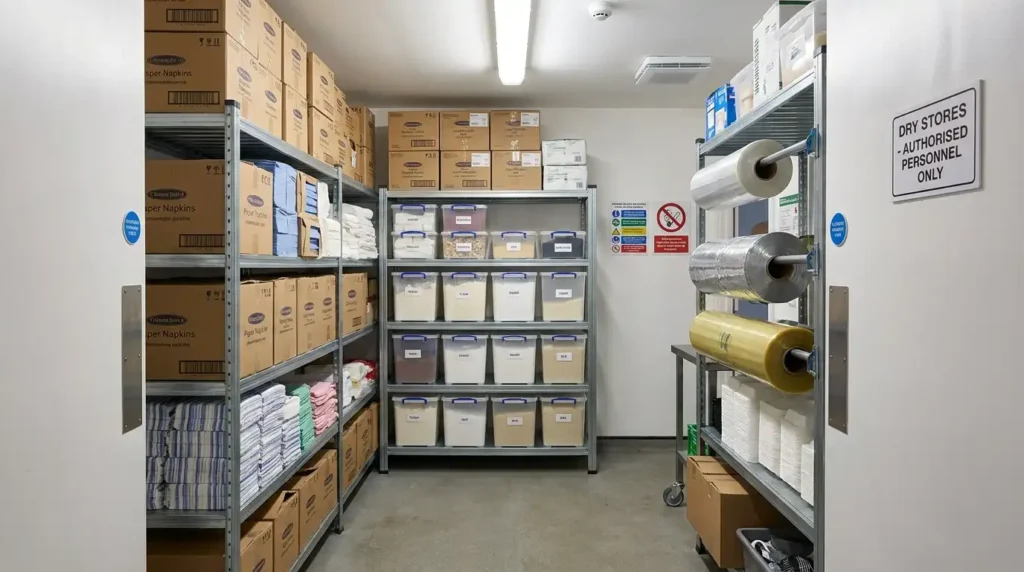
Bulk buying only creates savings when products can be stored properly.
A case of 2,000 napkins damaged by damp storage conditions is not a cost saving. A pallet of takeaway cups blocking a fire exit creates operational and compliance issues instead of efficiency.
Before placing a large order, assess your available dry storage space and compare it against the dimensions of the products you plan to buy. Most catering suppliers provide carton or case dimensions on product listings, which makes storage planning much easier.
If storage space is limited, ordering moderate quantities more frequently is usually more practical than overcommitting to a single oversized delivery.
Use Vertical Storage Efficiently
Well-organised shelving can significantly improve storage capacity.
A 2 metre shelving unit with multiple levels can hold far more case stock than floor storage alone, while also improving stock rotation and access. Keeping products elevated reduces exposure to moisture, dust, and pest risks, particularly for paper products and food packaging.
Good storage management is just as important as securing lower pricing.
How to Negotiate Better Pricing with Your Supplier

Many UK catering businesses simply accept the listed website or invoice price without reviewing whether better rates are available.
In practice, pricing is often more flexible than it appears, especially once a supplier sees consistent repeat ordering and higher annual spend.
Practical Ways to Secure Better Trade Pricing
Request a Trade Account Review
Review your account pricing at least once per year.
If your purchasing volume has increased since opening the account, suppliers may offer access to improved discount tiers or account-specific pricing. A business spending £10,000 to £15,000 annually with one supplier often has more negotiating power than many operators realise.
Consolidate More of Your Spend
Suppliers are usually more willing to improve pricing when they receive a larger share of your total purchasing across multiple categories.
Consolidating disposables, cleaning chemicals, packaging, and paper products with one supplier can sometimes unlock stronger overall trade rates.
Ask About Pallet Pricing
For very high-volume products, pallet quantities may qualify for pricing tiers not shown in the standard online catalogue.
This is particularly common for takeaway cups, food containers, napkins, and paper consumables.
Give Advance Notice of Large Orders
If you expect increased demand from a major event, seasonal rush, or catering contract, inform your supplier in advance.
Advance notice allows suppliers to reserve stock, plan deliveries more efficiently, and occasionally offer improved pricing in exchange for confirmed volume.
Review Your Core Product Pricing Regularly
Supplier pricing changes throughout the year due to freight costs, material prices, and manufacturer adjustments.
A product line that was expensive 12 months ago may now be competitively priced, while another may have increased significantly. Reviewing your top five consumable lines every 6 months helps maintain competitive purchasing costs over time.
Common Bulk Buying Mistakes UK Caterers Make
Bulk purchasing can reduce operating costs significantly, but only when it is planned properly. Many catering businesses lose part of those savings through avoidable purchasing mistakes.
Below are some of the most common issues UK cafés, restaurants, takeaways, and catering operators run into when ordering in volume.
Buying Without Checking Storage Capacity
This is one of the most common and expensive mistakes.
Large orders only create savings if products can be stored safely and correctly. Paper products exposed to damp conditions, overcrowded stockrooms, or poorly organised storage areas often lead to damaged stock and unnecessary waste.
Before increasing order quantities, confirm that you have enough clean, dry, and accessible storage space available.
Ordering Large Volumes Before Testing Products
Committing to a large order without testing the product first creates unnecessary risk.
A takeaway cup, food container, glove, or cleaning product may appear suitable online but perform differently during real service conditions. Running a short test period with staff before committing to thousands of units helps identify quality, usability, or compatibility issues early.
A small sample order is far less expensive than replacing unusable bulk stock later.
Not Reviewing Consumption Data
Ordering based on estimates rather than actual purchasing records often results in overstocking or under-ordering.
Without reviewing usage history, businesses may end up holding several months of unnecessary stock or running out of key consumables before the next delivery cycle. Regularly checking purchasing data helps maintain more accurate stock levels and reduces wasted spend.
Relying on One Supplier Without Comparing Pricing
Working closely with one supplier can simplify ordering and account management, but pricing should still be reviewed periodically.
Product costs, freight rates, and supplier margins change over time. Reviewing alternative pricing every 6 to 12 months helps confirm that your current rates remain competitive, particularly on high-volume consumable lines.
Ignoring Packaging Compliance Requirements
When ordering food packaging in bulk, compliance matters just as much as pricing.
Purchasing large quantities of packaging that does not meet current UK single-use plastics regulations can create operational and financial problems later. Always confirm material specifications and compliance standards before committing to volume orders.
Choosing the Right Supplier for Long-Term Bulk Purchasing
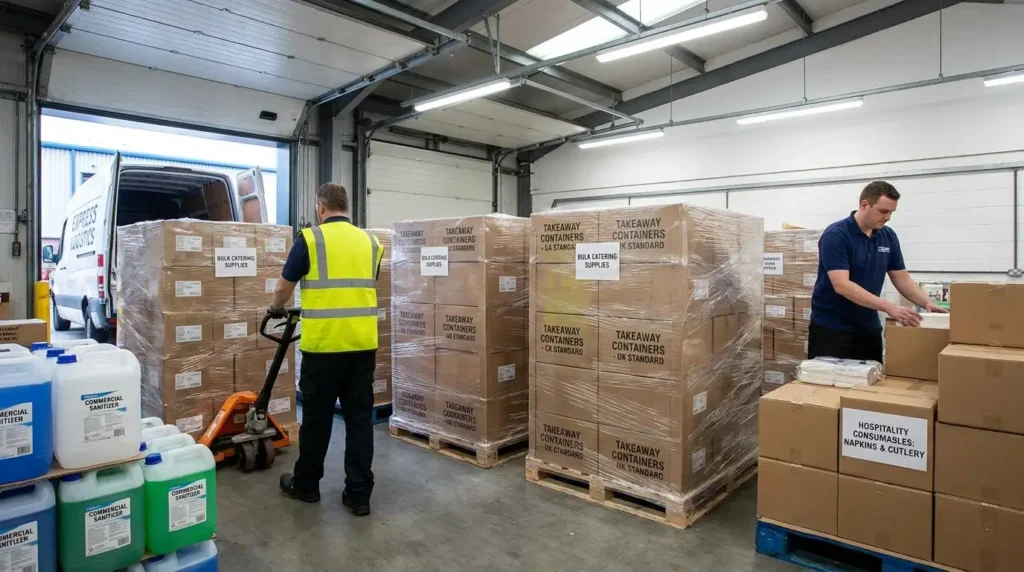
For many UK food businesses, the most effective purchasing setup combines competitive trade pricing, reliable delivery, consistent stock availability, and access to multiple catering product categories in one place.
We Can Source It supplies bulk catering and hospitality products across categories, including disposables, food packaging, cleaning chemicals, food date labels, glassware, and kitchen consumables. Trade account pricing and volume discount tiers are available for businesses placing regular orders.
You can browse the catering supplies range here: Catering Supplies Collection.
👉 For a broader overview of catering product categories, operational essentials, and purchasing guidance, see the complete catering supplies UK guide.
Frequently Asked Questions
Where is the best place to buy bulk catering supplies in the UK?
For most UK cafés, restaurants, takeaways, and catering businesses, specialist online trade suppliers offer the best balance of pricing, product range, and delivery convenience. Cash and carry wholesalers can still provide good value on selected high-volume basics, while online marketplaces are usually more useful for emergency restocking than long-term bulk purchasing.
How much can you save by buying catering supplies in bulk?
Savings vary by product type and supplier pricing, but high-volume consumables often deliver significant reductions in unit cost. Paper napkins, disposable gloves, takeaway packaging, and cleaning chemicals commonly become much cheaper when ordered in larger quantities rather than small packs.
What catering supplies are usually worth buying in bulk?
The strongest bulk-buy categories are products with predictable usage and long shelf lives. These typically include disposable packaging, coffee cups, paper products, cleaning chemicals, disposable gloves, and food date labels.
How do I calculate how much stock to order?
Review your purchasing history from the previous 3 months, calculate average monthly usage for each core consumable line, then multiply by 3 for a standard bulk order. Many businesses also add a small buffer to cover seasonal demand or unexpected increases in trade.
Do I need a trade account to buy bulk catering supplies in the UK?
Not always. Many catering suppliers allow standard online purchases without a trade account. However, opening a trade account can provide access to better pricing tiers, account management support, and improved discounts for regular volume ordering.
Author
We Can Source It, Team
The We Can Source It team supplies catering and hospitality products to restaurants, cafés, bars, hotels, schools, takeaways, and commercial kitchens across the UK. The company works with businesses of different sizes, from independent operators to larger hospitality and foodservice environments, supplying everyday consumables, packaging, and operational essentials.