
Glassware procurement is one of the most consistently mismanaged areas of UK restaurant operations. Most managers know they need more glasses than their cover count suggests. Few know exactly how many, or how to calculate it with any precision. Even fewer have a stock management system that tells them when to reorder before they run short mid-service.
This guide covers all three problems the keyword promises to solve: how to calculate your par stock using UK service patterns and real glasswasher cycle times, how to structure your first bulk glassware order with UK suppliers, and how to organise storage and manage stock so you do not discover a shortfall during a busy Saturday evening service.
The Par Stock Calculator: How Many Glasses Does Your Restaurant Actually Need?
The standard multiplier advice, hold two to three times your cover count, is a starting point, not a calculation. It does not account for glasswasher cycle time, service pattern, peak trading, or the realistic rate at which glasses move through the cycle from table to kitchen to rack to back bar. Here is the correct approach for a UK restaurant.
The Formula
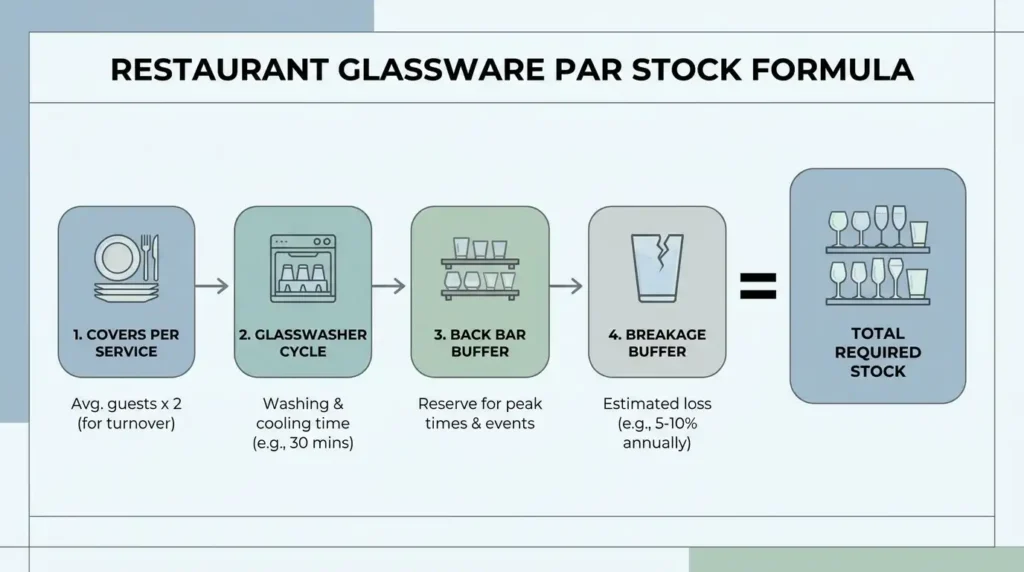
Minimum par stock per glass type = (Covers per peak service x glasses per cover) + (Glasswasher cycle time in minutes/service pace) x simultaneous service demand + breakage buffer
In practical terms, the calculation works as follows.
Step 1: Establish your peak service cover count.
Use the largest single service you run, not a daily average. A restaurant running two dinner sittings at 60 covers each has a peak service of 60 covers, not 120.
Step 2: Calculate glasses in circulation during peak service.
For a 60-cover dinner service using one wine glass per cover, 60 glasses are in use at the table at any given time.
Step 3: Account for glasswasher cycle time.
A standard commercial undercounter glasswasher runs a 90-second to 3-minute cycle. Allow for load time, unload time, and drain rack cooling time. A realistic total cycle from loading to returned-to-service is approximately 15 minutes per rack. A full rack holds 25 to 36 glasses depending on rack type.
For a 60-cover service with 60 wine glasses in use:
- ▸ 60 glasses at the table
- ▸ 20 to 25 glasses cycling through the washer and drain rack at any given time during service
- ▸ 15 to 20 glasses as a back-bar buffer for direct replacement when tables turn
Minimum working stock for a 60-cover restaurant, wine glasses only: approximately 95 to 105 glasses.
Step 4: Apply the breakage buffer.
Add 15 to 20% to your minimum working stock to account for breakage losses. For 100 working glasses, the breakage buffer adds 15 to 20 glasses.
Minimum par stock for wine glasses, 60-cover restaurant: 115 to 125 glasses.
Step 5: Adjust for multiple sittings and peak trading.
A restaurant running two dinner sittings per evening with peak trading on Friday and Saturday does not gain the full glasswasher cycle benefit between sittings unless the first sitting ends with sufficient time to complete two to three full glasswasher cycles. If the turnaround between sittings is under 30 minutes, treat the two sittings as a single continuous service demand.
For a 60-cover restaurant running two dinner sittings with a 30-minute turnaround:
- ▸ Working stock needed: 95 to 105 glasses (same as single sitting with adequate washer time)
- ▸ If turnaround is under 20 minutes, treat as 120 covers, minimum working stock 170 to 190 glasses
Par Stock Quick Reference by Restaurant Type
| Restaurant Type | Cover Count | Recommended Par Stock Per Glass Type | Key Variable |
| 40-cover independent restaurant | 40 covers, one sitting | 70 to 85 glasses | The standard glasswasher cycle is sufficient |
| 60-cover restaurant, two sittings | 60 covers per sitting | 115 to 130 glasses | Turnaround time between sittings |
| 100-cover casual dining, continuous service | 100 covers | 200 to 240 glasses | Continuous glasswasher cycling is essential |
| 150-cover pub restaurant | 150 covers, mixed service | 280 to 330 glasses | Multiple glass formats increase the total |
| Bar with standing capacity | 80 standing covers | 120 to 160 glasses | Higher loss rate in standing service |
Key takeaway: The standard 2x to 3x multiplier is not wrong, but it does not tell you why. The par stock calculation above gives you the reasoning behind the number, which allows you to adjust it accurately for your specific service pattern rather than guessing.
How to Structure Your First Bulk Glassware Order
Ordering bulk glassware for a restaurant for the first time involves more decisions than a standard supply purchase. Getting these right at the ordering stage avoids expensive mistakes on delivery.
Confirm Case Quantities Before Calculating Your Order
Commercial glassware wholesalers supply in case quantities of 6, 12, 24, or 48 units depending on the glass format and brand. Your par stock calculation will rarely divide neatly into case quantities.
The correct approach: calculate your par stock requirement, then round up to the nearest full case. If your wine glass par stock requirement is 125 and your chosen glass comes in cases of 12, you need 11 cases (132 glasses). Order 11 full cases and hold the 7 surplus as an immediate breakage buffer.
Do not attempt to order partial cases. Most trade suppliers do not supply partial cases, and those who do typically charge a premium that negates the volume pricing benefit.
Request Samples Before Committing to Volume
For any bulk glassware order above 100 units, request a physical sample before committing. The priority tests to run on a sample glass before ordering at volume:
- ▸ Glasswasher test. Run the sample through five to ten cycles on your actual machine at operating temperature. Inspect for etching, clouding, and rim stress marks.
- ▸ Service test. Carry the glass at the speed your busiest service demands. Check rim weight, grip, and whether the stem (if applicable) feels secure at carrying pace.
- ▸ Table test. Place the glass on your table surface under your service lighting. Check clarity, any visual distortion in the glass, and how it looks with a drink in it.
A glass that looks good on a product page can perform poorly on your actual glasswasher or look different under your dining room lighting. Physical sampling before a 200-unit order is not optional for any premium glassware purchase.
Confirm Lead Times Before Your Opening Date or Reorder Point
Standard commercial glassware from UK wholesalers typically delivers in 3 to 5 working days for stock items. For specialist formats, imported ranges, or out-of-stock items, lead times extend to 2 to 4 weeks.
For a restaurant opening or a complete glassware refresh, place your bulk order at least 3 weeks before you need the stock to allow for delivery, inspection, and replacement of any damaged units on arrival.
Inspect All Stock on Delivery
Open every case on delivery and inspect for transit damage before the delivery driver leaves, if possible. Note any breakages or chips on the delivery note before signing. Commercial glassware is fragile enough to sustain transit damage even in well-packed cases. A supplier’s returns policy for transit damage typically requires the damage to be documented at the point of delivery.
UK Trade Accounts: Where to Buy Bulk Glassware and on What Terms
Many online buying guides are written for North American markets and do not reflect UK trade accounts, compliance requirements, or supplier lead times. The comparison below focuses on suppliers commonly used by UK restaurants, pubs, and hospitality venues.
The suppliers below are included for comparison purposes. Product ranges, pricing, and lead times may vary based on stock availability and account status.
UK restaurant buyers typically source glassware from national catering suppliers, specialist hospitality wholesalers, and manufacturer-direct trade accounts depending on volume requirements.
UK Supplier Comparison
| Supplier | Strengths | Typical MOQ | Lead Times | Trade Account |
| Nisbets | Widest commercial range in the UK; next-day delivery on stock items; strong on basics | Case quantities, no formal MOQ | Next day available on most stock | Trade account with credit terms available |
| We Can Source It (wecansourceit.co.uk) | Wide range of toughened glass, polycarbonate, and crystal; CE/UKCA compliant; UK-based | Case quantities from 6 units | 3 to 5 working days standard | Available; contact the trade team |
| Alliance Online | Good toughened glass range; bulk pricing at volume | Case quantities | 2 to 5 working days | Trade account available |
| Ascot Wholesale | Design-led and premium formats; strong on bar and cocktail glassware; price match available | Case quantities, some MOQ on specialist lines | 3 to 7 working days | Trade account available |
| Steelite International | Fine dining and hotel specification; premium crystal and commercial glass | Higher MOQs for direct account | 1 to 2 weeks | Direct trade accounts for qualifying volume buyers |
The best supplier depends on your venue type and purchasing priorities. Independent restaurants often prioritise low MOQs and fast delivery, while larger groups and hotel operators may benefit from direct manufacturer accounts offering volume discounts and long-term pricing agreements.
Opening a Trade Account
Most UK commercial glassware suppliers offer trade account terms to verified hospitality businesses. The typical requirements are:
- ▸ Proof of business (Companies House registration or VAT number)
- ▸Trading address
- ▸ An initial order to establish the account
Credit terms typically run 30 days from the invoice date for established accounts. For new accounts, the first order is often pro forma (payment in advance) before credit terms are offered.
The benefit of a trade account over one-off purchasing is consistent pricing, priority stock access, and simplified reordering when replacement stock is needed urgently. For any restaurant expecting to reorder glassware regularly, opening a trade account with your primary supplier within the first three months is worth the ten minutes it takes to apply.
Buying in Bulk vs Regular Small Orders
The pricing advantage of bulk glassware purchasing is most significant between the 48-unit and 144-unit quantity brackets. Below 48 units, trade pricing is typically only marginally better than retail. Above 144 units, volume pricing tiers become more meaningful.
The trade-off with large bulk orders is storage space and capital commitment. For a new restaurant, ordering 6 to 12 months of glass supply upfront frees procurement time but ties up cash and requires adequate storage. Ordering in smaller, more frequent batches preserves cash flow but increases per-unit cost.
The balanced approach for most UK restaurants: order initial par stock in full at opening to establish the trade account and volume pricing, then reorder in 48 to 96 unit increments at the reorder point identified in Section 5.
Need commercial glassware for your restaurant? Browse our trade glassware collection for wine glasses, beer glasses, tumblers, cocktail glasses, and specialist hospitality formats available in trade case quantities. Many ranges are designed for commercial glasswasher use and are available with volume pricing for hospitality businesses.
Storage and Organisation: Managing Flow, Not Just Space
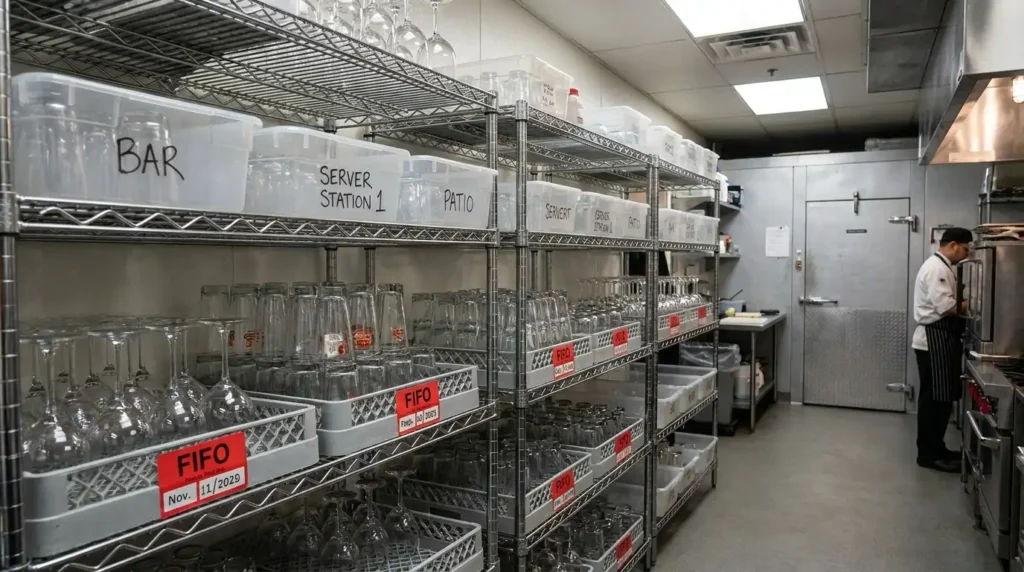
The storage section of every competitor guide for this keyword focuses on display and aesthetics. This section focuses on operational flow, which is what determines whether your glass stock actually works during a busy service.
Organise by Service Position, Not Glass Type
The most common glass storage mistake in UK restaurants is organising glasses by type (all wine glasses together, all tumblers together) rather than by service station. During a busy service, a waiter reaching for a glass needs it immediately accessible at their nearest service point, not at the central back-bar storage area.
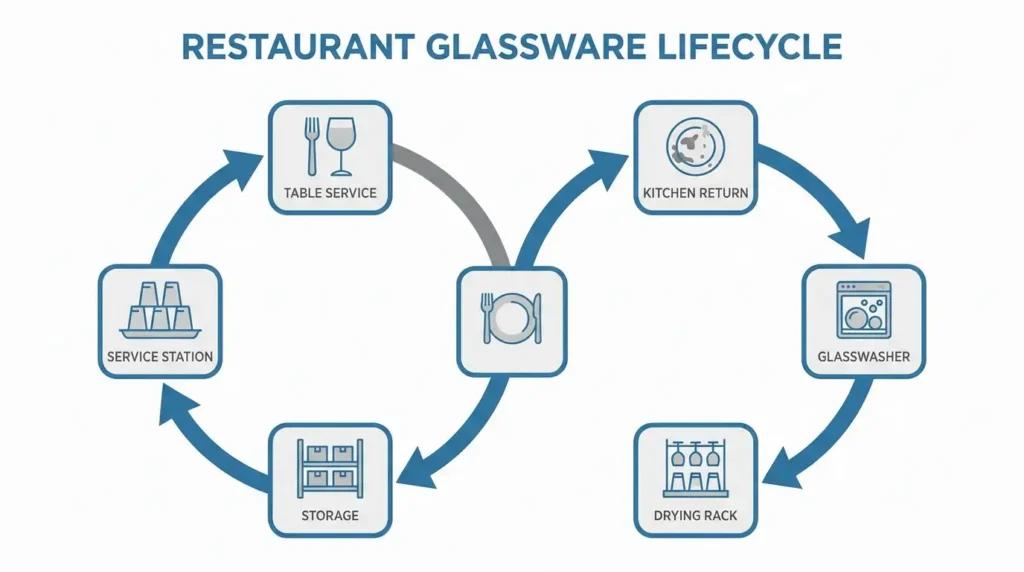
The correct organisation principle: each service station should hold a working set of every glass format used in that station’s section. Central back-bar storage holds overflow and replacement stock. The flow is central storage to service station to table to kitchen to glasswasher to drain rack to service station.
Stemware Storage: Rim-Down vs Rim-Up
The choice between rim-down and rim-up stemware storage involves a genuine trade-off:
Rim-down on ventilated racks:
- ▸ Keeps the bowl interior clean and dust-free
- ▸ Allows drainage after washing
- ▸ Creates chip risk at the rim contact point on hard wire racks
- ▸ Correct choice for: venues with high foot traffic, kitchen vibration, or poor air quality around storage
Rim-up on padded shelves:
- ▸ No rim contact damage
- ▸ The bowl is exposed to dust and contamination
- ▸ Requires more frequent washing before service
- ▸ Correct choice for: display storage in low-traffic areas, fine dining pre-set service
For commercial restaurant back-of-house storage, rim-down on ventilated racks with rubber mat lining at contact points is the standard. The rubber mat eliminates the rim chip risk from hard wire contact while maintaining the hygiene benefit of rim-down storage.
Stack Height and Separation
Pint glasses and tumblers: Limit stacks to six to eight glasses. Stacks above this height concentrate weight on the bottom glass and increase base fracture rates. In high-vibration environments (near the kitchen or below the speaker system), limit stacks to five.
Stemware: Do not stack. Store on individual rack positions or on shelving with enough clearance between glasses to prevent contact during normal kitchen vibration.
The Glass Rotation System
A rotation system prevents the same glasses from being pulled repeatedly from the front of the shelf while identical glasses at the back sit unused. Over time, the front glasses accumulate disproportionate washing cycles and wear faster than the back stock.
The solution is a first-in, first-out rotation applied every time glasses are returned from the washer. New clean glasses go to the back of the storage row. Glasses for service are taken from the front. This is a 10-second habit per rack that extends the average life of your glass stock measurably over a season.
Stock Management and Reorder Triggers
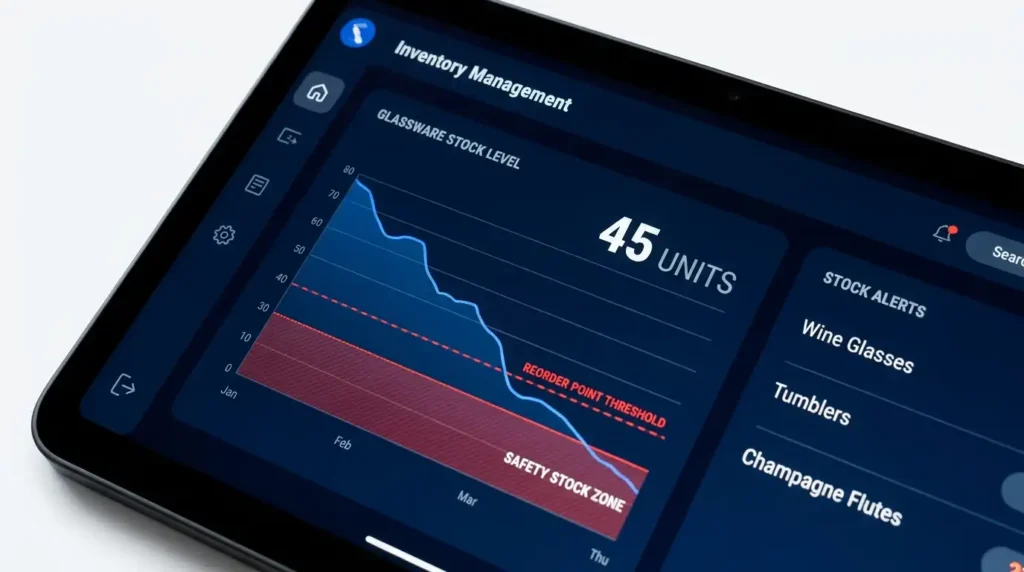
Most UK restaurants reorder glassware reactively, when a service runs short or when the manager notices stocks looking thin. This creates the worst possible reorder timing: urgent, at full price, with no time for sample testing or lead time planning.
A simple proactive stock management system eliminates this entirely.
Setting Your Reorder Point
Your reorder point is the stock level at which you place a new order, timed to arrive before you drop below your minimum working stock.
Reorder point formula: Reorder point = (Average weekly usage + Average weekly breakage) x Supplier lead time in weeks + Safety stock
For a 60-cover restaurant with a 3-day average supplier lead time:
- ▸ Average weekly usage of wine glasses: 0 (glasses are not consumed, but breakage acts as usage)
- ▸ Average weekly breakage: 3 to 5 glasses
- ▸ Lead time: 0.5 weeks (3 working days)
- ▸ Safety stock: 20 glasses
Reorder point = (5 x 0.5) + 20 = approximately 22 to 23 glasses below par stock
When your wine glass stock falls to within 23 glasses of par stock, place your reorder.
A Weekly Stock Check System
A weekly stock check for glassware takes five minutes and prevents reactive ordering. The process:
- Count the total glasses in each format at a consistent time each week (Sunday evening before the week’s service is a good default)
- Note any formats within 20% of the reorder point
- Place orders for any format at or below the reorder point before Monday trading begins
A simple spreadsheet or even a handwritten log covering format, current count, par stock, and reorder point is sufficient. The discipline of the weekly check matters more than the sophistication of the system.
Not sure which glassware fits your par stock calculation? We can help estimate the right stock levels based on your covers, service style, and glass types.
A Simple Breakage Log System
A breakage log serves two purposes: it tells you your actual annual breakage cost (which most operators significantly underestimate), and it helps you identify whether breakage is concentrated in a specific service pattern, glass format, or time of week, information that points directly to the preventable cause.
What to Record
For each breakage event, record:
- ▸ Date and service period (lunch/dinner/bar)
- ▸ Glass format
- ▸ Cause if known (dropped by staff, dropped by customer, glasswasher, polishing, unknown)
- ▸ Whether injury occurred (if yes, also record in the accident book)
A small laminated card near the waste bin in the kitchen is sufficient. Staff record breakages in real time. The manager reviews the log weekly.
What the Log Tells You
After four weeks of consistent logging, you have enough data to identify:
- ▸ Which glass format breaks most frequently
- ▸ Whether breakage clusters around specific services or days
- ▸ Whether the cause is predominantly staff handling, glasswasher, or customer
This data directly informs both your reorder schedule and your staff training priorities. If 60% of your wine glass breakage is coded “glasswasher” in the log, the solution is the thermal shock management covered in our guide on how to prevent glass breakage in bars and restaurants. If it is predominantly “dropped by staff,” the solution is a carrying technique induction.
For the complete context of glassware selection, materials, and UK legal compliance across all venue types, see our hospitality glassware guide for UK venues.
FAQs
How many glasses does a restaurant need per cover?
The correct answer is not a fixed multiple but a calculation based on service pattern and glasswasher cycle time. A 60-cover restaurant running one dinner sitting needs approximately 115 to 125 wine glasses minimum per format, accounting for glasses in use, in the washer cycle, on the drain rack, and a 15 to 20% breakage buffer. The standard 2x to 3x multiplier is a reasonable approximation but underestimates stock requirements in restaurants with fast table turns and short glasswasher cycle times.
What is the minimum order quantity for bulk glassware in the UK?
Most UK commercial glassware wholesalers supply in case quantities of 6, 12, 24, or 48 units. There is typically no formal minimum order quantity in cases, but pricing tiers improve significantly above 48 units (approximately 2 cases of 24). For standard formats like toughened nonic pint glasses, cases of 48 represent the most common bulk order unit.
How do I open a trade account for glassware in the UK?
Most UK commercial glassware suppliers require proof of business (Companies House registration number or VAT number), a trading address, and an initial order. The first order is typically pro forma before credit terms are offered. Trade account credit terms of 30 days from invoice are standard once the account is established. Contact your preferred supplier directly; most account applications can be completed in under 10 minutes.
How often should I reorder bulk glassware for a restaurant?
For most UK restaurants, a quarterly reorder cycle is sufficient for standard formats with predictable breakage rates. The trigger should be a stock count reaching the reorder point (typically 20% below par stock), not a fixed calendar date. High-breakage periods such as the Christmas trading season typically require a reorder in November to avoid shortfalls in December.
What is the correct way to store wine glasses in a restaurant?
Store wine glasses rim-down on ventilated racks with a rubber mat lining at contact points. Rim-down storage keeps the bowl clean and allows drainage after washing. Rubber mat lining at contact points prevents rim chipping from hard wire rack contact. Apply a first-in, first-out rotation so glasses at the front of the shelf are used first and cleaned glasses are returned to the back.
How do I track glass breakage in a restaurant?
A simple handwritten breakage log near the kitchen bin is sufficient. Record the glass format, date, service period, and cause for each breakage. Review weekly. After four weeks, the data identify which formats break most, when breakage clusters, and what the predominant cause is, which directly determines whether the solution is staff training, glasswasher management, or glass format replacement.
Is it worth buying sample glasses before a bulk order?
Yes, always for orders above 100 units. Run the sample through five to ten cycles on your own glasswasher, carry it at service pace, and inspect it under your dining room lighting. A glass that looks good online can perform poorly under your specific glasswasher conditions or look different under your service lighting. The cost of a sample is trivial compared to the cost of discovering a glasswasher incompatibility after a 200-unit delivery.
References
- ▸ Weights and Measures Act 1985 via legislation.gov.uk
- ▸ Health and Safety at Work Act 1974 via legislation.gov.uk
- ▸ UKCA marking guidance via gov.uk