
Food date labels are one of the most inspected elements of a commercial kitchen and also one of the most misunderstood.
Most caterers know they should be labelling their food. Fewer understand exactly what the law requires, which labels apply to which situations, and what an Environmental Health Officer is actually checking when they open your walk-in fridge.
Getting this wrong does not just risk a lower hygiene rating. It can lead to an improvement notice, a re-inspection, and in serious cases, a prohibition order.
This guide explains UK food date labelling law in plain terms, covers the practical label system a professional kitchen needs, and tells you exactly what to expect when an EHO inspects your date labelling compliance.
The Law Behind Food Date Labels in the UK
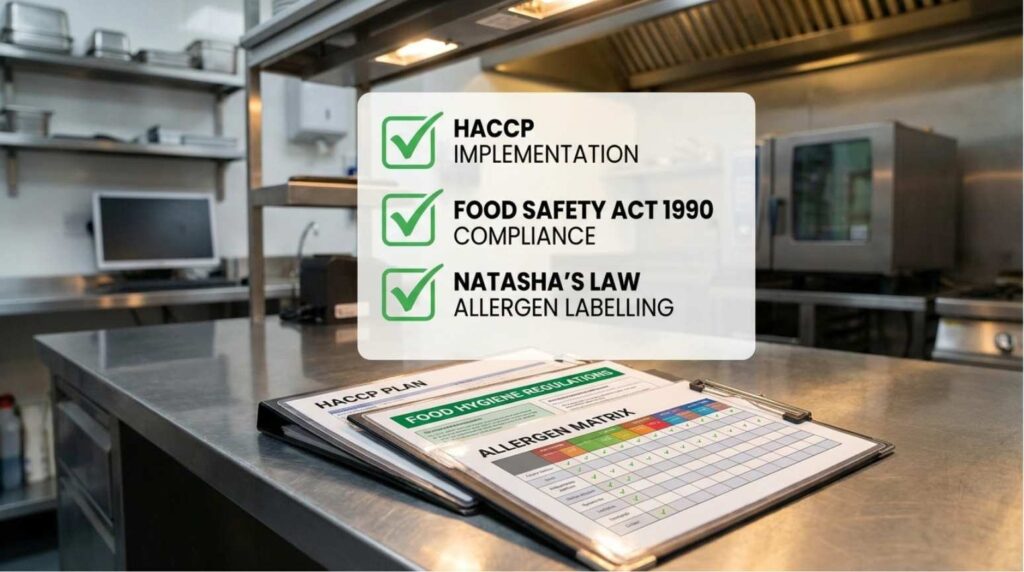
Date labelling in UK catering sits within a framework of three pieces of legislation that work together.
The Food Safety Act 1990 establishes the core framework for food safety law in England. It makes it a criminal offence to sell or process food that is harmful to health or does not meet food safety standards. Selling food past its use-by date is a direct offence under this Act.
Regulation (EC) No 852/2004, retained in UK law post-Brexit, requires all food businesses to have a documented food safety management system based on HACCP principles. Date labelling of prepared and stored food is a core element of HACCP. Without a functioning label system, your HACCP plan is incomplete.
The Food Information (Amendment) (England) Regulations 2019, commonly known as Natasha’s Law, came into force on 1 October 2021. It governs allergen and ingredient labelling for food that is prepacked for direct sale on the premises where it is made.
These three layers together mean that date labelling is not optional and not just administrative housekeeping. It is a legal requirement with inspection consequences and, in cases of selling out-of-date food, a criminal liability.
Use-By vs Best-Before: The Difference That Matters
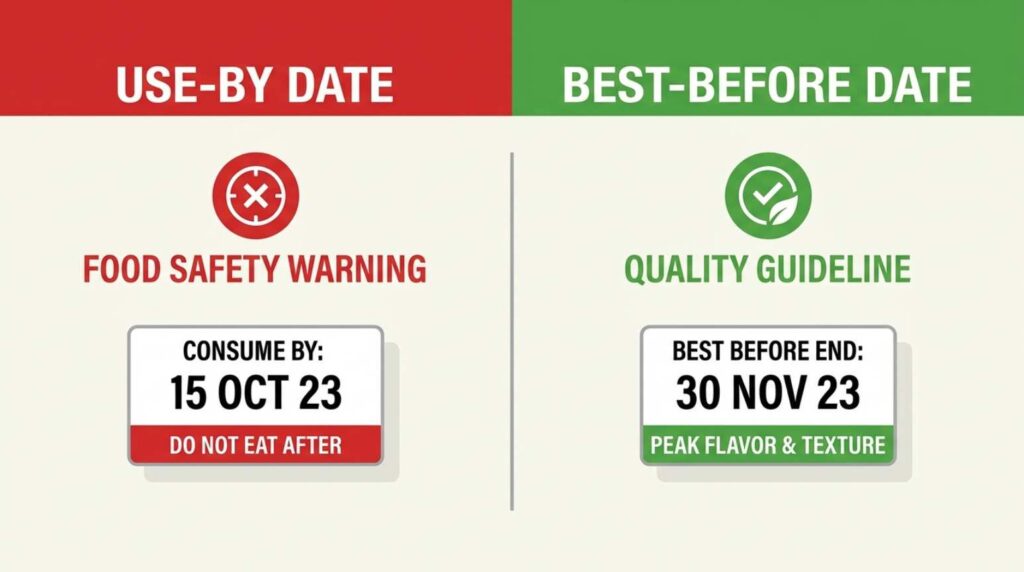
The two date marks used on food in the UK have different legal meanings and different consequences if ignored.
Use-by date is a safety marker. It applies to perishable foods where consumption after the stated date could cause harm, regardless of how the food looks or smells. Selling or serving food past its use-by date is a criminal offence under the Food Safety Act. This applies to foods you receive from suppliers and to any food you produce internally that you label with a use-by date.
Best-before date is a quality marker. Food past its best-before date may have declined in quality, but it is not necessarily unsafe. Selling best-before food past its date is not illegal in the same way, though it may be considered misleading if quality is significantly compromised.
The practical rule for a commercial kitchen is straightforward:
- ▸ Never serve or use as an ingredient any item past its use-by date
- ▸ Check best-before dates on incoming stock as part of your goods-in procedure
- ▸ Date all internally prepared food with a use-by date, not just a best-before date, because your HACCP plan requires a safety-based approach
Internal Date Labelling: What Your HACCP Plan Requires
Once food is opened, cooked, portioned, or combined with other ingredients in your kitchen, the original manufacturer’s date is superseded by your own internal dating system. This is where most kitchen date labelling happens day to day.
Your HACCP plan must define shelf lives for your prepared items. These are typically:
- ▸ Ready-to-eat refrigerated items (portioned sauces, salads, cold prep): up to 3 days as a general guideline, depending on the item and storage conditions
- ▸ Cooked proteins held in refrigeration: typically 2 to 3 days
- Items held in a bain-marie or hot holding: 2 hours maximum before disposal or rapid chilling
- ▸ Opened vacuum-packed products: follow manufacturer guidance once opened, often 3 to 5 days in refrigeration
- ▸ Items transferred to the freezer: label with the date frozen and a use-by date appropriate to the product
Your HACCP shelf lives need to be documented and consistent. An EHO will ask your staff what the shelf life of a specific product is. If different team members give different answers, it demonstrates that the system is not trained or followed.
The Day-Dot System Explained
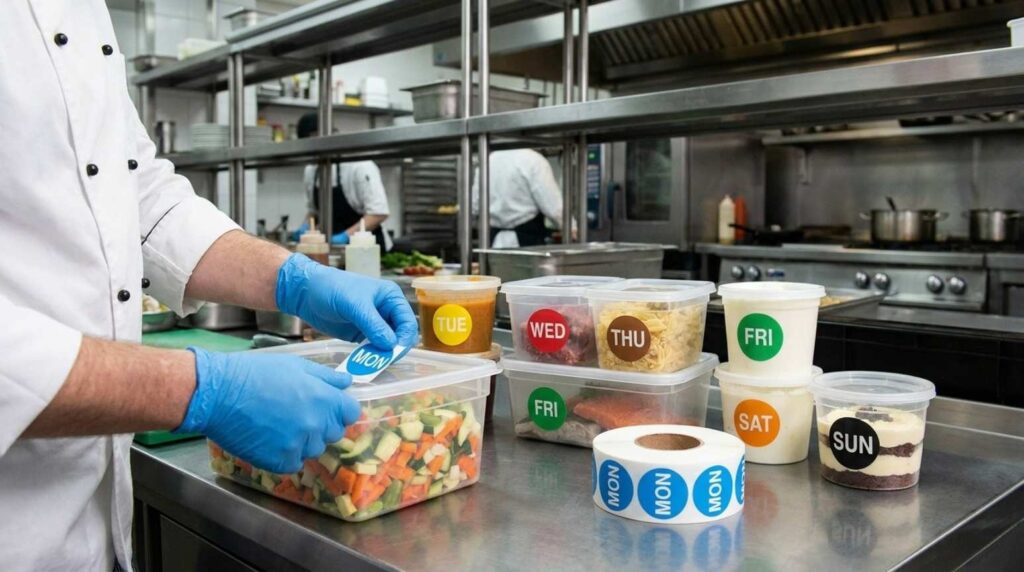
The day-dot system is the most widely used internal date labelling method in UK commercial kitchens. It is fast to apply, visual, and HACCP-compliant when used correctly.
Each colour-coded adhesive label represents a day of the week:
- ▸ Monday: Blue
- ▸ Tuesday: Yellow
- ▸ Wednesday: Red
- ▸ Thursday: Brown
- ▸ Friday: Green
- ▸ Saturday: Orange
- ▸ Sunday: Black
Labels are applied to food containers at the point of preparation. The colour tells staff at a glance which day the food was made. When cross-referenced with your documented shelf lives, they can immediately see whether the item is still within its use period.
How to use day-dot labels correctly:
- ▸ Apply the label for the day of preparation, not the use-by day
- ▸ Count the day of preparation as day one
- ▸ Use your HACCP shelf life guide to calculate the use-by date from the preparation day
- ▸ Remove or cover the label when the container goes through the dishwasher, then re-label if the item continues into the next day’s service.
Day-dot labels are designed to dissolve completely in a commercial dishwasher, which means no residue on reusable containers and no manual removal required.
One important note: day-dot labels alone are not sufficient for every situation. For items with longer storage periods, frozen products, and any labelling under Natasha’s Law, a more detailed label showing product name, date of preparation, and use-by date is required.
Natasha’s Law: Allergen Labelling for Prepacked Food

Natasha’s Law changed the labelling requirements for a specific category of food product that is common in cafés, delis, sandwich shops, and many restaurant grab-and-go sections.
Prepacked for direct sale (PPDS) food is food that is packaged on the premises where it is sold, before the customer orders it, and offered for direct selection by the customer. Examples include:
- ▸ Pre-made sandwiches in a display cabinet
- ▸ Wrapped cakes and pastries
- ▸ Pre-portioned salad boxes
- ▸ Packaged sushi or other ready-to-eat items prepared in advance
Under Natasha’s Law, all PPDS food must display the full ingredient list on the label with the 14 major allergens clearly emphasised, typically in bold. The name of the food must also appear on the label.
This is distinct from food made to order, which does not require a full printed label but does require staff to be able to provide allergen information verbally on request.
If your kitchen produces any PPDS items, you need allergen declaration labels that allow you to either print or handwrite the required information. Pre-printed allergen alert labels are available for businesses where a limited, consistent range of products makes this practical. For kitchens with a varied PPDS range, label printing systems are the more flexible option.
What Environmental Health Officers Check on Inspection

When an EHO visits your premises, date labelling is typically assessed within the first 15 minutes. Here is what they are looking for:
- ▸ All prepared food in the refrigerator and walk-in is labelled with a preparation date and use-by date
- ▸ No items are past their use-by date
- ▸ The labels in use match a documented system in your HACCP plan
- ▸ Staff can explain the shelf life of specific products correctly when asked
- ▸ Allergen labelling is present on all PPDS products where required
Common failures that result in a lower hygiene rating:
- ▸ Unlabelled containers in the walk-in fridge
- ▸ Items with labels so faded or smudged that the date cannot be read
- ▸ Inconsistent labelling, such as some items labelled and others not
- ▸ Staff unable to explain when an item was prepared or when it expires
- ▸ PPDS products without allergen information
A well-run date labelling system takes minutes per service to maintain. The consequence of not maintaining it is a hygiene rating that customers can see on your premises entrance and on the Food Standards Agency website.
The Label Types Your Kitchen Needs and When to Use Each
Every professional kitchen needs at least three types of labels as a minimum:
Dissolvable day-dot labels are the everyday workhorse for refrigerated prep with a short shelf life of up to 3 days. They dissolve in the dishwasher, leaving no residue, and the colour-coding makes them fast to use during a busy prep session.
HACCP extended labels are used for items held for longer periods, such as house-made stocks, sauces, marinated proteins, and any prep that will not be used the same day or the next day. These labels should show the product name, preparation date, and calculated use-by date in full.
Freezer labels use a permanent adhesive that holds at sub-zero temperatures. Standard labels peel off in a freezer environment. Dedicated freezer labels stay in place and remain readable throughout the storage period.
Allergen declaration labels are needed for any PPDS food under Natasha’s Law. These can be pre-printed for a fixed menu, or blank templates that allow you to write the required information by hand or via a label printer.
Common Date Labelling Mistakes UK Caterers Make
Not labelling everything: It is common to find some items labelled and others not, usually because staff are busy during prep. The HACCP requirement is consistent, not selective. An EHO inspecting a fridge will note every unlabelled item.
Using the wrong label type for frozen items: Standard day-dot labels that peel off in the freezer give no date information. All frozen items need a permanent-adhesive freezer label with a clear use-by date.
Staff not knowing their own shelf lives: An EHO will ask kitchen staff directly. If your team cannot confidently state how long your chicken preparation, your made sauce, or your marinated protein lasts, your HACCP training record will come into question, as well as the labelling system.
Ignoring Natasha’s Law for grab-and-go products: Many small cafés and delis are still non-compliant with allergen labelling requirements for PPDS food. If a customer has an allergic reaction to a pre-packaged item that lacked the required allergen information, the legal consequences are severe.
Reusing containers without removing old labels: A container with two overlapping labels creates confusion about which date applies. Remove or dissolve previous labels before each reuse.
We Can Source It stocks the full range of food date labels for professional kitchens, including dissolvable day-dot labels, HACCP extended labels, freezer labels, and allergen declaration labels. Browse the range at we can source it.
👉 For everything else your kitchen needs, across equipment, disposables, hygiene supplies, and consumables, see our complete guide to catering supplies UK.
Frequently Asked Questions
Are food date labels a legal requirement in UK commercial kitchens?
Yes. Under Regulation (EC) No 852/2004, retained in UK law, all food businesses must operate a food safety management system based on HACCP principles. Date labelling of prepared and stored food is a required element of that system. It is also a criminal offence under the Food Safety Act 1990 to sell or serve food past its use-by date.
What is the day-dot labelling system?
The day-dot system uses colour-coded adhesive labels, one colour per day of the week, to identify when food was prepared. Staff use the colour alongside documented HACCP shelf lives to determine whether an item is still within its use period. Day-dot labels are designed to dissolve in commercial dishwashers.
What is Natasha’s Law, and who does it apply to?
Natasha’s Law requires that all food prepacked for direct sale on the premises must carry the full ingredient list with the 14 major allergens clearly highlighted. It applies to cafés, delis, sandwich shops, and any food business that pre-packages food before a customer orders it, including wrapped cakes, pre-made sandwiches, and pre-portioned salad boxes.
How long can prepared food be kept in a commercial kitchen fridge?
Shelf lives must be defined in your HACCP plan and will vary by product. As a general guideline, most ready-to-eat refrigerated prep is held for up to 3 days. Your HACCP plan should document specific shelf lives for each category of prepared food in your kitchen, and these must be followed consistently.
What happens if an EHO finds unlabelled food in my kitchen?
Unlabelled food in refrigerated storage is one of the most common findings during food hygiene inspections and is a direct indication of an incomplete HACCP system. It typically contributes to a lower Food Hygiene Rating Scheme score. In cases where unlabelled out-of-date food is found, an improvement notice or, in serious cases, a prohibition notice can follow.
Author
We Can Source It, Team
We Can Source It is a UK-based specialist supplier of catering and hospitality supplies for restaurants, cafés, bars, hotels, and professional kitchens across the United Kingdom.