Few UK-focused guides explain what the Weights and Measures Act actually requires from your draught beer glasses. Fewer still explain why your commercial glassware goes cloudy after three months, how much glass breakage is actually costing you in pounds per year, or why your local authority outdoor events licence might make polycarbonate the only legal option for your beer garden.
This guide covers all of it. It is written for UK hospitality operators, pub managers, restaurant owners, bar operators, hotel F&B teams, event caterers, and festival organisers, who need to make informed glassware decisions in 2026, not generic advice written for a global audience.
Quick Reference: Glassware by UK Venue Type
| Venue Type | Primary Glass Formats | Recommended Material | Key Consideration |
| Wet-led pub | Pint (nonic), half pint, spirit tumbler | Toughened soda-lime | Government stamp mandatory for draught beer |
| Craft beer bar | Nonic pint, tulip, tasting glass | Toughened soda-lime | Weights and Measures compliance per vessel |
| Cocktail bar | Rocks, highball, coupe, nick-and-nora | Toughened soda-lime or crystal | Breakage rate drives material choice |
| Fine dining restaurant | Universal wine, champagne tulip, water glass | Crystal or high-quality soda-lime | Glasswasher compatibility critical |
| Casual restaurant/bistro | All-purpose wine, pint, tumbler | Commercial-grade soda-lime | Stock minimum 2.5x cover count |
| Hotel bar | Universal wine, highball, rocks, flute | Toughened crystal | Unified one-glass programmes are trending |
| Beer garden/rooftop bar | Pint, wine, spirit tumbler | Polycarbonate (CE/UKCA marked) | Many local authority licences mandate unbreakable |
| Festival / outdoor event | Pint, wine, spirit | Polycarbonate or disposable plastic | Check licence conditions before ordering |
| Wedding / private event | Wine, champagne flute or tulip, water | Polycarbonate reusable or hire glass | Hire vs buy calculation applies |
UK Licensing Law and Glassware: What Every Pub and Bar Must Know
This section covers the legal obligations that apply to every licensed hospitality venue in the UK. Most competitor guides skip this entirely.
The Weights and Measures Act and Government-Stamped Glasses
Under the Weights and Measures Act 1985 and the Drinking Glasses (Intoxicating Liquor) Regulations 1988, any pub or bar serving draught beer or cider in measures of half a pint or more must use either a government-stamped glass or an approved measuring device such as a metered dispense tap.
What a government stamp is: A crown stamp followed by the year of approval, confirming the glass has been tested to hold the stated measure accurately.
What CE and UKCA marks are not: These marks confirm that measure markings are accurate, but do not replace the crown stamp requirement for draught beer and cider served in Great Britain.
The practical rule: A pub serving draught bitter in a pint glass must use a crown-stamped glass, not simply any CE-marked or UKCA-marked vessel. Always confirm government stamp approval with your supplier when ordering pint and half-pint glasses for draught beer service.
Toughened Glass: What HSE Guidance Requires
The Health and Safety Executive expects licensed venues to assess and manage the risk of glass-related injuries to staff and customers. In high-volume service environments, toughened glass is the expected standard.
Key facts about toughened glass:
- ▸ Heat-treated during manufacture to be approximately four to five times stronger than standard glass
- ▸ Fractures into smaller, less dangerous pieces rather than large, sharp shards
- ▸ Required as standard in most commercial hospitality supplies
- ▸ Not always confirmed on product listings, always ask your supplier in writing
For venues using non-toughened glass, a documented risk assessment is the expected standard under HSE guidance. This is not optional in high-volume service environments.
UKCA Marking: What Changed in 2023
From January 2023, UKCA (UK Conformity Assessed) marking replaced CE marking as the standard for glassware sold in Great Britain. The practical implication for buyers:
- ▸ Confirm UKCA marking when purchasing new stock for UK-licensed premises
- ▸ CE-marked products may still be sold under transitional arrangements in some cases
- ▸ For polycarbonate and disposable plastic glassware used at licensed premises, correct measure marking is a direct Trading Standards compliance requirement.
If uncertain about marking requirements for a specific product or service context, contact your local Trading Standards authority for guidance specific to your premises licence.
Glass Materials Explained: Soda-Lime, Crystal, Borosilicate, and Beyond
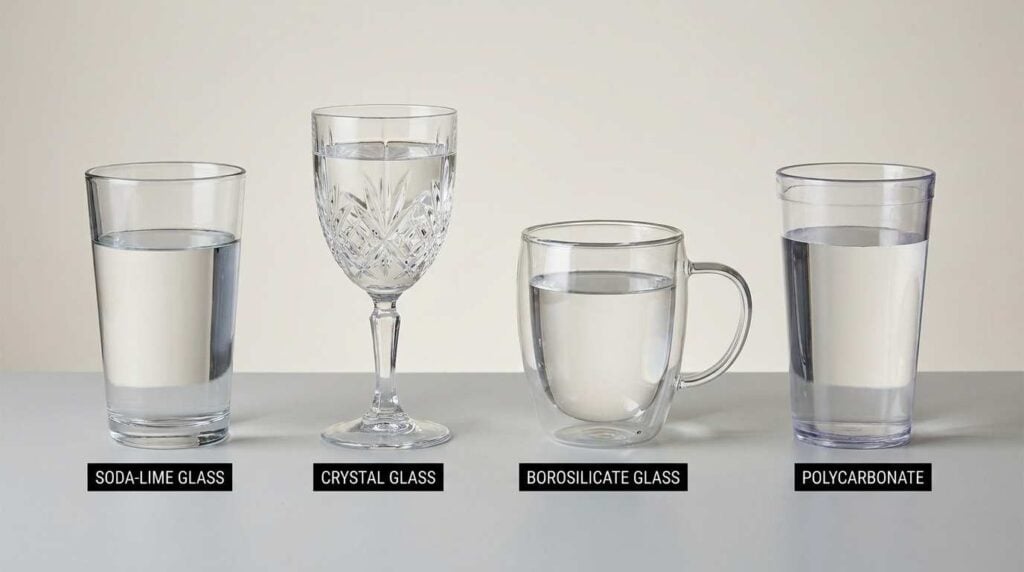
The material your glass is made from determines clarity, durability, weight, glasswasher survival rate, and cost. Choosing the wrong material for your service environment costs more in replacements than any initial savings justify.
Soda-Lime Glass
The standard material for commercial hospitality glassware worldwide. Made from silica, soda ash, and limestone.
Strengths:
- ▸ Most affordable commercial format
- ▸ Widely available in toughened versions
- ▸ Compatible with commercial glasswashers at the correct detergent concentration
Key weakness: Etching
Soda-lime glass etches gradually under repeated commercial washing with high-alkaline detergents. This causes the clouding effect seen on glasses after hundreds of dishwasher cycles. The etching is chemical, not mechanical, and it is irreversible.
Crystal Glass
Crystal contains lead oxide (traditional lead crystal) or alternative minerals such as barium oxide or zinc oxide (modern lead-free crystal). Its higher refractive index gives it the distinctive sparkle associated with fine dining.
Strengths:
- ▸ Superior clarity and visual quality
- ▸ Heavier, more resonant feel at the table
- ▸ Signals premium service
Key weakness: Crystal is more fragile than soda-lime and etches faster under commercial washing. For high-volume bars where breakage rates are significant, it is an expensive choice. For a direct operational comparison, see our dedicated guide to crystalware vs standard glassware for UK restaurants.
Borosilicate Glass
Contains boron trioxide, giving it significantly higher thermal shock resistance than soda-lime glass.
Best use in hospitality: Japanese-style thin-walled craft beer glasses, espresso cups, pour-over coffee equipment.
Important caveats:
- ▸ More expensive than soda-lime
- ▸ Harder to source in bulk
- ▸ Not widely available in toughened formats
- ▸ Not compatible with high-alkaline commercial glasswasher detergents
Borosilicate suits venues where the glass is a deliberate part of the brand presentation and where staff are trained to handle it accordingly.
Polycarbonate
A thermoplastic polymer, not glass. Included here because it functions as a direct glass substitute in many hospitality contexts. The glass vs polycarbonate decision is one of the most commercially significant decisions a UK venue can make.
Glass Types by Drink Category
Beer and Cider: The Pint Glass and the Craft Beer Debate
The nonic pint glass is the legal default for draught beer served by the pint in Great Britain. Designed to stack without sticking, resist rim chipping, and carry the government stamp required for Weights and Measures compliance.
The craft beer pressure:
The craft beer movement has created real operational pressure to serve in alternative formats: tulip glasses, stemmed craft glasses, brewery-branded glassware, or tasting glass formats.
The legal position is clear:
Any glass used for draught beer or cider sold by the half pint or pint must either be:
- ▸ Government-stamped, or
- ▸ Paired with an approved measuring device at the point of dispense
Serving craft beer in an unstamped tulip glass with a half-pint measure places the venue outside the Weights and Measures Act requirements. Enforcement varies by local Trading Standards team, but the legal position does not. The operational question of whether multiple glass formats are worth managing is covered in Section 7.
Wine: Universal Glasses, Crystal, and the Restaurant Question
The universal wine glass has become the operational standard in most UK restaurants and hotels. A single tulip-shaped glass used for both red and white wine simplifies stock management and reduces storage requirements.
When a varietal programme makes sense:
- ▸ Fine dining venues where wine service is a significant revenue category
- ▸ Venues where front-of-house knowledge justifies the different formats
For most UK pub restaurants and bistros, a full varietal programme is operationally unsustainable.
Wine served in measures of 125ml, 175ml, or 250ml at a licensed premise must be served in an appropriately marked glass or measured using an approved device. Confirm compliance requirements with your supplier when ordering wine glasses for measured service.
Gin: The Copa de Balon Debate
The Copa de Balon became the standard UK gin serve around 2015. Its large bowl holds ice and garnish while allowing gin aromatics to develop. In 2026, premium cocktail bars are increasingly moving away from it.
Why operators are switching:
- ▸ Copa glasses are large, fragile, difficult to stack, and expensive to replace
- ▸ The aroma benefit is achievable with simpler, more durable formats
Alternatives gaining ground in UK bars:
| Format | Advantage | Best Venue Type |
| Highball | Better aromatic control, lower breakage | High-volume bars |
| Nick-and-nora | Suited to short serves and martini-style presentations | Cocktail bars |
| Stemless wine glass | Lower breakage, easier storage | Casual dining and gastropubs |
For outdoor and event settings where you want the copa format without the breakage risk, our reusable plastic gin balloon glasses offer the balloon shape in commercial polycarbonate. For festival and large event disposable formats, our large plastic gin cocktail glasses provide a practical, recyclable alternative.
Champagne: Flute vs Coupe vs Tulip
| Glass | What It Does | Best For |
| Flute | Concentrates carbonation, restricts aroma | Hotel bars, banqueting, and visual consistency |
| Coupe | Wide bowl loses carbonation quickly | Short cocktails, retro presentation |
| Tulip | Preserves carbonation better than a coupe, more aroma than a flute | Fine dining, premium champagne service |
The shift in UK fine dining away from the flute toward the tulip is now visible across premium restaurant and hotel programmes. For most fine dining updates, the tulip or universal wine glass is the current recommendation. For hotel bars and banqueting where visual consistency and speed of service matter more than optimal sensory performance, the flute remains practical.
Spirits and Cocktails
| Glass Format | Best Use | Typical Capacity |
| Rocks / Old Fashioned | Spirits on ice, Negroni, Old Fashioned | 9 to 11oz (265 to 325ml) |
| Highball | G&T, Mojito, long cocktails | 10 to 12oz (295 to 355ml) |
| Coupe | Short cocktails, Daiquiri, Sidecar | 5 to 6oz (148 to 177ml) |
| Nick and Nora | Martini, short gin serves, Manhattans | 4 to 5oz (118 to 148ml) |
| Hurricane | Long tropical cocktails, frozen drinks | 13 to 15oz (385 to 444ml) |
| Shot / Shooter | Shots, chasers | 1.5 to 2oz (44 to 59ml) |
For outdoor bar operations where cocktail presentation matters but breakage does not, our Hurricane Cocktail Polycarbonate Glass provides the full cocktail aesthetic in commercial polycarbonate rated to approximately 1,000 glasswasher cycles.
Glasswasher Compatibility: The Buying Decision Nobody Talks About
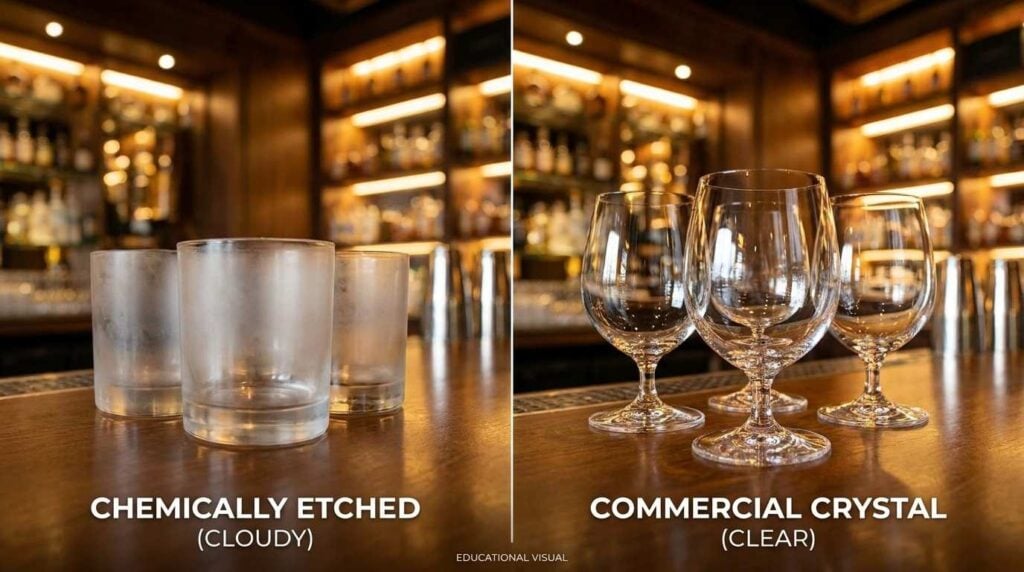
Every guide tells you which glasses to buy. None of them discusses what happens to those glasses across twelve months of commercial glasswasher cycles. This is where most commercial glassware fails prematurely.
Why Glasses Go Cloudy
Commercial clouding is almost always caused by chemical etching, not mechanical damage. It is irreversible once it has occurred.
Common causes:
- ▸ Excessive detergent concentration
- ▸ Insufficient rinse aid
- ▸ Hard water without a softener fitted
- ▸ Repeated high-temperature cycles above the glass’s rated tolerance
Prevention:
- ▸ Calibrate detergent dosing correctly for your machine
- ▸ Set rinse aid at the manufacturer’s recommended concentration
- ▸ Fit a water softener if your venue is in a hard water area (most of England)
- ▸ Use commercial-grade glassware, not the domestic or retail version of the same design
Key takeaway: Commercial-grade glassware from the same brand is manufactured to higher silica purity standards that resist etching longer. Always confirm commercial-grade specifications with your supplier.
Thermal Shock: Why Glasses Crack Before They Break
Commercial glasswashers wash at 55 to 65 degrees Celsius with a final rinse at 80 to 85 degrees. Moving a hot glass directly onto a cold surface, or placing cold glasses into a hot washer without pre-rinsing, creates thermal stress that builds micro-fractures over time.
Three habits that prevent thermal shock damage:
- ▸ Allow glasses to cool on a wire rack before placing them on bar surfaces or in refrigerators
- ▸ Pre-rinse glasses before the first hot cycle if they have been stored cold
- ▸ Never move glasses directly from a refrigerator into a hot glasswasher
Polycarbonate Glasswasher Limits
Polycarbonate is glasswasher safe, but has temperature limits that standard glass does not.
- ▸ Most commercial polycarbonate is rated to a 65 degrees Celsius wash temperature.
- ▸ Cycles above this threshold cause clouding, distortion, and structural weakening.
- ▸ Always confirm the glasswasher temperature rating with your supplier before purchase.
Our reusable polycarbonate range has been manufacturer-tested to over 1,000 glasswasher cycles at standard commercial temperatures. Specification sheets are available on request.
Polycarbonate Glassware for UK Outdoor Venues and Festivals

For UK outdoor hospitality, polycarbonate is not a compromise. In many settings, it is the correct choice, and in some, it is the only legal one.
Check your licence first. Many UK local authority outdoor event licences require unbreakable glassware in all areas accessible to the public. The relevant condition typically uses the phrase “unbreakable” or “non-glass.” Check your premises or event licence before purchasing any glass for outdoor use.
Polycarbonate vs Standard Plastic vs Disposable
| Format | Best For | Key Consideration |
| Commercial polycarbonate | Permanent outdoor venues, premium events | Rated to 500 to 1,000 wash cycles; BPA-free as standard |
| Crystal polystyrene (disposable) | One-off festivals, high-volume events | Single or limited use; lighter and cheaper |
| Reusable polycarbonate stemware | Outdoor fine dining, premium weddings | Maintains premium presentation without glass breakage risk |
For sparkling wine and champagne service outdoors, polycarbonate performs noticeably better than standard disposable plastic. Browse our polycarbonate stemware and champagne collection for reusable outdoor fine service options.
For draught beer at licensed outdoor events, our 20oz CE-marked disposable pint glasses are manufactured with appropriate measure marking for licensed service compliance.
For a full buyer’s guide to plastic glassware for outdoor events, including washing logistics, legal compliance, and break-even calculations, see our dedicated guide to reusable plastic glassware for UK outdoor events.
The Real Cost of Glassware: Breakage Modelling and Hire vs Buy
Every hospitality glassware guide acknowledges that glass breaks. None of them tells you what it costs in real annual numbers.
Annual Breakage Rates by Venue Type
| Venue Type | Annual Breakage Rate | Primary Cause |
| Wet-led pub | 15 to 25% of stock | Drop breakage, bar impact, glasswasher chips |
| Fine dining restaurant | 5 to 10% | Washing, polishing, and careful handling reduce the rate |
| Casual restaurant/bistro | 10 to 15% | Mixed causes, moderate volume |
| Nightclub / high-volume bar | 25 to 35% | Customer handling, high throughput |
| Festival / outdoor event | 30 to 40% per event cycle | Environmental factors, high service volume |
A Worked Cost Model
Wet-led pub with 200 pint glasses at £1.80 each:
- ▸ 15 to 25% annual breakage = 30 to 50 glasses replaced per year
- ▸ Replacement cost on pints alone: £54 to £90 per year
Add wine glasses (80 in circulation at £2.20, 15% breakage):
- ▸ Approximately 12 glasses, approximately £26 per year
Total for a modestly sized pub across all formats: £200 to £400 per year in routine glass replacement before any large-scale breakage events.
For a 200-cover restaurant: Annual breakage replacement at 10 to 15% typically runs £600 to £1,500 per year, depending on glassware programme quality.
Key takeaway: Reducing annual breakage by just 5% saves more money than upgrading to a more expensive glass format. Staff training delivers a better financial return than glass specification in most venues.
The Hire vs Buy Decision for Events
| Scenario | Hire Makes Sense | Buy Makes Sense |
| Fewer than 10 large events per year | Yes | |
| Monthly or more frequent events | Yes | |
| One-off wedding or private event | Yes | |
| Permanent outdoor licensed venue | Yes |
Glassware hire typically costs £0.20 to £0.60 per glass per event, including delivery, collection, and washing. Ownership at commercial wholesale prices typically becomes more economical after 12 to 18 months for regular event operators.
For a full breakdown of this decision for weddings and parties, see our guide to disposable glasses for weddings and UK events.
Bulk Glassware for Restaurants: How to Order, Store, and Manage Stock
Ordering glassware for a hospitality venue is not a one-time purchasing decision. It is an ongoing stock management programme. Venues that treat glassware as a capital purchase rather than a consumable consistently understock and run short during service.
How Much Stock to Hold
The standard rule: Hold two to three times your peak cover count in every glass format used during service.
| Covers at Peak Service | Minimum Stock Per Glass Type |
| 40 covers | 80 to 120 glasses |
| 60 covers | 120 to 180 glasses |
| 100 covers | 200 to 300 glasses |
| 150 covers | 300 to 450 glasses |
The multiplier accounts for:
- ▸ Glasses in use during service
- ▸ Glasses in the glasswasher
- ▸ Glasses on the drying rack
- ▸ A breakage buffer
For venues running multiple service formats, use the larger service count as your multiplier baseline, not an average.
Minimum Order Quantities and Lead Times
- ▸ Standard commercial glassware: supplied in case quantities of 6, 12, or 24 units
- ▸ Standard UK wholesaler lead times: 3 to 5 working days
- ▸ Branded or bespoke glassware: 4 to 8 weeks, depending on technique and volume
For a detailed guide to ordering, managing, and replenishing bulk glassware stock, see our dedicated article on bulk glassware for UK restaurants.
Storage Principles
Stemware: Store rim-down on a dedicated glass rack. Rim-up storage exposes the most fragile part of the glass to chips from contact overhead. Rim-down allows drainage after washing.
Pint glasses and tumblers: Can be stacked, but limit the stack height to six to eight glasses. Higher stacks concentrate weight on the bottom glass and increase chip rates.
Location: Do not store glasses above a heat source or directly above a glasswasher. Repeated thermal cycling, even when not in use, weakens glass over time.
Branded Glassware: When to Invest and How
Branded glassware is a meaningful investment decision. The case for it is strongest for operators with a clear brand identity, a customer base that will notice the detail, and volume that justifies minimum order quantities.
Branding Techniques and UK Minimum Order Quantities
| Technique | Typical UK MOQ | Durability | Notes |
| Screen printing | 144 to 288 pieces | Moderate, fades over cycles | Lowest cost, fastest turnaround |
| Sandblasting/etching | 144 to 240 pieces | Permanent | Premium finish, slower turnaround |
| Acid etching | 200 to 500 pieces | Permanent | High quality, higher cost |
| Laser etching | 72 to 144 pieces | Permanent | Best option for smaller runs |
For venues exploring branded glassware for the first time, screen printing on standard commercial glass is the most economical entry point. MOQs are achievable without a large capital commitment.
Supplier-Branded Glassware
Many UK spirits and beer brands supply branded glasses to trade customers as part of a listing or promotional agreement. Before accepting supplier-branded glasses, confirm:
- ▸ The supply arrangement if you delist the product
- ▸ Whether the glass quality suits your service standard
- ▸ Whether the brand on the glass aligns with your venue’s positioning
Storage, Handling, and Staff Training to Reduce Breakage
Which glasses you buy matters less than how they are handled every day. A 5% reduction in annual breakage saves more money in most venues than upgrading to a more expensive glass.
Correct Carrying Technique
Carrying multiple glasses by inserting fingers inside the rims is the single most common cause of rim chips and cracks. The correct approach:
- ▸ Carry by the base or stem, never by inserting fingers into the bowl or across the rim
- ▸ For volume carrying, use a glass rack or tray
Steam Polishing Protocol for Fine Dining
- Hold the glass over a steam source such as a kettle or dedicated polishing steamer
- Allow the bowl to fill with steam
- Polish with a lint-free cloth in a circular motion while the glass is warm
Polishing cold glasses with an unheated cloth leaves lint deposits and streaks visible under service lighting. The warmth of the glass allows the cloth to remove water spots cleanly.
New Staff Induction: What to Cover
Every new staff member should receive a brief glassware handling induction before their first service. Five minutes covering three things is sufficient:
- ▸ Correct carrying technique
- ▸ Correct storage position for each glass format
- ▸ Which glasswasher programme to use and why
The venues with the lowest breakage rates consistently treat glassware handling as a training item, not assumed knowledge.
For a complete guide to reducing glass breakage costs in your operation, see our dedicated article on how to prevent glass breakage in bars and restaurants.
2026 Glassware Trends
The No and Low Alcohol Movement
Premium and low alcohol serves priced at £8 to £12 need elegant, distinct glassware to justify their price point. A premium botanical non-alcoholic drink served in a standard tumbler undermines perceived value.
The trend in premium UK bars and hotel lounges is toward treating no and low serves with the same glass quality as their alcoholic equivalents: a Nick and Nora or coupe for non-alcoholic cocktails, a quality tulip for premium low-alcohol sparkling.
Japanese-Influenced Thin-Walled Beer Glasses
Craft beer venues in UK cities are increasingly adopting thin-walled Japanese-style beer glasses, typically 400ml to 500ml borosilicate or high-purity soda-lime formats designed to showcase craft product colour and carbonation.
Operational note: These glasses are not toughened, are more expensive per unit, and are not compatible with high-alkaline commercial glasswasher detergents. They suit venues where the glass is a deliberate brand presentation choice, and staff are trained accordingly.
Unified Serve Programmes in Premium Hotels
Premium UK hotel bars are simplifying: one glass for all still wine, one for all sparkling, one for all spirits. Fewer formats to stock, wash, and store deliver significant operational savings. The customer experience benefit is consistent, with a premium presentation across all categories.
Textured and Tinted Glass
Textured ribbed glass, smoked tints, and coloured base glassware continue to trend across cocktail bars and casual dining in 2026. Now available from major commercial suppliers at prices competitive with standard formats.
Where to Buy Hospitality Glassware in the UK
Key UK Suppliers
| Supplier | Strength | Notes |
| We Can Source It | Polycarbonate, reusable and disposable, CE/UKCA marked | Trade pricing, bulk orders, full compliance documentation |
| Nisbets | Wide range, fast delivery, standard commercial formats | Strong on basics and catering equipment |
| Alliance Online | Broad hospitality range, toughened glass | Good for mixed orders |
| Ascot Wholesale | Premium and branded formats, strong trends range | Higher price point, design-led |
| Steelite International | Fine dining and hotel specification | Trade accounts, premium positioning |
Pre-Order Checklist
Before placing any bulk glassware order, get written confirmation of:
- ▸ Toughening status of the glass
- ▸ Government stamp approval for draught beer glasses
- ▸ UKCA marking at stated measures for wine and spirit glasses
- ▸ Glasswasher temperature rating for any polycarbonate products
- ▸ Supplier’s return or replacement policy for damaged stock on delivery
For a full comparison of polycarbonate versus glass across price, compliance, and operational performance, see our detailed guide to polycarbonate vs glass for UK hospitality venues.
Browse our full glassware collection for beer, wine, cocktail, and spirit formats. For polycarbonate and reusable plastic options, our reusable plastic glassware range covers the full commercial range with compliance documentation available on request.
Need help choosing? Contact our trade team for recommendations tailored to your venue type, volume, and licence conditions.
FAQs
Do pub pint glasses legally need a crown stamp in the UK?
Yes. UK law requires a government-stamped glass or an approved measuring device for draught beer and cider sold by the pint or half pint. CE and UKCA measure markings confirm the stated capacity but do not replace the crown stamp requirement for draught service in licensed premises.
What is the difference between toughened and standard glass?
Toughened glass is heat-treated to be approximately four to five times stronger than standard annealed glass. It breaks into smaller, less dangerous fragments. For licensed hospitality venues, toughened glass is the expected standard under HSE health and safety guidance.
Can I use polycarbonate glasses in a commercial glasswasher?
Yes, but with temperature limits. Most commercial polycarbonate is rated to 65 degrees Celsius. Sterilisation cycles above this threshold cause clouding and distortion. Always confirm the glasswasher temperature rating with your supplier before purchase.
Why are my glasses going cloudy after a few months?
Commercial clouding is almost always chemical etching from high-alkaline detergents. It is irreversible once it has occurred. Prevent it by calibrating detergent dosing correctly, using rinse aid at the recommended concentration, and fitting a water softener in hard water areas.
How many glasses should a restaurant hold per cover?
Hold two to three times your peak cover count in each glass format used during service. A 60-cover restaurant should hold 120 to 180 of each main glass type, accounting for glasses in use, in the washer, drying, and a breakage buffer.
When does polycarbonate make more sense than glass?
Polycarbonate is the better choice for outdoor licensed areas where local authority licences require unbreakable vessels, for festival and event service, for high-volume operations with significant breakage rates, and anywhere glass injury risk to staff or customers is a documented concern.
Is a Copa de Balon still the right gin glass for a UK bar in 2026?
It depends on venue positioning and breakage tolerance. The Copa adds genuine value in premium gin-specialist venues. For high-volume bars, the operational and breakage costs are pushing many operators toward highball or stemless alternatives that deliver comparable aroma performance at lower cost.
What minimum order quantity should I expect for branded glassware?
Screen-printed branded glassware typically requires 144 to 288 pieces. Permanently etched or sandblasted formats require 144 to 240 pieces. Laser-etched runs are achievable from 72 pieces. Lead times range from 2 to 4 weeks for screen print to 4 to 8 weeks for etched formats.
Supporting Articles in This Series
- ▸ Disposable Glasses for Weddings: Full UK Buyer’s Guide
- ▸ Reusable Plastic Glassware for Outdoor Events: Is It Worth It?
- ▸ Crystalware vs Standard Glassware: Which Is Right for Your Restaurant?
- ▸ How to Prevent Glass Breakage in Busy Bars and Restaurants
- ▸ Bulk Glassware for Restaurants: How to Order, Store, and Manage Stock
- ▸ Polycarbonate vs Glass: The Definitive Comparison for Hospitality Venues
References
- ▸ Weights and Measures Act 1985 – legislation.gov.uk
- ▸ Drinking Glasses (Intoxicating Liquor) Regulations 1988 – legislation.gov.uk
- ▸ HSE: Managing risks in licensed premises – hse.gov.uk
- ▸ UKCA marking guidance – gov.uk
- ▸ Product Safety and Metrology guidance – gov.uk