A guest’s experience of your venue does not end at the table. A washroom that runs out of soap, has an empty toilet roll holder, or smells of yesterday’s air freshener undoes a good meal or a good stay faster than almost anything else. It is also, separately, a legal obligation, not just a presentation one.
This guide covers what washroom supplies for hospitality venues actually need, what UK law requires you to provide, how to work out realistic quantities for your venue size, and how to approach buying in bulk without overstocking a cupboard you do not have room for.
What Counts as Washroom Supplies, and Why Hospitality Is Different
Washroom supplies are split into two categories that are easy to confuse when you are ordering for the first time.
Hardware is the equipment you install once and replace rarely: soap dispensers, toilet roll holders, paper towel dispensers, hand dryers, and feminine hygiene bins. This is a one-off investment.
Consumables are what go into that hardware on an ongoing basis: toilet rolls, soap refills, paper towels, air freshener cartridges, and sanitary bags. This is your recurring weekly or monthly spend.
A hospitality washroom is not the same as an office washroom, even though most of the generic advice online treats them as interchangeable. The differences that matter:
- Footfall is uneven rather than steady. A restaurant washroom might see almost nothing for two hours and then forty people in ninety minutes during a busy Saturday service.
- It is guest-facing, not just staff-facing, so presentation and brand impression matter in a way they do not in a back office.
- Handwashing facilities for staff intersect with food hygiene compliance, not just general workplace welfare.
- Expectations are higher. A guest forgives very little in a venue they are paying to enjoy.
UK Legal Requirements: What You Are Actually Obligated to Provide
This is worth understanding properly because it changes a presentation decision into a compliance one.
Under the Workplace (Health, Safety and Welfare) Regulations 1992, employers must provide suitable and sufficient toilets and washing facilities for everyone working on the premises, kept clean, properly lit, and ventilated. HSE guidance is direct on consumables specifically: there must always be an adequate supply of toilet paper, soap, and a means of drying hands, and you need a system in place to keep that supply maintained, not just stocked once.
A few points worth flagging:
- The number of toilets and wash basins required scales with the number of people on site, covering staff as well as the public in most hospitality settings.
- “Adequate supply” is a continuous obligation, not a one-time delivery. Running out mid-service is itself a compliance gap, not just a guest complaint.
- Separate facilities for men and women are required unless each convenience is in a fully separate, lockable room.
Inclusive provision is also part of this picture. The Period Products (Free Provision) (Scotland) Act 2021 places a legal duty on certain public bodies in Scotland to provide free period products, and the wider direction of travel across UK hospitality is toward treating this as standard provision rather than an optional extra, even where it is not yet a strict legal requirement for private hospitality businesses outside Scotland.
The Essential Washroom Supplies Checklist
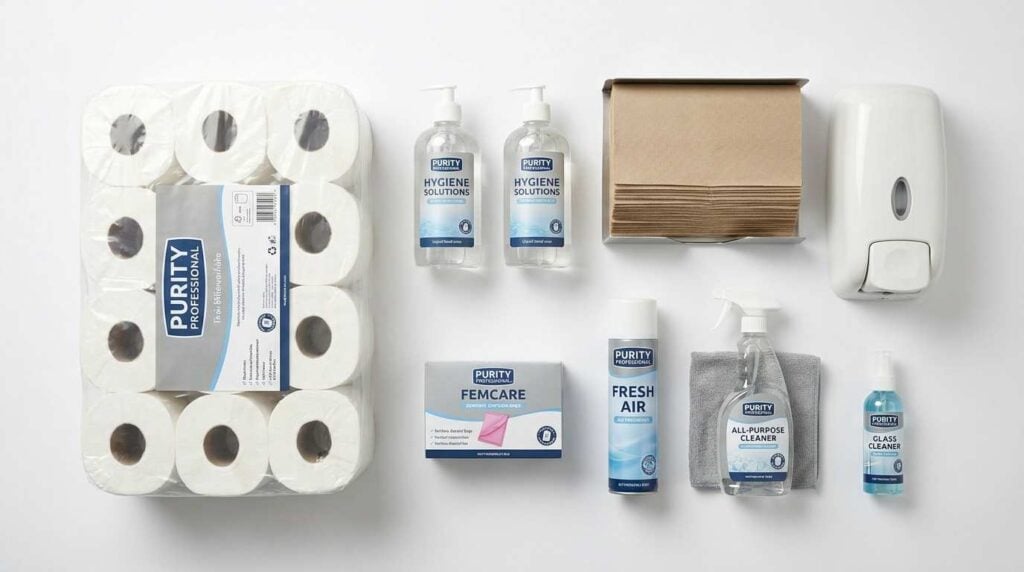
Use this as your starting list for any hospitality washroom, then adjust by venue type below.
Toilet area:
- Toilet rolls (standard, or a jumbo/centrefeed system for high-footfall public washrooms)
- Toilet rim blocks or urinal screens
- Toilet brush and holder
Sink and hand hygiene:
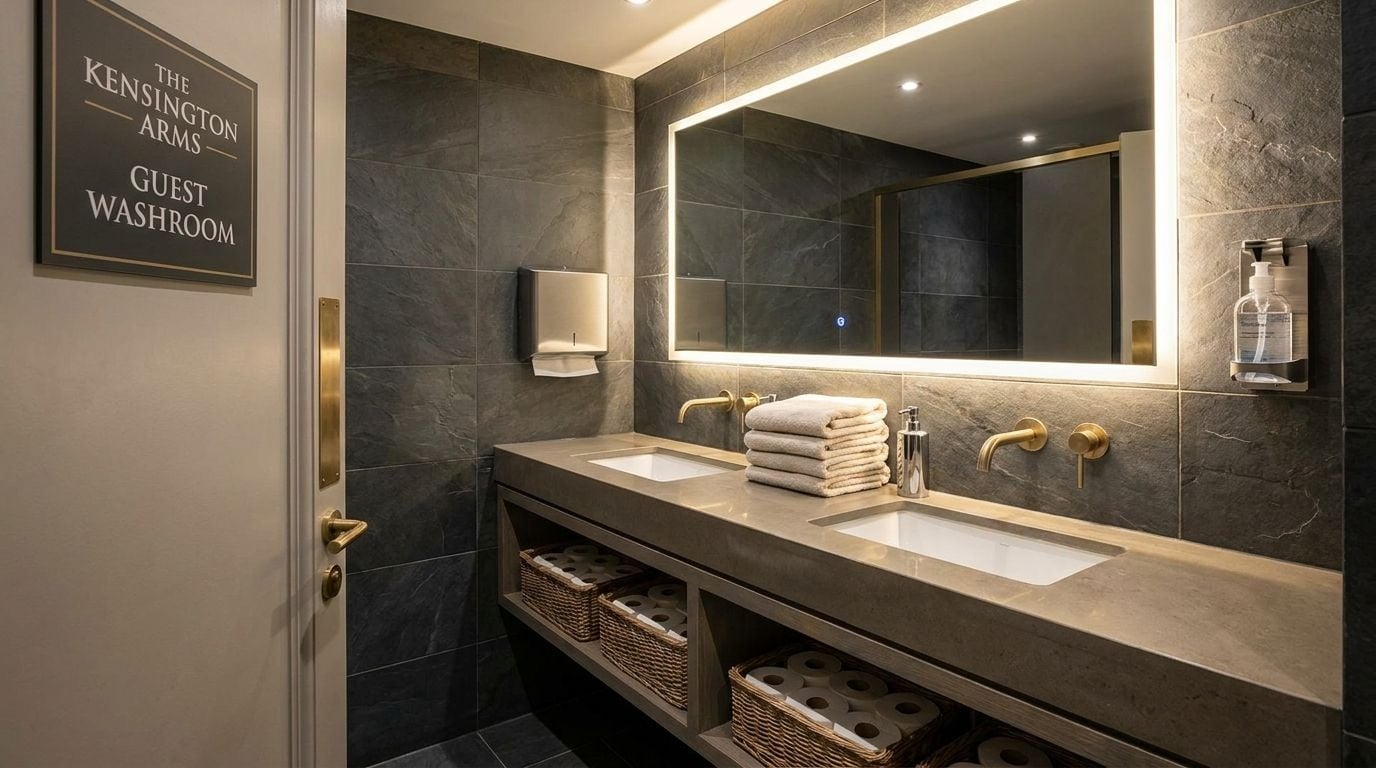
- Soap dispenser, ideally touch-free in food-facing or high-footfall settings
- Liquid or foam hand soap
- Paper hand towels or a hand dryer, plus the matching dispenser
- Hand sanitiser station, particularly near entrances and food service points
Hygiene and disposal:
- Sanitary disposal unit and bags
- Bin liners sized for washroom bins
- Nappy changing and disposal provision, if your venue is family-facing
Air care:
- Air freshener units or automatic dispensers, with a rotation schedule rather than a one-off install
Choosing Between the Main Product Types
A few decisions come up for almost every hospitality buyer setting up or restocking a washroom.
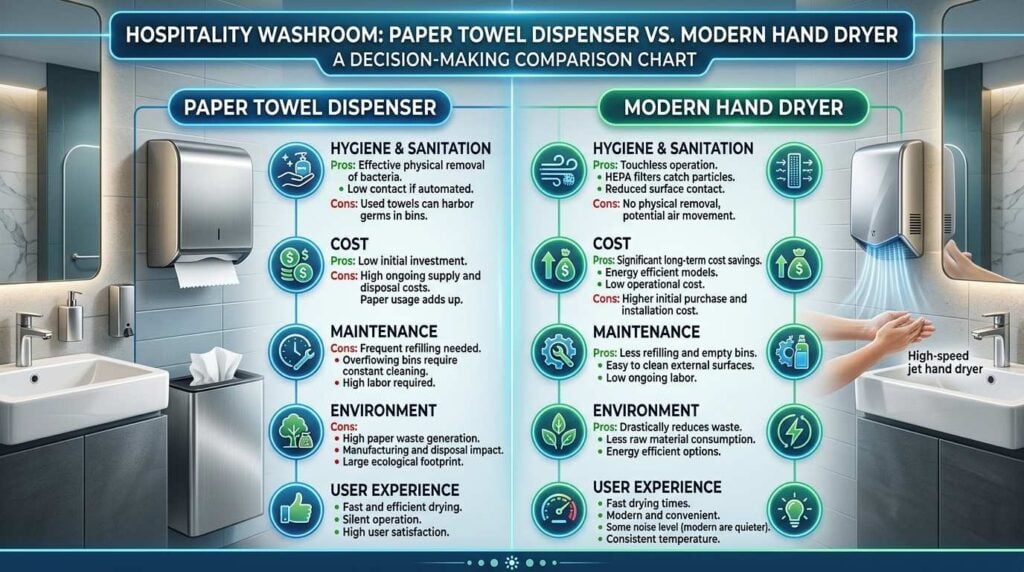
Paper towels or a hand dryer. Paper towels have a low upfront cost but a constant recurring one, are reliably hygienic since each towel is single-use, and generate landfill waste. Hand dryers cost more to install but have a low ongoing cost beyond electricity, produce no waste, and can be loud, which matters more in a quiet dining area than in a back-of-house staff washroom. For guest-facing washrooms in a restaurant, paper towels are usually the safer default; for high-footfall public washrooms where waste volume is the bigger concern, a modern low-noise hand dryer is worth the upfront cost.
Standard toilet rolls or a jumbo/centrefeed system. Standard rolls are cheaper per roll and familiar to guests, but need more frequent restocking. A jumbo or mini-jumbo system, dispensed from a lockable holder, holds far more paper per fitting, which matters for any public washroom that sees real footfall and where staff cannot realistically check it every hour during service.
Liquid soap, foam soap, or antibacterial gel. Foam soap generally costs less per use because it requires less product to generate a usable lather, and many foam dispensers use sealed cartridge refills, which speeds up restocking for cleaning staff. Liquid soap remains the most universally accepted option for guests. Either is appropriate for hospitality; the choice usually comes down to dispenser compatibility and cost per use rather than hygiene performance, since both are equally effective when used correctly.
Estimating How Much You Actually Need
This is the part most buyers get wrong in both directions, either running out mid-service or tying up cash and cupboard space in stock they did not need yet.
A simple way to think about it: take your typical daily covers or visitor footfall, apply a rough estimate of three to five washroom visits per person across a full day, and work out a weekly and monthly consumable requirement from there.
Worked example. An 80-cover restaurant running two sittings a day, six days a week, sees roughly 960 covers a week. At an average of four washroom visits per cover across the day (spread across both customers and staff), that is around 3,800 visits a week. A single jumbo toilet roll typically lasts several hundred uses depending on sheet length, so a venue at this volume is realistically working through multiple jumbo rolls per washroom per week during a busy period, alongside a steady draw on soap and paper towel stock. These are indicative figures rather than an exact formula. Track your actual usage for two to three weeks once you open or once you switch products, and you will have a far more accurate number than any generic estimate.
Approximate weekly guide by venue type:
- Small café, around 30 covers: light, steady consumable use through the day rather than sharp peaks
- Restaurant, around 80 covers: clear lunch and evening peaks, higher demand on weekends
- Pub or bar: lower daytime use, a strong evening peak, and typically higher wear on hardware
- Hotel: public washroom demand is similar to a busy café or restaurant, separate from guest room toiletries, which follow occupancy rather than footfall
- Function or event venue: extreme but predictable peaks tied to event capacity, best planned per booking rather than averaged across a normal week
What Different Venue Types Actually Need
Restaurants. The main pressure point is service speed. Washrooms need to be restocked fast between peaks, and touch-free soap dispensers reduce one more thing staff need to manage mid-shift. Since handwashing also intersects with food hygiene compliance for staff, keep washroom consumable checks on the same schedule as your kitchen hygiene routine rather than treating it as a separate task.
Cafés. Footfall is steady rather than peaked, and washrooms are often small, so compact, wall-mounted dispensers matter more than high-capacity ones. Cost per use becomes more significant here than in higher-turnover venues, since volume is lower and margins on a coffee shop ticket are tighter.
Pubs and bars. Evening peaks put real pressure on hardware, not just consumables. Sturdy, lockable chrome toilet roll holders hold up better under high-volume evening use than lighter plastic fittings, and air care matters more here than in most other hospitality settings.
Hotels. Treat guest room provision and public washroom provision as two separate systems. Public washrooms near reception and function spaces need the same approach as a busy restaurant; guest bathroom amenities are a presentation and brand decision tied to room occupancy rather than footfall.
Function and event venues. Plan stock per booking rather than as an ongoing weekly order. A 200-capacity event compresses a full week’s normal usage into a few hours, so order ahead of the date rather than relying on standard reorder points.
Buying in Bulk Without Overstocking
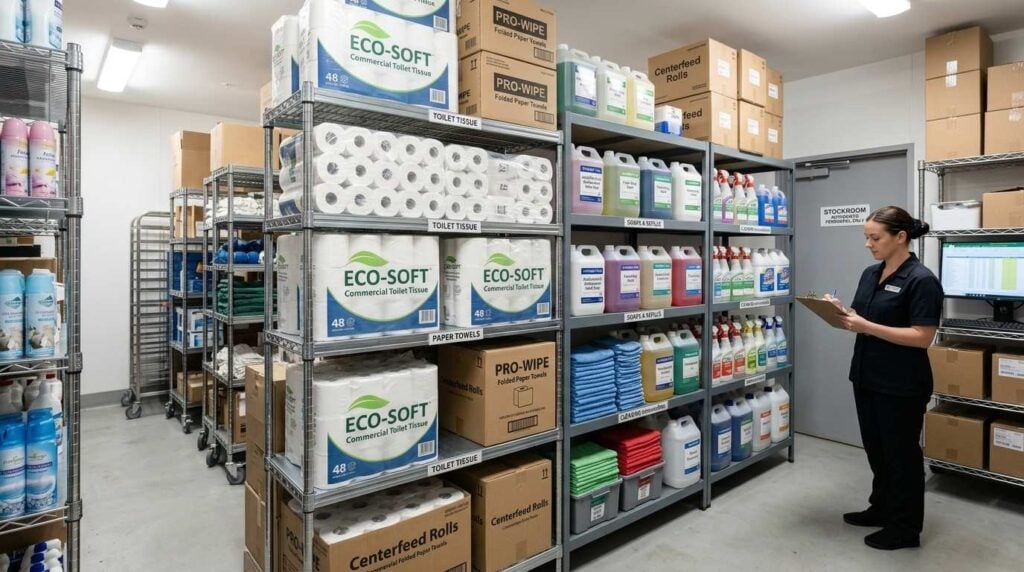
Bulk buying genuinely lowers your cost per unit and reduces how often you need to reorder, but it only works if you have planned for the storage and cash flow side of it too.
A practical approach for most hospitality venues:
- Order around four to six weeks of stock at a time once you have a reliable usage figure, rather than guessing at a larger one-off order
- Keep washroom stock in a dry, accessible area, rotating older stock to the front so it gets used first
- Set a simple reorder trigger, such as “reorder when down to two weeks of stock,” rather than waiting until you visibly run low.
- If you are managing more than one site, a trade account simplifies repeat ordering and keeps pricing consistent across locations.
Browse the full washroom supplies range for dispensers, paper products, and refills suited to hospitality volumes, including hand soap refills in bulk format designed for high-traffic washrooms.
Common Mistakes Worth Avoiding
- Using domestic toilet roll or soap in commercial dispensers, which often do not fit and run out faster than expected
- Underestimating weekend or event-night demand because a weekday average looks fine on paper
- Forgetting feminine hygiene provision entirely, which is both a guest expectation and, increasingly, treated as a standard part of inclusive provision
- Letting air freshener cartridges run empty for weeks before anyone notices
- Storing paper stock somewhere damp, which ruins rolls and towels before they are even used
FAQs
What washroom supplies does a hospitality venue legally need to provide?
Under the Workplace (Health, Safety and Welfare) Regulations 1992, you must provide suitable and sufficient toilets and washing facilities, kept clean and properly maintained, with a continuous supply of toilet paper, soap, and a means of drying hands. This applies to staff facilities as a baseline; most hospitality venues extend the same standard to guest-facing washrooms as a matter of course.
How much toilet roll does a restaurant need per week?
It depends heavily on covers and footfall, but as a rough guide, an 80-cover restaurant running two sittings a day will typically work through several jumbo rolls per washroom per week during normal trading, more on busy weekends. Track actual usage for two to three weeks to get an accurate figure for your specific venue rather than relying on a generic estimate.
Paper towels or hand dryers for a restaurant washroom?
Paper towels are usually the better default for guest-facing restaurant washrooms because they are reliably hygienic and quieter, which matters near a dining area. Hand dryers reduce ongoing waste and cost less to run over time, but carry a higher upfront hardware cost and can be noisy, which is more often an issue in hospitality than in a typical office.
Do I need a feminine hygiene unit in my restaurant washroom?
There is no blanket legal requirement for private hospitality venues outside Scotland, but providing sanitary disposal units and increasingly free period products is now a standard guest expectation, and the direction of UK policy, following the Period Products (Free Provision) (Scotland) Act 2021, is toward treating this as normal provision rather than optional.
What is the difference between washroom hardware and washroom consumables?
Hardware is the equipment you install once, such as dispensers, holders, and dryers. Consumables are what you restock regularly, such as toilet rolls, soap refills, and paper towels. New venues often underestimate that they need to invest in the right hardware before any consumables will actually work in their washroom.
How often should I reorder washroom supplies for a hospitality venue?
Once you have a reliable sense of your weekly usage, ordering four to six weeks of stock at a time is a sensible balance between bulk pricing and storage practicality. Set a simple reorder trigger, such as reordering when you are down to roughly two weeks of stock, rather than waiting until you run low.
References
- HSE: Workplace health, safety and welfare — Approved Code of Practice and guidance (L24) via hse.gov.uk
- HSE: Welfare at work — guidance for employers via hse.gov.uk
- Period Products (Free Provision) (Scotland) Act 2021 via legislation.gov.uk