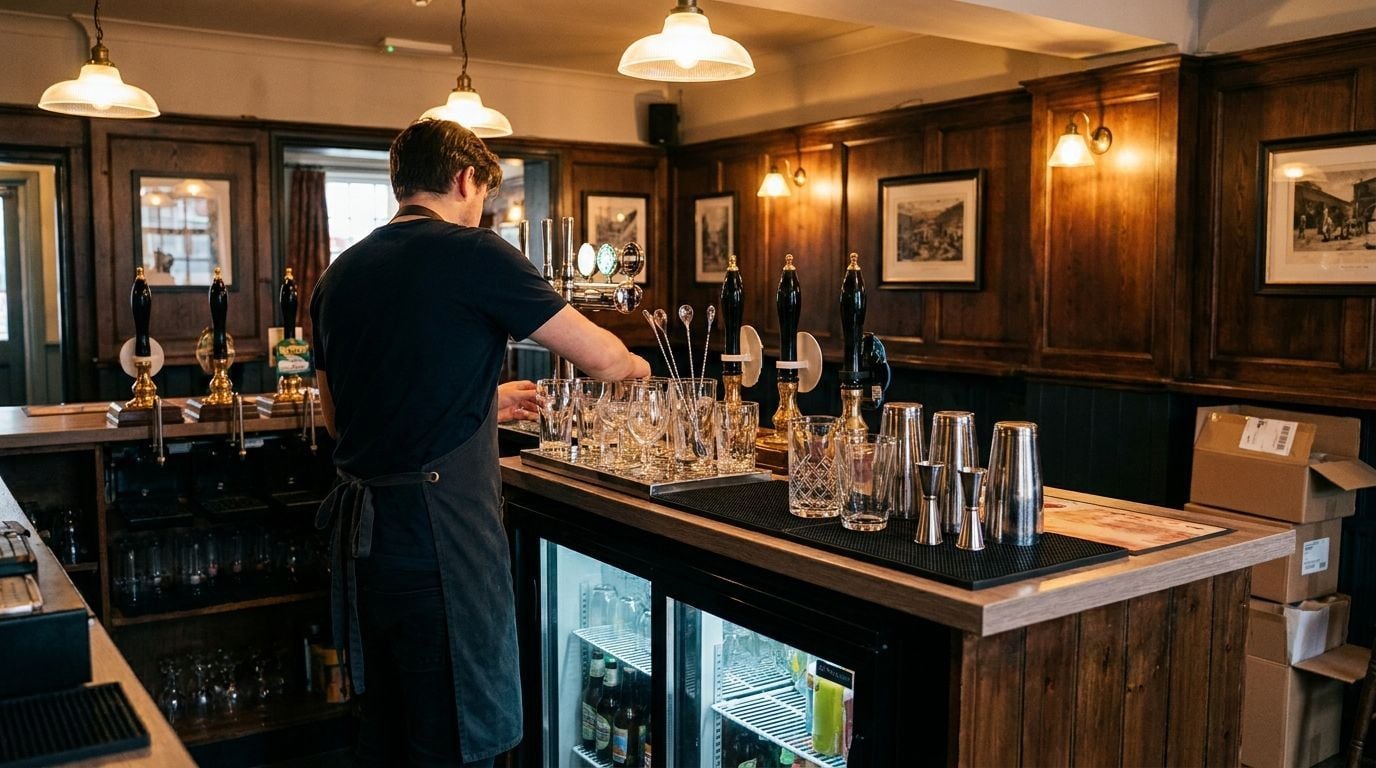
Whether you’re opening your first pub, fitting out a back bar, or stocking a private venue, the budget bar question is always the same: what do you actually need, what can you defer, and where are you overspending without realising it? This guide gives you honest answers for the UK market in 2026.
There are two ways to stock a bar. The first is to buy everything that looks appealing, build the most impressive back bar you can afford, and discover six months in that half of it is gathering dust while you’re perpetually running out of house vodka and tonic water. The second is to start from what your customers will actually order, build the minimum range that serves them well, and expand deliberately from a solid foundation. The second approach is not a compromise – it is how the best-run bars in the UK operate, whether they have a £2,000 opening budget or a £20,000 one.
This guide is for anyone setting up a UK bar from scratch – a new pub, a bar within a restaurant, a private members’ club, a function room, or an event venue – who wants to do it without overspending on the opening order or buying the wrong things in the wrong quantities. It covers the stock buying decisions, the equipment priorities, the glassware essentials, and the trade buying routes that make a meaningful difference to your cost base before you’ve even opened the doors.
Your opening order is a hypothesis about what your customers want. Until you’ve traded for four to six weeks and seen real sales data, you do not know which spirits will move fast, which will sit, or what your draught-to-bottle ratio actually is. For the opening order, buy conservatively across a wide range rather than heavily in any single category. Restock quickly from real sales data rather than from assumptions. The bars that get into cash-flow trouble in their first quarter are almost always the ones that over-bought their opening stock based on what they hoped to sell.
The Licensing Act 2003 governs alcohol sales in England and Wales; the Licensing (Scotland) Act 2005 and the Licensing Act (Northern Ireland) 2016 apply in their respective nations. Regardless of where you are, you cannot legally sell alcohol without a premises licence that includes the sale of alcohol as a licensable activity, and a named Designated Premises Supervisor (DPS) who holds a personal licence. These are not optional formalities – selling alcohol without them is a criminal offence.
| Requirement | Status | Notes for UK Bars |
|---|---|---|
| Premises Licence (England & Wales) | Required | Applied for via your local council licensing authority. Includes a plan of the premises and an operating schedule. Allow 2-3 months for the full process. Check the government’s licensing guidance for current application fees (set by premises band). |
| Designated Premises Supervisor | Required | The DPS must hold a personal licence issued by their local council. The DPS is named on the premises licence and is legally responsible for alcohol sales at the venue |
| Personal Licence (DPS) | Required | Obtained via the council by passing the APLH (Award for Personal Licence Holders) qualification and applying with a DBS (criminal record) check. Licences do not expire but must be kept up to date with training |
| AWRS (Alcohol Wholesaler Registration Scheme) | Check if applicable | Required if you sell alcohol wholesale to other businesses (including selling to trade customers). Managed by HMRC. Not required if you sell alcohol only by retail. If you buy from a wholesaler, confirm they hold a valid AWRS registration – buying from an unregistered supplier creates a due diligence risk |
| Duty Stamps | Required | Spirits over 30% ABV in retail-sized bottles (below 35cl) sold in the UK must carry a UK excise duty stamp. This is your supplier’s responsibility, but verify that all spirits you receive carry the correct stamp before accepting delivery |
| Challenge 25 Policy | Best practice (often required) | A formal Challenge 25 policy is required by most premises licences and all major pubcos. All staff serving alcohol must be trained on it. Failure to enforce Challenge 25 is one of the most common causes of licence review in the UK |
| GDPR / allergen labelling | Situational | Allergen information must be available for all food and drink served. For a bar serving cocktails, this includes allergen information for spirits containing sulphites, as well as for any garnishes, syrups, or mixers used |
- Premises licence granted and displayed at the premises in a visible location
- DPS named on the licence holds a current personal licence
- All staff serving alcohol trained on Challenge 25 and signed off on the training log
- Trade suppliers checked on the AWRS register – registration numbers recorded for your due diligence file
- Allergen information prepared for all drinks on the menu
- Proof of age policy written, posted, and communicated to all staff
The instinct when setting up a new bar is to fill the back bar. A packed shelf of forty spirits looks impressive and signals abundance – but in a budget bar setup, it is the fastest way to destroy your cash position before you’ve understood what your customers actually want. The more effective approach is to open with a tight, intentional range that covers every common order and every cocktail on your opening menu, and nothing more.
A well-chosen 12-bottle spirits list covers approximately 80-90% of what a typical UK bar will be ordered in any given week. The remaining 10-20% of orders – for niche spirits, specific brands by name, or unusual cocktail requests – can be managed by adding bottles in response to real demand rather than anticipated demand. This is the approach used by many of the UK’s most efficiently run bars.
Buy spirits by the case where your volume supports it – the saving is meaningful. Most UK cash-and-carry wholesalers (Booker, Bestway, Turner Wines, and others) offer case price discounts on spirits that represent a 12-18% reduction versus single-bottle trade prices. A case of 6×70cl of your house vodka at case price versus single-bottle buying will save £8-14 per case – across your full spirits range, that adds up to several hundred pounds on an annual basis. Only case-buy spirits you are confident will move within three months; spirits do not go off but your cash does not belong on the shelf.
Mixers are often an afterthought in bar setup, but they are the category where margins are highest and where customer perception is most directly shaped. A gin poured over ice with a premium tonic and the right garnish is a quality experience regardless of whether the gin itself is an entry-level or premium bottle. Conversely, the same premium gin served with a flat, flavourless own-brand tonic is a disappointment. Your mixer range shapes your bar’s perceived quality as much as your spirits range does – and in many cases, costs less to upgrade.
The category to be most careful about is juices. Cartons of chilled orange, cranberry, pineapple, and lime juice all have short shelf lives once opened, and bars consistently overbuy them at opening – particularly juices they assume will be popular that turn out not to be. Buy one carton of each key juice for your opening stock and reorder based on actual consumption within the first two weeks. Juice waste in the first month is an entirely avoidable cost.
| Mixer / Soft Drink | Opening Priority | Buy at Opening | Notes |
|---|---|---|---|
| Tonic water (regular) | Essential | 1 case (24 × 200ml) minimum | Your highest-volume mixer. A branded or premium tonic (Fever-Tree, Schweppes 1783, Franklin & Sons) significantly upgrades the gin and vodka serve perception. The price difference per bottle is 20-40p – easily absorbed into the serve price |
| Slimline / light tonic | Essential | Half a case | A consistent separate request from calorie-conscious customers. Always stock alongside regular tonic |
| Soda water | Essential | Half a case | Required for soda-and-spirits, spritzes, and as a diluting agent in cocktails. Can be dispensed via a post-mix system if your bar has one |
| Ginger beer | Essential | Half a case (200ml bottles) | Non-negotiable for Moscow mules, dark & stormy, and ginger beer serves. A branded ginger beer (Fever-Tree, Old Jamaica, Cawston Press) makes a meaningful difference to the serve quality |
| Cola (branded) | Essential | 1 case – or post-mix line if available | Your highest-volume soft drink. Coca-Cola and Pepsi are effectively brand-mandatory for a UK bar – own-brand cola creates customer resistance. Buy branded even at the budget stage |
| Lemonade | Essential | Half a case – or post-mix line | Required for shandy, lemonade & spirits, and as a mixer. R. White’s or a clear lemonade in individual 200ml bottles for bottle-serve; post-mix for high-volume applications |
| Orange juice (chilled carton) | Essential | 2-3 litres maximum at opening | For screwdrivers, bucks fizz, and breakfast serves. Short shelf life once opened. Do not bulk-buy – replenish from real usage |
| Cranberry juice | Essential | 1 litre maximum at opening | Required for cosmopolitans and vodka cranberry. Often lower volume than expected – buy conservatively and reorder |
| Pineapple juice | If menu requires it | 1 litre if ordered | Required for piña coladas and some tropical cocktails. Only buy if your cocktail menu includes these serves |
| Lime juice (bottled) | Essential | 1 × 1 litre bottle | Bottled lime juice (RealLime, Jif) for cocktail use where fresh lime is not being used. Buy fresh limes additionally for garnish and high-quality serves – fresh lime makes a measurable difference to a margarita |
| Premium flavoured tonics | Deferred | After week 4 | Mediterranean tonic, elderflower tonic, light tonic with citrus – useful upsell additions to a gin menu but not required at opening. Let your customer base confirm demand before investing in multiple SKUs |
| Energy drinks | Lower priority | After week 4 | Red Bull and Monster are consistent sellers in some venues (particularly late-night bars) but very location-dependent. Assess your customer demographic before buying in volume at opening |
- Branded cola is non-negotiable – own-brand creates genuine customer resistance in UK bars
- Premium tonic water (Fever-Tree or equivalent) at the budget level – the margin impact is minimal and the serve upgrade is significant
- Juices bought conservatively and replenished from real usage – not bought in bulk before trading reveals volumes
- Post-mix lines used for high-volume dispensing (cola, lemonade, soda) where equipment is available – significantly lower cost per serve than bottled
- Ginger beer stocked as a separate product, not substituted with ginger ale – they serve different orders and taste different
Bar equipment procurement on a budget is almost entirely about sequencing. Very little of what a bar needs is genuinely optional in the long run – but a significant amount of it can be deferred until cash flow from trading supports the purchase. The common mistake is to feel the pressure of opening day and either buy too much too soon (locking cash into equipment that isn’t yet needed) or to under-equip behind the bar and create operational problems from week one.
The priority split below is based on what is physically required to serve a standard UK bar drinks menu from day one, versus what improves efficiency or range but is not operationally blocking. Everything in the “defer” category should be on your equipment roadmap – the goal is not to go without permanently, but to sequence the investment sensibly.
- Speed rail or bar rail – keeps your six most-used bottles accessible at arm’s reach. Eliminates constant reaching to the back bar for house spirits
- Ice machine or ice supply arrangement – a bar without ice cannot function. If an ice machine is not yet in budget, arrange a daily ice delivery for the first weeks
- Ice scoop and ice bucket – a sanitation requirement; never use glassware to scoop ice (glass contamination risk)
- Jiggers (25ml/50ml) – required for consistent and legally compliant spirit measures under UK weights and measures law
- Boston shaker or cobbler shaker – required for every shaken cocktail on your menu
- Bar spoon – essential for stirred cocktails and for layering drinks
- Hawthorn strainer – for straining shaken cocktails over fresh ice
- Cutting board and bar knife – for citrus cutting, garnish prep, and fruit trimming
- Speed pourers for house spirits – consistent free-pouring and hygiene; one per house spirit bottle
- Bottle opener and corkscrew – essential for bottled beer, wine, and any sparkling wine service
- Glass rinser (if not built into bar) – rapid rinsing of pint glasses between use at the bar
- Till system or EPOS – required from day one for legal alcohol sales record-keeping and stock control
- Cocktail muddler – required only for mojitos and muddled-fruit cocktails; omit from your opening menu if you don’t have one yet
- Fine mesh strainer – for double-straining cocktails to remove ice shards; useful but not essential if your menu is simple
- Blender – required for frozen cocktails and blended drinks only. If your opening menu excludes these, defer until demand justifies it
- Sous vide or immersion circulator – for fat-washing spirits and infusions; a future refinement, not an opening necessity
- Second ice well – useful for a busy bar with two bartenders; one well is adequate for opening volume
- Bar mats (branded) – branded bar mats improve presentation but plain rubber mats serve the same functional purpose at a fraction of the cost
- Fruit tray or condiment caddy – useful once you’re running a garnish programme; at opening, a simple tray works
- Cocktail gun (post-mix) – for high-volume cocktail bars; not required at a standard pub or mixed bar at opening
- Bitters set (multiple varieties) – start with Angostura bitters; expand to orange, Peychaud’s, and others as cocktail menu complexity grows
- Kegging system upgrades – assess draught range after 4-6 weeks of trading data before committing to additional lines
Glassware is the category where budget bar setups most commonly make one of two mistakes: buying too little and running out during a busy service, or buying an expensive range that breaks too quickly to justify its cost. The right approach is to buy commercial-grade glassware (designed for repeated glasswasher cycles) in a range that covers every drink on your opening menu, at quantities that reflect realistic service volume plus a 20% breakage buffer.
Commercial glassware bought through a trade supplier is typically 35-50% cheaper than the same style purchased through a retail route. For a budget bar setup, this is a meaningful saving across an order that may total 150-300 glasses. A trade account with a hospitality supplier – including We Can Source It – gives you access to this pricing from the first order.
| Glass Type | Covers | Opening Qty (50-cover bar) | Trade Price Range |
|---|---|---|---|
| Pint glass (CE marked) | Draught beer, cider | 48-60 (includes breakage buffer) | £0.60-1.20 each trade – buy in cases of 24 |
| Half-pint glass (CE marked) | Half pints, soft drinks | 24-36 | £0.50-1.00 each trade |
| Highball / tumbler | Spirit and mixer, soft drinks, cocktails over ice | 36-48 – your most versatile glass | £0.70-1.50 each trade; wide range of quality levels |
| Short / rocks glass | Whisky neat or on the rocks, short cocktails, old fashioned | 24-36 | £0.60-1.40 each trade |
| Copa / balloon glass | Gin & tonic – the standard UK premium serve glass | 24-36 if serving premium G&T | £1.00-2.50 each trade – a copa serve justifies a price premium on the gin |
| Coupe glass | Espresso martini, cosmopolitan, Champagne | 18-24 – fragile; buy with a higher breakage buffer | £1.20-2.80 each trade |
| Wine glass (stemmed, universal) | Red and white wine | 24-36 – a single universal style reduces SKU count | £0.80-2.00 each trade; CE mark required for wine-by-the-glass service |
| Shot glass (CE marked 25ml/50ml) | Spirit measures served as shots | 12-18 | £0.40-0.90 each trade; CE mark is legally required for measured spirits in the UK |
| Champagne flute | Prosecco, Champagne, bucks fizz | 12-24 – only if sparkling wine is on the menu | £0.80-2.00 each trade; coupes increasingly replace flutes in many UK bars |
- All pint, half-pint, and shot glasses confirmed as CE or UKCA marked – legally required
- Quantities calculated at 1.5-2× your expected simultaneous-use cover count, not at a one-to-one ratio – allows for service without constant glasswashing
- 20% breakage buffer added to all quantities, particularly fragile stems (coupes, wine glasses)
- All glassware confirmed as glasswasher-safe at commercial temperatures – ask your supplier
- Copa glass ordered if premium gin & tonic is being served – a copa serve justifies a meaningful price premium
- Trade account set up with a hospitality glassware supplier before ordering – retail pricing is significantly higher for the same products
Most UK bar owners, particularly first-time operators, are aware that trade pricing exists and is significantly lower than retail – but they are less clear on which buying route to use for which category of product. The mistake is to default to a single route for everything, when the UK hospitality trade actually has four distinct channels that each excel in different categories. Using the right channel for each product category is where a meaningful proportion of your long-term cost savings will come from.
| Buying Route | Best For | Limitations | Key UK Examples |
|---|---|---|---|
| Cash & Carry (trade wholesale) | Spirits, mixers, soft drinks, beer, cigarettes – the bulk of your weekly replenishment | You collect yourself; no delivery for most cash & carry accounts. Range is broad but not always as deep as a specialist. Requires a trade card (VAT number and proof of business) | Booker, Bestway, Costco Business, Landmark Wholesale |
| Direct wholesale account (delivered) | Spirits, wines, and beers where you want a wider range than a cash & carry, or where delivery is essential | Often a minimum order value (typically £150-300 per delivery). Lead time of 24-72 hours. Better for planned restocking than for emergency orders | Matthew Clark, Bibendum, Enotria&Coe, LWC Drinks |
| Direct from brewery or distillery | Draught beer and cider from independent brewers; craft spirits direct from UK distilleries where a direct account is available | Requires a direct commercial relationship. Minimum volumes may apply. Delivery schedule less flexible than a drinks wholesaler | Many UK regional breweries offer direct trade accounts – worth approaching for any local draught line you’re running |
| Hospitality trade supplier (equipment & consumables) | Glassware, bar tools, cocktail equipment, garnish supplies, consumables (straws, napkins, cocktail picks), cleaning products | Not for alcohol stock – specialists in non-alcohol hospitality supplies. Delivery typically 2-5 working days for standard items | We Can Source It, Alliance Online, Nisbets, Hendi UK |
Separating your alcohol buying (cash & carry or wholesale account) from your equipment and consumables buying (hospitality trade supplier) gives you access to specialist pricing in both categories rather than a compromise from a single generalist source. A cash & carry will have spirits at excellent prices but mediocre bar tool ranges at average prices. A hospitality trade supplier will have glassware, bar tools, and consumables at trade prices but won’t supply your alcohol. Use each route for what it’s good at – the total saving versus buying everything through a single route is typically 15-25% across your overall cost base.
- Premises licence granted with alcohol as a licensable activity – displayed at the premises
- DPS confirmed, named on licence, holding a current personal licence
- All staff trained on Challenge 25 – training records signed and filed
- All trade suppliers verified on the HMRC AWRS register – reference numbers on file
- Allergen information prepared for all drinks on the opening menu
- Opening spirits list confirmed at 12 core bottles – wider range deferred until sales data justifies it
- Opening order placed conservatively – one to two bottles of each spirit, not bulk quantities before trading begins
- Trade account open with cash & carry or delivered wholesale account – trade pricing confirmed before first order
- All spirits received with UK duty stamps where required (spirits above 30% ABV in retail sizes below 35cl)
- Mixer range bought conservatively – juices in particular purchased to first-week quantities, not bulk
- All “buy before opening” bar tools acquired – jiggers, shakers, strainers, bar spoon, cutting board, pourers, bottle opener
- Ice supply confirmed – machine operational or daily delivery arrangement in place for opening period
- Glassware ordered through a trade supplier at trade pricing – not at retail
- All pint, half-pint, and shot glasses confirmed as CE or UKCA marked
- Glassware quantities calculated at 1.5-2× simultaneous cover count plus 20% breakage buffer
- EPOS / till system set up and tested before opening – required for stock control and legal sales records
- Par stock levels set for each spirit based on estimated weekly consumption – reorder triggers confirmed
- Gross margin target calculated for each category – spirits, mixers, draught, wine
- Waste and over-pour tracking system in place from week one – not introduced after a loss is discovered
- Opening stock valued and recorded – forms the baseline for your first weekly stock take
- Weekly stock take scheduled – consistency of timing matters more than perfect methodology at the start
Source your bar equipment & consumables through We Can Source It
Trade pricing on glassware, bar tools, cocktail equipment, consumables, and hospitality sundries. Delivered to pubs, bars, restaurants, and venues across the UK.