A kitchen cleaning schedule is a documented record of what gets cleaned, how often, and who is responsible for it. In a UK commercial kitchen, this is not a nice-to-have. It is part of how you demonstrate that your business has control over food safety, and it is one of the first things an Environmental Health Officer will ask to see.
This guide includes a free, editable template, plus the details most templates skip: what fields a compliant schedule actually needs, the daily, weekly, monthly, and often-forgotten quarterly and annual tasks, how the schedule connects to your Food Hygiene Rating, and what to use on which surface so you are not guessing.
What a Good Kitchen Cleaning Schedule Template Should Include
Before you download anything, it is worth knowing what a properly built schedule actually contains, so you can judge whether a template is fit for purpose or just a list of room names.
A compliant schedule needs to capture, for every task:
- ▸ The specific area or item being cleaned, named clearly rather than as a vague zone
- ▸ The cleaning method, in enough detail that a new staff member could follow it
- ▸ The product to be used, by name, including the standard it meets, where relevant
- ▸ How often the task is required
- ▸ Who is responsible for it
- ▸ The date and time it was completed
- ▸ A staff signature confirming completion
- ▸ A supervisor sign-off, separate from the person who did the cleaning
That last point matters more than it sounds. A schedule signed only by the person who did the work has no independent check built in. A supervisor sign-off is what turns a checklist into genuine due diligence evidence.
You can build this in a simple spreadsheet, a printed grid pinned to the kitchen wall, or a digital app, as long as those fields are present and the document is actually being completed, not just filed away.
DOWNLOAD THE FREE TEMPLATE
Is a Kitchen Cleaning Schedule a Legal Requirement?
Yes, in substance if not in a single named clause. UK food businesses must operate under a documented food safety management system, generally based on HACCP principles, and the requirement to keep premises and equipment clean runs through that framework. The FSA’s Safer Food Better Business toolkit is built around exactly this: a written record of how you manage cleaning, alongside the other food safety controls in your kitchen.
The regulations do not specify exactly how often every individual surface must be cleaned. That is left to the operator to judge based on their own kitchen. What they do require is that you have a system, that it is followed, and that you can show evidence of it. A completed, signed schedule is that evidence. The absence of one, or a schedule that is clearly not being filled in, is a real weakness if anything ever goes wrong and your due diligence is examined.
How a cleaning schedule connects to your Food Hygiene Rating
The Food Hygiene Rating Scheme scores a business on three separate elements at inspection: how hygienically food is handled, the physical condition of the premises, and confidence in management, meaning whether the business has the processes and systems in place to keep standards up in the future. To achieve a 5, a business needs to score well across all three, not just two out of three.
A cleaning schedule sits squarely in that third element. It is one of the clearest pieces of evidence an officer can point to when assessing whether your management has genuine control over food safety, rather than getting lucky on the day of inspection.
In England, the display of the rating remains voluntary rather than a legal requirement, unlike in Wales and Northern Ireland, where it is mandatory. That said, the commercial pressure to display a strong rating is real either way, since customers can look up any business’s rating online regardless of whether the sticker is in the window.
Understanding the Two-Stage Cleaning Process
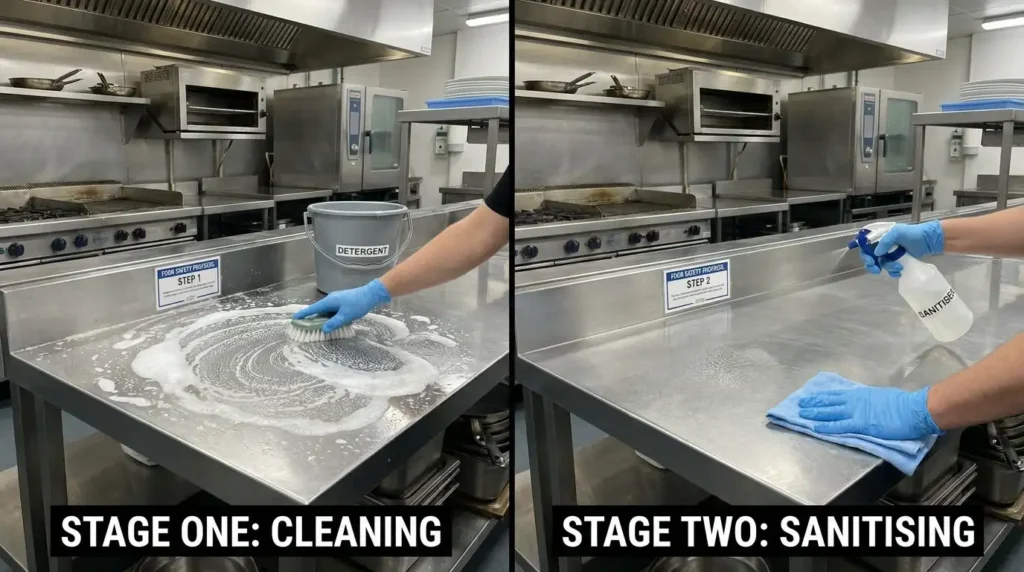
This is the single most misunderstood part of kitchen cleaning, and it is worth being clear about because it should shape how your schedule is written.
Stage one is cleaning. This means physically removing visible dirt, grease, and food residue using hot water, detergent, and some scrubbing. Most of what accumulates in a working kitchen is organic matter, and a disinfectant on its own does very little against a surface that is still visibly dirty.
Stage two is disinfecting. Once a surface is clean, a sanitiser is applied to reduce the microorganisms on it to a safe level. This is where contact time matters. A sanitiser needs to remain on the surface, wet, for a set period, often around 30 seconds for a food-contact surface that is already clean, in order to actually do its job. Wipe it off immediately, and you have not disinfected anything.
Your schedule should reflect both stages explicitly rather than just saying “clean.” A task that reads “scrub with detergent, rinse, apply EN 1276 sanitiser, leave for 30 seconds, wipe” is something a new starter can follow correctly on day one. A task that just says “clean surfaces” leaves too much to interpretation, and inconsistent interpretation is exactly what an EHO is trained to spot.
Daily Kitchen Cleaning Tasks
Daily cleaning is the backbone of food safety in any kitchen, and most of it happens at the end of service rather than the start.
Before service, the checks are quick: confirm work surfaces are visibly clean, cooking equipment is ready, sinks are clean with fresh cloths to hand, and boards and utensils from the day before are properly clean rather than just rinsed.
During service, clean-as-you-go is the standing expectation rather than a scheduled task: wipe spills immediately, switch to a clean board between raw and ready-to-eat food, get soiled items into the wash area rather than leaving them on a surface, and empty bins before they overflow.
After service is where the substantial daily cleaning happens, and it typically takes 30 minutes to an hour, depending on kitchen size:
- ▸ Work surfaces, the pass, and under-counter areas were scrubbed with detergent and then sanitised
- ▸ Hobs and grills deglazed, with attention to drip trays and control panels
- ▸ Fryers are drained and cleaned if not already done mid-service
- ▸ Sinks and draining boards cleaned, sanitised, and dried
- ▸ Fridge exteriors and handles were wiped with sanitiser as high-touch surfaces
- ▸ Floors swept and mopped, with particular attention to corners and behind equipment
- ▸ Bins emptied and the bin area cleaned, liners replaced
- ▸ Door handles and light switches sanitised
- ▸ All equipment is dried and stored correctly before staff leave
For the surface disinfection step in this routine, an EN 1276-certified kitchen sanitiser gives you the standard and the 30-second contact time in one product, which simplifies what you need to write on the schedule itself.
Weekly Kitchen Cleaning Tasks
Weekly cleaning catches everything that accumulates over several days of service but does not need attention every single shift.
Equipment needing a weekly clean:
- ▸ Ovens, with racks removed and interiors scrubbed, hinges and seals wiped down
- ▸ Fryers, with a deeper clean of the interior, filter, and oil disposal beyond the daily routine, if in heavy use
- ▸ Combination steamers and similar large equipment, descaled and checked for worn seals
- ▸ Griddles and flat-top grills, scrubbed to remove built-up carbon
- ▸ Fridge and freezer interiors, with shelves removed and wiped down
- ▸ Dishwasher filters, cleaned and checked for blockages
- ▸ Microwave interiors
- ▸ Ice machines, where stagnant water is a genuine bacterial risk if left unchecked
Areas often missed in a weekly clean:
- ▸ Door seals on refrigeration, where grease builds up out of sight
- ▸ Hinges on doors and cupboards
- ▸ Behind equipment, where crumbs and debris collect
- ▸ Wall tiles around cooking zones, where grease splatter settles
- ▸ Extraction hoods directly above cooking equipment
- ▸ Dry storage shelving
A grease trap and drain maintainer used weekly on floor drains prevents the slow grease build-up that otherwise turns into a blockage problem a few months down the line.
Monthly Kitchen Cleaning Tasks
Monthly tasks go deeper still and may need a short window of equipment downtime to be done properly.
- ▸ Refrigerator interiors emptied fully, with every surface wiped and sanitised before items go back in.
- ▸ Behind and underneath all large equipment, moved and cleaned thoroughly
- ▸ Ceiling and wall tiles in cooking areas, where grease and condensation discolour surfaces over time
- ▸ Floor drains are treated with a chemical descaler to prevent slow blockages
- ▸ Ventilation filters removed, cleaned, or replaced
- ▸ Pest trap inspection, with any activity recorded and reported to your contractor
- ▸ A cleaning product stock audit, checking expiry dates and reordering what is running low
Monthly deep clean versus professional deep clean
A monthly in-house deep clean is what your own team can reasonably manage: accessible grease removal, fridge interiors, a proper floor scrub. A professional deep clean, usually carried out quarterly or annually, covers work your team is not equipped or qualified to do, particularly extraction duct and hood cleaning to the TR19 standard, professional drain jetting, and specialist equipment servicing. You need a bot on different schedules.
Quarterly and Annual Cleaning: The Tasks Most Schedules Forget
Most kitchen operators think in daily, weekly, and monthly terms and stop there, which means the quarterly and annual obligations quietly get missed.
Quarterly:
- ▸ Professional extraction cleaning to the TR19 standard. Recommended frequency varies with how much the kitchen is used, but every six months is the common benchmark for an average kitchen, with high-volume frying operations sometimes needing it more often.
- ▸ Deep drain descaling beyond the monthly routine treatment
- ▸ A check-in with your pest control contractor to confirm monitoring is on track
Annual:
- ▸ A review of your COSHH assessment for every cleaning chemical in use, checking that nothing has changed, and that staff training is current
- ▸ Equipment service checks on hobs, ovens, fridges, and freezers, confirming seals, thermostats, and safety features are working correctly
- ▸ A broader food safety audit, either self-conducted or with outside help, to catch anything the routine schedule has not picked up
Choosing the Right Cleaning Products for Your Schedule
Your schedule is only as good as the products named on it. A task that says “sanitise” without specifying a product that actually meets the right standard is not really compliant; it just looks like it is on paper.
What EN 1276 actually means
EN 1276 is the European standard that tests a product’s bactericidal effectiveness under defined conditions, including a set contact time. A product that states EN 1276 on the label has been proven to do what it claims against bacteria. For any food-contact surface, this is the standard to look for. General-purpose domestic cleaning sprays rarely carry it, which is the main reason they are not suitable for a professional kitchen, even if they smell strong and look effective.
A practical product reference by task
| Surface or Task | Product Category | Standard to Look For |
| Work surfaces and food-contact areas | Food-safe surface sanitiser | EN 1276 |
| Hobs, grills, griddles | Heavy-duty degreaser | Not specifically rated; check dilution rate |
| Floor drains and grease traps | Enzyme drain maintainer | Not specifically rated; used preventatively |
| Sinks | Sanitiser or disinfectant | EN 1276 |
| Floors | Food-safe floor cleaner | EN 1276 is acceptable when used near food areas |
| Door handles, light switches | Surface wipe or spray | EN 1276, quick-drying preferred |
| Fridge interiors | Food-safe disinfectant | EN 1276, always remove food first |
COSHH compliance for the chemicals you use
Every cleaning chemical in your kitchen falls under the Control of Substances Hazardous to Health Regulations. In practice, this means each product needs a documented risk assessment covering the hazard and the controls in place, a safety data sheet kept on site and accessible to staff, training for anyone who uses or handles it, and secure, labelled storage away from food and food-contact surfaces. If your chemicals are sitting loose on an open shelf rather than in a lockable cabinet, that is a common and easily fixed EHO finding.
Colour-coded cleaning equipment
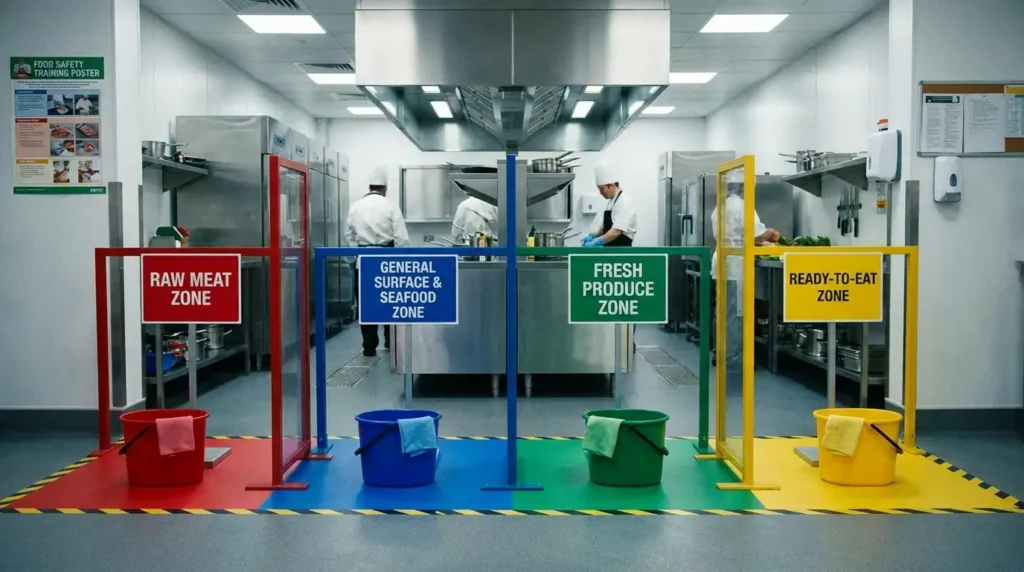
The standard UK colour system exists to stop cross-contamination between zones, and it is checked closely at inspection.
| Colour | Designated Use |
| Green | Food preparation areas, cutting boards, prep surfaces |
| Blue | General environmental surfaces, non-food areas |
| Red | Washrooms and sanitary areas only |
| Yellow | Kitchen sinks and wash basins |
Never let the same cloth or mop head cross zones. Using a red washroom cloth on a green food prep surface, even once, defeats the entire point of the system and is the kind of thing an inspector specifically looks for.
Allergen Cleaning Belongs on Your Schedule Too
Since Natasha’s Law came into force, allergen management has received close attention at inspection, and cleaning is part of that picture. Cross-contamination happens through shared boards, shared utensils, residue left on a surface, or staff handling an allergen and then touching another dish without washing their hands.
If you prepare food containing common allergens, your schedule should include a dedicated note on cleaning between an allergen dish and the next non-allergen dish, ideally with designated equipment for high-risk allergens like nuts or shellfish. A standard EN 1276 sanitiser is appropriate here. You do not need a specialist allergen-specific cleaning product; you need a clear, documented step that staff actually follow every time.
Common Mistakes on a Kitchen Cleaning Schedule
A handful of recurring issues account for most of the gaps EHOs find:
- ▸ No named person responsible for a task, just a generic “kitchen team” entry
- ▸ Missing supervisor sign-off, so there is no independent check that the work was actually done to standard
- ▸ Vague task descriptions like “clean surfaces” rather than naming the product and method
- ▸ A sanitiser used without the required contact time being followed or recorded
- ▸ No allergen cleaning step on a menu that includes allergens
- ▸ The same cloth or mop is used across different colour-coded zones
- ▸ A schedule that has not been updated after a menu change or a new piece of equipment, which makes the whole document look unused rather than current
What an EHO Looks For When They Check Your Cleaning Schedule
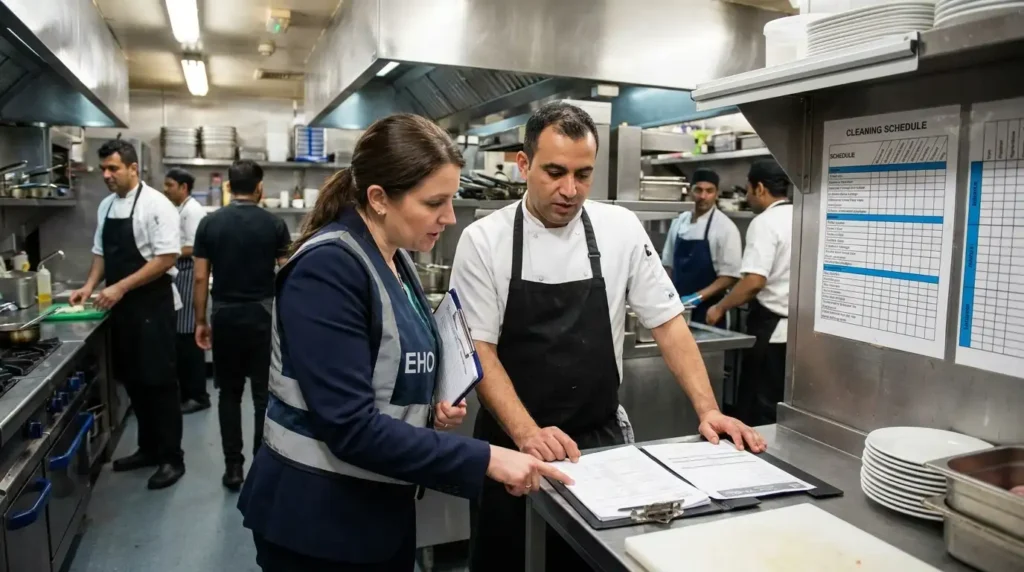
Inspections are unannounced, and the cleaning schedule is usually one of the first things asked for. An officer is typically checking whether a schedule exists at all, whether it has been filled in consistently with no suspicious gaps, whether tasks are specific rather than vague, whether the right products and standards are named, whether supervisor sign-off is present, and whether what the schedule claims matches what the kitchen actually looks like on the day. A schedule that says the fryer was deep cleaned yesterday means very little if the fryer is visibly dirty in front of the inspector.
Paper or Digital: Which Suits Your Kitchen
Paper is low-cost, needs no technology, and is familiar to most inspectors. It is also easy to lose in a busy kitchen and offers no real protection against a schedule being back-filled the morning before an inspection rather than completed in real time.
Digital systems make that kind of back-filling much harder, since entries are time-stamped automatically, and they tend to come with reminders that reduce missed tasks. The trade-off is a device requirement and, for some systems, an ongoing subscription cost.
For a small, single-site kitchen, paper is usually perfectly adequate provided someone takes it seriously. For larger operations with multiple shifts or several sites, digital tends to give a stronger, harder-to-dispute audit trail. Plenty of kitchens run a hybrid: a paper schedule on the wall for day-to-day use, backed by a simple digital log for trend tracking over time.
FAQs
Is a kitchen cleaning schedule a legal requirement in the UK? There is no single law that names “a cleaning schedule” as mandatory, but UK food businesses are required to operate a documented food safety management system, and a written cleaning schedule is the standard way of evidencing that the cleaning element of that system is genuinely in place and followed.
What should a kitchen cleaning schedule include? At minimum: the specific area or item being cleaned, the cleaning method, the product used and the standard it meets, the frequency, the person responsible, the date and time, a staff signature, and a separate supervisor sign-off.
What is the two-stage cleaning process? Stage one is cleaning, using detergent and hot water to remove visible dirt and grease. Stage two is disinfecting, applying a sanitiser that meets EN 1276 and leaving it on the surface for the required contact time, typically around 30 seconds for a surface that is already clean.
How does a cleaning schedule affect my Food Hygiene Rating? The Food Hygiene Rating Scheme scores three separate elements at inspection, one of which is confidence in management. A completed, properly signed cleaning schedule is one of the clearest pieces of evidence an officer uses to assess that element, and a weak score there can hold back an otherwise good rating.
How often should a commercial kitchen be deep cleaned? In-house deep cleaning of accessible areas should happen at least weekly, with deeper tasks monthly. Professional deep cleaning of extraction systems to the TR19 standard is commonly done every six months, with higher-volume kitchens sometimes needing it quarterly.
Do staff signatures and supervisor sign-off actually matter? Yes. A schedule signed only by the person who did the cleaning has no independent verification built in. Supervisor sign-off is what gives the record genuine weight as due diligence evidence.
What cleaning products are required for food-contact surfaces? Products meeting the EN 1276 standard for bactericidal effectiveness are the benchmark for any surface that comes into contact with food. General household cleaning sprays typically do not carry this certification and are not suitable for use on food-contact surfaces in a commercial kitchen.
For the wider context of kitchen hygiene compliance, see our commercial kitchen cleaning supplies guide and our guide to UK food hygiene regulations for restaurants.
References
- ▸ Food Standards Agency: Safer Food Better Business for caterers via food.gov.uk
- ▸ Food Standards Agency: Food Hygiene Rating Scheme via food.gov.uk
- ▸ Food Standards Agency: How food hygiene ratings work via food.gov.uk
- ▸ HSE: COSHH basics via hse.gov.uk