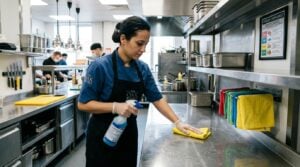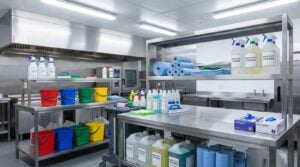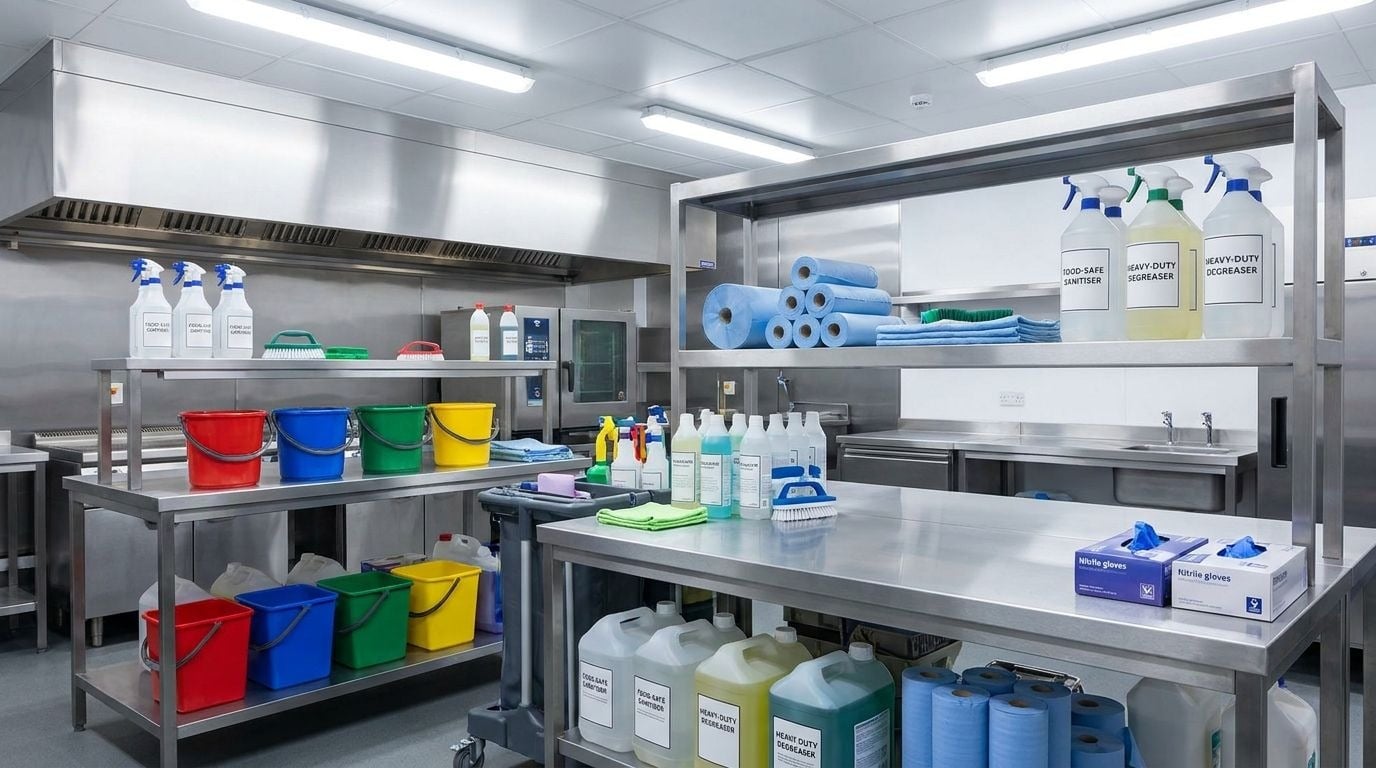
Every year, the Food Standards Agency estimates around 2.4 million cases of foodborne illness in the UK. A significant proportion traces back to poor kitchen hygiene – not just how kitchens are cleaned, but what they are cleaned with.
If an Environmental Health Officer walked into your kitchen today, the products in your cleaning cupboard matter as much as how often you use them. Using the wrong formulation, missing a safety data sheet, or lacking a colour-coded system are all inspection failures – even if the kitchen looks spotless.
This guide covers everything UK food businesses need to know about commercial kitchen cleaning supplies: what to buy, which certifications matter, how to organise by zone, how to stay compliant, and how to avoid the buying mistakes that create problems down the line.
Quick Compliance Checklist: Before you read further, here are the five things EHOs most commonly flag:
- ▸ EN 1276-certified sanitiser on food-contact surfaces
- ▸ COSHH Safety Data Sheets are accessible on site for every chemical
- ▸ Colour-coded cleaning equipment in use and segregated by zone
- ▸ Written cleaning schedule matching your actual products and frequency
- ▸ Chemicals stored in a locked cupboard, in original labelled containers
Why Commercial Kitchen Cleaning Supplies Are Different From Domestic Products
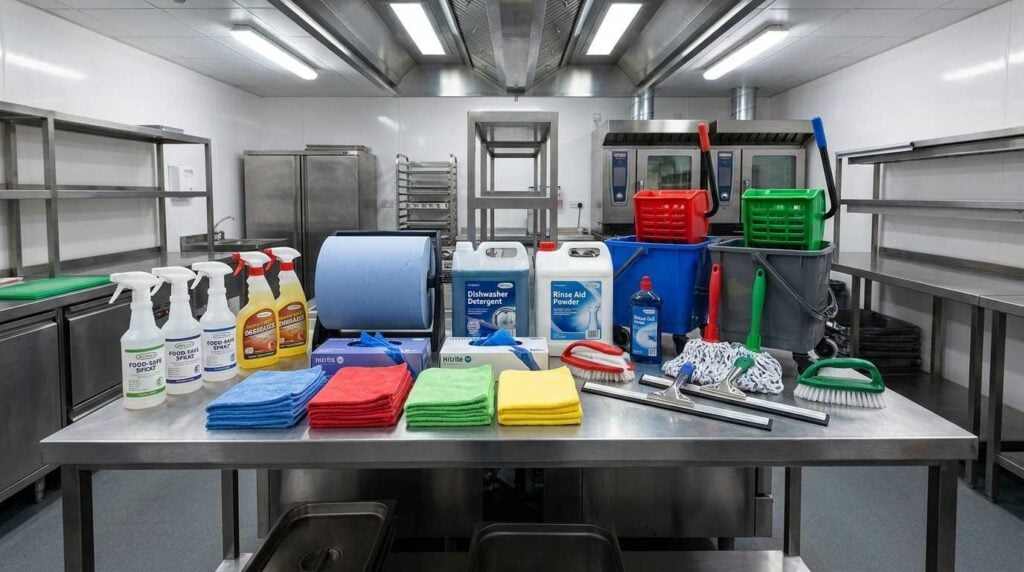
The cleaning products in the supermarket aisle are designed for home use. A catering kitchen has fundamentally different requirements – in terms of contamination volume, surface types, regulatory obligations, and the consequences of getting it wrong.
Formulation Strength and Contact Time
Commercial kitchen cleaning products are formulated at higher concentrations and tested to specific performance standards. A domestic antibacterial spray might reduce bacteria on your worktop; a commercial food-safe sanitiser certified to EN 1276 is proven to achieve 99.999% bacterial reduction under controlled conditions. That distinction matters when an EHO asks you to justify your cleaning regime.
Contact time is another key difference. Domestic products rarely specify dwell time clearly. Commercial sanitisers do – and using them correctly, for the stated contact time on the product label, is what separates surface cleaning from genuine disinfection.
Cost Per Application – The Numbers Most Buyers Miss
Domestic products look cheaper on the shelf. They are rarely cheaper to use.
Our 5L Heavy Duty Hard Surface Cleaner and Degreaser at a dilution of 1:10 gives 50 litres of working solution – at roughly 3–5p per application. A 750ml domestic trigger spray used neat at 10–15p per application costs three to four times as much, generates more packaging waste, and does not perform to a certified standard.
The concentrated commercial product wins on every measure.
The Three Things EHOs Actually Check About Your Cleaning Products
When an Environmental Health Officer inspects a commercial kitchen, they look beyond how clean the surfaces appear. They check:
- EN 1276 certification on disinfectant labels – the product must be proven to kill 99.999% of specified bacteria under conditions of use.
- COSHH Safety Data Sheets on site – every chemical product must have an SDS accessible to staff who use it, not locked in a manager’s office.
- Cleaning schedule matching your products – your written schedule must align with the products you actually stock, the areas you use them in, and the frequency you commit to.
Missing any of these is a compliance failure, regardless of how clean the surfaces look.
Cleaning, Sanitising, and Disinfecting: What’s the Difference?
These three terms are used interchangeably outside the industry. Inside a food business, they describe distinct stages of a legally required process.
Cleaning removes dirt, grease, and food debris using a detergent or degreaser. It reduces bacteria but does not kill them to a food-safe standard. This must happen first.
Sanitising reduces bacteria on a cleaned surface to a safe level for food contact. Food-safe sanitisers used on prep surfaces should carry EN 1276 certification. Many no-rinse formulations are available for food contact areas.
Disinfecting kills a broader spectrum of pathogens, including some viruses and fungi. Required in higher-risk areas, during outbreak situations, and in healthcare-adjacent catering settings.
The correct order is always: clean first, then sanitise or disinfect. Applying a sanitiser to a greasy surface does not make it safe. The grease prevents the active ingredient from reaching the bacteria underneath.
The Essential Commercial Kitchen Cleaning Supplies: A Zone-by-Zone Breakdown
Organising your procurement by kitchen zone is the most practical approach. It mirrors how inspectors assess a kitchen, prevents cross-contamination between areas, and makes training staff significantly more straightforward.
Zone 1 – Food Preparation and Cooking Surfaces
The highest-risk zone in any commercial kitchen. Cross-contamination at the food prep stage is one of the leading causes of foodborne illness in UK catering environments.
Products required:
- ▸ Heavy-duty degreaser – for chopping boards, stainless steel countertops, and equipment. Our 5L Heavy Duty Hard Surface Cleaner and Degreaser is formulated for exactly this application.
- ▸ Food-safe surface sanitiser (EN 1276) – applied after degreasing, before food contacts the surface. Many no-rinse formulations are available for high-frequency use.
- ▸ Concentrated washing-up liquid – for manual washing of utensils and prep equipment. Our Concentrated Washing Up Liquid 5L and Concentrated Lemon Washing Up Liquid 5L are both professional catering grade.
- ▸ Colour-coded cloths (green) – the UK standard for food preparation areas. Never share clothes between zones.
- ▸ Disposable food-safe gloves – our Disposable Food Safe Blue PE Gloves are suitable for food handling and cleaning tasks.
Frequency: Clean surfaces after every use during service; sanitise before food preparation begins.
Zone 2 – Ovens, Grills, Fryers, and Extraction Hoods
This zone accumulates the heaviest grease deposits and requires the most aggressive cleaning chemistry.
Products required:
- ▸ Heavy-duty oven and grill cleaner – formulated to dissolve carbonised grease and baked-on residue. Our Oven Cleaner Heavy Duty Commercial Grade 5L is a professional-strength formulation designed for commercial kitchen use. These high-pH products require PPE – chemical-resistant gloves and eye protection as a minimum.
- ▸ Extraction hood degreaser – heavy-duty formulation for canopies, filters, and hoods. Under TR19 Grease guidelines, extraction systems must be cleaned to a defined cleanliness standard to reduce fire risk.
- ▸ Stainless steel cleaner and polish – for oven exteriors and stainless surfaces after the main clean.
Frequency: Grills and fryers daily. Ovens are weekly in most operations. Extraction systems are periodically (quarterly to annually, depending on cooking volume)inspected by qualified contractors under TR19 guidelines.
Note on PPE: When working with caustic oven cleaners, disposable gloves are a minimum. For high-concentration splatter risk, chemical-resistant gloves and eye protection are required by COSHH.
Zone 3 – Floors, Drains, and Waste Areas
Floors in commercial kitchens take heavy traffic, grease splatter, and food debris throughout service. Drains and waste areas carry the highest contamination risk if neglected.
Products required:
- ▸ Grease-cutting floor cleaner – standard floor cleaners are inadequate in kitchen environments. The Heavy Duty Hard Surface Cleaner and Degreaser works effectively on kitchen floor surfaces, emulsifying fats and oils that standard cleaners leave behind.
- ▸ Drain maintainer – prevents FOG (fats, oils, and grease) build-up in drainage systems. FOG blockages are a compliance issue under BS EN 1825 and attract EHO attention and pest risk.
- ▸ Disinfectant – for mop-down of waste areas and bin surrounds. Our Professional Grade Disinfectant 5L is available in multiple fragrances and is suitable for floor and waste area disinfection.
- ▸ Colour-coded mops and buckets (red) – the UK standard for floor and sanitary areas.
- ▸ Safety signs and wet floor signs – not optional when floors are wet during service.
Refuse management: Bins and waste areas need daily disinfection. Our refuse bags are available in trade quantities to support a proper waste management routine.
Zone 4 – Refrigeration and Cold Storage
Refrigeration is frequently under-cleaned. Cold surfaces need products formulated to work at low temperatures – a standard sanitiser may not perform effectively at fridge temperature.
Products required:
- ▸ Low-temperature surface sanitiser – verify the product datasheet confirms effective performance at the storage temperature range of your equipment.
- ▸ Food-safe degreaser – for removing food spillage inside refrigerator compartments.
Frequency: Fridge interiors should be deep cleaned monthly at minimum; door seals and shelves wiped down daily. Walk-in cold rooms in high-volume operations should be cleaned weekly.
Zone 5 – Dishwashers and Warewashing
Commercial dishwashers require a specific product regimen. Domestic dishwasher products are not formulated for commercial machine temperatures, water volumes, or cycle times.
Products required:
- ▸ Commercial dishwasher detergent – our Dishwasher Powder 10kg Tub is trade-grade and available in the bulk quantities catering operations need.
- ▸ Professional Grade Glasswash / Dishwasher Rinse Aid 5L – essential for effective drainage and bacterial reduction on crockery and glassware after washing.
- ▸ Hard Water Dishwasher Detergent – if you’re in a hard water area, our Hard Water Dishwasher Detergent 5L with Built-in Tannin Remover prevents scale build-up and extends machine life.
- ▸ Rational Cleaning Tablets – if you run Rational combi ovens, our Red Rational Cleaning Tablets (100) and Blue Rational Care Control Tablets (150) are genuine Rational products – not third-party alternatives.
Frequency: Filters are cleaned after every service. Full machine clean weekly. Descaling monthly in hard water areas.
Zone 6 – Handwashing Points and Staff Welfare Areas
Handwashing compliance is one of the most scrutinised elements of any EHO inspection. Inadequate handwashing provision is a direct food safety risk.
Products required:
- ▸ Antibacterial liquid hand soap (BS EN 1499) – soap at handwashing stations must be bactericidal. Dispenser soap reduces contamination risk versus bar soap in food environments.
- ▸ Paper hand towels – the FSA recommends disposable paper towels at food business handwashing stations. Our Centrefeed Blue Roll 150m and 80m Centrefeed Blue Roll are trade-quantity options used across food service environments.
- ▸ Hand sanitiser (EN 1500) – a supplement to handwashing, not a replacement. Our sanitiser and disinfectant range includes hand sanitiser suitable for food business use.
Regulatory context: Food Safety and Hygiene (England) Regulations 2013 require adequate handwashing facilities. The FSA’s Safer Food, Better Business guidance specifies what constitutes adequate provision.
Commercial Kitchen Cleaning Supplies: The Master Checklist
Use this when auditing your current supplies or building a procurement order.
Cleaning Chemicals Checklist
| Product Type | Key Requirement | Recommended Format |
| Kitchen degreaser | Food-safe; COSHH SDS on site | Concentrate 5L |
| Food-safe sanitiser | EN 1276; no-rinse for food contact | RTU or concentrate |
| General disinfectant | EN 1276 | Concentrate 5L |
| Oven & grill cleaner | Caustic/alkaline; PPE required | 5L bottle |
| Floor cleaner | Grease-cutting for kitchen floors | Concentrate 5L |
| Washing up liquid | Food-safe; degreasing | Concentrate 5L |
| Dishwasher detergent | Commercial-grade | 10kg powder |
| Rinse aid | Commercial-grade | 5L |
| Surface alcohol cleaner | IPA-based; suitable for cold storage | 5L |
| Blue roll / centrefeed | For handwashing stations and surface cleaning | 80m or 150m rolls |
PPE and Safety Checklist
| Item | When Required |
| Disposable food-safe gloves | All cleaning tasks |
| Chemical-resistant gloves | Caustic oven cleaners, concentrated chemicals |
| Eye protection | Caustic chemicals; spray application |
| Wet floor signs | Whenever floors are wet |
| COSHH SDS folder | All chemical products on site |
| Refuse / bin bags | Daily waste management |
How to Choose the Right Cleaning System for Your Kitchen Size
Not every kitchen needs the same setup. Over-buying creates storage and waste problems; under-buying creates compliance gaps.
Small Café or Single-Site Takeaway
You need: one concentrated degreaser, one food-safe sanitiser, oven cleaner, washing up liquid, rinse aid, blue roll, and disposable gloves as a minimum. RTU spray formats work well for during-service spot cleaning where space for dilution equipment is limited.
Starter kit essentials:
- ▸ Heavy Duty Degreaser 5L
- ▸ Oven Cleaner 5L
- ▸ Concentrated Washing Up Liquid 5L
- ▸ Professional Rinse Aid 5L
- ▸ Centrefeed Blue Roll
- ▸ Disposable Gloves
Monthly spend estimate: £40–80 depending on covers.
High-Volume Restaurant or Pub Kitchen
Higher throughput means more frequent restocking, heavier grease build-up, and more stringent EHO scrutiny. Bulk buying in 5L concentrates is essential for cost management. Autodosing units are worth considering for high-use products like dishwasher detergent. Rational ovens should be cleaned with genuine Rational tablets – third-party alternatives can damage the machine.
Care Home or Healthcare Kitchen
Add virucidal disinfection capability (EN 14476) to your standard stock. Care homes are inspected by both EHOs and the CQC. Your cleaning documentation – SDS folders, COSHH assessments, cleaning schedules – needs to be ready for both. Infection control protocols may specify longer contact times than standard catering practice.
Multi-Site Contract Catering or Facilities Management
Standardise on an approved product list across all sites. Centralised bulk ordering from one supplier reduces per-unit cost and simplifies documentation management. Every site must hold the same SDS folder, follow the same colour-coding protocol, and use the same schedule format. This is the single most important operational decision for FM buyers.
UK Certification Guide: What to Look For on the Label
Most buyers get caught out here. “Antibacterial” or “commercial grade” on a label is marketing. The certifications below are the ones that matter in a UK food business.
| Certification / Standard | What It Covers | Required For | Where to Check |
| EN 1276 | Bactericidal activity – 99.999% bacterial reduction | Disinfectants on food-contact surfaces | Product label or technical datasheet |
| EN 14476 | Virucidal activity | Healthcare-adjacent catering; post-outbreak | Product label or technical datasheet |
| BS EN 1499 | Hygienic handwash standard | Antibacterial hand soap at food business washpoints | Product label |
| EN 1500 | Hygienic hand rub standard | Alcohol hand sanitisers | Product label |
| HACCP-compliant | Suitable within a HACCP food safety system | All food business cleaning products | Product description; manufacturer confirmation |
| Food-safe / food contact safe | Safe for use near food contact surfaces | Sanitisers on prep areas | Product label: verify with SDS |
| COSHH SDS | Safety data required for commercial chemical use | Every cleaning chemical on site | Provided by the supplier |
EN 1276: The Standard That Actually Matters
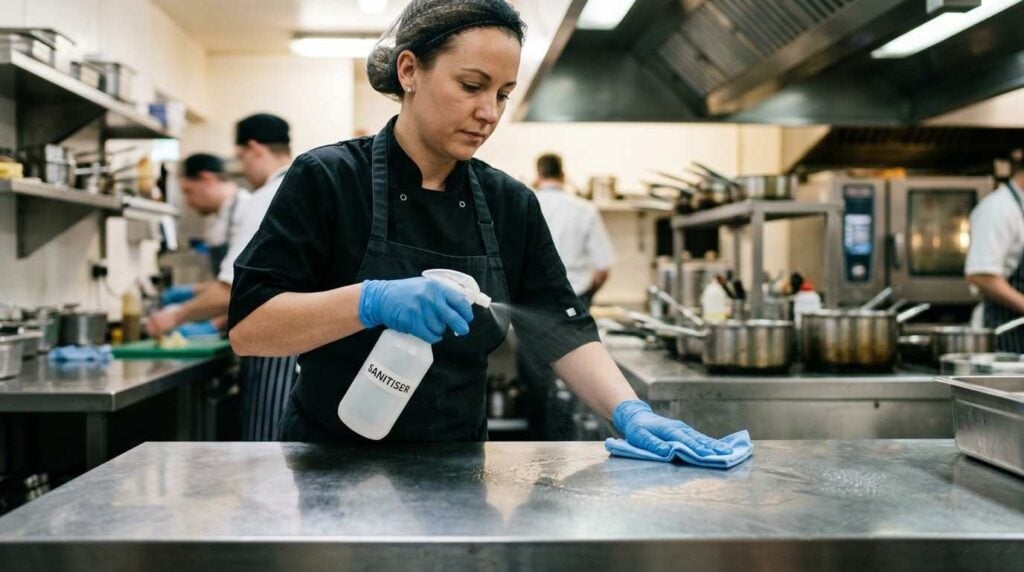
EN 1276 is a European test standard for bactericidal cleaning products. Under defined conditions of temperature, contact time, and organic load, the product must reduce test bacteria by 99.999% – a 5-log reduction.
In practice, a surface treated with an EN 1276-certified product, used correctly and for the specified contact time, reaches a bacteriologically safe state for food preparation.
What EHOs know: EN 1276 is the expected baseline for any disinfectant or sanitiser in a UK food business. Products without it – including some well-known consumer brands – do not meet the standard.
How to check: Look for “EN 1276” explicitly on the label or in the product’s technical datasheet. A product claiming “antibacterial” without citing EN 1276 may not pass the standard.
COSHH Compliance: What Must Be On Site
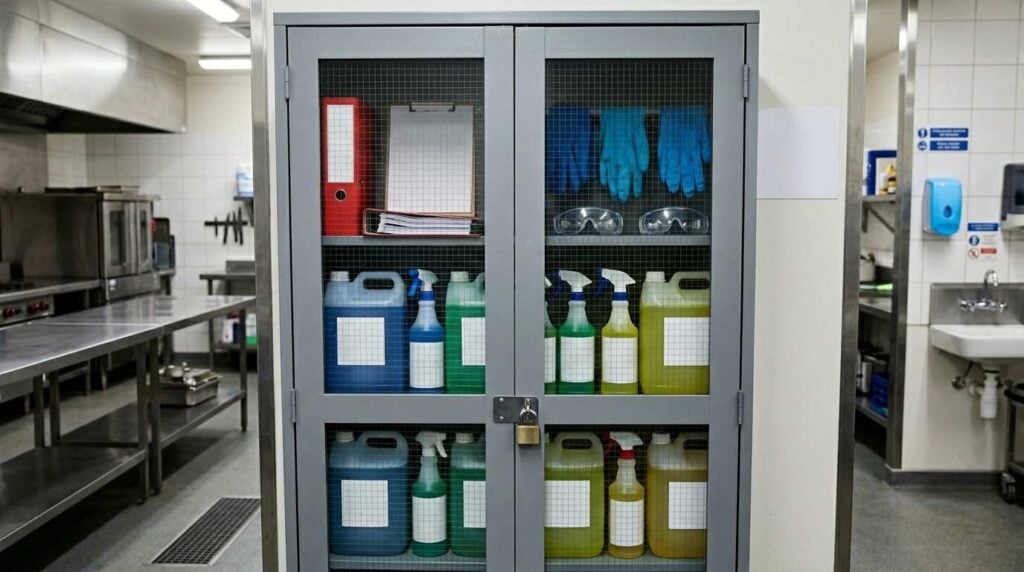
The Control of Substances Hazardous to Health Regulations 2002 require employers to assess and control risks from hazardous substances – including virtually all commercial cleaning chemicals.
What must be on site:
- ▸ A Safety Data Sheet (SDS) for every chemical in use – accessible to the people using it
- ▸ A completed COSHH risk assessment
- ▸ Records of staff training on chemical handling
Storage requirements: Chemicals must be stored in a locked cupboard, separately from food, in original labelled containers. Decanting into unlabelled containers is a COSHH violation.
For further guidance, the Health and Safety Executive publishes practical COSHH guidance at hse.gov.uk/coshh.
Colour-Coded Cleaning: The UK System Explained
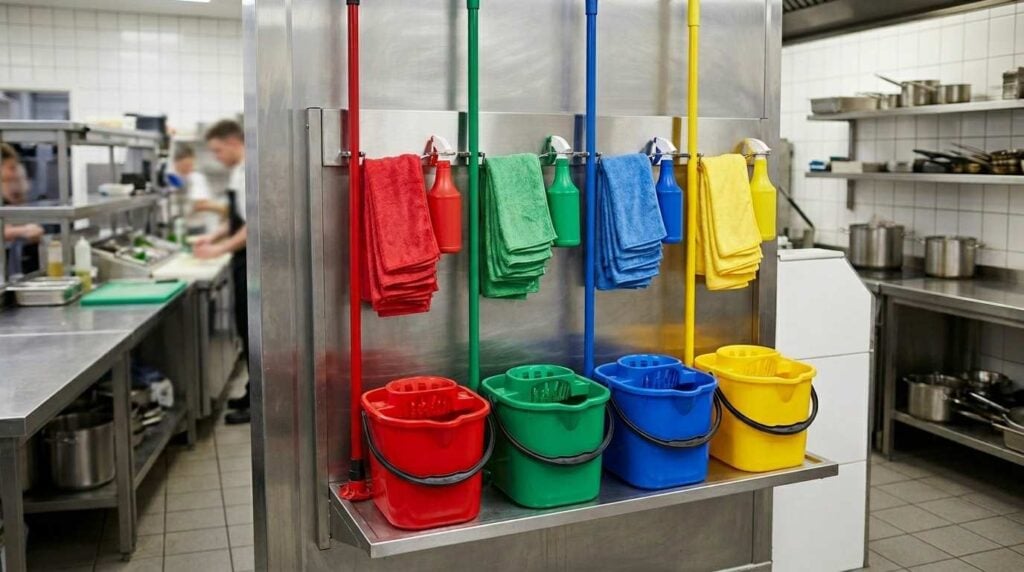
The colour-coded system is one of the most straightforward ways to prevent cross-contamination – and one of the most commonly ignored in smaller operations until an EHO inspection makes it unavoidable.
The UK Standard Colour Code
| Colour | Area / Application | Products Assigned |
| Red | Toilets, washrooms, drains, sanitary areas | Mops, buckets, cloths, brushes |
| Yellow | General non-food areas, corridors | Clothes, mops, general equipment |
| Blue | Low-risk general food areas | Clothes, mops in lower-contamination zones |
| Green | Food preparation surfaces and food contact areas | Clothes, chopping boards, and mops in food prep zones |
| White | Some facilities are used for specific food contact tasks | Varies by facility protocol |
Using a mop on toilet floors and kitchen floors is a serious cross-contamination risk and an immediate EHO concern. The colour system eliminates any ambiguity.
Training Your Team
Post a colour chart in the cleaning store. Walk every new member of staff through the system on induction. Attach the correct colour label to each storage hook or zone. For multi-site operations, standardise the same chart and the same products across all locations.
The full range of PPE accessories and safety signs supports a proper zone-management system alongside your cleaning equipment.
Concentrated vs Ready-to-Use: What Actually Saves You Money
This is one of the most under-discussed procurement decisions in catering. The format you buy significantly affects your cost per use, waste output, and compliance consistency.
Cost-Per-Application Comparison
| Format | Typical Cost | Applications | Cost Per Use | Notes |
| 5L concentrated degreaser (1:10) | ~£13–18 | 500+ | ~3–4p | Best value for any meaningful volume |
| 750ml RTU domestic trigger spray | ~£2–3 | 40–60 applications | ~5–8p | Not EN 1276; not commercial-grade |
| 750ml RTU commercial trigger spray | ~£4–7 | 100–150 applications | ~3–5p | EN 1276, where certified; less economical at volume |
| Wipes (single use) | ~£5–8 per 100 | 100 | ~5–8p | Convenient but high waste; specific use cases |
Approximate trade pricing for illustration. Actual costs vary by product and supplier.
Concentrated products win on cost at virtually any meaningful volume. The 5L Washing Up Liquid and 5L Degreaser both represent significantly better cost-per-application than domestic equivalents – with the performance certification to match.
When RTU Products Make Sense
- ▸ Spot cleaning during service, when dilution equipment is not at hand
- ▸ Smaller operations where monthly volume is low
- ▸ Specific formats not available in concentrate (some stainless steel polishes, glass cleaners)
Most kitchens benefit from concentrates for zone cleaning and RTU for during-service spot applications.
Eco-Friendly Commercial Kitchen Cleaning: Can You Switch and Stay Compliant?
More UK food businesses are under sustainability pressure – from procurement policies, ESG targets, and local authority requirements. The question is whether eco-friendly alternatives can meet the same compliance standards.
The honest answer: some can, and some cannot. The difference is in the certification.
What to look for: An eco disinfectant or sanitiser must still carry EN 1276 certification to be used on food-contact surfaces. EU Ecolabel or Ecocert credentials cover environmental performance – they do not automatically mean EN 1276 compliance. You need both if the product is being used for food surface disinfection.
Where eco products work well:
- ▸ General floor cleaners where EN 1276 is not required
- ▸ Washing up liquids, where biodegradable formulations perform comparably
- ▸ Biological drain treatments – enzyme-based drain maintainers are genuinely effective and more sustainable than caustic drain cleaners.
- ▸ Hand soaps certified to BS EN 1499 are available in eco-formulated versions.
Where conventional products may remain necessary: Heavy-duty oven and grill cleaners – the alkalinity required to dissolve carbonised grease is difficult to achieve at scale with current eco formulations.
The rule: always check the eco product’s EN 1276 status before switching. A product with sustainable packaging and a citrus scent is not automatically compliant.
Browse our Cleaning Products & Supplies range for the full picture of what’s available.
Sector-Specific Guidance: What Your Business Type Needs
Restaurants and High-Volume Pub Kitchens
High-volume cooking means heavy grease accumulation. Extraction hood compliance, fryer cleaning, and floor degreasing are the priorities. Allergen cross-contamination management is increasingly scrutinised – if you handle nuts, gluten, dairy, or shellfish, colour-coded equipment and single-use cloths between allergen prep zones are standard practice.
Rational oven operators: Use only genuine Rational cleaning tablets – they are genuine manufacturer products, not substitutes. Third-party tablets can damage the machine and void manufacturer warranties.
School Canteens and Local Authority Catering
School kitchens operate under a combination of EHO oversight and local authority procurement policies. Many school catering managers prefer lower-caustic or neutral-pH formulations where less experienced staff are involved in cleaning. Allergen colour-coding is increasingly important under the School Food Standards. Public sector procurement often requires EN 1276 certificates and SDS packs at point of purchase – ensure your supplier can provide these.
Care Home and Healthcare Kitchens
Care home kitchens fall under both FSA and CQC regulations. Residents are more vulnerable to foodborne illness and healthcare-associated infections. Key additions: at least one disinfectant with EN 14476 virucidal certification (particularly relevant during norovirus outbreaks), stricter contact time protocols, and documentation that satisfies both EHO and CQC inspection requirements. Cleaning equipment from resident areas must be completely segregated from kitchen equipment – different storage, different colour coding.
Contract Catering and Facilities Management
FM buyers managing cleaning supplies across multiple sites face a challenge that individual site managers do not. Standardise on an approved product list. Place bulk orders from a single trade account. Define the colour protocol centrally and implement it identically everywhere. Maintain a centralised SDS folder accessible at all sites. The admin burden of managing multiple supplier relationships – each with different SDS documentation – is rarely worth the marginal cost difference.
How to Build Your Commercial Kitchen Cleaning Procurement System
Cleaning supplies are an operational requirement, not a one-off purchase. An organised system saves time, money, and compliance risk.
Step 1: Audit Your Current Cleaning Products
Go through your cleaning cupboard and list every product. For each one, check: does it carry EN 1276 where required? Is there an SDS on site? Is it included in your COSHH assessment? Is it on your cleaning schedule? Remove anything that fails the compliance check. Identify zones with no appropriate product.
Step 2: Build a Zone-by-Zone Approved Product List
Using the zone breakdown in this guide, create a written list: zone, surface or equipment type, product name, dilution where applicable, certification, and frequency. This becomes your procurement reference and the foundation of your cleaning schedule.
Step 3: Introduce Colour Coding and Assign Zones
If your colour-coded equipment is inconsistent or missing, standardise it now. Post a colour reference chart in the cleaning store. Our PPE and safety range includes wet floor signs, gloves, and protective equipment to complete the system.
Step 4: Set Par Levels and a Restocking Schedule
Set minimum stock levels for every product and reorder when you reach them. Running out of sanitiser mid-service is not just inconvenient – it is a compliance failure. In high-volume kitchens, hold at least a week’s supply. Order monthly or fortnightly depending on throughput. Our full kitchen cleaning range is available in bulk at trade prices.
Step 5: Train Your Team and Keep COSHH Records Updated
Every person who handles chemicals must be trained on safe use, dilution, PPE requirements, and the cleaning schedule. Record training dates. Update COSHH assessments when products change. Set a calendar reminder to review SDS documents annually or when any product is added or removed.
Common Mistakes When Buying Commercial Kitchen Cleaning Supplies
These are the purchasing and compliance errors that cause the most problems when an EHO visits.
1. Using domestic bleach on food preparation surfaces
Domestic bleach is not a food-safe sanitiser for direct use on prep surfaces. Residue poses a chemical contamination risk. Use a certified food-safe sanitiser – many no-rinse formulations are designed specifically for food contact areas.
2. Buying sanitiser without a prior cleaning product
Sanitiser applied to a greasy surface does not work. The two-stage process – clean with a degreaser, then sanitise – is mandatory. Buying only a sanitiser skips the essential first stage.
3. No EN 1276 on your disinfectants
The cheapest available disinfectant is frequently not EN 1276 certified. The cheapest compliant product is a better purchase than the cheapest product overall.
4. No COSHH Safety Data Sheets on site
This is one of the most common compliance failures. Every chemical must have an SDS physically on site and accessible to staff. Storing them only in a manager’s email or a shared drive does not satisfy the requirement.
5. No colour-coded cleaning system
Using the same cloths across food prep surfaces, floors, and washrooms is a cross-contamination route. The colour-coded system is an EHO expectation and a HACCP requirement.
6. Concentrates used at the wrong dilution
Overuse wastes money. Under-dilution creates a product too weak to meet EN 1276 performance – the standard is tested at specific concentrations. Training on dilution ratios or the use of autodosing equipment solves this.
7. Relying on a single multi-purpose product for all zones
A single “all-purpose” cleaner is not HACCP-compliant and rarely performs adequately everywhere. Oven cleaning, food prep sanitation, floor degreasing, and drain maintenance all require different chemistry.
Frequently Asked Questions
What cleaning products does a commercial kitchen legally need?
UK commercial kitchens must maintain safe and clean conditions under the Food Safety and Hygiene (England) Regulations 2013 and the Food Safety Act 1990. In practice, EHO expectations require: a food-safe degreaser, an EN 1276-certified sanitiser or disinfectant, PPE, colour-coded cleaning equipment, COSHH-compliant chemical storage, SDS for all chemicals, and a written cleaning schedule.
What is EN 1276 and why does it matter for UK kitchens?
EN 1276 is a European test standard specifying that a bactericidal cleaning product must achieve a 5-log (99.999%) reduction in test bacteria under defined conditions. It is the minimum expected certification for any disinfectant or sanitiser used on food-contact surfaces in a UK food business. Products without it do not meet EHO expectations.
Can I use bleach in a commercial kitchen in the UK?
Domestic bleach (sodium hypochlorite) should not be applied directly to food preparation surfaces – residue creates a chemical contamination risk. Dilute bleach is sometimes used for drain treatment or as a general surface disinfectant in non-food areas. For food-contact surfaces, use a certified food-safe sanitiser carrying EN 1276. Always check the SDS and product instructions.
Do eco-friendly cleaning products meet EN 1276?
Some do; many do not. An eco product must carry explicit EN 1276 certification to be used as a disinfectant on food-contact surfaces. EU Ecolabel or Ecocert credentials cover environmental performance, not bactericidal performance. Always verify EN 1276 status separately before switching to an eco alternative in a food safety-critical application.
How often should a commercial kitchen be cleaned?
- ▸ After every use: Food-contact surfaces, utensils, chopping boards, food prep equipment
- ▸ Every shift: Countertops, hobs, fryers, sinks, hand basins, door handles, floor mop-down
- ▸ Weekly: Ovens, behind and under equipment, bins, fridge exteriors
- ▸ Monthly: Fridge and freezer interiors, cold room deep clean, dishwasher descale
- ▸ Quarterly to annually: Extraction systems and ventilation ducting under TR19 Grease (frequency depends on cooking volume)
What do Environmental Health Officers look for in kitchen cleaning?
EHOs typically check: EN 1276 on disinfectant labels; COSHH SDS accessible on site; cleaning schedule in use; colour-coded equipment in place and correctly segregated; chemicals stored in a locked cupboard in original labelled containers; adequate handwashing facilities with antibacterial soap; and the physical condition of high-risk zones such as food prep areas and extraction hoods.
What cleaning chemicals are needed for a new restaurant kitchen?
At minimum: a heavy-duty degreaser, a food-safe EN 1276-certified sanitiser, a commercial disinfectant, oven cleaner, commercial washing up liquid, dishwasher detergent, rinse aid, blue roll, and disposable gloves. Add drain maintainer and floor cleaner as your full zone-by-zone setup. All should have COSHH SDS available and be included in your opening cleaning schedule.
How do I set up a colour-coded cleaning system from scratch?
Assign a colour to each zone (red = toilets, yellow = general areas, blue = low-risk food areas, green = food prep). Replace existing cleaning equipment with colour-coded alternatives. Post a reference chart in the cleaning store. Train all staff at induction and run a refresher when new staff join. For multi-site operations, implement the same system identically at every location.
Shop Commercial Kitchen Cleaning Supplies at We Can Source It
We Can Source It supplies commercial kitchen cleaning products to restaurants, schools, care homes, contract caterers, and facilities management companies across the UK.
Our range includes food-safe degreasers, EN 1276-certified sanitisers and disinfectants, colour-coded cleaning equipment, PPE, commercial dishwasher products, blue roll, hand soaps, and specialist cleaners for every zone of the commercial kitchen.
Trade accounts are available for businesses placing regular orders – with competitive pricing, flexible bulk ordering, and fast UK delivery.
Browse our commercial cleaning supplies or contact us to discuss your requirements and set up a trade account.
Reference