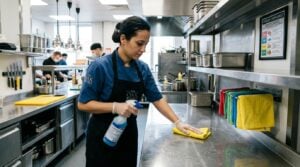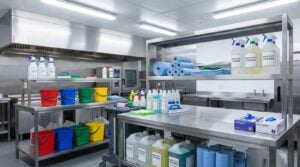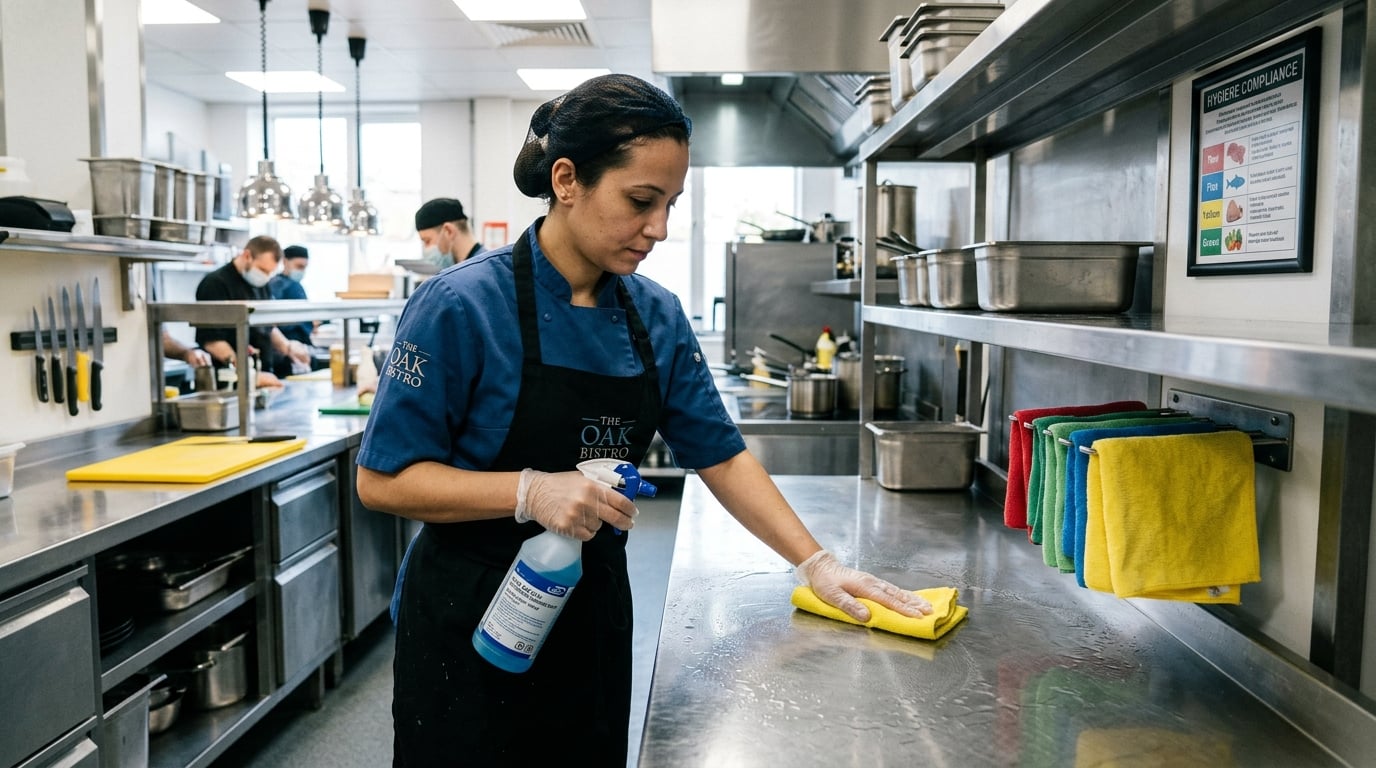
A restaurant in Chelmsford received an EHO improvement notice last year. The kitchen looked spotless. The issue had nothing to do with visible cleanliness.
Every disinfectant on the premises was a domestic brand; none carried BS EN 1276 certification. No Safety Data Sheets were on site. The cleaning schedule named no specific products and made no mention of contact times. The owner had no idea any of this was a problem.
The domestic products cost around £15 a week. The improvement notice, the follow-up re-inspection, and the drop from a 4 to a 2 on the Food Hygiene Rating Scheme created consequences that ran to considerably more.
This is the gap that UK food hygiene regulations create and that most compliance guides fail to close. The legislation tells you to keep your kitchen clean. It does not hand you a product list. This article does.
This is the gap that many UK food hygiene guides leave behind. Regulations require restaurants to maintain effective cleaning standards, but they do not provide a simple product-by-product checklist. This article explains exactly what cleaning products UK food businesses need and why.
The UK Legal Framework for Food Hygiene in 2026
UK food hygiene law sits across three primary instruments. Understanding which one does what prevents the confusion that causes most compliance failures.
Food Safety Act 1990 – The Foundation
The Food Safety Act 1990 is the primary food safety legislation in Great Britain. It places a general duty on food business operators to ensure food is produced, stored, and handled without risk of injury to health. Environmental Health Officers have powers under this Act to issue Hygiene Improvement Notices, Hygiene Emergency Prohibition Notices, and, in the most serious cases, close premises immediately. Prosecution under the Act can result in unlimited fines and up to two years’ imprisonment.
Cleaning is not mentioned by product name anywhere in the Act. But the Act’s requirements are effectively unenforceable without it.
Food Safety and Hygiene (England) Regulations 2013: The Operational Rules
The day-to-day obligations flow from the Food Safety and Hygiene (England) Regulations 2013, which implement Regulation (EC) No. 852/2004, now retained as UK assimilated law since January 2024.
The cleaning-specific obligations include:
- ▸Food premises must be kept clean and in good repair and condition
- ▸Cleaning agents and disinfectants must be stored separately from food and food contact materials
- ▸Food contact surfaces must be easy to clean and, where necessary, to disinfect
- ▸Adequate facilities for cleaning and disinfecting utensils and equipment must be available
- ▸Handwashing facilities must include materials for cleaning hands and hygienic drying
Critically, these regulations also require every food business to implement a food safety management system based on HACCP principles. Cleaning, including the specific products used, must form part of that system and be documented for EHO inspection.
Post-Brexit Assimilation: What Changed in January 2024
Since January 2024, EU food safety regulations no longer apply as directly effective EU law in the UK. They continue as UK assimilated law under the Retained EU Law (Revocation and Reform) Act 2023. In practice, the standards remain unchanged, but they are now technically UK law. References on product packaging to “EC Regulation 852/2004” remain valid; the same requirements apply.
Scotland, Wales, and Northern Ireland: Key Regulatory Differences
| Nation | Enforcement Body | FHRS Display | Primary Regulation |
| England | Local authority EHOs | Voluntary (mandatory display under active FSA consultation, progress report due June 2026) | Food Safety and Hygiene (England) Regulations 2013 |
| Scotland | Local authority EHOs + Food Standards Scotland | Voluntary | Food Hygiene (Scotland) Regulations 2006 |
| Wales | Local authority EHOs | Mandatory since November 2013 | Food Hygiene (Wales) Regulations 2006 |
| Northern Ireland | Local authority EHOs | Mandatory since October 2016 | Food Hygiene Regulations (Northern Ireland) 2006 |
Multi-site operators need to understand this distinction. A rating of 2 in a Welsh restaurant must be displayed at the premises. The same rating in an English restaurant is currently voluntary to display, but most delivery platforms enforce minimum rating requirements for listing regardless of the nation.
What Food Hygiene Regulations Say About Cleaning Products Specifically
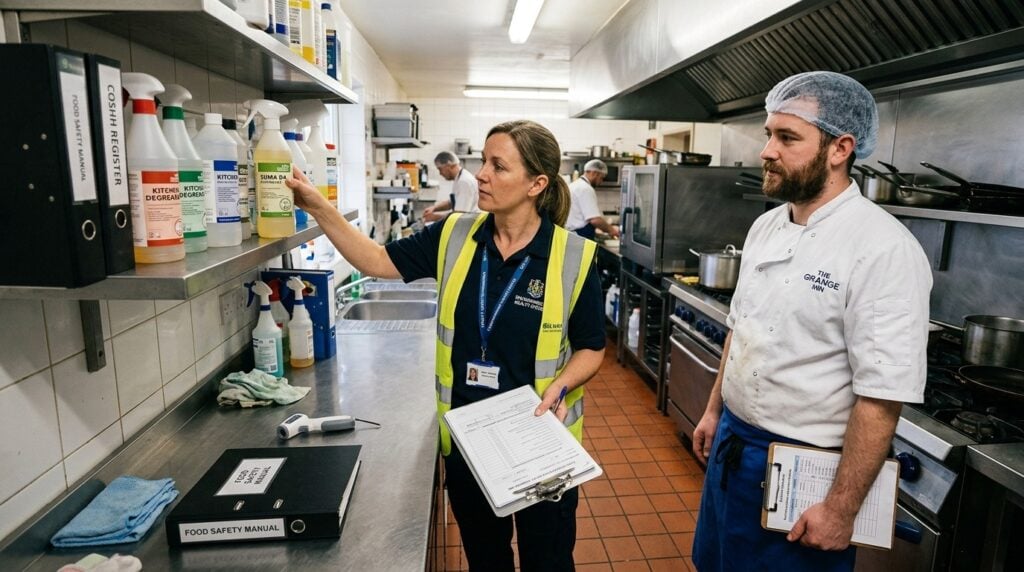
The regulations establish a performance standard: surfaces must be clean and, where required, disinfected to a safe level. The Food Standards Agency translates this into specific certification standards that products must meet.
The FSA’s guidance on cleaning effectively in food businesses specifies that disinfectants and sanitisers used on food-contact surfaces must meet BS EN 1276 or BS EN 13697. These are the benchmarks EHOs use when assessing whether your cleaning regime is adequate.
BS EN 1276, BS EN 13697, BS EN 1499, and EN 1500: The Full Comparison
This is the comparison most guides skip. Four different standards apply across your kitchen, and understanding which applies where prevents the compliance gap that catches most operators out.
| Standard | What It Tests | Pass Threshold | Where It Applies | Product Type |
| BS EN 1276 | Bactericidal activity in liquid suspension | 5-log (99.999%) bacterial reduction | Food-contact surface disinfectants and sanitisers | Disinfectant sprays, sanitisers, surface cleaners |
| BS EN 13697 | Bactericidal activity on surfaces (surface phase test) | 4-log (99.99%) bacterial reduction | Surface disinfectants tested under real-world contact conditions | Surface disinfectant products |
| BS EN 1499 | Hygienic handwash performance | Statistically significant reduction vs reference soap | Antibacterial hand soaps at food business handwashing points | Liquid hand soaps |
| EN 1500 | Hygienic hand rub performance | Performance equivalent to reference alcohol rub | Hand sanitisers in food environments | Alcohol hand gels and sprays |
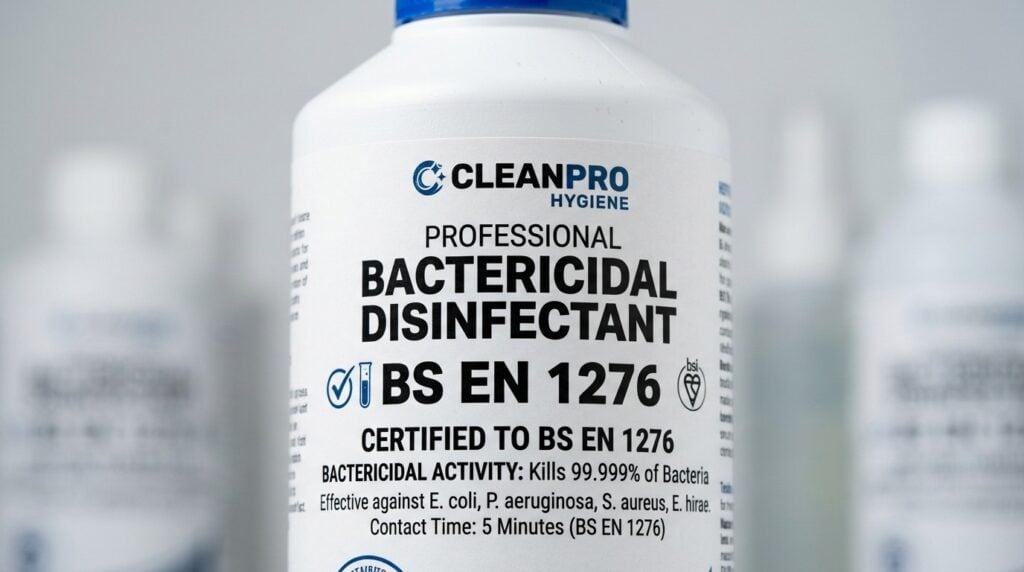
The practical distinction between EN 1276 and EN 13697: EN 1276 tests the product in liquid form under controlled conditions. EN 13697 tests the product as actually applied to a surface; it is the more operationally realistic test. A product carrying both certifications provides stronger compliance evidence than one carrying EN 1276 alone.
How to identify a compliant product: Look for the BS EN number explicitly on the product label or in the supplier’s technical datasheet. “Kills 99.9% of bacteria” and “antibacterial” are marketing claims, not certification references. They do not establish compliance with the regulatory standard. A product can legally claim “kills 99.9% of bacteria” in marketing copy without having passed the EN 1276 test protocol.
What Counts as a Food-Contact Surface
A food-contact surface is any surface that comes into direct contact with food or with the mouth. In a restaurant kitchen, this includes:
- ▸Food preparation countertops and worktops
- ▸Chopping boards
- ▸Kitchen utensils and equipment
- ▸Plates, bowls, glassware, and cutlery
- ▸Thermometer probes
All of these require BS EN 1276-certified disinfection, not general cleaning. The standard also applies to any surface on which ready-to-eat food might rest: if a sandwich is placed directly on a countertop, that surface is a food-contact surface for disinfection purposes at the point of use.
The Two-Stage Cleaning Process: Why Getting This Wrong Fails Inspections
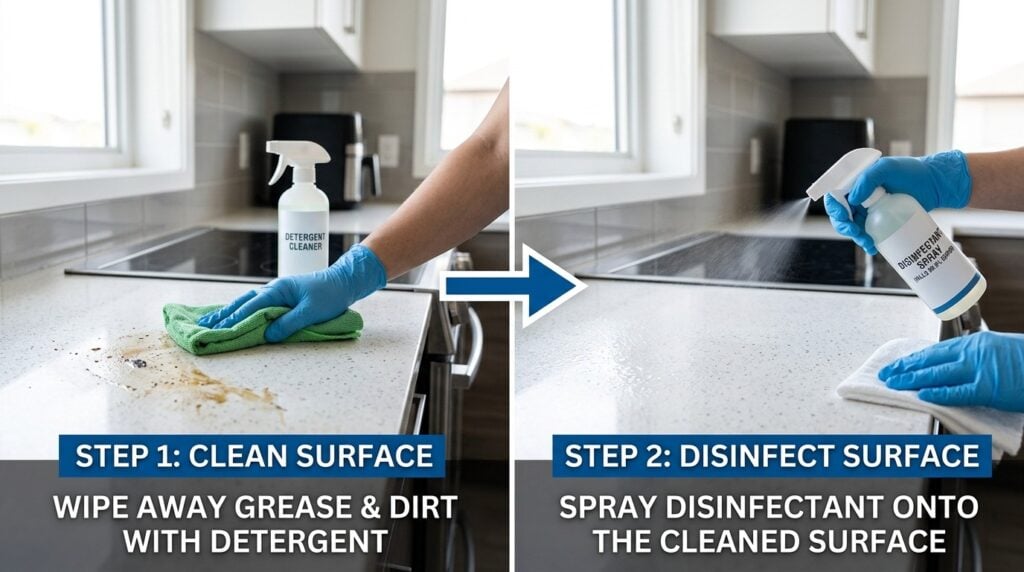
The FSA is explicit: the correct method for food-contact surfaces is a two-stage process.
Stage 1 – Clean: Remove food debris and grease using a detergent or degreaser. This is the physical removal of soil. It does not kill bacteria; it removes the organic matter that would otherwise protect bacteria from the disinfectant.
Stage 2 – Disinfect: Apply an EN 1276-certified disinfectant or sanitiser to the now-clean surface. Leave for the contact time stated on the product label before wiping.
The mistake that causes the most EHO failures: applying sanitiser directly to a greasy surface. Grease prevents the active ingredient from reaching the bacteria underneath. Disinfecting an uncleaned surface is not disinfection; it is product waste and a compliance failure simultaneously.
Contact time is the second most common failure. Spraying a surface and wiping immediately does not constitute disinfection under EN 1276 test conditions. The stated contact time on the label, typically 30 seconds to several minutes, must be observed. Kitchens that spray and wipe in one motion are not meeting the disinfection standard, regardless of which product they use.
Cleaning Schedules as HACCP Documentation
A cleaning schedule is not optional. Under HACCP requirements, it is a documented control measure, and EHOs inspect it.
A compliant cleaning schedule must include:
- What surface, area, or equipment is being cleaned
- How frequently (after each use, every shift, weekly, monthly)
- Which specific product to use, named product, not just “disinfectant”
- Correct dilution rate for concentrated products
- Contact time for disinfectants
- Who is responsible
- A sign-off column with date and initials
Three real scenarios where schedules fail inspections:
Scenario A: A busy London restaurant had a cleaning schedule. It said, “Sanitise prep surfaces daily.” The product named on the schedule was a domestic multi-surface spray the owner recognised from the original setup four years earlier. The product had been replaced twice since. The schedule had never been updated. The EHO found three different products on the shelf, none matching the schedule, none carrying EN 1276.
Scenario B: A café in Manchester had a thorough cleaning schedule, a laminated colour-coded chart, and clearly labelled products. The EHO opened the cleaning cupboard and found the disinfectant stored on the same shelf as cooking oil and pasta. COSHH violation. Improvement notice issued.
Scenario C: A catering operation in Birmingham used the correct products. The SDS folder existed but was in the manager’s car boot “for safekeeping.” Staff on site had no access to it during the inspection. Failed on documentation, not on products.
In each case, the physical cleanliness of the kitchen was adequate. The failure was procedural.
Why Domestic Cleaning Products Are Not Suitable for a Restaurant Kitchen
Walk into the cleaning cupboard of a significant proportion of small independent food businesses in the UK, and you will find domestic supermarket products: retail bleach, multi-surface spray, washing-up liquid from a high-street pack.
None are inherently dangerous. But the vast majority do not carry BS EN 1276 certification for use as food-contact surface disinfectants.
The reasons:
- ▸Domestic products are not tested to BS EN 1276 conditions; the standard specifies temperature, organic load, and contact time parameters that domestic products are not required to meet
- ▸Active ingredient concentrations in domestic products are typically lower than those in commercial-grade equivalents
- ▸Dilution ratios in domestic products are not specified for commercial use frequency
- ▸Many carry no BS EN certification whatsoever
Using domestic bleach on food preparation surfaces carries a specific additional risk: chemical contamination. Bleach residue on food-contact surfaces can transfer to food, which is itself a food safety hazard under the regulations, separate from the bactericidal performance question.
The cost argument reverses on inspection. Our commercial kitchen cleaning chemicals are available in 5L concentrated formats. A 5L concentrated degreaser at 1:10 dilution delivers over 500 applications at approximately 3–5p each. A 750ml domestic trigger spray from a supermarket delivers 40–60 applications at 5–8p each, without the certification. The domestic product costs more per use and does not comply.
How Cleaning Product Failures Affect Your Food Hygiene Rating
Here is how it actually works.
EHO inspections assess food businesses across several compliance areas. The scoring determines your Food Hygiene Rating (0–5). Cleaning failures can appear under two of the three assessment areas:
Hygienic food handling includes cross-contamination risks from inadequate cleaning or the wrong products used on food-contact surfaces.
Cleanliness and condition of facilities and building: Includes the evidence base for your cleaning regime products, schedules, SDS documentation, and storage compliance.
The consequence framework:
| Non-Compliance Level | Typical Outcome | FHRS Rating Impact |
| Minor (e.g., schedule not fully up to date) | Verbal advice or written recommendation | Minimal may not affect the score |
| Moderate (e.g., no EN 1276 on food-contact disinfectants, schedule outdated, SDS missing) | Improvement Notice issued; re-inspection required | Score reduction likely; rating of 2 or 3 is possible |
| Major (e.g., no food safety management system, chemical contamination risk, persistent non-compliance) | Hygiene Emergency Prohibition Notice; possible prosecution | Rating of 0 or 1; premises may be closed |
A rating of 2 in England currently does not require public display, but on Just Eat and Deliveroo, a 2 results in removal from the platform. For a restaurant generating significant revenue through delivery, the commercial impact of a failed inspection far exceeds the cost of compliant cleaning products.
In Wales and Northern Ireland, a rating of 2 must be displayed at the premises and on any website listing. The same rules are under active consultation for England in 2026.
Legally Required Cleaning Products for UK Restaurants By Area
The legislation establishes the performance standard. The area breakdown below establishes what product type satisfies that standard in each part of your premises.
Commercial Kitchen and Food Preparation Areas
The highest-risk zone in any food business. Cross-contamination at the preparation stage is among the most common causes of foodborne illness.
Required product types:
- ▸Heavy-duty degreaser: Stage 1 cleaning of food preparation surfaces, equipment, and chopping boards. Must be food-safe. Our Heavy Duty Hard Surface Cleaner and Degreaser 5L is a concentrated, food-safe formulation for all kitchen surfaces.
- ▸BS EN 1276 surface sanitiser: Stage 2 disinfection of all food-contact surfaces after degreasing. Must explicitly carry EN 1276 certification. Browse our sanitisers and disinfectants for EN 1276-certified options.
- ▸Commercial washing-up liquid: for manual washing of utensils and small equipment between dishwasher cycles. Our Concentrated Washing Up Liquid 5L is professional catering grade.
- ▸Disposable blue roll or single-use cloths: the FSA recommends disposable cloths in food preparation areas to prevent surface-to-surface contamination transfer. Reusable cloths can be used but must be laundered at 60°C minimum after each use session.
Allergen cleaning note: If you handle any of the 14 major allergens, dedicated colour-coded cloths and equipment for allergen prep areas are required. A shared cloth between a nut-containing prep station and a nut-free station is a cross-contamination route and an allergen management failure. EHOs and Trading Standards actively inspect allergen controls as a separate compliance area.
Service and Pass Areas
The pass between kitchen and front-of-house is a frequently overlooked contamination point. Plates, cutlery, and serving equipment pass through here; the surfaces are food-contact surfaces.
Required product types:
- ▸Food-contact grade surface sanitiser (BS EN 1276) – the same standard applies here as in the kitchen. Any surface that plated food or serving equipment rests on is a food-contact surface.
- ▸Disposable cloths – dedicated for the pass; not shared with kitchen or front-of-house.
- ▸Hand sanitiser (EN 1500) – for service staff between tasks where handwashing is not immediately practical. A supplement to handwashing, not a substitute.
Front-of-House and Dining Areas
The regulatory standard here depends on whether surfaces come into contact with food or the mouth. Table surfaces where food is placed, crockery, and glassware all fall under food-contact surface requirements.
Required product types:
- ▸Food-contact grade table sanitiser tables where food is placed directly (without a plate or mat) require a BS EN 1276-certified sanitiser between covers. Many operators use a combined sanitiser for food and non-food areas; verify the product is food-contact safe.
- ▸Commercial glass cleaner for glassware is not going through the dishwasher.
- ▸Floor cleaner non-food areas do not require BS EN 1276, but a commercial-grade product suited to the floor type is expected.
Washrooms and Handwashing Facilities
UK food hygiene regulations explicitly require food businesses to provide adequate handwashing facilities with suitable materials. This is a specific legal requirement, not a best-practice suggestion.
What the regulations require at every handwashing point:
- ▸Hot and cold running water (or water at a suitably controlled temperature)
- ▸Materials for cleaning hands: bactericidal hand soap meeting BS EN 1499 (the hygienic handwash standard)
- ▸Materials for hygienic drying: disposable paper towels are recommended by the FSA; hand dryers are permitted where they do not create a cross-contamination risk.
An antibacterial hand soap without BS EN 1499 certification does not meet the legal standard for a food business handwashing point.
The washroom itself requires regular disinfection with a product suitable for sanitary areas. This is a separate product from the kitchen sanitiser, and colour-coded cloths (red for sanitary areas in the UK standard system) must be used.
Waste and Bin Store Areas
Food waste is a significant source of contamination and pest risk. The regulations require food waste to be removed from food areas as frequently as possible and at least daily.
Required product types:
- ▸Bin sanitiser or disinfectant for daily cleaning of internal bin areas. A commercial-grade disinfectant is appropriate here.
- ▸Segregated waste sacks: food waste, general waste, and recycling must be segregated. The correct waste sack type for each stream is a compliance requirement under waste management legislation, separate from food hygiene law.
- ▸Drain maintainer FOG (fats, oils, and grease) build-up in kitchen drains is a pest risk, a blocked drain risk, and, in high-volume operations, a compliance issue under BS EN 1825 (grease separator standard). Regular biological drain treatment prevents build-up.
What EHOs Check About Your Cleaning Products During an Inspection
An EHO inspection is not a visual cleanliness assessment. Inspectors are trained to audit your food safety management system, and cleaning products form a documented part of that system.
The specific checks around cleaning products and chemicals:
1. BS EN certification on disinfectant labels
The inspector may pick up your sanitiser and check for the BS EN reference. If it is absent, this is a compliance failure regardless of how clean the surfaces appear.
2. COSHH Safety Data Sheets on site
Every chemical product in commercial use must have a COSHH Safety Data Sheet available on the premises and accessible to the staff who use it, not stored in a manager’s car, home, or email inbox. This is a legal requirement under the Control of Substances Hazardous to Health Regulations 2002, separate from food hygiene law.
3. Cleaning schedule matching the products on the shelf
If your schedule says “use Product X on food prep surfaces daily” and the shelf holds a different product, that discrepancy is flagged. The schedule must reflect what is actually in use.
4. Chemical storage
Chemicals stored with food, near food, or in unlabelled containers are a COSHH violation. The requirement is a locked cupboard, separate from food storage, with products in original labelled containers.
5. Staff knowledge
Inspectors occasionally ask a member of staff to describe the cleaning procedure or the colour-coding system. A staff member who cannot describe the two-stage process, the contact time for your disinfectant, or why different coloured mops are used in different areas creates concern about training, which is itself a HACCP documentation requirement.
Common Cleaning Failures That Cause EHO Inspection Problems
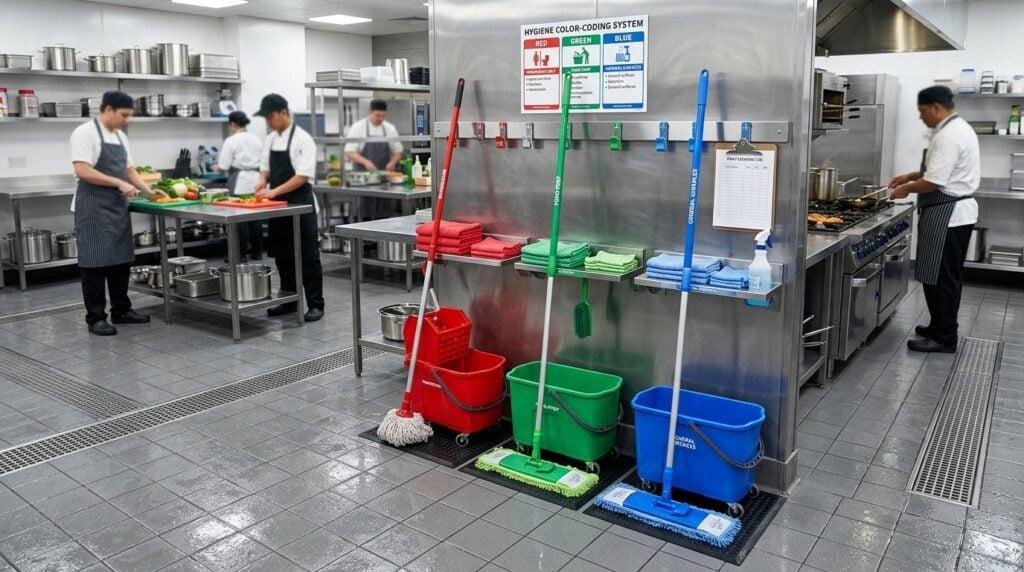
These are the specific failures that most frequently appear in EHO inspection reports and improvement notices related to cleaning:
- ▸Domestic disinfectants used on food-contact surfaces without BS EN 1276 certification
- ▸No Safety Data Sheets on site for chemicals in use
- ▸No cleaning schedule, or a schedule that has not been reviewed since the business opened
- ▸Sanitiser applied without prior cleaning (single-stage application)
- ▸The same mop is used across kitchen floors and washroom areas, with no colour-coded segregation
- ▸Cleaning chemicals stored in the food storage area or alongside food packaging materials
- ▸Handwashing stations stocked with hand wash that carries no BS EN 1499 certification
- ▸Contact times not observed; staff spray and wipe immediately
Pre-Inspection Cleaning Compliance Checklist
Run through this self-audit before any planned inspection, and build it into a quarterly internal review.
Products:
- ▸Every disinfectant on food-contact surfaces carries BS EN 1276 or BS EN 13697 explicitly on the label or datasheet
- ▸No domestic cleaning products in use on food-contact surfaces
- ▸Hand soap at all handwashing stations carries BS EN 1499 certification
- ▸All products are commercial-grade and in original labelled containers
Documentation:
- ▸Safety Data Sheet for every chemical product in a labelled folder, on site, accessible to all staff
- ▸COSHH risk assessment completed and current
- ▸Cleaning schedule in place, names specific products, includes dilution ratios and contact times
- ▸Cleaning schedule reviewed within the last 12 months or whenever products changed
- ▸Staff training records show cleaning procedure and chemical handling training
Storage:
- ▸Chemicals stored in a locked cupboard
- ▸Completely separate from food, food contact materials, and packaging
- ▸No decanting into unlabelled containers
Equipment:
- ▸Colour-coded mops, cloths, and buckets assigned to specific zones
- ▸Red equipment for washrooms and sanitary areas; green for food preparation; not interchanged
- ▸Wet floor signs are available and used whenever floors are wet
Special Considerations for Schools, Care Homes, and Healthcare Kitchens
UK food hygiene regulations apply equally across all food businesses. Some sectors face additional layers that change the product requirements.
School and Educational Catering
School kitchens are inspected by EHOs under the same framework as restaurants. Allergen management is a higher-priority concern given the potential severity of reactions in young people. Following the introduction of Natasha’s Law in October 2021, schools must demonstrate robust cross-contamination controls in food preparation. Dedicated colour-coded equipment, separate storage, and single-use cloths in allergen prep areas are standard EHO expectations in school catering.
Care Homes and Healthcare Kitchens
Care home kitchens sit under dual regulatory oversight: EHOs for food hygiene and the Care Quality Commission for infection control in registered settings. The key additional product requirement: care homes should hold at least one disinfectant carrying BS EN 14476 virucidal certification. Standard EN 1276 products kill bacteria; EN 14476 products also kill specified viruses critical during norovirus outbreaks, which are common in residential care environments and highly contagious among residents with reduced immunity.
How Cleaning Product Failures Affect Your Food Hygiene Rating Explained
The FHRS rating (0–5) is determined by three assessment areas:
- Hygienic food handling
- Cleanliness and condition of facilities and building
- Confidence in management/control procedures
Cleaning product compliance failures appear in areas 2 and 3.
A kitchen with compliant products but no documented schedule fails on area 3 (confidence in management). A kitchen with a good schedule but non-certified products fails in area 2. Failing in the most common scenario among independent operators typically results in a rating of 2 or below.
The FHRS scoring works on the basis of the lowest-scoring area determining the overall band. A perfect score on food handling does not compensate for serious failures in documentation or facilities.
For delivery-dependent businesses, a rating of 2 means removal from Just Eat and Deliveroo. For businesses in Wales or Northern Ireland, a rating of 2 must be displayed in the window. For any business in England, when mandatory display is enacted, the same applies. The legislation has not changed. The commercial consequences of non-compliance are growing.
2026 Regulatory Developments UK Food Businesses Need to Know
FHRS Mandatory Display in England
The FSA’s Future of Food Regulation programme includes a proposal to make FHRS display mandatory in England. A progress report is expected in June 2026. If the proposal advances, food businesses in England will need to display their rating prominently, bringing the requirement in line with Wales and Northern Ireland. The commercial implication for restaurants trading on delivery platforms will be immediate.
Post-Brexit Labelling
Following January 2024 assimilation, some certification references on packaging now reflect GB standards rather than EU references. When assessing a product’s EN 1276 status, check both the label and the supplier’s technical documentation if the label reference is unclear.
Restaurant Cleaning Compliance: A Four-Week Action Plan
This is what a restaurant manager should actually do after reading this article. Not in theory, in practice, starting Monday.
Week 1: Audit your current cleaning products
Go through every product in your cleaning cupboard. For each one, write down:
- ▸Product name
- ▸Where it is used
- ▸Does it carry BS EN 1276 (for surface disinfectants)?
- ▸Does it carry BS EN 1499 (for hand soaps)?
- ▸Is there a Safety Data Sheet for it on site?
At the end of this audit, you will have a list of compliant products, a list of non-compliant products to replace, and a gap in your SDS folder where documents are missing.
Week 2: Replace non-compliant products and collect missing SDS
Order commercial-grade replacements for any domestic or uncertified products. Request Safety Data Sheets from your supplier for every chemical product in use. Any reputable supplier provides these on request. Create or update your SDS folder in the cleaning cupboard.
Browse our kitchen cleaning chemicals for certified commercial alternatives.
Week 3: Update your cleaning schedule
Rewrite your cleaning schedule to name the specific products now in use, include dilution ratios for concentrates, and add contact times for each disinfectant. Cross-check the schedule against every area in your premises’ kitchen zones, pass, front-of-house, washrooms, and waste areas. Update your COSHH assessment to reflect any product changes.
Week 4: Train your team and run a mock inspection
Brief all staff on the cleaning products, the two-stage process, the contact times, and the colour-coding system. Run through the pre-inspection checklist above. If a member of staff cannot describe the cleaning procedure or explain the colour-coding, that is the gap an EHO will find. Fix it before the inspector does.
Frequently Asked Questions
What cleaning products do UK restaurants need by law?
UK food businesses must maintain clean premises and disinfect food-contact surfaces under the Food Safety and Hygiene (England) Regulations 2013. In practice, this requires: a food-safe degreaser for Stage 1 cleaning, a BS EN 1276-certified disinfectant or sanitiser for Stage 2 disinfection of food-contact surfaces, BS EN 1499-certified antibacterial hand soap at handwashing points, commercial warewashing chemicals, and waste management supplies including segregated refuse bags. All chemical products require Safety Data Sheets on site and inclusion in a COSHH assessment.
Is EN 1276 a legal requirement for UK restaurants?
EN 1276 is not named in the legislation itself. But the Food Safety Act 1990 and associated regulations require food businesses to demonstrate that their cleaning regime is effective. The FSA’s own guidance specifies BS EN 1276 or BS EN 13697 as the standards that disinfectants must meet for food-contact surfaces. EHOs use these standards during inspections. In practice, using a disinfectant without EN 1276 on food-contact surfaces is a compliance failure.
Can an EHO ask to see Safety Data Sheets?
Yes. EHOs routinely check that Safety Data Sheets are on site and accessible for all chemical products in use. This requirement sits under the Control of Substances Hazardous to Health Regulations 2002 (COSHH), not under food hygiene law, but EHOs cross-reference both during inspections. SDS documents must be physically on site and accessible to staff who use the products, not just available on a manager’s laptop or stored off-site.
Do I legally need a COSHH assessment for kitchen cleaning chemicals?
Yes. Any employer using hazardous substances, which includes virtually all commercial cleaning chemicals, must complete a COSHH risk assessment under the Control of Substances Hazardous to Health at Work Regulations 2002. The assessment must identify the chemicals in use, the risks they pose, and the control measures in place (PPE, dilution, ventilation, storage). EHOs may check COSHH documentation during food hygiene inspections as part of the management confidence assessment.
Can I use supermarket antibacterial spray in a restaurant?
Most supermarket antibacterial sprays do not carry BS EN 1276 certification. Using them on food-contact surfaces does not meet the cleaning standard the FSA expects and that EHOs assess against. A product can legally claim “kills 99.9% of bacteria” in its marketing without having passed the EN 1276 test protocol. The two claims are not the same. For food-contact surface disinfection, use a product that explicitly cites BS EN 1276 on its label or technical datasheet.
Are domestic cleaning products illegal in a restaurant?
Domestic cleaning products are not illegal by category. But most do not meet BS EN 1276 for use as food-contact surface disinfectants, and using them as a substitute for certified commercial products creates compliance exposure under the Food Safety and Hygiene Regulations. Using domestic bleach directly on food preparation surfaces also creates a chemical contamination risk, a food safety hazard in its own right under the regulations.
What is the difference between BS EN 1276 and BS EN 13697?
Both are British Standards for bactericidal cleaning products. EN 1276 tests the product in liquid suspension under controlled laboratory conditions; EN 13697 tests the product as applied directly to a surface, the more operationally realistic test. EN 1276 requires a 5-log (99.999%) bacterial reduction; EN 13697 requires a 4-log (99.99%) reduction. A product carrying both provides stronger compliance evidence. For most commercial kitchen applications, EN 1276 is the minimum standard. For surface-applied disinfectants, EN 13697 is the more directly relevant test.
How does a failed EHO inspection affect my Food Hygiene Rating?
The FHRS rating (0–5) is determined by three assessment areas: hygienic food handling, cleanliness and condition of facilities, and confidence in management controls. Cleaning product failures typically affect the second and third areas. Serious cleaning non-compliance, non-certified products, no SDS, and no cleaning schedule typically result in a rating of 2 or below. In Wales and Northern Ireland, a rating of 2 must be displayed publicly. For delivery platform-dependent restaurants, a rating of 2 triggers removal from major platforms.
Getting Your Cleaning Products Right
The gap between looking clean and being legally compliant comes down to product certification, documentation, and process. The regulations are not prescriptive about brand; they are prescriptive about the standard and outcome.
The practical summary for any UK food business:
- Replace domestic disinfectants on food-contact surfaces with BS EN 1276-certified commercial products
- Ensure a Safety Data Sheet is on site for every chemical product in use
- Write or update your cleaning schedule to name specific products, dilution ratios, and contact times
- Complete or update your COSHH assessment
- Implement colour-coded cleaning equipment if you have not already
For the full zone-by-zone product breakdown, certification reference table, and procurement checklist, read our complete commercial kitchen cleaning supplies guide.
For commercial-grade cleaning products available in trade quantities with next-day UK delivery, browse our kitchen cleaning products range.
References