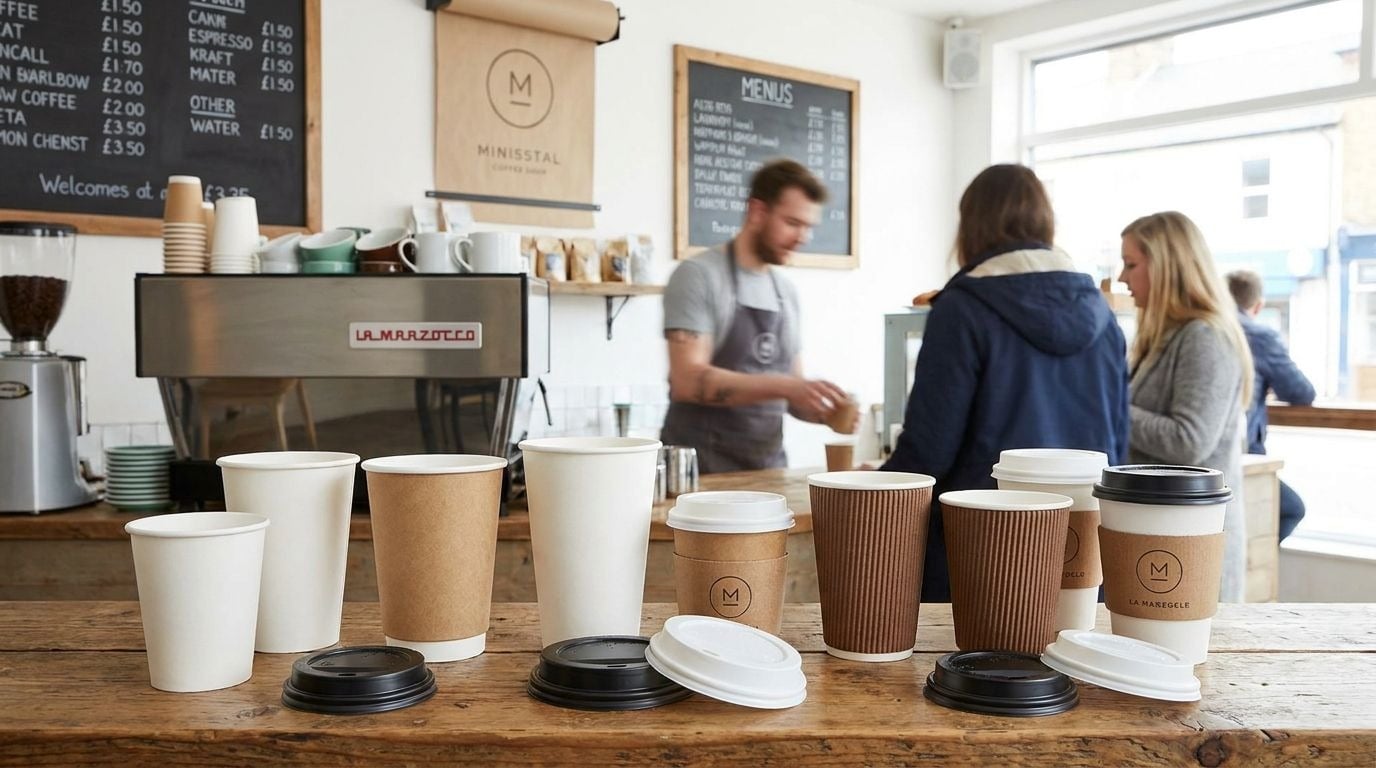
Buying paper coffee cups in bulk for a UK cafe, coffee shop, or catering operation looks straightforward until you open the first delivery and find the lids do not fit, or until your accountant asks why you are paying Plastic Packaging Tax on cups your supplier described as compostable.
This guide covers what no other bulk buying guide in the UK currently addresses: how to match lids to cups before you order at volume, which lining types attract the Plastic Packaging Tax and which do not, what a cup actually costs per serve when you include the lid, sleeve, and compliance fees, and which sustainability claims you can safely make about your cups without CMA enforcement risk.
Regulatory references in this guide are based on current guidance from HMRC, the Competition and Markets Authority, and the Food Standards Agency, all reviewed in May 2026.
If you want a guide to cup construction, wall types, and lining materials, we have already written those in depth. This guide is specifically about the bulk buying decision and the financial and compliance traps that catch operators who skip the details.
Many UK suppliers promote PLA-lined cups as compostable without disclosing that they remain subject to the Plastic Packaging Tax. This guide focuses on regulatory and operational realities rather than marketing terminology.
Quick Answer
When buying paper coffee cups bulk in the UK in 2026, the four questions that most affect your total cost and compliance position are: which lining type is the cup made with and does it attract the Plastic Packaging Tax, does the lid rim diameter match your cup before you order at volume, do you need a sleeve and have you included that cost in your per-serve calculation, and what can you legally say about the cup’s sustainability on your menu or packaging.
Who This Guide Is For
| Business Type | Primary Concern | Key Section |
| Independent coffee shop | Total cost per serve, lid fit | Cost comparison, lid compatibility |
| Cafe chain or multi-site operator | PPT compliance, volume pricing | PPT section, bulk pricing thresholds |
| Catering and events operator | Sleeve cost, size mapping | Sleeve decision, UK size guide |
| Food retailer with hot drinks | Greenwashing risk, claims | Safe vs risky claims section |
| New cafe opening | All of the above | Read every section |
The Lining Decision and the Plastic Packaging Tax: What Every Bulk Buyer Must Know
This is the most financially important section in this article and the one most completely absent from every other bulk buying guide in the UK market.
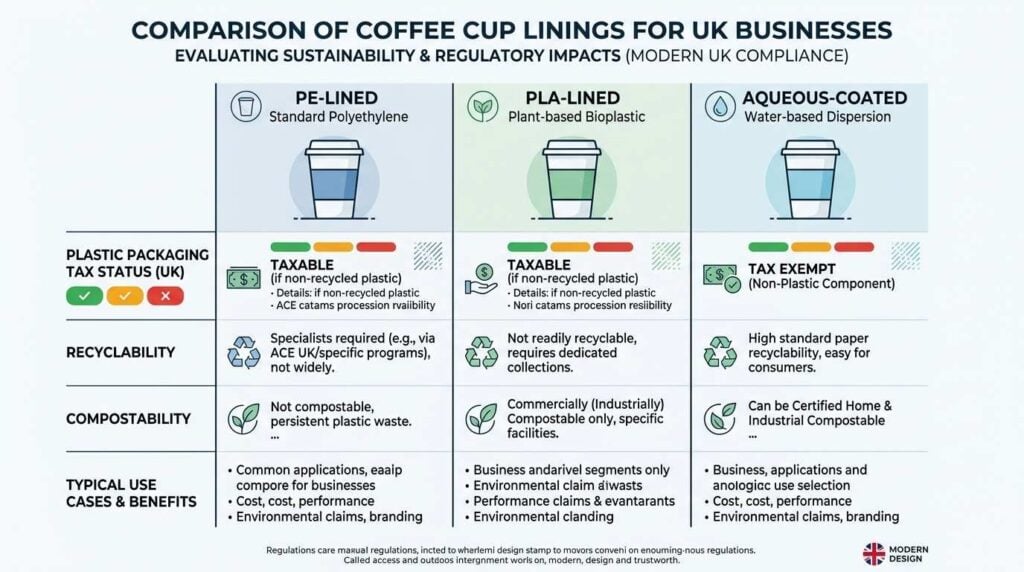
Paper coffee cups are made with one of three lining types: polyethene (PE), polylactic acid (PLA), or aqueous coating. The lining you choose determines not just the sustainability and recyclability story you can tell, but whether your cups attract the UK Plastic Packaging Tax.
PE-Lined Cups
PE (polyethene) lining is the traditional plastic coating bonded to the inside of most disposable coffee cups. It is the lowest cost lining option, performs reliably at high temperatures, and is the most widely used lining in UK coffee shops.
PPT position: PE is plastic. PE-lined cups manufactured in the UK or imported into the UK with less than 30% recycled content are subject to the Plastic Packaging Tax at £228.82 per tonne from April 2026, as published in HMRC’s PPT guidance at gov.uk. At typical cup weights of 10 to 14 grams per cup, this translates to approximately 0.2 to 0.3 pence per cup in PPT liability. At 500 cups per day, this is a small but real cost that compounds over a year.
Recyclability: PE-lined cups are not accepted in standard UK kerbside recycling. They require specialist cup recycling facilities. The proportion of PE-lined cups that are actually recycled in the UK remains very low.
Key takeaway: PE-lined cups are the lowest unit cost option but carry PPT liability and have no kerbside recycling route. Include the PPT cost in your per-serve calculation.
PLA-Lined Cups
PLA (polylactic acid) lining is made from plant starch and is widely marketed as compostable. It performs similarly to PE in hot drink applications up to around 85 degrees Celsius.
PPT position: This is the trap that catches the most operators. PLA is classified as plastic under HMRC’s Plastic Packaging Tax rules, as confirmed in HMRC’s published PPT guidance at gov.uk. A PLA-lined cup with less than 30% recycled plastic content is subject to the full PPT rate of £228.82 per tonne regardless of its compostable certification, its plant-based origin, or any sustainability claim made about it by the supplier. Buying PLA-lined cups because a supplier describes them as compostable or biodegradable does not exempt them from PPT. The tax applies to the material classification, not the marketing language.
This matters because multiple UK cup suppliers currently describe PLA-lined cups using language like “completely biodegradable” or “entirely compostable” without disclosing the PPT liability. A buyer acting on that description without checking the HMRC classification is making a purchasing decision based on incomplete information.
Recyclability: PLA-lined cups are not recyclable through kerbside systems and contaminate paper recycling streams. They require industrial composting conditions to break down correctly. Most UK customers do not have access to industrial composting, so the majority of PLA-lined cups currently end up in general waste.
Key takeaway: PLA-lined cups attract the full Plastic Packaging Tax despite being plant-based and compostable-certified. This remains one of the most commercially important compliance issues affecting UK paper cup buyers in 2026, and one of the details most frequently omitted from supplier product pages.
For a full explanation of how PLA is classified under the Plastic Packaging Tax and what this means for your compliance position, see our guide to UK plastic packaging tax and EPR for food businesses.
Aqueous-Coated Cups
Aqueous coating uses a water-based mineral or polymer dispersion coating rather than a plastic film. It is the newer option and is designed to allow the cup to be processed through paper recycling streams without the plastic contamination problem of PE or PLA linings.
PPT position: Aqueous-coated cups are not plastic-lined and are generally outside the scope of the Plastic Packaging Tax. This is a genuine financial advantage for operators buying at volume. No PPT liability on the cup body means a lower true cost per serve than the unit price alone suggests when compared against PE or PLA alternatives.
Recyclability: Aqueous-coated cups have better recyclability credentials than PE or PLA alternatives, though acceptance varies by facility. Always confirm recycling compatibility with your local waste contractor before making recycling claims to customers.
Key takeaway: Aqueous-coated cups remove PPT liability entirely, support more honest customer communication, and have better recyclability potential. The unit cost premium over PE is often smaller than the PPT saving at volume.
Our compostable plastic-free paper cups use an aqueous water-based coating rather than PE or PLA, which removes PPT liability and simplifies both your compliance position and your customer communication.
Lining Comparison Summary
| Lining Type | PPT Liable | Kerbside Recyclable | Compostable | Typical Unit Cost |
| PE (polyethene) | Yes (unless 30% recycled) | No | No | Lowest |
| PLA (polylactic acid) | Yes | No | Industrial only | Low to moderate |
| Aqueous coating | No | Potentially yes | No | Moderate |
For a detailed technical explanation of how each lining type affects cup performance, heat resistance, and disposal options, see our dedicated guide to paper cup materials and linings explained.
Lid Rim Diameter Compatibility: The Bulk Buying Trap Nobody Explains
This is the operational problem that catches operators most often when buying cups and lids from different suppliers, and no UK bulk buying guide currently addresses it clearly.
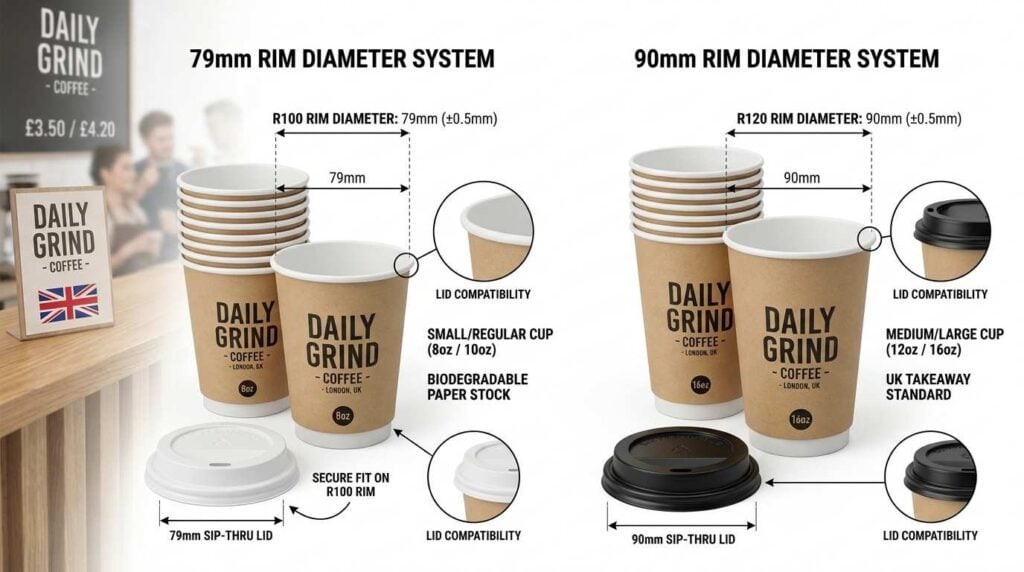
Paper coffee cup lids are manufactured to fit specific rim diameters. The rim diameter is the external diameter of the rolled top edge of the cup. A lid manufactured for a different rim diameter will either fall off, sit too loosely to prevent spills, or require force to fit, which risks cracking the lid and frustrating baristas during service.
The problem arises because cup sizes in fluid ounces (8oz, 12oz, 16oz) do not directly specify rim diameter. Two different manufacturers can produce a 12-oz cup with different rim diameters. If you buy cups from one supplier and lids from another without confirming rim diameter compatibility, you may receive 1000 lids that do not fit your 1000 cups.
Standard UK Rim Diameters
The two most common rim diameters in the UK market are 79mm and 90mm, though 80mm and 89mm variants exist from some manufacturers.
| Cup Size | Common Rim Diameter | Notes |
| 4oz espresso cups | 62mm | Narrow; specific lid required |
| 8oz cups | 79mm or 80mm | Most common small cup standard |
| 12oz cups | 79mm or 90mm | Varies significantly by manufacturer |
| 16oz cups | 90mm | Most common large cup standard |
| 20oz cups | 90mm | Confirm with the supplier |
The 12oz size is where most compatibility problems occur because some manufacturers produce 12oz cups with a 79mm rim (matching the 8oz standard) while others use a 90mm rim (matching the 16oz standard). If you are buying 12-oz cups and lids in bulk, confirm the rim diameter in millimetres with your supplier before placing the order. Do not assume compatibility based on the fluid ounce size alone.
How to Confirm Compatibility Before Ordering at Volume
Always order samples before committing to bulk quantities. Fit the sample lid to the sample cup, fill with hot water at your standard serving temperature, and carry it at arm’s length for 60 seconds. This replicates the handoff distance from counter to customer and reveals any lid seal weakness before you have 5000 units in your storeroom.
If you are switching suppliers for either cups or lids, treat it as a new compatibility test, even if the fluid ounce size appears identical to your current stock.
Our coffee cup lids range includes lids sized for 8oz through 16oz cups with rim diameter specifications on each product page. Our 8oz bagasse pulp coffee cup lid is a compostable lid option for operators wanting to remove plastic from the lid component as well as the cup.
The Sleeve Decision: When You Need One and What It Costs Per Serve
Single-walled cups transfer heat to the outside of the cup quickly. A customer holding a single-wall cup of coffee at 85 degrees Celsius for more than a few seconds will find it uncomfortable or painful to hold. A sleeve solves this, but adds cost, storage space, and a step to the service process.
Double-wall and ripple-wall cups have insulating air layers built into the cup construction and do not require a sleeve in normal service conditions.
This matters for the bulk buying decision because the true cost of a single-wall cup is the cup plus the sleeve. Operators who compare single-wall cup unit costs against double-wall or ripple-wall unit costs without including the sleeve cost are making an inaccurate comparison.
Sleeve Cost Impact on Per-Serve Calculation
| Cup Type | Cup Unit Cost (est.) | Sleeve Cost (est.) | True Per-Serve Cost |
| Single-wall PE-lined 12oz | 4 to 6p | 2 to 3p | 6 to 9p |
| Double-wall kraft 12oz | 7 to 10p | None needed | 7 to 10p |
| Ripple wall kraft 12oz | 8 to 12p | None needed | 8 to 12p |
| Aqueous coated 12oz | 6 to 9p | Depends on wall type | 6 to 12p |
The figures above are illustrative estimates based on typical UK wholesale pricing in 2026 and will vary by supplier, volume, and specification.
At 300 serves per day, a 2 pence sleeve cost adds approximately £1,800 per year to your packaging cost compared to a sleeve-free double or ripple wall cup. The ripple wall cup that appears more expensive per unit is often cost-neutral or cheaper per serve once the sleeve is removed from the single-wall calculation.
For a detailed comparison of single-wall, double-wall, and ripple-wall cup construction, including storage space requirements and handling differences, see our guide to paper coffee cup construction for UK buyers.
Our 12oz kraft ripple coffee cup is a sleeve-free option with built-in 3-ply insulation, available in bulk quantities with trade pricing. Our kraft coffee clutch sleeves are available for operators using single-wall cups who need a sleeve to complete their service setup.
UK Cup-to-Drink Size Mapping: Ordering the Right Size at Volume
Most paper cup manufacturers reference fluid ounce sizes. Most UK coffee shops describe drinks by name. The mismatch causes ordering errors at volume that result in either wasted stock or a gap in your service range.
| UK Drink Name | Volume | Correct Cup Size | Notes |
| Espresso (single or double) | 25 to 60ml | 4oz cup | Rarely takeaways; confirm if needed |
| Macchiato | 60 to 90ml | 4oz cup | Small format; specific lid needed |
| Flat white | 150 to 180ml | 6oz cup | Often underordered; check your menu |
| Cappuccino (regular) | 180 to 220ml | 8oz cup | Most common small cup format |
| Latte (regular) | 250 to 280ml | 12oz cup | Most common volume seller |
| Latte (large) | 350 to 400ml | 16oz cup | Second-highest volume for most cafes |
| Hot chocolate (large) | 400 to 450ml | 16oz or 20oz | Confirm with your recipe |
| Americano (large) | 350 to 400ml | 16oz cup | Black coffee volume varies |
The flat white is the most commonly underordered cup size in UK cafes because operators use an 8-oz cup for a drink that actually fills it, leaving no room for a lid to seal correctly. If your flat white sits at 180ml or above, use a 6-oz cup and confirm the lid fits with water at serving temperature before bulk ordering.
For a full buying guide to paper coffee cups by size, wall type, and application, see our complete guide to the best paper coffee cups for UK coffee shops.
Total Cost of Ownership: What Your Cups Actually Cost Per Serve
Most bulk buying decisions are made on unit cost alone. The unit cost of the cup is one of five cost components that determine what a cup of takeaway coffee actually costs to serve.
| Cost Component | Single Wall PE 12oz | Ripple Wall Kraft 12oz | Aqueous Coated 12oz |
| Cup unit cost | 4 to 6p | 8 to 12p | 6 to 9p |
| Lid unit cost | 1 to 2p | 1 to 2p | 1 to 2p |
| Sleeve cost | 2 to 3p | None | None (if double or ripple wall) |
| PPT liability per cup | 0.2 to 0.3p | 0.2 to 0.3p | None |
| EPR fee per cup | Small (non-recyclable) | Small (non-recyclable) | Lower (recyclable potential) |
| True per-serve cost | 7 to 11p | 9 to 14p | 7 to 11p |
The figures above are illustrative estimates based on typical UK wholesale pricing in 2026 and will vary by supplier, volume, and specification.
The single-wall PE cup and the ripple-wall kraft cup end up at comparable per-serve costs once sleeve and PPT are included. The ripple-wall cup delivers better hand comfort, no sleeve waste, and a better sustainability narrative. The aqueous-coated cup removes PPT liability entirely and potentially delivers better recyclability messaging to customers.
The decision that looks like a unit cost saving at the ordering stage often disappears entirely when the full per-serve cost is modelled. Model all five components before committing to a bulk order.
Bulk Pricing Thresholds: What Changes at Volume
UK paper coffee cup pricing typically changes at three volume thresholds. Understanding where those thresholds fall helps you plan stock levels and cash flow.
Under 1000 units: Standard retail pricing. No volume discount. Suitable for testing new sizes or lining types before committing to larger stock.
1000 to 5000 units: First volume tier. Most UK wholesale suppliers offer a price reduction at this level. Suitable for independent coffee shops with moderate daily volumes.
5000 to 25000 units: Second volume tier. Meaningful per-unit price reduction versus retail. Suitable for busy independent sites or small multi-site operators.
25000 units and above: Trade and wholesale pricing. Typically, the best available per-unit cost. Suitable for multi-site operators, catering businesses, or operators with adequate storage capacity.
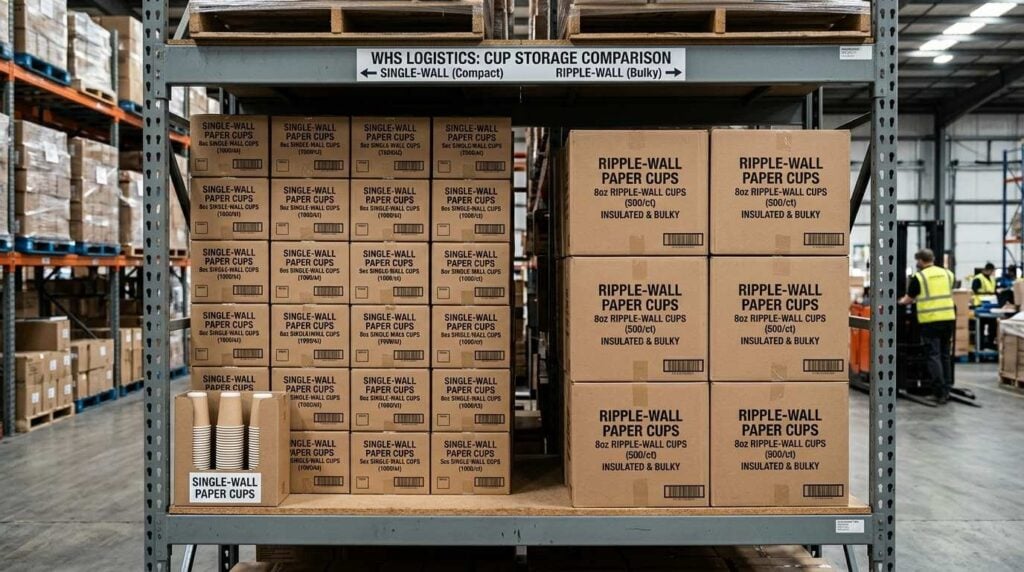
The storage constraint is the practical limit on bulk ordering for many operators. Ripple-wall and double-wall cups take up significantly more storage space than single-wall alternatives due to their wider profile.
A case of ripple-wall 12oz cups occupies approximately 40 to 60% more shelf space than the same quantity of single-wall cups at the same fluid ounce size. Operators switching from single-wall cups to ripple-wall formats often underestimate the additional storage space required for bulk stock holding, particularly when ordering at wholesale volume tiers. Factor storage space into your volume decision before ordering at the highest tier.
Browse our full paper coffee cups and accessories range for current bulk pricing across all cup sizes and wall types.
Safe vs Risky Sustainability Claims for Paper Coffee Cups
The CMA Green Claims Code applies to coffee cup sustainability claims, as published at gov.uk/cma. Under the Digital Markets, Competition and Consumers Act 2024, the CMA has enforcement powers to impose fines of up to 10% of global annual turnover for misleading environmental claims. This applies to retailers and food service operators, not just packaging manufacturers.
| Claim | Risk Level | Why |
| “Our cups are biodegradable” | Very High | No legal definition, no timeframe, unsubstantiated |
| “Eco-friendly cups” | High | No measurable basis, cannot be substantiated |
| “Compostable cups” without disposal guidance | High | Misleading if customers have no composting route |
| “Our cups are better for the planet” | High | Comparative claim requiring evidenced baseline |
| “PE-lined cups — please use our cup recycling point” | Low | Specific disposal instructions, honest about the route |
| “Aqueous-coated cup — recyclable at paper recycling facilities” | Low | Specific claim, verify local acceptance first |
| “EN13432 certified compostable at industrial facilities. Scan for local options.” | Low | Specific certification, honest about conditions |
| “Made from sustainably sourced paper. FSC certified.” | Low | Specific, verifiable, factual material claim |
| “No plastic lining. Aqueous coating.” | Low | Factual material claim, easily verified |
The highest-risk position is printing “compostable” or “biodegradable” on a PLA-lined cup without disclosing that industrial composting conditions are required, that most customers cannot access those conditions, and that the cup is subject to the Plastic Packaging Tax. All three facts are material information that a consumer or regulator would reasonably expect to be disclosed.
For the full greenwashing framework covering all packaging types and the CMA’s six green claims principles, see our complete guide to compostable food packaging for UK businesses.
Supplier Due Diligence Checklist for Bulk Cup Orders
Before placing any bulk order, get written confirmation of these points from your supplier.
Compliance questions:
- ▸ What is the lining type: PE, PLA, or aqueous coating?
- ▸ Is the cup subject to the Plastic Packaging Tax? If PLA-lined, what is the recycled content percentage?
- ▸ Does the cup carry EN13432 certification, and if so, for which components?
- ▸ Is the cup or lining PFAS-free?
Compatibility questions:
- ▸ What is the rim diameter in millimetres for each cup size?
- ▸ Which lid SKUs are confirmed compatible with each cup size?
- ▸ Are sample quantities available before the bulk order commitment?
Commercial questions:
- ▸ What are the pricing tiers by volume, and what is the minimum order quantity?
- ▸ What is the lead time at each volume level?
- ▸ Is free delivery available, and at what order value threshold?
- ▸ Can cups be custom printed, and does printing affect any certification?
Food safety questions:
- ▸ Does the cup carry UK food contact compliance under FSA requirements, as published at food.gov.uk?
- ▸ Are the inks and coatings used in printing food-safe?
- ▸ What is the maximum safe liquid temperature for the finished cup?
Suppliers who cannot answer compliance and compatibility questions with documentation should be treated with caution, regardless of how their product pages present the cups.
Choosing the Right Paper Coffee Cups for Bulk Buying in the UK
The bulk buying decision for paper coffee cups comes down to four things done in the right order. Confirm the lining type and its PPT position before comparing unit costs. Confirm lid rim diameter compatibility before placing volume orders. Model the true per-serve cost, including sleeve and compliance fees, rather than unit cost alone. And ensure any sustainability claim you make to customers is specific, certified, and honest about disposal conditions.
For most UK coffee shops and catering operators in 2026, the aqueous-coated cup removes the most financial and compliance risk at a unit cost premium that frequently disappears when PPT and sleeve costs are removed from the comparison. The ripple-wall format removes sleeve cost and waste while delivering better hand comfort and a stronger sustainability narrative than single-wall PE alternatives.
Need help selecting the most cost-effective and compliant paper coffee cups for your operation? Explore our full range of paper coffee cups, lids, and accessories or contact our team for tailored recommendations, samples, and trade pricing.
FAQs
Are PLA-lined coffee cups subject to the Plastic Packaging Tax?
Yes. PLA is classified as plastic under HMRC’s Plastic Packaging Tax rules. PLA-lined cups with less than 30% recycled plastic content are subject to PPT at £228.82 per tonne regardless of their compostable certification or plant-based origin. Always confirm PPT liability with your supplier before purchasing PLA-lined cups in bulk.
How do I know if a lid will fit my cups before ordering in bulk?
Confirm the rim diameter in millimetres for both the cup and the lid from your supplier. Order samples and test with hot liquid at your serving temperature before committing to bulk quantities. Do not assume compatibility based on fluid ounce size alone, as rim diameters vary between manufacturers at the same cup volume.
Do I need sleeves for all paper coffee cups?
No. Double-wall and ripple-wall cups have built-in insulation and do not require a sleeve for normal hot drink service. Single-wall cups transfer heat to the exterior quickly and typically require a sleeve for comfortable handling. Include sleeve cost in your per-serve calculation when comparing single-wall against double or ripple-wall options.
What is the difference between PE, PLA, and aqueous-coated cups for a UK coffee shop?
PE-lined cups are the lowest cost and most widely used, but are not kerbside recyclable and attract PPT. PLA-lined cups are marketed as compostable but also attract PPT, are not kerbside recyclable, and require industrial composting conditions that most customers cannot access. Aqueous-coated cups are outside the PPT scope, have better recyclability potential, and support more honest customer communication about disposal.
Can I recycle paper coffee cups in standard kerbside recycling?
Most PE-lined and PLA-lined cups are not accepted in standard UK kerbside recycling. Aqueous-coated cups have better compatibility with paper recycling streams, but acceptance varies by local facility. Specialist cup recycling schemes exist, but cover a small proportion of UK cups. Always verify the disposal route with your waste contractor before making recycling claims to customers.
What cup size should I use for a flat white?
A flat white at 150 to 180ml typically requires a 6-oz cup. Using an 8oz cup leaves adequate headspace for a lid seal. If your flat white recipe sits at 180ml or above, use a 6-oz cup and test the lid fit with water at serving temperature before bulk ordering. This is one of the most commonly misordered cup sizes in UK independent coffee shops.
What bulk volume threshold gives the best per-unit price for UK coffee cup buyers?
Most UK wholesale suppliers offer meaningful per-unit price reductions from 1000 units upwards, with the best available pricing typically at 25000 units and above. Storage space is the practical constraint for most independent operators. Factor storage capacity into your volume decision alongside per-unit cost.
Author
We Can Source It Team
The We Can Source It Team supplies certified eco-friendly takeaway packaging, compostable food containers, catering products, cleaning supplies, and hospitality essentials to food businesses across the UK. Our content is written to help restaurants, takeaways, cafés, and food service operators make practical, compliant, and cost-effective decisions about packaging, sustainability, and UK regulatory requirements.
References and further reading:
- ▸ HMRC: Plastic Packaging Tax – who must register and steps to take: gov.uk/guidance/check-if-you-need-to-register-for-plastic-packaging-tax
- ▸ HMRC: Plastic Packaging Tax – check which packaging is subject to the tax: gov.uk/guidance/work-out-which-packaging-is-subject-to-plastic-packaging-tax
- ▸ HMRC: Plastic Packaging Tax – full guidance collection: gov.uk/government/collections/plastic-packaging-tax
- ▸ CMA: Green Claims Code – making environmental claims: gov.uk/government/publications/green-claims-code-making-environmental-claims
- ▸ FSA: Food contact materials – regulations and guidance for businesses: food.gov.uk/business-guidance/food-contact-materials-regulations