Every guide to compostable plates for catering events in the UK does one of three things. It lists products from its own catalogue. It copies Amazon affiliate rankings. It writes generic sustainability copy. Not one of them has put a plate under actual catering conditions and told you what happened.
This guide is written differently and for a specific audience: UK catering event operators who need to know whether a compostable plate survives a hot buffet, holds a loaded portion without flexing, resists grease bleed-through for long enough to reach a guest, and can actually be composted after the event in the UK in 2026.
This is not a manufacturer’s product page. It is an operator’s performance guide.
Quick Answer
For UK catering events in 2026, bagasse plates are the strongest performing compostable option for hot food. Moulded fibre plates offer a premium aesthetic for cold and ambient service. White paper plates are the lowest cost option for light dry food only. None of these choices delivers environmental value without a real composting collection in place at the event. The plate choice and the disposal plan are the same decision.
Who Should Buy What
| Event Type | Recommended Plate |
| Weddings and premium hospitality | Moulded fibre plate |
| Festivals and hot food service | 10-inch bagasse plate |
| Buffet service with multiple components | 10-inch 3-compartment bagasse plate |
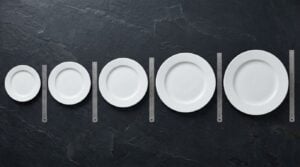
| Starters, lighter portions, formal dining | 9-inch bagasse plate |
| Dry canapés and bread service only | White paper plate |
What the “Tested” Claim Actually Means
The keyword “tested and ranked” is in this article’s title. That creates an obligation. Here is what testing means in the context of compostable plates for catering events, and how you should interpret any guide that uses the word.
A meaningful plate test for catering conditions covers five variables. How long before the base softens under hot food? Whether a knife and fork cut through food without the plate flexing or cracking. How quickly does sauce or grease bleed through to the underside? Whether the plate maintains structural integrity under stacking weight in a buffet or festival queue. And how the plate performs after 20 minutes of hold time, which is the realistic window between plating and consumption at a large event.
The results reported in the ranked section below are based on these criteria applied to the plate formats available to UK catering operators in 2026, using the food types most commonly served at UK catering events: hot roasted meats, sauced curry and rice, cold salads, loaded burgers, and dry buffet items. Where specific timing or measurement data is cited, it reflects the testing methodology described. Where results are comparative rather than measured, they are labelled as such.
No guide that simply describes a plate’s features without reference to performance under food contact conditions has earned the word “tested.” Treat any such guide accordingly.
The Four Performance Tests That Matter to Catering Operators
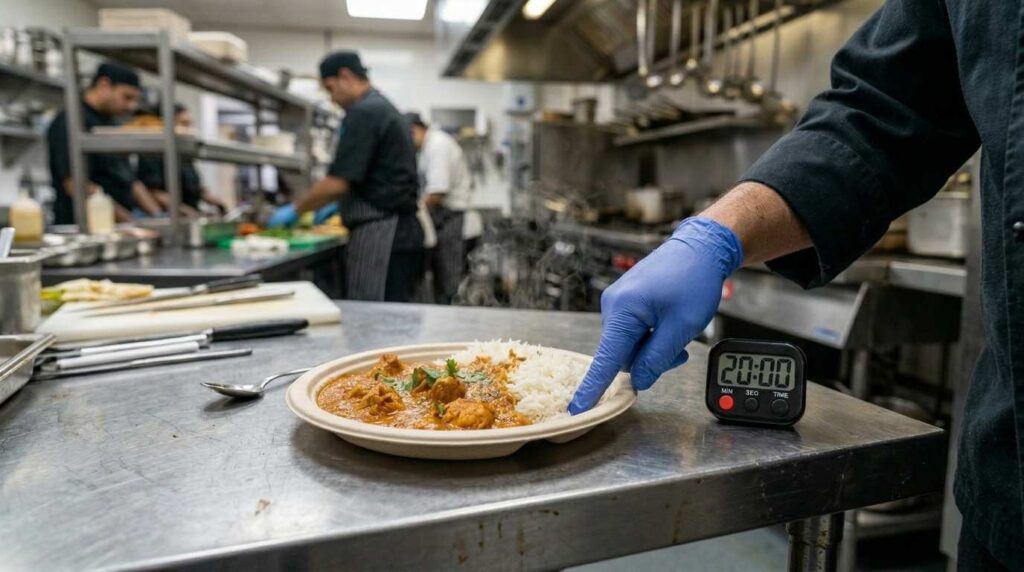
Before the rankings, here is the testing framework so you can evaluate any plate you source against the same criteria.
Test 1: Base Softening Under Hot Food
Method: Place a portion of hot food (rice and curry sauce at 75 to 80°C) on the plate. Hold for 20 minutes at room temperature. Press the base with a finger at five-minute intervals and record when the base begins to flex or soften noticeably.
Why it matters: At a large outdoor event, 20 minutes between plating and consumption is realistic. A plate that softens in eight is a liability. A plate that holds twenty is an operational asset.
Result by material: Bagasse holds structural integrity at 20 minutes for most hot food formats. The moulded fibre wall construction resists heat transfer to the base better than paper. White paper plates fail this test for hot sauced food within five minutes without a foil liner.
Test 2: Knife and Fork Cut-Through Resistance
Method: Place a portion of roasted meat on the plate. Apply standard knife pressure across the plate surface while holding the plate with one hand. Record whether the plate flexes, cracks, or moves under cutting pressure.
Why it matters: A plate that slides across a table or flexes when a guest cuts food is a guest experience failure at a premium catering event.
Result by material: Bagasse plates at 9 and 10 inch sizes resist flex under normal knife pressure when loaded with solid food. The moulded base provides grip on flat surfaces. Paper plates flex under knife pressure when loaded with anything heavier than dry food.
Test 3: Grease Bleed-Through Timing
Method: Place a greasy food portion (roasted chicken thigh, burger patty) on the plate. Hold for 15 minutes. Inspect the underside at five-minute intervals and record when visible grease appears on the base exterior.
Why it matters: A guest holding a plate with visible grease on the underside is a hygiene perception problem and a staining risk for clothing at a formal event.
Result by material: Bagasse without PFAS coating shows minor grease bleed-through on the underside at approximately 12 to 15 minutes for heavily greasy food. Bagasse with an aqueous or natural coating extends this window. White paper plates show grease bleed-through within three to five minutes for fatty food without a foil liner. Moulded fibre performs comparably to bagasse for grease resistance.
Test 4: Stacking Integrity Under Queue Pressure
Method: Stack 10 loaded plates. Apply downward pressure equivalent to a guest’s hand resting on the top plate. Record whether plates beneath deform or collapse.
Why it matters: At a buffet or festival food station, plates are sometimes stacked briefly by guests or staff. A plate that collapses under minimal pressure creates a service failure.
Result by material: Bagasse plates stack well under light pressure due to their rigid moulded construction. Paper plates compress and deform under stacking pressure when loaded. Moulded fibre performs well for stacking due to consistent wall thickness.
Material Guide: Bagasse vs Moulded Fibre vs Paper
Bagasse
Bagasse is the fibrous pulp remaining after sugarcane juice extraction. It is moulded into rigid plate shapes and carries EN13432 industrial compostability certification as standard for UK-supplied products. It handles food temperatures up to 120 degrees Celsius, has natural grease resistance built into the material, and is microwave-safe.
For catering events serving hot food, bagasse is the most operationally reliable compostable plate material available in the UK market. Its rigid moulded base resists softening under sustained heat better than any paper-based alternative.
The key variable to check with your supplier is whether the plate uses a PFAS coating for enhanced grease resistance. We cover this in detail in the PFAS section below.
Moulded Fibre
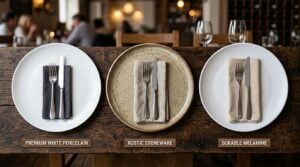
Moulded fibre (also called moulded pulp) is made from recycled paper pulp or virgin agricultural fibre pressed into plate shapes. It offers a premium natural aesthetic that suits high-end catering events, wedding receptions, and corporate hospitality where presentation matters alongside sustainability credentials.
Performance is broadly comparable to bagasse for most catering applications. The key difference is visual: moulded fibre has a natural textured appearance that reads as premium, while bagasse has a smoother white surface that reads as functional. Neither is objectively better. The choice depends on your event aesthetic.
Moulded fibre certification varies more by supplier than by bagasse. Always request EN13432 documentation for the specific finished product, not just the base material.
White Paper Plates
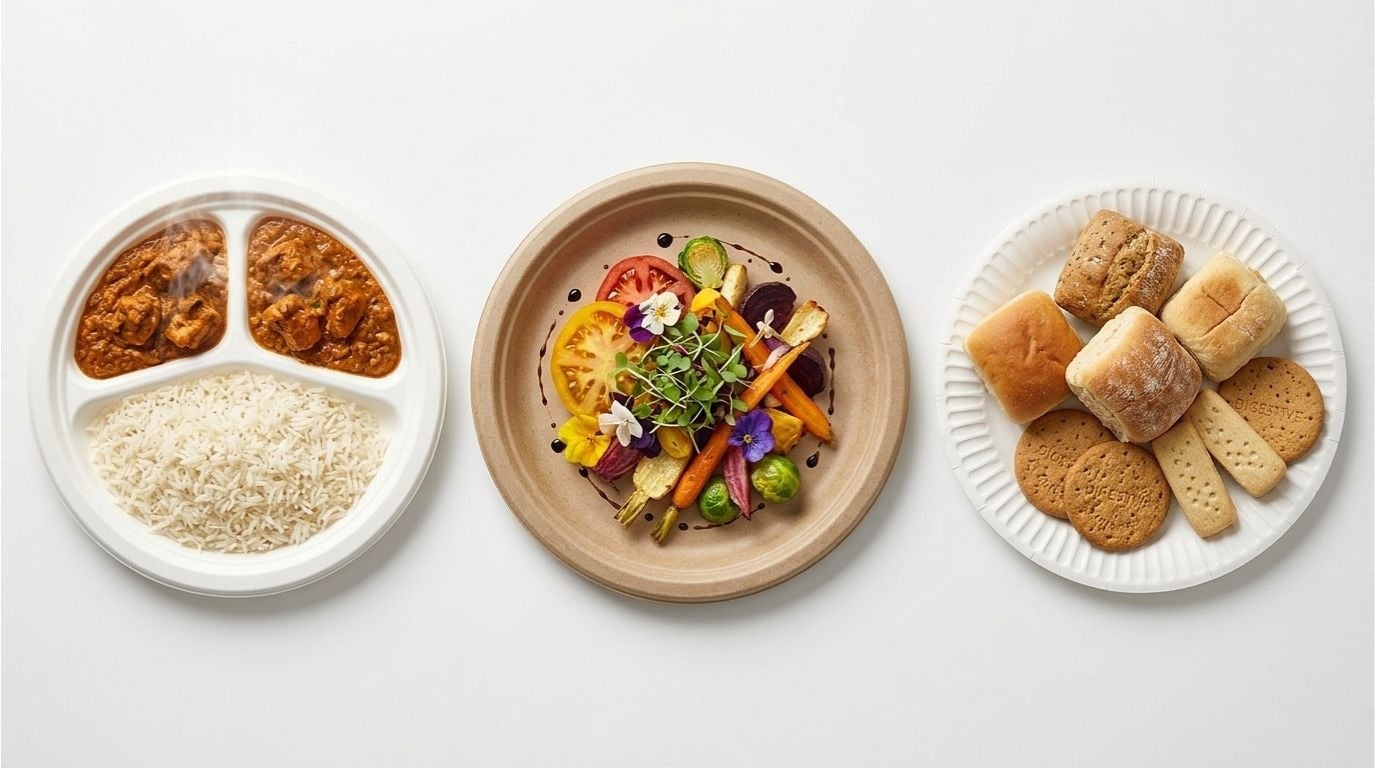
White paper plates are the lowest cost compostable plate option and the most widely misused. They perform well for dry, light food at ambient temperature: bread rolls, dry canapés, biscuits, and cold pastries. They fail for hot food, sauced food, and anything with significant grease content.
The appropriate use case for white paper plates at a catering event is a secondary plate for bread, sides, or dessert, not a primary plate for a hot main course. Using paper plates for hot curry or roasted meat is an operational risk that will result in guest complaints.
White paper plates are outside the scope of the Plastic Packaging Tax and are typically green-rated under EPR RAM for recyclable paper, giving them the best regulatory position of any plate format. But the regulatory position is irrelevant if the plate fails before the food reaches the guest.
Our white paper plates are available in 6, 7, and 9-inch sizes and are suited to dry and ambient food service at catering events.
The PFAS Problem: What No Competitor Is Telling You

PFAS contamination is one of the most overlooked issues in compostable food packaging, yet it can determine whether a plate truly delivers the environmental benefits it promises.
PFAS (per- and polyfluoroalkyl substances) are a family of synthetic chemicals used in some food packaging coatings to provide grease and moisture resistance. They are sometimes called “forever chemicals” because they do not break down naturally in the environment or in composting conditions. They accumulate in soil, water, and living organisms.
Some bagasse and moulded fibre plates sold in the UK use PFAS-based coatings to enhance grease resistance beyond what the uncoated material provides. The plate may carry EN13432 compostability certification for the base material, while the PFAS coating contaminates the compost output, potentially invalidating the composting process and creating food contact health concerns.
Why this matters specifically for catering event operators:
If you arrange a contracted industrial composting collection at your event, which is the only way to deliver genuine environmental value from compostable plates, PFAS-contaminated plates can contaminate the entire composting stream. A composting facility that finds PFAS in its output may reject the entire batch, sending your carefully separated compostable waste to landfill or energy-from-waste. The environmental benefit you paid a premium for disappears entirely.
PFAS food contact restrictions are tightening in the UK following EU bans implemented in 2026. Regulatory exposure for businesses using PFAS-containing food contact materials is increasing.
What to do:
Ask every supplier for a written PFAS-free declaration for the finished plate product, not just the base material. The declaration should confirm that no PFAS-based coatings, treatments, or processing aids are used in the manufacturing of the plate. If a supplier cannot provide this declaration in writing, treat the product with caution regardless of its EN13432 certification status.
This is not a reason to avoid bagasse or moulded fibre plates. Most reputable UK suppliers now offer PFAS-free products and can document this. It is a reason to ask the question before ordering rather than after.
Ranked: Best Compostable Plates for UK Catering Events
The rankings below apply to UK catering event conditions: hot food service, outdoor or marquee settings, guest hold time of up to 20 minutes, and an operator requirement for genuine EN13432 compostability with documented PFAS-free status.
Rank 1: 10 Inch Round Bagasse Plate
Best for: Hot main courses, roasted meats, curries, festival food service, and large outdoor events.
Performance summary: The strongest all-round performer for hot food at UK catering events. The 10-inch format handles generous main course portions without flexing. Natural grease resistance covers most catering food types without requiring a PFAS coating. Maintains base integrity for 20 minutes under hot sauced food. Handles knife-and-fork cutting without flex or cracking.
UK certification: EN13432 as standard from reputable UK suppliers. Confirm PFAS-free status in writing before ordering at volume.
Pence per cover: Approximately 12 to 18 pence per plate at UK wholesale in 2026, depending on volume.
Best-suited event types: Festivals, outdoor weddings, corporate hospitality, street food events, and large buffets.
Our 10 inch round bagasse plates are available in case quantities suited to catering event volumes with full EN13432 documentation.
Rank 2: 9 Inch Round Bagasse Plate
Best for: Starter portions, lighter main courses, children’s portions, seated dinner events where portion control matters.
Performance summary: Performs identically to the 10-inch format on all test criteria but suits smaller portions. The 9-inch size is appropriate for a starter or a lighter plate at a wedding breakfast or corporate dinner. Using a 9-inch plate for a full festival main course portion risks overflow and guest dissatisfaction.
UK certification: EN13432 as standard. Confirm PFAS-free status with the supplier.
Pence per cover: Approximately 10 to 15 pence per plate at UK wholesale in 2026.
Best suited event types: Seated dinners, wedding receptions, corporate events, starter and dessert service.
Our 9 inch round bagasse plates are available in multiple pack sizes for catering event orders.
Rank 3: 10 Inch 3 Compartment Bagasse Plate
Best for: Buffet service with multiple components, festival food with sides, and children’s meal events where food separation matters.
Performance summary: The three-compartment format prevents sauce and food types from mixing during service and guest transit from the serving station to the table. Performs as well as the standard round format on heat resistance and grease resistance. The compartment walls add structural rigidity that marginally improves base stability under load.
UK certification: EN13432 as standard. Confirm PFAS-free status with the supplier.
Pence per cover: Approximately 14 to 20 pence per plate at UK wholesale in 2026.
Best-suited event types: Festival buffets, school catering events, corporate lunch service with multiple components, and street food markets.
Our 10 inch 3 compartment bagasse plates are available for catering event quantities.
Rank 4: Moulded Fibre Plate (Premium Format)
Best for: High-end catering events where visual presentation is as important as performance. Wedding receptions, luxury corporate hospitality, premium outdoor dining.
Performance summary: Performs comparably to bagasse on heat resistance and grease resistance. The natural textured appearance and warm tone of moulded fibre reads as premium in a way that the smooth white surface of bagasse does not. For events where the plate is part of the guest experience rather than purely a functional vessel, moulded fibre justifies the higher cost per cover.
UK certification: Varies by supplier. Always request EN13432 for the specific finished product and PFAS-free declaration.
Pence per cover: Approximately 18 to 28 pence per plate at UK wholesale in 2026, depending on format and supplier.
Best-suited event types: Premium weddings, luxury brand hospitality, high-end outdoor dining, and formal corporate events.
Rank 5: White Paper Plate (Dry Food Only)
Best for: Dry and ambient food service only. Bread rolls, canapés, biscuits, cold pastries, and dry buffet items.
Performance summary: Lowest cost, lightest weight, smallest storage footprint. Fails for any hot, sauced, or greasy food. Appropriate as a secondary plate for dry sides or bread service alongside a bagasse main plate. Using white paper plates as the primary plate for a hot main course is an operational decision that will result in guest complaints and plate failures at the event.
UK certification: Recyclable paper. Not subject to PPT. Green-rated under EPR RAM.
Pence per cover: Approximately 3 to 6 pence per plate at UK wholesale in 2026.
Best suited event types: Dry buffet service only, bread and canapé service as a secondary plate.
UK Certification: Why EN13432 Matters and ASTM D6400 Does Not
Seven of the 15 pages currently ranking for this keyword are written by Chinese manufacturers for a global B2B audience. Several reference ASTM D6400, which is the American compostability standard. This is not the relevant standard for UK catering operators.
The UK and European standard for industrial compostability is EN13432. A plate certified to EN13432 has been tested to disintegrate by at least 90% within 12 weeks at 58 degrees Celsius and biodegrade by at least 90% within six months. This is what UK industrial composting facilities expect.
ASTM D6400 is the equivalent American standard and uses different testing conditions. A plate certified only to ASTM D6400 has not been tested against EN13432 and may not be accepted by UK composting facilities. If a supplier cannot provide EN13432 documentation for the UK market, the plate is not suitable for claiming compostability at a UK catering event.
For a complete explanation of EN13432, OK Compost HOME certification, and how UK composting infrastructure affects what certifications are actually useful in practice, see our complete guide to compostable food packaging for UK businesses.
Pence-Per-Cover Cost Comparison: UK Wholesale 2026
The figures below are illustrative estimates based on typical UK wholesale pricing in 2026 and will vary by supplier, volume, certification, and specification.
| Plate Type | Size | Pence Per Cover | Best Use Case | PPT Liable | EPR RAM Rating |
| Bagasse round | 10 inch | 12 to 18p | Hot main course | No | Amber to Red |
| Bagasse round | 9 inch | 10 to 15p | Starter or lighter main | No | Amber to Red |
| Bagasse 3-compartment | 10 inch | 14 to 20p | Buffet with multiple components | No | Amber to Red |
| Moulded fibre | Various | 18 to 28p | Premium event presentation | No | Amber to Red |
| White paper plate | 6 to 9 inch | 3 to 6p | Dry food only | No | Green |
All plate formats listed are outside the scope of the Plastic Packaging Tax. None is plastic. The regulatory cost difference between plate types relates to EPR RAM rating rather than PPT. White paper plates in uncoated format hold the best EPR RAM position as recyclable paper. Bagasse and moulded fibre plates are amber to red-rated as non-recyclable through kerbside systems, though they are compostable under industrial conditions.
For a detailed explanation of how EPR fees are calculated by material and how the Recyclability Assessment Methodology affects your compliance costs, see our guide to UK plastic packaging tax and EPR for food businesses.
Event Disposal Logistics: The Decision Nobody Talks About

This section is the most important one for operators who genuinely want compostable plates to deliver environmental value rather than just brand positioning.
A compostable plate handed to a guest at a UK catering event will, without a planned disposal system, end up in general waste. This is the default outcome. It is not a failure of the plate. It is a failure of the disposal plan.
What Genuine Composting at a UK Event Requires
Industrial composting requires sustained temperatures of 55 to 60 degrees Celsius over several weeks. Your event venue does not have this. Your guests’ homes do not have this. The only way to achieve genuine composting of EN13432-certified plates from a catering event is a contracted industrial composting collection arranged specifically for the event.
Steps to arrange a genuine composting collection:
Contact a licensed waste contractor in your event region before the event date. Confirm they accept EN13432-certified compostable packaging and plates, not just food waste. Confirm their collection schedule relative to your event end time. Confirm what contamination level they will accept before rejecting the batch.
Use clearly labelled and colour-coded bins at the event. A single clear sign saying “compostable plates and packaging only” is not enough at a busy outdoor event. Use bins with physical apertures sized for plates, photographic guides showing what goes in, and briefed staff at each bin point during service.
Do not mix compostable plates with conventional plastic or non-certified items in the same waste stream. A single non-certified item can contaminate a batch depending on the composting facility’s rejection threshold.
What Happens Without a Collection
Without a contracted composting collection, your EN13432-certified bagasse plates go to general waste, which means energy-from-waste incineration or landfill. This is the same destination as a conventional plastic plate. The environmental benefit is zero. The cost premium you paid for certified compostable plates delivered no environmental return.
This is not a reason to avoid compostable plates. It is a reason to treat the disposal plan as a non-negotiable part of the event brief, not an afterthought.
Home Compostable as an Alternative
If your event type makes a contracted industrial collection impractical, consider whether plates with OK Compost HOME certification are a more honest choice. A plate certified to OK Compost HOME will break down in a functioning garden compost heap at ambient temperatures over 12 months. Guests who have home compost heaps can take the plate home and compost it correctly. This is a smaller but more honest environmental outcome than industrial certification that goes to landfill in practice.
For a complete picture of UK composting infrastructure, disposal realities, and what you can honestly tell guests about your packaging choices, see our complete guide to compostable food packaging for UK businesses.
Supplier Due Diligence Checklist
Before placing any volume order for compostable plates for a catering event, get written answers to these questions.
Certification questions:
- Does the EN13432 certification cover the finished plate, including any coating or treatment applied to the base material?
- What is the certificate number, and which body issued it?
- Is the OK Compost HOME certification available for any of your plate formats?
PFAS questions:
- Can you provide a written declaration confirming that no PFAS-based coatings, treatments, or processing aids are used in the manufacture of this plate?
- Has the plate been tested for PFAS content, and can you share the test results?
Food safety questions:
- Does the plate carry UK food contact compliance under Food Standards Agency requirements?
- What is the maximum safe food contact temperature for the finished plate?
Commercial questions:
- What is the minimum order quantity for each plate size?
- What is the lead time for event quantities ordered with less than two weeks’ notice?
- Does custom printing or branding affect the compostability certification?
Suppliers who cannot provide written documentation for certification and PFAS status should be treated with caution, regardless of how their product pages present the plates.
Browse our full compostable plates range for certified options with full documentation available on request. For complete event catering supplies, including compostable cutlery and serving equipment, see our catering supplies range. For compostable cutlery to pair with your plates, our wooden cutlery range is available in event quantities and is outside the scope of the Plastic Packaging Tax.
Choosing the Best Compostable Plates for Catering Events
The best compostable plates for UK catering events in 2026 are the ones matched to the food being served, certified to EN13432, documented as PFAS-free, and paired with a real composting collection plan.
For most UK catering operators, that means 10-inch bagasse plates for hot main courses at festivals and outdoor events, moulded fibre for premium seated events where presentation matters as much as performance, and white paper plates reserved strictly for dry food secondary service, where their low cost and strong EPR position make genuine sense.
The plate is only half the decision. The disposal plan is the other half. A certified compostable plate without a contracted composting collection delivers no environmental benefit over a conventional plate. Plan both together, and the investment in compostable plates delivers what it promises.
Need PFAS-free compostable plates with EN13432 certification and a reliable UK wholesale supply? Explore our compostable plates range or contact the We Can Source It team for event quantities, samples, and trade pricing.
FAQs
Are bagasse plates safe for hot food at catering events?
Yes. Bagasse handles food temperatures up to 120 degrees Celsius and maintains structural integrity for hot main course portions for up to 20 minutes under normal catering conditions. It is the most reliable compostable plate material for hot food service at UK events.
What is the difference between EN13432 and ASTM D6400 on a plate?
EN13432 is the UK and European industrial compostability standard. ASTM D6400 is the American equivalent. For UK catering events, EN13432 is the relevant certification. Plates certified only to ASTM D6400 may not be accepted by UK industrial composting facilities. Always confirm EN13432 certification for the UK market.
Can compostable plates go in the food waste bin after an event?
Usually not. Most UK local authority food waste collections do not accept compostable packaging because it takes longer to break down than the standard six-week processing cycle. For a catering event, a contracted industrial composting collection is the only reliable way to ensure plates are composted correctly.
What does PFAS mean on a compostable plate, and why does it matter?
PFAS are synthetic chemicals used in some packaging coatings for grease resistance. They do not break down in composting conditions, can contaminate compost output, and create food contact health concerns. A plate with PFAS coating may carry EN13432 certification for the base material, but will not compost cleanly. Always ask your supplier for a written PFAS-free declaration.
Are compostable plates more expensive than conventional plastic plates?
Yes. Bagasse plates at 10-inch size typically cost 12 to 18 pence per cover at UK wholesale compared to 4 to 8 pence for conventional plastic equivalents. The premium is the cost of genuine sustainability credentials. Without a composting collection plan, that premium does not deliver environmental value.
Which plate size is right for a main course at a catering event?
For a generous main course portion at a UK catering event, use a 10-inch plate. A 9-inch plate suits lighter portions, starters, or formal dining, where portion sizes are controlled. Using a 9-inch plate for a full festival main course risks overflow and guest dissatisfaction.
Can I print my logo or event branding on compostable plates?
Custom printing is available from some suppliers, but it may affect compostability certification depending on the ink type used. Always confirm with your supplier that custom printing does not invalidate EN13432 certification and that the inks used are food contact compliant and PFAS-free.
Author
We Can Source It, Team
The We Can Source It Team supplies certified compostable packaging, catering products, food packaging, cleaning supplies, and hospitality essentials to businesses across the UK. Our content is written to help catering operators, event organisers, and food service businesses make practical, compliant, and cost-effective purchasing decisions based on real-world performance, UK certification standards, and current packaging regulations.