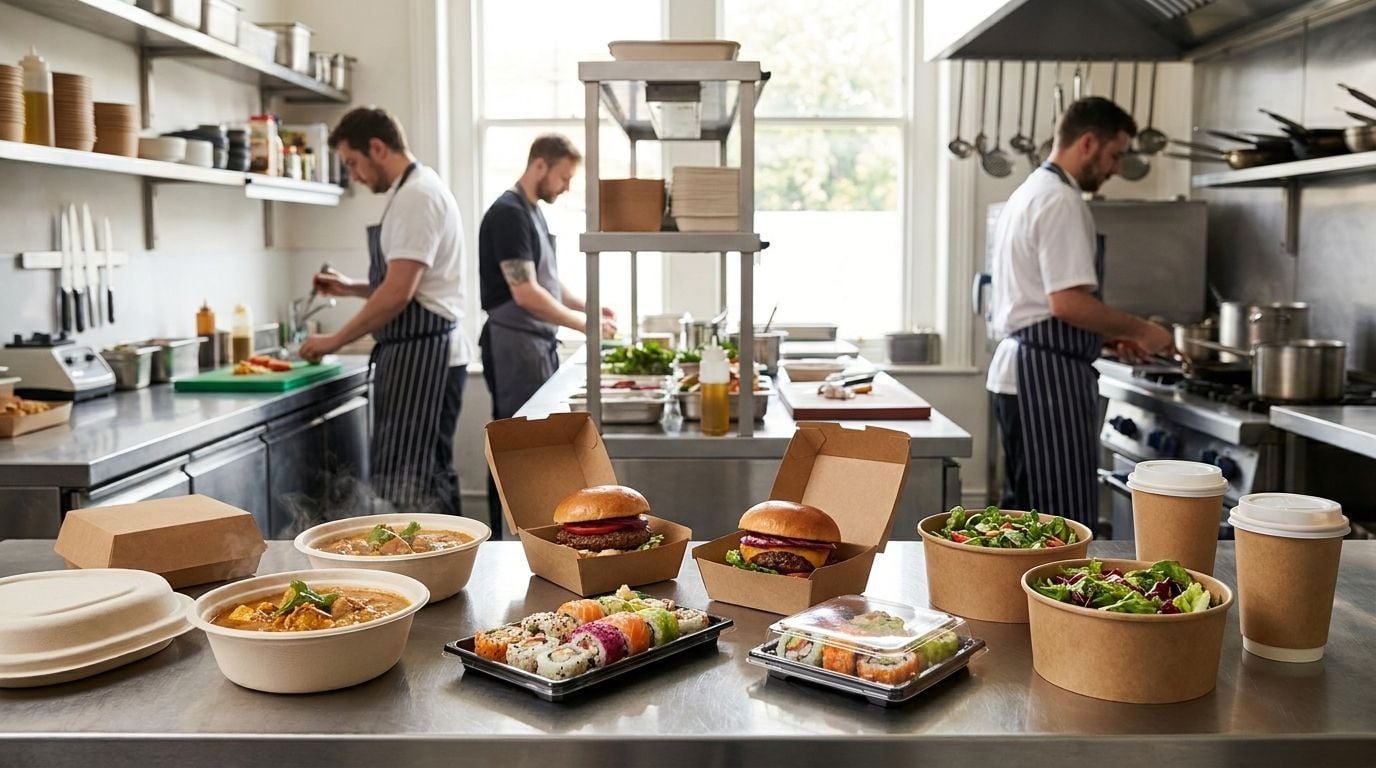
Most guides to eco-friendly takeaway packaging in the UK tell you the same three things. Look for the seedling logo. Choose compostable over plastic. Think about the planet. None of them tells you which specific packaging survives a 40-minute curry delivery, which materials attract lower EPR fees than compostable alternatives, or what Deliveroo and Just Eat actually require.
This guide takes the keyword at its word. It answers three specific questions: which packaging suits which food type, what it actually costs at UK wholesale prices in 2026, and how each material sits within the current compliance landscape. If you want the eco pitch, you will find it everywhere else. If you want a decision tool, read on.
Quick Answer
Eco-friendly takeaway packaging is not one decision. It is a series of decisions made by food type, delivery distance, temperature, grease load, and regulatory position. The right choice for a curry house is different from the right choice for a sushi restaurant, and compostable is not always the most sustainable or most cost-effective answer.
Here is the master decision table. The full explanation for each food type follows below.
| Cuisine or Food Type | Key Food Characteristic | Recommended Material | Key Specification | rPET or Bagasse Better Than PLA? |
| Indian, Chinese, Thai curry | Hot, liquid sauce, 40 min delivery | Bagasse | Liquid-resistant, 120°C rated | Bagasse: yes. PLA deforms above 45°C |
| Fish and chips | Very high grease, needs crispness | Uncoated kraft board | Grease-absorbent, ventilated | Neither. Kraft is the right choice |
| Burgers and loaded boxes | Heavyweight, sauce risk | Bagasse clamshell | Rigid base, deep sides | Bagasse: yes. PLA cannot hold weight at a temperature |
| Pizza | Large format, grease, steam | Bagasse or corrugated kraft | Grease-resistant base | Bagasse: yes. PLA is unsuitable for any hot format |
| Sushi and cold presentation | Cold, clear visibility, delicate | rPET 30% recycled | Crystal clear, no fogging at 4°C | rPET: yes. PLA clouds cold, attracts PPT, not recyclable |
| Salads and deli pots | Cold, wet dressing, visibility | rPET or kraft paper bowl | Leak-resistant lid, clear or kraft | rPET: yes for clear. Kraft: yes for paper aesthetic |
| Soups and noodles | Liquid, high temperature | Bagasse soup-grade bowl | Liquid-resistant interior rated | Bagasse: yes. PLA deforms under sustained heat |
| Hot drinks | 85°C sustained, handled hot | Aqueous-coated paper cup | Water-based coating, not PLA lining | Aqueous paper: yes. Avoids PPT that PLA lining attracts |
Why Compostable Is Not Always the Right Answer for UK Restaurants
Before the food-type detail, one honest statement that no competitor is making: compostable packaging is not the default best choice for every food type or every restaurant.
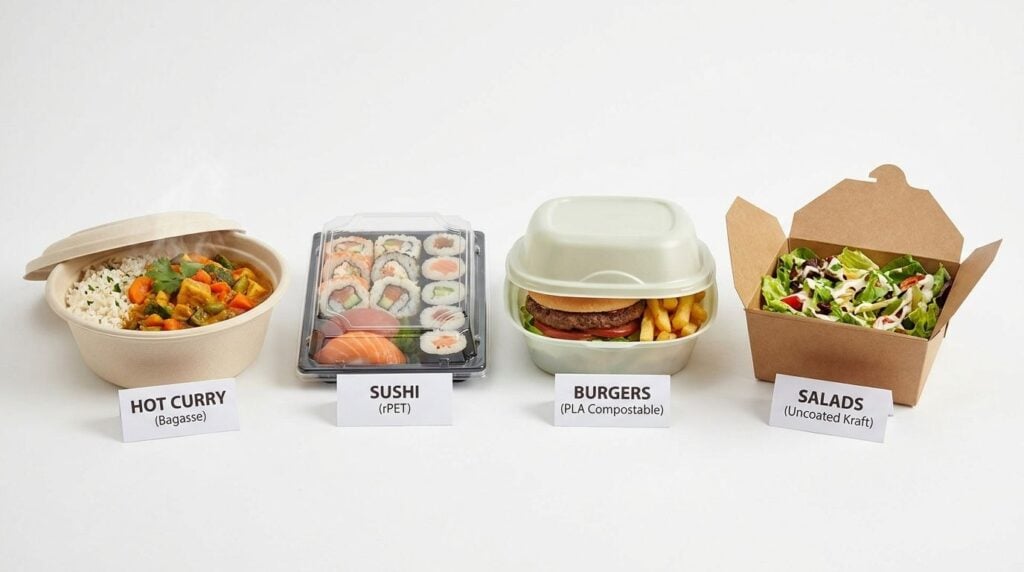
For hot food delivery, bagasse outperforms compostable PLA on every functional measure. PLA deforms above 40 to 45 degrees Celsius, which means it is unsuitable for hot curries, soups, or any food held in a heated display.
For cold food applications, rPET (recycled PET with 30% or more post-consumer recycled content) is frequently the better environmental and regulatory choice than compostable PLA. Here is why this matters for your compliance costs.
rPET with verified 30% or more recycled content is exempt from the Plastic Packaging Tax. Compostable PLA is not exempt and is subject to the full £228.82 per tonne rate. rPET is rated green under the EPR Recyclability Assessment Methodology and attracts lower EPR fees.
Compostable PLA is rated red and attracts higher fees. rPET is accepted in virtually every UK kerbside recycling collection. Compostable PLA cannot be recycled, and most customers have no access to industrial composting.
For cold food, the honest environmental choice in 2026 is often rPET, not compostable PLA. A guide that tells you otherwise is prioritising the eco-narrative over the operational and regulatory reality.
For a full breakdown of how EPR fees and the Plastic Packaging Tax apply to each material, see our complete guide to compostable food packaging for UK businesses.
The Food-Type Packaging Guide: UK Restaurants
Hot Delivery Cuisines: Indian, Chinese, Thai, Middle Eastern
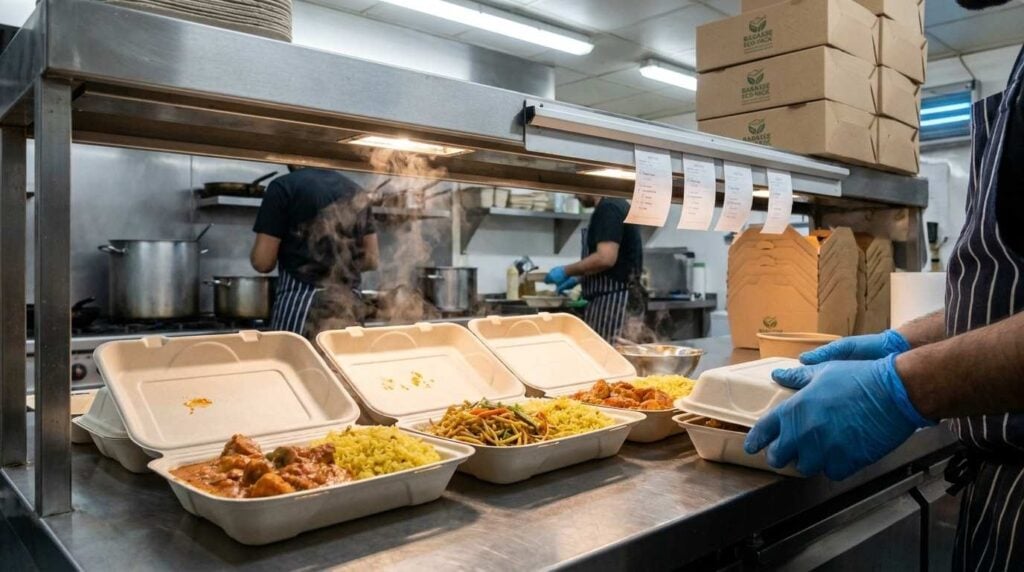
Food characteristics: High temperature at point of packing (75 to 90°C), significant liquid content in sauces, long delivery windows of 30 to 50 minutes, heavy portions.
Key packaging requirements: Leak-proof deep lid seal, structural rigidity under sauce weight, heat retention, and no deformation above 85°C.
Recommended material: Bagasse for main containers. Bagasse handles up to 120°C, is naturally grease-resistant, and maintains structural integrity throughout a standard delivery window. Do not use PLA for hot curry, soup, or noodle containers. PLA will deform before the food reaches the customer.
Compliance position: Bagasse is outside the scope of PPT and typically amber to red-rated under EPR RAM. No PPT liability. EPR fees apply at standard rates.
Cost indicator: 650ml to 1000ml bagasse containers typically range from £0.12 to £0.22 per unit at UK wholesale prices in 2026.
Our bagasse clamshell takeaway boxes are available in multiple sizes suited to curry house and Chinese takeaway portion sizes.
Fish and Chips
Food characteristics: Very high grease load, steam generation inside packaging, structural stress from the weight of battered fish, and customer expectation of crispness on arrival.
Key packaging requirements: Grease absorption rather than grease resistance. Unlike most food packaging, fish and chip packaging benefits from a material that draws grease away from the food rather than sealing it in. Ventilation is preferable to an airtight seal for maintaining crispness.
Recommended material: Uncoated or lightly coated kraft board. The natural fibre structure absorbs excess grease and allows steam to escape. Avoid bagasse for fish and chips if crispness matters; its sealed, moulded structure traps steam. Avoid PLA entirely for any hot application.
Compliance position: Uncoated kraft board is green-rated under EPR RAM and attracts lower EPR fees than bagasse or PLA. Outside the scope of PPT. Best combined regulatory position of any packaging material.
Cost indicator: Kraft fish and chip boxes typically range from £0.06 to £0.14 per unit, depending on size and coating.
Our kraft disposable food containers are available in sizes suited to fish and chip portions with full food contact compliance documentation.
Burgers and Loaded Boxes
Food characteristics: Structural weight from a loaded burger with multiple toppings, sauce and condiment leakage risk, customer expectation of intact presentation on opening.
Key packaging requirements: Rigid base that does not flex under combined burger and packaging weight, side walls that maintain shape during delivery, and grease resistance on the base panel.
Recommended material: Bagasse clamshell boxes for premium presentation. Bagasse moulded construction provides the base rigidity needed for a loaded burger without flexing. For operators prioritising cost, corrugated kraft board with an aqueous coating is a functional alternative with a better EPR RAM rating.
Compliance position: Bagasse is outside the PPT scope. Kraft with aqueous coating is outside the PPT scope. Both attract EPR fees at amber to red rates, depending on the specific format and coating confirmation with your supplier.
Cost indicator: 6-inch to 9-inch bagasse burger boxes typically range from £0.10 to £0.18 per unit at UK wholesale.
Pizza
Food characteristics: Large format (9 to 16 inches), high grease load, steam generation, customer expectation of hot pizza on arrival, and home delivery distance of 20 to 45 minutes.
Key packaging requirements: Base integrity under pizza weight, grease resistance on base and lower sides, adequate internal height to prevent lid contact with toppings.
Recommended material: Bagasse for premium eco positioning. Conventional corrugated kraft board for cost-sensitive operations. PLA is not suitable for any pizza format at any size.
Compliance position: Both bagasse and kraft board are outside the PPT scope. Grease-contaminated pizza boxes of any material are red-rated under EPR RAM because contamination prevents recycling regardless of the base material.
For a detailed comparison of compostable versus conventional pizza boxes, including performance data through a real delivery, cost comparison by box size, and a pizza-specific greenwashing claims table, see our dedicated guide to compostable pizza boxes for UK takeaways.
Sushi and Cold Presentation Foods
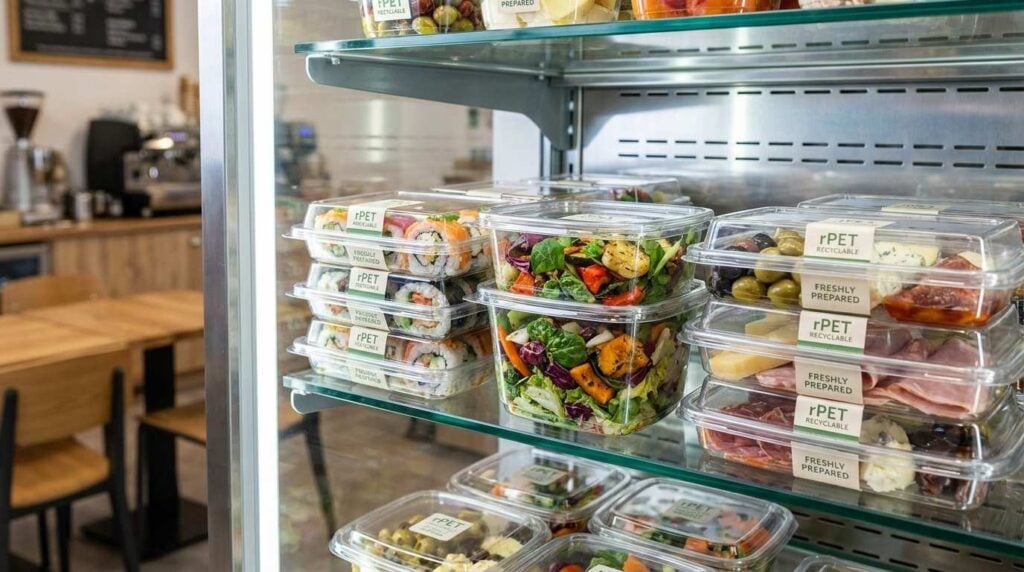
Food characteristics: Cold service temperature (2 to 8°C), customer expectation of clear visibility and presentation, no fogging of containers, structural integrity for stacked rolls and delicate items.
Key packaging requirements: Crystal-clear visibility without fogging at refrigeration temperatures, rigid structure for delicate items, secure lid seal for transport.
Recommended material: rPET with 30% or more post-consumer recycled content. This is the honest answer that no competitor is giving. rPET delivers superior clarity at cold temperatures compared to PLA, does not fog, is exempt from PPT with verified recycled content, is green-rated under EPR RAM, and is accepted in UK kerbside recycling. Compostable PLA clouds at cold temperatures, attracts PPT at £228.82 per tonne, attracts higher EPR fees, and cannot be recycled by customers.
Compliance position: rPET with verified 30% recycled content is PPT-exempt and green-rated under EPR RAM. Best combined regulatory position available for any cold, clear packaging format.
Cost indicator: rPET sushi and deli containers with lids typically range from £0.08 to £0.16 per unit at UK wholesale, broadly comparable to standard PLA equivalents.
Salads, Deli Pots, and Cold Grab-and-Go
Food characteristics: Cold or ambient service temperature, mixed wet and dry ingredients, customer visibility of product is a purchase driver, portion sizes from 300ml to 1000ml.
Key packaging requirements: Leak resistance for dressings and wet ingredients, product visibility for display and purchase decisions, secure lid for transport and stacking.
Recommended material: rPET with verified recycled content for clear formats where product visibility drives sales. Kraft paper bowls with clear lids for operators wanting a paper-forward aesthetic without sacrificing product visibility.
Compliance position: rPET with 30% recycled content is PPT-exempt. Kraft paper bowls are outside the PPT scope entirely. Both options deliver a better regulatory position than standard PLA for cold applications.
Our kraft paper bowls with lids are available in 500ml to 1300ml sizes for salads, grain bowls, and cold deli applications.
Soups and Noodle Dishes
Food characteristics: Liquid or semi-liquid content, high temperature at packing, significant leak risk if lid seal fails, delivery distance typically 20 to 40 minutes.
Key packaging requirements: Leak-proof lid seal rated for liquid content, temperature resistance above 85°C for both the container and lid, and no deformation under sustained heat.
Recommended material: Bagasse bowls with a tight-fitting lid rated for liquid. Moulded fibre bowls in premium grades for higher-end service. Always confirm the liquid resistance grade with your supplier before ordering for soup service. Standard bagasse bowls may not be liquid-resistant without a specific interior treatment. Specify liquid-resistant or soup-grade when placing your order.
Compliance position: Both bagasse and moulded fibre are outside the PPT scope. EPR fees apply at amber to red rates depending on the specific format.
Our food containers range includes options across multiple sizes suited to soup and noodle portion requirements.
Hot Drinks
Food characteristics: Sustained high temperature of 75 to 85°C, consumer handling while hot, lid security during transit, potential for condensation on the exterior.
Key packaging requirements: Paper cup with a heat-resistant lining, secure lid with drink-through aperture, comfortable grip at high temperatures without burning.
Recommended material: Paper cup with aqueous coating (not PLA lining) paired with a CPLA or aqueous-coated lid. The lining material determines the cup’s compostability classification and PPT position. PLA-lined cups are taxable under PPT. Aqueous-coated cups are outside the PPT scope.
Compliance position: Aqueous-coated paper cups are outside the PPT scope. PLA-lined cups attract PPT at £228.82 per tonne. Under the January 2026 fibre-based composite reclassification, cups where the lining represents 5% or less of total cup mass by weight may now reclassify as paper or cardboard under EPR, improving their fee band. Check the lining mass percentage with your supplier.
Our compostable plastic-free paper cups use a water-based aqueous coating rather than a plastic or PLA lining, which removes PPT liability and simplifies EPR classification.
Cost Comparison: Eco-Friendly vs Conventional Takeaway Packaging
The figures below are illustrative estimates based on typical UK wholesale pricing in 2026 and will vary by supplier, volume, certification, and specification.
| Food Type | Conventional Unit Cost | Eco-Friendly Unit Cost | Material | Annual Premium (300 covers/day, 6 days) |
| Curry (650ml container) | £0.06 | £0.16 (bagasse) | Bagasse | approx. +£6,240 |
| Fish and chips (box) | £0.06 | £0.10 (kraft board) | Kraft uncoated | approx. +£2,496 |
| Burger (clamshell) | £0.07 | £0.14 (bagasse) | Bagasse | approx. +£4,368 |
| Salad (500ml) | £0.07 | £0.10 (rPET 30%) | rPET recycled | approx. +£1,872 |
| Hot drink (12oz cup) | £0.05 | £0.09 (aqueous cup) | Aqueous paper | approx. +£2,496 |
The rPET row is the one most operators miss. The cost premium over conventional plastic for cold food applications using rPET is lower than for compostable PLA alternatives, and rPET delivers better compliance outcomes at a smaller cost difference.
Where Regulatory Savings Offset the Premium
Switching from plastic to non-plastic, eco-friendly formats removes PPT liability on those components. For a restaurant handling significant volumes of plastic cups and containers, the PPT saving of £228.82 per tonne can offset a meaningful portion of the unit cost premium. Model this against your actual tonnage before dismissing the switch on cost grounds alone.
For a full explanation of how to calculate your PPT and EPR liability and where switching materials changes your regulatory position, see our detailed guide to UK plastic packaging tax and EPR for food businesses.
Delivery Platform Sustainability Requirements: Deliveroo, Just Eat and Uber Eats
This is commercially urgent and absent from every competing page currently ranking for eco-friendly takeaway packaging in the UK.
All three major UK delivery platforms have published or are developing sustainability packaging policies that affect restaurant partners. Here is what operators need to know in 2026.
Deliveroo has run sustainability packaging initiatives and offers visibility advantages to restaurants demonstrating sustainable packaging commitments through its platform. Restaurants using certified compostable or clearly recyclable packaging and communicating this on their Deliveroo profile benefit from improved sustainability scores. Deliveroo has signalled that packaging sustainability will become a more prominent ranking factor for restaurant visibility on the platform.
Just Eat has published sustainability commitments and has encouraged partner restaurants to switch from single-use plastics to paper-based or certified compostable alternatives. Just Eat’s partner guidance references EN13432 certification as the relevant compostability standard for claiming compostable packaging status.
Uber Eats has sustainability initiatives at the platform level and has introduced sustainability filters for consumers in some markets. UK restaurant partners who can demonstrate certified sustainable packaging are better positioned as these filters become more prominent across the platform.
What this means for your packaging decisions:
Certified packaging is the minimum requirement for any platform sustainability claim. Vague descriptions like “eco-friendly” or “biodegradable” do not satisfy platform requirements and carry CMA greenwashing enforcement risk. EN13432 certified compostable, OK Compost HOME certified, or verified rPET with documented recycled content are the claims that hold up under both platform scrutiny and regulatory enforcement.
Document your packaging specifications before making any platform-facing claim. When platforms ask for evidence of sustainable packaging, you need written supplier documentation with certification numbers and material data sheets, not a description on your menu page.
Compliance Summary by Material: 2026
| Material | PPT Liable | EPR RAM Rating | Best Food Application | Avoid For |
| Bagasse | No | Amber to Red | Hot food, soups, burgers, curry | Cold clear applications |
| Uncoated kraft board | No | Green | Fish and chips, wraps, sandwiches | Liquid-heavy food |
| Kraft with aqueous coating | No | Check RAM rating | Hot food bags, counter wrapping | Heavily sauced food |
| rPET (30% recycled content) | No (PPT exempt) | Green | Cold food, sushi, deli, salads | Hot food |
| PLA | Yes | Red | Avoid for most applications | Hot food, any cold, clear application where rPET is available |
| CPLA | Yes | Red | Hot drink lids only | Containers |
| Moulded fibre | No | Amber to Red | Premium hot and cold food | Clear or transparent applications |
The compliance table makes the rPET case clear at a glance. For cold food, rPET with verified recycled content sits in a better regulatory position than compostable PLA on every measure: PPT exempt, green-rated EPR, kerbside recyclable. The only reason to choose PLA over rPET for cold applications is if your supplier cannot provide verified recycled content documentation for rPET alternatives.
Practical Decision Framework for UK Restaurant Operators
Step one: Map your food types. List every menu item that requires packaging. Categorise by temperature (hot or cold), liquid content (dry, sauced, or liquid), and delivery distance (under 20 minutes, 20 to 40 minutes, or over 40 minutes).
Step two: Match material to food characteristic. Use the master table and the food-type sections above. Do not default to compostable PLA for hot food. Do not use rPET for hot applications. For cold, clear formats, choose rPET with verified recycled content over standard PLA where available.
Step three: Calculate your regulatory position. Identify which of your current packaging items attract PPT. Calculate the tonnage. Model whether switching to non-plastic or rPET eco-friendly formats removes that liability.
Step four: Get supplier documentation. Before making any platform-facing or on-pack sustainability claim, obtain written certification documentation from your supplier for every packaging component, including lids, coatings, and adhesive labels.
Step five: Update your platform profiles and on-pack messaging. Remove vague language from your Deliveroo profile, menu, and packaging. Replace with specific certified claims: material name, certification standard, certification number, and disposal instruction.
Browse our full takeaway supplies range and packaging supplies for certified options across all food types and service formats.
FAQs
Is compostable packaging always the most eco-friendly choice for UK restaurants?
No. For cold food applications, rPET with 30% or more verified recycled content is frequently a better environmental and regulatory choice. It is PPT-exempt, green-rated under EPR RAM, accepted in kerbside recycling, and outperforms compostable PLA at cold temperatures. Compostable PLA attracts higher EPR fees, cannot be recycled, and requires industrial composting infrastructure that most UK customers cannot access.
Which packaging material has the lowest regulatory cost in 2026?
Uncoated kraft paper and board currently holds the best combined regulatory position: outside the scope of PPT and green-rated under EPR RAM. For cold, clear applications, rPET with verified 30% recycled content achieves the same green EPR rating and PPT exemption. Both outperform compostable PLA on combined regulatory cost.
Do delivery platforms require certified sustainable packaging?
Platforms including Deliveroo and Just Eat reference certified sustainable packaging in their partner guidance. EN13432 compostable certification and verified recycled content are the standards that hold up under platform and regulatory scrutiny. Vague claims like eco-friendly or biodegradable do not satisfy certification requirements and carry CMA enforcement risk.
Can I use the same packaging for both eat-in and takeaway customers?
Yes, but the EPR classification differs. Packaging consumed and disposed of on-premises is non-household and exempt from EPR waste management fees. Packaging taken away by customers enters the household waste stream and attracts waste management fees. Keep records that support the non-household classification for on-premises packaging.
What is the most cost-effective, eco-friendly packaging for a high-volume takeaway?
Uncoated kraft board for dry and lightly sauced food, and rPET with recycled content for cold, clear applications typically carry the lowest combined unit cost and regulatory cost of any eco-friendly format. Bagasse carries a higher unit cost but removes PPT liability and performs reliably for hot, sauced, and liquid food types where kraft board is not suitable.
What happens if I use PLA containers for hot food?
PLA begins to deform above 40 to 45 degrees Celsius. For hot curries, soups, and noodle dishes served at 75 to 90°C, PLA containers will lose structural integrity during packing or delivery. This is both a food safety risk and a customer satisfaction issue. Bagasse is the correct material for hot food applications.
Author
We Can Source It, Team
The We Can Source It Team supplies certified eco-friendly takeaway packaging, catering supplies, and hospitality essentials to businesses across the UK. Our content is written to help restaurants, takeaways, cafés, and food service operators make practical, compliant, and cost-effective packaging decisions.
References and Sources
- ▸ HMRC: Plastic Packaging Tax guidance – https://www.gov.uk/guidance/check-if-you-need-to-register-for-plastic-packaging-tax
- ▸ DEFRA: Extended Producer Responsibility for Packaging – https://www.gov.uk/guidance/extended-producer-responsibility-for-packaging
- ▸ DEFRA: EPR Recyclability Assessment Methodology (RAM) – published December 2024
- ▸ WRAP: Sustainable Packaging Design guidance – https://www.wrap.org.uk/resources/guide/sustainable-packaging-design
- ▸ OPRL: On-Pack Recycling Label guidance – https://www.oprl.org.uk
- ▸ CMA: Green Claims Code – https://www.gov.uk/government/publications/green-claims-code-making-environmental-claims
- ▸ EN13432: European standard for compostable packaging – referenced in BSI guidance
- ▸ Deliveroo: Partner sustainability programme guidance (accessible via Deliveroo for Business portal)
- ▸ Just Eat: Sustainability partner guidance (accessible via Just Eat partner hub)