If you have searched for guidance on UK plastic packaging law and found only sector-neutral government pages and general producer guides, you are not alone. Every piece of content currently ranking for this topic is written for packaging producers in general. None of it is written specifically for food businesses.
That gap matters because food operators face a set of EPR and Plastic Packaging Tax obligations, classifications, and exemptions that general guides simply do not address. This article covers what you actually need to know as a food business in 2026, including three rules that could materially change what you owe.
Key facts for food businesses in 2026:
- ▸ Paper cups with a plastic lining representing 5% or less of total cup mass may now be classified as paper or cardboard under EPR, not fibre-based composite.
- ▸ Packaging consumed and disposed of on your premises may qualify as non-household and be exempt from EPR waste management fees entirely.
- ▸ Food importers may owe both the Plastic Packaging Tax and EPR fees simultaneously on the same packaging.
- ▸ Recycled plastic content of 30% or more removes PPT liability completely with documented evidence.
- ▸ For most food operators, accurate classification of existing packaging saves more in 2026 than switching materials.
Quick Reference: Are You in Scope?
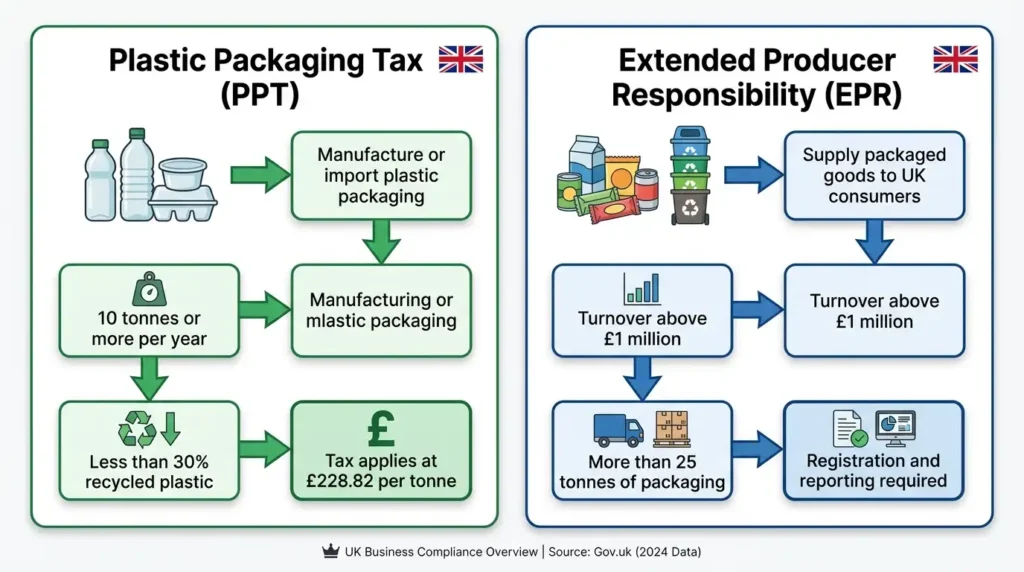
Plastic Packaging Tax (PPT) is a UK tax charged on plastic packaging containing less than 30% recycled plastic content, applied at the point of manufacture or import. It applies if you manufacture or import plastic packaging in the UK and handle 10 tonnes or more per year.
Extended Producer Responsibility (EPR) for packaging is a scheme that charges producers for the cost of collecting and disposing of packaging waste. It applies if you supply or import packaged goods to UK consumers, own a brand under which packaged goods are sold, have an annual turnover above £1 million, and handle more than 25 tonnes of packaging per year.
If you are below these thresholds, you are a small organisation under EPR and have lighter-touch obligations. If you are above them, read every section of this article before your next compliance submission.
What Changed in 2026: The Rules Food Businesses Must Know Now
The Fibre-Based Composite Reclassification: Urgent Action Required
From 1 January 2026, DEFRA revised how fibre-based composite packaging is classified under the EPR scheme. This change directly affects some of the most commonly used food packaging formats in the UK, and it is almost completely absent from existing guidance.
The revised rule works as follows. Packaging is classified as fibre-based composite only where the plastic layer or layers exceed 5% of total packaging mass and cannot be separated from the fibre component by hand. If the plastic content is 5% or less by mass, the entire component is reclassified as paper or cardboard regardless of the plastic layer’s presence.
Why this matters for food businesses specifically:
Three formats used daily across the UK food service are directly affected.
Paper coffee cups typically have a plastic or PLA lining that represents around 5% or less of total cup mass. Under the revised rule, many paper coffee cups are now classified as paper or cardboard rather than fibre-based composite. This changes both the EPR fee band and the recyclability rating under the Recyclability Assessment Methodology.
Juice cartons and beverage cartons with thin plastic or aluminium barriers may fall below the 5% threshold depending on construction. Each format needs to be assessed individually against the actual mass data from your supplier.
Ready meal trays with plastic film lids need careful assessment. The tray itself is often paper or moulded fibre; the plastic film lid is a separate component and is classified separately. Do not treat the assembled product as a single fibre-based composite item.
Key takeaway: Request material composition by mass from your supplier for every packaging format containing both fibre and plastic. Calculate the plastic percentage. If it is 5% or less and cannot be separated by hand, reclassify as paper or cardboard in your EPR submission.
What you need to do right now:
Contact your packaging suppliers and request the material composition by mass for every packaging format you use that contains both fibre and plastic elements. Calculate the plastic percentage by total component mass. If it is 5% or less and the plastic cannot be separated by hand, reclassify the component as paper or cardboard in your EPR data submission. If you have already submitted data using the pre-2026 classification, check whether an amended submission is required.
For food operators switching to paper-based formats to improve their EPR classification, our compostable plastic-free paper cups use a water-based aqueous coating rather than a plastic lining, which simplifies the classification question entirely.
The Household vs Non-Household Distinction: The Rule That Could Save Your Business Money
This is the highest-value piece of information in this entire article, and it is buried so deep in EPR guidance that almost no food operator knows it exists.
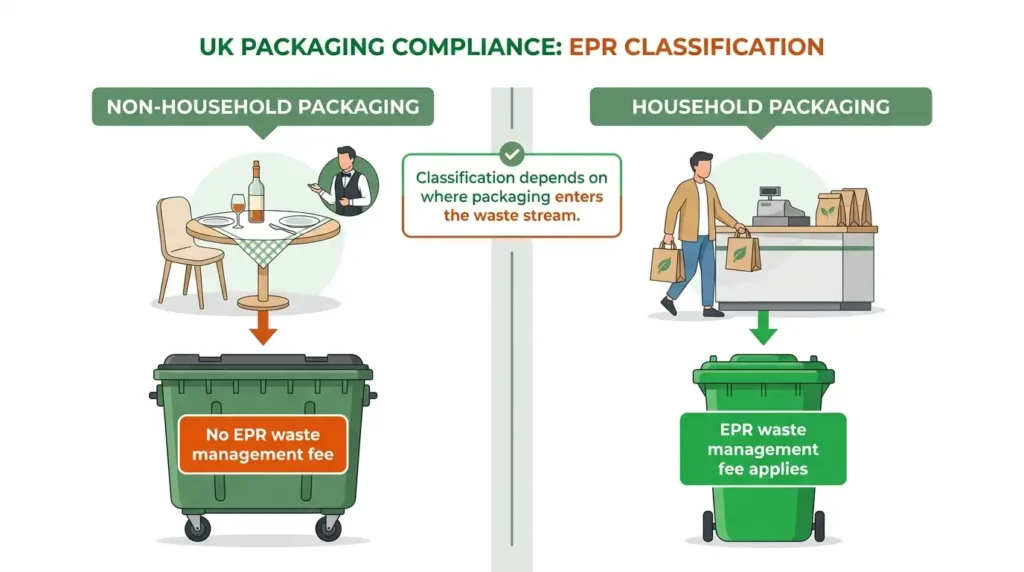
Under the UK EPR scheme, packaging is split into two categories for the purpose of waste management fees: household packaging and non-household packaging. Waste management fees, which fund local authority collection and disposal costs, apply only to household packaging. Non-household packaging is exempt from these fees.
The critical distinction is where the packaging enters the waste stream. Packaging that is consumed on-premises and disposed of through commercial waste collections, not kerbside household collections, can be classified as non-household. This means it attracts no waste management fee under EPR.
What this means for food businesses in practice:
A restaurant that sells wine by the glass does not supply the bottle to the consumer. The bottle is disposed of through the restaurant’s own commercial waste contractor. That bottle is non-household packaging and is exempt from EPR waste management fees. The same logic applies to any packaging that is consumed and disposed of on your premises rather than taken home by a customer.
A takeaway that hands a customer a sealed bag of food is supplying household packaging. That bag will go into the customer’s household waste stream. It is household packaging and waste management fees apply.
The distinction is not about the business type. It is about where the packaging ends up. A restaurant that also sells packaged items to take away has both household and non-household packaging in the same operation and needs to report them separately.
Key takeaway: If your packaging is consumed and disposed of on your premises through a commercial waste contractor, it may qualify as non-household and attract no EPR waste management fee. This distinction alone could save a mid-size restaurant group a significant amount annually.
Evidence DEFRA expects you to keep:
To classify packaging as non-household, you need to be able to demonstrate that it does not enter the household waste stream. Acceptable evidence includes commercial waste contractor invoices showing on-site collection, written policies confirming all packaging is collected commercially, and records showing no packaging is supplied directly to consumers for off-premises consumption.
Businesses that correctly classify on-premises packaging as non-household could significantly reduce their EPR waste management fee liability. The savings scale with volume. For a mid-size restaurant group handling significant packaging volumes on-premises, this classification is worth calculating carefully with your compliance adviser.
The PPT and EPR Double Liability Problem for Food Importers
This is the financial issue that catches food importers most often, and it is absent from every general guidance page currently ranking for UK plastic packaging law.
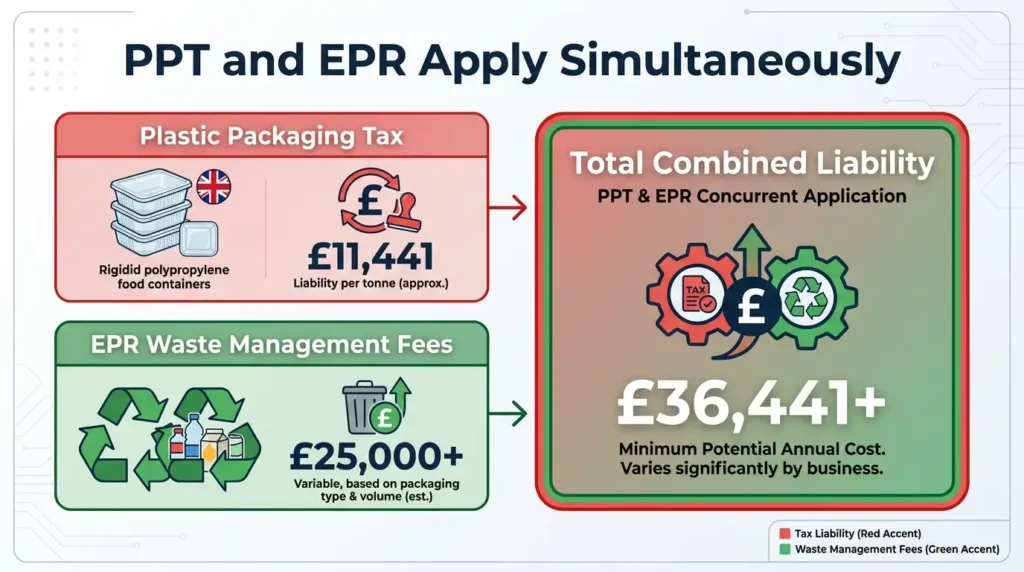
The Plastic Packaging Tax and EPR waste management fees are separate obligations that can apply simultaneously to identical packaging. A food business importing plastic food containers with less than 30% recycled plastic content may be paying both taxes on the same items at the same time.
Here is a worked example by material type.
Scenario: Food importer bringing in 50 tonnes of polypropylene deli containers per year, containing 0% recycled content.
| Obligation | Calculation | Annual Cost |
| Plastic Packaging Tax | 50 tonnes x £228.82 per tonne | £11,441 |
| EPR waste management fee (household, red-rated) | 50 tonnes x approx. £500+ per tonne (RAM modulated, indicative) | £25,000+ |
| Total combined liability | Both apply simultaneously | £36,441+ |
The same containers are being taxed under PPT for their plastic content and charged under EPR for their end-of-life disposal cost. These are not alternative obligations. They stack.
Key takeaway: PPT and EPR fees are not alternatives. They apply simultaneously to the same packaging. A food importer with plastic containers containing under 30% recycled content may be paying for both identical items without realising it.
How to reduce double liability:
Switching to packaging with 30% or more recycled plastic content eliminates the PPT liability. The recycled content must be verified and documented; HMRC does not accept unsubstantiated supplier claims.
Switching to non-plastic compostable or paper-based formats eliminates PPT liability on those components. Paper and bagasse are not plastic under PPT and attract no Plastic Packaging Tax regardless of recycled content. EPR fees still apply, but the PPT element is removed.
For food operators reviewing their plastic container range, our kraft disposable food containers are paper-based, outside the scope of PPT, and available in sizes suited to takeaway and catering applications.
EPR Registration: What Food Businesses Must Do and When
Who Must Register
Under the UK EPR scheme, food businesses with an annual turnover above £1 million and packaging volumes above 25 tonnes per year must register with an approved compliance scheme or directly with the Environment Agency.
Businesses below the large producer threshold (turnover above £2 million and volumes above 50 tonnes) have reporting obligations but reduced fee obligations in the scheme’s early years.
If you are not sure which threshold applies to your business, calculate your total packaging volume across all formats, including primary packaging (in contact with food), secondary packaging (outer packaging), tertiary packaging (transit packaging), and service packaging (packaging provided to consumers at the point of sale, such as carrier bags and takeaway containers).
How to Calculate Your Packaging Tonnage
Packaging tonnage is calculated as the total weight in tonnes of all packaging you place on the UK market in a calendar year.
For food businesses, this means every component separately: the cup, the lid, the sleeve, the bag, the container, the label. Each component is weighed individually in grams, multiplied by the number of units placed on the market, and converted to tonnes.
If you are close to the 25-tonne threshold, a component-by-component audit is worth doing before your next submission. Underestimating volume is a compliance risk. Overestimating it means paying higher fees than necessary.
Registration Deadlines and Reporting Calendar for 2026
| Obligation | Deadline | What Is Required |
| Q1 2026 data submission | 30 April 2026 | Packaging data for January to March 2026 |
| Q2 2026 data submission | 31 July 2026 | Packaging data for April to June 2026 |
| Q3 2026 data submission | 31 October 2026 | Packaging data for July to September 2026 |
| Q4 2026 data submission | 31 January 2027 | Packaging data for October to December 2026 |
| EPR fee payment | Invoiced by the scheme operator | Based on the submitted data and RAM modulation |
Missing a submission deadline can result in enforcement action by the Environment Agency. If you have not registered and you meet the thresholds, register now. Late registration does not remove the obligation for prior periods.
What Data You Must Collect
For each packaging component you supply or import, you need to record the material type (plastic, paper, glass, aluminium, steel, wood, fibre-based composite), the weight in tonnes, whether it is household or non-household, and whether it is recyclable or non-recyclable under the RAM methodology.
Food businesses often underestimate the number of packaging components they handle. A single meal deal generates primary packaging (sandwich wrapper, drink cup, crisp packet), service packaging (paper bag), and potentially secondary packaging depending on how supplies arrive. Each component is reported separately.
The Plastic Packaging Tax: Specific Rules for Food Operators
What PPT Applies To
The Plastic Packaging Tax applies to plastic packaging manufactured in the UK or imported into the UK that contains less than 30% recycled plastic content by weight. The rate from April 2026 is £228.82 per tonne, as published in HMRC guidance at gov.uk.
For food businesses, the most commonly affected items are polypropylene food containers and deli pots, PET drinks bottles and cold drinks cups, PLA cups and containers (PLA is plastic under PPT regardless of its compostable certification), plastic carrier bags and packaging films, and polystyrene trays and foam packaging.
Are Paper Coffee Cups Subject to PPT?
It depends on the lining. Paper coffee cups with a PE or PLA lining are subject to PPT because the lining is plastic. Paper coffee cups with an aqueous coating are not subject to PPT because the coating is not classified as plastic under HMRC rules. The cup’s PPT liability is determined by the lining material, not the outer paper construction.
This is one of the most frequently misunderstood PPT questions in the food service sector. A supplier describing a PLA-lined cup as compostable or plant-based does not change its PPT classification. HMRC classifies by material type, not marketing language.
What Evidence Does HMRC Require for the Recycled Content Exemption?
HMRC requires written documentary evidence from your supplier confirming the recycled content by weight. The minimum standard is a written declaration on supplier letterhead specifying the recycled content percentage and the source of the recycled material. HMRC requires this evidence to be kept for at least six years. Verbal assurances from suppliers are not sufficient and will not protect you in an HMRC compliance check.
For imported packaging, the obligation falls on the importer. If your overseas supplier cannot provide documented recycled content evidence in writing, you cannot claim the exemption, and the full PPT rate applies regardless of what the supplier tells you verbally.
What PPT Does Not Apply To
Bagasse (sugarcane fibre) packaging, uncoated and aqueous-coated kraft paper packaging, moulded fibre trays and containers, glass, aluminium, and steel packaging, and plastic packaging with verified 30% or more recycled content are all outside the scope of PPT.
How EPR Fees Are Calculated: The RAM System Explained for Food Businesses
The Recyclability Assessment Methodology (RAM) rates each packaging format as green, amber, or red based on whether it can be collected and recycled through existing UK kerbside systems. Green-rated packaging attracts lower EPR fees. Red-rated packaging attracts higher fees.
| Packaging Format | RAM Rating | EPR Fee Impact |
| Clear PET bottles and containers | Green | Lower fee |
| HDPE bottles and pots | Green | Lower fee |
| Uncoated paper and cardboard | Green | Lower fee |
| PLA compostable containers | Red | Higher fee |
| Bagasse food boxes | Amber to Red | Higher fee |
| Grease-contaminated paper (pizza boxes, chip papers) | Red | Higher fee |
| Plastic films and wraps | Amber | Intermediate fee |
| Multi-material pouches | Red | Higher fee |
The practical implication for food operators is that switching from recyclable plastic to compostable PLA does not reduce your EPR fees. PLA is red-rated under RAM because it cannot be collected through kerbside recycling. Recyclable plastic (PET, HDPE in the right formats) is green-rated and attracts lower fees.
For a detailed material-by-material breakdown of how compostable packaging interacts with both EPR and PPT, see our complete guide to compostable food packaging for UK businesses.
What Matters Most: A Summary for Food Operators
Before you consider switching packaging materials, get your classifications right. The three rules covered in this article, the fibre-based composite reclassification, the household versus non-household distinction, and the PPT and EPR double liability calculation, are where food businesses most commonly either overpay or remain exposed to enforcement risk.
For most food operators, the largest savings available in 2026 come from accurate classification of existing packaging rather than switching materials immediately. A restaurant correctly classifying on-premises packaging as non-household, a cafe correctly reclassifying its paper cups under the 5% rule, and an importer eliminating PPT liability through documented recycled content evidence can each reduce compliance costs significantly without changing a single product.
Once classifications are correct, material switching decisions can be modelled against your actual fee exposure rather than estimated. That is when the numbers become reliable enough to act on.
Need packaging that reduces your Plastic Packaging Tax exposure? We help UK food businesses choose compliant paper, fibre, and recycled-content packaging. Browse our packaging supplies range or contact our team for tailored recommendations.
FAQs
Do small takeaways need to register for EPR?
If your turnover is below £1 million or your packaging volume is below 25 tonnes per year, you are currently classified as a small organisation under EPR and have no registration or reporting obligation. If you are above both thresholds, you must register regardless of your business type.
Does PPT apply to packaging I buy from a UK supplier?
If you buy pre-filled packaging from a UK manufacturer, the PPT obligation is on the manufacturer, not you. If you import packaging into the UK yourself, filled or unfilled, the obligation is on you as the importer.
Can I claim the recycled content exemption for PLA packaging?
No. PLA is classified as plastic under PPT regardless of its plant-based origin or compostability certification. The recycled content exemption requires 30% recycled plastic content. PLA sourced from virgin plant starch contains no recycled content and attracts the full PPT rate.
Are paper coffee cups subject to the Plastic Packaging Tax?
It depends on the lining. PE-lined and PLA-lined cups are subject to PPT because both linings are classified as plastic under HMRC rules. Aqueous-coated cups are outside the PPT scope because the coating is not plastic. Always confirm the lining type with your supplier before making a PPT assessment.
How do I calculate my packaging tonnage for EPR reporting?
Calculate the weight in grams of each packaging component, multiply by the number of units you place on the UK market in the reporting period, sum across all components, and convert to tonnes. Each component is reported separately. A cup, its lid, and its sleeve are three separate components with three separate material classifications.
What evidence does HMRC require for the recycled content exemption?
A written declaration from your supplier on company letterhead specifying the recycled content percentage and the source of recycled material is the minimum standard. HMRC requires this documentation to be retained for at least six years. Verbal supplier assurances are not sufficient.
What is the penalty for missing an EPR data submission?
The Environment Agency can issue civil penalties for late or missing submissions. Penalties escalate with the period of non-compliance. Registering late does not remove the obligation for prior periods; back-data submissions may be required.
If my restaurant composts its packaging on-site, does that change my EPR classification?
No. On-site composting does not change whether packaging is classified as household or non-household under EPR. The classification is based on whether the packaging enters the household waste stream, not how it is ultimately disposed of.
Where do I register for EPR?
Large producers register through an approved compliance scheme or directly with the Environment Agency via the EPR for packaging service on gov.uk. Registration requires a UK Companies House number and packaging data for the preceding year.
Author
We Can Source It, Team
The We Can Source It Team supplies certified compostable and conventional takeaway packaging, catering products, cleaning supplies, and hospitality essentials to food businesses across the UK. Our content is written to help food service operators make practical, compliant, and cost-effective decisions about packaging, sustainability, and regulatory requirements.
References and further reading:
- ▸ HMRC: Plastic Packaging Tax – who must register and steps to take: gov.uk/guidance/check-if-you-need-to-register-for-plastic-packaging-tax
- ▸HMRC: Plastic Packaging Tax – full guidance collection: gov.uk/government/collections/plastic-packaging-tax
- ▸ DEFRA: Extended Producer Responsibility for packaging – who is affected and what to do: gov.uk/guidance/extended-producer-responsibility-for-packaging-who-is-affected-and-what-to-do
- ▸ DEFRA: Extended Producer Responsibility for packaging – full guidance collection: gov.uk/government/collections/extended-producer-responsibility-for-packaging
- ▸ CMA: Green Claims Code – making environmental claims: gov.uk/government/publications/green-claims-code-making-environmental-claims
- ▸ CMA: Full collection of environmental claims guidance: gov.uk/government/collections/how-to-make-environmental-claims-about-products-and-services
- House of Commons Library: Extended Producer Responsibility for packaging – research briefing: commonslibrary.parliament.uk/research-briefings/cbp-10352