An ice bucket is one of those pieces of bar equipment that looks straightforward until you are standing in a supplier catalogue trying to decide between six materials, four stand types, three sizes, and finishes that range from hammered copper to clear acrylic.
Get it wrong, and you end up with a bucket that sweats condensation onto tablecloths, a stand that wobbles on carpeted floors, or a finish that looks dated against your bar aesthetic.
This guide cuts through the choices for UK pub and bar operators. It covers the main bucket types and what they are genuinely suited for, stand specifications by venue type, the UK food safety rules that apply to ice handling, and the material decision that most operators get wrong when buying stainless steel.
Why Ice Buckets and Stands Matter More Than Most Bars Realise
Why Ice Buckets and Stands Matter More Than Most Bars Realise
Ice buckets and stands sit at the intersection of compliance, service efficiency, and customer experience. They are visible in a way that most bar equipment is not.
A beautifully presented bottle of champagne in a polished ice bucket on a floor stand is a signal to every customer in the room. A cheap plastic tub of murky meltwater communicates something quite different.
Beyond presentation, ice buckets affect service speed. A service station ice caddy that runs empty halfway through a busy service creates a bottleneck at the bar.
An ice bucket that sweats excessively damages tablecloths and irritates customers. A stand that tips on an uneven floor is a spillage waiting to happen.
Choosing the right ice bucket and stand for each application in your bar is a small decision with a disproportionate impact on how professional your operation looks and runs.
The Two Distinct Jobs an Ice Bucket Does in a Bar
Before choosing a bucket, be clear about which job it is doing. The requirements are meaningfully different.
Service station ice storage means holding a usable supply of ice at the bar for drink building throughout a service session. The priorities here are capacity, insulation to slow melt, hygiene compliance, and ease of access for staff. Aesthetics matter less because this bucket is behind the bar, not in front of customers.
Tableside bottle chilling means presenting a bottle of wine, champagne, or beer to a customer at the table, in view, as part of the service experience. The priorities here are presentation, the correct capacity to properly submerge a bottle, and stability on the surface or stand it will sit on. A floor stand is typically used for this application.
Most bars need both. The service station caddy and the tableside presentation bucket are different products serving different purposes. Buying one type and trying to use it for both leads to compromises on both.
Ice Bucket Materials Compared: Stainless Steel, Acrylic, Copper, and More
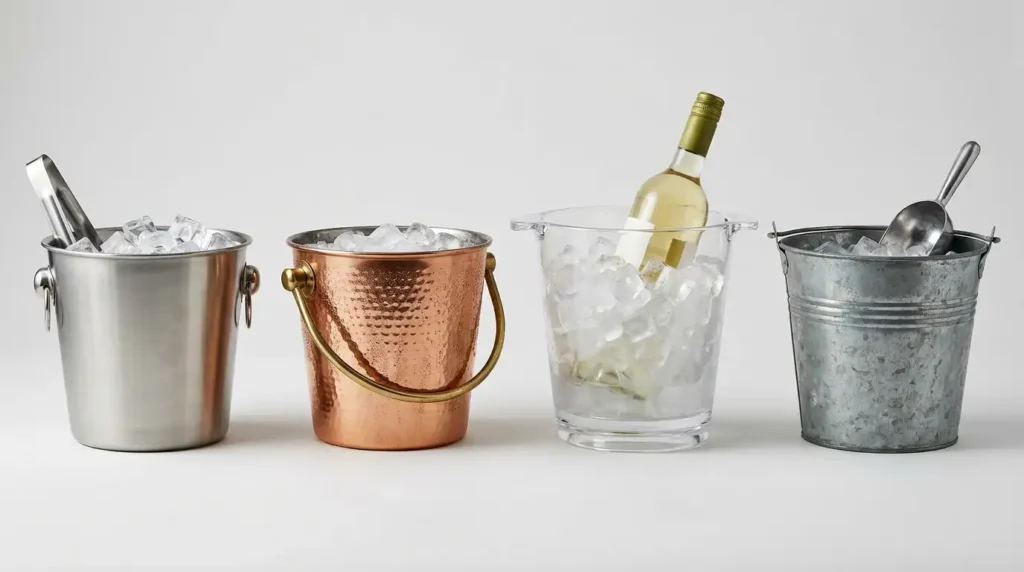
Stainless steel is the professional standard for commercial bar use. It is durable, food-safe, easy to sanitise, resistant to odours and staining, and available in finishes from mirror polish to brushed satin to hammered texture.
Double-wall stainless steel provides meaningfully better ice retention than single-wall. For any bar doing consistent volume, stainless steel is the correct choice.
Acrylic and polycarbonate offer a lighter, lower-cost alternative. Clear acrylic works well in contemporary venues where the visual of the ice and bottle is part of the presentation.
The trade-off is lower thermal insulation, meaning ice melts faster, and susceptibility to scratching and cracking under commercial use. For moderate-volume use in a venue where the aesthetic suits it, acrylic is a reasonable choice.
Copper and copper-finish buckets have strong visual appeal and suit traditional pubs, gin and cocktail bars, and venues with a heritage or craft aesthetic. Genuine copper requires maintenance to prevent tarnishing.
Copper-finish plated steel is more practical for commercial use and achieves a similar look without the maintenance overhead.
Galvanised steel and hammered finishes work well in rustic, gastropub, and industrial-aesthetic venues. They are durable, and the textured finish hides surface marks better than mirror polish.
Chrome-plated options offer a classic hotel bar and fine dining look. The plating can wear over time with heavy commercial use and is more susceptible to damage than solid stainless steel.
The Stainless Steel Grade Question: 304 vs 201
This is the detail that most buyers miss and that most supplier websites do not explain clearly.
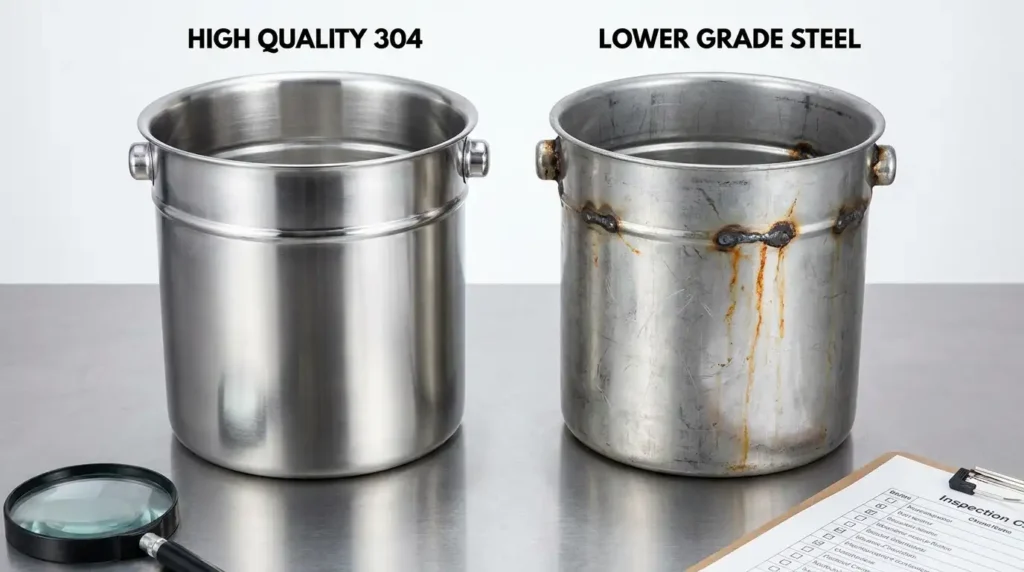
Stainless steel ice buckets are made from one of two common grades: 304 (also written as 18/8 for its 18 per cent chromium and 8 per cent nickel content) or 201 (which substitutes manganese for some of the nickel).304-grade stainless steel is the correct choice for commercial bar use. It offers high corrosion resistance, holds up in humid environments, resists rust at weld joints, and remains food-safe long-term. It is the standard specification for professional hospitality equipment.
201-grade stainless steel looks identical to 304 when new. The problem shows up at 12 to 24 months of regular use: rust spots appearing at weld points, discolouration at rim edges, and surface pitting in humid environments. For a bar where ice buckets sit with standing water inside regularly, 201 is a false economy.
When buying stainless steel ice buckets for commercial use, ask the supplier to confirm the grade in writing. If they cannot specify it, that is a useful signal.
Ice Bucket Sizes: What You Actually Need by Use Case
Sizing an ice bucket correctly matters because an undersized bucket does not chill a bottle properly, and an oversized bucket is unwieldy for tableside service.
For a single bottle (wine or champagne): A 3 to 4 litre bucket is the standard. This comfortably holds a 750ml bottle with enough ice and cold water to cover the bottle to the shoulder.
Always use ice and cold water together, not ice alone. Water conducts cold much more effectively than ice alone and chills the bottle considerably faster.
For two bottles or a magnum: A 5 to 7 litre bucket allows both bottles to sit properly surrounded by ice and water without overcrowding.
For service station ice storage: A capacity of 8 to 12 litres is practical for most bar stations. An insulated caddy with a lid of this size holds enough service ice for a busy session without constant refilling.
For beer garden and outdoor table service: A 4 to 6 litre insulated bucket holds a selection of bottled beers or a wine bottle with reasonable ice retention. Insulation matters more for outdoor use because ambient temperature accelerates melt.
Ice Type Matching: Why the Wrong Ice Undermines the Right Bucket
The bucket is only half the equation. The type of ice you use has a significant effect on its performance, and different service applications call for different ice types. This is an area where even well-equipped bars make consistent errors.
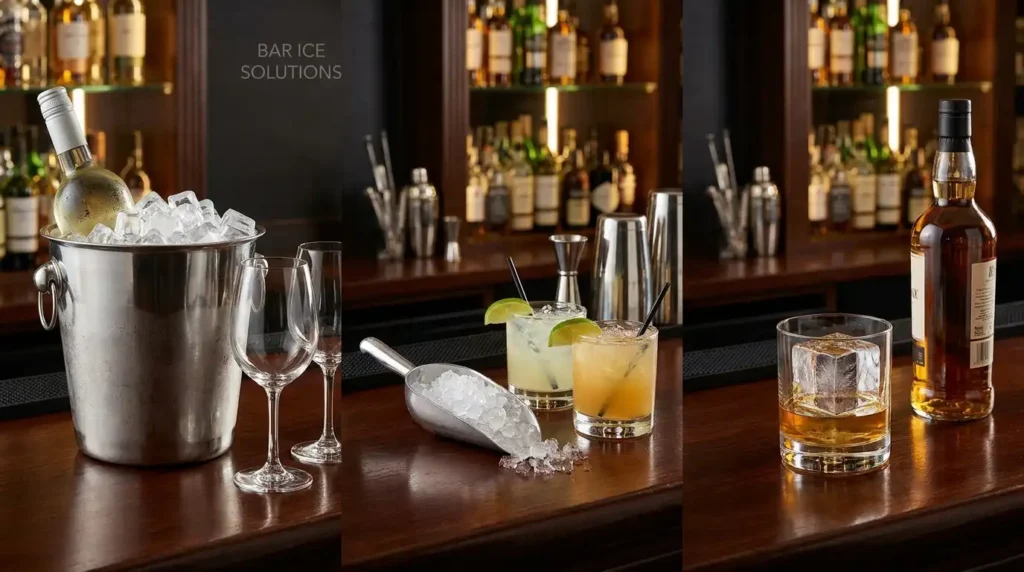
Cubed ice for bottle chilling
Standard cubed ice is the correct choice for tableside wine and champagne service. The irregular surfaces of cubed ice create air gaps that, combined with cold water, allow cold to circulate the bottle efficiently.
Cubed ice also melts at a rate that keeps melt water cold for longer. Use cube ice in your tableside presentation buckets and service station caddies for bottle work.
Crushed ice for cocktail stations
Crushed ice has a far higher surface area than cubed ice, which makes it ideal for quickly chilling spirit-forward drinks and for cocktails served over ice. At the cocktail station, a service bucket filled with crushed ice allows bartenders to pack glasses quickly and chill mixing tins rapidly.
It is not, however, a good choice for bottle chilling: the high surface area means faster melt, and crushed ice compacts around a bottle in a way that reduces rather than improves cold circulation.
Block or large-format ice for premium spirits service
A single large cube or a hand-cut block melts far more slowly than standard cubed ice due to its lower surface-area-to-mass ratio.
For whisky service, premium rum, or any spirits presented as a considered serve, a rocks glass over a single large cube or block is both the correct practical choice and a strong presentation signal.
Investing in a large-cube mould or a block ice programme for a cocktail-focused bar justifies itself quickly in perceived quality.
What this means for your ice bucket selection
A service station caddy used for cocktail builds should ideally be positioned near your crushed ice source. Your tableside wine and champagne buckets should always be stocked with cubed ice and cold water. If your bar runs both a cocktail programme and a wine service, treat these as two separate ice setups with separate dedicated equipment, not a shared compromise.
Commercial Bar Workflow: Ice Volume Planning and Station Setup
This is the planning step that most ice bucket buying guides skip entirely, and it is the one that actually determines whether your ice service holds up through a busy Friday or Saturday night. Buying the right buckets is straightforward; making sure you have enough of them, positioned correctly, and stocked to handle your service volume is the operational question.
Calculating how many buckets you need per station.
A practical starting point is to work backwards from your expected covers and drink mix. For a bar station handling 50 to 80 covers with an active wine-by-the-bottle service, assume you will need to present between 8 and 15 tableside ice buckets simultaneously at peak.
That means having that many tableside buckets available, not the three or four that most bars keep behind the bar.
For service station caddies, the standard is one per active bar station. If your bar runs two stations during a busy service, each station needs its own ice caddy.
Sharing a single caddy between stations creates a bottleneck. In high-volume settings, two caddies per station (one in use, one being refilled or chilling) is the professional setup.
Ice demand by service type.
A rough working guide: each tableside wine bottle presentation uses approximately 1.5 to 2 kg of ice, including the melt water refresh if the table requests one.
A cocktail station processing 80 to 100 cocktails per service session will use considerably more, typically 8 to 12 kg, depending on the drinks mix and whether crushed or cubed ice is the primary build ice.
A busy beer garden service using insulated buckets for bottled beer service will use 3 to 5 kg per bucket, depending on ambient temperature and insulation quality.
For a 100-cover Friday night service running a full cocktail programme, wine service, and beer garden: planning for 25 to 35 kg of ice available and circulating through your station caddies and tableside buckets is a reasonable baseline.
This should inform how you size your ice machine or ice delivery order, not just what buckets you buy.
Speed-rail and station positioning.
An ice caddy that requires a bartender to turn 180 degrees or walk two steps to access is a caddy that slows every drink build. The ideal positioning is within arm’s reach of the speed rail, at a height that allows scooping with one hand without bending.
A caddy positioned at a slightly lower level than the speed rail reduces the risk of ice scatter when scooping at pace.
If your bar has a separate glassware chilling area, position a dedicated caddy there as well. Pre-chilling glasses with a brief ice rinse before building cocktails is a quality standard that adds negligible time when the ice is directly at hand.
Planning for refill cycles.
Even a well-insulated 10-litre service caddy will need refilling during a four-hour service. Build a refill schedule into your service prep. Assign responsibility for ice caddy monitoring to a specific team member during peak service.
Running empty on ice at 9 pm on a Friday is a service failure that reflects more seriously on the bar’s preparation than it might seem.
Ice Bucket Stands: Choosing the Right Type for Your Venue
The stand is often an afterthought in the buying decision. It should not be.
Folding champagne stands with three or four legs are the most common type in UK bars. They fold flat for storage, are easy to position at a table, and come in finishes from chrome to brushed steel. Key considerations: the leg spread determines stability on different floor surfaces.
A narrow-leg stand that works fine on a flat, hard floor can tip on carpet. Test any stand on your actual flooring before committing to a quantity.
Fixed-height floor stands are more stable than folding options and suit venues where the stands live in fixed positions for tableside service. They are heavier and less storable, but for a restaurant with consistent table wine service, they are the more premium-feeling option.
Telescopic stands adjust to different heights and are practical for venues with mixed seating, from standard dining tables to bar stools and low cocktail tables.
Stand types by base design: tripod vs pedestal.
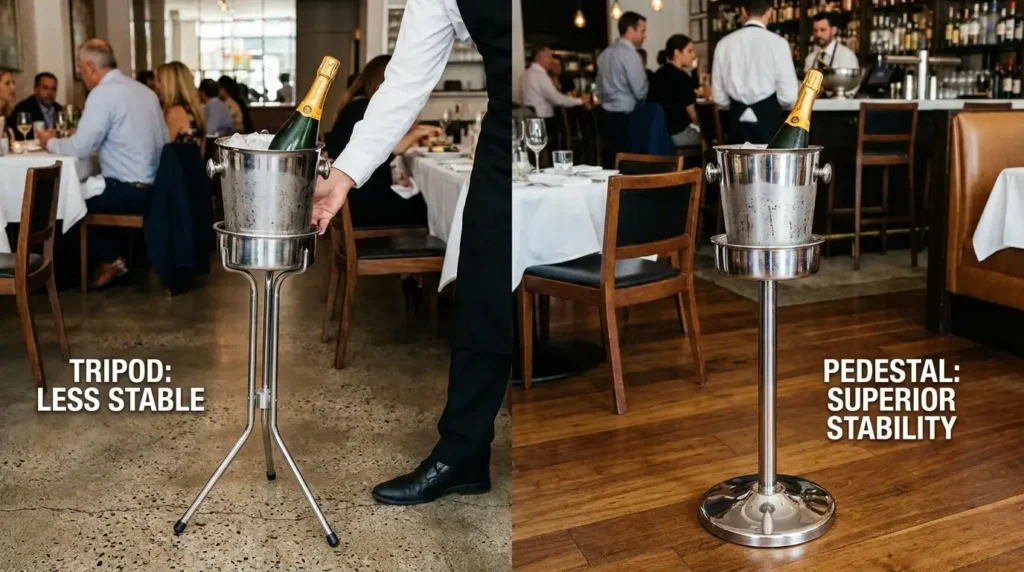
This distinction matters more than most buyers realise. A tripod base, three legs spreading outward from a central column, is lighter and easier to store,t but concentrates the load on three contact points.
On carpet or textured flooring, the tips of the legs sink slightly and create instability, particularly when a full ice bucket adds 3 to 5 kg of load.
A pedestal base, a circular or square weighted base with no separate legs, is heavier but distributes load evenly and is substantially more stable on both hard floors and carpet.
For a pub with mixed flooring across a restaurant area and a bar area, a pedestal-base stand is the more reliable choice across both surfaces.
Rubber feet, floor protection, and wet floor performance.
Any stand used in a bar environment will eventually be positioned on a wet surface, from spilt drinks, melted water drips, or post-mop flooring. Stands with bare metal feet are a slip hazard on wet tile or sealed concrete.
Rubber feet cap the base contact points and provide grip on wet surfaces, protect wooden or tile flooring from scratching, and reduce the noise of a stand being repositioned mid-service. When buying stands, check whether rubber feet are standard or an add-on.
For stands that do not include them, commercial rubber floor protectors that fit over the feet are inexpensive and worth adding.
Load-bearing ratings and commercial durability.
A full 4-litre ice bucket with ice and water weighs approximately 5 to 6 kg. A stand rated to 3 kg is not the right stand for this application. Most commercial stands are rated to at least 8 to 10 kg, but lower-cost stands imported for home or event use are often rated below that.
For commercial purchase, confirm the load rating and check whether the stand is built for repeated commercial use or for occasional event use. The weld quality at the joint where the bucket ring meets the column is the most common failure point: inspect this on any stand before purchasing in volume.
Stand material matching: Wrought iron stands are durable but heavy. Stainless steel stands match a stainless bucket aesthetically and are lighter. Chrome-plated stands are fine for indoor dry environments, but can show corrosion in outdoor or humid conditions over time.
How many stands do you need? A practical guideline is one stand for every 4 to 6 covers if you are running active tableside wine service. For occasional use on request, 2 to 4 stands behind the bar are typically sufficient for a pub or small restaurant.
UK Food Safety Rules for Ice Handling in Bars
Under UK food safety law, ice is classified as a food. The same hygiene standards that apply to food handling apply to ice service at the bar. This has three practical implications for ice buckets:
First, the ice bucket must be clean before each use. A bucket that has been rinsed and left to drain is not a clean bucket. It should be washed with a food-safe detergent, rinsed, and air-dried or dried with a clean cloth between services.
Second, ice must not be handled with bare hands. A dedicated ice scoop or tongs must be used to transfer ice from the storage source to the bucket. Never use glassware to scoop ice. A glass pressed into an ice bin can chip or shatter, and a glass chip in the ice supply is a serious food safety incident.
Third, melted water in an ice bucket used for tableside service should not be reused. Empty and clean the bucket between uses.
FSA guidelines and what Environmental Health Officers check.
The Food Standards Agency’s guidance on ice handling in licensed premises sits within the broader framework of food safety management under the Food Safety Act 1990 and Regulation (EC) 852/2004, which remains part of UK law post-Brexit.
Under these requirements, bars must be able to demonstrate that ice is produced, handled, and stored in a hygienic manner.
In practice, an Environmental Health Officer inspecting a bar will look for a documented cleaning schedule for ice equipment, evidence that ice scoops are stored hygienically (not left sitting in the ice), and that staff have received basic food hygiene training covering ice handling.
Sanitisation schedules for commercial ice buckets.
A practical commercial sanitisation schedule for ice buckets: wash with a food-safe detergent and hot water between each tableside use; at the end of each service, all buckets should be washed, rinsed with a food-safe sanitiser solution, and left to air dry inverted.
Service station caddies should be emptied and sanitised at the end of each service and not simply topped up from one session to the next. A logbook recording the cleaning of ice equipment, while not a legal requirement, is straightforward to maintain and provides useful documentation during an EHO inspection.
Open-top buckets and contamination risk.
An open-top ice bucket at a service station presents a contamination risk that a lidded caddy does not. Aerosol contamination from carbonated drinks, contact from bar cloths, and airborne debris are all more likely with an open top.
For service station ice storage, a lidded insulated caddy is the preferred format on both food safety and ice retention grounds. For tableside presentation, an open-top bucket is conventional and acceptable, but the bucket must be clean and the ice freshly scooped.
A tableside bucket that has been sitting for more than 45 minutes with a bottle in it should not be used as a source for additional drink-building ice.
These requirements apply to both the service station ice caddy and the tableside presentation bucket. They are straightforward to maintain and are checked by Environmental Health Officers during inspections.
Matching Ice Bucket and Stand Choices to Your Venue Style
The visual coherence of your ice service affects how professional your bar looks. A quick guide by venue type:
Traditional pub: Hammered or galvanised steel buckets, or barrel-style wooden-effect ice tubs. Folding chrome or black metal stands. Copper-finish options work well in pubs with a craft or heritage aesthetic.
Gastropub or restaurant: Brushed stainless steel or hammered copper. Clean folding stands in matching finishes. Consistency across all table ice service equipment is worth the investment.
Hotel bar or fine dining: Mirror-polished 304 stainless steel. Fixed-height floor stands, or premium folding stands. The quality of the finish is visible and matters at this level of service.
Cocktail bar: Clear acrylic or contemporary copper-finish buckets. Presentation is part of the brand identity. Consider branded or printed options for a more considered look.
Beer garden or outdoor licensed area: Insulated stainless steel with lids for service station use. Robust stands with a wide-leg spread for outdoor surfaces. Avoid chrome-plated stands in permanently outdoor settings.
What to Buy for Outdoor Licensed Areas
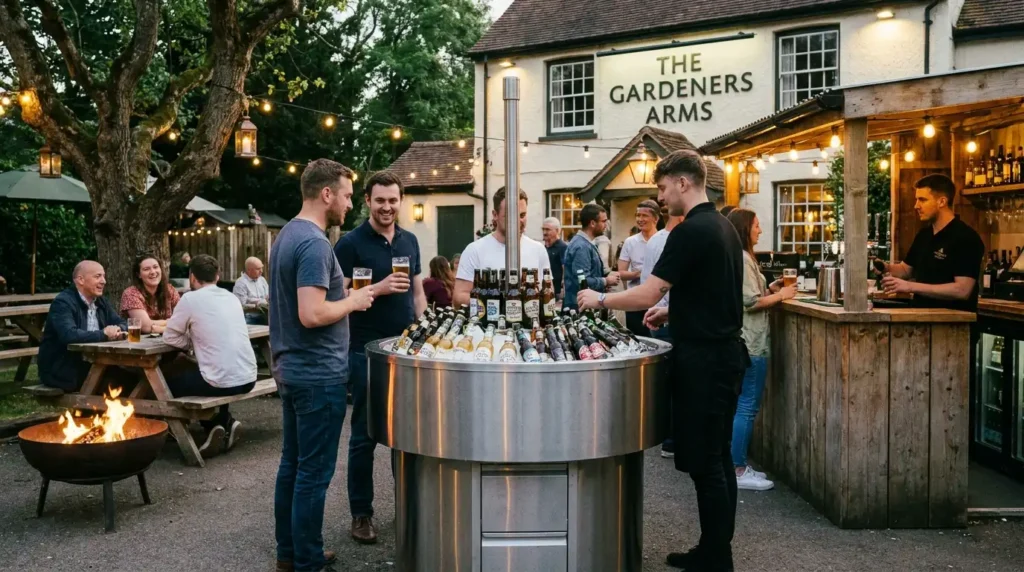
Outdoor service creates specific requirements that indoor bar equipment does not always meet.
Ice melts considerably faster outdoors in warm weather. A standard uninsulated stainless bucket needs refilling every 20 to 30 minutes in summer conditions. An insulated double-wall bucket extends that to 45 to 60 minutes, which meaningfully reduces service interruption.
Stand stability is more critical outdoors. Decking, paving with slight falls, and uneven ground all create tipping risk with narrow-leg stands. Wide-base or four-leg stands are a safer choice for any outdoor or garden service area.
If your premises licence requires polycarbonate or non-glass service in outdoor areas, polycarbonate ice buckets are the compliant choice for tableside service. They are lighter, shatterproof, and available in contemporary designs that do not look like a compromise.
Common Mistakes When Buying Ice Buckets for Bars
Buying on aesthetics without checking the steel grade. A mirror-polished ice bucket that begins rusting at the weld joints within a year is expensive to replace and damaging to presentation. Always confirm 304 grades for commercial purchase.
Buying a stand without checking stability on your specific flooring. Folding stands behave differently on carpet, tiles, and wooden floors. Test before buying in quantity.
Using one size for everything. A tableside wine bucket that is too small to properly submerge a bottle will not chill the wine correctly. Undersized ice buckets for service stations run out quickly during a busy service. Match size to application.
Not using ice and water together. Ice alone is a poor conductor of cold. A bottle sitting among ice cubes with no water chills much more slowly than one submerged in ice water. This is a consistent service standard issue in UK bars.
Skipping the hygiene protocol. An unwashed ice bucket used repeatedly is a food safety issue. The cleaning step is quick, and the compliance obligation is clear.
We Can Source It supplies a full range of ice buckets and stands for UK bars and pubs, including stainless steel service caddies, tableside presentation buckets, champagne stands, and polycarbonate options for outdoor licensed areas. Explore the full Bar Equipment & Supplies collection for commercial bar service equipment and accessories.
👉For the full guide on bar equipment, from spirit measures and cocktail tools to cellar management and bar organisation, see our complete article on Pub and Bar Equipment Supplies
Frequently Asked Questions
What size ice bucket do I need for a wine or champagne bottle?
A 3 to 4 litre ice bucket is the standard for a single 750ml bottle. This gives enough capacity to surround the bottle with ice and cold water up to the shoulder, which is the correct way to chill wine quickly. Always use ice and cold water together, not ice alone.
What is the best material for a commercial ice bucket in a UK bar?
304 grade stainless steel is the professional standard for commercial bar use. It is durable, food-safe, corrosion-resistant, and easy to sanitise. Double-wall construction provides better ice retention than single-wall. Confirm the steel grade with your supplier before purchasing, as 201-grade steel looks identical but corrodes significantly faster in commercial use.
How many ice bucket stands does a bar need?
A practical guideline is one stand for every 4 to 6 covers if you run active tableside wine service. For occasional use, 2 to 4 stands available behind the bar are sufficient for most pubs and small restaurants.
Is ice classified as a food under UK law?
Yes. Under UK food safety regulations, ice is classified as a food product and must be handled accordingly. This means using a dedicated ice scoop or tongs at all times, never using glassware to scoop ice, and ensuring that ice buckets are properly cleaned between uses.
Can I use standard ice buckets in outdoor licensed areas?
Standard uninsulated ice buckets lose ice quickly in warm outdoor conditions. For outdoor service, insulated double-wall buckets are more practical. If your premises licence requires non-glass service in outdoor areas, polycarbonate ice buckets are the compliant choice for tableside bottle service.
What type of ice should I use in a tableside wine bucket?
Cubed ice is the correct choice for bottle chilling. Always combine it with cold water; ice alone chills far more slowly than ice and water together. Crushed ice is better suited to cocktail station builds, not tableside wine service.
How much ice does a bar need for a busy service?
For a 100-cover service running wine table service and a cocktail programme, planning for 25 to 35 kg of ice in circulation is a reasonable baseline. Service station caddies should be sized and positioned so each active bar station has its own dedicated caddy, with refill cycles built into the service plan.
Author
We Can Source It, Team
We Can Source It is a UK-based specialist supplier of catering and hospitality supplies for bars, pubs, restaurants, hotels, and event operators across the United Kingdom.