A coffee machine that is not properly cleaned does not just make worse coffee. It costs you in repair call-outs, shortened machine life, and, for any food business, it sits squarely inside your food hygiene obligations. Most guides treat machine cleaning as a nice habit. For a commercial kitchen or café, it is closer to a legal one.
This guide covers why cleaning matters beyond taste, the real difference between cleaning and descaling, what each machine type actually needs, a practical daily-to-annual schedule, how UK water hardness should change your descaling frequency, and what to buy for each task.
Why Commercial Coffee Machine Cleaning Is Not Optional

The effect on taste
Coffee oils left inside a group head, portafilter, or brew unit go rancid over time. That residue does not wash away with water alone, and it is the most common cause of a bitter or stale aftertaste that customers blame on the beans rather than the machine. A machine cleaned to schedule will produce a noticeably more consistent cup than one that is only rinsed.
The effect on the machine itself
Limescale and old coffee oils do more than affect coffee quality. Over time, heating elements become coated with scale, valves can become restricted, and seals wear prematurely. These issues increase the likelihood of costly repairs; a commercial espresso machine engineer call-out can easily cost £100–£250 before replacement parts are even considered. Regular cleaning and maintenance help prevent avoidable breakdowns and extend the working life of the machine.
The food hygiene angle
According to the Food Standards Agency’s guidance on cleaning effectively in food businesses, all surfaces and equipment that come into contact with food must be cleaned and disinfected on a documented schedule, and the FSA notes that not cleaning thoroughly is one of the most commonly cited reasons food businesses are prosecuted. A coffee machine is not exempt from that requirement just because it produces drinks rather than meals. Its milk system, spouts, and any component that touches a drink before it reaches a customer all fall within scope.
Milk systems in particular carry a genuine allergen cross-contamination risk if not cleaned between uses, which is worth taking as seriously as any other allergen control point in your kitchen.
Cleaning Versus Descaling: Two Different Jobs
This distinction trips up more people than almost anything else in coffee machine maintenance, and it is worth being precise about it.
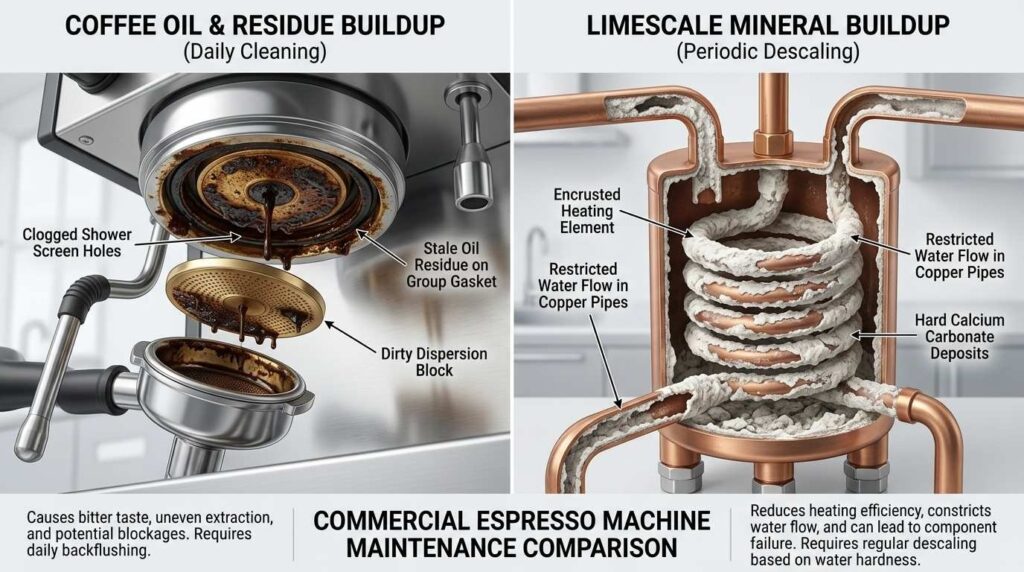
Cleaning removes organic residue, coffee oils, coffee grounds, and milk deposits. This is what backflushing, portafilter soaking, and steam wand wiping are for.
Descaling removes inorganic mineral deposits, primarily calcium and magnesium, from your water supply, which build up inside boilers, heating elements, and water lines as limescale.
No amount of cleaning will remove limescale, and no amount of descaling will remove rancid coffee oil. A machine that is descaled regularly but never properly cleaned will still taste bad. A machine that is cleaned diligently but never descaled will eventually fail mechanically. You need both, on their own separate schedules.
Cleaning by Machine Type
Different machine types need genuinely different approaches, and most generic guides flatten this into one set of instructions that does not really fit any of them well.
Traditional espresso machines
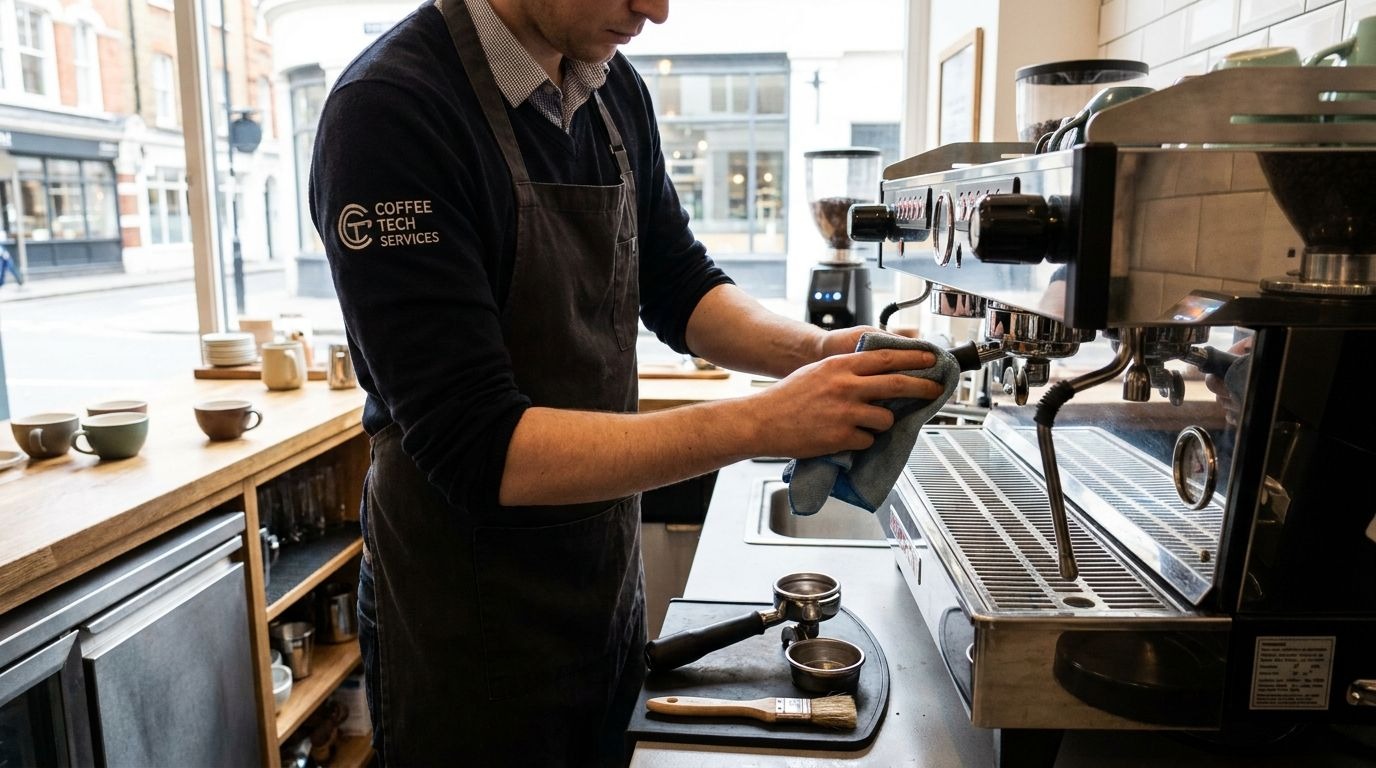
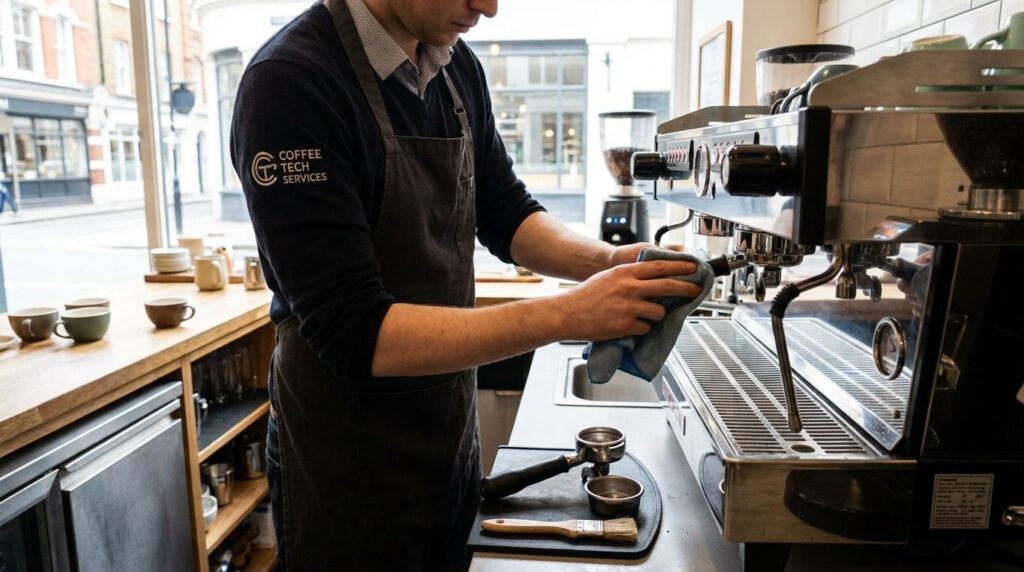
The group head, portafilter, and steam wand are the priority areas. Daily backflushing with a blind filter and a cleaning powder or tablet clears the group head of built-up coffee oils. Portafilters should be removed and soaked, not just rinsed under the tap. The steam wand needs purging and wiping after every single use, not just at the end of the day, since milk residue dries onto it within minutes and becomes far harder to remove once it has.
Bean-to-cup machines
Most modern bean-to-cup machines run an automated cleaning cycle, but that cycle is not a substitute for manual attention to the brew unit and milk circuit. The brew unit should be removed and rinsed regularly per the manufacturer’s instructions. The milk system needs a dedicated cleaning cycle daily if the machine is dispensing milk-based drinks; this is the highest hygiene risk component on the entire machine.
Filter and bulk-brew machines
These get overlooked in most cleaning guides, which tend to assume an espresso setup. The water reservoir, carafes or jugs, and filter funnel all need regular cleaning to prevent coffee oil build-up and limescale, and the heating plate or element benefits from the same descaling attention as any espresso boiler.
Pod and capsule machines
The simplest of the four to maintain. Descaling is the main ongoing task, alongside keeping the drip tray and capsule chamber clear of residue.
Quick comparison
| Machine Type | Daily Backflush | Daily Milk System Clean | Descaling Frequency Driver |
| Traditional espresso | Yes | If using milk | Water hardness and volume |
| Bean-to-cup | Automated cycle, plus manual brew unit care | Yes | Water hardness and volume |
| Filter / bulk-brew | Not applicable | Not applicable | Water hardness |
| Pod / capsule | Not applicable | If the milk attachment is used | Water hardness |
The Cleaning Schedule
Daily, at the end of every shift
- ▸ Backflush group heads on espresso machines using a cleaning powder or tablet.
- ▸ Purge and wipe the steam wand after every use, not just at close
- ▸ Empty and clean the drip tray and grounds container
- ▸ Soak portafilters and baskets
- ▸ Run a milk system clean cycle on any machine dispensing milk drinks
- ▸ Wipe down all exterior surfaces
Weekly
- ▸ A deeper portafilter and basket soak beyond the daily routine
- ▸ Check group head gaskets for wear
- ▸ Clean the filter funnel on filter machines
- ▸ Wipe down the grinder hopper and checkthe burrs
- ▸ Full exterior sanitise, not just a wipe
Monthly
- ▸ A full backflush deep clean
- ▸ Check whether descaling is due based on your water hardness (see below)
- ▸ Inspect or replace the water filter if your machine uses one
- ▸ Remove and soak the shower screen on espresso machines
Quarterly and annual
- ▸ Book a professional service, at minimum annually, twice yearly for high-volume machines.
- ▸ Inspect O-rings and gaskets for replacement
- ▸ A full descale if your monthly checks have not already required one
Our coffee machine clean and descale tablets handle both the cleaning and descaling jobs in one product across most bean-to-cup and capsule formats, simplifying what you need to keep in stock, available in 25, 50, and 100-tablet packs so you can match your stock to your actual usage and water hardness.
Descaling and UK Water Hardness
This is the part most guides get wrong by giving one generic frequency that ignores where in the UK the machine actually is.
Hard water, high in dissolved calcium and magnesium, causes limescale to build up far faster than soft water does. Large parts of England, particularly London, the South East, and the East of England, sit on hard or very hard water. Scotland and much of Wales and the North West of England generally have softer water.
The practical implication: a machine running in a hard water area needs descaling considerably more often than the same machine in a soft water region. A café in London, for example, may need to descale every two to four weeks, while a similar café in Glasgow may only require descaling every eight to twelve weeks. Using a single generic frequency across multiple sites in different parts of the country means some machines are being under-descaled and quietly damaged.
A reasonable starting framework:
| Water Hardness | Light Commercial Use | Heavy Commercial Use |
| Soft (much of Scotland, parts of Wales and NW England) | Every 8 to 12 weeks | Every 4 to 6 weeks |
| Moderate | Every 6 to 8 weeks | Every 3 to 4 weeks |
| Hard to very hard (London, South East, East of England) | Every 4 weeks | Every 2 weeks |
Check your local water supplier’s website for your area’s hardness, or use a simple test strip on-site if you operate across multiple regions and want a definitive answer rather than relying on a postcode lookup. If you are in a hard water area and replacing parts or repairing the machine more often than feels reasonable, increasing descaling frequency is usually the first thing worth changing before assuming the machine itself is at fault.
What Coffee Machine Cleaning Products Do You Need?
People searching this topic often need to stock up on the right products, not just understand the process. Here is a straightforward summary of what each task requires:
| Task | Product Needed |
| Daily backflushing (espresso) | Coffee machine cleaning powder or tablet |
| Descaling – tablets format | Coffee machine descaling tablets (25, 50, or 100-pack) |
| Descaling – liquid format | Coffee machine cleaning and descaler liquid (1 litre, suited to bean-to-cup and capsule machines) |
| Milk system cleaning | Dedicated milk system cleaner (not a water rinse) |
| Hard water areas | Aquasol salt tablets to reduce limescale reaching the machine |
| Exterior surfaces | Food-safe sanitiser |
For a full overview of coffee machine cleaning products available for commercial use, browse our coffee machine cleaning range.
For sites running a separate water softening system, Aquasol salt tablets reduce the limescale reaching the machine in the first place, which can stretch out your descaling interval.
For crockery used alongside coffee service, a tannin stain remover keeps cups and saucers free of the coffee and tea staining that builds up even when the machine itself is well maintained.
Common Cleaning Mistakes
Using vinegar as a homemade descaler. It is acidic enough to do some of the job but can taint future brews and, on some internal components, cause more harm than the manufacturer-approved product it was meant to replace.
Cleaning visible surfaces while ignoring the group head or brew unit. This is where the residue that actually affects taste accumulates.
Skipping the milk system clean because it “was only used a couple of times today.” Milk residue does not need volume to become a hygiene risk; it needs time.
Descaling at the same fixed interval regardless of local water hardness. This under-protects machines in hard water areas, which is most of England.
Using a non-approved cleaning product that voids the manufacturer’s warranty. Worth checking before switching to a cheaper alternative.
When to Call a Professional
In-house cleaning and descaling cover routine maintenance. A professional service goes further: internal inspection, component replacement where needed, calibration, and a professional-grade descale of parts that are not accessible during normal daily cleaning.
Signs it is time to book one rather than rely on your own routine: inconsistent water temperature, noticeably slower flow than usual, loss of steam pressure, unusual noises during operation, or a persistent taste issue that does not clear up despite a thorough clean and recent descale. Booking a service annually at minimum, and twice yearly for a high-volume machine, is a reasonable baseline regardless of whether you have noticed a specific problem.
Cleaning Considerations by Sector
Cafés and coffee shops run the highest volume and the tightest margin for error, since a bad cup is immediately visible to a paying customer. Daily discipline matters more here than anywhere else.
Offices and workplaces typically run a bean-to-cup machine with moderate, often unmonitored use. A simple reminder system for the automated cleaning cycle, plus a named person responsible for the milk system clean, closes the most common gap.
Schools, colleges, and care settings carry an added allergen consideration around milk, and irregular use patterns, particularly during school holidays, mean a shutdown and restart protocol matters as much as the daily routine.
Hotels often run multiple machines across different areas with shift handovers between staff, which makes a written schedule and clear sign-off genuinely necessary rather than optional, since responsibility can otherwise fall between two shifts.
FAQs
How often should a commercial coffee machine be cleaned?
Daily, at minimum, covering group head backflushing, steam wand purging, drip tray emptying, and milk system cleaning where applicable. Weekly and monthly tasks add deeper cleaning of components that do not need daily attention.
Is it a legal requirement to clean a commercial coffee machine in the UK?
There is no clause naming coffee machines specifically, but the FSA’s cleaning guidance requires all food-contact equipment, which includes a coffee machine’s milk and dispensing components, to be cleaned and disinfected on a documented schedule as part of a food business’s wider hygiene obligations.
What is the difference between cleaning and descaling a coffee machine?
Cleaning removes organic residue: coffee oils, grounds, and milk deposits. Descaling removes inorganic mineral deposits, mainly calcium and magnesium, from hard water that build up inside boilers and heating elements. Both are necessary, and neither replaces the other.
Can I use vinegar to descale a commercial coffee machine?
It is best avoided. Vinegar can taint future brews and is not formulated for the specific internal components of a commercial machine the way a proper descaling product is, and using it can risk the kind of damage a manufacturer-approved descaler is designed to prevent.
How do I know if my coffee machine needs descaling?
Common signs include slower water flow than usual, visible white mineral deposits, a flat or bitter taste despite recent cleaning, and inconsistent water temperature. If you are in a known hard water area and have not descaled within your expected interval, that is usually the first thing to check.
Does water hardness affect how often I need to descale?
Yes, significantly. Machines in hard water areas, common across much of England, particularly London, the South East, and the East, need descaling considerably more often than machines in softer water regions like much of Scotland and parts of Wales and the North West.
How do I clean the milk system on a bean-to-cup machine?
Run the machine’s dedicated milk system cleaning cycle daily using a milk system cleaner, not just a water rinse. This is the highest hygiene risk component on the machine and should never be left for “just a couple of uses.
For the wider context of kitchen hygiene compliance, see our commercial kitchen cleaning supplies guide and our kitchen cleaning schedule template. For UK food hygiene compliance more broadly, see our guide to food hygiene regulations for UK restaurants.
References
- ▸ Food Standards Agency: Cleaning effectively in your business
- ▸ Food Standards Agency: Setting up your food business premises