Most of what is written about IPA cleaning solutions online is written for electronics technicians and laboratory staff, not catering operators. The 70% versus 99% comparisons exist, but they are framed around circuit boards and lab benches, not stainless steel worktops, combi oven touchscreens, and the very specific question every kitchen manager actually wants answered: is it safe to use this near food?
This guide answers that question properly, in a UK catering context, then covers which concentration suits which task in a commercial kitchen, where IPA fits alongside your existing cleaning products, what COSHH actually requires of you, and how to store it safely in an environment full of gas rings, fryers, and open flame.
In short: IPA cleaning solution, or isopropyl alcohol, is a fast-evaporating solvent used in commercial kitchens to disinfect already-clean surfaces, remove grease and adhesive residue, and clean touchscreens and equipment controls. The two strengths most catering operators use are 70% IPA for disinfection and 99% IPA for degreasing and residue removal.
What Is IPA Cleaning Solution?
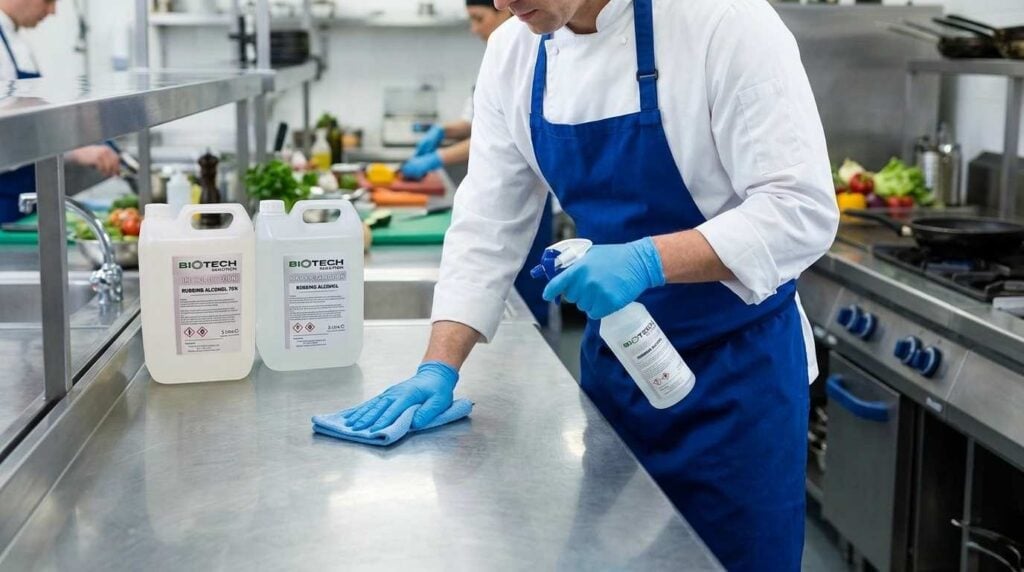
IPA stands for isopropyl alcohol, also known as isopropanol or rubbing alcohol. It is a clear, fast-evaporating solvent sold at different concentrations, most commonly 70% and 99%, with the remainder typically made up of water.
It works in two distinct ways depending on concentration. At lower concentrations such as 70%, the water content slows evaporation just enough to give the alcohol time to denature proteins in bacteria and some viruses, which is why 70% is the more effective disinfecting strength. At higher concentrations such as 99%, it evaporates almost immediately, which makes it a stronger solvent for grease, adhesive residue, and fingerprints, but a weaker disinfectant, since it does not stay on the surface long enough to do the same biological work.
It leaves no residue once evaporated, which is the main reason it is used so widely across commercial kitchens, electronics maintenance, and healthcare settings alike.
Is IPA Cleaning Solution Safe to Use in a Commercial Kitchen?
This is the question every catering buyer actually wants answered, and it deserves a direct answer rather than a vague one.
IPA is safe to use in a commercial kitchen when it is applied correctly, on the right surfaces, and allowed to fully evaporate before any food contact resumes. It is not banned or restricted under UK food hygiene law for use on kitchen surfaces, but it is not a substitute for your normal cleaning and disinfection routine either. It works best as part of that routine, not instead of it.
What UK food hygiene rules actually require
Under FSA guidance for setting up and running a food business, all surfaces and equipment that come into contact with food must be kept clean, in good repair, and properly disinfected. The guidance does not name specific chemical products. It sets the outcome you need to achieve, not the brand or formula you must use to get there. The Safer Food Better Business guidance for caterers reinforces the same principle: a documented cleaning schedule, the right product for the right surface, and evidence that staff are following it.
That means the real compliance question is not “is IPA allowed,” but “are you using it correctly, on the right surface, as part of a documented routine.” IPA passes that test easily when used the way this guide describes.
The pre-cleaning rule that catches people out
IPA’s effectiveness as a disinfectant drops sharply on a surface that still has visible food residue, grease, or organic matter on it. Alcohol works at a molecular level, and a layer of grease or food debris physically blocks it from reaching the surface and the microbes on it.
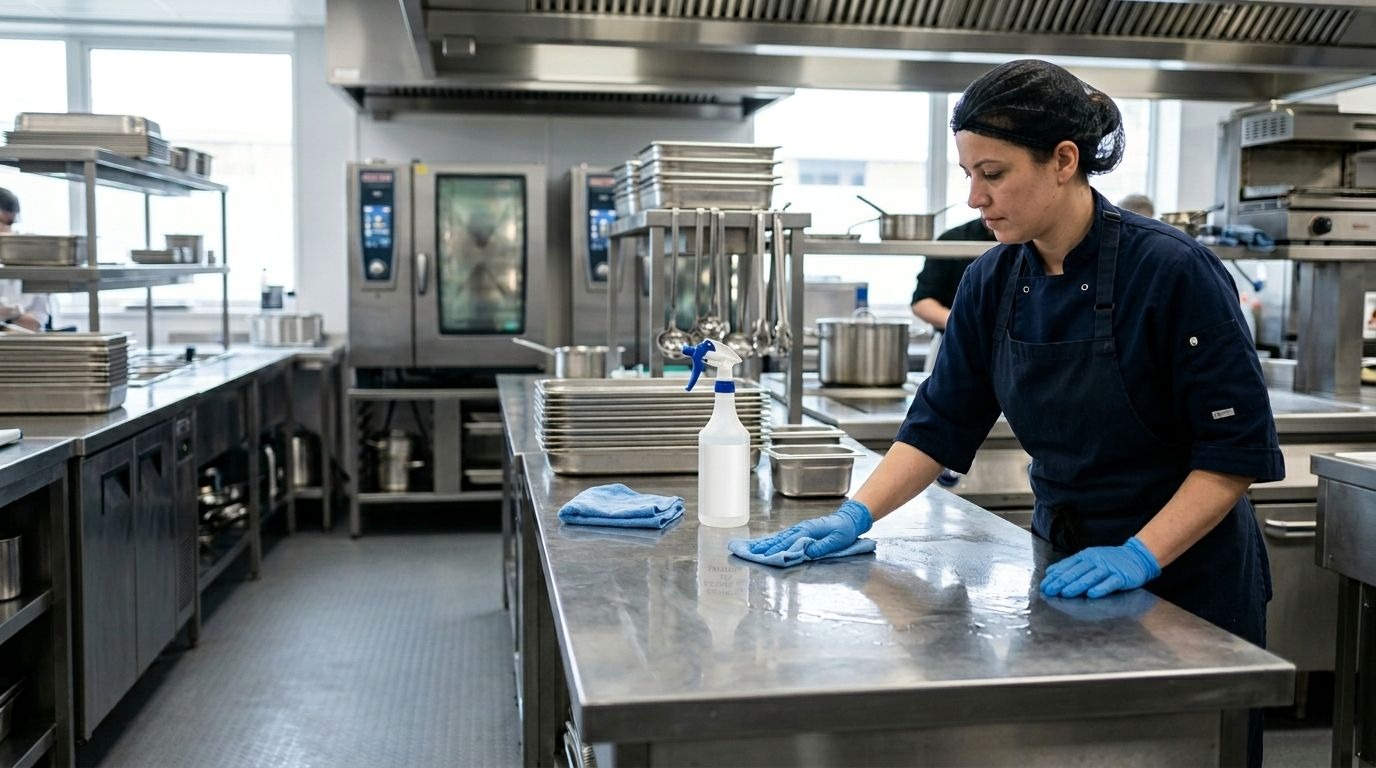
The practical rule for kitchens: clean first, then disinfect. Wipe away visible mess with your normal detergent and a cloth, then apply IPA to the cleaned surface. Skipping straight to IPA on a dirty surface wastes product and gives you a false sense of having disinfected something you have not.
Food contact surfaces specifically
For surfaces that food will touch directly, the safest and most straightforward approach is to apply IPA, allow it to fully evaporate, and only then bring food into contact with the surface. Evaporation typically takes a minute or two, depending on ventilation and how much product was applied. Many operators choose to wipe the surface again with a clean, damp cloth as an extra precaution before food contact resumes, though this is a precaution rather than a regulatory requirement once full evaporation has occurred.
Cleaning and disinfecting are not the same step
This distinction matters more than most kitchen teams realise, and it is worth being explicit about it. Cleaning removes visible dirt, grease, and food residue using detergent and physical action. Disinfecting reduces the number of microorganisms on a surface to a safe level, but it only works properly once the surface is already clean, which is exactly why the pre-cleaning rule above exists.
Disinfectants, including IPA, also rely on contact time, meaning the product needs to remain wet on the surface for a certain period to do its work. With 70% IPA, that contact time is short, typically under a minute, because the water content keeps it from flashing off instantly. With 99% IPA, the contact time is so brief that it often evaporates before it has had a meaningful chance to act on bacteria, which is the main reason it is the weaker disinfectant of the two despite being the higher concentration. For a full breakdown of cleaning chemical types and how they fit into a documented kitchen routine, see our commercial kitchen cleaning supplies guide.
IPA versus a dedicated food-safe sanitiser
IPA is not the only option for disinfecting kitchen surfaces, and it is worth knowing where it fits next to the alternative most kitchens already have on the shelf.
| Factor | IPA (70%) | BS EN 1276 Food-Safe Sanitiser |
| Best for | Fast disinfection of small areas, equipment, electronics, and adjacent surfaces | General food contact surface disinfection as part of routine cleaning |
| Contact time | Short, but the product evaporates quickly | Often slightly longer, by design, to guarantee microbial kill |
| Residue | None | Usually none, if a no-rinse formula |
| Electronics and touchscreens | Safe when applied to a cloth | Not typically designed for this use |
| Grease cutting | Reasonable, stronger at 99% | Limited; sanitisers are not formulated as degreasers |
| Typical role in a kitchen | A flexible, multi-purpose product for specific tasks | The primary disinfectant for routine surface sanitising |
In most kitchens, a BS EN 1276-certified food-safe sanitiser remains the right default for routine prep surface disinfection as part of a documented cleaning schedule, simply because it is purpose-built for that exact job and contact time. IPA earns its place alongside it for the tasks a sanitiser is not designed for: equipment with electronics, adhesive or label residue, and quick spot-disinfection where a sanitiser spray is not practical or available. Most well-run kitchens use both, not one instead of the other.
70% or 99% IPA: Which Concentration for Your Kitchen?
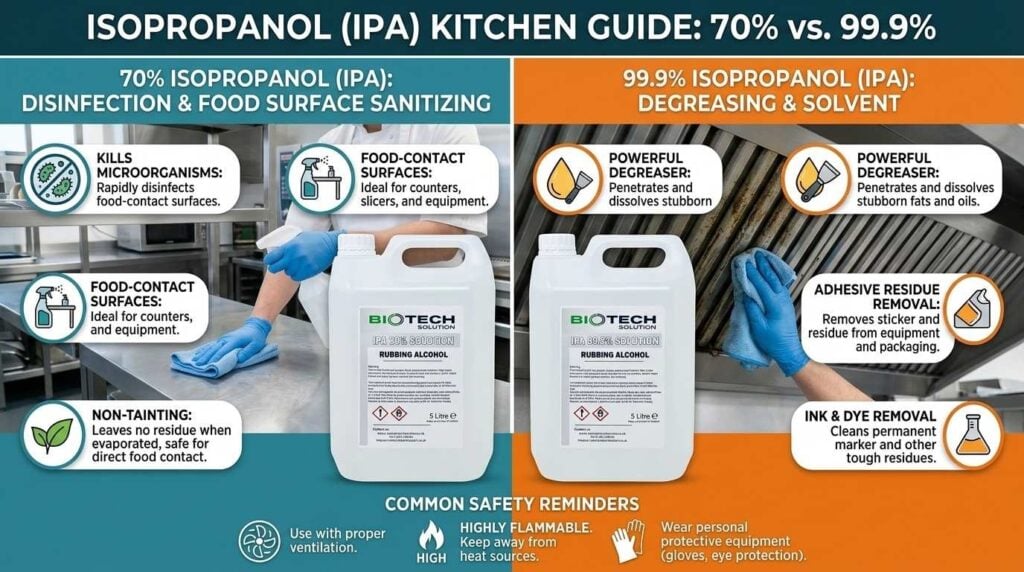
This is the single most useful decision a catering buyer needs help with, and it depends entirely on the task.
| Task | Recommended | Why |
| Prep surface disinfection | 70% | Slower evaporation gives the alcohol time to work against bacteria |
| Equipment degreasing | 99% | Stronger solvent action, evaporates fast, no residue |
| POS terminals and touchscreens | Either applied via cloth | Avoid direct spraying near any electronics |
| Stainless steel worktops and equipment | Either | Both are compatible; choose based on whether disinfection or degreasing is the priority |
| Adhesive or label residue removal | 99% | Faster, stronger solvent action |
| General sanitising support | 70% | Standard strength for surface disinfection tasks |
A simple rule is that 70% IPA is generally preferred for disinfection, while 99% IPA is better suited to degreasing and residue removal. If you are unsure which task you are performing, ask whether the surface is visibly greasy or sticky (use 99%) or whether it is already clean and simply needs disinfecting before food contact resumes (use 70%).
Our 1L IPA 70% solution suits the disinfection side of this, and 5L IPA 70% is a more practical volume for a kitchen using it regularly across a full service. For degreasing and residue removal, the 1L IPA 99.9% solution and 5L IPA 99.9% cover both occasional and high-frequency use.
Where IPA Is Useful in a Commercial Kitchen
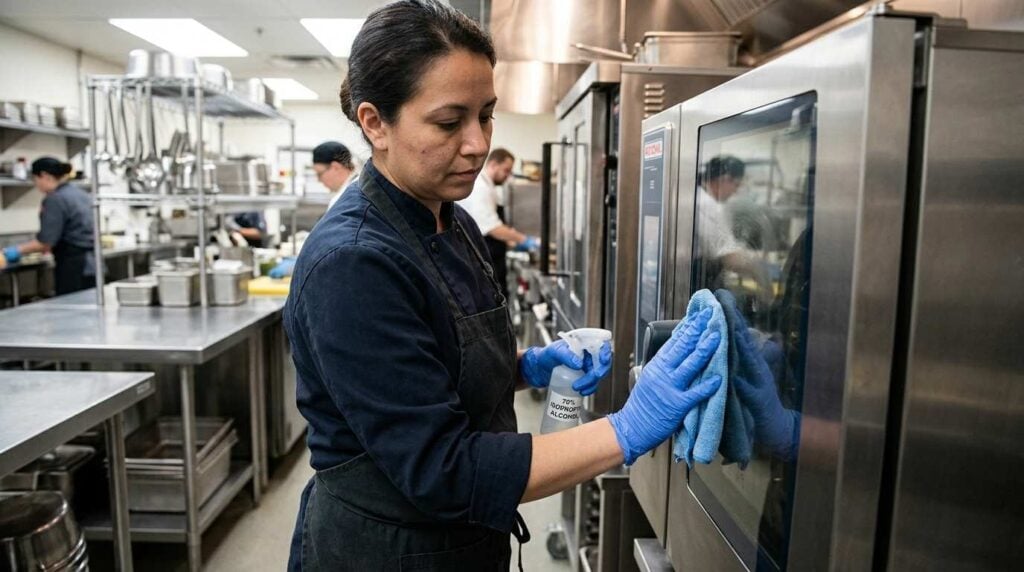
- ▸ Stainless steel worktops and prep surfaces, once pre-cleaned of visible food residue
- ▸ Combi oven and dishwasher control panels and touchscreens, applied to a cloth rather than sprayed directly
- ▸ POS terminals and front-of-house tablets, again via cloth to avoid moisture ingress
- ▸ Catering knives, tools, and utensils when they are not currently in food contact use
- ▸ Cold storage door seals and handles, and other high-touch non-food surfaces around the kitchen
For the broader legal context around what your kitchen is required to keep clean and how, see our guide to UK food hygiene regulations for restaurants.
Where it is not the right product
- ▸ Directly on food itself, under any circumstances
- ▸ On hot surfaces or anywhere near open flame, gas rings, or active fryers, given how flammable IPA is
- ▸ As a substitute for proper degreasing of extraction hoods, ductwork, or heavily soiled deep-clean areas, where it is simply not the right tool for the volume of grease involved
- ▸ On rubber seals where the manufacturer specifically warns against alcohol-based cleaners, since some rubber compounds degrade with repeated alcohol contact
COSHH and Safety in the Kitchen
IPA is classified as a flammable liquid and can be an irritant to eyes and skin, which means it falls within the scope of the Control of Substances Hazardous to Health Regulations. As an employer using IPA in your kitchen, you are required to assess the risk it presents and put reasonable controls in place.
In practice, a basic COSHH assessment for IPA in a catering setting covers a short list: confirming what the substance is and checking the safety data sheet, identifying who handles it and how, deciding on reasonable controls such as ventilation and limiting the quantity kept in the kitchen at any time, and making sure staff know how to use it safely. This does not need to be a lengthy or complicated document for a single cleaning product used in a controlled way. Our IPA products are supplied with COSHH data sheets available, which give you the underlying information your assessment needs to reference.
Storage and fire safety
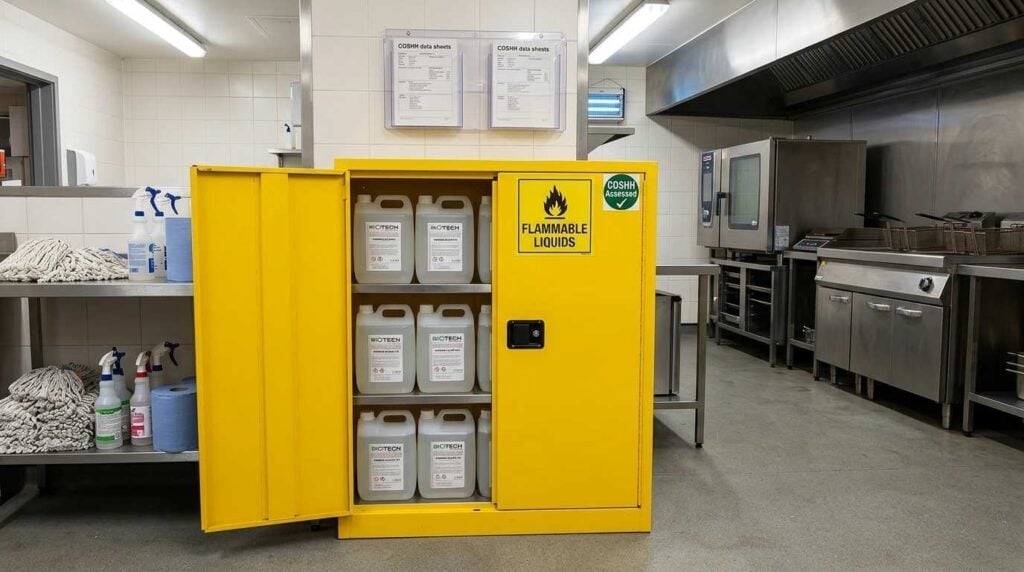
This is worth taking seriously in a kitchen specifically, since most kitchens are full of exactly the ignition sources IPA needs to be kept away from.
- ▸ Store IPA away from gas rings, fryers, ovens, and any open flame
- ▸ Keep containers sealed and in a cool, ventilated area rather than next to heat sources
- ▸ Avoid storing large volumes in the kitchen itself; keep working quantities only and hold bulk stock in a separate, ventilated store if you are buying 5L containers
- ▸ Label containers clearly, particularly if any product is ever decanted into a smaller bottle for use at a workstation
Basic PPE
Nitrile gloves are a sensible precaution for regular use, and good general ventilation is more important than any specific respiratory protection for the quantities used in routine kitchen cleaning. Avoid eye contact and skin contact with concentrated solution where practical, and wash off promptly if either occurs.
Buying IPA Cleaning Solution for Catering Use
A few practical things to check before ordering:
- ▸ Concentration. Confirm whether you need 70% or 99% for the task, or both, since many kitchens keep one of each.
- ▸ Volume. A 1L bottle suits light or occasional use, particularly for front-of-house or office-adjacent tasks. A 5L container is the more sensible choice for a busy kitchen using IPA as part of a daily cleaning routine, since it reduces how often you are reordering and lowers the cost per litre.
- ▸ COSHH data sheet availability. Always confirm your supplier can provide one. It is the document that our own COSHH assessment will reference.
- ▸ Supplier reliability. For a product you are using regularly, a UK trade supplier with consistent stock and the ability to deliver to multiple sites is worth more than a marginally lower one-off price.
Which size should you buy?
| Kitchen Type | Suggested Starting Volume |
| Small café or takeaway | 1L of each concentration |
| Restaurant or pub kitchen | 5L of 70%, 1L of 99% for occasional degreasing tasks |
| Hotel or care home catering | 5L of each, with bulk stock held in a separate ventilated store |
| Multi-site operation | Multiple 5L containers per site, ordered on a trade account for consistent stock and pricing |
This is a starting point rather than a fixed rule. A care home kitchen with a strong general sanitiser routine already in place may use comparatively little IPA day to day, while a busy pub kitchen with a lot of equipment and front-of-house technology may go through 99% faster than the table suggests. Track actual usage for a few weeks and adjust from there.
Common Mistakes Worth Avoiding
- ▸ Applying IPA straight onto a visibly dirty or greasy surface and expecting it to disinfect effectively
- ▸ Reaching for 99% when the task is disinfection rather than degreasing, and ending up with weaker results than 70% would have given
- ▸ Storing bottles near a gas range or fryer, because that happens to be where the cleaning cupboard is
- ▸ Spraying IPA directly onto electronic touchscreens or control panels rather than applying it to a cloth first
- ▸ Letting food contact resume before the surface has fully evaporated
FAQs
Can IPA be used on food contact surfaces in a UK kitchen?
Yes, when used correctly. UK food hygiene guidance does not name specific products but requires food contact surfaces to be properly cleaned and disinfected. The practical rule is to clean off any visible residue first, apply IPA, and allow it to fully evaporate before food touches the surface again.
What is the difference between 70% and 99% IPA cleaning solution?
70% IPA evaporates more slowly, which gives it time to work effectively as a disinfectant against bacteria and some viruses. 99% IPA evaporates almost immediately, making it a stronger solvent for grease, adhesives, and residue, but a weaker disinfectant since it does not stay on the surface long enough. Use 70% for disinfection tasks and 99% for degreasing and residue removal.
Do I need to rinse IPA off kitchen surfaces after use?
Generally, no, provided the surface is allowed to fully evaporate before food contact resumes. Some operators choose to wipe the surface again with a clean damp cloth as an extra precaution, but this is not a strict requirement once evaporation is complete.
Is IPA flammable, and is it safe to keep in a commercial kitchen?
Yes, IPA is highly flammable. It can be used safely in a kitchen provided it is stored away from gas rings, fryers, and open flame, kept in sealed containers, and used in reasonable working quantities rather than stored in bulk right next to cooking equipment.
How much IPA cleaning solution does a commercial kitchen typically need?
This depends on the size of your operation and how often you are using it as part of your cleaning routine. A smaller kitchen using IPA occasionally may be well served by a 1L bottle lasting several weeks. A busy kitchen incorporating it into daily prep surface or equipment cleaning will usually find a 5L container more cost-effective and less frequent to reorder.
Where can I buy IPA cleaning solution in bulk for a catering business in the UK?
Trade suppliers offering both 1L and 5L formats with COSHH data sheets available are the practical choice for catering buyers, since you can match the volume to your usage and have the compliance documentation ready when you need it.
Should I use IPA or a food-safe sanitiser in my kitchen?
Most kitchens benefit from having both. A BS EN 1276-certified food-safe sanitiser is generally the right default for routine prep surface disinfection, since it is purpose-built for that contact time and task. IPA is the better choice for equipment with electronics, adhesive residue, and quick spot disinfection where a sanitiser spray is not practical.
References
- ▸ Food Standards Agency: Setting up your food business premises via food.gov.uk
- ▸ Food Standards Agency: Safer Food Better Business for caterers via food.gov.uk
- ▸ HSE: COSHH basics via hse.gov.uk
- ▸ HSE: How to carry out a COSHH risk assessment via hse.gov.uk