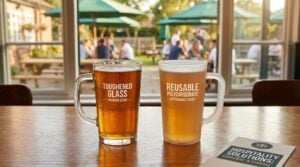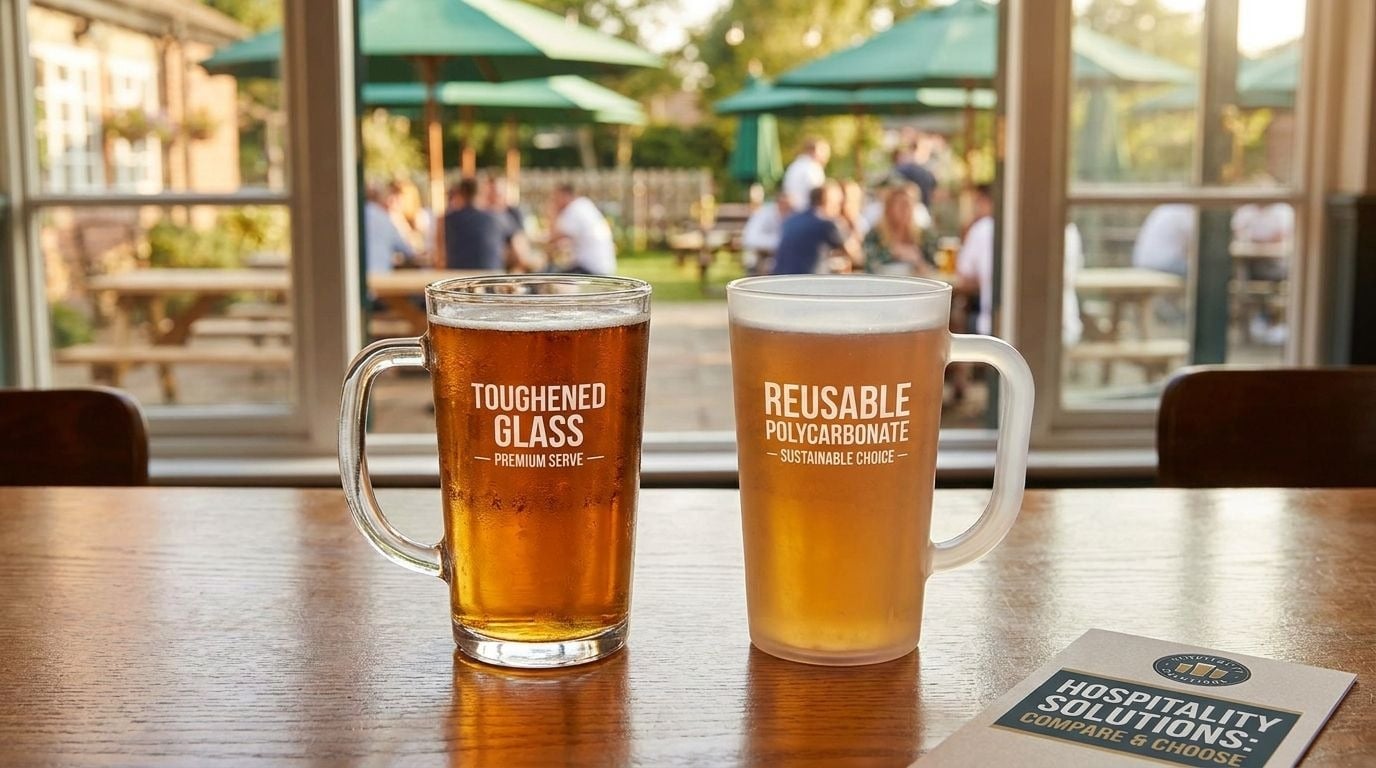
The polycarbonate vs glass decision is not one question. It is five. Which material is safer for your specific service environment? Which survives commercial glasswashers better? Which is legally compliant for measured alcohol service? Which costs less to run over a full season? And which is right for your venue type?
Most competitor guides answer one of these questions, usually the safety one, and stop there. This guide answers all five, with the BPA question addressed honestly, commercial glasswasher performance data included, UKCA compliance explained, and a venue-type decision matrix that gives you a direct answer rather than a list of considerations.
Quick Decision Guide
| Venue Type | Recommended Material | Primary Reason |
| Wet-led pub, indoor service | Toughened glass | Government stamp required for draught beer; glass is correct |
| Pub beer garden or outdoor area | Polycarbonate (UKCA marked) | Licence conditions often require an unbreakable UKCA stamp for measured pours |
| Hotel pool bar or spa service | BPA-free polycarbonate or Tritan | Safety and BPA duty of care; glass prohibited near water |
| Rooftop cocktail bar | Polycarbonate or Tritan premium formats | Outdoor setting; premium aesthetic; no glass licence condition |
| Fine dining restaurant, indoor | Commercial-grade lead-free crystal | Crystal justified at this price point |
| Fine dining terrace service | High-quality polycarbonate stemware | Outdoor setting; glass unsuitable; premium presentation required |
| Festival or outdoor event (TEN) | Polycarbonate (UKCA marked) | Licence conditions mandate unbreakable; measured for compliance |
| School, hospital, or care venue | BPA-free polycarbonate or Tritan | Duty of care; unbreakable mandatory |
At We Can Source It, we supply commercial drinkware to pubs, hotels, festival operators, outdoor caterers, and event venues across the UK. The most common operational mistake we see is venues running standard polycarbonate through a glasswasher programme set up for toughened glass: wash temperatures above 65°C, high-alkaline detergent at maximum dose, with no temperature check before the first polycarbonate load. The glasses cloud within weeks, the venue assumes the product is poor quality, and they switch back to glass for the outdoor area, where breakage then resumes at 30 to 40% per season.
The second most common mistake is ordering standard polycarbonate for a hotel pool bar or spa setting without confirming BPA-free status. Both mistakes are avoidable with the right specification information upfront, which is what this guide provides.
The Material Landscape: Standard PC, Tritan, SAN, and Glass
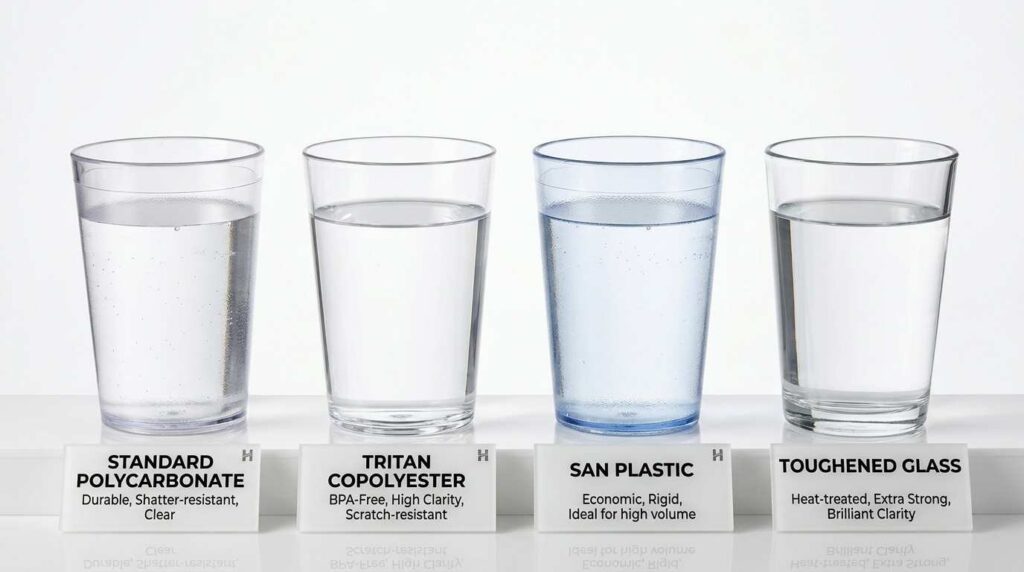
Before comparing polycarbonate vs glass, it helps to understand that “polycarbonate” covers more than one material in the commercial drinkware market. The three main plastic alternatives to glass in UK hospitality are:
Standard Polycarbonate (PC)
The most widely used material for commercial reusable drinkware. Rigid, high-clarity thermoplastic with good impact resistance. Rated to approximately 500 to 1,000 commercial glasswasher cycles at temperatures below 65 degrees Celsius. Standard polycarbonate contains BPA (bisphenol A) in its base polymer structure. See Section 2 for the implications.
Standard polycarbonate is the material used in most commercial reusable plastic glasses sold in the UK hospitality market, including the majority of products sold as “polycarbonate glasses” without further material qualification.
Tritan Copolyester
Tritan is a BPA-free copolyester manufactured by Eastman Chemical. It is optically clearer than standard polycarbonate, more resistant to chemical etching from glasswasher detergents, and maintains clarity for significantly more commercial wash cycles. It is also more expensive per unit than standard polycarbonate.
Tritan is the material used in premium reusable drinkware brands like Govino and Strahl. It is increasingly specified by hotel groups, contract caterers, and healthcare operators as the default for any application where BPA is a concern.
SAN (Styrene Acrylonitrile)
SAN is a lighter, less expensive alternative to polycarbonate used in disposable and semi-disposable plastic glassware. It is BPA-free, optically clear, but significantly less impact-resistant than polycarbonate and rated for far fewer wash cycles. SAN is used in the mid-range disposable and economy reusable market rather than commercial hospitality.
Toughened Glass
Toughened (tempered) soda-lime glass is the standard for commercial indoor hospitality. It is heat-treated to be approximately four to five times stronger than standard glass, breaks into smaller fragments, and is fully compatible with commercial glasswashers at operating temperatures. Government-stamped toughened glass is the legal requirement for draught beer service in UK licensed premises.
The BPA Question: What Every Hospitality Buyer Should Know in 2026
BPA is often overlooked in discussions about polycarbonate drinkware, yet it has become an increasingly important consideration for hospitality buyers in 2026.
What BPA Is
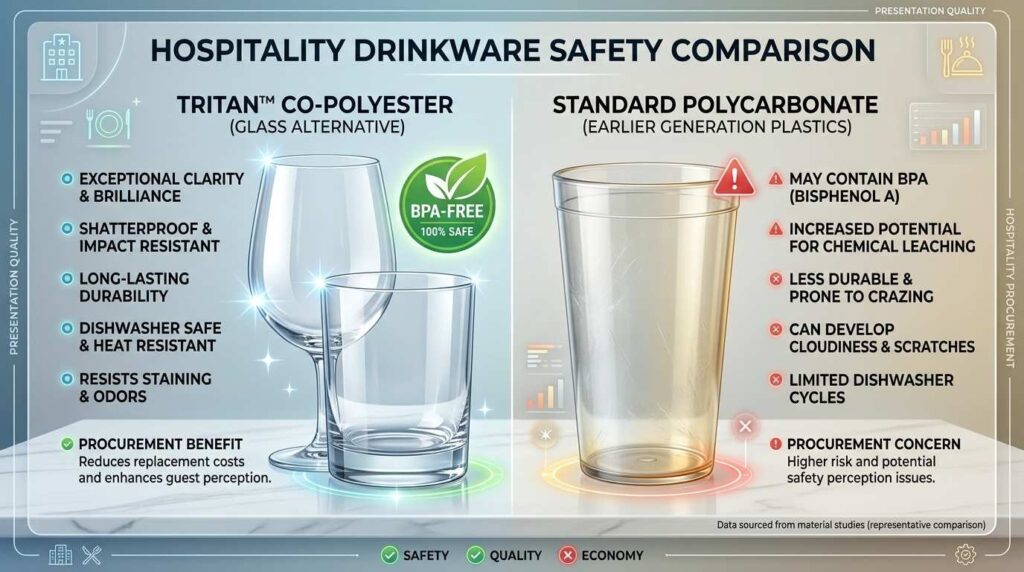
Bisphenol A (BPA) is a chemical compound used in the production of standard polycarbonate plastic. BPA can migrate from the polymer into food and drink, particularly at elevated temperatures and under acidic or alkaline conditions.
The Current Regulatory Position
The European Food Safety Authority significantly lowered the tolerable daily intake for BPA in 2023, reflecting updated evidence on its effects as an endocrine disruptor. In Great Britain, the Food Standards Agency acknowledges BPA migration from food contact materials as a monitored concern.
BPA has not been banned from polycarbonate drinkware in Great Britain as of May 2026. However:
- ▸ The EU has proposed restrictions on BPA in food contact materials that are being implemented progressively
- ▸ Major hotel groups, contract catering companies, and healthcare operators have moved to BPA-free specifications as a precautionary procurement standard.
- ▸ Any operator with a duty of care to vulnerable groups (children, elderly, immunocompromised guests) has a stronger case for specifying BPA-free materials.
The Practical Position for UK Hospitality Operators
For standard outdoor bar service at a pub, beer garden, or festival using polycarbonate glasses at ambient temperature for short service periods, BPA migration is a low practical concern. The migration rate increases with temperature and duration of contact.
For hotel pool bars, spa food and drink service, care home settings, or any venue where drinks are consumed from the same polycarbonate glass over an extended period or at elevated temperatures, specifying BPA-free Tritan or HDPE alternatives is a defensible and increasingly standard procurement decision.
Key takeaway: Standard polycarbonate contains BPA. BPA-free alternatives (Tritan, SAN, HDPE) are available at comparable or slightly higher unit costs. The choice to specify BPA-free is a duty of care decision, not a legal requirement in Great Britain as of May 2026, but it is becoming the procurement standard in institutional and premium hospitality settings.
Our reusable polycarbonate glassware range includes products manufactured from Food and Drug-approved polycarbonate conforming to the Materials and Articles in Contact with Food (England) Regulations 2012. BPA-free status should be confirmed with the specific product listing or by contacting our trade team before purchase.
Glasswasher Performance: The Comparison Nobody Has Done for UK Venues
Every product page for polycarbonate glasses says they are dishwasher-safe. None of them explains what that means in a UK commercial kitchen, or how standard polycarbonate compares to glass and Tritan under real operating conditions.
The Three Variables That Determine Glasswasher Survival
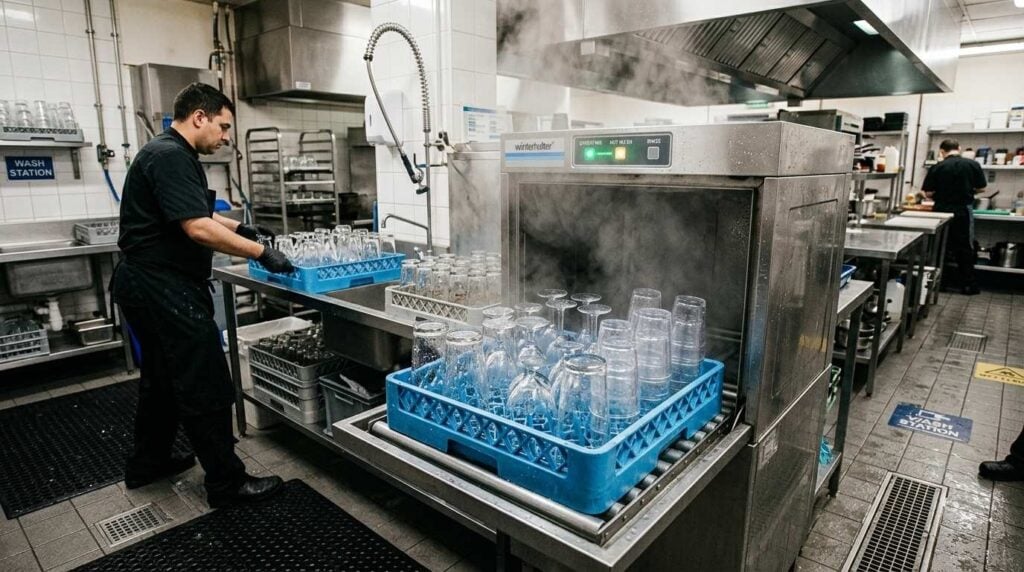
Maximum wash temperature:
| Material | Max Recommended Wash Temperature | What Happens Above This |
| Toughened glass | 65 degrees Celsius wash, 85 degrees rinse | Etching with overdosed detergent; otherwise, resilient |
| Standard polycarbonate | 65 degrees Celsius | Deformation, clouding, and distortion begin above this threshold |
| Tritan copolyester | 70 to 75 degrees Celsius | Better thermal tolerance than standard PC |
| SAN | 55 to 60 degrees Celsius | Distortion begins at moderate commercial temperatures |
Detergent compatibility:
High-alkaline commercial glasswasher detergents are the most aggressive chemical environment that hospitality glassware encounters. Their effect on each material:
- ▸ Toughened glass: gradual etching over hundreds of cycles, primarily driven by water hardness rather than detergent chemistry
- ▸ Standard polycarbonate: crazing and surface whitening accelerate noticeably above 500 cycles under high-alkaline conditions
- ▸ Tritan: significantly more resistant to alkaline etching; maintains clarity for 1,000 or more cycles under correct dosing conditions
- ▸ SAN: most vulnerable to alkaline detergents; not suitable for high-cycle commercial use
Cycle tolerance before visible degradation:
| Material | Approximate Cycles to Visible Degradation | Primary Degradation Type |
| Toughened glass | 500 to 1,000 cycles (detergent-dependent) | Chemical etching, clouding |
| Standard polycarbonate | 500 to 800 cycles | Crazing, surface whitening, light distortion |
| Tritan copolyester | 1,000 or more cycles | Maintains clarity longer under correct conditions |
| SAN | 100 to 300 cycles | Scratching, surface dulling |
The UKCA Measure Mark Consideration
For polycarbonate glasses used for measured alcohol service (wine at 125 ml or 175 ml, spirits by measure), the UKCA mark at the stated measure must remain legible and accurate throughout the glass’s service life. Repeated commercial wash cycles that cause crazing or distortion in the glass wall can affect measure mark legibility. This is a compliance consideration for any operator relying on the glass itself as the measuring device rather than using an approved dispense measure.
Key takeaway: For UK hospitality venues running a high-cycle commercial glasswasher programme, Tritan outlasts standard polycarbonate in both clarity retention and chemical resistance. Standard polycarbonate is a sound choice for lower-frequency use, outdoor events, seasonal beer gardens, and temporary service. For permanent venues, glasswashing daily, the higher unit cost of Tritan pays back in longer service life.
UK Licensing Requirements: UKCA Stamps and Government Stamps
For Measured Alcohol Service
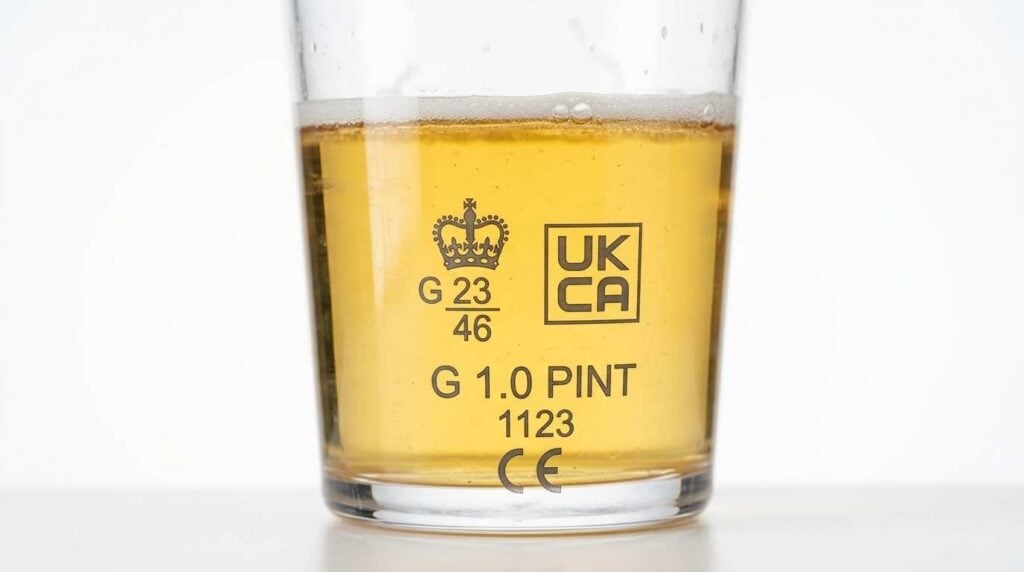
Any glass used to sell alcohol by a specified measured volume at a UK licensed premises must be either:
- ▸ UKCA-marked (or CE-marked under current transitional arrangements) at the stated measure, or
- ▸ Paired with an approved measuring device at the point of dispense
This applies equally to glass and polycarbonate formats. A polycarbonate wine glass marked at 125ml and 175ml with a UKCA stamp satisfies the Weights and Measures requirement for measured wine service. A polycarbonate pint glass with a UKCA mark satisfies the requirement for non-draught beer service. For draught beer and cider served by the pint or half pint, the additional requirement is a government crown stamp on the glass or the use of a metered dispense tap.
Most commercial polycarbonate pint glasses supplied for UK licensed premises carry both UKCA measure marking and the government crown stamp. Always confirm both markings are present when ordering polycarbonate pints for draught beer service.
Licence Conditions Requiring Polycarbonate
Many UK local authority outdoor event licences and premises licences include a condition requiring unbreakable glassware in specified areas. If your licence includes such a condition, check the specific wording. Conditions that specify “polycarbonate” require polycarbonate material specifically. Conditions that specify “unbreakable” are satisfied by any non-glass material of adequate strength. Confirm interpretation with your licensing authority if the wording is ambiguous.
Our reusable polycarbonate pint glasses carry CE/UKCA marking at the stated measure for full compliance at UK-licensed events and premises.
Cost of Ownership: Which Material Costs Less Over a Full Season?
The unit cost comparison, polycarbonate at £1.50 to £2.50 versus glass at £2.00 to £5.00, does not tell the full cost of ownership story. The relevant comparison is the total cost across a full service season, including breakage, replacement, and washing costs.
Unit Cost Comparison
| Material | Trade Price Per Unit | Pack Sizes |
| Toughened glass pint | £2 to £5 | Cases of 6, 12, 24, 48 |
| Standard polycarbonate pint | £1.50 to £2.50 | Cases of 6, 12, 24 |
| Tritan premium reusable | £3.50 to £6.00 | Cases of 6, 12 |
| SAN semi-disposable | £0.30 to £0.80 | Cases of 12, 24, 50 |
Breakage and Replacement
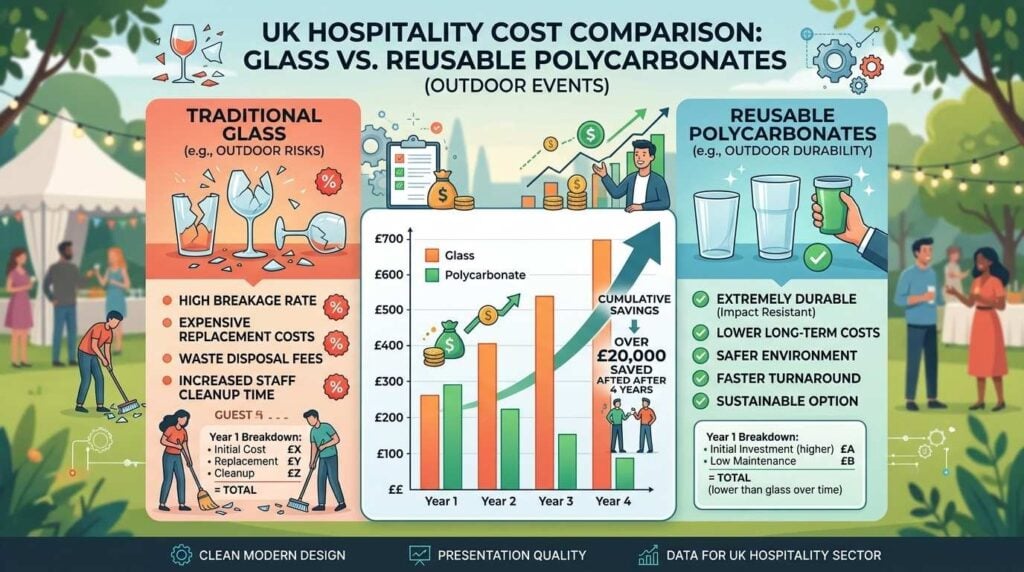
Toughened glass in a high-volume outdoor environment breaks at 30 to 40% per event cycle. At £3.50 average replacement cost, 100 glasses replaced at 35% cost £122.50 per event cycle.
Commercial polycarbonate in the same environment breaks at under 5% per event cycle, virtually unbreakable under normal outdoor service conditions. At £2.00 average replacement cost, 5 glasses replaced cost £10 per event cycle.
Over a 20-event outdoor season, the polycarbonate programme costs £200 in replacements. The toughened glass programme costs £2,450 for replacements. The polycarbonate capital investment of £250 for 100 glasses pays back within one event cycle in a high-breakage outdoor environment.
Washing Cost Differential
Polycarbonate requires lower wash temperatures (maximum 65 degrees Celsius vs 85 degrees rinse for glass). In practice, most venues wash polycarbonate on the same programme as glass at standard temperatures. There is no significant energy cost differential between the two materials at the washing stage.
The real operational cost difference is in the glasswasher temperature monitoring required to protect polycarbonate from deformation. In venues running a mixed programme of glass and polycarbonate, this requires either a dedicated lower-temperature programme for polycarbonate loads or confirmation that the standard programme runs within polycarbonate tolerances.
The Venue-Type Decision Matrix
| Venue Type | Indoor | Outdoor | Recommended Material |
| Wet-led pub | Toughened glass | Polycarbonate (UKCA/crown stamped) | Indoor: government stamp for draught beer. Outdoor: licence condition and breakage risk |
| Craft beer bar | Toughened glass | Polycarbonate | Same as wet-led pub; UKCA pint for outdoor craft pours |
| Cocktail bar | Toughened glass or crystal | Polycarbonate or Tritan premium | Outdoor cocktail service needs premium-looking polycarbonate |
| Fine dining | Commercial-grade crystal | High-quality polycarbonate stemware | Crystal indoors; polycarbonate for the terrace where glass is a breakage or a liability risk |
| Hotel pool bar | Not applicable | Tritan or BPA-free polycarbonate | Glass is prohibited near water; BPA-free preferred for duty of care |
| Hotel rooftop bar | Toughened glass (enclosed) | Polycarbonate or Tritan | Outdoor rooftop: licence conditions often mandate unbreakable |
| Festival / outdoor event (TEN) | Not applicable | Polycarbonate UKCA/crown stamped | Licence mandate; UKCA for measured service; crown stamp for draught beer |
| Care home or healthcare | Not applicable | Tritan or BPA-free polycarbonate | Unbreakable mandatory; BPA-free duty of care |
| Wedding / private event | Hire glass or polycarbonate | Polycarbonate | Outdoor weddings: polycarbonate preferred; see our guide to disposable glasses for weddings |
Where to Buy Polycarbonate Glassware for UK Hospitality Venues
For UK hospitality operators, the key buying criteria before ordering polycarbonate are:
- ▸ UKCA marking at the stated measure (mandatory for licensed measured service)
- ▸ Crown stamp for draught beer pints (mandatory for draught service without metered taps)
- ▸ BPA-free status confirmed in writing (important for hotel, healthcare, and premium settings)
- ▸ Maximum glasswasher temperature rating confirmed (65 degrees Celsius for standard polycarbonate)
- ▸ Cycle tolerance data (how many commercial wash cycles before visible degradation)
We Can Source It supplies commercial-grade polycarbonate reusable glassware in formats covering all major hospitality service applications. Our Elite range is manufactured from Food and Drug-approved polycarbonate conforming to UK food contact regulations, tested to over 1,000 glasswasher cycles at standard commercial temperatures.
Key ranges for UK hospitality venues:
- ▸ Reusable polycarbonate pint glasses, CE/UKCA marked, nonic and pilsner formats for licensed outdoor and event service
- ▸ Polycarbonate wine and champagne stemware, flutes, wine glasses, and martini formats for premium outdoor presentation
- ▸ Reusable gin balloon glasses, 600ml copa format for premium outdoor gin service
- ▸ Hurricane cocktail polycarbonate glass, cocktail bar formats for outdoor and event service
- ▸ Full reusable plastic glassware range, complete commercial range with trade pricing and compliance documentation on request
For the broader glassware selection context across all venue types and materials, see our complete hospitality glassware guide for UK venues.
For the specific reusable plastic glassware decision at outdoor events, including break-even calculations and washing logistics, see our guide to reusable plastic glassware for UK outdoor events.
Final Verdict: Polycarbonate vs Glass for UK Hospitality
There is no universal winner. The right answer depends on where you are serving, who you are serving, and what your licence conditions require.
Toughened glass remains the correct choice for indoor licensed service. It carries government stamps for draught beer compliance, delivers the visual and tactile quality guests expect at the bar, and handles a well-managed commercial glasswasher programme with low annual replacement costs at moderate volumes.
Polycarbonate becomes the better operational choice the moment you move outside. Breakage rates in outdoor environments make glass expensive to run within a single season. Licence conditions at most outdoor events and beer gardens already mandate unbreakable drinkware. UKCA-marked polycarbonate satisfies both the safety case and the compliance requirement simultaneously.
For venues where BPA is a genuine duty of care consideration, including hotel pool bars, spas, care settings, and children’s areas, Tritan represents the premium standard. Its higher unit cost is offset by longer service life under commercial glasswasher conditions and a cleaner procurement position on BPA.
The practical framework: start with your licence conditions, add your service environment, then factor in volume and cover price. The decision matrix in this guide covers every major UK venue type. If your situation is not in the table, the answer is almost always glass indoors, polycarbonate outdoors, and Tritan where BPA matters.
FAQs
Is polycarbonate better than glass for a bar?
It depends entirely on the service environment. For indoor licensed bar service, toughened glass is the correct choice; it carries government stamps for draught beer compliance and provides the visual and tactile quality customers expect. For outdoor areas, beer gardens, events, and any area where licence conditions require unbreakable glassware, commercial polycarbonate is the correct choice. The two materials are not interchangeable across all settings.
Does polycarbonate contain BPA?
Standard polycarbonate contains BPA (bisphenol A) in its polymer structure. BPA can migrate into food and drink, particularly at elevated temperatures. BPA-free alternatives, including Tritan copolyester and SAN, are available. Specifying BPA-free polycarbonate is increasingly standard in hotel groups, contract catering, and healthcare settings. Confirm BPA-free status with your supplier in writing before purchasing for any application involving vulnerable groups or extended hot drink service.
What is the difference between polycarbonate and Tritan?
Both are clear, rigid thermoplastics used for commercial drinkware. The key differences are that Tritan is BPA-free while standard polycarbonate is not, Tritan is more resistant to commercial glasswasher detergents and maintains clarity for more wash cycles, and Tritan is more expensive per unit. For high-cycle commercial use with a permanent glasswasher programme, Tritan typically delivers better long-term value than standard polycarbonate despite the higher unit cost.
Can polycarbonate glasses go in a commercial glasswasher?
Yes, at temperatures below 65 degrees Celsius, wash temperature. Above this threshold, polycarbonate deforms, clouds, and loses structural integrity. Check your glasswasher’s operating temperature before using polycarbonate. Tritan has a slightly higher thermal tolerance of approximately 70 to 75 degrees Celsius.
Do polycarbonate glasses need a UKCA stamp for licensed venues?
Yes, for measured alcohol service at UK licensed premises. Polycarbonate glasses used to sell wine, spirits, or beer by a stated measured volume must carry a UKCA marking at the stated measure. Polycarbonate pint glasses used for draught beer service must also carry a government crown stamp or be used with a metered dispense tap. Always confirm both the UKCA marking and the crown stamp status when ordering polycarbonate for licensed service.
How long does polycarbonate glassware last in commercial use?
Standard commercial polycarbonate rated for hospitality use typically maintains acceptable clarity for 500 to 800 commercial glasswasher cycles under high-alkaline detergent conditions. Tritan maintains clarity for 1,000 or more cycles. Actual lifespan depends heavily on detergent dosing, wash temperature, and water hardness. A correctly configured glasswasher with a water softener and accurate detergent dosing will significantly extend polycarbonate service life beyond these benchmarks.
When should a hospitality venue use glass instead of polycarbonate?
Toughened glass is the correct choice for all indoor licensed service where government-stamped formats are required for draught beer, where the aesthetic and tactile quality of glass is part of the guest experience, and where breakage rates are manageable through staff training and handling protocols. Polycarbonate is the correct choice wherever glass is prohibited by licence condition, wherever breakage risk is unacceptable (poolside, outdoor events, high-vibration environments), or wherever the duty of care case for unbreakable drinkware is clear.
Is Tritan safer than standard polycarbonate?
Tritan is BPA-free, which removes the primary safety concern associated with standard polycarbonate. From a breakage and injury perspective, both materials perform similarly and are virtually unbreakable under normal hospitality service conditions. For venues with a duty of care to vulnerable groups, Tritan is the more defensible specification.
Why do polycarbonate glasses go cloudy?
Clouding in commercial polycarbonate is almost always caused by one of three things: wash temperature above 65°C, overdosed high-alkaline detergent, or hard water without a fitted softener. The damage is usually irreversible. Preventing it requires confirming your glasswasher’s operating temperature is within polycarbonate tolerances before the first wash cycle, and setting detergent dosing at the manufacturer’s recommended concentration rather than the maximum setting.
Can you serve hot drinks in polycarbonate glasses?
Standard polycarbonate is not recommended for sustained hot drink service. Heat accelerates BPA migration from the polymer, and repeated thermal cycling above 65°C degrades the material faster. For hot drink service in a non-glass environment, including care settings, outdoor catering, and pool bars, specify Tritan or purpose-made hot drink polypropylene cups rather than standard polycarbonate drinkware.
Do UK festivals require UKCA-marked glasses?
For any festival operating under a Temporary Event Notice (TEN) or premises licence where alcohol is sold by a measured volume, the glass used to serve that measure must carry a UKCA mark at the stated volume, or an approved measuring device must be used at the point of dispense. Most festival polycarbonate pint glasses are supplied with both a UKCA measure mark and a government crown stamp to satisfy both requirements simultaneously. Confirm both markings are present before ordering for a licensed event.
How often should polycarbonate glasses be replaced in commercial use?
As a practical guide, inspect polycarbonate glasses for crazing, clouding, or distortion at the start of each season or event series. Glasses showing visible surface degradation should be retired, as degraded surface structure indicates the material has been compromised and the UKCA measure mark may no longer be reliable. Under correct glasswasher conditions, standard polycarbonate should reach 500 to 800 cycles before visible degradation. Tritan should reach 1,000 or more cycles.
References
- ▸ Weights and Measures Act 1985 https://www.legislation.gov.uk/ukpga/1985/72/contents
- ▸ UKCA marking guidance, gov.uk https://www.gov.uk/guidance/placing-ukca-or-ce-marked-products-on-the-market-in-great-britain
- ▸ Food Standards Agency: BPA in plastic, food.gov.uk https://www.food.gov.uk/science/bpa
- ▸ EFSA: Re-evaluation of the risks to public health related to BPA in foodstuffs (2023) https://efsa.onlinelibrary.wiley.com/doi/10.2903/j.efsa.2023.6857
- ▸ Materials and Articles in Contact with Food (England) Regulations 2012 https://www.legislation.gov.uk/uksi/2012/2619/contents