Every guide to sustainable packaging for restaurants tells you the same things. Bagasse is good. Bamboo is good. Plastic is bad. None of them tells you how actually to make the switch happen inside a real hospitality business, what it costs in honest numbers, how to train staff so the new system works, or what UK regulations you now need to comply with, regardless of whether you switch at all.
This guide is the one that fills that gap. It is written for UK hospitality operators, restaurant owners, cafe managers, pub groups, catering businesses, and event operators, who have decided to switch and now need to know what to do in what order.
Regulatory references in this guide are based on current guidance from HMRC, DEFRA, the Competition and Markets Authority, and the Food Standards Agency, all reviewed in May 2026.
Quick Answer
Switching to sustainable packaging for a UK hospitality business in 2026 is a six-step process: audit what you currently use, understand your regulatory obligations, choose the right materials for each food type, calculate the true cost, implement the switch operationally, and train your team. Most businesses try to start with step three and skip the rest. That is why most switches fail or deliver less value than expected.
Who This Guide Is For
| Business Type | Primary Challenge | Most Relevant Section |
| Independent restaurant or cafe | Cost and supplier choice | Cost breakdown, material selection |
| Pub or bar with food service | Regulatory compliance, mixed packaging | UK legislation section |
| Hotel or conference catering | Volume, staff training, consistency | Staff training, operational implementation |
| Event and festival caterer | Disposal logistics, greenwashing risk | Disposal planning, safe claims section |
| Multi-site hospitality group | Standardisation, EPR reporting | Audit section, regulatory compliance |
UK Legislation Every Hospitality Operator Must Know in 2026
Most competing content is written for a global or US audience and is entirely silent on the regulations that UK hospitality operators face in 2026. These are not optional considerations. They are live financial obligations.
The Plastic Packaging Tax
The UK Plastic Packaging Tax (PPT) applies to plastic packaging manufactured in or imported into the UK containing less than 30% recycled plastic content. The rate from April 2026 is £228.82 per tonne, as published in HMRC guidance.
For hospitality operators, the most important PPT fact is one that most sustainable packaging suppliers do not disclose: PLA (polylactic acid), the most widely marketed compostable alternative to plastic, is classified as plastic under HMRC rules and attracts the full PPT rate regardless of its plant-based origin or compostability certification. Switching from conventional plastic to PLA-lined cups or PLA containers does not reduce your PPT liability. It transfers it.
Bagasse, uncoated kraft paper, moulded fibre, and wooden cutlery are all outside the scope of PPT. Switching to these materials removes PPT liability on those components entirely.
Extended Producer Responsibility (EPR) for Packaging
The UK EPR scheme charges packaging producers for the cost of collecting and disposing of packaging waste. From 2026 to 2027, fees are modulated using the Recyclability Assessment Methodology (RAM), rating packaging green, amber, or red based on recyclability. Green-rated packaging attracts lower fees. Red-rated packaging attracts higher fees.
EPR applies to hospitality businesses with an annual turnover above £1 million and packaging volumes above 25 tonnes per year. If you meet both thresholds, you have registration, reporting, and fee payment obligations.
The most important EPR fact for hospitality operators considering a sustainable packaging switch: compostable PLA is red-rated under RAM and attracts higher EPR fees than recyclable plastic alternatives. Switching from recyclable plastic to compostable PLA increases your EPR liability, not reduces it. Switching to bagasse or kraft reduces PPT liability, but EPR fees still apply at amber to red rates.
Key takeaway: The regulatory case for switching to sustainable packaging is real, but the materials that reduce regulatory cost are not always the ones marketed as the most sustainable. Bagasse and kraft paper improve your PPT position. rPET with verified recycled content improves your EPR position. PLA improves neither.
The DEFRA Single-Use Plastics Ban
DEFRA’s ban on certain single-use plastics in England came into force in 2023 and prohibits the supply of specific plastic items, including plastic plates, cutlery, balloon sticks, and polystyrene food and drinks containers. The ban applies to all hospitality businesses in England,d regardless of size or turnover.
If you are still using any of the banned formats, switching to sustainable alternatives is not optional. It is a legal requirement with enforcement powers held by local authorities.
For a complete breakdown of how PPT, EPR, and RAM interact with your specific packaging portfolio, see our detailed guide to UK plastic packaging tax and EPR for food businesses.
Step One: Audit Your Current Packaging
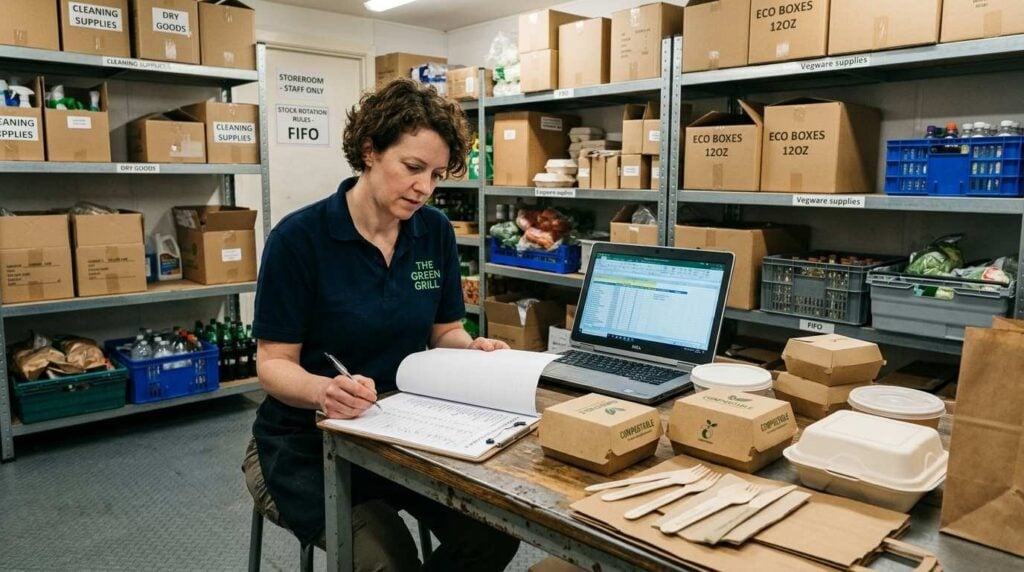
Do not order a single piece of sustainable packaging before completing this step. Operators who skip the audit end up switching the wrong items first, paying premiums on formats where the environmental impact is minimal, and missing the high-volume items where a switch would make the biggest difference.
How to Conduct a Packaging Audit
List every packaging item your business uses. Everyone. Not just the obvious takeaway containers, but also include the following categories.
Primary packaging: everything in direct contact with food or drink. Containers, cups, lids, plates, bowls, cutlery, straws, napkins.
Secondary packaging: outer packaging used to carry or protect primary items. Carrier bags, paper bags, takeaway bags.
Service packaging: items provided to customers at the point of sale. Condiment sachets, sugar sachets, stirrers.
Back of house packaging: packaging that arrives with your supplies. Cardboard boxes, cling film, and plastic wrapping on bulk supplies. This category is often overlooked and sometimes generates the largest EPR obligation.
For each item, record the material type, the supplier, the approximate number of units used per week, the unit cost, and whether the item is classified as plastic under PPT rules.
Prioritise by Volume and Visibility
Once you have the full list, rank items by weekly unit volume. The three or four highest-volume items are where a sustainable switch delivers the most impact. For most hospitality businesses, the highest-volume items are hot drink cups, takeaway containers, cutlery, and carrier bags. Start there.
Step Two: Choose the Right Sustainable Materials by Food Type
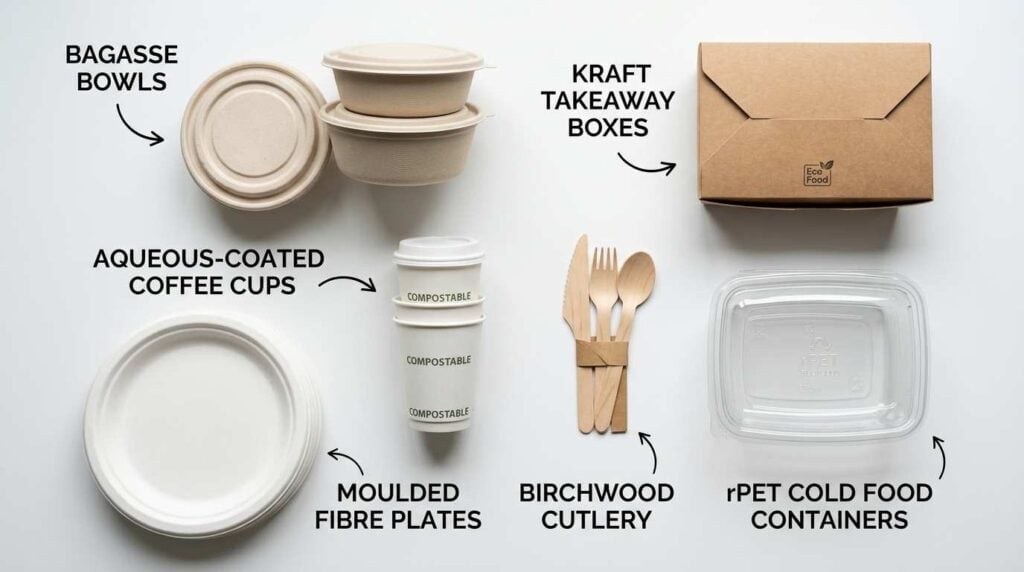
The material choice is not one decision. It is a series of decisions made by food type, service temperature, delivery distance, and regulatory position. The wrong material for the food type creates operational problems that undermine the entire switch.
| Food or Drink Type | Recommended Sustainable Material | PPT Position | Notes |
| Hot food (curries, soups, noodles) | Bagasse | PPT-free | Handles 120°C, natural grease resistance |
| Cold food (salads, deli, sushi) | rPET (30% recycled) | PPT-exempt | Better than PLA for cold clarity and EPR rating |
| Hot drinks | Aqueous-coated paper cup | PPT-free | Avoid PLA-lined cups, same PPT as plastic |
| Cold drinks | rPET cup or paper cup | PPT-exempt or PPT-free | Confirm recycled content with the supplier |
| Pizza | Bagasse or kraft board | PPT-free | PLA unsuitable for any pizza format |
| Fish and chips | Uncoated kraft board | PPT-free | Green EPR RAM rating, best regulatory position |
| Burgers | Bagasse clamshell | PPT-free | Rigid base for loaded portions |
| Cutlery | Birchwood or TPLA | Birchwood: PPT-free | Birchwood removes PPT liability entirely |
| Plates (events) | Bagasse (hot) or moulded fibre (premium) | PPT-free | Confirm PFAS-free status with the supplier |
| Carrier bags | Paper bags | PPT-free | Green EPR RAM rating |
For a broader breakdown of certified materials, compliance requirements, and disposal considerations, read our guide to compostable food packaging for UK businesses.
Our bagasse clamshell takeaway boxes and kraft food containers are available with full EN13432 certification and PFAS-free documentation. Browse our wooden cutlery range for event and takeaway formats outside the scope of PPT.
Step Three: The Real Cost Breakdown
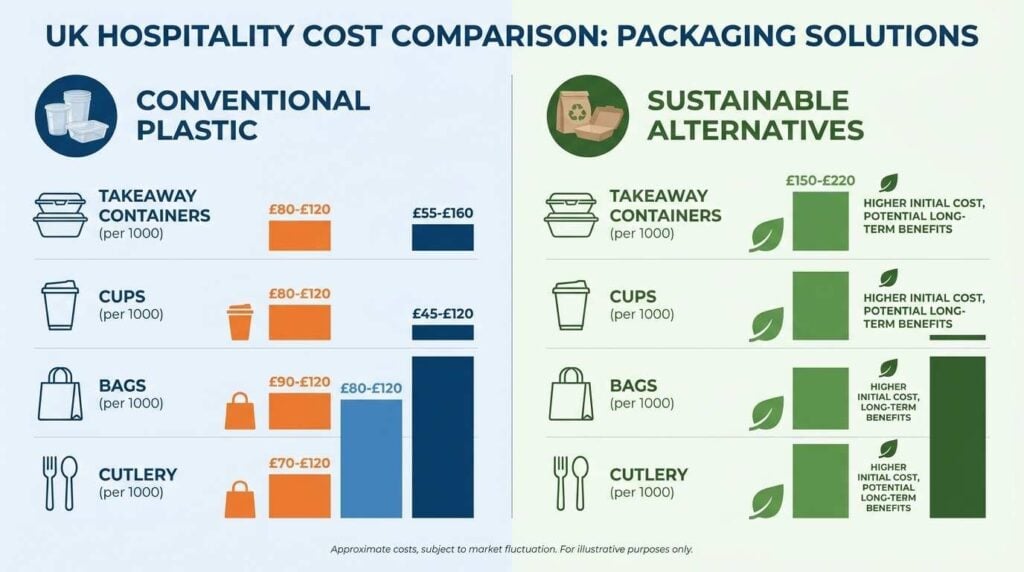
Every sustainable packaging guide admits the switch costs more. None of them shows you the maths. Here it is.
The figures below are illustrative estimates based on typical UK wholesale pricing in 2026 and will vary by supplier, volume, certification, and specification.
Per-Unit Cost Comparison: Conventional vs Sustainable
| Item | Conventional Unit Cost | Sustainable Alternative | Sustainable Unit Cost | Premium Per Unit |
| Takeaway container (650ml) | £0.06 | Bagasse bowl | £0.16 | +£0.10 |
| Hot drink cup (12oz, PE-lined) | £0.05 | Aqueous-coated paper cup | £0.09 | +£0.04 |
| Cutlery set (plastic) | £0.04 | Birchwood set | £0.07 | +£0.03 |
| Pizza box (12 inch) | £0.10 | Bagasse or kraft | £0.15 to £0.18 | +£0.05 to £0.08 |
| Carrier bag (plastic) | £0.03 | Paper bag | £0.06 | +£0.03 |
| Cold food container (500ml, PLA) | £0.08 | rPET (30% recycled) | £0.10 | +£0.02 |
Annual Cost Premium: Three Business Scenarios
| Business Type | Daily Volume | Key Items Switched | Annual Premium |
| Independent cafe (100 covers/day) | 100 hot drinks, 60 food items | Cups, containers, cutlery | approx. +£4,200 |
| Mid-size restaurant (250 covers/day) | 250 covers across the full menu | Full packaging range | approx. +£12,500 |
| High-volume takeaway (500 covers/day) | 500 covers, delivery-focused | Containers, boxes, bags | approx. +£22,000 |
Where Regulatory Savings Offset the Premium
The premium above does not account for regulatory savings. Two specific switches generate genuine cost reductions that partially offset the unit cost premium.
Switching from PE or PLA-lined cups to aqueous-coated cups removes PPT liability on the cup component. At 100 cups per day (36,500 per year), at approximately 12 grams per cup, this represents approximately 0.44 tonnes per year. The PPT saving is approximately £100 per year for a small cafe, modest but real.
For higher-volume operations handling multiple tonnes of plastic packaging annually, the PPT saving becomes more significant. A restaurant group handling 10 tonnes of plastic packaging per year saves approximately £2,288 in PPT by switching those components to non-plastic alternatives.
Model your specific PPT liability against your actual packaging tonnage before dismissing the switch on cost grounds alone. For larger operators, the regulatory savings change the break-even calculation materially.
The Break-Even Framing
The question is not “can I afford to switch?” The more useful question is “What is the cost per cover of the switch, and can I recoup it?” For a restaurant charging £12 to £18 per main course, a 10 pence per cover packaging premium represents less than 1% of the ticket price. For a high-volume takeaway on tight margins, the same 10 pence per cover requires a more deliberate decision.
The break-even point varies by business type, but for most UK hospitality operators, the sustainable packaging premium is absorbable if it is planned for rather than discovered on delivery of the first invoice.
Step Four: Running Down Old Stock Without Waste
This is the operational detail that no competitor addresses and that causes the most practical problems during a switch.
Most hospitality businesses carry four to eight weeks of packaging stock. Switching immediately to sustainable alternatives means either writing off existing stock (a direct financial loss) or running both conventional and sustainable packaging simultaneously (an operational and customer communication nightmare).
The Planned Rundown Approach
Time your new sustainable packaging order to arrive when your conventional stock reaches a two-week buffer. Continue using conventional stock until it is depleted, then switch completely. This avoids write-offs and prevents mixed stock in service.
Communicate the planned switch date to your team at least two weeks in advance so staff know what is coming and training can happen before the new stock arrives, not after.
If your conventional stock includes items covered by the DEFRA single-use plastics ban that you are still using under transition arrangements, prioritise running those down first, regardless of your wider switch timeline.
Dealing with Mixed Stock During Transition
If you cannot avoid a period of mixed stock, designate clear storage locations for each packaging type. Label shelves or storage areas clearly. Brief service staff on which stock to use first and why. A simple rule (use the old stock before the new stock, first in, first out) prevents the common problem of new sustainable packaging being used while conventional stock sits unused at the back of the storeroom.
Step Five: Staff Training and Operational Change Management
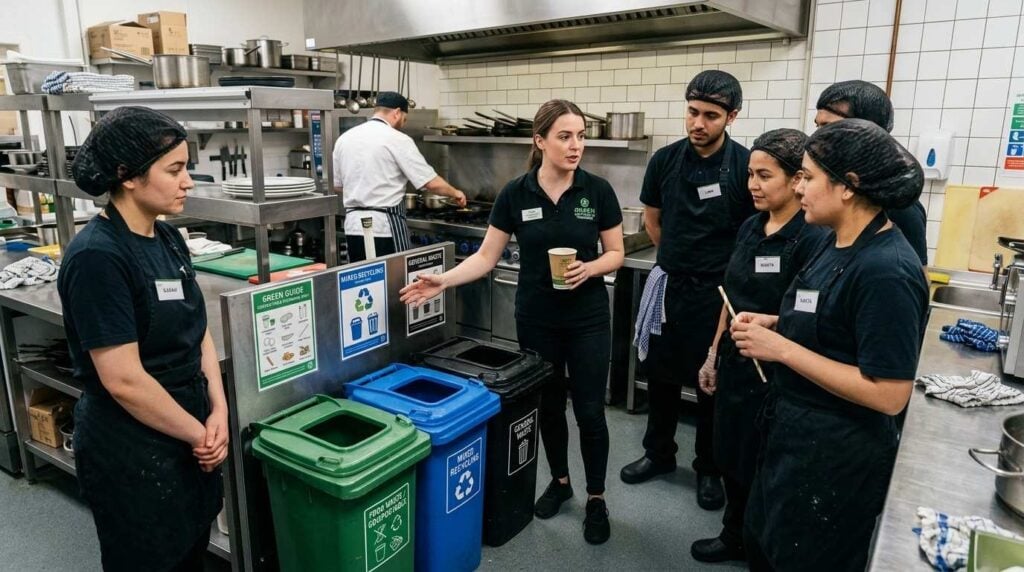
It is the section that determines whether a sustainable packaging switch actually works in practice or exists only on paper.
The Three Things Staff Need to Know
Every member of staff who handles packaging, serves food, or talks to customers needs to understand three things and only three things. Keep the training simple, or it will not stick.
One: Which bin receives which item? This is the most operationally critical piece of training. If compostable packaging goes into the general waste bin because a staff member does not know the difference, the entire environmental benefit of the switch is lost. Create a clear, laminated bin guide for every waste point showing photographs of each packaging item and the bin it belongs in. Photographs, not words. This works across language barriers and requires no reading.
Two: What the packaging is made from and what it can do. Staff will be asked by customers. “Is this compostable?” “Can I put this in my food bin at home?” The answer depends on the certification. Train staff on three facts: what the packaging is made from, what certification it carries, and what disposal route is available. One sentence per item is sufficient. Write it on the laminated bin guide.
Three: What to say when something goes wrong. A customer asks why their container looks different from last month. A lid does not fit correctly. A plate softens unexpectedly under hot food. Staff who have not been briefed on the switch become flustered and give inconsistent answers that undermine customer confidence. Brief your team on the most likely questions and the approved answers before the new stock goes live.
Running a Pre-Switch Briefing
Hold a ten-minute briefing with all staff before the new packaging goes live. Cover the three things above. Show the new packaging physically, not just on paper. Explain why the switch is happening in one sentence that staff can repeat to customers. Invite questions and answer them honestly. The briefing should happen the day before the new stock goes live, not the day of.
For multi-site operations, standardise the briefing across all sites using a written briefing document that site managers can deliver consistently. Brief managers first so they can answer follow-up questions from their teams.
Bin Labelling: The Practical Detail That Makes or Breaks the Switch
Every waste point in your operation needs a laminated guide created specifically for your packaging. Generic compostable or recycling symbols are not sufficient. Your guide should show:
A photograph of each packaging item you use, the bin it belongs in, shown by colour and label, and the one-line disposal instruction for each item.
Laminate the guides. Place one at every bin point, including back of house. Replace them if they become damaged. Check compliance weekly for the first month after the switch. Contamination of compostable waste streams by staff putting the wrong items in the wrong bin is the most common reason a sustainable packaging switch fails to deliver its environmental goals.
Step Six: Customer Communication and Safe Claims
The CMA Green Claims Code applies to every environmental claim you make about your packaging. Under the Digital Markets, Competition and Consumers Act 2024, fines of up to 10% of global annual turnover apply for misleading environmental claims. Hospitality businesses are within scope.
Safe vs Risky Claims for Hospitality Operators
| Claim | Risk Level | Why |
| “We have switched to sustainable packaging” | High | Vague, undefined, no measurable basis |
| “Our packaging is eco-friendly” | High | No legal definition can be substantiated |
| “100% compostable packaging” | High | Misleading without disposal guidance and route |
| “We use biodegradable packaging” | Very High | No legal definition, no timeframe, unsubstantiated |
| “Our containers are made from sugarcane. No plastic.” | Low | Factual material claim, easily verified |
| “EN13432 certified compostable at industrial facilities. Ask us about disposal.” | Low | Specific, honest, directs to available guidance |
| “Our cups use no plastic lining. Aqueous-coated paper.” | Low | Factual, specific, verifiable |
| “We have removed single-use plastic from our takeaway service.” | Low | Specific, measurable, honest, and accurate |
| “Scan here for disposal guidance in your postcode.” | Low | Demonstrates genuine intent, directs to accurate info |
Customer Scripts for Common Questions
Give your team approved one-line answers to the three most common customer questions about sustainable packaging.
“Is this packaging compostable?” Approved answer: “Yes, it is certified compostable at industrial composting facilities. Scan the QR code on the packaging for disposal options in your area.”
“Can this go in my food waste bin at home?” Approved answer: “It depends on your local council. The QR code on the packaging links to disposal guidance by postcode.”
“Is this better for the environment than plastic?” Approved answer: “It is made from sugarcane (or kraft paper, or recycled content, whichever is accurate) and contains no plastic. We have also switched our collection contract to separate compostable waste from general waste.”
These answers are honest, specific, and defensible. They do not overstate the environmental benefit, and they point customers to accurate information rather than making claims that cannot be substantiated.
Disposal Planning: Making the Switch Actually Work Environmentally
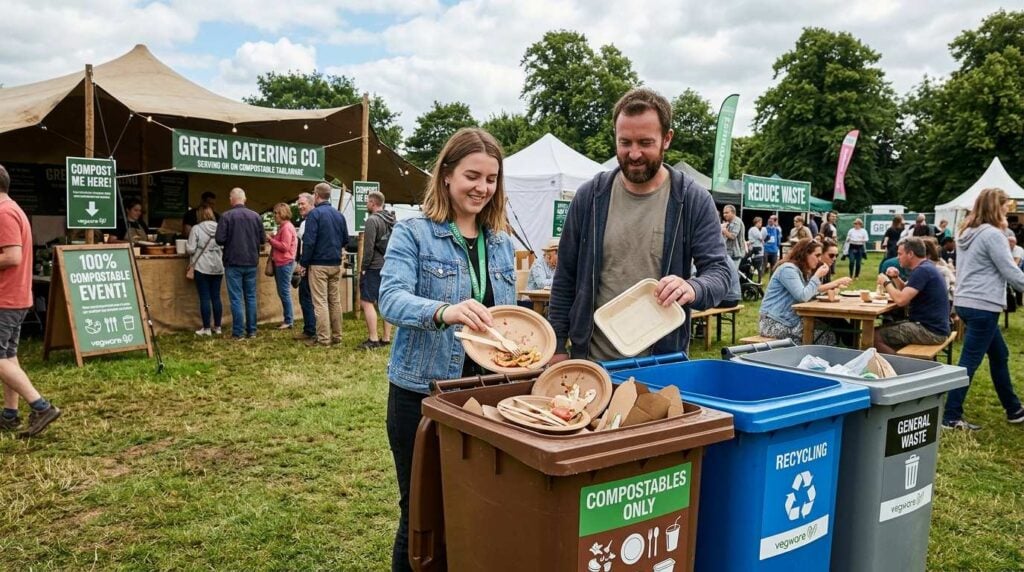
A sustainable packaging switch without a disposal plan is a branding exercise, not an environmental one. This is the most important section for operators who want the switch to deliver genuine environmental value rather than just visual sustainability credentials.
For Restaurants and Cafes with On-Premises Consumption
If your packaging is consumed and disposed of on your premises through your own commercial waste contractor, classify it as non-household under EPR. This means it is exempt from EPR waste management fees. Keep commercial waste contractor invoices and a written policy confirming on-premises disposal to support this classification.
Contact your current waste contractor and ask whether they accept EN13432-certified compostable packaging separately from general waste. If they do, arrange a separate compostable packaging stream. If they do not, ask for a referral to a contractor that does. A separate compostable collection is the only way to ensure your certified compostable packaging reaches industrial composting conditions rather than landfill.
For Takeaways and Delivery Operations
Your packaging leaves the premises with the customer. You cannot control its end-of-life disposal. The most honest and practical things you can do are: add a QR code to your packaging linking to postcode-specific disposal guidance, communicate clearly about what your packaging is made from and what certification it carries, and avoid making claims that imply the packaging will safely disappear regardless of disposal route.
For delivery operations on platforms like Deliveroo and Just Eat, document your packaging specifications with written certification numbers and material data sheets. Platform sustainability credentials are increasingly visible to customers and affect restaurant visibility on some platforms.
For Event Caterers
Events are the scenario where compostable packaging delivers its full environmental promise, because you can control the end-of-life infrastructure. Before every event, commission a licensed waste contractor to collect compostable packaging separately from general waste. Confirm the contractor accepts EN13432-certified compostable packaging and plates. Use colour-coded bins with photographic guides and brief all front-of-house staff on which bin receives which item.
Do not mix compostable and conventional packaging in the same waste stream. One non-certified item can contaminate an entire batch at some composting facilities. For a detailed guide to compostable packaging for events, including plate performance testing, PFAS risks, and disposal logistics, see our guide to the best compostable plates for catering events.
Supplier Due Diligence Checklist
Before switching any packaging component to a sustainable alternative, get written answers to these questions from your new supplier.
Certification and compliance:
- ▸ Does the EN13432 or OK Compost HOME certification cover the finished product, including all components, coatings, inks, and adhesives?
- ▸ What is the certificate number and issuing body?
- ▸ Is the product PFAS-free, and can you provide a written declaration?
- ▸ Does the product carry UK food contact compliance under FSA requirements?
Regulatory position:
- ▸ Is this product classified as plastic under the UK Plastic Packaging Tax?
- ▸ What is the product’s RAM rating under the UK EPR scheme?
- ▸ Can you provide a material data sheet or a written compliance declaration?
Commercial:
- ▸ What is the minimum order quantity, and what are the volume pricing tiers?
- ▸ What is the lead time for your standard order quantities?
- ▸ Can you guarantee the same certified specification for a 12-month supply period?
- ▸ Does custom printing affect the compostability certification or food contact compliance?
Suppliers who cannot answer certification and compliance questions with written documentation should be treated with caution, regardless of how their product pages present the items.
Browse our full takeaway packaging and catering supplies range for certified sustainable options across all formats, with documentation available on request.
The Sustainable Packaging Switch Done Right
The hospitality businesses that make the sustainable packaging switch successfully do three things differently from those that do not. They audit before they order. They train before the new stock arrives. And they tell customers specifically and honestly what the packaging is made from rather than making vague claims that carry legal risk.
The switch costs more per unit than conventional packaging. In most cases, the premium is absorbable, especially when PPT savings on switched components are included in the calculation. The businesses that find the switch financially painful are usually the ones that did not model the cost before committing to volume.
The regulatory direction is clear. PPT rates are rising. EPR fees are modulating based on recyclability. The DEFRA single-use plastics ban has already removed some conventional options from the market. The financial case for switching improves every year because the cost of not switching rises with each regulatory update.
Need help selecting the right sustainable packaging for your hospitality business? Browse our full packaging supplies range or contact our team for tailored recommendations, samples, and trade pricing.
FAQs
Where do I start when switching to sustainable packaging for my restaurant?
Start with an audit of everything you currently use. List every packaging item, its material, weekly volume, and unit cost. Then prioritise the three or four highest-volume items. Switching those items first delivers the most impact on both cost and environmental credentials. Do not start by ordering sustainable packaging before you know what you use and how much of it.
Does switching to sustainable packaging reduce my Plastic Packaging Tax?
It depends on the material you switch to. Switching from plastic to bagasse, uncoated kraft paper, moulded fibre, or wooden cutlery removes PPT liability on those components entirely. Switching from conventional plastic to PLA does not reduce PPT liability because PLA is classified as plastic under HMRC rules. The material choice determines the tax outcome.
How long does a sustainable packaging switch take for a hospitality business?
A single-site operation can complete a full switch within four to eight weeks from audit to new stock going live, allowing time for supplier sourcing, stock rundown, staff training, and bin labelling. Multi-site operations typically require eight to twelve weeks to standardise across sites. The most common cause of delays is skipping the audit and discovering mid-switch that some items are harder to source sustainably than expected.
What should I say to customers about our new sustainable packaging?
Use specific, factual claims. Tell them what the packaging is made from (sugarcane, kraft paper, recycled content), name the certification it carries (EN13432, OK Compost HOME), and direct them to disposal guidance via a QR code or printed instruction. Avoid vague claims like eco-friendly, sustainable, or better for the planet without specific evidence backing them. Vague claims carry CMA enforcement risk. Specific and honest claims are defensible.
Do I need to train staff before switching packaging?
Yes. Staff training before the new stock arrives is not optional. Staff who do not know which bin receives which item will contaminate your compostable waste stream and eliminate the environmental benefit of the switch. Staff who cannot answer customer questions about the new packaging give inconsistent responses that undermine trust. A ten-minute pre-switch briefing covering bin guide, material facts, and customer scripts is the minimum standard.
Can compostable packaging go in the food waste bin?
Usually not. Most UK local authority food waste collections operate on a six-week processing cycle and do not accept compostable packaging because it takes longer to break down. Compostable packaging requires industrial composting conditions to break down correctly. For on-premises dining, arrange a separate compostable packaging collection through a licensed waste contractor. For takeaway and delivery, use a QR code to direct customers to postcode-specific disposal guidance.
Is sustainable packaging required by UK law for hospitality businesses?
Some formats are now legally required. The DEFRA single-use plastics ban prohibits the supply of plastic plates, cutlery, balloon sticks, and polystyrene food containers in England. For everything else, switching to sustainable packaging is a commercial and environmental decision rather than a legal requirement, though EPR fees increasingly make unsustainable packaging more expensive to use at volume.
How do I ensure compostable packaging actually gets composted at a catering event?
Commission a licensed waste contractor before the event to collect compostable packaging separately from general waste. Confirm the contractor accepts EN13432-certified formats. Use colour-coded bins with photographic guides at every waste point. Brief all front-of-house staff on which bin receives which item. Do not mix compostable and conventional packaging in the same waste stream.
Author
We Can Source It, Team
The We Can Source It Team is a sustainable packaging specialist supplying certified sustainable packaging and catering supplies to hospitality businesses across the UK. Our content is written to help food service operators make practical, compliant, and cost-effective decisions about packaging, sustainability, and UK regulatory requirements.
References:
- ▸ HMRC: Plastic Packaging Tax, steps to take: gov.uk/guidance/check-if-you-need-to-register-for-plastic-packaging-tax
- ▸ DEFRA: Extended Producer Responsibility for packaging: gov.uk/government/collections/extended-producer-responsibility-for-packaging
- ▸ CMA: Green Claims Code: gov.uk/government/publications/green-claims-code-making-environmental-claims
- ▸ DEFRA: Single-use plastics ban guidance: gov.uk