
Coffee shop operators often assume all takeaway cups perform the same, but in practice, paper coffee cup quality varies significantly between manufacturers. Through years of observing hospitality packaging procurement and supplier comparisons, one pattern is clear: many cafés only discover cup quality problems after ordering thousands of units.
The most reliable way to evaluate paper coffee cup quality before bulk ordering is to test seam strength, rim consistency, lid compatibility, heat insulation, and structural rigidity using real hot drinks over 30 minutes. A high-quality cup should remain leak-free, comfortable to hold, structurally stable, and securely sealed with a lid.
For a broader overview of cup types, sizes, and materials, this evaluation process complements the complete guide on choosing paper coffee cups for UK coffee shops.
Why Should Coffee Shops Test Paper Coffee Cup Quality Before Ordering?
Testing cup quality prevents costly operational problems.
Bulk packaging orders often range from 1,000 to 10,000 cups, so discovering defects after delivery can create waste, service disruption, and customer complaints.
Common issues caused by low-quality cups include:
- Leaking side seams
- Poor lid fit and spills
- Cups collapsing when squeezed
- Drinks cooling too quickly
- Unprofessional printing quality
Key takeaway: A simple testing process before ordering can prevent thousands of pounds in wasted stock and protect the customer experience.
What Are the Most Important Indicators of Paper Coffee Cup Quality?
Five technical factors determine whether a takeaway cup performs well in a real café environment.
Core Quality Indicators
| Quality Factor | What It Affects | Why It Matters |
| Seam integrity | Leak prevention | Weak seams cause cup failure |
| Rim quality | Lid seal and drinking comfort | Uneven rims cause spills |
| Heat insulation | Customer comfort | Prevents burning hands |
| Structural rigidity | Cup durability | Prevents crushing during use |
| Lid compatibility | Spill prevention | Poor fits lead to complaints |
A high-quality cup performs well across all five categories, not just appearance.
How Can You Test Seam Strength in Paper Coffee Cups?
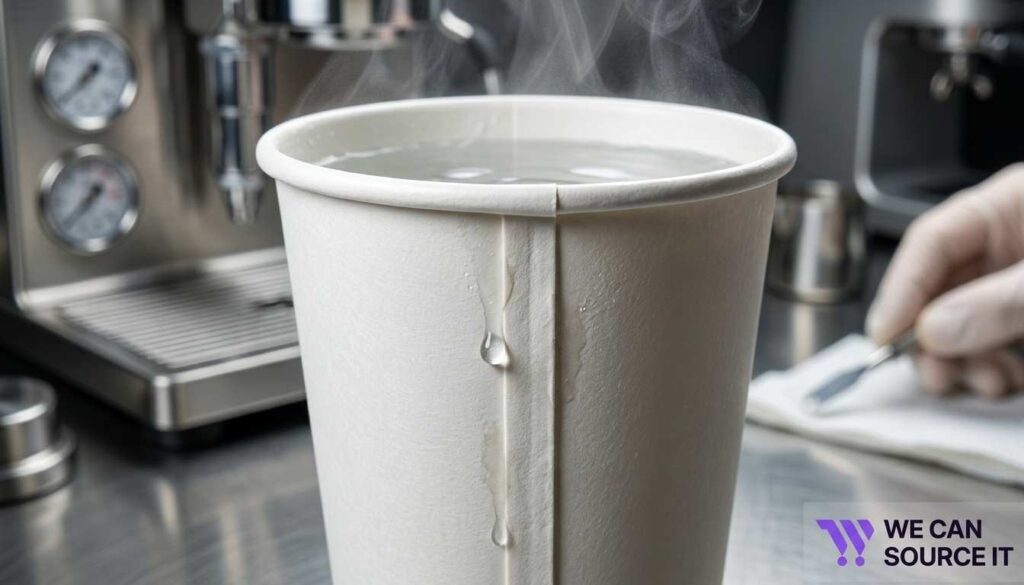
The side seam is the most common failure point in disposable coffee cups.
This seam joins the flat paperboard sheet to form the cup shape. Poor bonding or inconsistent adhesive can cause leaks when the cup holds hot liquid.
Practical Seam Test
- Fill the cup with boiling water or a standard hot drink (85–90°C).
- Leave the cup sitting for 30 minutes.
- Inspect the side seam carefully.
Look for:
- Moisture along the seam
- Small bubbles forming in the lining
- Separation or softening of the seam
Pass criteria: The seam should remain completely dry and structurally intact after 30 minutes.
Key takeaway: If a seam fails during testing, it will fail much faster during busy service conditions.
Why Does Rim Quality Matter for Paper Coffee Cups?
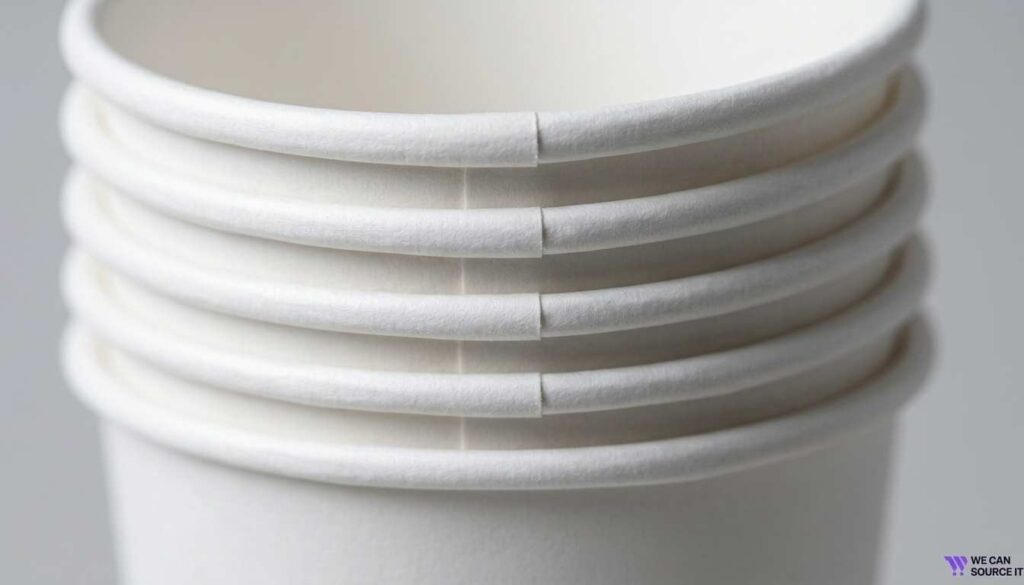
The rim determines whether lids fit securely and whether customers have a comfortable drinking experience.
The rolled rim at the top of a cup performs three essential functions:
- Creates structural strength
- Provides a smooth drinking surface
- Forms the sealing edge for lids
How to Evaluate Rim Quality
Inspect several cups from the same sleeve.
Check for:
- Even rolling around the entire rim
- No sharp edges or paper fibres
- Consistent shape and diameter
Poor rims can cause:
- Loose lids
- Leakage around the drinking edge
- Difficulty stacking cups in dispensers
Key takeaway: An uneven rim is often the first sign of low manufacturing precision.
How Do You Test Heat Insulation and Hand Comfort?
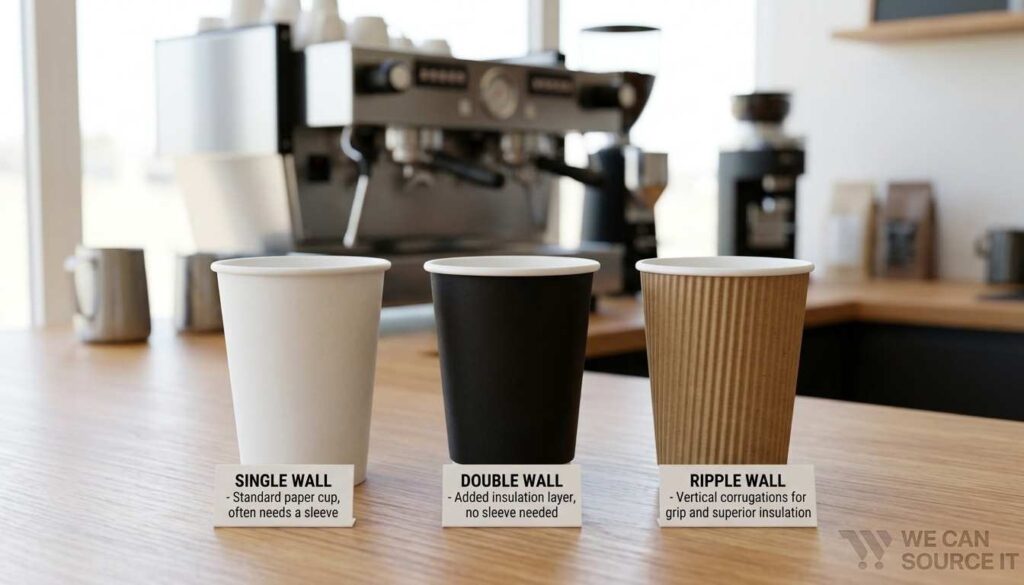
A takeaway coffee cup must keep drinks hot while remaining comfortable to hold.
Different cup constructions affect insulation performance:
- Single wall cups provide minimal insulation and often require sleeves
- Double wall cups provide moderate insulation
- Ripple wall cups provide the highest insulation due to trapped air pockets
Practical Heat Test
- Fill the cup with water at 90°C.
- Hold the cup after 1 minute, 5 minutes, and 10 minutes.
Evaluate:
- Exterior temperature
- Comfort when held without a sleeve
- Heat retention inside the cup
Typical results:
| Cup Type | Comfort Level |
| Single wall (no sleeve) | Uncomfortable after 1–2 minutes |
| Double wall | Comfortable for several minutes |
| Ripple wall | Comfortable throughout drinking time |
Key takeaway: Customer comfort is directly tied to cup wall construction and insulation performance.
How Can Coffee Shops Check Lid Compatibility?

Even high-quality cups fail if lids do not fit properly.
Lid compatibility depends on rim diameter and manufacturing tolerances.
Most 12 oz coffee cups in the UK use 89–90 mm rim diameters, but small differences between suppliers can cause poor lid seals.
Lid Fit Testing Steps
- Attach lids to at least 10 cups from the same batch.
- Listen for a clear snap or click when the lid attaches.
- Rotate the lid gently.
Evaluate:
- Does the coffee cup lid spin freely?
- Does it feel loose?
- Does liquid leak when tilted?
Pass criteria: The lid should sit firmly and not rotate freely or leak when tilted to 45 degrees.
Key takeaway: Never assume lids from one supplier will fit another supplier’s cups perfectly.
How Do You Evaluate Structural Strength and Durability?
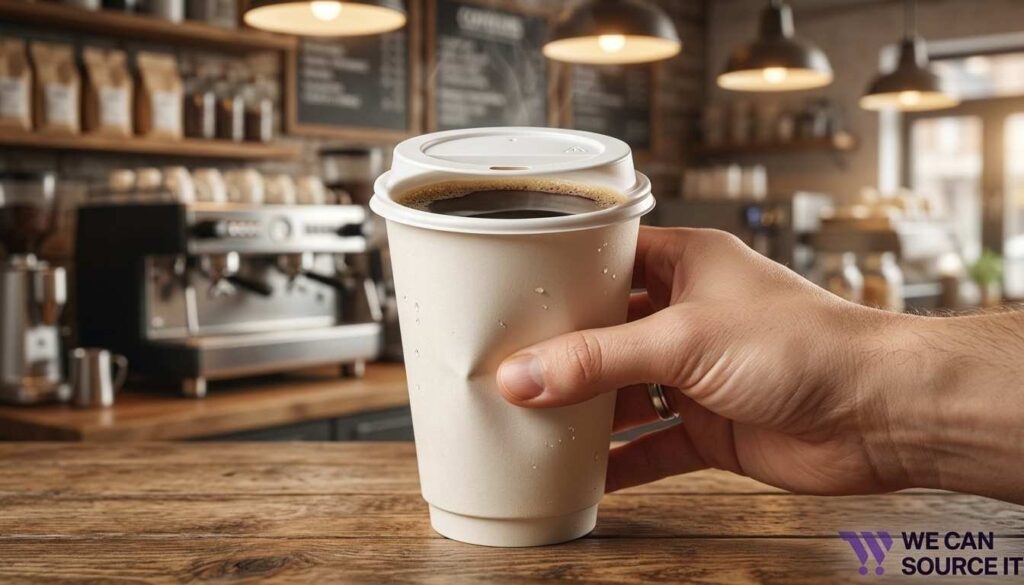
Customers often grip takeaway cups tightly when walking or commuting.
Low-quality cups can collapse or deform when squeezed, especially when filled with hot liquid.
Structural Test
Hold the filled cup normally and apply light pressure.
Observe whether:
- The cup maintains its shape
- The side walls crease easily
- The base weakens under the weight
High-quality cups should remain stable under normal hand pressure.
Key takeaway: Durability matters most during busy takeaway service when cups are handled quickly.
Should Coffee Shops Test Cups During Real Service?
Yes. Real service testing reveals issues that controlled tests may miss.
Baristas often identify operational problems such as:
- Cups sticking together in stacks
- Difficulty writing on cup surfaces
- Slow lid attachment during rush periods
- Poor cup dispensing
Staff Testing Method
Provide test cups to baristas during a normal service shift.
Ask them to evaluate:
- Handling speed
- Lid application
- Cup stacking
- Writing surface quality
Key takeaway: Barista feedback is one of the most valuable quality checks before committing to bulk orders.
Simple Paper Coffee Cup Testing Checklist
Before placing a large order, confirm the following:
Leak resistance
- No seam leaks after 30 minutes
Rim consistency
- Smooth, evenly rolled rim
Heat comfort
- Comfortable to hold for several minutes
Lid seal
- Secure fit with no spinning
Structural durability
- Maintains shape under normal pressure
Operational usability
- Easy stacking and handling during service
Completing this checklist helps ensure the cups will perform reliably in a real café environment.
Frequently Asked Questions
How can I tell if a paper coffee cup is high quality?
A high-quality paper coffee cup has strong seams, a smooth rim, good heat insulation, and a secure lid fit. Testing with hot drinks for 30 minutes is the most reliable method.
Do more expensive paper cups always mean better quality?
Not necessarily. Some mid-priced cups perform just as well as premium options. Performance testing is more reliable than price when evaluating cup quality.
How many samples should a coffee shop test before ordering?
Testing 2–3 different suppliers and multiple cups from each batch provides a realistic comparison of quality and consistency.