You picked the wrong crockery material. You might not know it yet, but somewhere in the next six months, a stack of chipped plates, a failed glaze inspection, or a surprisingly large replacement invoice is going to make it painfully clear.
For busy UK restaurants, crockery is not a one-time purchase. It is a recurring operational cost that quietly eats into your margin every single week. The material you choose determines how long each piece survives your kitchen, your commercial dishwasher, and your front-of-house team. Get it right, and a set of plates can serve you for a decade. Get it wrong, and you are reordering within eighteen months.
If you want the full picture on choosing, pricing, and ordering restaurant tableware in the UK, read our Restaurant Tableware and Crockery Buyer’s Guide first. This article goes deeper into a single, critical question: which material actually lasts?
Short answer: Which material lasts longest?
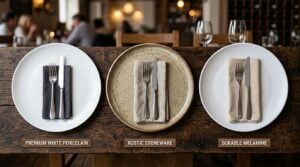
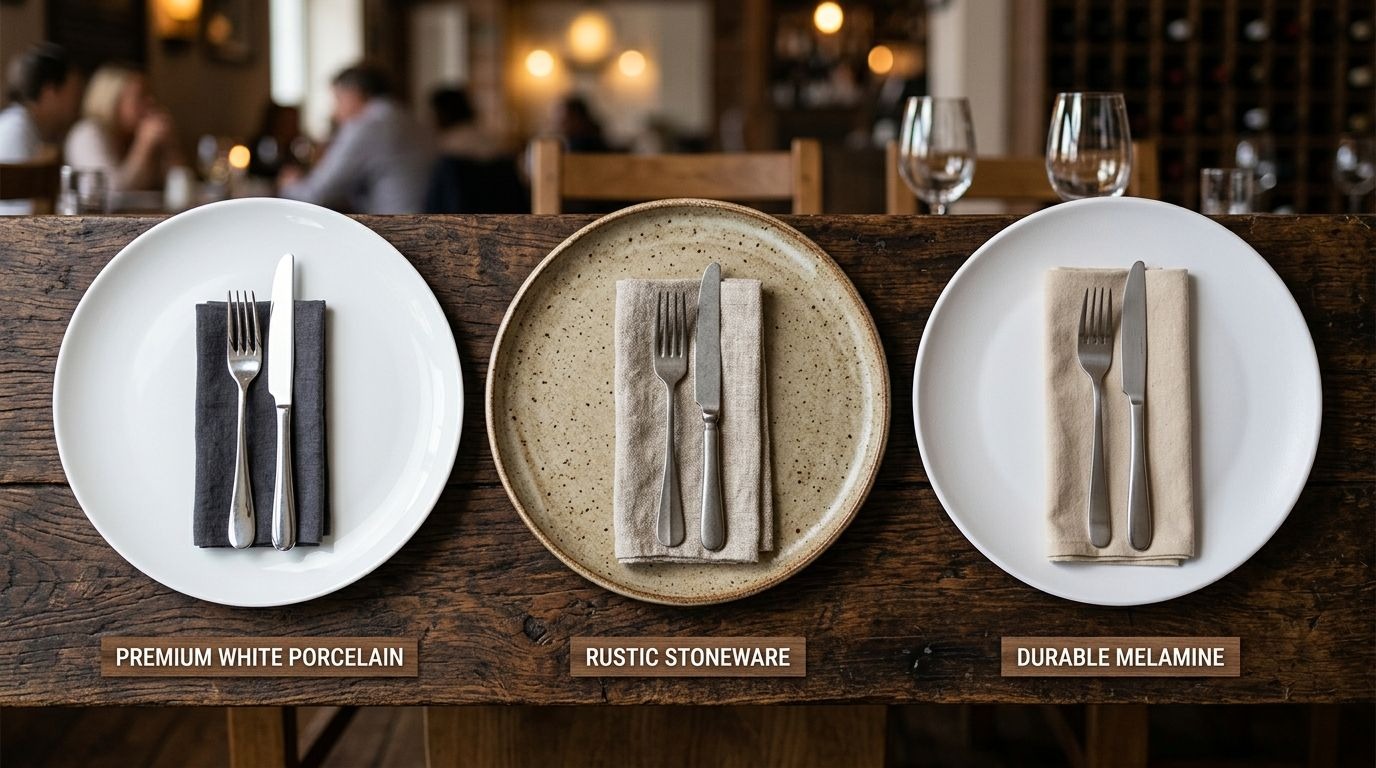
For most busy UK restaurants, vitrified hotelware (a commercial-grade form of porcelain) lasts the longest. It combines the best impact resistance, dishwasher durability, and the lowest replacement rates of any ceramic option. Standard porcelain is a strong mid-market choice with good longevity. Stoneware delivers excellent heat retention and aesthetics but degrades faster in high-volume commercial dishwashing conditions. Melamine is virtually unbreakable but scratches quickly in commercial use and has food safety limitations with hot food above 70 degrees Celsius.
The full explanation of why follows.
Porcelain vs stoneware vs melamine at a glance
| Factor | Porcelain | Vitrified Hotelware | Stoneware | Melamine |
| Impact resistance | Moderate | High | Good | Excellent |
| Commercial dishwasher durability | Good | Excellent | Moderate | Moderate |
| Heat retention | Good | Good | Excellent | Poor |
| Chip resistance | Moderate | High | Good | Excellent |
| Food safety (hot food above 70C) | Excellent | Excellent | Excellent | Limited |
| Approximate commercial lifespan | 3 to 5 years | 5 to 10 years | 2 to 4 years | 1 to 2 years |
| Best for | Bistros, mid-market dining | Hotels, high-volume restaurants | Gastropubs, tasting menus | Outdoor venues, care homes |
What does “durable” mean in a commercial kitchen?
This is where most buyer guides go wrong. They describe materials in isolation and say things like “porcelain is strong but can chip.” That is technically true and practically useless.
Durability in a restaurant kitchen has four distinct dimensions.
Physical impact resistance refers to what happens when a plate is dropped, knocked against another, or stacked roughly by a tired member of staff at the end of a Friday service.
Thermal shock resistance is the ability of a material to survive rapid temperature changes, such as going from a hot oven to a cold prep surface, or being put through a commercial dishwasher that rinses at 85 degrees Celsius.
Glaze and surface integrity determine whether the plate degrades visually over time. Commercial dishwashers strip glazes faster than domestic machines. A plate that looks pristine after two years in a home kitchen can look dull and scratched after eight months in a busy restaurant.
Chemical resistance covers how the material responds to the industrial-strength detergents and sanitisers used in commercial warewashing cycles.
When you evaluate any crockery material against all four of these criteria, the picture looks very different from a simple pros and cons list.
The materials: what they are and how they actually perform
Porcelain
Porcelain is fired at temperatures between 1,200 and 1,400 degrees Celsius, which creates a dense, non-porous surface. Because it absorbs almost no liquid or bacteria, it resists staining and retains a clean appearance longer than most alternatives.
Standard porcelain performs well in a mid-market restaurant environment. It chips more easily than vitrified hotelware when dropped, particularly at the rim, and the chip point tends to be sharp rather than gradual. However, it holds its glaze well through commercial washing cycles and does not scratch under cutlery contact as visibly as softer materials.
Where porcelain works well: bistros, casual dining, hotel dining rooms, and any operation where presentation matters but the budget does not extend to vitrified hotelware.
Vitrified hotelware
This is the version of porcelain specifically engineered for commercial foodservice, and it deserves its own category in this comparison. During the manufacturing process, the ceramic body is fired at extremely high temperatures until it becomes dense, non-porous, and glass-like throughout. This creates a material that is significantly more impact-resistant than standard porcelain, with substantially better resistance to thermal shock and the repeated chemical cycles of a commercial dishwasher.
Vitrified hotelware is what you find in most UK hotel breakfast rooms, contract catering operations, and high-turnover casual dining venues. It is heavier than standard porcelain, which some operators consider a drawback from a presentation perspective, but that weight is part of what makes it last.
If you are running more than sixty covers a day, and crockery goes through a pass-through dishwasher multiple times per shift, vitrified hotelware is almost always the most cost-effective long-term choice. Browse our commercial tableware range to see commercial-grade options suited to exactly these environments.
Stoneware
Stoneware is fired at a lower temperature than porcelain, roughly 1,000 to 1,200 degrees Celsius. It is slightly more porous, heavier per unit, and has a more rustic, textured aesthetic that has become extremely popular in the UK casual dining and small plates scene over the past decade.
In terms of durability, stoneware is chip-resistant but not chip-proof. Its edges are less sharp when damaged, which is a safety advantage. However, the reactive glazes that give stoneware its distinctive look are more vulnerable to commercial detergents. Over 12 to 18 months of commercial washing at high temperatures, the surface can become dull, and the glaze can develop micro-cracks that make thorough sanitisation harder.
Where stoneware works well: independent restaurants, gastropubs, and tasting menus where the aesthetic contributes directly to the dining experience and daily cover counts are moderate, typically under sixty covers per day. It is not the right choice for high-volume operations with aggressive warewashing programmes.
Melamine
Melamine is a thermosetting plastic, not a ceramic. It is made from melamine-formaldehyde resin, which creates a lightweight, virtually unbreakable surface that is considerably cheaper per unit than any ceramic option.
In terms of raw impact resistance, melamine wins outright. For this reason, it has become standard in outdoor hospitality, children’s venues, care homes, and high-volume fast-food operations where breakage risk is high and formal presentation is not a priority.
However, melamine has real limitations in commercial restaurant use.
It scratches visibly under commercial cutlery contact. Those scratches are not merely cosmetic. They create surface irregularities that can harbour bacteria and make effective sanitisation harder to achieve. Melamine also degrades in colour and finish noticeably faster than any ceramic alternative when subjected to commercial dishwasher temperatures. Repeated exposure at the higher end of commercial wash cycles ages melamine surfaces within 12 months.
And there is a compliance issue that almost no buyer guide mentions.
What does UK food safety law say about melamine
The UK has retained the EU food contact materials framework following Brexit. Under assimilated Commission Regulation (EU) No. 10/2011 on plastic materials and articles intended to contact food, formaldehyde migration from melamine tableware must not exceed 15 mg per kilogram of food. This limit is based on testing conducted at 70 degrees Celsius.
Above that temperature, the rate at which melamine and formaldehyde migrate into food increases significantly. Research published in the journal Food Control in early 2025 confirmed that melamine migration increases substantially when tested with hot, acidic liquids at temperatures above 70 degrees Celsius.
The UK FSA has also issued specific warnings about bamboo and plant-fibre products that use melamine-formaldehyde resin as a binder, noting these can leach chemicals above the legal limit when used with hot food or drink. The FSA’s formal guidance on food contact materials regulations is published at food.gov.uk/business-guidance/food-contact-materials-regulations.
Additionally, the Plastic Kitchenware (Conditions on Imports from China) (England) Regulations 2011 require importers of melamine kitchenware originating from China and Hong Kong to provide a declaration of conformity and a laboratory test report confirming that formaldehyde migration stays within legal limits. If you are sourcing melamine at very low price points, always request this documentation from your supplier.
What this means practically: melamine is safe and fully compliant for cold or room-temperature service. Using it to serve hot soups, hot mains, or any dish arriving from a heat lamp or hot plate above 70 degrees Celsius puts you in territory where compliance is harder to verify, and your food safety obligations are less straightforward. For a care home, outdoor bar, or children’s venue where food is served cold or warm rather than hot, melamine remains an excellent choice. For a full-service restaurant serving hot mains, the compliance position is more complex than most suppliers will tell you.
How commercial dishwashers change the durability equation
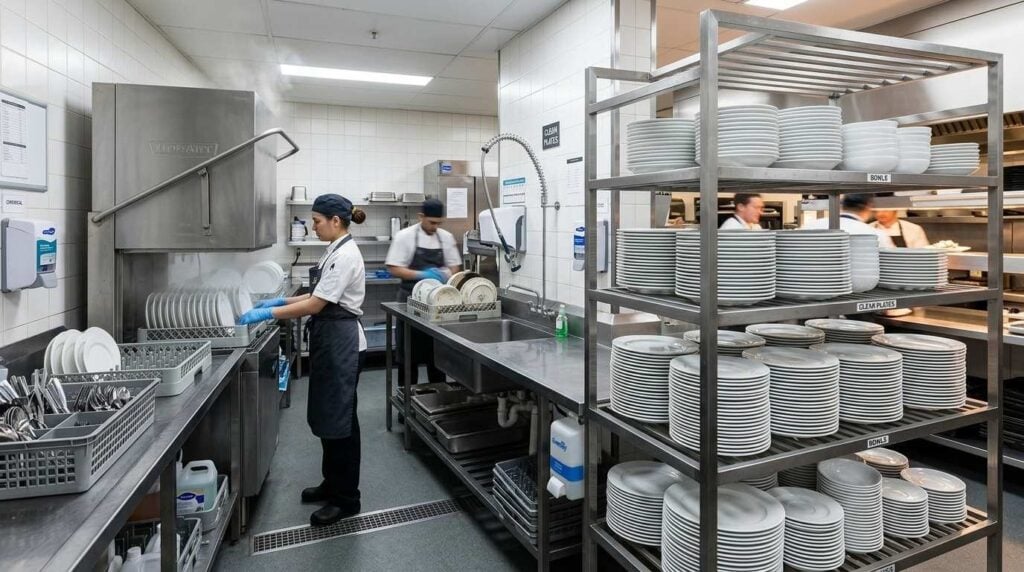
A domestic dishwasher runs a 90-minute cycle at around 50 to 60 degrees Celsius. A commercial pass-through dishwasher in a busy restaurant runs a full cycle in 90 seconds to three minutes, at wash temperatures of 60 to 65 degrees Celsius and rinse temperatures of 80 to 85 degrees Celsius, with industrial detergents and high-pressure water jets. Your commercial machine may complete 80 to 120 cycles per day.
This changes everything.
For standard porcelain, the thermal cycling degrades the glaze over time, but a decent-quality piece will survive 400 to 600 commercial cycles before showing visible wear. Vitrified hotelware is specifically engineered for these conditions and typically maintains its appearance for 1,000 or more commercial cycles.
For stoneware, the reactive glaze is particularly vulnerable to repeated high-temperature washing combined with alkaline commercial detergents. Budget stoneware can begin looking dull and matte after as few as 200 to 300 cycles. If you choose stoneware for its aesthetic, invest in higher-quality pieces and use a lower-temperature wash programme where your machine allows it.
For melamine, the surface begins to scratch and dull visibly within the first few hundred commercial cycles. Scratched melamine is also harder to sanitise and more likely to retain odours. Some operators extend melamine life by reducing wash temperature, but this introduces its own sanitisation trade-off.
The practical upshot: when you buy crockery, ask the supplier for the manufacturer’s stated commercial dishwasher cycle guarantee. Quality vitrified hotelware products are guaranteed for a specific number of commercial cycles. That figure is worth far more than any abstract durability claim.
Total cost of ownership: a worked example for a 60-cover restaurant
The figures below are illustrative estimates based on typical UK wholesale pricing and average commercial breakage rates. Your actual costs will vary depending on service type, staff handling, and table turnover.
Scenario: a 60-cover casual dining restaurant running two sittings per day, six days a week, approximately 720 covers per week. Opening stock of 300 plates.
Standard porcelain at roughly £2.50 per plate. Opening cost for 300 plates: £750. Average commercial breakage rate: 12 per cent per year. That is 36 replacements at £2.50, so £90 per year. Total over three years: £1,020.
Vitrified hotelware at roughly £4.50 per plate. Opening cost for 300 plates: £1,350. Average breakage rate due to higher impact resistance: 7 per cent per year. That is 21 replacements at £4.50, so £94.50 per year. Total over three years: £1,633.
Melamine at roughly £1.20 per plate. Opening cost for 300 plates: £360. Average replacement rate in commercial use, accounting for scratching and cosmetic degradation as well as breakage: 25 per cent per year. That is 75 replacements at £1.20, so £90 per year. However, factoring in the likelihood of a full replacement cycle at around 18 months due to surface degradation, the real three-year cost is closer to £720 to £900.
The gap between vitrified hotelware and melamine over three years is smaller than most operators expect, particularly once you account for the presentation quality difference, the compliance considerations above, and the fact that worn melamine plates affect the perceived quality of every dish served on them.
Which material suits your restaurant type?

High-volume casual dining and pub kitchens (60-plus covers, three or more sittings per day): vitrified hotelware. The investment per unit is higher, but the total cost of ownership is competitive once breakage frequency, replacement rates, and dishwasher performance are factored in.
Independent bistros and small plates restaurants: stoneware or standard porcelain, depending on the aesthetic you are going for. If the look of the plate contributes to the experience, stoneware justifies the durability trade-off. Invest in quality rather than the lowest price, and factor in more frequent replacement.
Hotel dining rooms and contract catering: vitrified hotelware across the board. Volume, turnover, and the need for a consistent professional look all point in the same direction.
Care homes and NHS catering: melamine for cold service, everyday use, and environments where resident safety is a priority. Be rigorous about replacing worn pieces and never use melamine for hot food service.
Outdoor venues, beer gardens, festival catering, and events: melamine. The compliance considerations above are less relevant when food is served cold or at ambient temperature, and the unbreakable quality is a genuine operational advantage.
Fast food and quick service restaurants: melamine or polypropylene for any format that does not require formal presentation.
Pair your crockery choice with the right wholesale cutlery range to make sure your full table setting holds up under the same commercial conditions.
Quick decision guide
| If you need | Choose |
| Longest commercial lifespan | Vitrified hotelware |
| Best on-plate presentation | Stoneware |
| Lowest breakage rate | Melamine |
| Best value per unit | Standard porcelain |
| Outdoor dining or events | Melamine |
| High-volume restaurant | Vitrified hotelware |
| Care home or vulnerable users | Melamine (cold service only) |
| Gastropub or small plates | Stoneware |
Heat retention and the pass-to-table problem
One operational consideration that rarely appears in crockery guides is how quickly a plate loses heat between the kitchen pass and the diner’s table.
Stoneware retains heat better than porcelain, which retains heat better than melamine. In a busy restaurant where dishes sit at a pass for even a minute or two before a front-of-house team member carries them out, this matters. A stoneware plate warmed in a plate heater will keep a steak at serving temperature noticeably longer than a thin porcelain plate under identical conditions.
If your concept relies on dishes arriving at the table at the correct temperature and you run a busy pass, stoneware’s thermal mass is a genuine operational advantage worth factoring into the decision.
Sustainability: Which material is more responsible in the long term?
For UK restaurant operators with sustainability goals, whether driven by ESG targets, customer expectations, or procurement policies, the environmental picture is worth understanding.
Melamine is a thermosetting plastic. Once it reaches the end of its life, it cannot be recycled or composted. It goes to the landfill. A plate replaced every 12 to 18 months generates considerably more waste per cover over five years than a vitrified porcelain piece lasting ten years.
Vitrified porcelain has a higher carbon footprint per unit at the point of manufacture due to the higher firing temperatures required. But its lifespan means the lifecycle carbon cost per year of service is significantly lower than that of melamine. The piece that lasts longest almost always has the lowest environmental impact over time.
If your business is working toward a net zero commitment, quality vitrified hotelware or high-fired porcelain is the lower-lifetime-impact choice by a considerable margin over cheap melamine or entry-level stoneware.
Frequently asked questions
Which crockery material lasts longest in a restaurant?
Vitrified hotelware lasts the longest in a busy commercial restaurant environment. It is engineered specifically for the high temperatures, chemical detergents, and heavy throughput of commercial dishwashers. Quality pieces are rated to 1,000 or more commercial wash cycles and carry a significantly lower breakage rate than standard porcelain or melamine.
Is melamine safe for restaurant use?
Melamine is safe for cold and ambient-temperature service. However, under UK retained food contact materials law, melamine migration into food increases significantly above 70 degrees Celsius. Restaurants serving hot food on melamine should be aware of this compliance consideration. Always request a declaration of conformity from your supplier for any melamine products imported from China or Hong Kong.
Does stoneware chip easily in a restaurant?
Stoneware is more chip-resistant than standard porcelain, and its edges tend to be less sharp when damage does occur. However, in a high-volume operation with aggressive commercial dishwashing programmes, the reactive glaze common on stoneware can degrade faster than vitrified porcelain. Stoneware performs best in operations with moderate cover counts and careful handling.
What is the best crockery material for a busy UK restaurant?
For the majority of busy UK restaurants, vitrified hotelware offers the best balance of durability, commercial dishwasher performance, food safety compliance, and total cost of ownership. Standard porcelain is a sound choice for mid-market operations with lower daily volume. Stoneware suits independent restaurants and gastropubs where presentation is a priority. Melamine is best suited to outdoor, cold-service, or care settings.
Buying checklist before you order
Before you place your next crockery order, work through these questions:
Does the product specify commercial dishwasher compatibility, and if so, to how many cycles?
What is the manufacturer’s stated temperature range, and does that cover how your dishes will actually be served?
Have you calculated the total cost of ownership over three years, not just the unit price?
If you are buying melamine, can your supplier provide a declaration of conformity confirming formaldehyde migration compliance under UK retained regulations?
Does the piece have a weight and profile suited to your service format and the ergonomics of your front-of-house team?
For more guidance on quantities, styles, trends, and wholesale pricing across all restaurant crockery materials, the full Restaurant Tableware and Crockery Buyer’s Guide covers everything you need to make the right decision for your operation.
Browse our full commercial tableware range to find the right fit for your venue.
References
- ▸ Food Standards Agency. Food contact materials regulations: https://www.food.gov.uk/business-guidance/food-contact-materials-regulations
- ▸ UK Government legislation. The Plastic Kitchenware (Conditions on Imports from China) (England) Regulations 2011: https://www.legislation.gov.uk/uksi/2011/1517/contents
- ▸ UK Government legislation. Commission Regulation (EU) No 284/2011 (retained in UK law: https://www.legislation.gov.uk/eur/2011/284/article/3
- ▸ Food Standards Agency. FSA Committee on Toxicity (COT) review of bamboo and plant-based tableware: https://www.food.gov.uk/topic/food-contact-materials
- ▸ Bechynska, K. et al. Migration of melamine from bio-based tableware. Food Control, February 2025.
- ▸ Food Standards Agency. Post-implementation review: Plastic Kitchenware: https://www.food.gov.uk/sites/default/files/media/document/plastic_kitchenware_regs2011_china_review.pdf