Search for bio vs non-bio washing powder, and almost everything you find is written for someone choosing a detergent for their family’s weekly wash. That advice does not transfer cleanly to a hotel laundering 200 sets of bed linen a week, a restaurant fighting grease stains on table linen every service, or a care home managing infection control on top of everything else.
This guide answers the question for hospitality specifically. It covers what actually changes when you wash at commercial rather than domestic volume, which detergent suits which linen type, where the energy cost argument genuinely matters, and where non-bio is the safer choice regardless of cost.
What Is the Actual Difference Between Bio and Non-Bio Washing Powder?
What bio (biological) washing powder contains
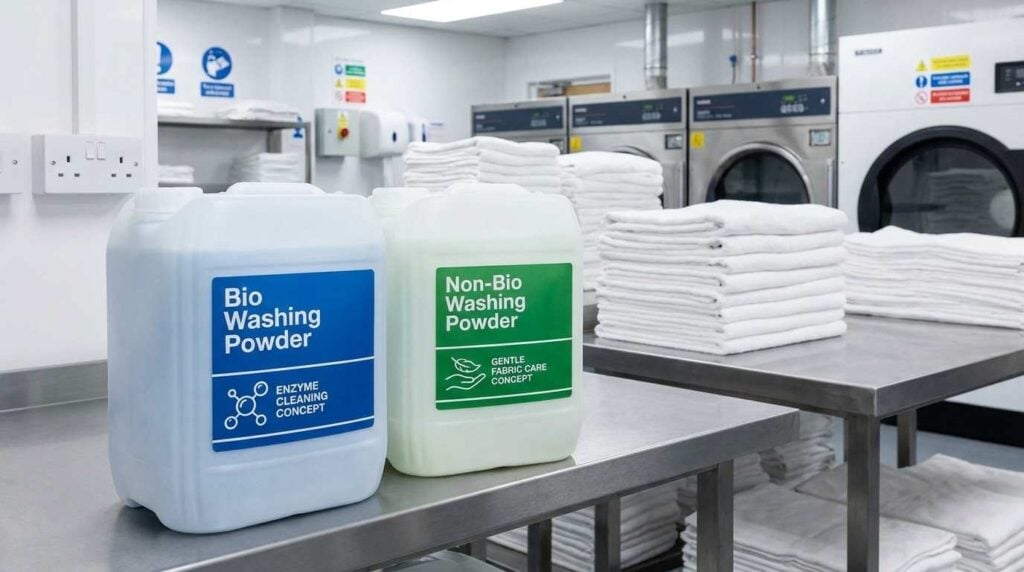
Bio detergents contain enzymes that break down specific types of stains at a molecular level. The three enzymes that matter most for hospitality laundry are protease, which breaks down protein stains such as blood, egg, and sweat; lipase, which targets fat and oil, including cooking oil and body oils; and amylase, which works on starch-based stains like gravy, pasta sauce, and custard. A fourth enzyme, mannanase, is increasingly common and targets gum-based stains such as ketchup and some sauces.
Because these enzymes do the chemical work, bio detergent achieves strong stain removal at lower wash temperatures, typically from 30 to 40 degrees Celsius.
What non-bio (non-biological) washing powder contains
Non-bio relies on surfactants and, in many formulations, oxygen-based bleaching agents to lift stains, rather than enzyme action. It generally needs a higher wash temperature, often 40 to 60 degrees Celsius, to achieve comparable results on the same stains. Non-bio is not a weaker product. It cleans differently, and in some hospitality contexts, that difference is exactly what you need.
The key practical differences at a glance
| Factor | Bio | Non-Bio |
| Enzyme content | Yes (protease, lipase, amylase) | None |
| Effective temperature | From 30 to 40°C | Typically 40 to 60°C |
| Best against | Protein, fat, starch stains | General soiling, surfactant-based cleaning |
| Fabric risk over time | Can affect protein-based fibres (wool, silk) with repeated exposure | Safer for delicate and protein-based fabrics |
| Energy use per cycle | Lower (effective at lower temperatures) | Higher (often needs hotter washes) |
| Typical hospitality use | Bed linen, towels, table linen, uniforms | Wool blankets, delicate items, infection-control linen |
Why the Domestic Advice Does Not Transfer to Hospitality Laundry
A domestic household typically washes a given sheet set 40 to 60 times a year. A busy hotel can put the same linen through 200 or more wash cycles annually. That difference in volume changes the calculation in two ways: the cumulative effect of any fabric stress becomes far more significant, and the cost difference between a 40-degree wash and a 60-degree wash, multiplied across hundreds of cycles a week, becomes a real operational figure rather than a rounding error.
It is also worth flagging plainly that domestic supermarket detergent is not the right product for a commercial laundry operation in the first place. Commercial-grade detergents are formulated and concentrated for higher-volume use, dosed correctly in commercial machines, and are priced for bulk buying in a way domestic packaging is not. If your business is still buying domestic boxes from a supermarket for anything beyond a handful of loads a week, switching to a commercial-grade bio or non-bio bulk powder is usually the first cost-saving change worth making.
Where Bio Washing Powder Performs Best in Hospitality
Bio is the right starting point for most hospitality linens because most hospitality staining is exactly what enzymes are designed to break down: body oils and sweat on bed linen, food and grease on restaurant table linen and chef whites, and general grass and food soiling on uniforms.
The temperature advantage matters at volume. A wash that works at 40 degrees instead of 60 uses meaningfully less energy across hundreds of cycles a week. For an on-premise laundry running continuously, the running cost difference between a fleet of 40-degree and 60-degree cycles adds up over a full year, even though any single wash looks marginal.
Where bio earns its place in hospitality:
- ▸ Restaurant and catering table linen, where food and grease staining is constant
- ▸ Hotel bed linen and pillowcases, where body oils and sweat are the dominant soiling type
- ▸ Gym, spa, and leisure towels, where body protein staining is frequent
- ▸ School and contract catering uniforms, where food and general soiling predominate
The fabric longevity trade-off is worth knowing
Enzymes that break down protein stains are, by definition, acting on protein-based material. Cotton itself is a cellulose fibre rather than a protein fibre, so a bio detergent does not break down the core cotton structure in the way it would attack wool or silk. Over hundreds of commercial wash cycles, however, repeated enzyme exposure combined with mechanical agitation does contribute to gradual fibre wear, and this is worth weighing against the alternative: non-bio at higher temperatures causes its own mechanical and thermal stress on fibres over the same number of cycles. Neither option is free of long-term wear. The practical response is the same either way: a fabric conditioner used alongside your detergent reduces fibre friction, and linen replacement is best treated as a planned cost rather than a surprise.
Where Non-Bio Washing Powder Is the Right Choice
Non-bio is not a fallback option. In several hospitality contexts, it is the correct default.
Delicate and protein-based fabrics. Wool blankets, silk trims, and similar protein-based fibres are genuinely vulnerable to enzyme action in a way cotton is not, so non-bio is the safer choice here regardless of volume.
Care home and healthcare linen. This is the context where the decision is not really about detergent chemistry at all. According to NHS guidance on linen decontamination for health and social care, linen carrying infection risk should undergo thermal disinfection, typically washing at 65 degrees for at least ten minutes, or 71 degrees for at least three minutes. At those temperatures, the lower-temperature advantage that makes bio attractive elsewhere becomes irrelevant, and many care providers default to non-bio at the required high temperature as the safer, simpler standard across all linen rather than running two separate systems.
Sensitive skin policies. The clinical evidence that bio detergent causes more skin irritation than non-bio is genuinely weak, but plenty of hotels, spas, and care settings maintain a non-bio policy for guest or resident comfort and peace of mind regardless of what the evidence says. If your venue has made that commitment, it is a reasonable operational choice to maintain consistently.
Commercial operators in these settings typically stock a non-bio washing powder in bulk sack or tub format to suit high-volume use.
Does hard water affect bio vs non-bio performance?
Water hardness matters more than most hospitality operators realise, and it affects both detergent types, not just one. In hard water areas, which cover much of the UK, minerals in the water reduce detergent effectiveness and can leave a limescale residue on linen and inside machines over time. This shows up as dull, stiff-feeling towels and reduced rinsing performance, regardless of whether you are running bio or non-bio.
Bio detergent’s enzymes can be slightly less effective in very hard water if dosing is not adjusted upward to compensate. Non-bio is less sensitive to this, since it relies more on surfactant action than enzyme activity. In either case, the practical fix is the same: use a water softener salt in your machine’s softening system if you are in a hard water area, and check that your dosing guidance accounts for local water hardness rather than using a flat dose across every site if you operate in more than one location. A water softener salt, such as Aquasol tablets, protects machines and improves how either detergent type performs.
Bio vs non-bio in commercial laundry machines
Format matters as much as formulation once you are running commercial equipment. Powder detergent is generally the better fit for large-load commercial washers and is the standard choice for bulk hospitality buying, since it stores easily in bulk sacks and tubs and doses predictably. Liquid detergent suits auto-dosing systems better in some installations, since liquid pumps more reliably through a dosing line than powder, which can clump or settle.
If your laundry uses an auto-dosing system, confirm with your equipment supplier whether it is set up for powder or liquid before changing products, since switching formats without recalibrating the dosing pump is a common cause of underdosed or overdosed loads. Underdosing leaves stains behind and allows residue build-up; overdosing wastes produce and can leave detergent residue in the fabric, which shows up as stiffness or a faint smell after drying.
Choosing by Linen Type: A Hospitality Quick Reference
Quick decision flow
- ▸ Is it cotton bed linen, towels, table linen, or general uniforms? Use bio at 40°C.
- ▸ Is it wool, silk, or another delicate protein-based fabric? Use non-bio at 30°C or below.
- ▸ Is it care home or healthcare linen carrying infection risk? Follow your thermal disinfection requirement (65°C for 10 minutes, or 71°C for 3 minutes) and use non-bio at that temperature.
- ▸ Does your venue have a sensitive skin policy? Use non-bio regardless of fabric type to maintain consistency.
| Linen Type | Recommended | Typical Temperature | Notes |
| Hotel bed linen, white cotton | Bio | 40°C | Body oils and sweat respond well to enzyme action |
| Hotel bed linen, coloured | Bio | 40°C | Lower temperature also helps protect colour |
| Hotel and spa towels | Bio | 40 to 60°C | Pair with a stain remover for makeup and cosmetic marks |
| Restaurant table linen | Bio | 40 to 60°C | Grease and food staining are the dominant soiling types |
| Chef whites and kitchen uniforms | Bio, often at higher temperature | 60°C | Food hygiene practice may call for a hot wash regardless of detergent type |
| School uniforms and sports kits | Bio | 40°C | Grass and food soiling respond well; non-bio if a sensitive skin policy applies |
| Wool blankets and delicate items | Non-bio | 30°C max | Protein-based fibres are vulnerable to enzyme exposure |
| Care home and healthcare linen | Non-bio | 65 to 71°C | Set by infection control and thermal disinfection requirements, not by detergent preference |
For linen that needs extra attention on white table linen or stubborn marks, a dedicated stain remover powder used alongside your main detergent handles staining that the wash cycle alone does not fully shift.
Building Out the Rest of Your Laundry Programme
Bio versus non-bio is the starting decision, not the whole laundry strategy. Most hospitality operations get better, more consistent results by treating the detergent choice as one part of a small system rather than the only variable.
A fabric conditioner reduces fibre friction over repeated washes, helps maintain softness, and can shorten drying time, which matters when you are running linen through a dryer at commercial volume. In a hard water area, a water softener salt protects machines and improves how effectively any detergent performs, bio or non-bio.
For mixed loads, where white towels and coloured table linen end up needing to go through together, non-bio at a moderate temperature is generally the safer uncontrolled default, since you avoid the colour-fade risk that comes with washing mixed loads at the higher temperatures bio sometimes benefits from.
A Simple Way to Decide
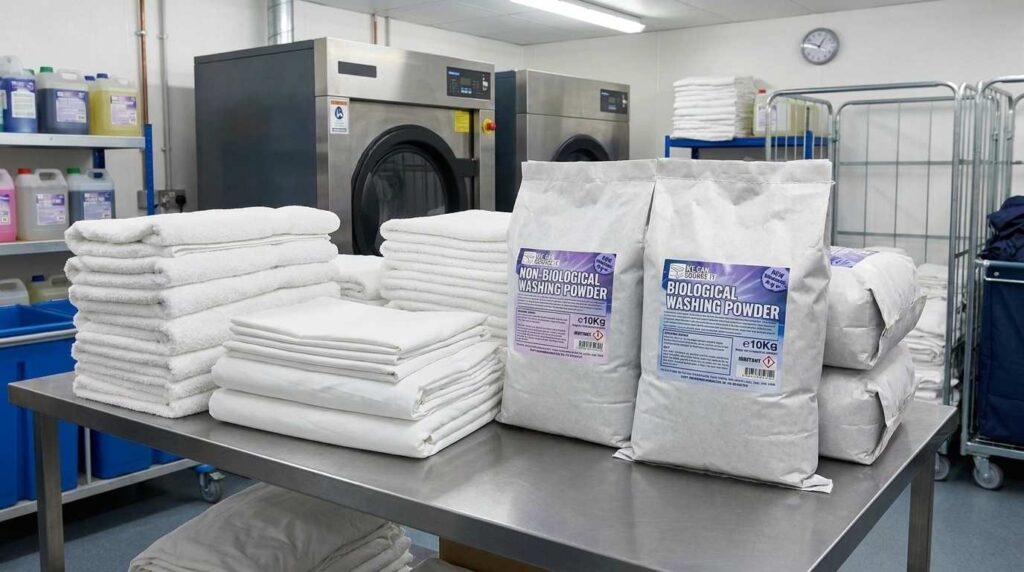
If most of your linen is cotton bed linen, towels, table linen, or general uniforms, and you are not operating under a specific infection control or sensitive skin policy, bio at 40 degrees is the sensible default and the more energy-efficient choice across a full year of commercial washing.
If you are washing wool, silk, or other delicate protein-based items, default to non-bio.
If you operate in care or healthcare and are following thermal disinfection guidance, the wash temperature is set by that guidance first, and non-bio at the required high temperature is the standard, lower-complexity choice.
Browse our full laundry detergent and washing powder range for bulk bio, non-bio, and liquid formats suited to hospitality volumes. For the wider context of hygiene compliance across your kitchen and laundry operation, see our commercial kitchen cleaning supplies guide and our guide to UK food hygiene regulations for restaurants.
FAQs
Should hotels use bio or non-bio washing powder for bed linen?
Bio is generally the better choice for hotel bed linen. The enzymes in bio detergent are effective against the body oil and sweat staining that bed linen accumulates, and bio performs well at lower wash temperatures, which reduces energy cost across the hundreds of wash cycles a hotel runs each year.
Does bio washing powder damage linen over time?
Not in the way people often assume. Cotton is a cellulose fibre, not a protein fibre, so the protein-targeting enzymes in bio detergent are not directly breaking down the cotton structure. Repeated washing at commercial volume causes some fibre wear regardless of detergent type, through mechanical agitation and, with non-bio, often higher temperatures. A fabric conditioner and sensible wash temperatures help either way.
Is non-bio better for sensitive skin in a hospitality setting?
The clinical evidence that bio causes more skin irritation than non-bio is limited, but many hotels, spas, and care settings maintain a non-bio policy as a precaution or to support guests and residents with known sensitivities. It is a reasonable policy to maintain consistently if your venue has adopted it.
What temperature should care home linen be washed at?
UK infection control guidance for care and healthcare linen typically calls for thermal disinfection at 65 degrees Celsius for at least ten minutes, or 71 degrees for at least three minutes, for linen carrying infection risk. At these temperatures, non-bio is the standard choice, and the wash temperature is determined by the disinfection requirement rather than by detergent preference.
Can I use bio washing powder for restaurant table linen?
Yes, and it is usually the right choice. Restaurant table linen is constantly exposed to food and grease staining, which is precisely what Bio’s enzyme formulation is designed to address. A stain remover powder used alongside your main detergent helps with particularly stubborn marks on white linen.
Does washing at a lower temperature actually save money at commercial volume?
Yes, meaningfully. A single wash at 40 degrees instead of 60 looks marginal in isolation, but a hospitality laundry operation running continuous cycles across a week sees that difference compound. Bio detergent’s effectiveness at lower temperatures is one of the more practical cost arguments in favour of it for general hospitality linen.
References