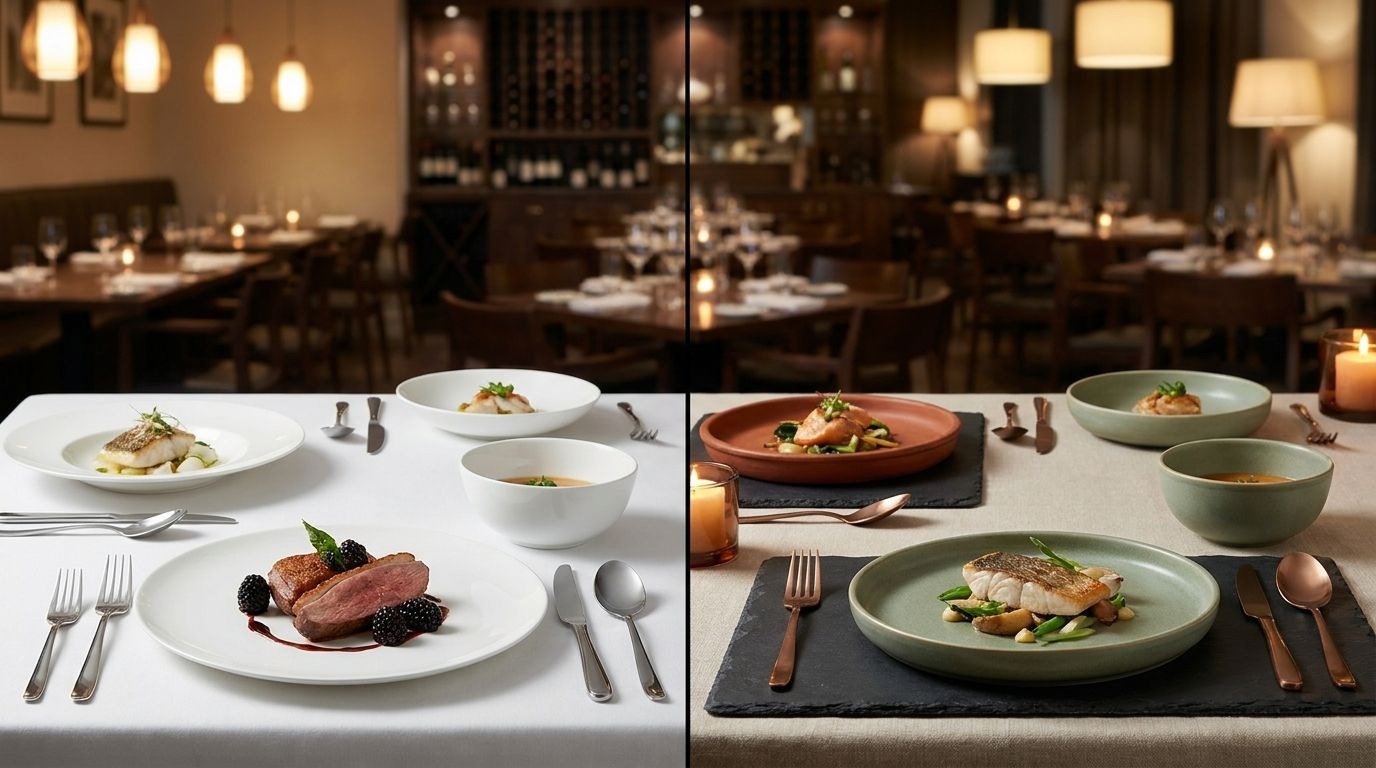
Most guides on this topic will tell you that white makes food pop, coloured adds personality, and both can work. That is not a decision. That is a description.
This guide maps specific colours to specific brand signals for UK restaurants in 2026, shows you which plate colours work with which food types and which create visual problems, explains what coloured crockery does to your food photography under real service lighting, covers the operational realities that experienced operators know before committing, and finishes with a clear decision framework that tells you which choice is actually right for your venue.
White crockery is an active brand choice, not a default. Coloured crockery is a commitment, not a decoration. The difference between operators who get this right and those who regret it is usually not the colour they chose. It is the thought they put into it before they ordered.
What White Crockery Actually Does for Your Restaurant Brand
White crockery is the dominant choice in UK restaurants, not because operators are playing it safe. It is because white does a specific job exceptionally well, and understanding what that job is helps you decide whether you need something different.
The case for white
White is not neutral. It is a frame. A white plate says the food is the point, the chef is confident, and the presentation does not need amplification from the vessel. That is a deliberate brand position, and in the right context, it is exactly the right one.
The practical advantages compound quickly:
- ▸ White makes food colours more vibrant. Red sauces, green garnishes, golden pastry, and yellow custard all read more clearly against white than against most other backgrounds.
- ▸ White works across every cuisine and every seasonal menu change without creating visual conflict.
- ▸ Replacement is straightforward. If a piece breaks, finding an identical or close replacement is far easier than with a coloured or reactive-glaze range.
- ▸ Batch variation is invisible. Two white plates from different production runs are indistinguishable at the table.
- ▸ White photographs consistently well under a wide range of lighting conditions.
For the full material and durability comparison across porcelain, stoneware, and melamine, see our guide to restaurant crockery materials.
When white becomes a liability
The limitation of white is not that it is boring. The limitation is that it is interchangeable. When every restaurant in a neighbourhood is using white plates, and your food photography looks like everyone else’s, and your table looks like every other mid-range dining room, white stops doing differentiation work. It does presentation work, which is valuable, but it does not do brand work.
If your brand has a strong visual identity, a distinct design language, or a cuisine with a specific cultural or aesthetic heritage, white may be underselling you. That is the moment to consider colour seriously.
What Coloured Crockery Signals: A UK Colour-to-Brand Map for 2026
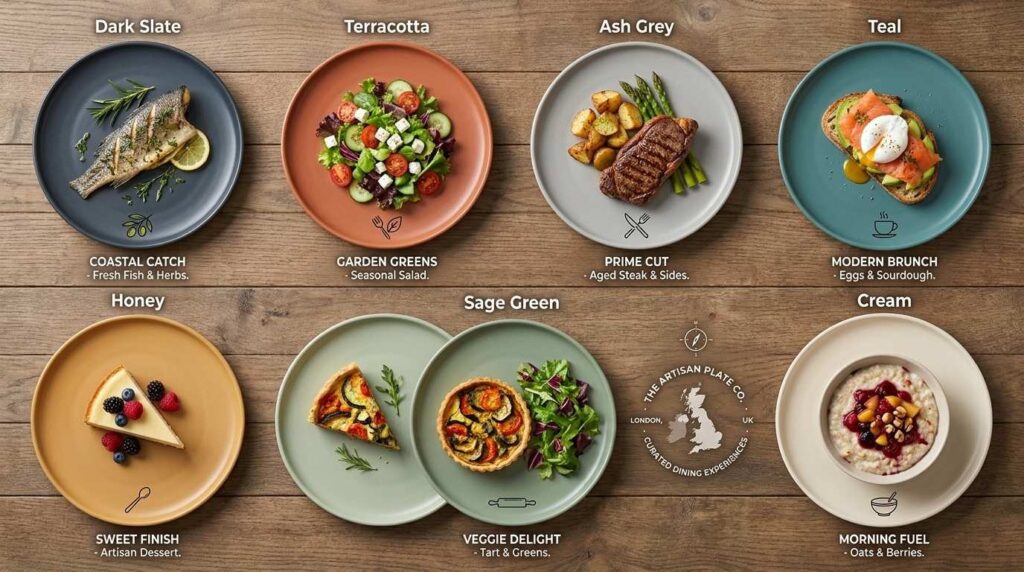
Every colour communicates something to diners before they taste the first dish. The signals are not universal, and they shift with context, but they are consistent enough to make deliberate decisions around them. Here is how the colours gaining traction in UK restaurants in 2026 read at the table.
Colour-to-brand signal table
| Colour | Brand Signal | Best Venue Type |
| Dark slate or charcoal | Premium, confident, modern, slightly masculine | Gastropubs, steak restaurants, craft beer venues, small plates bars |
| Warm terracotta or toffee | Rustic, Mediterranean, artisan, grounded | Brunch cafes, Mediterranean restaurants, farm-to-table, neighbourhood bistros |
| Ash grey (mid-tone) | Contemporary, calm, considered, understated | Modern European restaurants, hotel restaurants, and casual fine dining |
| Pacific blue or teal | Bold, coastal, confident, slightly dramatic | Fish restaurants, coastal dining, cocktail bars, boutique venues |
| Honey or warm amber | Welcoming, organic, natural, autumnal | All-day cafes, wellness-led dining, farm concepts, seasonal tasting menus |
| Deep forest or sage green | Botanical, wellness, quiet luxury | Health-conscious restaurants, boutique hotel dining, afternoon tea |
| Warm cream or off-white | Heritage, traditional, approachable | Countryside pubs, classic British dining, hotel breakfast service |
What this means in practice
The colour you choose does not operate in isolation. It interacts with your interior design, your menu language, your staff uniform, your lighting, and your price point. A terracotta plate that looks exactly right in a sun-filled Mediterranean concept looks incongruous in a dark, moody cocktail bar. A slate-grey plate that reads as premium in a gastropub reads as cold in a family-friendly casual restaurant.
The most successful coloured crockery choices in UK restaurants are ones where the plate colour and the interior design were decided together, not retrofitted against each other. If you are mid-operation and looking to introduce colour, test a single table before committing to a full floor.
From our supply team: “The operators who are happiest with coloured crockery at the two-year mark are almost always the ones who ordered samples and set them on an actual table in the dining room before placing the main order. The ones who ordered based on product photography online and discovered the colour looked different under their specific lighting are the ones who call us.”
Real venue examples
Gastropub, dark slate plates: A 60-cover gastropub serving a small-plates and craft beer menu switches from white to dark slate for main plates. The darker background creates a visual lift for pale seared fish and cream-sauced dishes; the table reads as more premium, and the food photography on their Instagram account gains contrast and depth that drives a measurable increase in followers and booking enquiries. Side plates and ramekins remain white, which creates a deliberate contrast at the table rather than a heavy, uniform dark look.
Mediterranean brunch cafe, terracotta plates: A neighbourhood brunch restaurant with terracotta-toned interior walls and exposed wood introduces Murra Toffee plates across its weekend brunch menu. The warm earthenware tone matches the palette of the room, makes egg dishes and avocado toast feel more at home visually than they did on white, and reinforces the artisan, sun-drenched brand story the owners are building. The plates are conversation pieces. Customers photograph them.
Coastal fish restaurant, Pacific blue plates: A harbourside fish restaurant introduces a teal-toned plate for their fish course. The contrast between the blue-toned ceramic and pale white fish fillets, golden breadcrumbs, and bright lemon garnish creates the kind of dish photography that spreads on social media without requiring professional styling. The plate does brand work that the food alone would not.
Our coloured tableware range includes the full Murra collection in five colourways, each in vitrified porcelain with a reactive glaze. The Murra Toffee range suits Mediterranean and artisan concepts. The Murra Ash range works well in modern European and gastropub settings. The Murra Pacific range suits venues with a coastal or cocktail identity. The Murra Honey range brings a warm amber tone suited to wellness-led and all-day dining concepts.
How Colour Affects Customer Perception and Spending
This is the section that most directly justifies investing in coloured crockery for operators focused on the bottom line.
Colour affects how diners perceive food before they taste it. This is not a marketing claim. It is a well-established area of sensory science sometimes called crossmodal correspondence, studied extensively in academic settings including Oxford University’s Crossmodal Research Laboratory, where Professor Charles Spence has published widely on the relationship between tableware, colour, and taste perception.
The practical implications for restaurant operators are more useful than the theory.
Dark plates and premium perception
Dishes served on dark-coloured plates are consistently rated as tasting more intensely and as having higher perceived quality than the same dishes served on white plates in controlled settings. For a restaurant positioning in the premium casual or gastropub tier, dark slate or charcoal plates are not just an aesthetic choice. They are doing active work on the perceived value of the food, which has direct implications for price anchoring and customer satisfaction.
White plates and perceived portion size
White plates with a wide rim consistently create the perception of a larger and more generously portioned dish than the same quantity of food on a smaller or narrower plate. This is relevant for restaurants where portion size perception is a customer satisfaction driver. It is also relevant to why many fine dining restaurants use very large white plates with minimal plating at the centre: the white space amplifies the perceived quality and artistry of the food.
Colour and appetite
Red and orange tones in the dining environment are associated with increased appetite and faster eating pace in hospitality research. Cooler tones, including blue and grey, are associated with a slower, more considered dining experience. Translating this directly to plate choice is not straightforward, but it suggests that warm-toned plates in a casual, high-turnover setting and cooler-toned plates in a more relaxed, experience-led setting are both behaviourally coherent choices, not just aesthetic ones.
What this means for your buying decision
If you are choosing between white and coloured for a premium positioning venue, the evidence from sensory science suggests that darker plates will actively support your pricing. If you are operating a high-volume casual concept where fast, satisfying portions are the draw, white with a wide rim may serve you better than a smaller, coloured plate. These are not absolute rules, but they are useful directional signals when you are deciding between two options that feel equally valid aesthetically.
Food Visibility: Which Plate Colours Work With Which Food
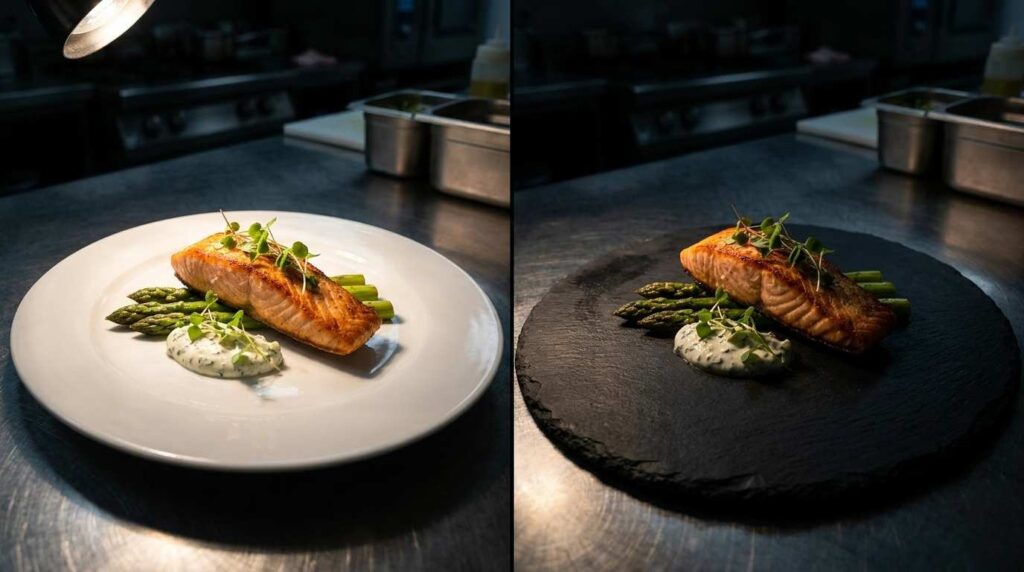
The plate is a frame, not a backdrop. The frame should create contrast with and support for the food on it. When it fights the food visually, both the plate and the dish lose. For how plate size interacts with food presentation, see our chef’s guide to plate sizes.
The contrast principle
Food that is pale or cream-toned needs contrast from the plate beneath it. On a white plate, pale food can disappear. On a dark slate or charcoal plate, the same dish becomes dramatically legible.
Food that is richly coloured tends to be self-presenting on almost any plate, but can clash with strongly tinted backgrounds. A vivid red tomato sauce on an orange-toned terracotta plate creates visual competition. The same sauce on a dark slate plate allows the red to read cleanly.
Food-by-plate-colour decision guide
| Food Type | Works Well On | Creates Problems On |
| Pale fish (sea bass, halibut, turbot) | Dark slate, charcoal, deep navy | White (disappears), cream (blends) |
| Green salads and vegetables | White, cream, dark slate | Sage green (blends), green-tinted glaze |
| Red tomato sauces | White, dark slate, charcoal | Orange-toned terracotta, warm amber |
| Golden pastry and fried food | Dark plates, slate, charcoal | White (high contrast works but reduces warmth) |
| Cream and white desserts | Dark slate, navy, charcoal, terracotta | White (disappears), pale grey |
| Seared meat (steak, lamb, duck) | Slate, charcoal, cream, white | Strong colour tones (compete with the protein) |
| Brightly garnished modern dishes | White (maximum colour accuracy) | Strongly coloured plates (compete with garnishes) |
| Rustic, earthy dishes (stews, braises, curries) | Terracotta, toffee, honey, cream | Stark white (creates clinical contrast) |
The reactive glaze consideration
Reactive glazes vary from piece to piece within the same batch. Two plates from the same box will not be exactly identical in tone. On a sharing table where multiple plates arrive together, this variation is visible and intentional. The practical implication for plating is that you are framing against a slightly different background each time, which requires slightly more considered plating rather than a rigid formula.
Photography and Social Media: The Dimension Most Operators Overlook
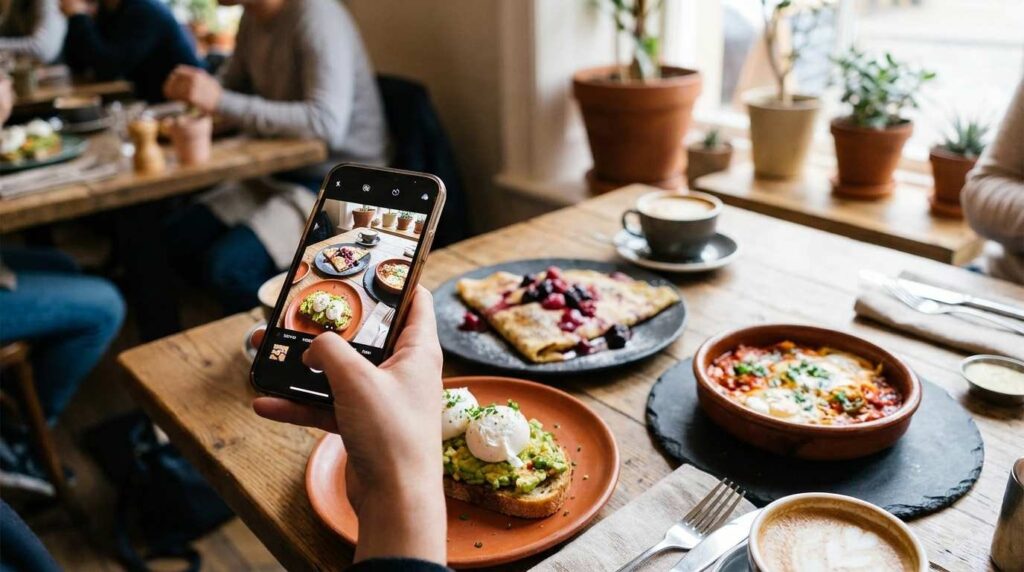
Plate choice in 2026 is a social media decision as much as a dining room decision. The dishes that drive bookings in UK restaurants are almost never the most technically accomplished ones. They are the ones that look compelling on a phone camera at 70cm distance in mixed lighting.
How coloured plates behave under service lighting
Restaurant lighting is rarely uniform. A mix of warm tungsten, cool LED, and natural light creates a colour-shifted environment that affects how glazes read on camera.
- ▸ Dark slate and charcoal plates hold their visual weight under warm tungsten lighting and do not shift noticeably toward orange or yellow.
- ▸ Terracotta and honey glazes can intensify under warm lighting, moving from warm-earthy to orange-heavy in photography. Testing under your actual service lighting before committing matters.
- ▸ Pale grey and ash tones can shift slightly cool under LED-heavy lighting, which is usually flattering for food photography but can make the plate feel cold in person.
- ▸ White reflects whatever light hits it, which can cause glare and overexposure in phone photography without careful framing.
The phone camera test
Before committing to any crockery choice, particularly a coloured one, run this test. Set the plate on your actual dining table surface under your normal service lighting. Plate a typical dish. Photograph it with a phone camera from a 70cm overhead angle and from a 45-degree side angle. Assess whether the plate competes with or frames the food. Check whether the colour of the glaze has shifted from how it looked in the product listing.
This takes ten minutes and prevents discovering a mismatch after you have received a full case order.
The consistency advantage of white for content creation
White crockery produces more consistent social media imagery than coloured crockery because the background variable is removed. Your content will look cohesive across posts because the plate is always the same. With coloured crockery, particularly reactive glazes, the variation between pieces means your content has a slightly different visual baseline each time. This can work well if the variation reads as artisanal quality rather than inconsistency, but it requires more considered photography and editing.
The Operational Reality of Coloured Crockery
Coloured crockery requires more operational attention than white. Whether that additional attention is worth it depends on your volume, your team, and your maintenance discipline.
Glaze fading under commercial dishwasher use.
Commercial dishwashers run at wash temperatures between 55 and 65 degrees Celsius, often with high-alkaline detergents. White porcelain handles these conditions without visible change over hundreds of cycles. Coloured glazes, particularly reactive and earthy-toned ones, can shift subtly in tone over sustained high-temperature commercial washing. The shift is typically toward a slightly more muted version of the original colour rather than a dramatic change, but it is worth being aware of before committing.
Mitigation is straightforward: use a rinse aid compatible with ceramic ware and keep detergent dosing within the manufacturer’s recommended concentration.
Batch variation and replacement matching
Reactive glazes are formulated to vary between pieces and between firings. Two plates from the same batch will be similar but not identical. Two plates from different production batches may be more noticeably different. On a busy table with mismatched plates from different replacement orders, this variation can look unintentional rather than artisanal.
The practical implication is to order more than you need on the first order. A 20 per cent buffer over your calculated requirements means you have replacement pieces from the same batch for longer. When you do need to reorder, ask your supplier whether the replacement batch is from the same or a newer production run.
Hard water and limescale visibility
Most of England is in a hard water area. Limescale and water spotting are more visible on dark-glazed plates than on white, particularly under dining room spotlighting. A slate or charcoal plate that is not polished after dishwashing will show water marks that are not visible on white. This is manageable with consistent polishing as part of your service preparation, but it adds a step that white crockery does not require.
Which colours show wear and scratching fastest
This is a practical question that affects long-term cost. Dark-coloured glazes show metal marks from cutlery more visibly than white or light-coloured plates. When a stainless steel knife or fork drags across a dark slate surface, it can leave a faint metallic streak that accumulates over service. These marks can usually be removed with a mild ceramic cleaner, but they require attention. Light-coloured glazes and white porcelain show cutlery marks less visibly and require less routine maintenance. Chipping is visible on any colour, but chips on dark plates expose the lighter clay body beneath and are more immediately obvious to diners than chips on white.
Replacement availability
Before committing to a coloured range, ask your supplier directly: how long has this colourway been in production, and what is the expected future stock availability? Established commercial ranges from major manufacturers are far more likely to be available for five or more years than niche or fashion-led pieces.
For the full framework on tableware purchasing, quantity calculation, and material selection, see our complete restaurant tableware buyer’s guide.
The Mix-and-Match Strategy: Introducing Colour Without Visual Chaos
Many UK operators want the visual impact of coloured crockery without the operational commitment of a full range switch. The mix-and-match approach done well is one of the most effective ways to differentiate a table without overcomplicating stock management.
Done badly, it looks like random mismatched crockery that arrived in different delivery batches.
The one anchor piece rule
The most reliable approach is to choose one coloured anchor piece and keep all other pieces white or neutral. The anchor piece is typically the main dinner plate because it carries the most visual weight on the table. A terracotta or slate main plate with white side plates, white ramekins, and white serving dishes creates a clear, intentional contrast. It reads as a design decision rather than an accident.
The one consistent element rule
If you are mixing more than one coloured piece, there must be one consistent element across every piece on the table. This could be:
- ▸ A consistent rim style (all pieces share the same walled or coup profile)
- ▸ A consistent colour family (all pieces are within the same tonal range, such as all earthy warm tones)
- ▸ A consistent material (all pieces are from the same commercial range and therefore share the same base glaze characteristics)
Without a unifying element, mixed pieces look like the result of ordering from several different suppliers rather than a deliberate aesthetic choice.
Where to introduce colour first
The lowest-risk entry point for colour is accessories rather than the main plate. Ramekins, sauce jugs, and tapas bowls in a coloured glaze are low-cost items that can be tested across the full service before committing to main plate investment. Our Murra Toffee Ramekin and Murra Honey Tapas Bowl are both available in boxes of 12, which makes testing realistic before a larger order.
The Decision Framework: White, Colour, or Mixed
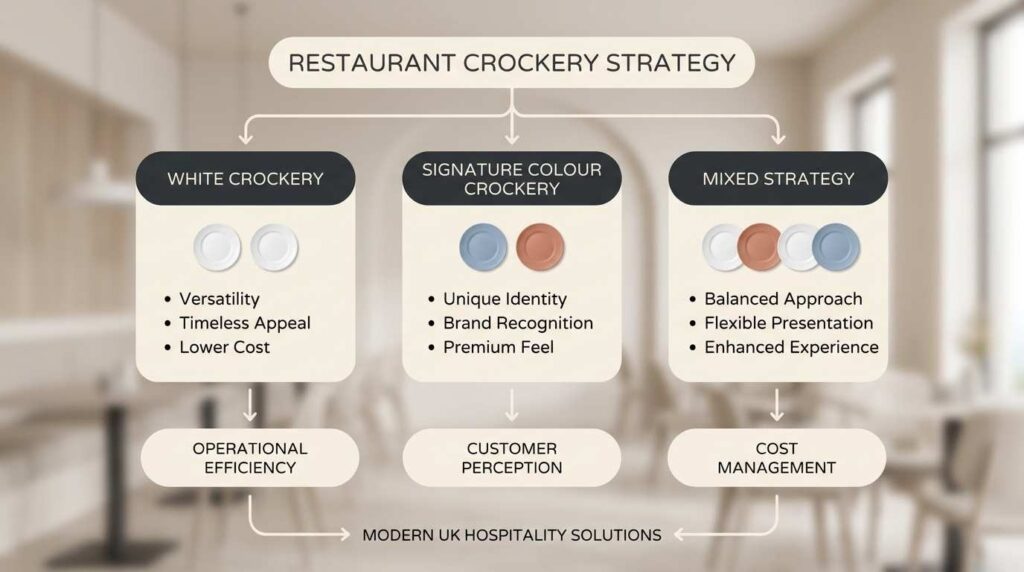
Quick decision summary
| Goal or Situation | Best Choice |
| Maximum food visibility across all menu items | White |
| Rustic, Mediterranean, or artisan dining concept | Terracotta or toffee |
| Premium gastropub or steak restaurant | Dark slate or charcoal |
| Wellness cafe or botanical restaurant | Sage green or honey |
| Coastal or fish restaurant | Pacific blue or teal |
| High-volume service above 80 covers | White (replacement simplicity) |
| Strong brand identity with a stable menu | Signature colour |
| Testing colour without full commitment | Mixed (anchor piece in colour, rest in white) |
| Safe long-term choice with longevity | White or terracotta / dark slate |
Choose white if:
- ▸ Your menu changes seasonally, and you need maximum flexibility in food presentation
- ▸ Your food is highly coloured and vibrantly garnished, and you want the plate to frame rather than compete
- ▸ Your volume is high (above 80 covers per service), and replacement simplicity is a priority
- ▸ Your social media content strategy prioritises consistency and cohesion over visual variety
- ▸ Your interior design is neutral or minimalist, and the food is intended to carry all the visual weight
Choose a signature colour if:
- ▸ Your brand has a strong, consistent visual identity with a clear aesthetic language
- ▸ Your menu is stable enough that seasonal changes will not create colour conflicts with a fixed plate choice
- ▸ Your cuisine has an earthy, rustic, or cultural heritage that is amplified by a non-white plate
- ▸ Your covers are moderate enough (under 80 per service) that the additional maintenance steps are manageable
- ▸ You have confirmed stock availability for at least 18 months of potential replacements from your supplier
Choose mixed if:
- ▸ You want to differentiate visually without the full commitment of a coloured main plate
- ▸ You are in the early stages of establishing a visual identity and want to test responses before committing
- ▸ Your sharing-format menu benefits from visual variety at the table without requiring every piece to match
The one test that simplifies the decision
Set your current white plate next to the coloured option you are considering. Put the same dish on both. Photograph both. If the coloured option clearly makes the dish look better and more distinctive, and you are willing to manage the replacement and maintenance implications, the answer is probably colour. If the improvement is marginal or the dish looks equally good on white, the operational simplicity of white is likely the better long-term choice.
Where to Browse Coloured Crockery in the UK
Our coloured tableware range includes the full Murra collection in five colourways, all in vitrified porcelain with a reactive glaze, available in trade quantities with 3 to 5-day delivery. Each range includes plates, bowls, ramekins, cups, and serveware, making it practical to build a full table setting within a single cohesive range.
Need help matching a colourway to your cuisine type, interior design, or photography goals? Contact our team for a recommendation before ordering samples.
And for the full tableware procurement picture, including quantities, trends, and supplier guidance, the Restaurant Tableware and Crockery Buyer’s Guide covers the complete framework.
FAQs
Does coloured crockery cost more than white for restaurants?
Generally, yes, though the gap varies by supplier and specification. Reactive-glaze coloured ranges tend to cost more per piece than equivalent commercial white porcelain. The cost difference is partly offset by the lower replacement frequency of vitrified coloured ranges compared to standard white porcelain. The total cost of ownership over 18 months is a more useful comparison than unit price alone.
Can coloured crockery go in a commercial dishwasher?
Yes, but with caveats. Vitrified porcelain with a commercial-grade glaze, such as the Murra range, is designed for commercial dishwasher use. The key considerations are detergent dosing (keep within manufacturer recommendations to avoid glaze dulling) and rinse aid (use a ceramic-compatible formulation). Reactive glazes may shift subtly in tone over hundreds of high-temperature cycles, but this is typically a gradual muting rather than a dramatic colour change. Always confirm dishwasher compatibility with your specific supplier before ordering.
How do I replace broken coloured crockery pieces?
Order replacement pieces from the same range as soon as you notice stock levels dropping. Ask your supplier whether replacement orders will come from the same production batch or a newer one, as reactive glazes vary slightly between firings. Building a 20 per cent reserve into your initial order gives you more time before the batch matching issue becomes a service problem.
Is coloured crockery a trend or a permanent shift in UK restaurants?
The move toward colour and texture reflects a sustained shift in UK dining aesthetics away from the standardised white-plate template toward more concept-driven table settings. Earthy tones in particular have genuine longevity because they connect to food and nature rather than to a specific design moment. Terracotta and dark slate have more staying power than more directional colour choices. The safest approach is to choose colours grounded in your specific concept rather than chasing the most current trend.
What colour plate makes food look best for social media photography?
It depends on the food. White creates the most consistent, colour-accurate photography because the neutral background does not shift the apparent colour of the food. Dark slate or charcoal creates the most dramatic contrast for pale or delicate dishes. For rich, deeply coloured dishes, dark plates can sometimes read as too heavy on a phone camera. Test your actual dishes on your actual plates under your actual lighting with a phone camera before committing.
How many coloured plates should I order when starting?
Use the standard commercial formula of covers multiplied by service turns multiplied by a 1.5 buffer, then add 20 per cent as a replacement reserve from the same batch. For a 60-cover restaurant doing two services a day: 60 x 2 x 1.5 = 180 as the working stock, plus 36 in reserve from the initial order. Order all 216 from the same batch to maximise colour consistency across the full working stock.
Are black plates still in style for UK restaurants?
Dark slate and charcoal are more prevalent than true black in current UK restaurant tableware, because pure black glazes can feel stark and one-dimensional compared to the tonal variation of slate or charcoal reactive glazes. Very dark plates remain popular in premium gastropubs, steak restaurants, and small-plates bars, and show no signs of declining in the UK market in 2026. The more nuanced dark tones of reactive-glaze slate tend to age better than a flat black glaze.
What colour plates do professional chefs prefer?
White remains the default choice for most professional chef training and for Michelin-level fine dining, because it provides maximum creative control over food presentation and the most accurate colour rendering of the dish. Many chefs who operate their own restaurants have moved toward coloured or textured plates as part of a deliberate brand identity decision rather than a technical plating preference. The choice is typically driven by the concept the chef is building rather than by any universal preference for one colour over another.
Is coloured crockery suitable for fine dining?
Yes, when chosen deliberately. Some of the most acclaimed fine dining restaurants in the UK and internationally use coloured, textured, or artisan plates as part of their tasting menu experience. The key difference at the fine dining tier is that each plate choice is made in relation to a specific dish on a fixed menu, rather than needing to work across a broad rotating menu. This makes intentional colour choices more manageable operationally and more visually coherent at the table.
Which plate colour makes portions look bigger?
White plates with a wide rim create the perception of a larger, more generous portion compared to the same quantity of food on a smaller, narrow, or coloured plate. The visual contrast between the white rim space and the food at the centre makes the plated dish feel expansive. This is one of the reasons wide-rim white plates remain the standard in venues where portion perception is a customer satisfaction driver, such as hotel restaurants and classic British gastropubs.
References
- ▸ Food Standards Agency: Food contact materials guidance via food.gov.uk
- ▸ BS4034:1990 – Specification for vitrified hotelware via knowledge.bsigroup.com
- ▸ Crossmodal Research Laboratory, University of Oxford – Professor Charles Spence’s published research on tableware colour and taste perception: http://www.crossmodal-research.com