
For most UK outdoor venues running regular events, reusable polycarbonate glassware pays for itself. For one-off event organisers, it usually does not. The answer depends on three factors that rarely get explained clearly: the true break-even point against disposables, what washing logistics actually cost, and whether your glasses are legally compliant for licensed service.
This guide works through all three with real numbers. It is written for UK event organisers, pub and bar operators running beer gardens, festival caterers, and wedding and private event managers.
What Is Reusable Polycarbonate Glassware?
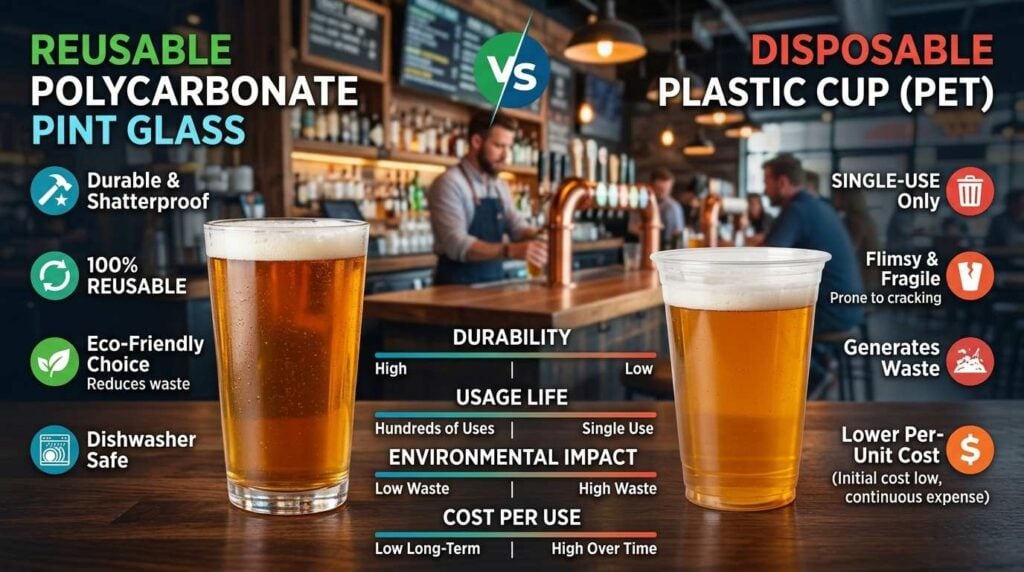
Polycarbonate is a rigid thermoplastic used to manufacture commercial reusable drinkware for hospitality and events. It looks like glass, feels substantially heavier than disposable plastic, and is virtually unbreakable under normal event conditions.
The key distinction for UK buyers in 2026 is between three types of plastic drinkware that are often confused:
Commercial-grade polycarbonate:
- ▸ Designed for 500 to 1,000 commercial glasswasher cycles
- ▸ Maintains clarity when washed below 65 degrees Celsius
- ▸ BPA-free as standard from reputable UK suppliers
- ▸ Carries CE or UKCA measure markings for licensed service
Crystal polystyrene (disposable):
- ▸ Lighter and less expensive than polycarbonate
- ▸ Designed for single or limited use
- ▸ Best suited to events where washing logistics are impractical
Consumer-grade reusable plastic:
- ▸ Sold in retail packs, not manufactured for commercial glasswasher use
- ▸ Not suitable as a substitute for hospitality-specification polycarbonate
The right question for any outdoor event is not simply “reusable or disposable?” It is “what does each option cost in total across the events I am planning, and which fits my washing logistics?”
The Break-Even Calculation: Reusable vs Disposable for a 2,000-Person Event
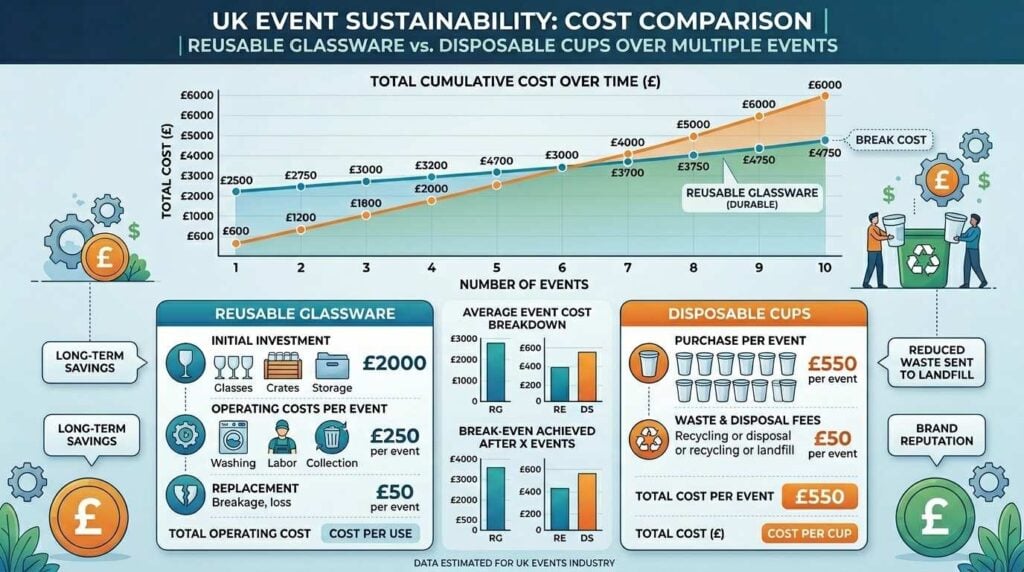
The break-even calculation requires a full multi-event model, not just a first-event comparison. Here is how it actually works.
Step 1: The Disposable Baseline Per Event
Standard CE/UKCA-marked disposable pint glasses for outdoor licensed events cost approximately £0.04 to £0.08 per unit at volume. For a 2,000-person event where each attendee uses an average of two glasses, you need approximately 4,000 glasses.
| Item | Unit Cost | Quantity | Cost Per Event |
| Disposable pint glasses (CE marked) | £0.06 | 4,000 | £240 |
| Waste disposal and bin bags | n/a | n/a | £40 to £80 |
| Total disposable cost per event | £280 to £320 |
Step 2: The Reusable Polycarbonate Investment
Commercial polycarbonate pint glasses cost between £1.50 and £2.50 per unit at trade prices. For a 2,000-person event with a 1:1 glass ratio plus a 25% cup loss buffer:
| Item | Cost | Type |
| Polycarbonate pint glasses (2,500 at £2.00) | £5,000 | One-off capital purchase |
| Washing logistics per event (see Section 3) | £400 to £700 | Recurring |
| Storage per year (amortised) | £100 to £200 | Recurring |
| Total at first event | £5,500 to £5,900 | |
| Each subsequent event (washing + storage only) | £500 to £900 |
Step 3: The Correct Break-Even Model
This is where most comparisons go wrong. The break-even is not calculated by comparing the total cost at event one. It is calculated across the lifespan of the glasses.
Assumptions used in this model:
- ▸ 25% cup loss rate per event without a deposit scheme
- ▸ Glasses replaced at a cost of £2.00 per unit
- ▸ Washing costs £550 per event (mid-range)
- ▸ Disposable equivalent costs £300 per event (mid-range)
- ▸Glasses last 500 wash cycles each
| Event Number | Cumulative Reusable Cost | Cumulative Disposable Cost |
|---|---|---|
| Event 1 | £5,750 | £300 |
| Event 5 | £8,750 | £1,500 |
| Event 10 | £11,250 | £3,000 |
| Event 20 | £16,250 | £6,000 |
| Event 30 | £21,250 | £9,000 |
| Event 38 (break-even) | approx. £24,000 | approx. £24,000 |
| Event 50 | £27,250 | £15,000 |
Key takeaway: Without a deposit scheme, the break-even point at a 2,000-person event scale falls at approximately 35 to 40 events. After that point, reusable polycarbonate becomes progressively cheaper than disposable on a per-event basis.
Step 4: How a Cup Deposit Scheme Changes the Maths
A cup deposit scheme is the single most powerful variable in the break-even calculation.
At a 2,000-person event with a £1 deposit, if 30% of attendees do not reclaim their deposit, the unclaimed revenue is £600. Applied to the capital cost, this reduces the break-even to approximately 20 to 25 events. With a £2 deposit and the same unclaimed rate, the break-even can fall below 15 events.
For a permanent outdoor venue running weekly events, a deposit scheme typically makes reusable polycarbonate financially superior to disposable within a single season.
Summary: When reusable polycarbonate wins financially
| Scenario | Reusable Wins? |
| One-off event, no deposit scheme | No |
| Fewer than 10 events per year, no deposit | Usually no |
| Regular weekly venue, no deposit | Yes, within 2 seasons |
| Any venue with a deposit scheme | Yes, significantly sooner |
| Venue with a licence condition requiring unbreakable glassware | Yes, disposable may not be legal |
Commercial reusable polycarbonate pint glasses in nonic and pilsner formats with CE/UKCA measure marking are available from our reusable polycarbonate pint glass range, with trade pricing and compliance documentation on request.
Washing Logistics: The Full Cost Breakdown
The per-event washing cost is the largest recurring variable in the reusable polycarbonate model. Here is what each option actually costs.
Option 1: On-Site Mobile Glasswasher Unit
Mobile glasswashing units can be hired for outdoor events at approximately £150 to £300 per day, including delivery and set-up. A standard commercial glasswasher processes 500 to 1,000 glasses per hour.
Full on-site washing cost breakdown for a 2,000-person one-day event:
| Item | Estimated Cost |
| Mobile glasswasher hire | £150 to £300 |
| Water bowser hire (if no mains supply) | £100 to £250 |
| Grey water collection tank | £80 to £150 |
| Detergent and rinse aid | £20 to £40 |
| Operator staffing (one person, full day) | £80 to £120 |
| Total | £430 to £860 |
Best for: Single-day events with an accessible water supply and enough staff to dedicate one person to washing.
Option 2: Contract Post-Event Washing
Specialist event equipment companies collect, wash, and return polycarbonate glassware at approximately £20 to £35 per 100 glasses, with a typical 24 to 48-hour turnaround.
For a 2,500-glass inventory, contract washing costs approximately £500 to £875 per event cycle.
Best for: Multi-day festivals where on-site washing between event days is impractical.
Option 3: In-House Washing at a Permanent Venue
For a permanent outdoor venue with an existing commercial glasswasher, the incremental cost of washing polycarbonate is minimal. Detergent and water costs add approximately £10 to £20 per 1,000 glasses.
Important temperature note: Polycarbonate is typically rated to 65 degrees Celsius. If your glasswasher runs a sterilisation cycle above this temperature, use a lower-temperature programme for polycarbonate stock. Running polycarbonate through a high-temperature cycle causes irreversible clouding and distortion.
Best for: Beer gardens, rooftop bars, and event spaces with a fixed commercial glasswasher on site.
UK Legal Requirements: UKCA Marking, Government Stamps, and Licence Conditions

UKCA Marking
From January 2023, glassware sold in Great Britain for use at licensed premises must carry the UKCA marking at the stated measure capacity under the current UK government product marking guidance. UKCA replaced CE marking as the Great Britain standard.
In practice, many polycarbonate glasses in circulation still carry CE marking under transitional arrangements. When purchasing new stock, confirm the UKCA marking with your supplier. Our reusable polycarbonate pint glasses carry CE/UKCA marking for full compliance at UK licensed events.
Government Stamps for Draught Beer
Under the Weights and Measures Act 1985 and the Drinking Glasses (Intoxicating Liquor) Regulations 1988, any outdoor event serving draught beer or cider in half-pint measures or more at a licensed bar must use either a government-stamped glass or an approved measuring device at the point of dispense.
Key distinction: A UKCA-marked measure line on a polycarbonate glass confirms the glass holds the stated volume. It does not replace the crown stamp requirement for draught beer service unless a metered dispense tap is used.
Practical solution: Use UKCA-marked polycarbonate glasses with metered dispense taps at all draught beer bar points. If uncertain, contact your local Trading Standards team before the event.
Licence Conditions Requiring Unbreakable Glassware
Many UK local authority outdoor event licences require unbreakable glassware in areas accessible to the public. These conditions are common for:
- ▸ Beer gardens
- ▸ Festival arenas
- ▸ Poolside bars
- ▸ Rooftop venues
Check your licence for wording such as “unbreakable,” “non-glass,” or “polycarbonate.” If such a condition applies, disposable glass-look plastic does not necessarily satisfy it. Confirm with your licensing authority if the wording is ambiguous.
England, Wales, and Scotland: Single-Use Plastics Differences
The regulatory position on single-use plastics differs across the UK nations:
| Nation | Position on Disposable Cups |
| England | DEFRA 2023 restrictions apply to certain formats; cups are not currently banned |
| Scotland | Broader regulations came into force earlier; confirm the current position before ordering |
| Wales | Separate implementation timeline; confirm before ordering for Welsh events |
Reusable polycarbonate is not affected by single-use plastics regulations in any UK nation. For disposable formats at Scottish events, confirm the current position with your event licence adviser before ordering.
Which Formats to Choose for Outdoor Events
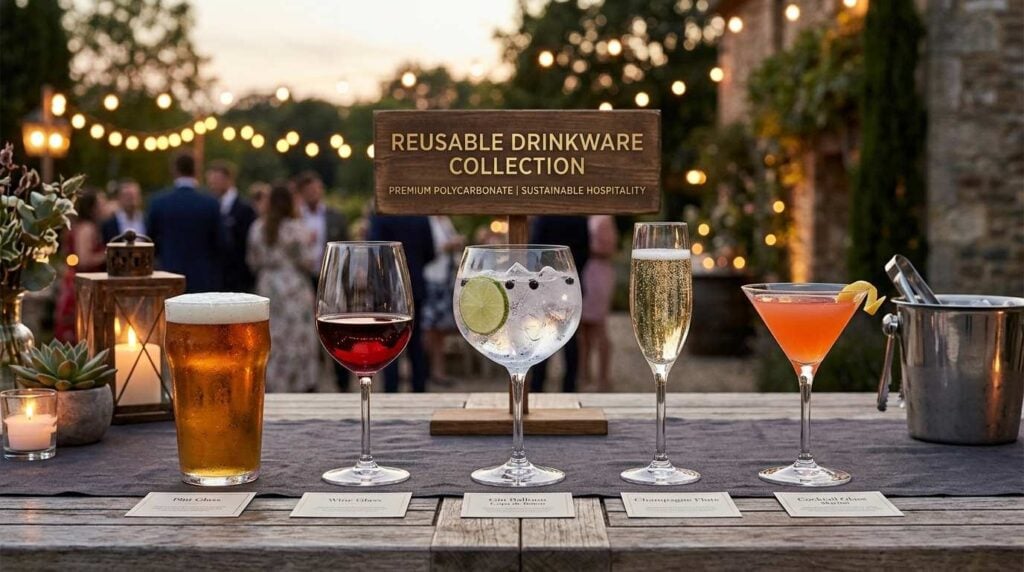
| Drink Served | Recommended Format | Compliance Note |
| Draught beer/cider (pint) | Polycarbonate nonic pint, 20oz UKCA | Crown stamp or metered dispense required |
| Draught beer (half pint) | Polycarbonate half pint, UKCA marked | Same compliance as pint |
| Wine (still or sparkling) | Polycarbonate wine glass or stemware | Marked at 125ml and 175ml if sold by measure |
| Gin and tonic | Reusable gin balloon or highball | Copa format available; highball has a lower loss rate |
| Champagne/prosecco | Polycarbonate flute or tulip | Stemware has a higher loss rate; factor into stock quantity |
| Cocktails | Polycarbonate highball or hurricane | Hurricane suits, frozen, and long drinks |
| Soft drinks/water | Any format | No measure marking required |
For premium stemware at outdoor events, our polycarbonate wine and champagne collection covers flutes, wine glasses, and martini formats in commercial-grade polycarbonate.
For gin service, the reusable gin balloon glass in 600ml copa format delivers the premium balloon presentation without the glass breakage risk at outdoor events.
How Many Glasses Do You Actually Need?
The standard formula:
Total glasses = (Attendees x average drinks per person per session) + 20 to 25% buffer for loss and simultaneous use
For a one-day festival without on-site washing:
| Scenario | Calculation | Minimum Stock |
| 2,000 attendees, no deposit scheme | 2,000 x 1 + 25% buffer | 2,500 glasses |
| 2,000 attendees, with deposit scheme | 2,000 x 1 + 15% buffer | 2,300 glasses |
For a multi-day festival with on-site washing:
The wash cycle turnaround time determines minimum stock, not total attendance. With a one-hour wash and dry cycle at peak service, minimum stock for a 2,000-person multi-day event is 1,200 to 1,500 glasses, with the rest cycling through the glasswasher continuously.
For safe glass carrying between bar and service areas at outdoor events, the fold-away cup carrier and glass holder handles up to 6 glasses at once and reduces dropped glass incidents during service.
Cup Loss: What to Expect and How to Reduce It

Cup loss covers glasses taken off-site, broken, lost in crowd areas, or accidentally disposed of. It is the largest variable in the break-even model.
Typical cup loss rates at UK outdoor events:
| Event Type | Loss Rate Without Deposit | Loss Rate With £1 to £2 Deposit |
| Festival | 20 to 35% per event | 8 to 15% per event |
| Beer garden / permanent venue | 2 to 8% per season | n/a |
| Corporate/private event (supervised) | 3 to 8% per event | n/a |
Practical loss reduction tactics:
- ▸ Run a £1 to £2 cup deposit scheme. This is by far the most effective intervention.
- ▸ Use colour-coded glasses for each event so returned glasses are easily identifiable from other stock.
- ▸ Station glass collection staff in the crowd at regular intervals during the event.
- ▸ Place clear return signage at all event exits.
When Disposable Is Still the Right Answer
Reusable polycarbonate is not always the correct choice. Three scenarios consistently favour disposables.
One-off events under 500 attendees. For a private party, charity event, or one-time community event with no ongoing events programme, the capital investment in polycarbonate will not recover within a reasonable timeframe.
Events without washing infrastructure. If the venue has no mains water access, no commercial washing capability, and no budget for mobile washing hire, disposables are the practical choice regardless of event frequency.
High-energy festivals where presentation is not a priority. For a music festival where cups are functional rather than aspirational, disposable pints are faster to deploy, simpler to manage, and cheaper per event at scale.
For UK licensed outdoor events where disposables are the right choice, 20oz CE-marked disposable pint glasses carry CE/UKCA marking for licensed service compliance. For wine and cocktail formats, the disposable stemware range covers marked wine glasses and gin formats.
For a full cost and compliance comparison of disposable versus reusable across wedding and event scenarios, see our guide to disposable plastic glasses for UK weddings.
Where to Buy Reusable Plastic Glassware in the UK
For UK outdoor event operators, the key buying criteria before placing any order are:
- ▸ UKCA or CE marking at the stated measure
- ▸ Glasswasher temperature rating (confirm it is 65 degrees Celsius or above)
- ▸ BPA-free confirmation in writing
- ▸ Case quantities available at your required volume
We Can Source It supplies commercial-grade polycarbonate glassware with CE/UKCA marking at stated measures, tested to 1,000 commercial glasswasher cycles, with full compliance documentation available on request.
Key ranges for outdoor events:
- ▸ Reusable polycarbonate pint glasses – nonic and pilsner formats, 20oz UKCA marked
- ▸ Polycarbonate wine and stemware – flutes, wine glasses, martini formats
- ▸ Reusable gin balloon glasses – 600ml copa format for premium gin service
- ▸ Full reusable plastic glassware range – complete commercial range with trade pricing
For the broader picture of glassware selection across indoor and outdoor venue types, see our complete hospitality glassware guide for UK venues.
FAQs
Is reusable polycarbonate glassware worth it for a one-off outdoor event? For most one-off events, no. The capital investment does not break even against disposables within a single event. Break-even at a 2,000-person scale falls at approximately 35 to 40 events without a deposit scheme, or 15 to 25 events with one. Reusables make clear financial sense for permanent outdoor venues and operators running a regular programme of events.
Do reusable polycarbonate glasses need to be UKCA marked for outdoor events? Yes, for any outdoor event operating under a UK premises or event licence where alcohol is sold by measure. UKCA marking confirms the glass holds the stated volume at the marked level. From January 2023, UKCA is the current standard for glassware sold in Great Britain.
Can I put polycarbonate glasses through a commercial glasswasher? Yes, at temperatures below 65 degrees Celsius. Running polycarbonate through a high-temperature sterilisation cycle causes irreversible clouding and distortion. Use the standard wash programme and confirm the temperature rating with your supplier before purchasing.
What is a realistic cup loss rate for a UK festival? Without a deposit scheme, expect a 20 to 35% loss per event. With a £1 to £2 deposit scheme, loss typically falls to 8 to 15%. For permanent outdoor venues such as beer gardens, annual loss rates of 2 to 8% are typical.
Do I need a government-stamped glass for draught beer at an outdoor event? Yes. Under the Weights and Measures Act 1985, draught beer and cider served in half-pint measures or more at any licensed premises, including outdoor events, require either a government-stamped glass or an approved measuring device. A UKCA measure marking is not a substitute for the crown stamp unless a metered dispense tap is used at the point of service.
How many polycarbonate glasses do I need for a 2,000-person outdoor event? Without a washing programme, plan for one glass per attendee plus a 25% buffer: approximately 2,500 glasses. With an on-site washing programme capable of a one-hour turnaround, you can reduce this to 1,200 to 1,500 glasses by cycling stock through the event.
What is the typical cost of washing polycarbonate glasses at an outdoor event? On-site mobile glasswasher hire, water supply, drainage, chemicals, and staffing totals approximately £430 to £860 for a one-day event at a 2,000-person scale. Contract post-event washing costs approximately £500 to £875 for a 2,500-glass inventory, including collection and return.
Author
We Can Source It, Team
The We Can Source It Team supplies commercial polycarbonate glassware, disposable plastic drinkware, and event catering supplies to hospitality venues, event organisers, caterers, and businesses across the UK. Our content is written to help readers choose practical, compliant, and cost-effective solutions for licensed events, outdoor venues, weddings, parties, and hospitality operations.
References
- ▸ Weights and Measures Act 1985 – legislation.gov.uk
- ▸ Drinking Glasses (Intoxicating Liquor) Regulations 1988 – legislation.gov.uk
- ▸ UKCA marking guidance – gov.uk