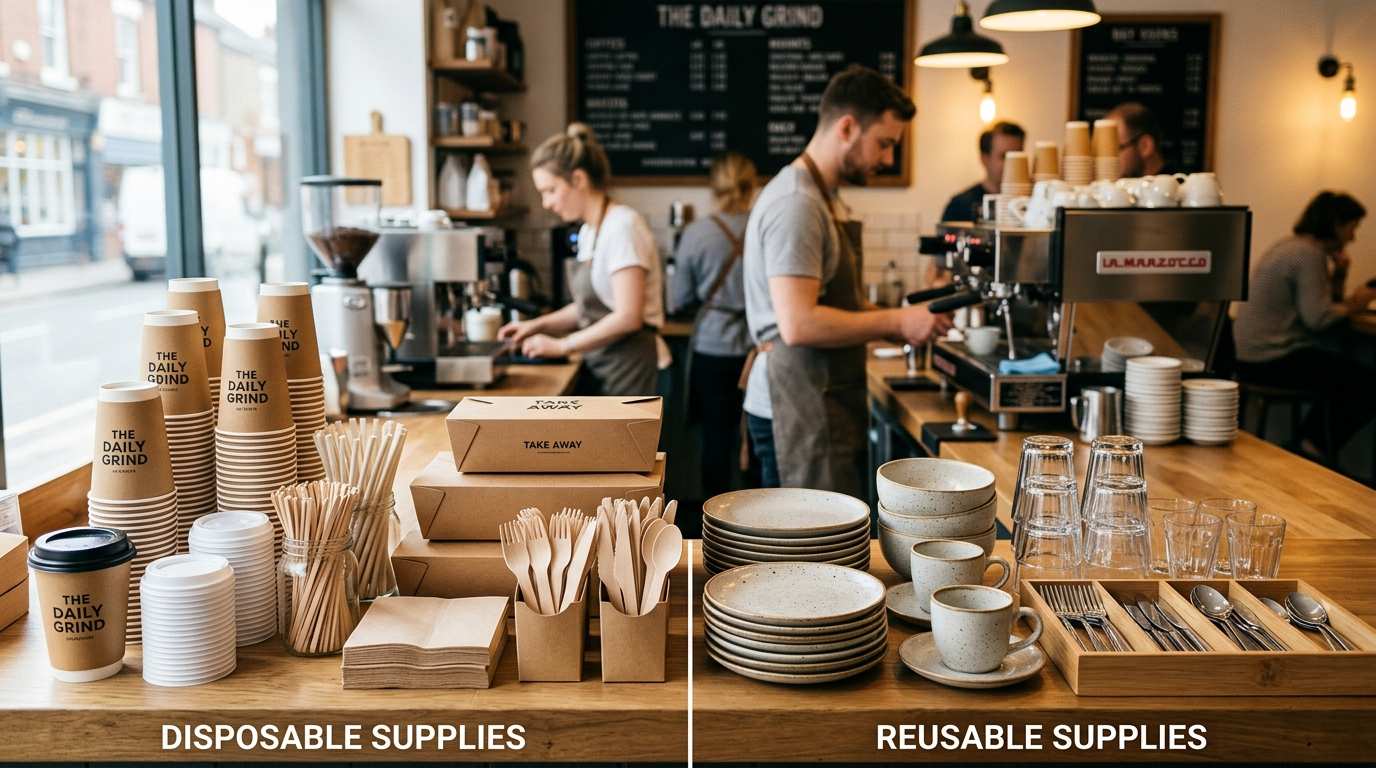
It sounds like a simple question. Disposable catering supplies cost less upfront. Reusable ones last longer. So reusable should save more money, right?
Not always. The real answer depends on how your business runs. Your service volume matters. Your washing setup matters. And UK packaging rules are changing the cost of single-use products fast.
This guide breaks it down in plain terms. No generic pros and cons. Just real cost logic. By the end, you will know which option fits your business. You will also see where the hidden costs usually catch operators off guard.
Disposable vs Reusable Catering Supplies: Why This Decision Is More Complex

Choosing between disposable and reusable catering supplies used to be simple. It was a balance between upfront cost and long-term savings. That has changed.
Three key factors are now shifting the decision.
1. Plastic Packaging Tax is increasing costs
The UK Plastic Packaging Tax started in April 2022. It is now set at £228.82 per tonne. It applies to plastic packaging with less than 30 per cent recycled content.
If you buy large volumes of non-compliant packaging, you are already paying for it. Suppliers pass this cost through pricing.
2. Single-use plastic bans are now enforced
The 2023 regulations banned several plastic items in England.
This includes:
- ▸ Plastic plates, bowls, and trays
- ▸ Polystyrene food containers and cups
- ▸ Single-use plastic cutlery
These are not guidelines. They are legal requirements. If you use banned items, you risk penalties from Trading Standards.
3. Customers care more than ever
Customer expectations have changed. Many UK consumers now care about how businesses handle packaging. This is especially true for younger customers.
Your packaging choice now affects how people see your brand. It is no longer just a cost decision.
The True Cost of Disposable Catering Supplies
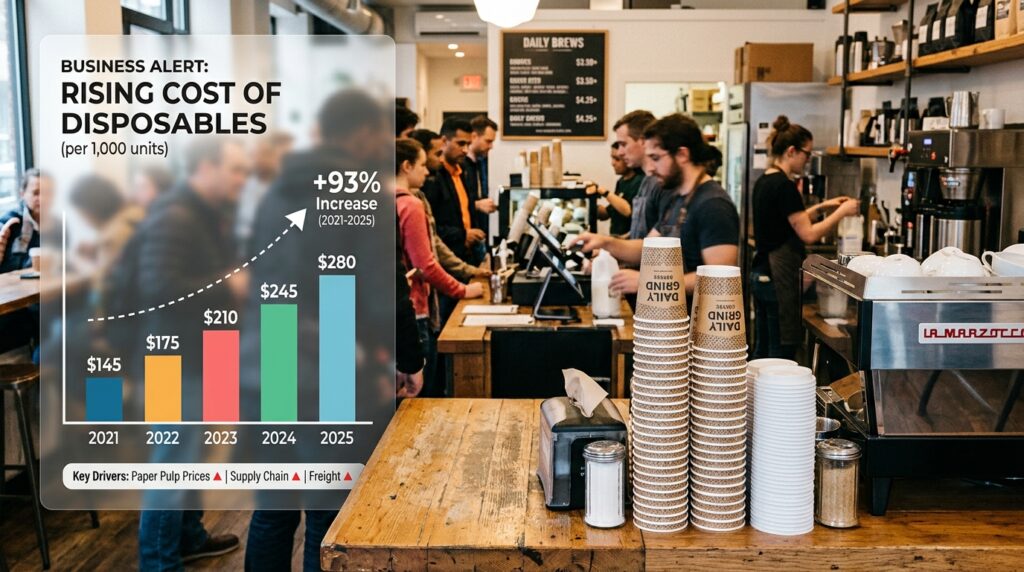
Disposable catering supplies have one clear advantage. They are cheap to buy upfront and need no setup costs.
- ▸ You do not need a commercial dishwasher.
- ▸ You do not need space for clean and used items.
- ▸ You do not need staff just to wash and restock items.
For busy takeaways or mobile caterers, this simplicity really helps. But the real issue is what happens over time. Costs keep adding up.
Let’s take a simple example. A medium café uses 300 disposable coffee cups per day.
At 8 p.m. per cup, that equals:
- ▸ £24 per day
- ▸ £144 per week (based on 6 trading days)
- ▸ Around £7,500 per year just on cups
Now add lids at around 4 p.m. each. That pushes total yearly spend close to £11,000. And this is only coffee cups. It does not include food boxes, napkins, or cutlery.
At higher volumes, disposable supplies become a constant cost. They never stop. They never reduce. Even after years of trading.
What makes this cost even higher
Several factors can push costs up further:
- ▸ Raw material prices for paper and board keep changing
- ▸ Plastic Packaging Tax adds extra cost to non-compliant products
- ▸ Waste disposal fees are rising as councils tighten rules
- ▸ Using banned or non-compliant items creates legal risk
The True Cost of Reusable Catering Supplies
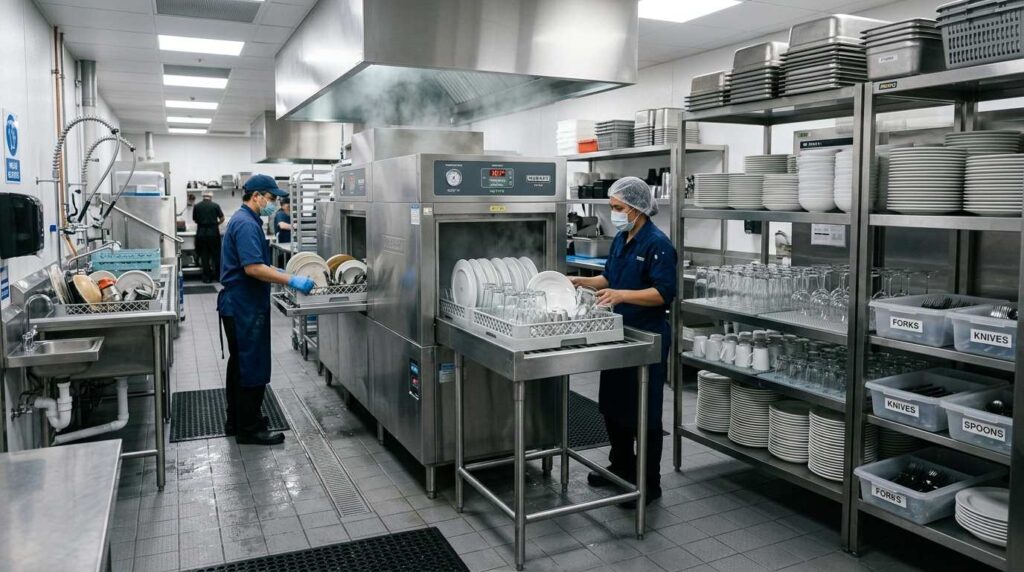
Reusable catering supplies work differently. They cost more at the start, but save money over time if managed properly.
The initial setup for a 60-cover restaurant may look like this:
- ▸ 150 plates at £3 to £8 each = £450 to £1,200
- ▸ 180 sets of cutlery at £4 to £10 each = £720 to £1,800
- ▸ 150 wine glasses at £2 to £6 each = £300 to £900
Total starting cost: around £1,500 to £4,000
At first, this looks expensive. But compared to ongoing disposable costs, many businesses recover this within 6 to 18 months.
But reusables still have ongoing costs.
Reusable supplies are not free after purchase. There are hidden running costs.
Breakage
- ▸ Most businesses lose 15 to 25 per cent of items each year.
- ▸ For example, replacing 30 broken plates at £5 each adds about £150 per year.
Dishwashing costs
- ▸ A commercial dishwasher uses electricity, water, and chemicals.
- ▸ This can cost around £2,400 to £3,600 per year, depending on usage.
Labour
- ▸ Staff time is needed for washing, checking, and storing items.
- ▸ In small setups, this is manageable. In busy kitchens, it becomes a real cost.
Storage
- ▸ Reusable items need proper storage space.
- ▸ In small kitchens, this space is often limited and valuable.
Hidden Costs That Change the Calculation
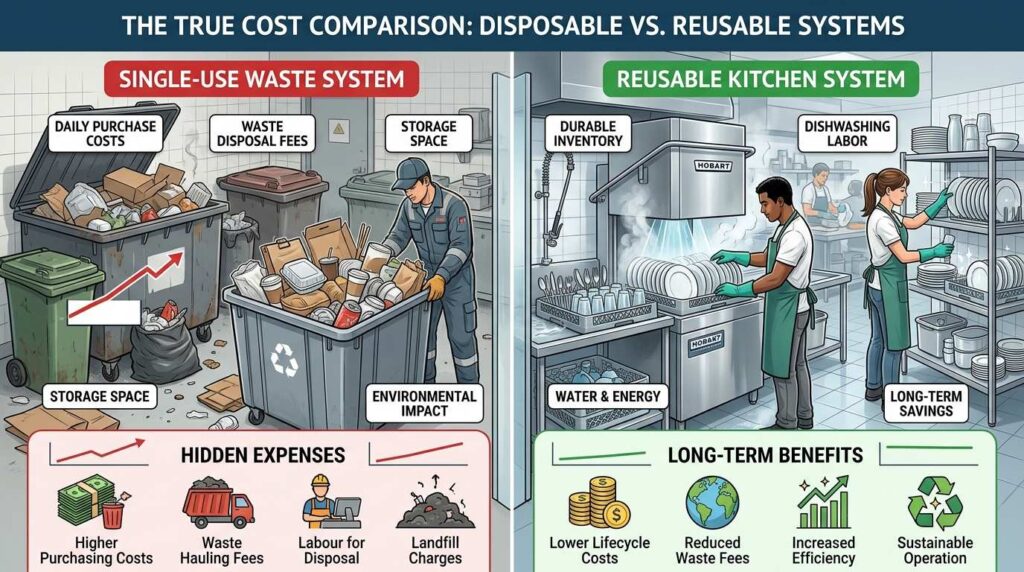
One of the most common mistakes operators make is simple. They compare only the purchase price of disposables with the purchase price of reusables.
But that does not show the full picture. To understand the real cost, you need to look at the total cost over 12 to 36 months.
Hidden costs of disposable supplies
Disposables come with ongoing costs that often get overlooked:
- ▸ Costs keep rising with every order, with no limit
- ▸ Waste disposal fees increase with higher volume
- ▸ You may need to replace banned or non-compliant items
- ▸ Small price increases per unit add up over time
These costs build slowly but steadily.
Hidden costs of reusable supplies
Reusables also have ongoing costs that are often underestimated:
- ▸ Breakage and regular replacement of items
- ▸ Energy, water, and cleaning chemicals for dishwashing
- ▸ Staff time for washing, sorting, and storing items
- ▸ Upfront cost of commercial dishwashing equipment if not already installed
When you look at everything over a three-year period, the pattern becomes clear. For full-service dine-in restaurants with steady volume, reusables are usually cheaper overall.
For takeaway, delivery-only, or highly variable catering businesses, disposables often make more sense because there is no washing setup and less operational complexity.
Which Operations Should Choose Which
There is no single right answer. It depends on how your business operates.
Full-service dine-in restaurant
Reusable crockery, glassware, and cutlery work best here. The volume of service and existing washing setup make reusables the most cost-effective long-term choice. They also improve customer experience.
Café with mixed dine-in and takeaway
A hybrid approach works best. Use reusable items for dine-in. Use compostable packaging for takeaway. This keeps costs balanced and operations flexible.
Takeaway or dark kitchen
Compostable or high-recycled-content disposables are the best fit. There is no washing system, and order volume can change quickly. Bagasse, kraft board, and CPLA packaging are the most practical and compliant options.
Events and contract catering
Use disposables for outdoor or off-site events where washing is not practical. Use reusables when operating in a fixed kitchen or institutional setup with proper facilities.
Pub or bar
Use reusable glassware for indoor service. Use polycarbonate reusable glasses for outdoor areas where glass is not allowed. Use disposables only for food-to-go items.
Mobile catering and food trucks
Disposables are usually the main choice. Compostable materials are preferred for compliance and customer expectations in street food settings.
UK Packaging Regulations: What Every Caterer Needs to Know
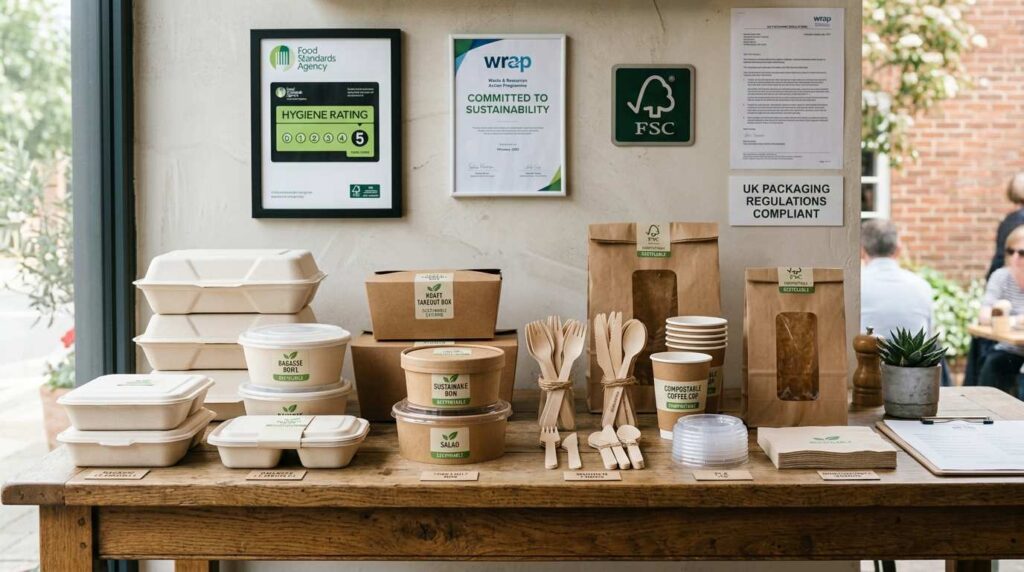
Choosing between disposable and reusable catering supplies in 2026 is not just about cost. You also need to understand the rules.
UK packaging laws are strict now. If you do not follow them, it is not only an environmental issue. It can also lead to fines and legal trouble.
What is banned in England
Some single-use plastic items are no longer allowed:
- ▸ Single-use plastic plates, bowls, and trays
- ▸ Polystyrene food containers and cups
- ▸ Single-use plastic cutlery (forks, knives, spoons, chopsticks)
- ▸ Plastic balloon sticks
These items cannot be used or sold.
What is restricted
Some products are still allowed but under strict conditions:
- ▸ Plastic straws can only be provided on request and must not be displayed
- ▸ Oxo-degradable plastic packaging is not allowed
You cannot freely offer these products to customers.
What the Plastic Packaging Tax means
The UK Plastic Packaging Tax applies to plastic packaging that contains less than 30 per cent recycled content. The tax rate is £228.82 per tonne.
In most cases, suppliers include this cost in their pricing. That means you are paying for it indirectly. Using recycled or compostable packaging helps you avoid this extra cost completely.
Compliant disposable materials in 2026
If you want to stay compliant, these are safe options:
- ▸ Bagasse containers, plates, and bowls (made from sugarcane)
- ▸ Kraft paper food boxes and bags
- ▸ CPLA cutlery (plant-based alternative to plastic)
- ▸ Wooden cutlery and stirrers
- ▸ 3-ply paper straws
- ▸ Compostable cling film alternatives are suitable
These options meet current UK requirements and are widely used in catering.
If you are still using banned items, it is important to replace them before your next Environmental Health or Trading Standards inspection.
The Hybrid Approach: How Most UK Food Businesses Operate
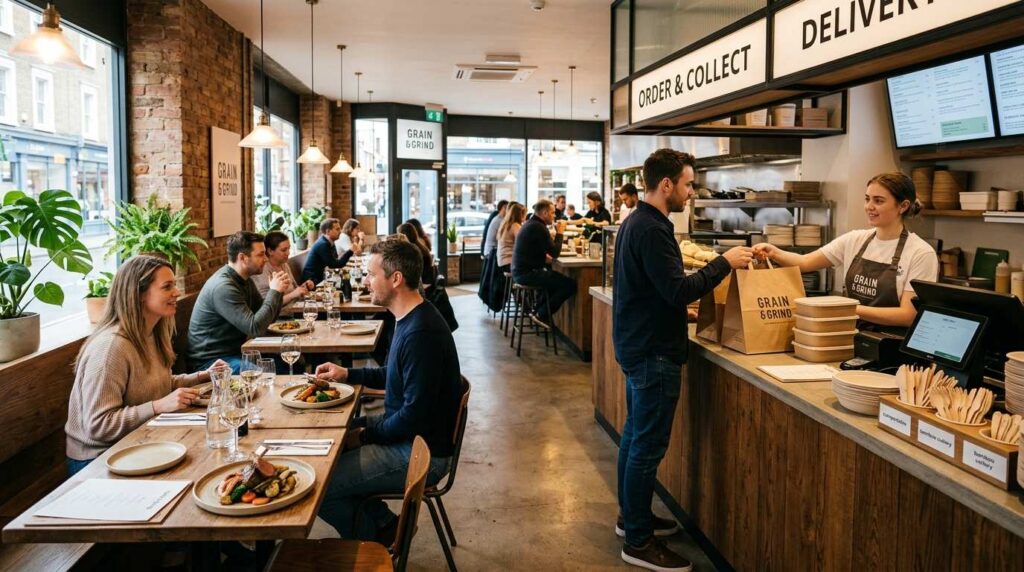
Most successful UK food businesses do not choose only one system. Instead, they use a hybrid approach. They match the product to the job.
A typical hybrid setup looks like this:
- ▸ Reusable plates, glasses, and cutlery for dine-in service
- ▸ Compostable containers and bags for takeaway and delivery
- ▸ Paper napkins for both service types
- ▸ Reusable storage containers in the kitchen
- ▸ Approved disposable items for hygiene tasks like labels, PPE, and cling film
This approach gives the best of both worlds. It keeps costs low where reusables make sense. It also keeps operations simple where disposables are needed.
Common Mistakes When Choosing Between Disposable and Reusable
Many businesses make the same mistakes when choosing catering supplies.
1. Comparing purchase price only
This is the most common mistake. A disposable plate at 8 p.m. looks far cheaper than a £4 ceramic plate.
But this changes when you look at long-term use. If a ceramic plate lasts for hundreds of uses, the real cost per use becomes much lower over time.
2. Buying reusables without a proper washing setup
Reusable items only save money if they are used efficiently. Without a commercial dishwasher, washing becomes slow and difficult. This often leads to buying extra stock, which increases costs instead of reducing them.
3. Ignoring regulations
Using banned plastic items is not just a bad practice. It is a legal risk. Always check if your supplier is offering compliant products. If not, you may already be stocking items that should not be used.
4. Underestimating breakage
Many new operators forget to include breakage costs. A normal loss rate is around 15 to 25 per cent per year for glassware and crockery. This should always be part of your cost planning from day one.
5. Choosing the cheapest reusable products
Low-cost crockery and glassware often break more easily. Thin or lightweight items chip and crack faster. In many cases, the replacement cost cancels out any initial savings within months.
Supplier Note
We Can Source It supplies a full range of catering products, including:
- ▸ Compliant disposable packaging
- ▸ Compostable food containers
- ▸ Commercial glassware and crockery
- ▸ Gastronorm containers
- ▸ General catering consumables
You can explore the full range here: Catering Supplies
👉 If you want a full breakdown of all catering supplies, UK regulations, and buying strategies, see our complete guide to catering supplies in the UK.
Frequently Asked Questions
Are disposable catering supplies cheaper than reusable ones in the UK?
Disposable supplies are cheaper at the start, but more expensive over time if used in high volume. For dine-in restaurants, reusable items usually recover their cost within 6 to 18 months and are cheaper over a 3-year period. For takeaway or event catering without washing facilities, disposable options are often more practical.
What disposable catering supplies are banned in the UK?
In England, several single-use plastic items are banned. These include:
- ▸ Plastic plates, bowls, and trays
- ▸ Polystyrene food containers and cups
- ▸ Plastic cutlery
Plastic straws are restricted and can only be given on request. Using banned items can lead to penalties from Trading Standards.
What are the best eco-friendly disposable catering supplies in the UK?
Common complaint options include:
- ▸ Bagasse containers made from sugarcane
- ▸Kraft paper food boxes
- ▸CPLA cutlery
- ▸ 3-ply paper straws
These materials are widely used and meet current UK regulations.
How much does breakage cost a restaurant using reusable items?
Most kitchens lose around 15 to 25 per cent of items each year. For example, a small restaurant may spend £90 to £150 per year replacing broken plates alone. This cost should always be included in budgeting.
Can a UK café use both disposable and reusable supplies?
Yes. In fact, this is the most common setup. Reusable items are used for dine-in service. Disposable or compostable packaging is used for takeaway. This hybrid approach keeps operations simple and cost-effective.
Author
We Can Source It, Team
We Can Source It is a UK supplier of catering and hospitality products for restaurants, cafes, bars, hotels, and events across the United Kingdom.