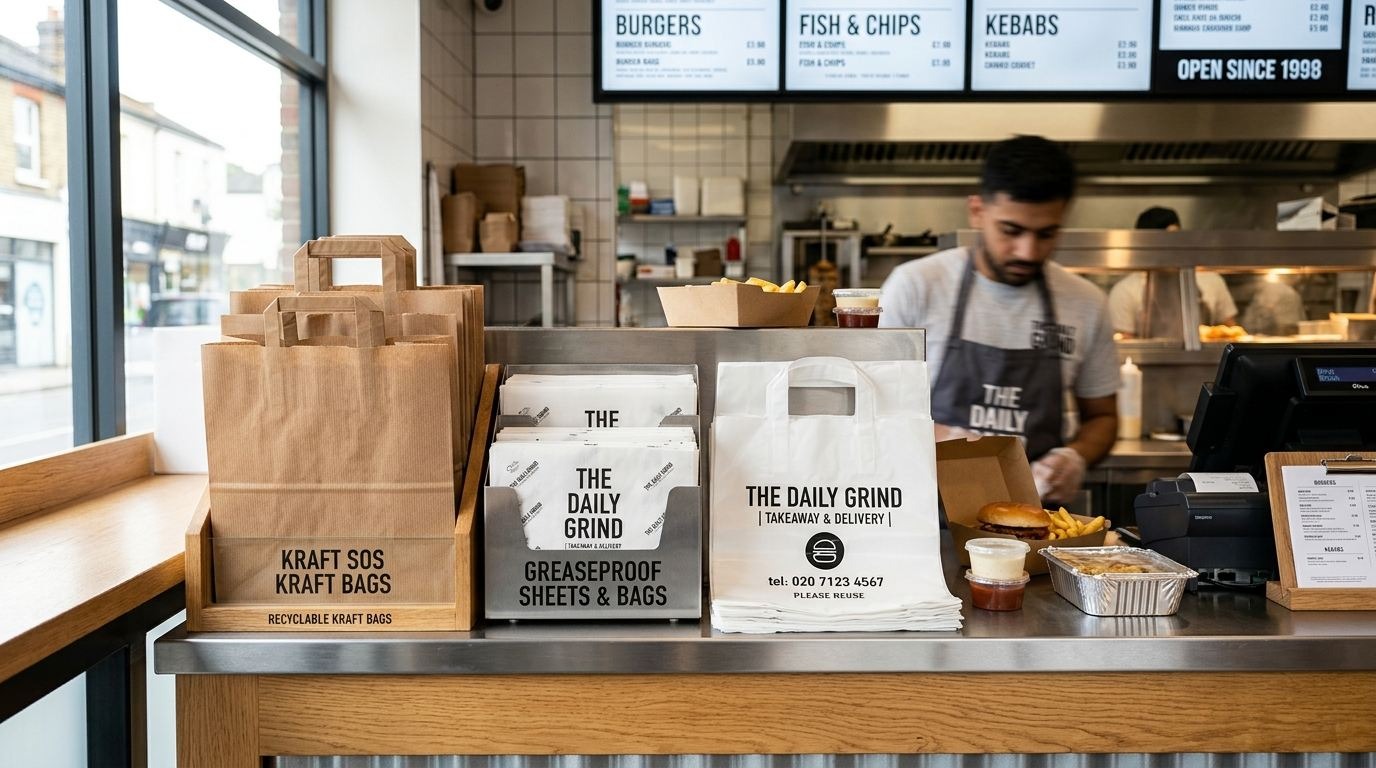
When comparing paper vs plastic takeaway bags, most people assume paper is the better option. Ask them why, and the answer is usually “it’s more eco-friendly.” Ask them whether that is true across the full lifecycle, whether it matters for their specific cuisine, or whether their turnover puts them inside the EPR scheme, and the certainty quickly disappears.
This guide works through all of it. It is written for UK takeaway owners who need a practical answer based on their specific food format, not a general sustainability opinion borrowed from a non-food business. The cuisine-by-cuisine section alone makes this guide different from anything currently ranking for this topic.
Quick Answer by Cuisine Type
| Cuisine / Food Format | Best Bag Choice | Primary Reason |
| Fish and chips | Greaseproof paper bag or SOS kraft bag | Grease resistance; ventilation; traditional format |
| Curry house / Indian | Large SOS kraft bag with flat handles | Weight capacity, grease resistance with liner; recyclable |
| Pizza delivery | Pizza sleeve or large flat kraft bag | Structural support for boxes; no carrier handle needed |
| Kebab/wraps | Greaseproof paper bag or small SOS bag | Grease resistance; fast service; single-item format |
| Burgers and fried chicken | Medium SOS kraft bag | Holds multiple items; ventilation; greaseproof option |
| Chinese / Asian noodles / rice | Medium to large SOS kraft bag | Multiple containers; weight; recyclable |
| Bubble tea/drinks | Carrier bag with handle; reinforced base | Liquid weight; handle strength is critical |
| Salads / light meals | Small to medium kraft bag | Lightweight; flat-pack; presentation |
| Meal deal family order | Large SOS kraft bag or recyclable carrier | Volume and weight capacity |
What UK Regulations Actually Say About Takeaway Bags in 2026
Most guides on this topic repeat “paper is better” without addressing what UK law actually requires from a takeaway business in 2026. Here is what the regulations actually say.
The Single-Use Carrier Bag Charge
Under the Single Use Carrier Bags Charges (England) Order 2015 (as amended 2021), all businesses must charge a minimum of 10 pence per single-use plastic carrier bag. This applies to any plastic bag with handles supplied to carry purchases, including takeaway food.
Key points for takeaway operators:
- ▸ The charge applies to standard plastic carrier bags with handles
- ▸ It does not apply to bags used directly to contain food (a bag placed around a hot container, for example)
- ▸ Paper bags are not subject to the charge
- ▸ The charge must be itemised separately on any receipt or invoice
In practice, most UK takeaways have moved away from plastic carrier bags as the primary delivery bag format, partly because of the charge and partly because of customer expectation. Paper kraft bags have become the standard for most independent takeaway operations.
DEFRA Single-Use Plastics Restrictions
DEFRA’s single-use plastics bans and restrictions cover specific items in England, including plastic plates, cutlery, and polystyrene containers. Standard plastic carrier bags are not banned under these regulations. However, the EPR scheme (covered in Section 2) creates a financial incentive to move away from plastic packaging at volume.
For Scotland and Wales, separate regulations apply with broader scope. If you operate across the UK nations, confirm the current position for each nation before ordering plastic bag formats.
Key takeaway: Paper bags are not legally required for takeaway businesses in England. The 10p charge on plastic carrier bags and growing customer expectation of sustainable packaging are the practical drivers pushing most operators toward paper. The EPR scheme adds a financial dimension at higher volumes.
EPR 2026: Does Your Takeaway Business Need to Register?
The UK Extended Producer Responsibility scheme for packaging is one of the most searched topics among UK food business operators right now, and the answer directly affects which bag material makes more financial sense.
The EPR Thresholds
EPR applies to businesses that meet both of the following thresholds:
- ▸ Annual turnover above £2 million, AND
- ▸ Packaging volumes above 50 tonnes per year
Important update for 2026: The original thresholds widely cited (£1 million turnover / 25 tonnes) applied to the reporting obligation only. From 2026, the fee-paying threshold has been updated. Always confirm current thresholds in the gov.uk EPR guidance, as these figures are subject to change.
Most independent single-site takeaway operations will be comfortably below the 50-tonne packaging threshold.
How to Calculate Your Approximate Packaging Volume
As a rough guide, 1,000 paper carrier bags at 50 grams each represent approximately 50kg of packaging. To reach 50 tonnes, a single-site takeaway would need to use approximately 1,000,000 bags per year, roughly 2,740 bags per day. This is well above the volume of most independent takeaways.
For multi-site groups or high-volume operations, the calculation is different. If you are approaching the thresholds, register with the Environment Agency packaging data service and report your packaging data accordingly.
How EPR Affects Material Choice for Operators Who Are In Scope
For operators inside the EPR thresholds, packaging fees from 2026–27 onwards are modulated by the Recyclability Assessment Methodology (RAM), a red-amber-green rating system where green-rated packaging attracts lower fees and red-rated packaging attracts higher charges.
| Bag Material | RAM Rating | EPR Fee Implication |
| Kraft paper bag (uncoated) | Green | Lower EPR fees |
| Paper bag with PE lining | Amber to red | Higher EPR fees |
| Standard plastic carrier bag (LDPE) | Amber | Mid-range EPR fees |
| Recycled plastic bag (rLDPE) | Green to amber | Lower than virgin plastic |
| Compostable plastic bag (PLA) | Red | Higher EPR fees – not recyclable under RAM |
The important EPR insight: Switching from standard plastic carrier bags to uncoated kraft paper bags reduces EPR liability for operators inside the scheme. Switching to PLA compostable bags does not; PLA is red-rated under RAM.
Key takeaway: Most independent takeaways are below the EPR thresholds and do not need to register for fee payments. For those who are in scope, uncoated kraft paper bags deliver the best EPR position of all common takeaway bag formats.
Paper vs Plastic: A Balanced Lifecycle Analysis
The paper versus plastic question does not have a single answer. Here is where each material wins and loses across the environmental, operational, and commercial factors that matter most to takeaway businesses.
Where Paper Wins
End-of-life: Kraft paper bags are kerbside recyclable and biodegradable. A customer who cannot recycle them can dispose of them in general waste with lower long-term environmental impact than plastic.
Regulation: The 10p plastic bag charge, EPR modulation, and customer expectation all favour paper in the UK market in 2026.
Brand signal: A kraft paper bag communicates sustainability to the customer at the moment of handover. For independent food businesses building a local reputation, this is a genuine commercial benefit.
No persistent pollution risk: Paper bags that end up as litter degrade relatively quickly compared to plastic.
Where Paper Loses
Manufacturing carbon: Paper production is more energy-intensive per unit than plastic in many comparative lifecycle analyses. A paper bag typically requires more CO2 to manufacture than a comparable plastic bag.
Water use: Paper manufacturing uses significantly more water than plastic bag production.
Weight: Paper bags are heavier than plastic bags of comparable capacity, adding to transport emissions across the supply chain.
Wet performance: Paper degrades in wet conditions. A paper bag carrying a wet or greasy food container in heavy rain will fail structurally faster than a plastic alternative.
Where Plastic Wins
Durability: Plastic carrier bags are more resistant to moisture, grease, and weight than paper.
Manufacturing footprint: Lower CO2 and water use per unit at the manufacturing stage.
Cost: Standard plastic carrier bags are cheaper per unit than equivalent paper bags.
Where Plastic Loses
End-of-life: Most plastic bags are not recycled in practice despite being technically recyclable. Plastic litter persists for hundreds of years.
Regulation and charge: The 10p minimum charge adds cost, either absorbed by the business or passed to the customer.
Customer perception: For most UK food businesses, a plastic carrier bag now generates a negative customer perception that a paper bag does not.
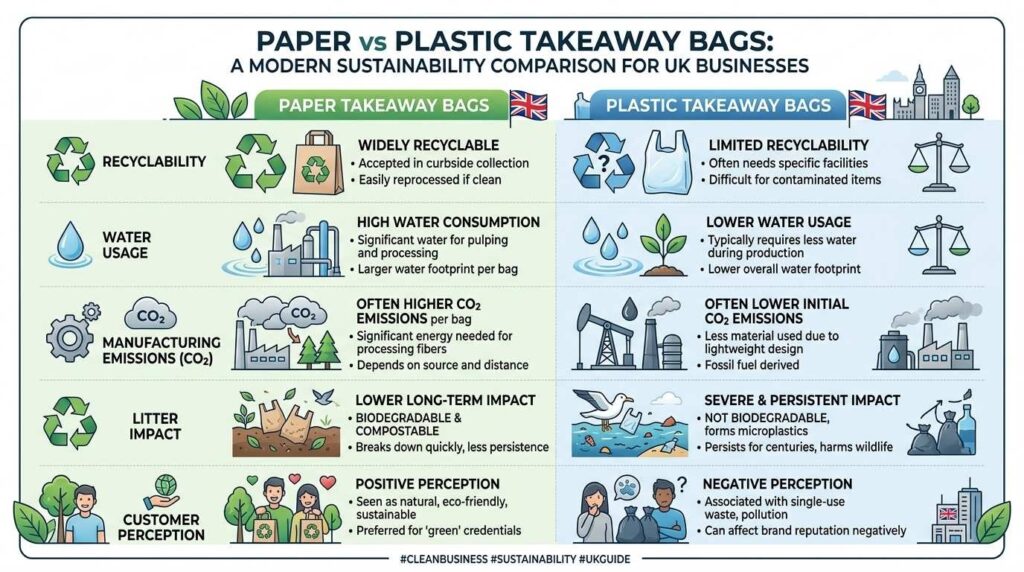
Environmental Impact at a Glance
| Factor | Paper | Plastic |
| Recyclability in practice | Excellent | Moderate |
| Water usage in manufacturing | High | Low |
| Manufacturing emissions | Higher | Lower |
| Litter persistence | Low | High |
| Customer perception (UK 2026) | Positive | Neutral to negative |
| EPR fee position | Better | Worse |
| Wet and grease performance | Worse without treatment | Better |
The Honest Summary
| Factor | Paper | Plastic |
| Manufacturing CO2 | Higher | Lower |
| Water use in manufacturing | Higher | Lower |
| End-of-life recyclability in practice | Better (kerbside, biodegrades) | Worse (low actual recycling rate) |
| Litter persistence | Low | High |
| Wet and grease performance | Worse without treatment | Better |
| Cost per unit | Higher | Lower |
| UK regulatory position | Favoured | 10p charge + EPR disadvantage |
| Customer perception in the UK | Positive | Neutral to negative |
For most UK takeaway businesses in 2026, paper is the right operational and commercial choice, not because it is universally environmentally superior at every lifecycle stage, but because the end-of-life performance, regulatory position, and customer expectation all point in the same direction.
Key takeaway: Paper is not straightforwardly “greener” than plastic across every lifecycle measure. Paper wins on end-of-life and customer perception; plastic wins on manufacturing footprint and cost. In 2026 UK conditions, paper is the right choice for most takeaway operations because the regulation, customer expectation, and EPR modulation all favour it, not because the lifecycle argument is one-sided.
Bag Types Explained: SOS, Flat Handle, Twisted Handle, Carrier
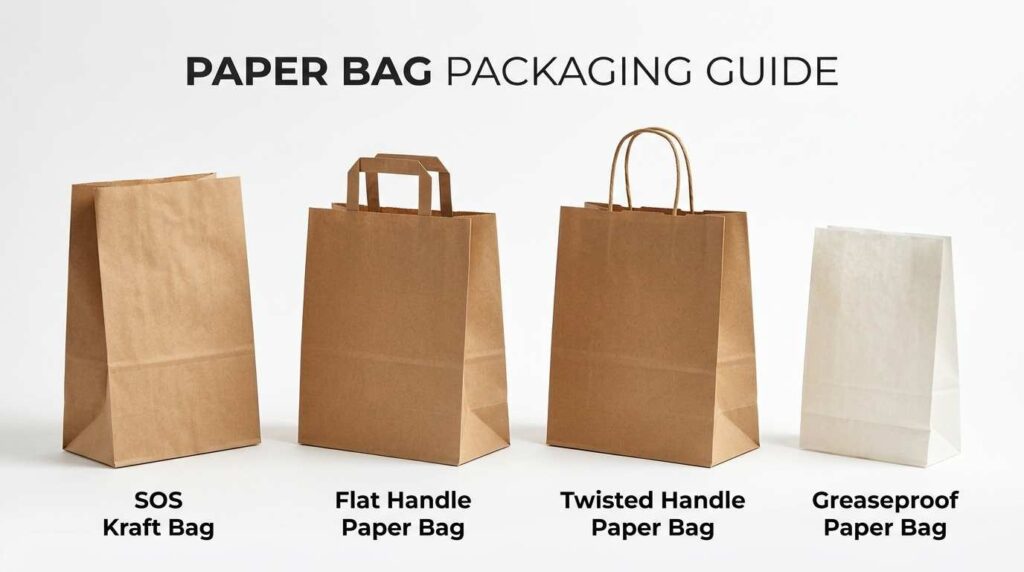
Not all paper bags are the same. The format determines how much weight the bag handles, how it performs with different food types, and how fast staff can pack at service speed.
SOS Bags (Self-Opening Sacks / Flat Handle Bags)
SOS bags are the workhorse of the UK takeaway bag market. They have a flat bottom that expands to hold multiple containers upright, a wide gusset, and flat reinforced handles integrated into the bag body.
Best for: Curry houses, Chinese and Asian takeaways, multi-item orders, kebab shops. Any operation packing multiple containers into a single bag.
Our small kraft brown SOS paper grab bags suit single-item and small orders. Our medium kraft brown SOS bags handle standard 2 to 3 container orders, and our large kraft brown SOS bags suit family orders and high-volume packs.
All three are made from 90gsm kraft paper, are kerbside recyclable, and carry flat handles rated for the weight of a full takeaway order.
Twisted Handle Bags
Twisted handle bags use a paper rope handle twisted and glued into the bag top rather than a flat paper handle. The twisted handle provides a better grip and a more premium feel.
Best for: Premium food businesses, cafes, restaurants with takeaway service, operations where presentation at the door matters. Less suited to high-speed packing under service pressure because the twisted handle is less ergonomic than a flat handle at volume.
Our kraft brown twisted-handle bags and black paper bags with twisted handles are available in small, medium, and large formats. The black option suits a premium presentation where the kraft aesthetic does not match the brand identity.
Greaseproof Paper Bags
Standard kraft bags are not grease-resistant. For fried food, oily food, and battered products, a greaseproof inner lining or a dedicated greaseproof paper bag prevents grease from soaking through and weakening the bag structure.
Best for: Fish and chips, fried chicken, pastries, battered products, any food with significant surface grease that would saturate an unlined kraft bag within minutes.
Browse our brown kraft and white greaseproof paper food bags category for formats suited to fried and greasy food service.
Flat Handle Takeaway Bags
Flat handle bags are a variation on the SOS format with a slightly different handle construction. They sit between the SOS and twisted handle in terms of presentation quality and packing speed.
Browse our flat-handled takeaway bags and SOS bags category for the full range of flat-handle formats across sizes and paper weights.
Bag Type Performance Comparison
| Bag Type | Grease Resistance | Weight Capacity | Recyclable | Best For |
| SOS kraft bag | Medium | High | Yes | Curry, Chinese, multi-item |
| Greaseproof paper bag | Excellent | Medium | Yes | Fish & chips, fried chicken |
| Twisted handle bag | Medium | Medium | Yes | Cafes, premium formats |
| Flat handle bag | Medium | High | Yes | Standard takeaway multi-item |
| Plastic carrier bag | Excellent | High | Limited in practice | Drinks, wet formats |
Cuisine-by-Cuisine Bag Decision Guide
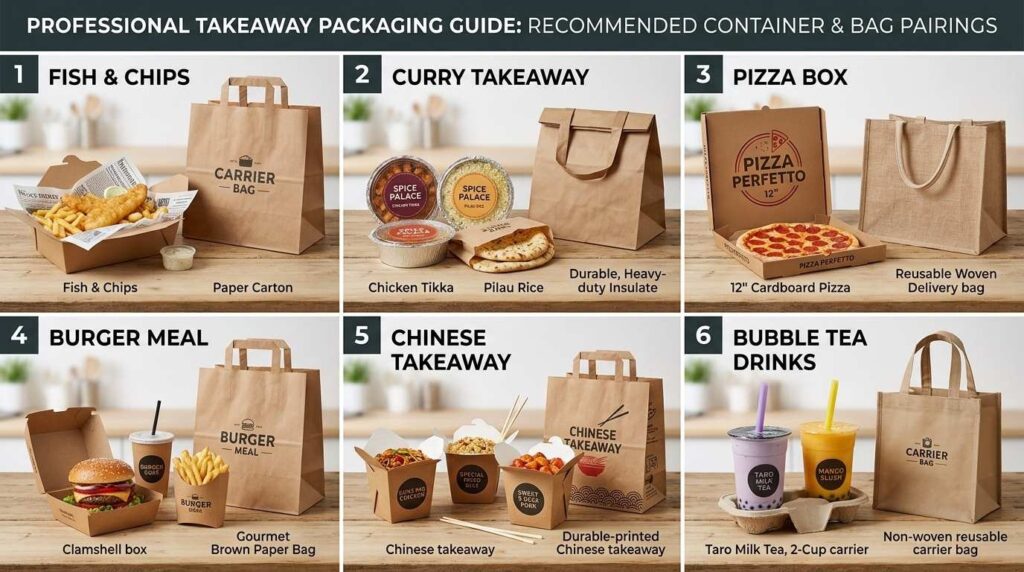
Here is what each major UK takeaway format actually needs from a bag.
Fish and Chips
Fish and chip shops face the most demanding bag performance requirement of any UK takeaway format. The combination of hot, greasy food, high service volume, and the expectation of wrapping-in-bag service means bag failure is visible immediately.
What works: A greaseproof paper bag or a kraft SOS bag with a greaseproof inner liner. The greaseproof surface prevents oil from penetrating the paper structure. For chip shop service where the food is placed directly in the bag rather than a container, a sturdy greaseproof bag is the standard and historically correct format.
What fails: A standard unlined kraft bag with no grease resistance will darken, weaken, and potentially tear at the base within 10 minutes of contact with hot chips.
Experience note: Chip shops that have switched from specialist greaseproof bags to generic kraft SOS bags to save cost consistently report higher bag failure rates, particularly on busy Friday and Saturday evenings when bags sit longer and the grease contact time is extended by service queues.
Curry Houses and Indian Takeaways
Indian and curry takeaways typically pack multiple foil containers, rice bags, and naan bread into a single order bag. The weight is the primary performance variable.
What works: A large SOS kraft bag with flat handles. The flat bottom allows foil containers to sit upright, which is critical for preventing curry from leaking between the container lid and base during transit. The flat handles distribute the weight across the bag top more evenly than twisted handles for heavy multi-container orders.
What fails: A bag that is too small, forcing foil containers to be stacked at an angle. A stacked foil container tilted 30 degrees will leak regardless of how well the lid is fitted.
Pizza Delivery
Pizza boxes are flat and wide. Standard carrier bag formats do not work for pizza delivery because the handles pull the bag sides together and put lateral pressure on the box, distorting it.
What works: A flat kraft sleeve designed for pizza box dimensions, or a large flat-bottom bag with enough width to allow the pizza box to sit flat without the handles touching the sides. For collection only (no delivery), no bag is needed; the box handles its own transport.
What fails: A standard SOS bag that is too narrow for the pizza box. The box buckles, the toppings slide, and the customer gets a disappointing product.
Kebab Shops and Wrap Formats
Kebab and wrap formats typically involve a single main item, sometimes with sides in a portion pot. Orders are fast and high-volume, and the food is often greasy from meat fat and sauces.
What works: A small to medium greaseproof paper bag or a standard SOS bag. The single-item format means weight is not a concern. Grease resistance matters more than volume capacity.
Burgers and Fried Chicken
Burger and fried chicken orders typically involve a burger box or clamshell plus fries in a separate tray or bag. The bag needs to hold multiple items without the fries tipping.
What works: A medium SOS kraft bag with enough base width to hold a burger box and a fries portion upright side by side. The flat base of the SOS format is critical here; a bag that allows containers to tip during handover produces cold, scattered fries by the time the customer opens the bag.
Chinese and Asian Noodles / Rice
Chinese and Asian takeaways often produce some of the heaviest individual orders: multiple rice cartons, noodle boxes, and sauce pots. The bag needs a strong base, strong handles, and enough volume.
What works: A large SOS kraft bag with 90gsm or above paper weight. At high weights (above 2kg of food), the handle attachment points are the primary failure risk. Confirm the handle weight rating with your supplier before ordering at volume for heavy multi-container orders.
Bubble Tea and Drinks-Led Formats
Drinks orders present a unique bag challenge: the weight is concentrated at the base, and any tilting of the bag sends liquid weight sideways and stresses the base seams.
What works: A reinforced SOS bag or a dedicated drinks carrier with a circular base cutout that holds cups upright. A standard flat-bottom SOS bag works if the cups are seated flat, but any bag movement that allows the cups to tilt creates base stress that weakens the seam.
Bag Failure: The Most Common Causes and How to Avoid Them
Bag failure at the customer’s door is a one-star review waiting to happen. The most common causes are predictable and preventable.
Overloading. Every bag has a weight rating. Standard 90gsm kraft SOS bags are rated for approximately 5 to 8kg depending on handle construction. A family Indian order with six foil containers can easily reach or exceed this. Use a large bag for heavy orders, or double-bag where necessary.
Wrong bag for the food. Unlined kraft bags in contact with very greasy food will fail structurally within 10 to 15 minutes. Match the bag type to the food: greaseproof for fried and oily items, standard kraft for dry or containerised food.
Wet bags. Paper degrades rapidly when wet. If your pick-up area is exposed to rain or your delivery riders leave bags outside, the base seam is the first point of failure. A wet kraft bag carrying 3kg of food will lose structural integrity within minutes. Brief the delivery staff to keep bags upright and dry.
Overfilling. A bag that cannot close properly at the top loses the structural contribution of the top fold to handle load distribution. Pack bags to leave a 5cm fold clearance at the top.
Base stress from container edges. Sharp-cornered foil containers or box corners pressing against the inside base create point-stress that weakens the base seam. Use bags with a base wider than the container footprint, not a tight fit.
Cost Comparison: Paper vs Plastic at UK Trade Prices
| Bag Type | 100 Units | 500 Units | 1,000 Units | Per Unit at 1,000 |
| Small kraft SOS paper bag | £2 to £4 | £6 to £12 | £10 to £18 | £0.01 to £0.02 |
| Medium kraft SOS paper bag | £3 to £5 | £8 to £15 | £12 to £22 | £0.01 to £0.02 |
| Large kraft SOS paper bag | £4 to £7 | £12 to £20 | £18 to £30 | £0.02 to £0.03 |
| Twisted handle kraft bag (medium) | £4 to £7 | £14 to £22 | £22 to £35 | £0.02 to £0.04 |
| Standard plastic carrier bag | £1 to £2 | £3 to £6 | £5 to £9 | £0.005 to £0.009 |
| Biodegradable plastic bag | £2 to £4 | £6 to £12 | £10 to £18 | £0.01 to £0.02 |
All prices are indicative of UK trade pricing in 2026 and vary by supplier and specification.
At 1,000 units, the cost difference between a medium kraft SOS bag and a standard plastic carrier bag is approximately £0.01 to £0.015 per bag. On 500 orders per week, switching from plastic to paper adds approximately £5 to £7.50 per week in bag cost, well under £0.02 per order. For most UK takeaways, the commercial and regulatory case for paper bags easily outweighs this margin impact.
The 10p plastic bag charge must also be factored in. If you are charging customers 10p per plastic bag, the net cost to the business is lower than the unit cost suggests. But most operators have found that the customer friction of the plastic bag charge is a stronger argument for switching to paper than the cost savings.
Cost vs Performance Comparison
| Bag Type | Cost | Strength | Sustainability | Overall Value |
| SOS kraft bag | ★★★ | ★★★★★ | ★★★★★ | ★★★★★ |
| Greaseproof bag | ★★★ | ★★★★ | ★★★★★ | ★★★★★ |
| Twisted handle bag | ★★ | ★★★ | ★★★★★ | ★★★★ |
| Plastic carrier bag | ★★★★★ | ★★★★★ | ★★ | ★★★ |
Where to Buy Takeaway Bags in the UK
We Can Source It supplies kraft paper takeaway bags, greaseproof paper bags, and SOS format bags made from FSC-certified 90gsm kraft paper, available with kerbside recyclable credentials and bulk pricing from 25 units.
Key ranges:
- ▸ Small kraft brown SOS paper grab bags – for single-item and small orders
- ▸ Medium kraft brown SOS bags – for standard 2 to 3-item orders
- ▸ Large kraft brown SOS bags – for family and multi-container orders
- ▸ Kraft brown twisted handle bags – for premium presentation and cafe formats
- ▸ Black paper bags with twisted handles – for premium branding on dark formats
- ▸ Brown kraft and white greaseproof paper food bags – for fried and greasy food formats
- Flat-handled takeaway bags and SOS bags – full range across sizes
For the full picture of takeaway packaging UK across all supply categories, see our complete UK takeaway supplies buying guide.
For guidance on matching containers to food types, see our guide to the best food containers for takeaways in the UK.
FAQs
Are paper bags or plastic bags better for takeaway in 2026?
For most UK takeaway businesses in 2026, kraft paper bags are the better operational choice. They are kerbside recyclable, do not carry a mandatory 10p charge, carry a positive customer perception, and attract lower EPR fees for businesses inside the scheme. Plastic bags have a lower manufacturing carbon footprint and cost less per unit, but the regulatory position, customer expectation, and end-of-life performance all favour paper in current UK market conditions.
Do takeaway businesses have to charge for bags in the UK?
Businesses must charge a minimum of 10 pence for each single-use plastic carrier bag supplied to customers. This applies to all businesses in England, regardless of size, following the 2021 amendment to the carrier bag charge legislation. Paper bags are not subject to the charge.
What bags do fish and chip shops use?
Traditional fish and chip shops use greaseproof paper bags or white paper bags with a greaseproof lining. Standard unlined kraft bags are not suitable for direct contact with hot, greasy fried food; they absorb grease, weaken, and can fail structurally within minutes.
Does the EPR scheme apply to my takeaway business?
From 2026–27, EPR fee obligations apply to businesses with annual turnover above £2 million and packaging volumes above 50 tonnes per year. Most independent single-site takeaways will be comfortably below the 50-tonne threshold. If you are in scope, uncoated kraft paper bags attract the lowest EPR fees of the common takeaway bag formats under the Recyclability Assessment Methodology (RAM). PLA compostable bags attract the highest fees. Check current thresholds at the gov.uk EPR guidance page, as these figures are updated.
What size bag do I need for a standard curry house order?
A large SOS kraft bag is the correct format for a standard curry house order of 2 to 4 containers. The flat bottom allows foil containers to sit upright, which is critical for preventing leaks during transit. For family orders of 6 or more containers, a very large SOS bag or double-bagging a large format is recommended.
Are paper takeaway bags waterproof?
Standard kraft paper bags are not waterproof. They degrade rapidly in sustained wet conditions and will lose structural integrity at the base seam if exposed to rain or wet surfaces while carrying heavy loads. Brief staff to keep bags upright and covered until handover.
What is an SOS bag?
SOS stands for Self-Opening Sack. It describes a paper bag with a flat, gusseted base that expands when opened, allowing it to stand upright and hold multiple containers. The flat base and wide gusset make SOS bags the most practical format for multi-item takeaway orders. They are the most widely used takeaway bag format in the UK food service.
Are paper bags stronger than plastic bags?
For weight capacity, 90gsm kraft SOS paper bags perform comparably to standard plastic carrier bags in dry conditions. In wet conditions, plastic outperforms paper. For grease resistance, a greaseproof-lined paper bag matches plastic. For most dry takeaway applications, 90gsm kraft paper is entirely sufficient.
What GSM paper bag is best for takeaway use?
90gsm is the standard weight for commercial takeaway bags and the minimum recommended for orders above 1kg. Lighter bags (70 – 80gsm) suit single-item or lightweight orders only. For heavy curry or Chinese orders above 2kg, confirm the handle attachment rating with your supplier regardless of paper weight.
Can greaseproof paper bags be recycled?
Uncoated greaseproof paper bags are kerbside recyclable. Bags with a PE or plastic lining are not recyclable. Check the product specification before ordering if recyclability matters to your customers.
References
- ▸ Single Use Carrier Bags Charges (England) Order 2015 (as amended 2021) – legislation.gov.uk
- ▸ Single-use plastics bans and restrictions – DEFRA / GOV.UK
- ▸ ▸ Extended Producer Responsibility for packaging: who is affected and what to do – GOV.UK
- ▸ Extended Producer Responsibility for packaging announcements – GOV.UK