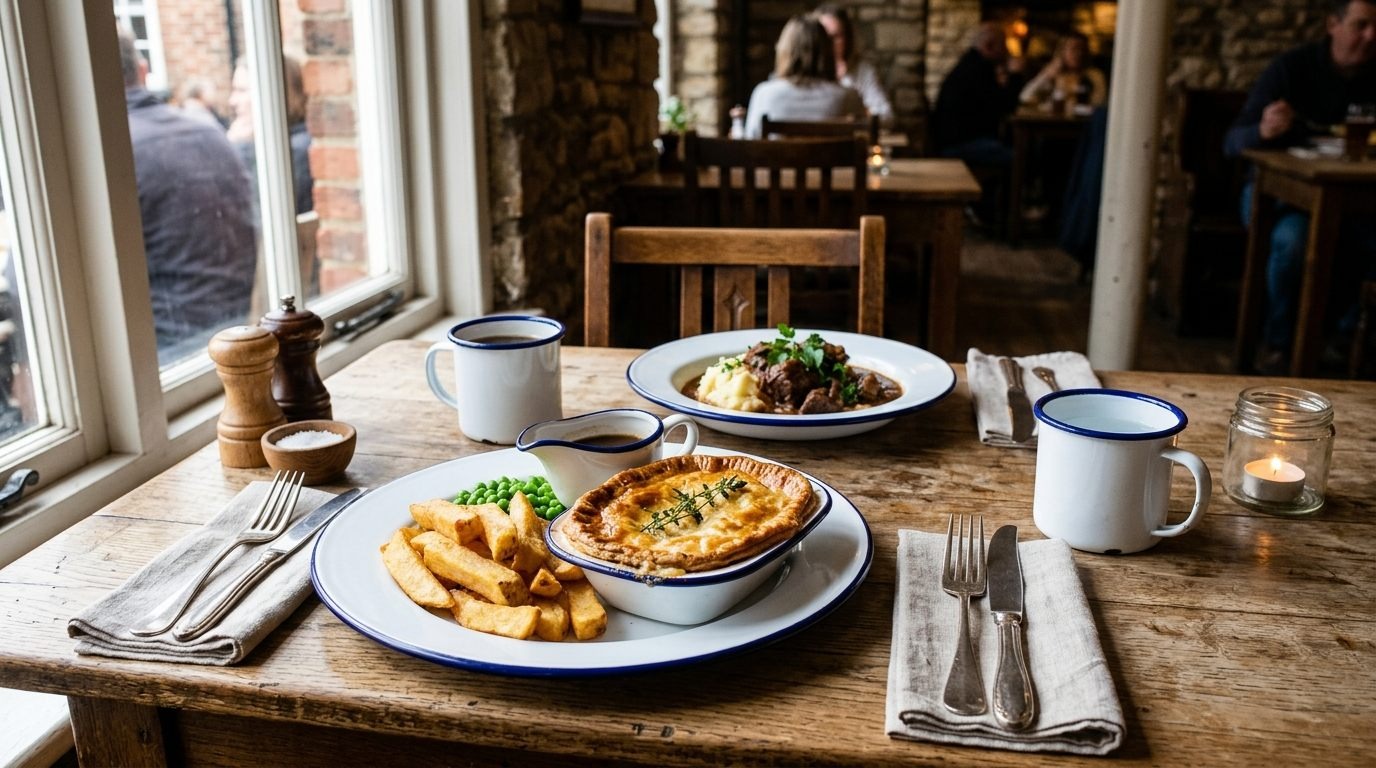
Enamel tableware for pubs has become one of the most recognisable serving formats in British hospitality. Walk into almost any gastropub in the UK that has been refitted in the last six years, and you will find enamel somewhere on the table. A bubbling chicken pie arriving in a white and blue enamel dish. A Full English served on an enamel plate. A flat white in an enamel mug. The format has moved from niche to mainstream in British pub dining and for good operational reasons that go well beyond aesthetics.
But enamel is also the tableware category that generates the most questions before purchase and the most regret after it. Not because the product is bad, but because operators buy it based on how it looks in a supplier photo rather than on a clear understanding of what it is, how it behaves in a working kitchen, and when it is the right choice.
This guide covers all of it. What commercial enamel actually is (which is not the camping plate you are picturing). Why it works for pub and casual dining environments. The real pros and the real cons, including the ones suppliers prefer not to mention. The chipping protocol your kitchen team needs to follow. The oven-to-table service format that most operators underuse. And a direct recommendation by piece type for pub kitchens ready to commit.
What Commercial Enamel Tableware Actually Is
When most people hear the word enamel in a food context, they picture camping. The lightweight speckled tin plate from a scout trip. The blue and white mug that burns your lips if the tea is too hot. That product exists, and it is not what commercial enamel tableware is.
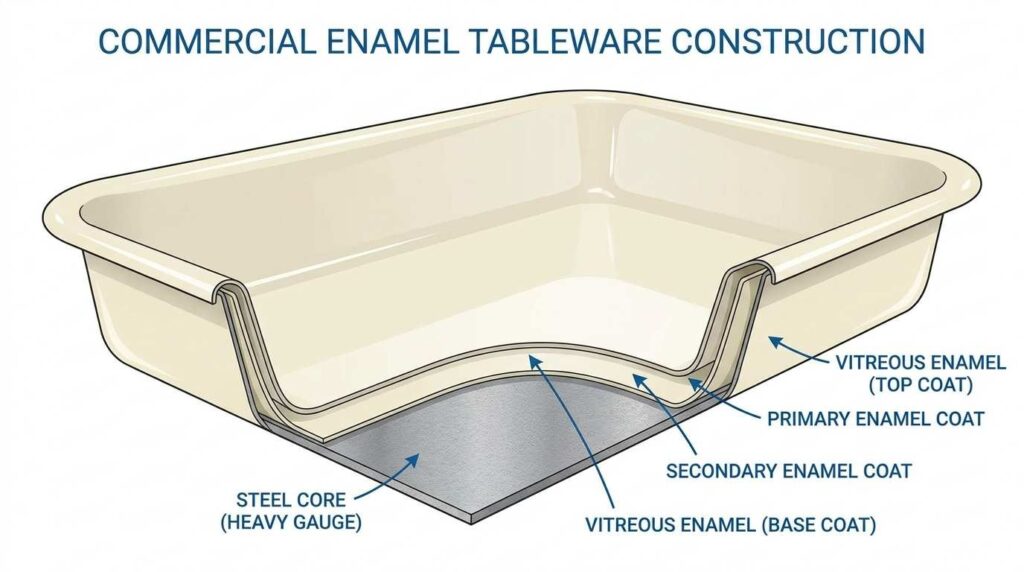
Commercial enamelware, the format used in hospitality, is vitreous enamel applied in a double coat over a steel base. Vitreous enamel is powdered glass fused to metal at extremely high temperatures. The result is a surface that is chemically inert, non-porous, and bonded permanently to the steel substrate. It is not a paint or a coating in the conventional sense. It is glass, fired directly onto steel.
The steel base gives the piece structural weight and heat retention properties that thin tin cannot match. The double coating provides a smooth, dense surface that resists staining, does not absorb odours, and does not react with acidic foods. The characteristic white body with a coloured rim, typically blue, red, or black, is a result of the enamel application process, not a design applied after manufacture.
The relevant difference from camping enamelware:
- ▸ Base material: Commercial enamel uses heavier-gauge steel. Camping enamelware uses thin-gauge tin or lightweight steel.
- ▸ Coating weight: Double-coat vitreous enamel in commercial formats versus single-coat in camping formats.
- ▸ Edge treatment: Commercial pieces have sealed or rolled edges that reduce chipping at the rim. Camping enamelware often has exposed edges.
- ▸ Dishwasher tolerance: Commercial enamel is rated for commercial dishwasher cycles. Camping enamelware is not designed for repeated commercial washing.
When you are buying enamel tableware for a pub kitchen, you are buying a fundamentally different product category from what you find in an outdoor gear shop. Understanding this distinction matters because the camping association leads many operators to underestimate durability or overfocus on chipping risk at the expense of the genuine operational advantages.
Why Enamel Suits Pubs and Casual Dining
Enamel tableware sends a very specific message to a dining customer, and it is a message that happens to align almost exactly with what the modern UK pub dining market is trying to communicate.
The format reads as: traditional, unfussy, honest, local, and unpretentious. It does not try to be fine dining. It does not pretend to be a restaurant. It says: this is proper food, served with confidence, in a place that knows what it is.
That positioning resonates in the casual dining and pub environment in a way it does not in a formal restaurant context. A white tablecloth restaurant serving a chicken pie on an enamel dish would feel confused. A well-run gastropub doing the same thing feels entirely coherent.
Beyond the brand signal, enamel suits pub kitchens for practical reasons:
The format handles high-volume service. Enamel pieces are not precious. They stack without ceremony. They go from the dishwasher to the shelf to the service pass without special handling. Kitchens that cannot afford to treat tableware gently because there is a 200-cover Sunday lunch to get through benefit from a format that can absorb that treatment.
The aesthetic is consistent across a wide menu range. A single enamel plate or dish works as naturally under a full English breakfast as under a ploughman’s lunch, a burger, a pie, or a sharing board. Stoneware and coloured ceramic ranges require more careful menu matching. Enamel is broadly versatile within the casual pub dining aesthetic.
The format photographs well. This is not a trivial consideration in 2026. Pub food is marketed on Instagram, TikTok, and Google before a customer ever walks through the door. Enamel provides a clean, high-contrast backdrop that food photographs well against.
The Pros of Enamel Tableware for Pub Kitchens
Oven-safe for direct kitchen-to-table service
Commercial enamel is oven-safe. A pie dish can go from the oven to the service pass to the table without being transferred to a separate serving vessel. This is the feature most operators underuse, and its operational implications are covered in detail in Section 6.
Heat retention above ceramic alternatives
Steel retains heat better than ceramic or stoneware. A dish served in enamel arrives at the table warmer than the equivalent dish on a ceramic plate, and stays at serving temperature longer through the meal. For pie service, braises, and cooked breakfast formats, this is a genuine quality advantage.
Dishwasher-compatible for commercial cycles
Commercial enamel is rated for commercial dishwasher use. The vitreous enamel surface does not absorb detergent, does not harbour bacteria, and does not degrade under the temperature and chemical conditions of a commercial glasswasher or dishwasher cycle. This is not the case for all alternative formats; some coloured stoneware requires lower-temperature washing to preserve glaze integrity.
Distinctive visual identity at a competitive price point
Enamel tableware is priced below hand-thrown stoneware and above standard white porcelain. For a pub operating at scale, the combination of distinctive aesthetic and manageable unit cost is commercially sensible. A pack of six Eagle Enamel Pie Dishes 6.25″ at trade price represents a lower per-unit cost than comparable artisan stoneware while delivering a more characterful presentation than standard white china.
Hygienic and non-porous surface
The vitreous enamel surface is non-porous. It does not absorb food particles, oils, or bacteria. Unlike unglazed stoneware formats, there is no risk of surface absorption causing hygiene issues over time. Under UK food hygiene regulations, non-porous food-contact surfaces are the standard against which other materials are assessed.
Compatible with UK pub aesthetic trends
The white with blue or black rim enamel format sits naturally within the interior language of the contemporary UK gastropub: reclaimed wood, bare brick, chalkboard menus, and locally sourced provenance claims. It does not require an interior redesign to introduce it complements what most casual dining pubs already look like.
The Cons: What Pub Operators Need to Know Before Committing
Chipping is a real operational risk
Enamel chips. Not easily, not frequently under normal use, but it chips when pieces are dropped, stacked carelessly, or handled at volume in a busy kitchen environment. A chip in an enamel piece creates a small area of exposed steel, which can rust and constitutes a food safety concern. This is the most important management challenge associated with enamel, and it requires a specific inspection and replacement protocol covered in Section 5
Not microwave-compatible
Steel-based enamelware cannot go in a microwave. For pub operations that reheat items in a microwave sauces, soups, stored portions this means enamel dishes cannot be used in that part of the workflow. Operations reheating food in service must use a separate vessel or switch to a different dish format for microwave-reheated items.
Cutlery noise is more pronounced than on ceramic.
Metal cutlery on enamel creates a louder contact noise than on stoneware or porcelain. In a noisy pub dining environment, this is rarely perceptible. In a quieter restaurant setting it can feel incongruous. This is a minor consideration but worth noting if your operation occupies the quieter end of the casual dining spectrum.
Replacement matching requires consistency from the supplier
Enamel ranges from different manufacturers vary slightly in shade, rim colour intensity, and profile. If you establish a look with one enamel range and need to replace pieces six months later, ordering from a different source may produce pieces that do not match precisely. Commit to a single supplier range and maintain stock continuity.
Limited format range compared to ceramic.
Commercial enamel comes in a defined format range: plates, bowls, mugs, pie dishes, casserole dishes, and baking trays. It does not replicate the full range of shapes available in ceramic or stoneware, no oval platters, no sauce boats, no speciality presentation formats. Menus that require a wider variety of service shapes will need to supplement enamel with other formats.
Chipping: Food Safety, Inspection, and Stock Management
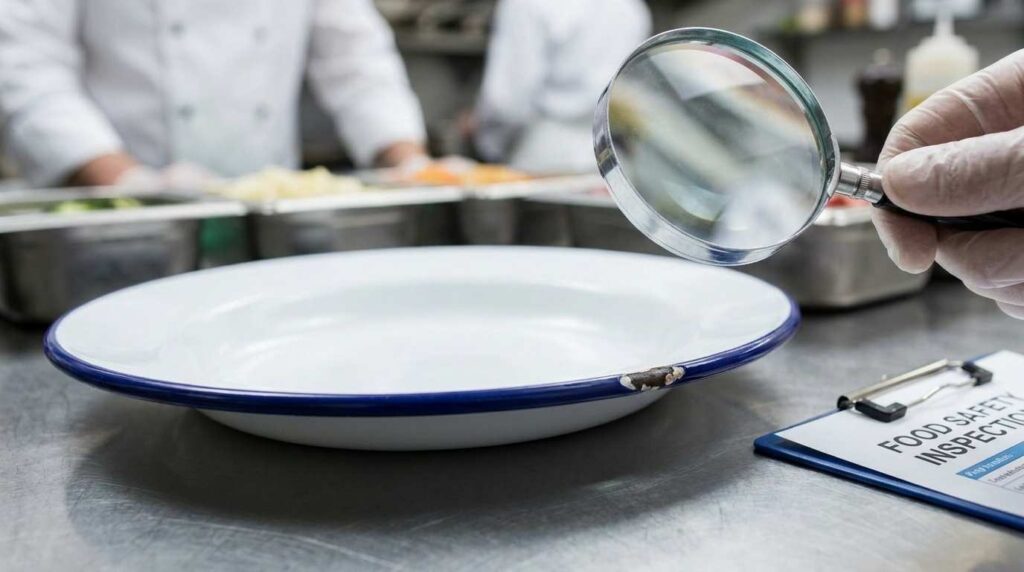
Chipping is the topic that makes operators most anxious about enamel, and it deserves a clear, direct section rather than a footnote.
What a chip actually is
A chip in enamel removes a small section of the glass coating, exposing the steel substrate underneath. The exposed steel will begin to oxidise if it comes into contact with moisture — which in a kitchen environment it will. Over time, an untreated chip will develop surface rust at the exposed point. This is a food safety concern because rust particles can contaminate food, and the exposed surface becomes a potential harbour for bacteria.
A chip does not make a piece immediately dangerous. A newly chipped piece that has not yet developed rust is not a contamination risk in the way that a cracked ceramic piece is. But a chipped piece that continues in service without inspection becomes a progressive risk.
The inspection protocol
Every kitchen using enamel tableware should perform a daily visual inspection as part of the standard pre-service check. The check is simple: pick up each piece, run your thumb along the rim and across the surface, and look for any exposed grey or silver steel beneath the white enamel surface.
A piece that passes inspection, with no visible chips and no exposed steel, is safe for service. A piece with a visible chip should be removed from service immediately and set aside for assessment.
When to replace vs when to retire
A newly chipped piece with no rust development and a clean exposed steel surface can, in some cases, be assessed by the head chef and returned to a non-food-contact role — storage, prep, staff use while replacement stock is ordered. A piece with visible rust at the chip point must be disposed of. Do not return it to service.
The Food Standards Agency guidance on food-contact materials requires that surfaces in contact with food are maintained in a clean condition, in good order and repair, and made of materials that do not pose a contamination risk. A rusted chip fails this standard, and the piece should be retired.
Stock buffer management for enamel
Because chipping is the primary cause of piece retirement in enamel ranges, the stock buffer calculation for enamel is different from that of ceramic. Ceramic is more likely to break; a dropped plate shatters catastrophically and is immediately removed. Enamel is more likely to chip gradually. A piece that develops a chip is inspected and is retired.
This means enamel stock buffers should be slightly larger than for ceramic equivalents, and reorder triggers should be set earlier. A pub running 30 enamel pie dishes as its working stock should hold a minimum of 6 to 8 replacement pieces in storage and reorder when the buffer drops below 4. Section 10 covers the full stock buffer calculation by operation size.
Oven-to-Table Service: Enamel’s Most Underused Commercial Advantage
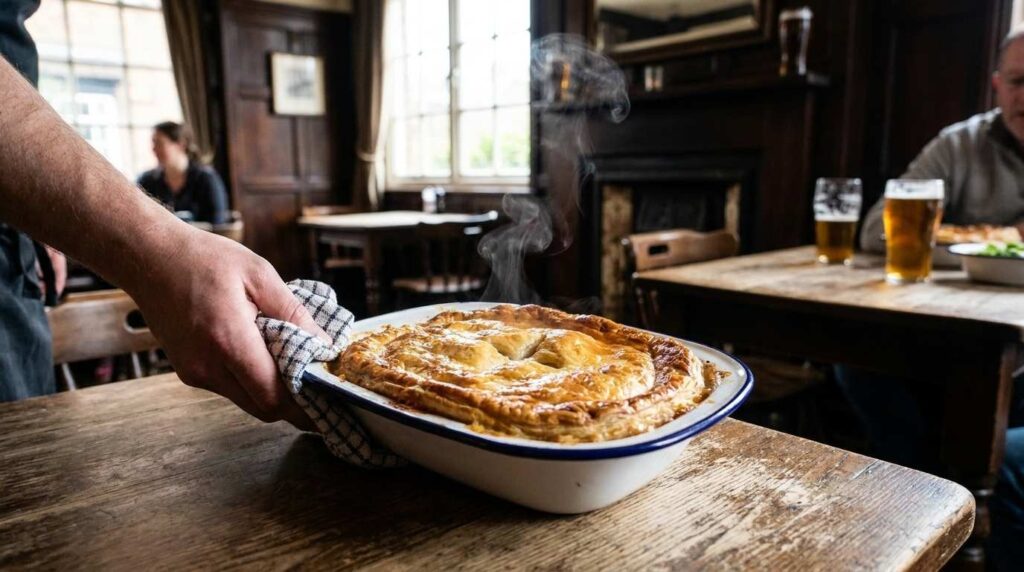
This is the section that most enamel tableware suppliers skip over entirely, because it requires the operator to change their kitchen workflow rather than simply buy a product. But it is also the section where enamel generates the most genuine commercial value.
What oven-to-table service means
Oven-to-table means the cooking vessel becomes the serving vessel. The pie is cooked in the enamel pie dish. That same dish hot from the oven, still bubbling, is carried directly to the table and set in front of the customer.
No transfer. No second vessel. No loss of heat at the pass. No visual difference between what came out of the oven and what arrives at the table.
Why it matters for pub dining specifically
The theatre of oven-to-table service is disproportionately valuable in the pub dining context for three reasons.
First, it is a visible quality signal. A customer watching an enamel pie dish arrive still bubbling at the edges is receiving a message about the food that no verbal description can match. The dish communicates: this was cooked properly, it is genuinely hot, it was made for you.
Second, it differentiates pub food from fast casual. The oven-to-table format is intrinsically unhurried. It positions the meal as a proper sit-down occasion rather than a feeding stop. That positioning supports higher average spend and longer dwell time, both of which matter to pub profitability.
Third, it reduces service complexity. A kitchen that plates into a serving dish at the pass, then transfers to a serving vessel for the table, has added a step and a potential point of heat loss. Oven-to-table removes that step entirely.
Which enamel pieces support oven-to-table formats
Pie dishes: The format most associated with oven-to-table pub service. Our Eagle Enamel Pie Dish 6.25″ suits individual pub pie portions. The Eagle Enamel Pie Dish 7.75″ suits a more generous portion or a pie with a side served in the dish.
Casserole dishes: The Eagle Enamel Casserole 4.5″ suits braises, stews, and slow-cooked dishes served at the table in their cooking vessel. The format works for lamb shoulder, beef cheek, and slow-roasted dishes where the sauce is as important as the protein.
Baking trays: The Eagle Enamel Baking Tray 11 x 8.5“ and the 13.75 x 5″ format work for sharing formats – nachos, roasted vegetables, loaded fries – where a tray arriving at the table is part of the casual dining experience.
The one operational requirement
Oven-to-table service requires adequate table protection. An enamel pie dish directly from an 180°C oven will mark or damage a wooden pub table. A dedicated heat mat or trivet at each table is non-negotiable for this service format. This is a minor kit addition relative to the service quality improvement.
Enamel vs Stoneware vs Melamine for Pubs: Comparison Table
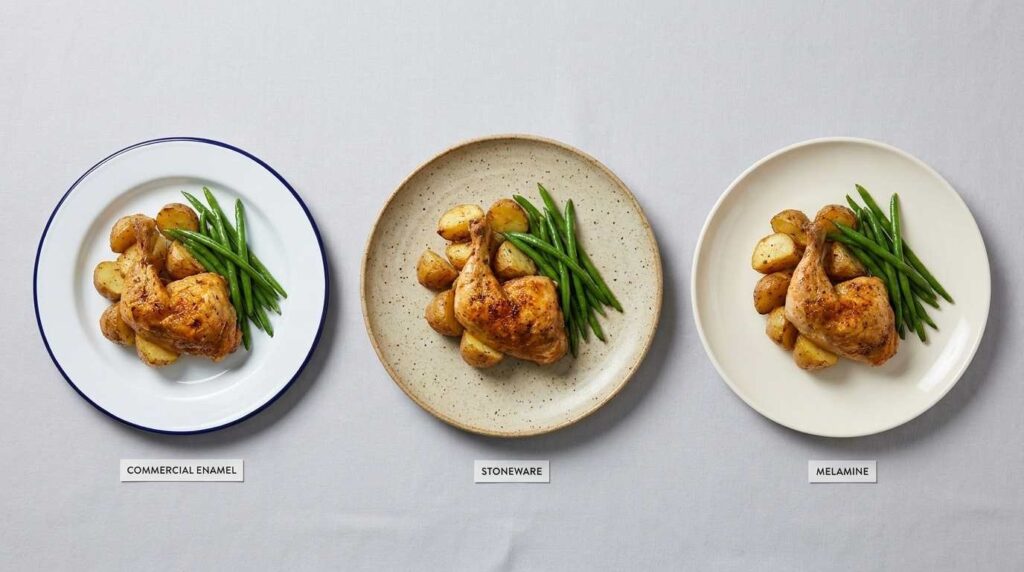
| Factor | Enamel | Stoneware | Melamine |
| Oven-safe | Yes | Yes (most formats) | No |
| Microwave-safe | No | Yes | Yes (check product) |
| Dishwasher-safe | Yes, commercial cycles | Yes, lower temperatures recommended | Yes |
| Heat retention | Excellent | Good | Poor |
| Drop resistance | Chips but do not shatter | Chips and shatters | Does not chip or shatter |
| Aesthetic | Rustic, traditional, pub-appropriate | Artisan, premium, flexible | Functional, outdoor-appropriate |
| Social media performance | Excellent — high contrast, strong visual identity | Good | Poor — reads as cheap on camera |
| Price point (trade) | Mid-range | Mid to high | Low |
| Format variety | Limited | Extensive | Moderate |
| Suitable for formal dining | No | Yes | No |
| Best pub application | Pies, cooked mains, brunch, mugs | Premium mains, fine casual | Garden, outdoor, events |
Photography and Social Media: How Enamel Performs on Camera
This section exists because in 2026 a pub’s social media presence is part of its marketing infrastructure, not an optional extra. The tableware a dish is served on contributes directly to whether that dish gets photographed, shared, and saved by customers.
Enamel performs unusually well in food photography for three specific reasons.
High-contrast background. The white enamel surface with a strong coloured rim creates a clean, naturally high-contrast base that makes food colours read clearly in photographs taken on a smartphone. Coloured stoneware can compete with the food for visual attention. Plain white ceramic can look clinical. Enamel sits in a middle position that is visually interesting without being distracting.
Texture interest without complexity. The slight surface variation of vitreous enamel, not perfectly smooth like porcelain, not aggressively textured like rough stoneware, provides enough visual interest to make a photograph feel considered without requiring professional food styling.
Authentic narrative. Enamel reads as genuine and unpretentious in a way that premium restaurant tableware does not. A pub posting a photo of a bubbling pie in an enamel dish is communicating the right message for its audience. The format tells the story without a caption.
The blue-rimmed white enamel format photographs particularly well in natural light. If your pub has window seating, positioning it to catch natural light will consistently produce better social media content than flash photography under artificial lighting.
Best Picks: Which Enamel Pieces Suit Which Pub Kitchen
For Pie Service
The enamel pie dish is the single most commercially valuable piece in a pub enamel range. It enables oven-to-table service, creates strong visual theatre at the table, and works across a wide range of fillings.
Eagle Enamel Pie Dish 6.25″ (16cm) – the standard individual pub portion. Suits chicken, beef, and vegetable pies. Available in packs of 6 at trade price.
Eagle Enamel Pie Dish 7.75″ (20cm) – the larger format for a more generous portion or a pie with an accompaniment in the dish. Suits operators whose pie is the signature dish and needs the space to match.
For Full English and Brunch Service
Eagle Enamel Plate 10″ (25cm) – the standard dinner plate in the range. Works for a full cooked breakfast, a burger plate, or a main course where a flat plate is the appropriate format. The 10-inch diameter suits standard pub portion sizes without feeling cramped.
For Braised and Slow-Cooked Dishes
Eagle Enamel Casserole 4.5″ (11cm) – a versatile oven-to-table vessel for braises, stews, and slow-cooked dishes. Suits single-portion service of beef cheek, slow-roasted lamb, or any dish where the sauce is integral to the presentation.
For Hot Drinks Service
Eagle Enamel Mug 13.5oz (38cl) – the standard pub-appropriate mug size. Works for filter coffee, tea, hot chocolate, and hot toddies. The enamel mug is one of the most recognisable elements of the gastropub aesthetic.
Eagle Enamel Mug 19oz (54cl) – the larger format for operations where a generous mug is part of the offering. Works particularly well for brunch service and breakfast menus.
Eagle Enamel Mug 5.5oz (15.5cl) – the smaller format is suited to espresso-based drinks, small hot chocolate portions, or children’s hot drinks.
For Sharing and Tray Formats
Eagle Enamel Baking Tray 11 x 8.5″ – suits loaded sharing formats: nachos, roasted vegetables, loaded fries, sharing starter plates. The standard size works for a 2-person sharing portion.
Eagle Enamel Baking Tray 13.75 x 5″ – a narrower, longer format suited to bread service, charcuterie boards, or elongated sharing plates.
For Soup and Bowl Dishes
Eagle Enamel Bowl 19oz (54cl) – suits soup service, ramen, or salad bowl formats. The 54cl volume is generous without being oversized.
Browse the Full Range
For the complete Eagle Enamel range across all formats and sizes, browse our Eagle Enamel crockery and tableware category.
How Many Pieces to Order: Stock Buffer Guidance for Enamel
Getting the opening order quantity right for enamel avoids two common mistakes: ordering too few pieces and running out during service, or ordering so many that a large sum is tied up in a format you have not yet tested with your customers.
The baseline calculation
For enamel service pieces (plates, pie dishes, bowls), the standard calculation is:
Working stock = peak covers × 1.5
If your peak service covers 80 customers and every customer receives an enamel pie dish, your working stock is 120 pieces. The 1.5 multiplier accounts for pieces in the dishwasher cycle, pieces in transit from pass to table, and pieces cooling before washing.
Buffer stock = working stock × 0.25
This is your replacement buffer, the pieces you hold in storage to replace chipped or damaged items as they are retired from service. For a 120-piece working stock, hold 30 pieces in reserve.
Opening order = working stock + buffer stock
Following this formula, an 80-cover pub opening with enamel pie dishes should order 150 pieces at the outset.
Practical guidance by operation size
| Operation Size | Peak Covers | Working Stock (Pie Dishes) | Buffer Stock | Opening Order |
| Small pub / gastropub | 40 covers | 60 pieces | 15 pieces | 75 pieces (13 packs of 6) |
| Medium pub dining room | 80 covers | 120 pieces | 30 pieces | 150 pieces (25 packs of 6) |
| Large pub / events venue | 150 covers | 225 pieces | 56 pieces | 281 pieces (47 packs of 6) |
For mugs
Mugs turn over faster than plates in a pub environment, and the chip risk at the handle point is higher than on flat pieces. Apply a buffer stock of 30% rather than 25% for mug orders, and set reorder triggers at buffer stock below 20% of working stock.
Reorder timing
For Eagle Enamel pieces supplied by We Can Source It, standard delivery is 3 to 5 working days. Set your reorder trigger at buffer stock dropping to 50% (half your reserve). This gives you enough time to receive replacement stock before your working stock is compromised by retirements.
For more guidance on quantities, styles, trends, and wholesale pricing across all restaurant crockery materials, the full Restaurant Tableware and Crockery Buyer’s Guide covers everything you need to make the right decision for your operation.
FAQs
Is enamel tableware safe for commercial restaurant use?
Yes. Commercial enamel tableware vitreous enamel double-coated over steel is a food-safe, non-porous format suitable for commercial restaurant and pub use. The enamel surface does not react with food, does not absorb bacteria, and meets the requirements of UK food-contact material regulations under the Food Safety Act 1990 and associated regulations, provided pieces are maintained in good condition. The critical food safety management requirement for enamel is a chip inspection protocol: any piece with exposed steel or visible rust at a chip point must be removed from service immediately and retired. Undamaged enamel is as food-safe as any other commercial tableware format.
Can enamel plates go in a commercial dishwasher?
Yes. Commercial enamel tableware is rated for commercial dishwasher and glasswasher cycles. The vitreous enamel surface is chemically inert under the temperatures and detergent conditions of commercial washing. Enamel does not require the lower-temperature washing cycles recommended for some coloured stoneware glazes. The one dishwasher-related risk is that impact chipping pieces that collide during loading or unloading can chip at the rim. Loading enamel pieces with adequate spacing and using a rack system reduces this risk.
What are the disadvantages of enamel tableware in a pub?
The main disadvantages are: chipping risk under high-volume handling (requiring a daily inspection and retirement protocol); incompatibility with microwave reheating (the steel base reflects microwave energy); audible cutlery-on-enamel contact noise (noticeable in quieter environments); limited format range compared to stoneware or ceramic; and the requirement for consistent supplier sourcing to maintain visual matching across replacements. None of these is a disqualifying disadvantage for most pub environments, but all should be assessed against the specific operational context before committing.
How does enamel tableware compare to stoneware for pub use?
Enamel and stoneware each suit different pub kitchen requirements. Enamel is oven-safe, has excellent heat retention, is rated for commercial dishwasher cycles at full temperature, and has a strong visual identity well-suited to traditional and gastropub aesthetics. Stoneware offers a wider format range, is more versatile across dining styles from casual to premium, and does not carry a chipping risk in the same way, though it will shatter if dropped. For pie service and oven-to-table formats, enamel is the better operational choice. For a broader menu requiring varied presentation shapes or a higher-end positioning, stoneware may be more appropriate. Many pubs use both formats for different menu sections.
References