Quick answer: Most UK restaurants use a 27-28 cm dinner plate for main courses. Pub restaurants often move up to 28 cm to 30 cm. Tasting menus and fine dining formats typically use 19 cm to 23 cm plates for individual courses. The right size for your operation depends on your menu format, portion design, table dimensions, and dishwasher capacity.
Choosing the right plate for your menu sounds like a simple job. In practice, it is one of those decisions that quietly affects almost everything: how your food looks when it lands on the table, how much a portion appears to be worth, whether your front-of-house team can carry two covers at once, how many wash cycles you need per service, and what your crockery replacement bill looks like at the end of the year.
Get it right, and the plate works for you. Get it wrong, and it works against you, usually in ways you only notice once you are already committed to a full stock order.
This guide is written for chefs, owners, and operations managers making real procurement decisions in UK hospitality. It covers standard plate sizes for restaurants, how those sizes behave differently across service styles and cuisine types, the operational factors that most buyers overlook until it is too late, and a practical setup guide by venue type so you can move from reading to ordering.
For the full picture on tableware covering materials, budgets, trends, and quantity planning, the Restaurant Tableware and Crockery Buyer’s Guide is the place to start. This article goes deep on one specific question: which plate size, for which situation, and why.
Restaurant plate sizes: the standard reference
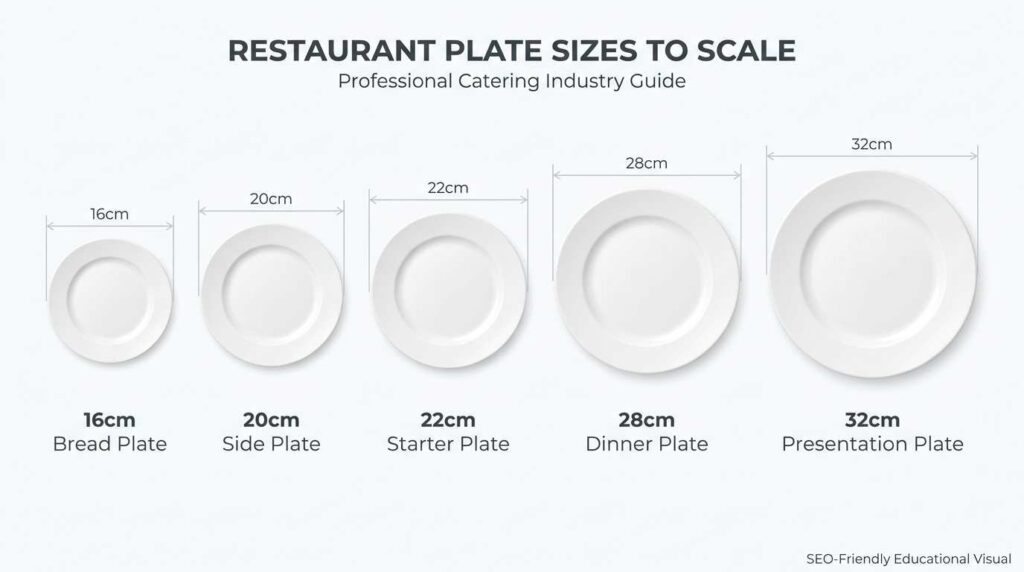
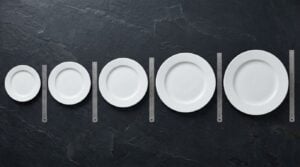
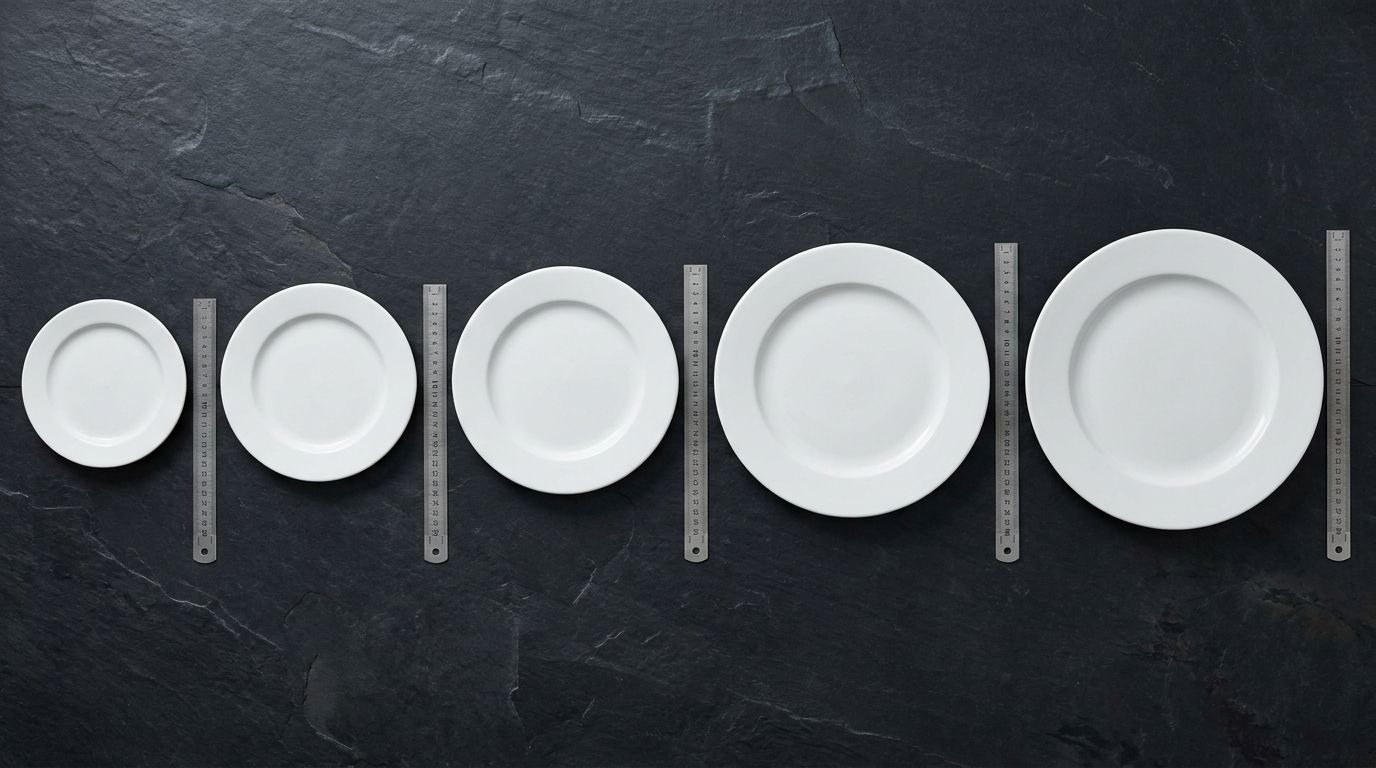
Before getting into the decisions, here is a clean reference table covering the standard restaurant plate sizes used across UK hospitality. These are industry norms rather than rigid rules, and real-world usage varies. But if you are specifying a new tableware setup and need a starting point, this is what the majority of UK operators work from.
| Plate type | Diameter (cm) | Common use in restaurants |
| Bread plate | 15 to 17cm | Bread, amuse-bouche, petits fours, small sides |
| Side plate | 18 to 20cm | Salads, starters, light desserts |
| Starter plate | 20 to 23cm | Starters, tapas courses, tasting menu dishes |
| Pasta plate / shallow bowl | 25 to 27cm | Pasta, risotto, ramen, noodle dishes |
| Standard dinner plate | 27 to 28cm | Main courses across most restaurant formats |
| Large dinner plate | 28 to 30cm | Pub mains, hearty casual dining |
| Presentation plate | 30 to 32cm | Steaks, premium mains, chef’s table formats |
| Charger plate | 30 to 33cm | Formal settings, banqueting, hotel dining rooms |
These are the plate sizes for restaurants that UK wholesalers stock as standard. Anything outside this range, particularly above 32cm for individual plates, moves into specialist or bespoke territory.
Why the plate size decision is also a margin decision
Plate size has a direct relationship with how a diner perceives the value of what they are eating. Understanding this relationship is useful for any operator thinking about menu engineering, not just presentation.
Research by Van Ittersum and Wansink (2012), published in the Journal of Consumer Research, found that the Delboeuf optical illusion causes people to overserve on larger plates because the same quantity of food on a larger surface looks smaller.[^1] A separate study published in Foods (2024) by Głuchowski, Koteluk, and Czarniecka-Skubina, involving 1,005 respondents, confirmed that as plate diameter increased from 24- 27 cm up to 31cm, diners rated the dish lower in perceived portion size, perceived appearance, and perceived food energy.[^2]
For a restaurant, this matters in two directions.
A wide-rim plate with a 16 to 18cm usable well on a 28cm overall diameter creates a natural frame. The food is surrounded by visual space that makes the composition look intentional. The portion does not need to be large; it needs to look considered. This is the logic behind the wide-rim plate’s dominance in mid-range and fine dining.
Conversely, a flat 30cm coupe plate for a dish designed around 250g of protein and two garnish elements will read as sparse. The same dish on a 26cm flat plate with a narrow rim would look balanced.
Plate size is not a trick. It is the same principle that governs every other plating decision: scale, proportion, and negative space. Understanding it means you can use it consciously rather than discovering its effects after the reviews come in.
Plate sizes for restaurants across UK hospitality formats
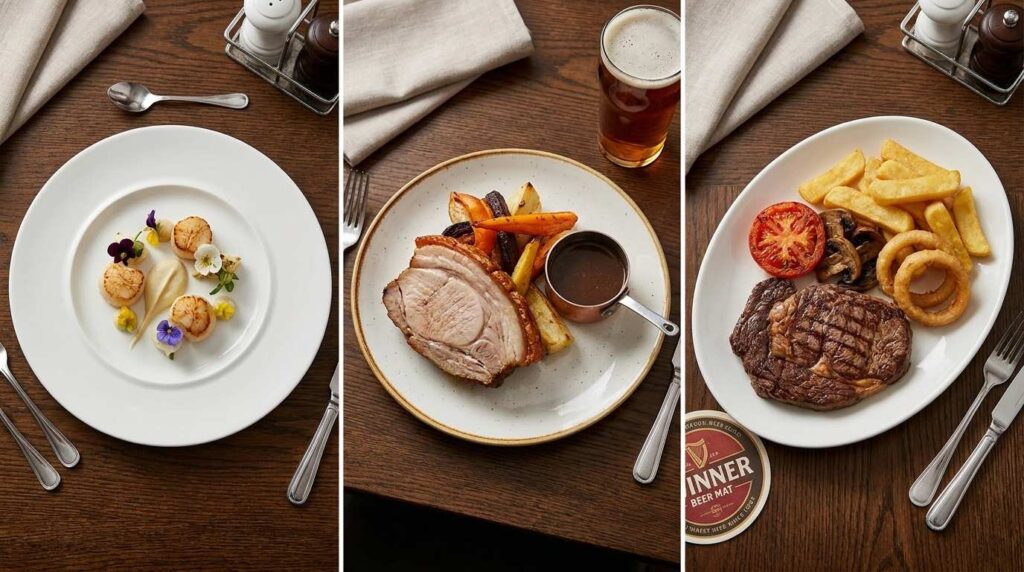
There is no universal right answer on plate size. The right choice depends on what you are cooking, how you are serving it, and what the rest of your operation looks like. Here is how plate sizes for restaurants actually break down by format across the UK.
Hotels and formal dining rooms
Hotel restaurants and formal dining rooms tend to work with a full-size hierarchy: 15 to 17cm bread plates, 20 to 22cm starters, 27 to 28cm mains, and 30 to 33cm charger plates at formal settings. The charger is a purely presentational piece that sits under the dinner plate for the duration of the meal and is removed before the main course is placed.
Weight is a relevant consideration in hotel dining. In contract catering and large hotel operations, front-of-house staff are carrying multiple plates per run across large floor plans. Heavier presentation plates contribute to fatigue across a long service. This is covered in more detail in the plate weight section below.
Fine dining and tasting menus
Multi-course tasting menus generally use smaller plates in the 19 to 23cm range, often with a pronounced rim that frames a central well of 12 to 16cm. The tight framing creates drama around a small, precise composition. A 4cm portion of cured salmon on a 22cm rimmed plate reads as a considered, complete dish. On a flat 27cm plate with no frame, the same dish looks unfinished.
Coupe plates are widely used in fine dining for amuse-bouche and specific courses because the full surface is available for plating and the clean lines suit contemporary presentation. The trade-off is covered below in the rim versus coupe section.
Gastropubs and casual dining
The gastropub and casual dining format in the UK has gravitated toward the 27 to 28cm range as a standard main plate, with a 20 to 23cm starter. Many gastropubs are now using stoneware or textured porcelain in these sizes, where the plate’s visual texture contributes to the perceived quality of the setting.
For sharing plate concepts, which are common in this format, a mix of sizes across the 18 to 23cm range works well. Varied plate sizes create visual interest on the table and signal to the diner that the experience is curated rather than formulaic.
Pubs and high-volume casual
In high-volume pub dining, the plate size tends to track portion size. Sunday roasts, fish and chips, pies, and burger-and-fries builds all need physical space for components to be laid out without stacking. The 28 to 30cm range is standard here.
Going significantly above 30cm for a pub main starts to create table space problems, which is covered in the section below. It also risks making the portion look smaller than it is, which is rarely what a pub kitchen wants.
Cafes and all-day dining
Cafe and brunch formats typically work with a 25 to 27cm plate for mains like full breakfasts and hot lunch dishes, and 20 to 22cm for lighter items. The plate weight consideration is more relevant in cafes than most operators realise: a lighter-weight plate speeds up clearing and reduces staff fatigue across a long split-shift day.
Contract catering and care homes
Contract catering and care home environments work primarily in the 23 to 27cm range for mains, with lightweight materials prioritised. In care home settings, particularly, a lighter plate is a genuine practical requirement, not just a preference. Melamine is widely used here, though its limitations with hot food service are worth understanding before specifying it.
Our guide to restaurant crockery materials covers the compliance and temperature considerations in full.
Plate size by dish type: a practical guide for the kitchen
Moving from venue format to specific dishes, here is how plate size decisions map onto common menu categories.
Pasta, risotto, and noodle dishes
Flat dinner plates in the 27 to 28cm range are a poor choice for pasta. The dish ends up spread thin across the surface, the sauce pools at the edges, and a portion that would look substantial in a bowl looks modest on a flat plate. The right vessel for pasta, risotto, and ramen is a pasta plate or shallow bowl in the 25 to 27cm range with a raised edge wall. The wall keeps the dish contained, provides something for the diner to fork against, and prevents sauce from reaching the rim and ending up on fingers and tablecloths.
If pasta features prominently on your menu and you are currently serving it on flat dinner plates, this is worth revisiting.
Steaks and premium protein mains
A 30 to 32cm flat or minimal-rim plate gives a steak the space to be presented without forcing components together. A 300g ribeye, resting juices, two garnish elements, and a sauce need room to breathe. On a 27cm plate, something has to be stacked or sacrificed. On a 32cm plate, every element has its position.
Steak plates set a table expectation that carries through to cutlery. The right steak knives need to match the premium positioning that a large presentation plate signals.
Sharing dishes and platters
For dishes designed to share, the relevant sizes move above the individual plate range into 35 to 45cm serving pieces. The key practical consideration is whether the piece sits flat on the table throughout the meal or is passed between diners. Pieces being passed need to be manageable in weight and have a profile that gives a secure grip. Pieces sitting centrally on the table can be wider and shallower.
Desserts
Desserts in most restaurant formats use a 19 to 22cm plate. At fine dining level, this shrinks further to 17 to 19cm for petit-four sized courses and expands to 22 to 23cm for more substantial dessert plates. The smaller size frames the dessert composition and signals a different register to the main course: smaller, more intricate, more precise.
Rim versus coupe: what it actually means for the person plating
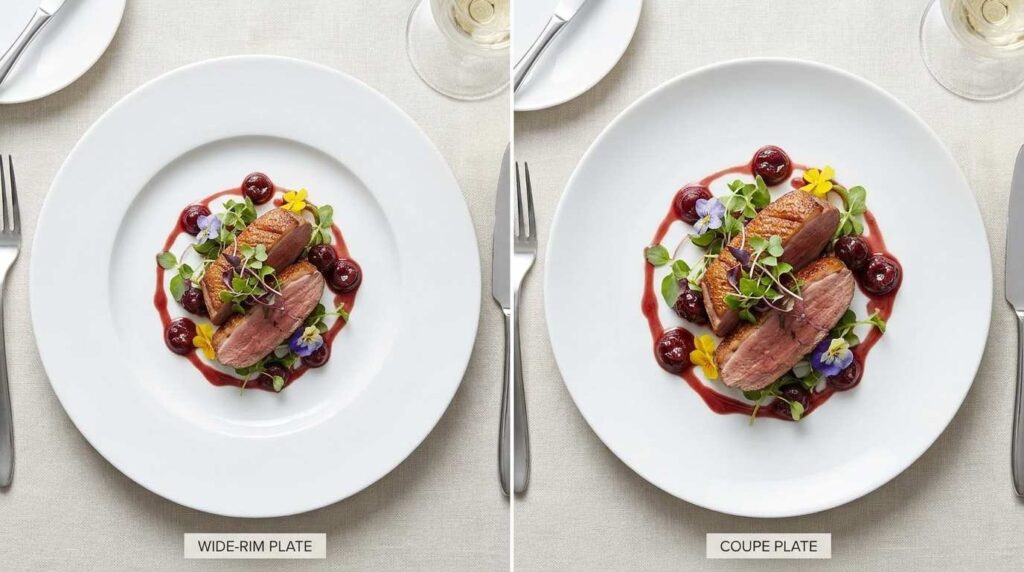
A rimmed plate creates a defined boundary between the plating area and the edge of the plate. This boundary does several useful things:
- ▸ It gives the chef a natural frame to plate within, which creates visual structure even with a relatively simple composition
- ▸ It provides a handling surface that does not require touching the food area
- ▸ The rim itself can be used as a design element, for sauce dragging, micro garnishes, or deliberate negative space
- ▸ It signals to the diner that the food is within a defined stage, not just placed on a surface
The practical constraint is well size. A 28cm plate with a 5cm rim gives a 18cm usable well. That is enough for most main course presentations but can feel restrictive for dishes with multiple components spread across a larger canvas.
A coupe plate removes the defined rim and slopes gently from the centre upward to the edge. The entire diameter is available for plating. For chefs with a strong compositional approach, this freedom suits certain dishes very well.
The limitations of coupe plates in commercial use are:
- ▸ Saucy dishes are a problem. Liquid migrates outward on the slope and reaches the edge, which means sauce on hands when carrying and potential sauce transfer when the plate is set down
- ▸ Without a rim providing visual structure, weaker compositions look spread out and unintentional
- ▸ They are harder to grip securely when warm, which matters across a busy service
Coupe plates work well for dry-plated dishes, dishes where sauce is applied as dots or deliberate streaks rather than a natural cooking liquid, and for presentations where the chef wants the full diameter as a canvas. They are the wrong choice for braises, sauced proteins, curries, and anything with significant natural jus.
Table space and cover layout: the maths that matters
There is an interaction between plate size and table geometry that affects how comfortable a table feels once set and how practical service is. Plate size cannot be decided without reference to the tables it will be placed on.
Standard UK bistro tables for two covers are typically 60 by 60cm. Slightly larger operations use 70 by 70cm or 75 by 75cm. When you work through the numbers, the differences compound quickly:
At a 60 by 60cm table for two:
- ▸ A 27cm plate leaves roughly 33cm of table space per side. Glassware and a side plate fit comfortably.
- ▸ A 30cm plate reduces that margin to 30cm. The table starts to feel tight, particularly once glassware is added.
- ▸ A 32cm plate at a 60cm table is genuinely difficult to lay correctly without something being stacked or removed.
At a 70 by 70cm table for two:
- ▸ A 30cm plate is workable. This is why premium casual and fine dining operations typically specify larger tables alongside larger plates. The two decisions are linked.
For operators working at tight covers per square metre on standard bistro tables, the 27 to 28cm dinner plate is not a default choice made by habit. It is the size that works with the most common UK table geometry. Understanding this means you can make a deliberate choice to move up to 30cm only when your table specification supports it, rather than creating service problems in the interest of a more premium look.
Why plate weight matters in a commercial kitchen
Plate weight is one of the practical considerations most catalogues and buying guides never address, and it affects operations in several concrete ways.
Carrying capacity. A waiter or waitress carrying two covers per run on a large floor plan is dealing with the cumulative weight of all the plates they carry per shift. A vitrified hotelware dinner plate in the 28cm range typically weighs between 500 and 700 grams. A heavier presentation plate in stoneware or thick porcelain can reach 900g to 1.2kg. Across 80 to 100 covers in an evening, the difference is felt.
Stacking and storage. Heavier plates require more robust shelving. They are also harder to stack safely in large quantities. Most commercial kitchen shelving is designed around standard plate weights, and very heavy plates create a stacking height problem that affects storage capacity and the risk of column collapse.
Speed of service. Lighter plates are faster to move from the pass to the table and from the table to the wash. In a high-volume operation where the speed of table turn matters, this is not a trivial factor.
Dishwasher handling. Commercial dishwasher operators loading and unloading racks across a full service handle hundreds of individual pieces. Plate weight contributes to the physical load of this role.
The general guide is:
- ▸ Lighter plates (350 to 500g for a 27 to 28cm piece) suit high-volume operations, cafes, contract catering, and any operation where staff cover a large floor area
- ▸ Medium weight (500 to 700g) is the standard for most UK restaurant formats and represents the best balance of presence and practicality.
- ▸ Heavier plates (700g and above) suit formats where pieces are placed rather than carried: chef’s table, tasting menus with low cover counts, formal hotel dining
If you are buying for a high-volume casual operation and have not considered plate weight as part of your specification, it is worth checking before committing to an order.
Dishwasher rack compatibility: the operational factor most buyers miss
Standard commercial dishwasher racks in UK hospitality are 500 by 500mm. The number of plates per rack changes meaningfully as plate diameter increases, and this has a direct impact on wash cycle throughput and operational cost.
As a working guide:
- ▸ 28cm plates: approximately 9 per standard rack
- ▸ 30cm plates: approximately 6 to 7 per standard rack
- ▸ 32cm plates: approximately 4 per standard rack, depending on the specific rack configuration
The practical implication: if you choose 30cm plates for a 100-cover operation’s main course, you are running roughly 40 per cent more rack cycles to wash the same number of plates compared to 28cm. Over a full service, that is additional time, water, detergent, and machine wear.
This is not a reason to always choose the smallest plate. It is a reason to factor rack compatibility into the specification process alongside size, profile, and quantity. Before confirming a large-format plate order, check the manufacturer’s specifications and confirm fit with your machine’s rack dimensions.
How many plates do you actually need?
The question of how many plates to order is one that buyers underestimate more consistently than almost any other part of the specification process. Too few, and you are mid-service with no clean covers. Too many, and you have storage problems and capital tied up in crockery sitting on shelves.
The standard industry calculation for plate stock in a full-service restaurant is:
(Covers per sitting) x (number of sittings per day) x (applicable courses) + 25 to 30 percent buffer
The buffer accounts for wash cycle time, breakage, and rotation.
Working through a practical example for a 60-cover restaurant running two sittings per day with a three-course menu:
- ▸ Dinner plates: 60 covers x 2 sittings x 1 main = 120 plates in active service daily. Add 30 per cent buffer = 156 minimum. In practice, most operators of this size round to 180.
- ▸ Starter plates: the same logic applies, though the buffer can be reduced slightly if wash cycles return plates to service fast enough between courses.
- ▸ Dessert plates: same as starter plates.
For a high-volume casual operation running three or four sittings with a two-course offer and a fast wash cycle, the plate count per cover can be reduced because pieces return to service more quickly. The key variable is wash cycle throughput, which connects back to the rack compatibility point above.
Recommended plate setup by venue type
This is intended as a practical buying starting point. Actual specifications will vary based on your specific menu, table sizes, and service format.
| Venue type | Bread plate | Starter | Main | Dessert | Notes |
| Bistro and casual dining | 16cm | 21cm | 27 to 28cm | 20cm | The wide rim main works well here |
| Gastropub | 16cm | 23cm | 28 to 30cm | 21cm | Stoneware suits this format |
| Fine dining | 15 to 16cm | 20 to 22cm | 27 to 28cm | 19 to 20cm | Add a charger for formal settings |
| Tasting menu | Optional | 19 to 22cm (multiple) | 22 to 24cm | 18 to 20cm | Coupe or wide rim depending on the dish |
| Hotel restaurant | 16cm | 22cm | 28cm | 21cm | Weight and durability are priorities |
| Pub dining | 17cm | 23cm | 28 to 30cm | 21cm | Flat or minimal rim, durability first |
| Cafe and brunch | Not usually | 20cm | 25 to 27cm | 20cm | Lightweight plates beneficial |
| Contract catering | Not usually | 23cm | 25 to 27cm | 20cm | Compliance and weight are key factors |
How UK Restaurant Plate Sizes Differ from International Norms
There is a practical difference between choosing plate sizes for restaurants in the UK context versus simply following international norms. UK hospitality has some distinct tendencies:
- ▸ The UK default dinner plate, the 27 to 28cm standard, is slightly smaller than the US norm, which runs closer to 28 to 30cm. This reflects the difference in average portion sizes and table sizes between the two markets.
- ▸ UK pub dining runs large: the 30cm plate is more common in traditional pub mains than in equivalent formats in mainland Europe, where the 27cm range is more typical.
- ▸ Fine dining in the UK has followed the European and Nordic trend toward smaller, more precise plates in the 19 to 23cm range, particularly for tasting-menu formats.
- ▸ Contract catering in the UK, driven partly by NHS and care home specifications, leans toward lighter materials and mid-range diameters in the 23 to 27cm range.
When specifying plate sizes for restaurants in the UK, using a UK-focused wholesale supplier means the standard size options align with these norms. US or European catalogues may list sizes in inches or millimetres using different conventions, which creates conversion errors when ordering in quantity.
Frequently asked questions
What is the standard dinner plate size for UK restaurants?
Most UK restaurants use a dinner plate between 27 and 28cm in diameter for main courses. High-volume casual dining and pub formats often use 28 to 30cm. Fine dining and tasting menu formats use smaller plates of 19 to 23cm for individual courses. There is no single regulated standard; the right size depends on your menu format, portion design, and the dimensions of your tables.
Does plate size affect how large a portion appears?
Yes. Research published in the Journal of Consumer Research found that participants served themselves 22 to 25 per cent more food when given larger plates, because the same portion looks smaller on a larger surface. A 2024 study in Appetite confirmed that as plate diameter increases beyond 27cm, diners rate both the portion size and the apparent food energy as lower. A wide-rim plate on a mid-range diameter makes a carefully portioned dish appear more generous than the same portion on an oversized flat plate.
What is the difference between a coupe plate and a rimmed plate for restaurant use?
A coupe plate has no defined rim and slopes from the centre to the edge, giving the chef the full diameter as a plating surface. A rimmed plate has a raised border that frames the food within a central well. Rimmed plates suit most restaurant formats, including saucy dishes, because they contain liquids and provide visual structure. Coupe plates work well for dry or semi-dry compositions in fine dining formats, but create service problems with liquid dishes because sauce migrates to the edge.
How many plates does a restaurant need per cover?
The standard calculation is: (covers per sitting) x (sittings per day) x (courses using that plate) plus 25 to 30 per cent for wash cycles, breakage, and rotation. For a 60-cover restaurant running two sittings with a three-course menu, that typically means a minimum stock of 150 to 180 dinner plates. Operations with slower dishwasher throughput or higher breakage rates should stock toward the higher end of that range.
Does plate weight matter in a commercial restaurant kitchen?
Yes, particularly in high-volume operations. Heavier plates add to the physical load carried by front-of-house staff across a full service, affect stacking and storage capacity, and slow dishwasher handling. Lighter plates in the 350 to 500g range suit cafes and high-volume casual formats. Standard restaurant weight of 500 to 700g suits most full-service formats. Heavier pieces above 700g are best reserved for low-cover fine dining or table-placed service where carrying weight is not a factor.
Are larger plates better for restaurants?
Not automatically. Larger plates give more plating space and suit premium formats, but they fit fewer per dishwasher rack, take more table space, are heavier to carry, and can make portions look smaller due to the Delboeuf illusion effect confirmed in published research. The 27 to 28cm dinner plate remains the most operationally efficient choice for most UK restaurant formats.
Bringing the decision together
Choosing the right plate size is a decision with more variables than it first appears. The diameter affects portion perception, table layout, wash throughput, and staff workload. The profile, flat, rimmed, or coupe, affects what you can plate and how it reads. The weight affects who can carry it, how many you can stack, and how the role of your dishwasher operator changes across a service.
For most UK restaurant formats, the 27 to 28cm dinner plate remains the right starting point for mains: it works with standard bistro table dimensions, fits commercial dishwasher racks efficiently, suits the range of dish types that most menus cover, and is available across a wide range of materials and profiles from UK wholesalers.
The decisions get more interesting at the edges: when you are running a tasting menu, specifying for a pub with large covers, managing a care home contract, or trying to stretch a limited budget across a full tableware setup. Those are the situations where the detail in this guide becomes most useful.
Browse our full commercial tableware range to explore plate sizes, profiles, and materials available for UK hospitality.
And for the full tableware procurement picture, including quantities, trends, and supplier guidance, the Restaurant Tableware and Crockery Buyer’s Guide covers the complete framework.
References
[^1]: Van Ittersum, K., and Wansink, B. (2012). Plate Size and Colour Suggestibility: The Delboeuf Illusion’s Bias on Serving and Eating Behaviour. Journal of Consumer Research, 39(2), 215-228. DOI: 10.1086/662615. Available at: https://doi.org/10.1086/662615
[^2]: Głuchowski, A., Koteluk, K., and Czarniecka-Skubina, E. (2024). Effect of Shape, Size, and Colour of the Food Plate on Consumer Perception of Energy Value, Portion Size, Attractiveness, and Expected Price of Dessert. Foods, 13(13), 2063. DOI: 10.3390/foods13132063. Available at: https://pmc.ncbi.nlm.nih.gov/articles/PMC11241694/