Choosing tableware for a restaurant is one of those decisions that looks simple from the outside and turns out to be surprisingly consequential once you are sitting inside it. The wrong plate can make a beautifully cooked dish look flat. The wrong material can add hundreds of pounds a year to your replacement bill. And ordering the wrong quantity means your front-of-house team is stacking dirty crockery mid-service, which nobody wants.
This guide covers everything a UK hospitality buyer needs to know in 2026: what to buy, how much to buy, which materials last, what the current trends actually mean for your budget, and how to build a procurement strategy that does not fall apart every time a table of six orders the sharing board.
It is written for restaurant owners, head chefs, operations managers, and anyone stepping into a procurement role for the first time. Whether you are opening a new site, refreshing a tired tableware set, or scaling from one location to three, the framework here applies.
From the WeCanSourceIt supply team: “The biggest mistake we see from new operators is buying on looks alone. The tableware that photographs best for your launch content is not always the tableware that holds up six months into service. Our job is to help you find pieces that do both.”
What Counts as Restaurant Tableware? Defining the Full Scope
Before you open a wholesale catalogue, it helps to be clear about what “tableware” actually covers in a commercial context. The term is broader than most people assume when they first start buying for a venue.
Crockery is the foundation: plates in multiple sizes, bowls, cups, mugs, saucers, ramekins, and serving dishes. This is where most of the budget goes and where most of the decisions need to be made.
Cutlery includes every piece of flatware at the table, from dinner forks and dessert spoons to steak knives and butter spreaders. In the UK hospitality trade, cutlery is usually sold by the dozen pieces and specified by steel grade.
Glassware covers water glasses, wine glasses, tumblers, highballs, and everything else that holds a drink. Commercial glassware is technically separate from crockery but forms an essential part of the complete tabletop picture.
Serveware refers to the larger pieces used to bring food from the kitchen to the table: platters, sharing boards, large serving bowls, sauce jugs, and condiment sets.
Table accessories round out the category: salt and pepper mills, napkin rings, menu holders, candle holders, and table numbers.
This guide focuses primarily on crockery and serveware because those are where the most complex buying decisions live. Glassware and cutlery have their own logic, but many of the principles here apply across all tabletop categories.
UK Hospitality Tableware Materials: A Practical Comparison
The material your crockery is made from determines almost everything else: how it looks, how heavy it is, how long it survives in a busy dishwasher, and what it costs to replace when pieces inevitably break. Here is how the main options stack up for commercial use in the UK.
Porcelain vs Stoneware vs Bone China: What Is the Actual Difference?
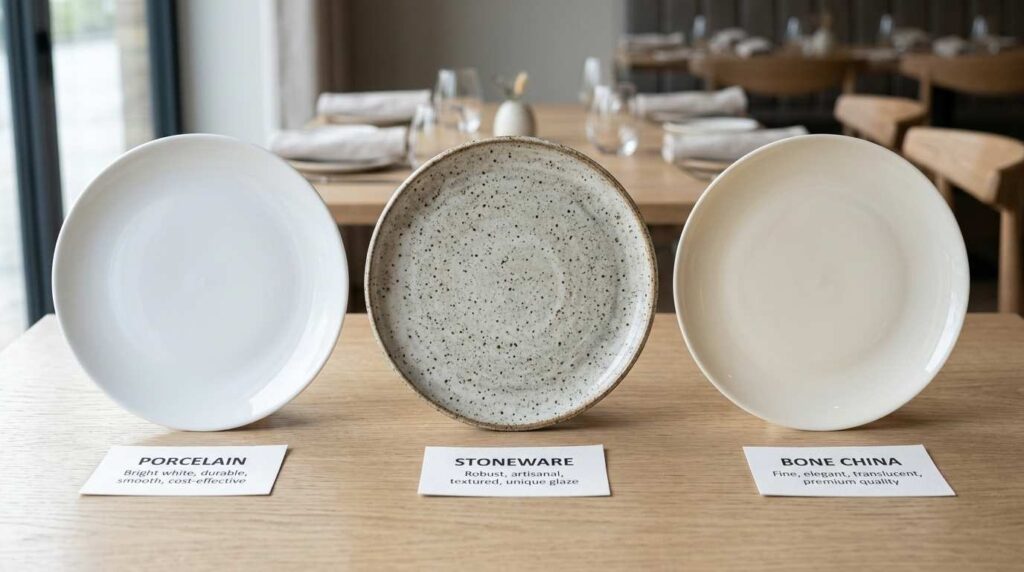
This is the most searched comparison among restaurant buyers, and the answer is more practical than most guides make it sound.
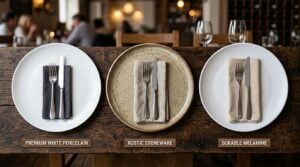
Porcelain is fired at very high temperatures, giving it a hard, dense body with a slight translucency and a smooth, bright finish. It is the default choice for the majority of UK restaurants because it sits at the intersection of durability, versatility, and cost. It handles commercial dishwashers well, holds up against everyday chipping better than its delicate appearance suggests, and presents food cleanly across every cuisine type.
The main limitation is that standard porcelain is not as chip-resistant as vitrified hotelware. If your kitchen is high volume or your front-of-house team is working under pressure with a lot of plate-stacking, you will go through porcelain faster than you expect.
Stoneware is made from a denser, coarser clay than porcelain and fired to a slightly lower temperature. The result is a heavier, more tactile piece with a natural, artisan quality to its surface. Stoneware has a significant presence in UK restaurants in 2026 because it fits naturally into the organic, handcrafted aesthetic dominating UK restaurant interiors right now. From a durability standpoint, it is chip-resistant and robust, though it is heavier than porcelain, which serves notice after a long service. Reactive glazes on stoneware can shift in appearance after sustained high-temperature dishwasher use, so always test a sample batch before committing to a full order.
Bone china contains a proportion of bone ash in its clay body, which gives it exceptional whiteness, a warm translucency, and a refined lightness in the hand. It is the prestige choice for fine dining and afternoon tea venues, and there is a legitimate reason for that. It genuinely looks and feels different to porcelain, and diners notice it. The trade-off is fragility relative to cost. Bone china chips more readily than vitrified hotelware; pieces cost more to replace, and some ranges have long lead times on replacements. For a 30-cover fine dining restaurant turning two sittings a week, bone china makes sense. For a 90-cover gastropub doing lunch and dinner seven days a week, it is an expensive frustration.
Supply team insight: “In our experience supplying UK hospitality businesses, operators who switch from standard porcelain to vitrified hotelware typically report a meaningful reduction in annual replacement orders. The upfront cost difference often pays back within the first year for venues doing 60-plus covers per service.”
Vitrified Hotelware
Vitrified hotelware is porcelain that has undergone an additional firing or treatment process that makes the body fully non-porous and significantly harder. This is the material specified under the British Standard BS4034:1990, which we cover in detail later in this guide. In practical terms, vitrified hotelware is the most durable everyday crockery available for commercial use. It resists chipping, stains less, and survives more dishwasher cycles before showing wear. It costs more upfront than standard porcelain, but when you factor in replacement rates over 12 to 18 months, it frequently works out cheaper. It is the recommended choice for any venue doing more than 60 covers per service.
Semi-Porcelain (Ironstone)
Semi-porcelain sits between porcelain and stoneware in density and weight. It is thicker than standard porcelain, which makes it naturally more chip-resistant, and it comes at a lower price point. It is a sensible choice for casual dining, canteen settings, and any venue where volume and cost efficiency matter more than the refinement of the tabletop presentation.
Polycarbonate and Melamine
Polycarbonate and melamine are plastic-based materials that will not break under any normal service conditions. They are the right choice for venues serving children, outdoor dining, festivals, poolside food service, and anywhere that breakage is both inevitable and unacceptable. They are dishwasher-safe, lightweight, and available in a wide range of colours and styles. Browse our melamine tableware range for commercial formats suited to care homes, schools, and outdoor service.
Material Comparison at a Glance
| Material | Chip Resistance | Weight | Approx. Dishwasher Cycles Before Wear | Best For | Relative Cost |
| Vitrified hotelware | Excellent | Medium | 1,000 or more | High-volume restaurants, hotels | Medium-high |
| Bone china | Moderate | Light | 300 to 500 | Fine dining, afternoon tea | High |
| Porcelain | Good | Medium | 500 to 800 | Casual to mid-range dining | Medium |
| Stoneware | Good | Heavy | 400 to 700 | Gastropubs, artisan cafes | Medium |
| Semi-porcelain | Very good | Heavy | 600 to 900 | Canteens, casual dining | Low-medium |
| Polycarbonate / Melamine | Unbreakable | Very light | Unlimited | Outdoor, children’s venues | Low |
Dishwasher cycle estimates are indicative. Actual performance depends on detergent concentration, water hardness, temperature, and glaze type. Always request supplier confirmation for the specific product you are ordering.
Browse our commercial tableware range to compare options across material types and price points.
How to Calculate How Much Crockery You Actually Need
This is the question that most guides skip, and it is the one that causes the most operational problems for new and expanding venues. Order too little, and you are hand-washing between services. Order too much, and you have tied up capital in stock sitting in a rack most of the time.
The industry formula used by experienced catering buyers:
Base quantity = (Number of covers) x (Number of turns per service) x (Buffer multiplier)
The buffer multiplier accounts for items that are in the dishwasher, broken, or temporarily out of circulation. For a busy commercial kitchen, a buffer of 1.5 is the minimum. For a high-volume operation, 2.0 is safer.
Worked example: A 60-cover restaurant doing two lunch turns and two dinner turns in a day, with a standard 1.5 buffer:
60 covers x 4 turns x 1.5 buffer = 360 of each core item (theoretical daily ceiling)
In practice, you will not run all four turns simultaneously, and your dishwasher cycle will return plates to service. A realistic operational stock for this venue is 180 to 240 main plates, with your glasswasher closing the gap. But the formula gives you the ceiling to plan against.
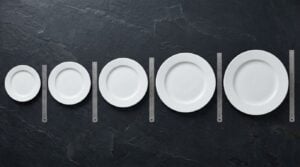
From our supply team: “Our most requested plate sizes by UK restaurant operators are 27 cm and 29 cm dinner plates. The 27cm is the workhorse for mid-range dining; the 29cm tends to be the choice for gastropubs and casual fine dining venues where presentation space matters.”
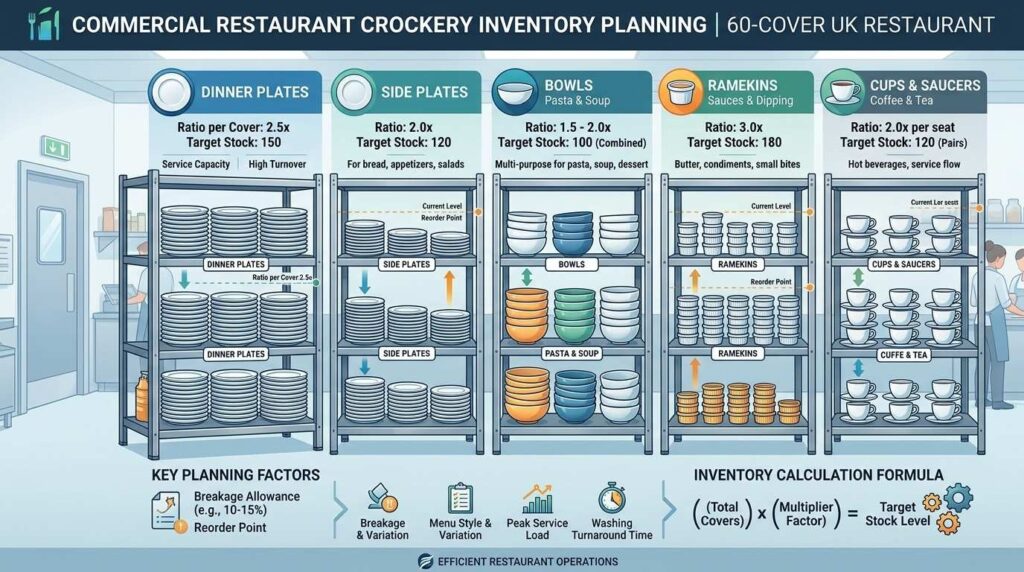
Recommended Starting Stock for a 60-Cover Restaurant
| Item | Starting Quantity | Notes |
| Main plates (27 to 29cm) | 120 to 150 | Highest-use item, highest breakage risk |
| Side plates (17 to 20cm) | 80 to 100 | Bread, starters, sharing formats |
| Starter or dessert plates (22 to 24cm) | 80 to 100 | Skip if your format uses one plate size |
| Pasta or soup bowls | 60 to 80 | Scale up for bowl-heavy menus |
| Ramekins | 60 to 80 | These disappear fast between the sides and sauces |
| Cups and saucers | 40 to 60 sets | For table-side coffee and tea service |
| Serving platters | 20 to 30 | Across a range of sizes for sharing formats |
Always add 20 per cent to your first order to account for breakage in the first three months, when your team is still learning the feel of the pieces and how they stack.
Matching Tableware to Your Restaurant Concept
One of the most common mistakes buyers make is choosing crockery they personally like rather than crockery that fits the concept. The tableware at a Michelin-starred tasting menu restaurant is doing a completely different job to the tableware at a neighbourhood pizzeria, and the right choice in one context is a poor choice in the other.
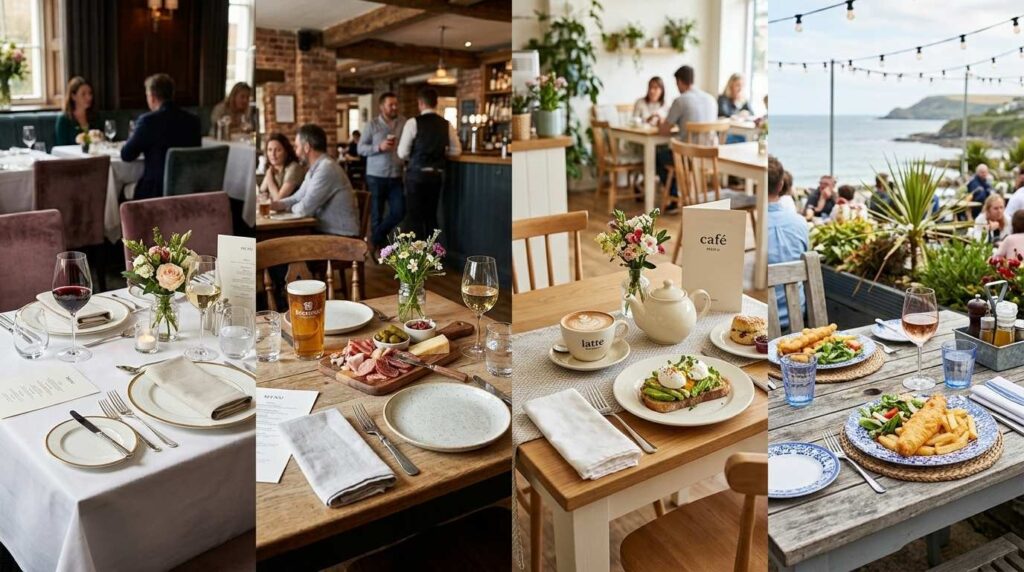
Fine Dining and Tasting Menu Restaurants
The tabletop in a fine dining context is part of the composition. Every piece is chosen deliberately, and guests are paying attention. Bone china and high-end porcelain are the natural choices here, particularly in white or very restrained off-white tones that let the food speak. Plate shapes matter more at this level: consider coup plates (rimless), wide-rim plates that frame the food, and asymmetric shapes for specific courses.
Budget more generously per cover, and accept that replacement costs will be higher. The experience justifies the investment.
Gastropubs and Casual Fine Dining
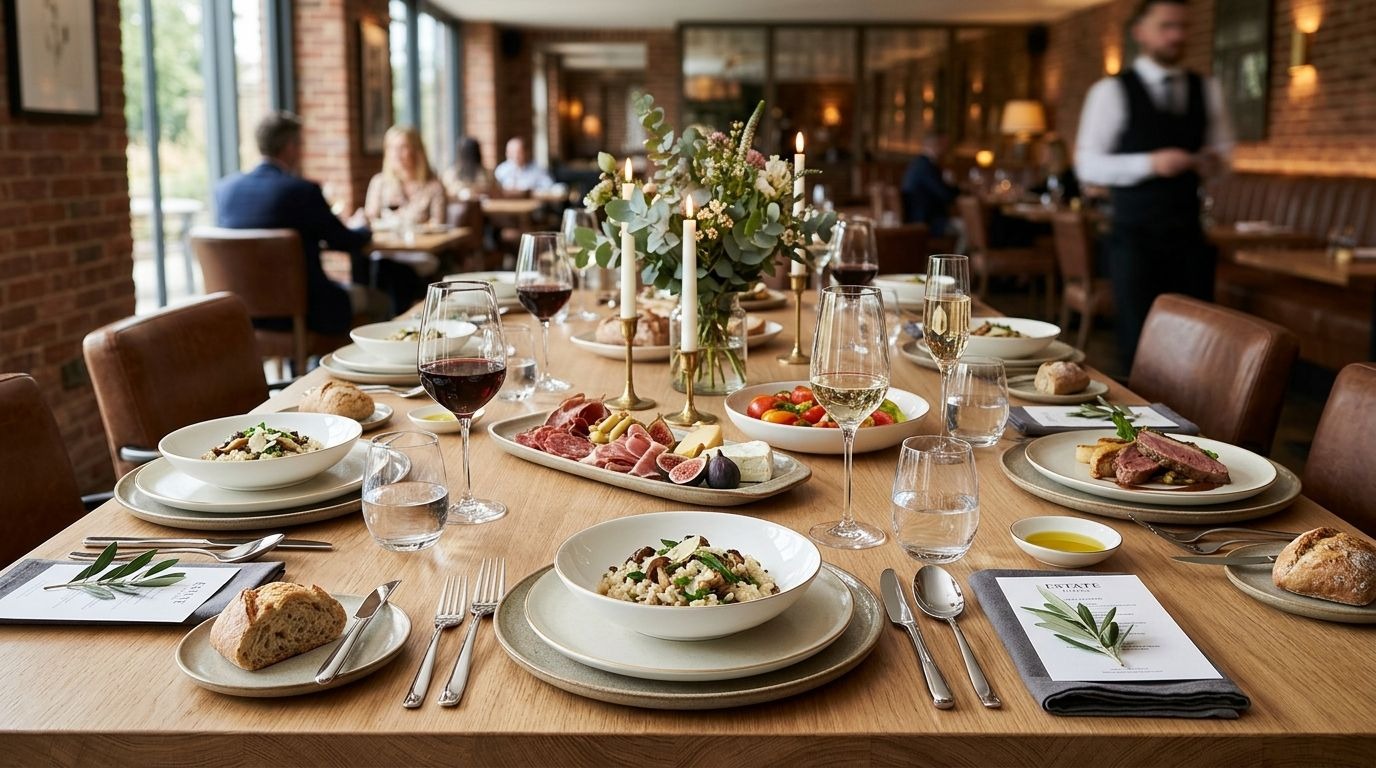
This is the broadest category and the one where the 2026 trend toward texture and organic finishes is most visible. Vitrified hotelware in slate, charcoal, or warm stone tones works well here, as does stoneware in reactive glazes. Sharing boards, slate serving pieces, and ramekins for sides are as important as the main plate. Durability is critical because gastropubs typically run high covers across long trading hours. Vitrified hotelware is almost always the right call for main plates and bowls at this tier.
For operators at this level, our catering tableware range includes commercial-grade options suited to high-volume service.
Neighbourhood Cafes and All-Day Dining
Consistency and warmth are the priorities. Thick-rimmed porcelain or semi-porcelain in white or cream performs well and looks friendly without being precious. Cups and mugs matter as much as plates in this format because coffee service is a significant revenue stream. Choose mugs that hold heat well, feel comfortable in the hand, and stack without chipping.
Consider a cohesive “family” approach: buy one range that includes plates, bowls, mugs, and saucers so everything looks intentional without being matched in a way that feels overly formal.
Fast-Casual and Counter Service
Speed of service and ease of cleaning are the primary drivers. Semi-porcelain or melamine for main plates, polycarbonate for drinks, and simple white or single-colour finishes that can be replaced identically without worrying about batch variation. Keep it simple, keep it robust.
Street Food, Pop-Up, and Outdoor Dining
Polycarbonate and melamine are the sensible choices for outdoor use, high-footfall events, and festival settings. Compostable and recyclable plate options are increasingly viable for outdoor events where washing facilities are limited. WeCanSourceIt stocks a full range of compostable catering plates designed for exactly this format.
Concept-to-Tableware Quick Reference
| Restaurant Type | Recommended Material | Key Pieces to Prioritise |
| Fine dining / tasting menu | Bone china, premium porcelain | Wide-rim presentation plates, coup plates |
| Gastropub / casual fine dining | Vitrified hotelware, stoneware | Main plates, sharing boards, ramekins |
| Neighbourhood cafe / all-day | Porcelain, semi-porcelain | Mugs, plates, and bowls as a coordinated family |
| Fast-casual / counter service | Semi-porcelain, melamine | Durable main plates, stackable bowls |
| Hotel restaurant / breakfast | Vitrified hotelware | Full cover sets, teapots, jugs |
| Outdoor / pop-up / events | Polycarbonate, melamine, compostable | Lightweight, stackable, weather-resistant |
2026 UK Tableware Trends: What Is Actually Worth Acting On
The hospitality trade press talks about trends constantly, and not all of them translate into practical buying decisions. Here is an honest assessment of what is genuinely shaping tableware choices in UK restaurants in 2026.
Texture as the New Colour
For the past decade, the default for mid-range UK restaurants was plain white porcelain. That is not going away, but venues that want to feel current in 2026 are moving toward surface texture as their point of difference rather than colour. This means embossed patterns, ribbed edges, hammered surfaces, and matte glazes that catch the light differently at different angles.
From a buying standpoint, you do not need to replace everything to engage with this trend. Start with your hero plate, the main plate used for your most visually striking dish, and introduce a textured or matte version there. Your sides and smaller pieces can stay in your existing range while you test how the new piece reads in your space.
The Small Plates and Social Dining Movement
Sharing menus, grazing boards, and small-plates formats have reached genuine mainstream adoption in UK dining in 2026. This shift has real implications for what you need to buy. A sharing-format menu needs a broader range of piece sizes: small plates around 15 to 18cm for individual bites, larger sharing platters at 30 to 40cm, and a variety of bowl depths for saucier dishes. Ramekins and dipping bowls become high-rotation items rather than occasional accessories.
The Organic and Wabi-Sabi Aesthetic
Wabi-sabi is a Japanese design philosophy that finds beauty in imperfection and impermanence. In practical tableware terms, this translates to pieces with irregular edges, reactive glazes that mean no two pieces are exactly alike, unglazed bases, and earthy tones from terracotta to deep charcoal.
This aesthetic fits naturally with the direction UK restaurant interiors are moving: natural materials, indoor planting, exposed brick and wood, and a deliberate rejection of the overly polished. Stoneware ranges and reactive-glaze porcelain collections serve this look well. The operational note is that reactive glazes can fade or shift in appearance after sustained commercial dishwasher use, so test a batch before committing to volume.
Multifunctional and Versatile Pieces
Rising food and labour costs in the UK hospitality sector have made operational efficiency a genuine priority for buying decisions. The result is growing interest in pieces that do more than one job: a wide, shallow bowl that works equally well for pasta, salad, and dessert; a cup size that covers both espresso and flat white service; a platter that functions as both a sharing board and a presentation plate. Versatile pieces reduce the number of SKUs you need to manage, simplify storage, and make replacement ordering more straightforward.
UK Catering Industry Standards and Compliance
What BS4034 Means and Why It Matters
BS4034:1990 is the British Standard for vitrified hotelware, published by the British Standards Institution (BSI). It specifies requirements for resistance to water absorption and crazing for ceramic ware used in commercial hospitality settings. A piece that meets BS4034 has been tested to confirm it can withstand the demands of a commercial kitchen environment in terms of porosity and crazing resistance.[^1]
When you see “BS4034 compliant” in a product description, it is a meaningful quality signal, not marketing language. It means the piece has been manufactured and tested to this specification.
If you are buying for a hotel, a large restaurant group, or a venue subject to regular environmental health inspections, specifying BS4034-compliant crockery is good practice and demonstrates that your tableware purchasing follows a documented, independently verified standard.
Food Contact Material Regulations
In the UK, all crockery and serveware used in commercial food service must comply with food contact material regulations. These requirements continue to follow the framework established under assimilated Regulation (EC) No 1935/2004 on materials and articles intended to come into contact with food, as retained in UK law.[^2] In practical terms, glazes, dyes, and surface treatments must be food-safe and must not leach harmful substances into food.
Reputable commercial suppliers will supply products meeting these requirements as standard. If you are buying from an unfamiliar source at an unusually low price, it is worth asking for a declaration of compliance. This is particularly relevant for coloured glazes and decorated pieces.
Allergen Considerations at the Table
If your kitchen manages severe allergen requirements, your crockery and serveware regime needs to support that. Some operators use a different-shaped or differently coloured ramekin as a kitchen-to-table signal for allergen-managed dishes. If this applies to your operation, factor it into your buying plan from the start rather than retrofitting it later. The Food Standards Agency guidance on allergen management in catering recommends that colour-coding systems for allergen-safe service items be documented in your HACCP plan.[^3]
Total Cost of Ownership: The Number That Actually Matters
The price on a per-unit basis is the least useful number when buying commercial crockery. The number that matters is the total cost of ownership over 12 to 18 months, which means factoring in replacement frequency, replacement availability, and the indirect costs of breakage during service.
How Breakage Rates Affect Your Annual Bill
Based on our experience supplying UK hospitality businesses across different venue types, breakage rates typically fall into these ranges:
| Venue Type | Typical Annual Breakage Rate |
| High-volume gastropub or brasserie | 15 to 20% of the total stock |
| Neighbourhood cafe or bistro | 10 to 15% of the total stock |
| Fine dining (lower covers, trained FOH) | 5 to 10% of total stock |
| Fast-casual or counter service | 20 to 25% of the total stock |
A venue with 200 main plates losing 15 per cent per year is replacing 30 plates annually. If those plates cost £3.50 each in a standard porcelain range, that is £105 in replacements. If the plates are vitrified hotelware at £5 each but break at a 10 per cent rate, the annual replacement cost is £100, and your team spends less time managing stock shortfalls mid-service.
A Simple Total Cost of Ownership Calculation
To compare two options honestly, use this structure:
Total cost over 2 years = (Units purchased x unit price) + (Annual breakage rate x unit price x stock volume x 2)
Run this for each material option you are considering. You will often find that the more expensive upfront option works out cheaper at the 18-month mark, particularly when comparing standard porcelain against vitrified hotelware.
Replacement Availability Is a Hidden Cost
One of the most frustrating situations in restaurant operations is a crockery range going out of production or out of stock at the point when you need to replace broken pieces. When evaluating ranges, ask your supplier two questions: how long has this range been in production, and what is the expected stock continuity? Established commercial ranges from major manufacturers are far more likely to be available for five or more years than niche or fashion-led pieces.
Where to Buy Restaurant Tableware Wholesale in the UK
The UK market for commercial crockery and tableware is well-served by a range of wholesale and trade suppliers.
Specialist catering suppliers such as Nisbets, Alliance Online, and Ascot Wholesale carry broad ranges across multiple brands and materials and typically offer trade accounts with deferred payment terms.
Direct wholesalers such as WeCanSourceIt give you access to commercial-grade tableware alongside the full range of catering supplies, packaging, and food service essentials you are likely to need anyway. Buying across categories from one supplier simplifies ordering and often unlocks better pricing on delivery. We offer free UK mainland delivery on orders above £75 excluding VAT, with no minimum order commitment and trade pricing available from your first order.
Brand direct purchasing from manufacturers like Churchill China or Steelite is an option for larger operators buying at scale. Minimum order quantities are typically higher, but pricing per unit can be more competitive for large restaurant groups.
Things to Check Before Placing a Wholesale Order
Before committing to a supplier, confirm:
Stock continuity: Can they supply replacement pieces of the same range in 12 months?
Lead times: How long from order to delivery, particularly for initial large orders?
Sample policy: Will they send samples before you commit to a full order? Testing a plate in your actual kitchen under your actual dishwasher is worth the wait.
Returns and breakage policy: What happens if a delivery arrives with damaged pieces?
Trade account terms: If you need 30-day payment terms, can they accommodate this?
Sustainability and Eco Considerations in 2026
Sustainability in tableware is a more complex topic than it often appears in trade media. The reality involves trade-offs worth understanding.
The Longevity Argument for Quality Crockery
The most sustainable piece of crockery is one that does not need to be replaced. A vitrified hotelware plate that survives 1,000 dishwasher cycles and five years of service has a significantly lower environmental footprint per use than a cheaper piece that needs replacing every 18 months. Durability is the most practical sustainability credential available in commercial tableware.
The Disposable Trade-Off
For outdoor dining, festivals, and pop-up events, the choice between reusable and disposable tableware involves a genuine sustainability calculation. High-quality reusables have a lower per-use environmental impact if they are used enough times before disposal, but they require washing facilities, transport, and loss management. Compostable and recyclable disposables have improved significantly in quality and are the right answer for many outdoor formats, particularly where washing infrastructure is not available. WeCanSourceIt stocks compostable plates and eco-friendly disposable tableware for operators who need a reliable option for events and outdoor service.
Packaging and End of Life
Ceramic crockery cannot typically be recycled through standard municipal streams when it reaches the end of its life. Some specialist ceramics recyclers accept commercial quantities. Polycarbonate and melamine also have limited recycling options and generally end up in landfill at the end of their life. For forward-thinking buyers, this is a factor worth considering when evaluating the full lifecycle of any purchase.
Care, Cleaning, and Commercial Dishwasher Compatibility
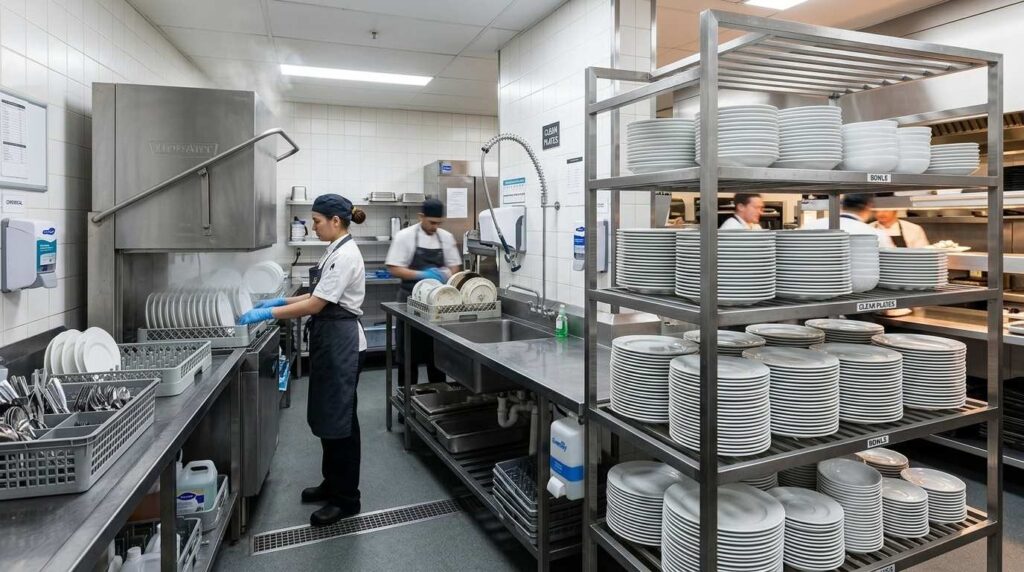
Commercial Dishwasher Temperatures and Glazes
Most commercial pass-through dishwashers operate at wash temperatures between 55 and 65 degrees Celsius, with a rinse cycle at 82 to 85 degrees for hygiene compliance. Standard vitrified porcelain and vitrified hotelware handle these temperatures without issue over thousands of cycles.
The pieces most vulnerable to high temperatures are those with:
Reactive glazes: The surface chemistry that makes these glazes beautiful also makes them slightly more susceptible to change over time in high-temperature commercial machines. Colours can shift, and surface texture can alter with sustained heavy use.
Metallic or lustre finishes: Gold, platinum, and other metallic decorations on crockery are not safe for commercial dishwashers at high temperatures. They are strictly hand-wash only, which makes them impractical for high-volume service.
Dark solid-colour glazes: These show limescale and water marking more visibly than white pieces, particularly in hard-water areas. Using a rinse aid designed for ceramic ware and descaling your machine regularly will extend the life and appearance of dark-glaze pieces significantly.
Stacking, Storage, and Reducing Chip Risk
A large proportion of crockery damage in commercial kitchens happens not in the dishwasher but in stacking and storage. Practical steps that genuinely reduce breakage:
Rack your plates in the dishwasher rather than stacking them flat if your machine has rack capacity. Flat stacking creates impact points at the edges.
Store plates in stacks no higher than 20 to 25 pieces. Higher stacks put pressure on pieces at the bottom and increase the chance of a wobble bringing the whole stack down.
Use rubber matting on shelving and storage racks to cushion the base of stacks.
Train front-of-house staff to carry a maximum of two to three plates in a hand stack. The speed gain from a tall carry is not worth the breakage risk.
Detergent Compatibility
Commercial dishwasher detergents are significantly more aggressive than domestic products. Using a commercial-grade rinse aid alongside your main detergent helps maintain the surface and reduces streaking on both light and dark pieces. If you are running a large operation, discuss your crockery material with your dishwasher chemical supplier to confirm you are using a compatible formulation.
Restaurant Crockery Buying Checklist
Use this checklist before placing any order.
Before You Buy
- [ ] Defined your restaurant concept and matched it to the right material type
- [ ] Calculated your base quantity using the cover count formula
- [ ] Added a 20 per cent buffer for initial breakage
- [ ] Confirmed the range is BS4034 compliant if buying vitrified hotelware
- [ ] Requested samples and tested them through your actual dishwasher
- [ ] Confirmed replacement stock availability with your supplier
- [ ] Checked for metallic finishes that are incompatible with your dishwasher
- [ ] Considered allergen management requirements and whether differentiated serving pieces are needed
Item-by-Item Checklist for a Full Restaurant Setup
- [ ] Main plates (27 to 29cm)
- [ ] Side or bread plates (17 to 20cm)
- [ ] Starter or dessert plates (22 to 24cm)
- [ ] Pasta or soup bowls
- [ ] Shallow bowls for sharing dishes or salads
- [ ] Ramekins (small, for sides and dipping sauces)
- [ ] Cups (espresso, cappuccino, or standard depending on coffee format)
- [ ] Mugs (if offering tea and filter coffee)
- [ ] Saucers to match cups and mugs
- [ ] Milk jug and sugar bowl for table service
- [ ] Serving platters (small, medium, large)
- [ ] Sharing boards if applicable
- [ ] Sauce or condiment jugs
- [ ] Teapots if offering loose-leaf service
- [ ] Salt and pepper mills or pots
- [ ] Cutlery sets matched to your cover count
- [ ] Glassware matched to your drinks menu
Ongoing Stock Management
- [ ] Carry a minimum of 15 per cent reserve stock for emergency replacements
- [ ] Audit your stock quarterly and reorder before you hit a critical shortfall
- [ ] Track breakage by item type to identify which pieces are most vulnerable
- [ ] Review your material choice at the 18-month mark against actual replacement cost
Need Help Choosing the Right Restaurant Tableware?
Whether you are opening a new venue, replacing worn stock, or building a tabletop from scratch, the WeCanSourceIt team is available to help you find the right product for your operation and budget.
Opening a new restaurant? We can help you build a full opening order covering tableware, catering disposables, packaging, and cleaning supplies in a single order.
Replacing existing crockery? Tell us what you are currently using, your covers, and your typical service format, and we can recommend the most cost-effective replacement option.
Unsure how much stock to order? Use the cover count formula above, or contact our team, and we will work through the numbers with you.
Browse our full tableware range or get in touch with our supply team for trade pricing and account setup.
Frequently Asked Questions
How much crockery does a restaurant need per cover?
The standard formula is covers multiplied by the number of meal turns in a day, multiplied by a buffer of 1.5 to 2. For a 60-cover restaurant doing two services a day, you need roughly 180 to 240 main plates as a working operational stock. Add 20 per cent to your initial order to absorb early breakage.
What is the difference between porcelain and vitrified hotelware?
Porcelain is a high-fired ceramic with a smooth, dense finish. Vitrified hotelware is porcelain that has been additionally treated or fired to make the body fully non-porous and significantly more resistant to chipping, crazing, and staining. Vitrified hotelware meets the BS4034:1990 standard and is the recommended choice for high-volume commercial use.
Porcelain vs stoneware: which is better for restaurants?
For most UK restaurants, porcelain is the more practical everyday choice because it is lighter, easier to manage in a fast-service environment, and available in a wider range of replacement options. Stoneware suits venues where the tactile, artisan aesthetic is part of the offer and where covers are moderate enough that the extra weight per plate is manageable for front-of-house staff.
Is bone china suitable for a busy commercial kitchen?
Bone china performs well in fine dining settings with trained front-of-house staff and moderate covers. It is not ideal for high-volume operations because its relative fragility and higher replacement cost make it expensive to maintain at scale. For venues doing more than 60 covers per service, vitrified hotelware is a more practical choice.
What does the BS4034 standard mean for restaurant crockery?
BS4034:1990 is the British Standard for vitrified hotelware published by the British Standards Institution. It defines minimum requirements for resistance to water absorption and crazing, confirming the ceramic body meets vitrified classification. Products meeting this standard are confirmed suitable for commercial hospitality use.
Can I mix different crockery collections in the same restaurant?
Yes, and when done intentionally, it can look excellent. The key is one consistent element that ties the pieces together, whether that is a matching colour family, a similar weight and rim style, or a shared material. Mixing pieces from completely different aesthetic worlds without a unifying element tends to look like disorganisation rather than a deliberate choice.
How often should a restaurant replace its tableware?
There is no fixed schedule. The right approach is to track breakage quarterly and reorder as needed to maintain your buffer stock. A well-chosen vitrified range in a well-run kitchen should last three to five years before a full refresh is warranted for aesthetic rather than operational reasons.
Where can I buy restaurant tableware wholesale in the UK?
Specialist catering suppliers, direct wholesalers, and manufacturer-direct routes are all options. For operators wanting to combine tableware with their broader catering supplies order, WeCanSourceIt offers trade pricing and free delivery over £75 ex VAT with no minimum commitment.
Summary: The Buying Framework in Brief
Buying restaurant tableware well comes down to four decisions made in the right order.
First, match your material to your concept. The durability requirements of a 90-cover gastropub and the aesthetic requirements of a 20-cover tasting menu are not the same problem, and the crockery that serves one will frustrate the other.
Second, calculate your quantity honestly using the cover count formula, and build in a realistic buffer from day one.
Third, factor in the total cost of ownership rather than the unit price. A plate that costs less per piece but breaks twice as often is not cheaper.
Fourth, choose a range with genuine stock continuity from a supplier you can call when something goes wrong.
Ready to order? Browse the WeCanSourceIt tableware and catering supplies range or contact our team for trade pricing and account setup.
References
[^1]: BS4034:1990 — Specification for vitrified hotelware. British Standards Institution. Available at: https://knowledge.bsigroup.com/products/specification-for-vitrified-hotelware
[^2]: Food contact materials guidance. Food Standards Agency. Available at: https://www.food.gov.uk/business-guidance/regulated-products/food-contact-materials-guidance
[^3]: Allergen guidance for food businesses. Food Standards Agency, 2024. Available at: https://www.food.gov.uk/business-guidance/allergen-guidance-for-food-businesses