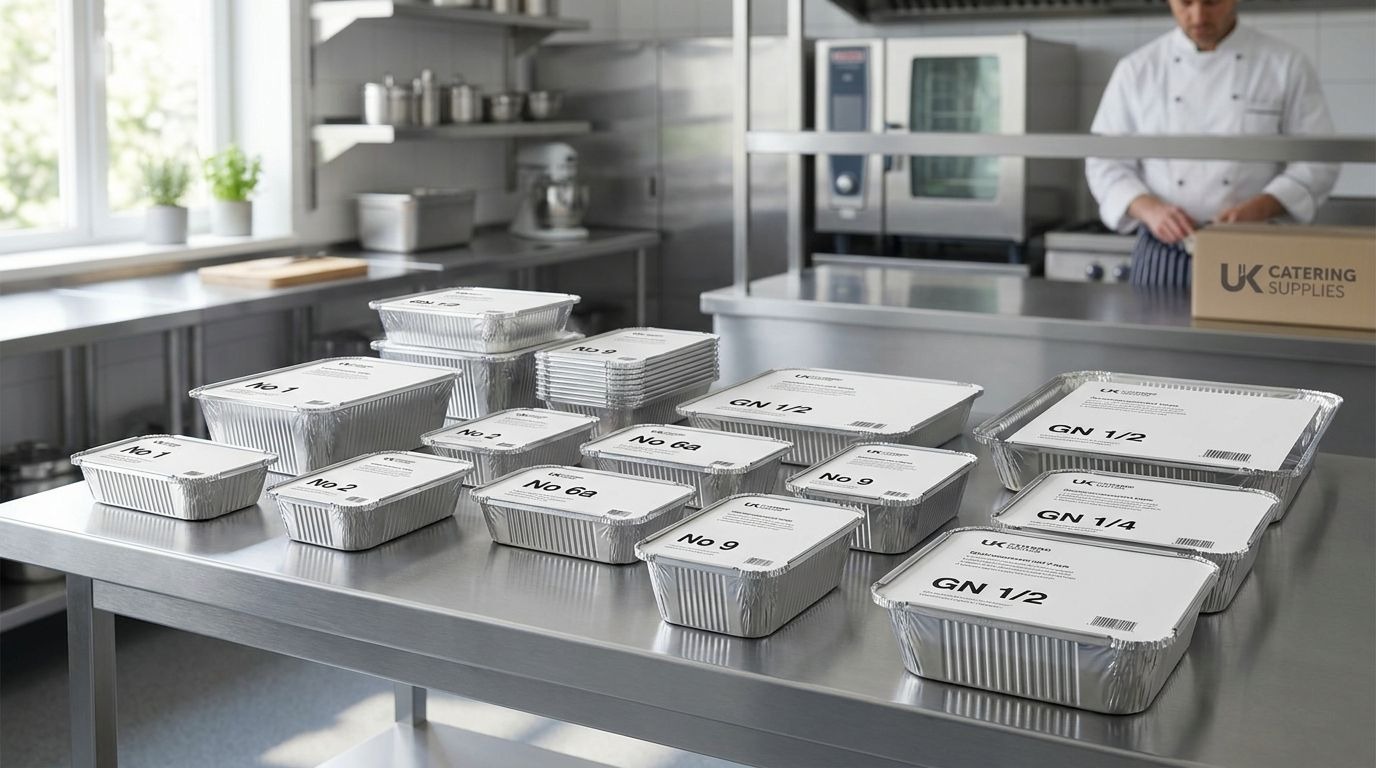
Aluminium Foil Containers for Catering are one of the most widely used packaging solutions in the UK foodservice industry, offering a practical, recyclable, and oven-safe option for takeaways, restaurants, meal prep companies, and professional caterers.
Available in a wide range of sizes, from single-portion curry containers to full gastronorm catering trays, they support everything from takeaway delivery to large-scale foodservice operations. While the basics of the No. sizing system, smoothwall versus wrinklewall containers, and foil thickness are well documented, many operators still have practical questions about choosing the right container for specific foods, complying with labelling requirements, and managing packaging costs effectively.
This guide focuses on the practical decisions that get less coverage: which container to use for which cuisine, what operators should do about the microwave reheating problem, how Natasha’s Law allergen labelling applies to food packed in foil, how to calculate a weekly order requirement, and a practical independent comparison of where UK operators can buy.
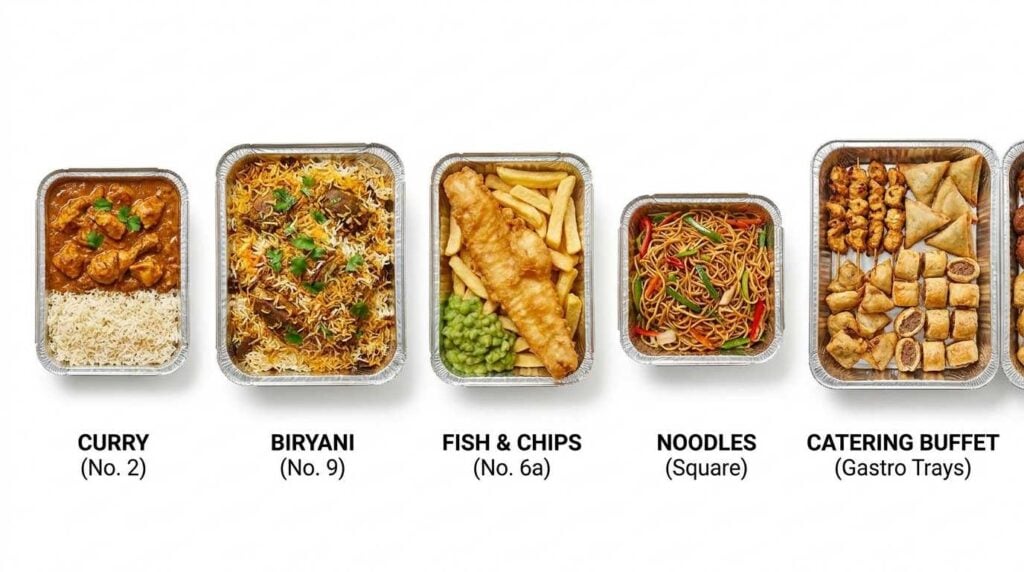
Quick Answer: Foil Container by Cuisine Type
| Cuisine / Food | Recommended Container | Key Reason |
| Indian curry (single portion) | No 2 smoothwall + card lid | Standard portion capacity; lid seals flat |
| Biryani/rice dishes | No 9 deep + card lid | Volume capacity for rice with sauce layer |
| Kebab / elongated dishes | No 6a + card lid | Shape suited to longer portions |
| Chinese chow mein / noodles | No 9 + card lid | Volume: noodle portion size |
| Fish and chips | No 6a or No 12 + vented board lid | Shape: ventilation reduces sogginess |
| Lasagne / baked pasta | Half gastro wrinklewall deep | Even heat distribution for oven cooking |
| Roast dinner | 3-compartment or full gastro shallow | Component separation; catering volume |
| Catering/buffet service | Full gastro shallow or deep | Chafing dish compatible; bulk volume |
| Meal prep/gym delivery | No 2 or No 9 heavy-gauge + film lid | Freezer-to-oven; heat-sealable lid required |
Which Container Should I Buy?
| Business Type | Recommended Container |
| Curry House | No 2 Smoothwall |
| Chinese Takeaway | No 9 Deep |
| Fish & Chips Shop | No 6a |
| Meal Prep Company | Heavy Gauge No 2 + Film Lid |
| Catering Company | Full Gastro Deep |
| Buffet Service | Full Gastro Shallow |
The Cuisine-by-Cuisine Foil Container Selector
The No. sizing system tells you the capacity of a container. What it does not tell you is which size suits which food. Here is a practical format guide by UK cuisine type.
Indian and South Asian Takeaways
Indian takeaways are among the largest users of foil containers in the UK food service sector. The standard formats and their uses:
No 2 smoothwall with card lid – the workhorse of Indian takeaway service. Dimensions approximately 14 cm x 11.5 cm x 4 cm. Suited to a single portion of curry, dhal, bhaji, or side dish. The smoothwall finish allows the card lid to seat flat and create a consistent seal.
No 9 deep with card lid – the standard for biryani, larger rice portions, and main-course servings with a significant rice component. Dimensions approximately 22.8 cm x 22.8 cm x 5.2 cm. Also used for catering quantities of a single dish.
No 1 with card lid – the smallest standard format. Suited to chutneys, pickles, raita, and small side portions.
Chinese and Asian Takeaways
No 9 with card lid – for noodle dishes, chow mein, and larger portions. The square format holds noodles well and allows even distribution across the container base.
No 2 with card lid – for rice portions, smaller side dishes, and sauces served separately from the main.
An important operational note for Chinese takeaways: soup and broth dishes are better packed in a PP snap-lid round container rather than a foil format. Card lids on foil containers are not designed for thin liquid-rich dishes and may leak at the seal edge during delivery movement.
See our guide to the best food containers for takeaways in the UK for soup container recommendations.
Fish and Chips
No 6a with a vented board lid – the No 6a is a wider, shallower format suited to chip portions and fish pieces. A vented board lid allows steam to escape rather than condensing inside the container and softening the food.
If your current packaging is generating complaints about soggy texture on fried food, an unvented cardboard lid is a likely cause. Switching to a vented board lid on the No 6a is the most direct fix.
Pizza and Baked Goods
Foil is not the standard container for pizza delivery; corrugated pizza boxes perform better for structural reasons. For smaller baked items, individual pizza portions, or calzones, the No 12 wide format provides adequate base support.
Catering and Buffet Service
For weddings, corporate events, school catering, and NHS contract work, the relevant formats are gastronorm-compatible:
Full gastro shallow (525 x 325 x 36mm) – for buffet service in a chafing dish or bain-marie.
Full gastro deep (525 x 325 x 67mm) – for bulk cooking and service of liquid-rich dishes at catering volume.
Half gastro deep (rolled edge) – for half-gastronorm applications with approximately 3,200ml capacity.
Browse the full aluminium foil containers range for all formats with current pricing and case quantities.
The Microwave Problem: What Operators Should Do
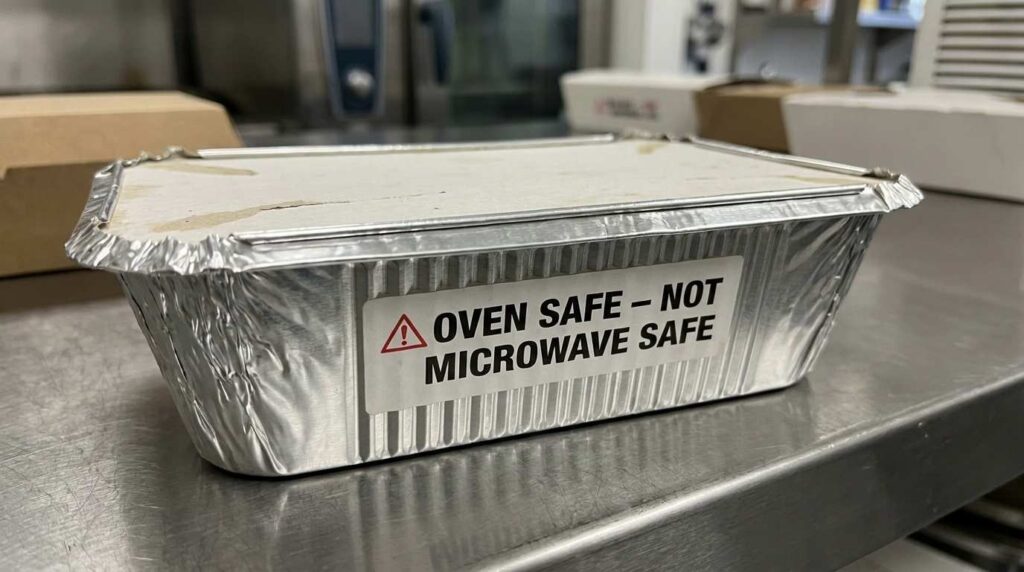
Every guide on foil containers mentions in one sentence that foil cannot go in a microwave. The practical and operational implications are worth covering in more depth.
What Happens
When a customer places a foil container in a microwave, the metal reflects microwave energy and causes electrical arcing – visible as sparking. This can damage the appliance or trip the electrical circuit. It happens because customers do not always realise the container is metal or assume that food packaging is microwave-safe by default.
For takeaway using foil containers for delivery, a proportion of customers will attempt to reheat leftovers in the original container. This is a predictable outcome that operators can address with simple communication.
The Operator’s Position
This section provides general guidance and does not constitute legal advice. Food business operators should seek professional advice for their specific circumstances.
Under general product liability principles, a food business that supplies food in packaging presenting a foreseeable risk to consumers is in a stronger position if reasonable steps have been taken to communicate that risk. Providing a clear reheating warning on the packaging is considered a reasonable step.
Three Practical Solutions
A printed reheating label on the card lid. A small label stating “OVEN SAFE – NOT MICROWAVE SAFE. Transfer food to a microwave-safe dish before microwaving” addresses the issue at the point of most relevance. The label goes on the card lid because the card surface accepts standard adhesive labels reliably. Standard adhesive labels from a desktop thermal printer are adequate for most operations and cost approximately £0.01 to £0.02 per label.
A printed insert slip in the delivery bag. For operations serving mixed container formats, an A7 or A6 insert with reheating instructions per container type is a practical alternative to labelling every individual container.
Reheating instructions on the delivery platform order confirmation. All three major UK delivery platforms allow operators to add order notes. Adding “Foil containers are oven-safe only, not microwave-safe” to the order confirmation is a free, immediate intervention.
Key takeaway: A printed label on the card lid stating the container is not microwave-safe costs approximately £0.01 to £0.02 per order and removes the ambiguity for customers. For operations that have not yet done this, it is a straightforward improvement to make.
Natasha’s Law and Allergen Labelling on Foil Containers
This section provides general guidance on UK food labelling requirements. Operators should consult the Food Standards Agency guidance and seek professional advice for their specific business circumstances.
Natasha’s Law (the Food Information Amendment Regulations 2019, in force from October 2021) requires that food prepacked for direct sale, food packaged before the customer orders it, must carry a full ingredients list with the 14 major allergens clearly emphasised.
For standard made-to-order takeaway service where food is packed after the customer’s order, allergen labelling on the individual foil container is not required as a PPDS obligation. Allergen information must still be available on request.
For pre-packed elements, batch-cooked food portioned in advance, meal prep boxes packed before ordering, or grab-and-go items displayed ready for selection, full PPDS labelling applies. The FSA’s PPDS guidance for fast food and takeaways covers kebab shops, burger restaurants, pizzerias, fried chicken shops, Chinese takeaways, and fish and chip shops.
The Practical Labelling Challenge for Foil Surfaces
The reflective, textured surface of an aluminium foil container does not accept standard adhesive labels reliably when the container has been filled with hot food, has been in a warm delivery bag, or when the label spans a wrinklewall pattern.
The recommended approach is to label the card lid rather than the foil container. The card lid provides a flat, consistent surface that accepts standard adhesive labels from most desktop printers. A 70 mm x 36 mm or 99 mm x 67 mm adhesive label provides sufficient space for the food name, full ingredient list, and allergen emphasis on a standard card lid.
Where labelling must go on the foil base rather than the card lid, use a label with a strong permanent adhesive rated for low-surface-energy materials. Standard paper adhesive labels will not reliably adhere to foil surfaces under temperature variation.
Key takeaway: Label the card lid rather than the foil container surface. If your operation pre-packs any food before the customer orders, allergen labelling is a legal requirement.
Using Foil Containers as Cooking Vessels
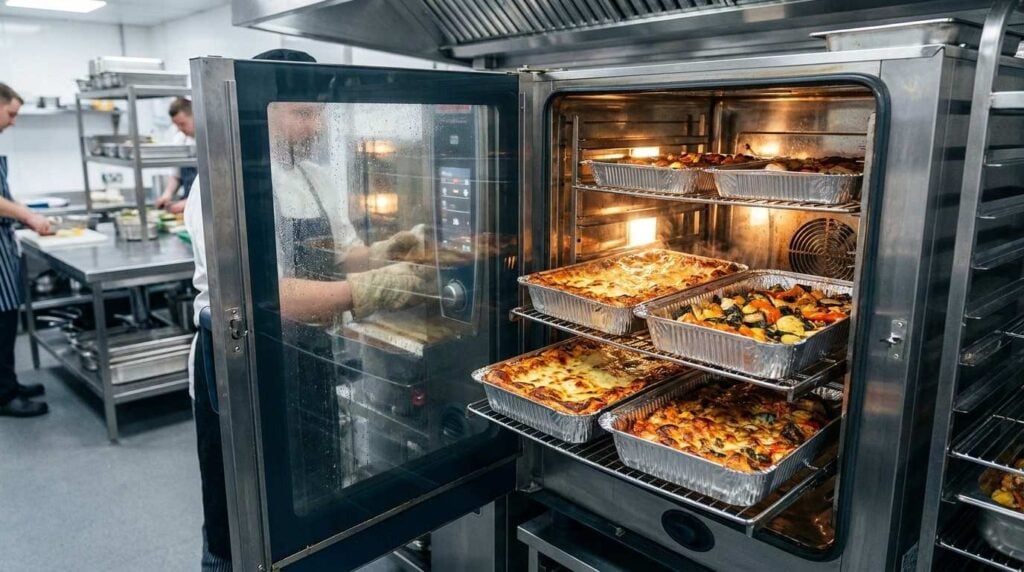
UK catering operations frequently use foil containers as cooking vessels, roasting chicken portions, baking lasagne, and bulk reheating of curry. The spec requirements for cooking use differ from packaging use.
Gauge Requirements
Standard takeaway foil containers are typically manufactured at approximately 30 to 50 microns gauge. At this gauge, a container filled with liquid food and placed in an oven can flex under its own weight when lifted, particularly if the oven temperature is above 180 degrees Celsius or the container is overfilled.
For cooking use, a heavier gauge (80 microns or above where possible) provides better structural stability. Heavy-gauge gastro containers are manufactured specifically for cooking and bulk heating applications.
Wrinklewall for Even Heat Distribution
Wrinklewall containers have a ridged base pattern. For cooking use, wrinklewall performs better than smoothwall because the ridges create slight air gaps between the food and the container base, allowing more even heat distribution from beneath. For baking lasagne, roasting vegetables, or batch cooking meat portions, wrinklewall is generally the preferred format.
Smoothwall remains the better choice for delivery packaging, where a flat base allows the card lid to seat evenly.
Using a Baking Sheet
For foil containers used at oven temperatures above 180 degrees Celsius, placing a flat baking sheet underneath is good practice. It provides a rigid base for removal from the oven, prevents deformation of a filled container when lifted, and catches any spillage from an overfilled container.
Temperature Ceiling
Aluminium foil containers perform reliably at standard commercial oven temperatures. The practical upper limit for most commercial foil containers is approximately 220 degrees Celsius. Above this, the foil may discolour and thin at the wrinkle points. Standard commercial cooking temperatures of 160 to 200 degrees Celsius are well within the safe range.
Meal Prep and Subscription Box Services: Different Spec Requirements
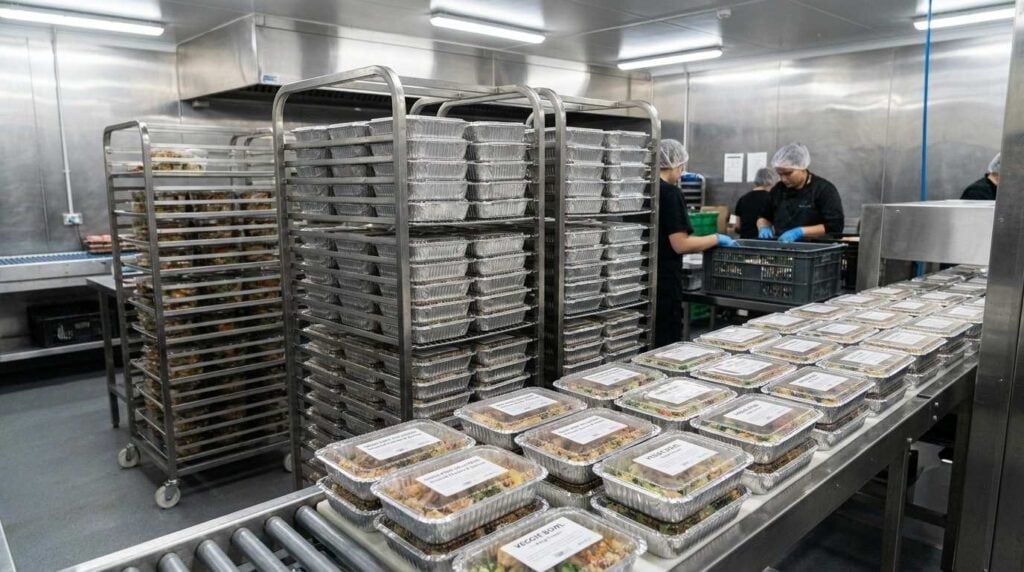
The UK meal prep and subscription delivery sector, gym meals, diet delivery services, and NHS contract catering have different spec requirements from standard takeaway operations. These are worth covering separately.
Freezer-to-oven performance. Meal prep containers are filled, lidded, frozen, and then placed directly in an oven by the customer. A container going from -18 degrees Celsius in a freezer to 180 degrees in an oven needs a heavier gauge and a lid that maintains its integrity through freeze-thaw cycles. Confirm the specific product’s freeze-to-oven rating with your supplier before ordering for a meal prep application.
Heat-sealable film lids. Card lids are not suitable for meal prep delivery because they do not maintain an airtight seal during freezing and thawing and are not tamper-evident. Heat-sealable polyester film lids, applied using a tray sealing machine, create a hermetic seal that maintains integrity through freezing, transit, and oven entry.
Consistent fill volumes. Meal prep operations typically work to exact gram specifications for calorie and macro labelling. Containers must fill consistently from batch to batch. Section 8 of this guide covers the inter-supplier sizing variability that can affect this.
PPDS compliance. Meal prep services selling directly to consumers are almost always operating within Natasha’s Law PPDS territory. Full allergen labelling compliance is required.
How to Calculate Your Weekly Order Requirement
The Formula
Weekly container requirement = (Weekday covers x weekday container ratio) + (Weekend covers x weekend container ratio), then add 20% safety stock, rounded up to the nearest full case.
Worked Example
A curry house operating as follows:
- ▸ Monday to Thursday: 80 covers per evening; 65% ordering a main in a No 2, 35% ordering a rice dish in a No 9
- ▸ Friday and Saturday: 150 covers per evening; same ratio
Weekday requirement (4 nights):
- ▸ No 2: 80 x 0.65 x 4 = 208 per week
- ▸ No 9: 80 x 0.35 x 4 = 112 per week
Weekend requirement (2 nights):
- ▸ No 2: 150 x 0.65 x 2 = 195 per week
- ▸ No 9: 150 x 0.35 x 2 = 105 per week
Total weekly requirement:
- ▸ No 2: 403 per week, plus 20% buffer = 484, order in cases: 490
- ▸ No 9: 217 per week, plus 20% buffer = 260, order in cases: 260
Recommended stock holding (4 weeks):
- ▸ No 2: approximately 1,936 – order 2,000
- ▸ No 9: approximately 1,040 – order 1,000
For a new business without trading data, start with a 2-week stock estimate using this formula and adjust after the first fortnight of actual trading. Running out of containers on a Friday evening is one of the more disruptive operational problems a takeaway can face, and holding 4 weeks of stock at the calculated weekly requirement is a straightforward way to avoid it.
Key takeaway: The capital cost of 4 weeks of foil containers at typical unit prices is approximately £30 to £80 for most independent operations. That is a modest investment against the operational disruption of a stock-out on a busy evening.
Simpler Recycling 2025: What Foil Container Users Need to Know
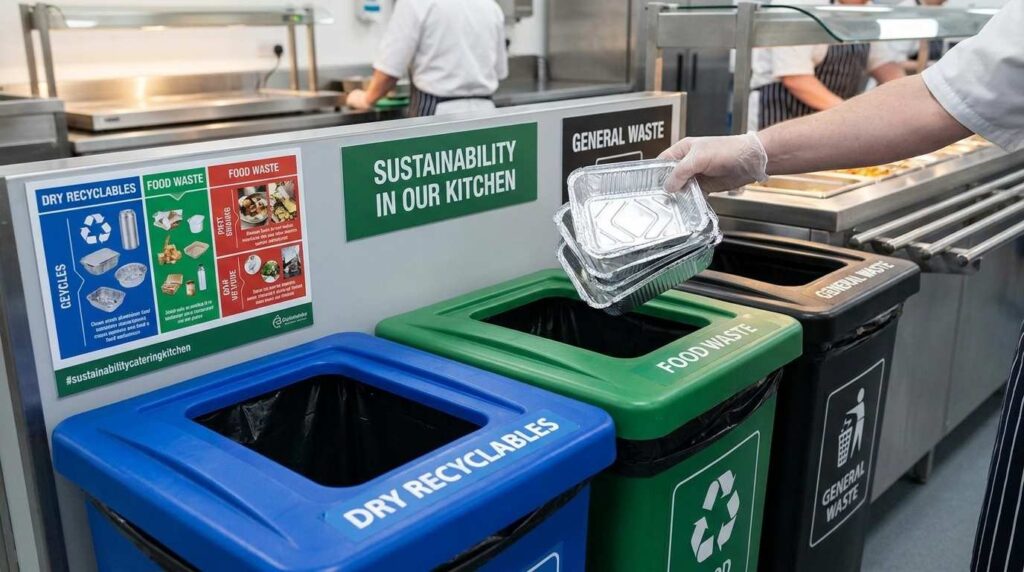
The Simpler Recycling legislation came into force on 31 March 2025 under gov.uk guidance. It requires all workplaces in England to separate waste before collection into three streams: food waste, dry recyclables, and general residual waste.
For food businesses using aluminium foil containers:
Clean foil containers go in dry recyclables. Aluminium is widely accepted in commercial dry recycling collections and is one of the most recycled materials in the UK. Rinsed or clean foil containers should be separated from general waste.
Food-contaminated foil with significant residue that cannot be rinsed should go in the food waste stream rather than dry recyclables, as contaminated foil can downgrade the recycling batch.
Compliance timeline: Businesses with 10 or more full-time equivalent employees were required to comply from 31 March 2025. Micro-firms with fewer than 10 FTE employees have until 31 March 2027.
A simple staff briefing covering which bin receives which item is all that is required for most food businesses. Three clearly labelled bins, food waste, dry recyclables, and general waste – make compliance straightforward in practice.
| Factor | Aluminium Foil | Plastic PP |
| Recyclability | Excellent | Moderate |
| Heat Resistance | Excellent | Good |
| Oven Safe | Yes | Limited |
| Customer Perception | Positive | Mixed |
| Circular Economy Fit | Strong | Moderate |
Sizing, Compatibility, and Supplier Variability
The UK foil container No. sizing system is not standardised across manufacturers, and this has practical operational consequences.
A No 2 container from one UK supplier may measure 140 mm x 115 mm x 40 mm with a 415cc capacity. The same nominal size from a different supplier may measure 150 mm x 120 mm x 40 mm with a 450cc capacity. A difference of 35cc across a container you are buying in thousands affects both fill consistency and lid compatibility.
Lid incompatibility is the most common practical problem. Lids from one supplier may not seat correctly on containers from another, even when both are described as the same nominal size. A lid that does not seat correctly creates a leak risk during delivery.
The practical rules:
- ▸ Always buy lids from the same supplier as the containers they are designed to fit
- ▸ Verify exact dimensions – length, width, depth, and capacity – before switching suppliers
- ▸ Order samples and confirm fit before committing to volume from a new source
- ▸ For meal prep and PPDS operations where fill weight is calculated against container volume, a 35cc variation between nominal sizes matters and should be confirmed with your supplier.
The Sample Test Protocol Before You Commit to Volume
Running a few simple tests on a sample order before committing to volume is a reliable way to avoid discovering a performance problem on a busy evening service.
Test 1: The Lid Seal Test
Fill the container with warm water to approximately 80% capacity. Press the card lid on firmly. Tilt the container at 45 degrees for 30 seconds. A well-seated card lid should show no seepage. If water tracks under the lid edge, the seal is not reliable for liquid-rich dishes.
Test 2: The Delivery Heat Retention Test
Fill the container with curry or a thick sauce at approximately 75 degrees Celsius. Seal with the card lid. Place in an insulated delivery bag. Leave for 35 minutes. Open and assess temperature and steam on opening. This gives you a realistic picture of how the container performs across a typical delivery window.
Test 3: The Cooking Use Test
For operators using foil as a cooking vessel, place an empty container in a preheated oven at 200 degrees Celsius on a baking sheet. After 20 minutes, check for deformation or discolouration at the wrinkle points or container edges.
Test 4: The Structural Rigidity Test
Fill four containers with curry or a similar dense food at the typical service weight. Stack them. Lift the bottom container. Check whether the base deforms under the combined weight of the stack. Deformation at the base of a stacked delivery creates a leak risk.
Test 5: The Label Adhesion Test
Apply your standard PPDS or reheating label to the card lid. Leave the sealed container in a warm environment for 35 minutes. Check whether the label has lifted, curled, or detached. If it has, try an alternative label adhesive grade before committing to a labelling programme.
UK Supplier Comparison
The following comparison is based on publicly available information. Prices are indicative of UK market conditions as of May 2026 and will vary by volume and specification. Always confirm current pricing and availability directly with suppliers before ordering.
| Supplier | Range | Unit Price Range (No 2, 100 units) | MOQ | Lead Time | Lid Compatibility | Sample Policy |
| Nisbets | Standard formats, wide range | £4 to £7 per 100 | 1 case | The next day, on most stocks | Matched formats | Not standard |
| We Can Source It (wecansourceit.co.uk) | No 1 to No 12, full and half gastro | £3.50 to £5.95 per 100 | 1 case | Next day (before 4 pm) | Lids matched per product | Available on request |
| Alliance Online | Standard takeaway formats | £3 to £5 per 100 | 1 case | 2 to 5 days | Matched formats | Not standard |
| Catering24 | Takeaway and catering formats | £3.50 to £6 per 100 | 1 case | 2 to 5 days | Matched formats | Not standard |
| B&P Wholesale | Catering and bulk formats | £2.50 to £4.50 per 100 at volume | Higher MOQ for the best price | 3 to 7 days | Check per product | Variable |
Regardless of supplier, confirming exact container dimensions and lid compatibility before ordering in volume is always worth the extra step. The No. sizing system is not standardised, and a brief sample test before a large order is a simple safeguard.
Where to Buy Aluminium Foil Containers in the UK
We Can Source It supplies the full standard range of aluminium foil containers with matched card lids, next-day delivery available on orders placed before 4 pm, and bulk pricing from 10 to 2,000 units.
- ▸ No 1 aluminium foil containers – smallest standard format
- ▸ No 2 aluminium foil containers – standard single-portion curry and hot food containers
- ▸ No 6a aluminium foil containers – for fish, chips, kebabs, and wider portion formats
- ▸ No 9 aluminium foil containers – for biryani, large portions, and Chinese cuisine formats
- ▸ No 12 aluminium foil containers – wider, shallower formats for baked goods
- ▸ Full gastro shallow – 525 x 325 x 36mm for buffet and bain-marie service
- ▸ Full gastro deep – 525 x 325 x 67mm for bulk cooking and catering
- ▸ Half deep gastro container – half gastronorm format, approx. 3,200ml capacity
- ▸ Full aluminium foil containers category – complete range with current pricing
For the full picture of takeaway packaging across all supply categories, see our complete UK takeaway supplies buying guide.
FAQs
Can aluminium foil containers go in the microwave?
No. Aluminium is a metal and will arc in a microwave, causing sparking and potential appliance damage. Operators using foil containers for delivery should label the card lid clearly to state the container is oven-safe but not microwave-safe, and advise customers to transfer food to a microwave-safe dish before reheating.
What is the difference between No 2 and No 9 foil containers?
A No 2 is approximately 14 cm x 11.5 cm x 4 cm with a capacity of approximately 415 to 450ml, suited for single-portion curries, rice dishes, and side portions. A No 9 is approximately 22.8 cm x 22.8 cm x 5.2 cm, suited for biryani, large portions, and noodle dishes. The No 9 holds approximately 2.5 to 3 times the volume of a No 2.
Do foil containers require allergen labelling under Natasha’s Law?
Only if the food is prepacked for direct sale, packaged before the customer orders. For standard made-to-order takeaway service, allergen labelling on the container is not required as a PPDS obligation, though allergen information must be available on request. For pre-packed or batch-prepared food, full PPDS labelling applies. Operators should consult FSA guidance and seek professional advice for their specific circumstances.
Can foil containers be used for cooking in a commercial oven?
Yes, with the right spec. For oven cooking, use a heavier-gauge container where possible (80 microns or above), a wrinkle-wall format for even heat distribution, and place on a baking sheet for stability. Standard takeaway-grade containers at 30 to 50 microns can deform under their own weight when filled with liquid food at higher oven temperatures.
Are No 2 containers from different suppliers interchangeable?
Not reliably. The No. sizing system is not standardised across UK manufacturers. Dimensions and capacity can vary meaningfully between suppliers, and lids from one supplier may not seat correctly on containers from another. Always buy lids from the same supplier as the containers and confirm exact dimensions before switching sources.
What are the Simpler Recycling requirements for foil containers?
From 31 March 2025, for businesses with 10 or more FTE employees, UK workplaces must separate waste before collection. Clean aluminium foil containers go in the dry recyclables stream. Food-contaminated foil goes in the food waste stream. Micro-firms with fewer than 10 FTE employees have until 31 March 2027 to comply.
How do I calculate how many foil containers to order per week?
Calculate your weekly cover count, apply the proportion using each container size, add a 20% safety stock buffer, and round up to the nearest full case. Section 6 of this guide includes a worked example based on a typical curry house operation.
Are aluminium foil containers recyclable in the UK?
Yes. Clean aluminium foil containers can usually be recycled through commercial and household recycling streams. Containers with significant food contamination should be cleaned before recycling or disposed of according to local guidance.
Can aluminium foil containers be frozen?
Yes. Most aluminium foil containers are freezer-safe and can be used for storing prepared meals before reheating. Always check the manufacturer’s specifications for freeze-to-oven applications.
What size foil container is best for curry?
A No 2 aluminium foil container is the most commonly used size for single-portion curry dishes in UK takeaways.
References
- ▸ FSA: PPDS allergen labelling for fast food and takeaways via food.gov.uk
- ▸ FSA: Allergen labelling changes for PPDS food via food.gov.uk
- ▸ Consumer Protection Act 1987 via legislation.gov.uk
- ▸ Simpler Recycling: workplace recycling in England via gov.uk
- ▸ DEFRA: Extended Producer Responsibility for packaging via gov.uk
- ▸ Food Safety (General Food Hygiene) Regulations 1995 via legislation.gov.uk