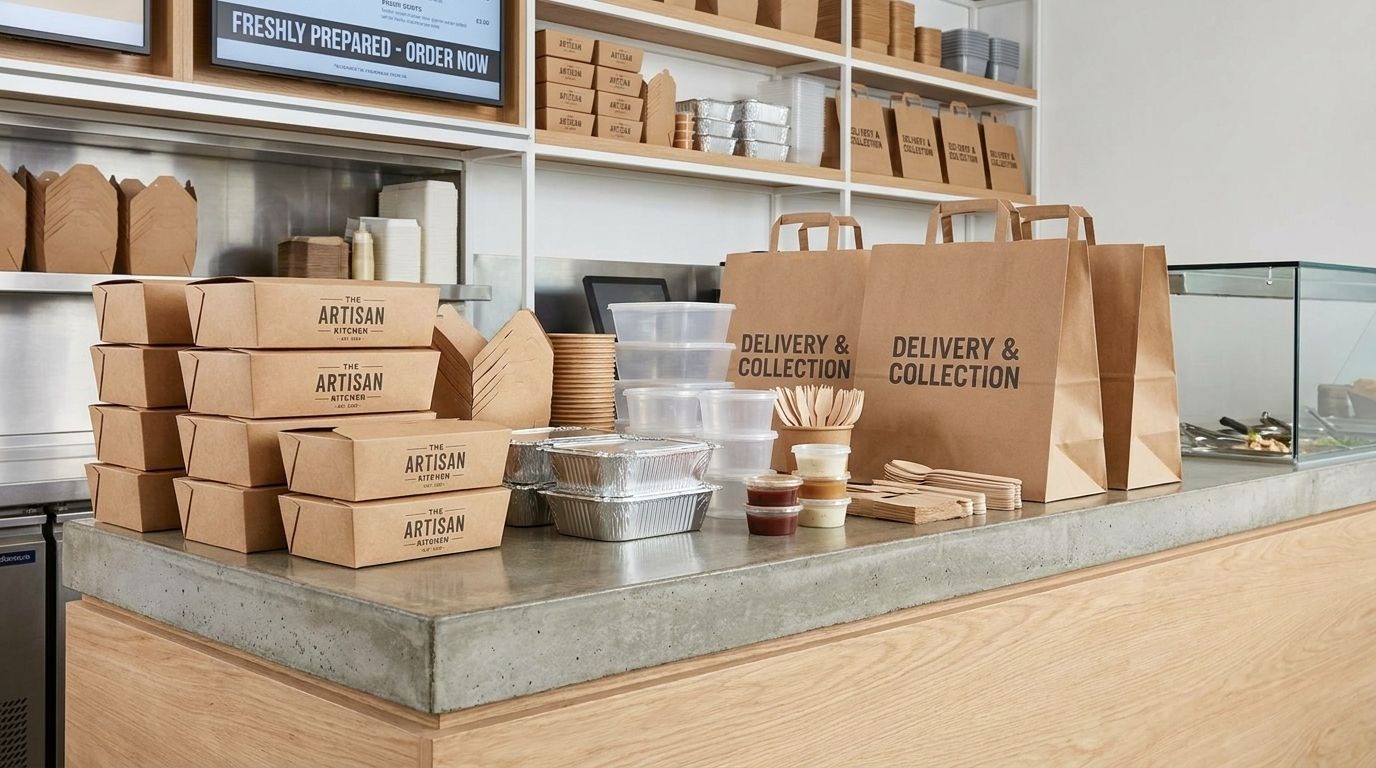
Every guide to takeaway supplies UK covers the same narrow ground: sustainable packaging, EPR regulations, hot versus cold containers. Most of them are packaging guides dressed up as buying guides.
A real takeaway business needs more than packaging. It needs containers matched to its cuisine, bags that work for its order sizes, portion pots for sauces and sides, napkins, disposable cutlery, and hygiene essentials, all bought in the right quantities from the right suppliers, at a cost that makes the business’s unit economics work.
This guide covers the complete basket. It is written for UK food business owners in 2026, new takeaway operators setting up their first supply order, established businesses reviewing costs and compliance, and delivery-focused operations trying to reduce complaints from soggy food arriving cold in the wrong container.
Quick Reference: What Your Takeaway Business Actually Needs to Order
| Category | What to Buy | Why It Matters |
| Food containers | Matched to cuisine and temperature | Wrong container = soggy food, cold delivery, negative reviews |
| Takeaway bags | Paper or plastic matched to order size | Bag failure at the door is a one-star review waiting to happen |
| Portion pots and deli pots | 2oz, 4oz, 6oz by sauce volume | Sauce leakage is the most common delivery complaint |
| Aluminium foil containers | Curry, rice, hot dishes at volume | Best heat retention; oven-safe; fully recyclable |
| Disposable cutlery and napkins | Matched to food type and format | Missing cutlery is the second most common delivery complaint |
| Food safety and hygiene supplies | Gloves, date labels, cleaning products | Legal obligation under food hygiene regulations |
| Allergen labelling materials | Pre-packed for direct sale (PPDS) labels | Mandatory under Natasha’s Law since October 2021 |
UK Regulations Every Takeaway Must Know in 2026
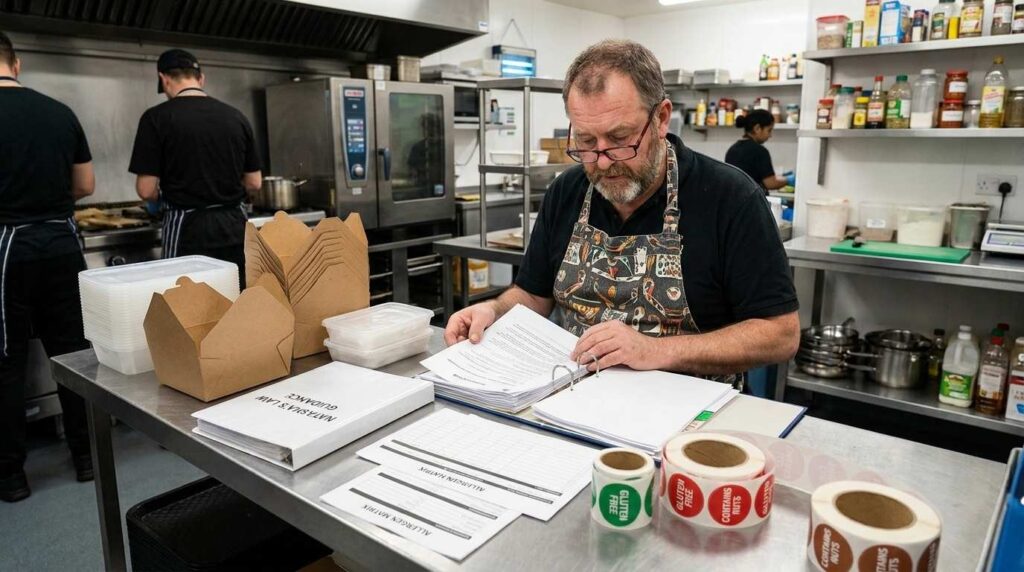
These are not optional considerations; they are live legal obligations affecting every UK food business.
Natasha’s Law and Allergen Labelling
Natasha’s Law (the Food Information (Amendment) (England) Regulations 2019) came into force in October 2021. It requires that any food prepacked for direct sale (PPDS), food packaged on the same premises where it is sold, before the customer orders it, must carry a full ingredients list with the 14 major allergens clearly emphasised.
For takeaway businesses, the practical implications are:
What requires PPDS labelling:
- ▸ Pre-made sandwiches, wraps, or salads packaged before the customer orders
- ▸ Pre-packed grab-and-go items displayed at a counter
- ▸ Meal prep items packaged in advance for collection
What does not require PPDS labelling (but still requires allergen information available on request):
- ▸ Food made to order in response to a customer’s direct verbal order
- ▸ Food is delivered hot and freshly prepared per order
For most traditional takeaway operations (food prepared per order), Natasha’s Law does not require a label on every container. However, any pre-packaged elements, sauces portioned in advance, pre-made sides, and grab-and-go items do require PPDS labelling. The Food Standards Agency PPDS guidance should be your reference for specific circumstances.
Key takeaway: If your takeaway pre-packs any food before the customer orders it, allergen labelling is a legal requirement, not a choice. The fine for non-compliance can reach £5,000 per offence under the Food Safety Act 1990.
Extended Producer Responsibility (EPR) for Packaging
The UK EPR scheme charges packaging producers for the cost of collecting and disposing of packaging waste. From 2026 to 2027, fees are modulated using the Recyclability Assessment Methodology (RAM); green-rated packaging attracts lower fees, and red-rated packaging attracts higher fees.
EPR applies to food businesses with annual turnover above £1 million and packaging volumes above 25 tonnes per year. If you meet both thresholds, you have registration, reporting, and fee payment obligations.
The practical implication for takeaway packaging choices:
- ▸ Kraft paper, uncoated cardboard, and aluminium foil containers attract lower EPR fees than plastic
- ▸ PLA (compostable plastic) is red-rated under RAM despite its plant-based origin
- ▸ rPET with verified recycled content improves your EPR position
DEFRA Single-Use Plastics Ban
DEFRA’s ban on certain single-use plastics in England prohibits the supply of plastic plates, cutlery, balloon sticks, and polystyrene food containers. If you are still using any of these banned formats, switching to compliant alternatives is a legal requirement with local authority enforcement powers.
For Scotland and Wales, separate regulations apply with broader scope. Confirm the current position for your nation before ordering any disposable plastic product.
Container Selection by Cuisine Type: The Decision Nobody Else Makes
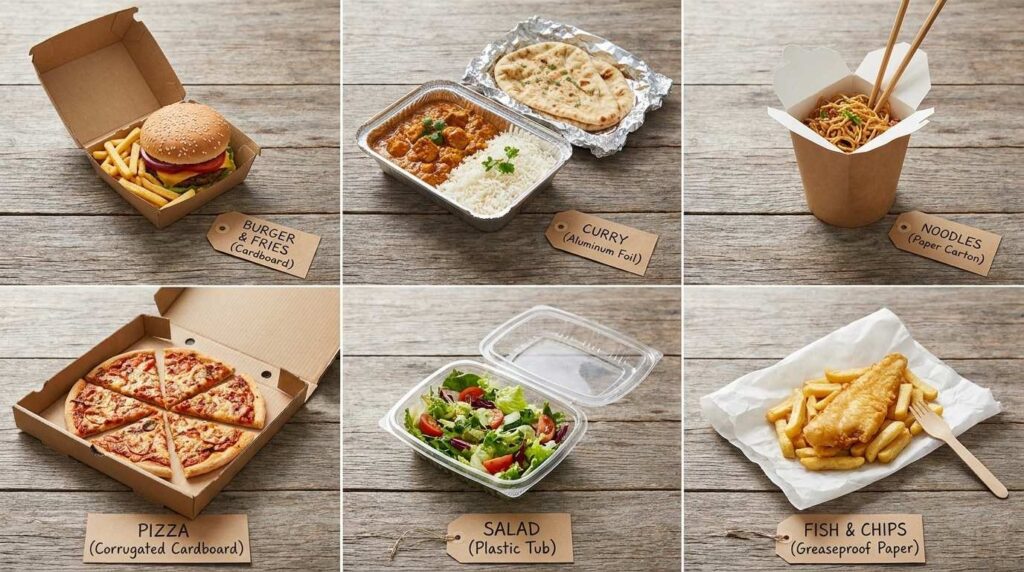
Choosing the right container depends on the type of food you serve. Different foods create different challenges, from moisture and heat retention to leak prevention and presentation. The guide below matches common takeaway foods with the container formats that perform best in real delivery conditions.
Fried Chicken, Fish and Chips, and Battered Foods
Primary problem: Moisture and steam from hot fried food cause sogginess inside a sealed container within minutes.
Correct container: Vented clamshell box or open-base liner with a vented lid. Ventilation allows steam to escape rather than condense on the food surface. For fish and chips specifically, paper bags or greaseproof paper wrapping inside a bag allows the right amount of ventilation while retaining heat.
Avoid: Sealed plastic containers with no ventilation. Fried food in a sealed container arrives soggy regardless of how quickly it is delivered.
Our bagasse 1-compartment takeaway box provides natural micro-ventilation through the sugarcane fibre structure and handles hot fried food at up to 120 degrees Celsius without deformation.
Curries, Stews, and Liquid-Rich Dishes
Primary problem: Liquid dishes require leak-proof containers that maintain heat across a delivery journey of 20 to 45 minutes.
Correct container: Aluminium foil containers with card or foil lids for high-volume curry operations, or microwaveable plastic containers (650 ml to 1,000 ml) for operations where customers are expected to reheat at home. Foil containers are oven-safe and provide superior heat retention; plastic microwaveable containers offer the convenience of direct reheating.
Avoid: Kraft paper containers without a waterproof coating for liquid-rich dishes. Uncoated kraft absorbs moisture and fails within minutes of hot liquid contact.
Browse our No 2 aluminium foil food containers with lids and 650ml microwaveable plastic containers for liquid-rich dish service.
Rice, Noodles, and Pasta Dishes
Primary problem: These dishes need containers that prevent compression, maintain separation, and can be microwaved by the customer.
Correct container: Kraft noodle boxes or Kraft food boxes with folding lock lids (No 2, No 3, or No 8 format depending on portion size). These are microwave-safe, eco-friendly, and provide a premium presentation at a low unit cost.
Our No 8 kraft food takeaway box handles noodles, rice, and pasta dishes with a folding lock lid that keeps contents secure during transport.
Burgers and Sandwiches
Primary problem: Bread becomes soggy from steam if sealed in an airtight container. Burger components separate during transport without adequate containment.
Correct container: Clamshell burger box that holds the burger shape while providing minimal ventilation. For gourmet burgers, expandable burger boxes allow for taller builds.
Our large expandable burger box is made in the UK from FSC-certified sustainable paperboard and is fully compostable. It handles loaded gourmet burgers without collapsing.
Pizza
Correct container: Pizza box. No alternative format performs comparably. The vented corrugated cardboard box is the right answer for pizza in all formats and sizes. Pizza delivered in any other container format loses crispness and structural integrity.
Salads and Cold Food
Primary problem: Cold food needs to stay cold and separated; dressings need to be packaged separately to prevent sogginess.
Correct container: Clear rPET containers for visual presentation of salads, with a separate portion pot for dressing. rPET is fully recyclable in standard kerbside collections if the customer rinses it.
Quick Cuisine-to-Container Reference
| Cuisine / Food | Recommended Container | Key Feature Needed |
| Fried chicken/fish and chips | Vented clamshell or paper bag | Ventilation to prevent sogginess |
| Curry/stew | Foil container with lid or microwaveable plastic | Leak-proof, heat retention |
| Rice/noodles/pasta | Kraft noodle box or food box | Microwave-safe, lock lid |
| Burger/sandwich | Clamshell burger box | Holds shape, minimal moisture |
| Pizza | Pizza box (corrugated) | Vented, structural, heat retention |
| Salad | Clear rPET container | Visibility, cold performance |
| Soup | Leak-proof container with secure lid | Liquid-proof seal essential |
| Sides/fries | Small open tray or vented box | Ventilation, portion size |
Takeaway Bags: Paper vs Plastic in 2026
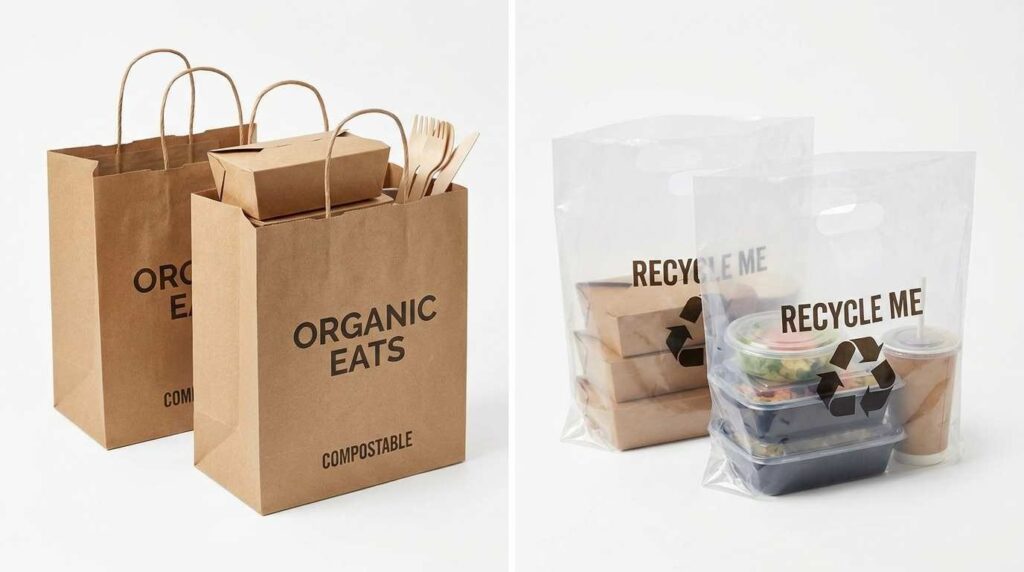
The takeaway bag is the last thing the customer touches before opening their food. A bag failure at the door, handles tearing, the bottom giving way, grease soaking through, is a direct customer experience failure that generates negative reviews.
For a full comparison including sustainability, cost, and performance across order types, see our dedicated guide to takeaway bags for UK food businesses.
Paper Bags
Strengths: Brown kraft paper bags are now the standard for premium takeaway presentation. They are recyclable, carry a natural sustainability signal that customers notice, and are available with twisted or flat handles for different weight capacities.
Limitations: Standard kraft paper bags are not grease-proof. For fried or oily food, a greaseproof paper bag or a greaseproof liner inside a kraft bag is required. Unlined kraft paper saturated with grease will fail structurally within minutes.
For greasy or oily food, our white greaseproof paper bags provide a grease-resistant barrier suitable for fish and chips, fried chicken, and pastry items.
Plastic Carrier Bags
Plastic carrier bags remain legal in the UK for takeaway use in most formats. They carry a 10p minimum charge under the single-use plastic bag charge regulations for businesses with 10 or more employees (and since 2021 for all businesses in England).
For high-volume takeaway operations where paper bags are impractical, particularly for heavy or wet orders, a biodegradable or recycled plastic carrier bag is a compliant option. Foamed polystyrene is banned; standard LDPE or recycled plastic bags are not.
Bag Size Matching
| Order Type | Recommended Bag Size | Notes |
| Single meal (small) | Small kraft bag | 1 container, 1 drink |
| Standard meal deal | Medium kraft bag | 2 to 3 containers |
| Family order | Large kraft bag or carrier | 4 or more containers; twisted handle rated for weight |
| Pizza collection | Pizza box sleeve or large flat bag | Structural support for flat boxes |
Portion Pots, Deli Pots, and Sauce Containers
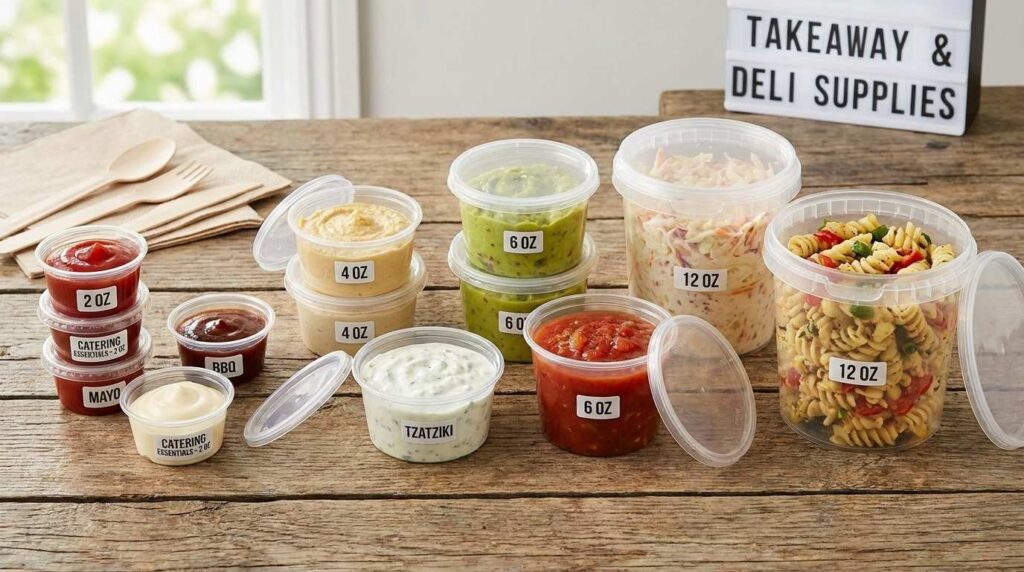
Missing cutlery and leaking sauces are consistently the two most common complaints in UK takeaway delivery reviews. Portion pot selection directly addresses the second.
For a full guide on sizing and uses, see our dedicated article on deli pots for UK catering businesses.
Choosing the Right Size
| Pot Size | Volume | Best Use |
| 2oz (60ml) | Very small | Ketchup, mayo, small dipping sauces |
| 4oz (120ml) | Small | Curry sauce, sweet and sour, standard dips |
| 6oz / 7oz (180 to 210ml) | Medium | Larger sauce portions, salad dressings, gravy |
| 8oz to 12oz (240 to 360ml) | Large | Soups, porridge, medium deli portions |
Our 2oz hinged clear plastic portion pots are ideal for condiments and small dipping sauces with a secure hinged lid that prevents leakage during delivery.
For larger sauce portions, our 6oz/7oz round kraft sauce pots provide an eco-friendly presentation in kraft paperboard with paper or plastic lid options.
For full deli portions, dressings, and cold preparations, our deli pots and food pots range covers the full size spectrum from 2oz to 32oz with matching lids.
Aluminium Foil Containers for Catering
Aluminium foil containers are the workhorse format for curry houses, Indian and Middle Eastern takeaways, catering operations, and any food business handling large volumes of hot, liquid-rich dishes.
For a full buying guide covering sizes, uses, and bulk ordering, see our dedicated article on aluminium foil containers for UK catering.
Why Foil Containers Remain the Default for Hot Food
- ▸ Superior heat retention versus all paper and plastic alternatives
- ▸ Oven-safe for pre-heating and customer reheating
- ▸ Fully recyclable (aluminium is one of the most recycled materials in the UK)
- ▸ No flavour transfer or moisture absorption from liquid dishes
- ▸ Stackable with card lids for efficient delivery bag packing
Size Guide
| Container Size | Typical Use | Approx. Capacity |
| No 1 | Side dishes, small portions | 200 to 300ml |
| No 2 | Standard single portion | 400 to 500ml |
| No 3 | Large single portion or two servings | 600 to 750ml |
| Full gastro | Catering, bulk service, buffet | 1 to 2 litres |
Our No 2 aluminium foil food containers with lids are the most popular format for UK curry and Asian takeaway operations, available in bulk packs of 10 to 5,000 units with card lids included.
Disposable Cutlery and Napkins
Missing cutlery generates more one-star delivery reviews in the UK than almost any other single oversight. Cutlery and napkins are the last items most operators think about and the ones customers notice immediately when they are absent.
Cutlery Selection by Food Type
| Food Type | Cutlery Needed | Preferred Material |
| Curry/rice dishes | Fork and spoon | Wooden (DEFRA compliant, not banned) |
| Noodles / Asian | Fork or chopsticks | Wooden or CPLA |
| Salads | Fork and knife | Wooden or CPLA |
| Soups | Spoon | Wooden |
| Burgers/sandwiches | Often none required | n/a |
| Desserts | Spoon or dessert fork | Wooden |
Under DEFRA’s single-use plastics ban, single-use plastic cutlery (forks, knives, spoons) is prohibited in England. Wooden, CPLA (compostable PLA), or stainless steel reusable alternatives are the compliant options.
Napkins
Standard 1-ply or 2-ply napkins are a low-cost addition that customers expect with any takeaway order. For fried and oily food, a heavier 2-ply or airlaid format absorbs grease effectively and reduces the chance of greasy hands transferring to packaging.
Our airlaid napkins linen feel 40cm provide a premium napkin option suitable for delivery presentation and restaurant service.
Food Safety and Hygiene Supplies
This section is absent from every competing guide. It covers the non-packaging supplies that every UK food business must order alongside packaging.
Disposable Gloves
Under the Food Safety (General Food Hygiene) Regulations, food handlers must maintain personal hygiene standards that prevent food contamination. Disposable gloves are standard practice for direct food handling. Vinyl gloves are the most common format for UK food service; nitrile is preferred where latex sensitivity is a concern.
Date Labels and Day Dot Labels
Date labels are a food safety requirement for any prepared food stored before service. FIFO (First In, First Out) discipline requires clear labelling of all stored items with preparation date and use-by date. Day dot labels, colour-coded round labels for each day of the week, are the standard format in UK commercial kitchens.
Cleaning Products
Cleaning schedules are a requirement under food hygiene law. Surface sanitisers, degreasers for cooking equipment, and antibacterial hand soap are the minimum hygiene supply requirements for any food business.
Cost Comparison: What Takeaway Supplies Actually Cost per Order
Vague cost information is one of the biggest frustrations for new takeaway operators researching supplies. Here are real indicative UK prices in 2026 by product type and quantity bracket.
Container Costs
| Container Type | 100 Units | 500 Units | 1,000 Units | Per Unit at 1,000 |
| Kraft food box (No 2/3) | £4 to £6 | £15 to £25 | £25 to £45 | £0.03 to £0.05 |
| Bagasse clamshell 9×6″ | £8 to £12 | £30 to £50 | £55 to £90 | £0.06 to £0.09 |
| Aluminium foil No 2 with lid | £3 to £5 | £12 to £20 | £20 to £35 | £0.02 to £0.04 |
| 650ml microwaveable plastic | £2 to £4 | £8 to £14 | £14 to £22 | £0.01 to £0.02 |
| Pizza box (12 inch) | £10 to £18 | £40 to £70 | £70 to £120 | £0.07 to £0.12 |
| Expandable burger box | £9 to £15 | £35 to £55 | £60 to £95 | £0.06 to £0.10 |
Bags and Accessories
| Item | Per 100 | Per 500 | Per 1,000 |
| Kraft paper bag (medium) | £2 to £4 | £7 to £15 | £12 to £25 |
| Greaseproof paper bag | £2 to £3 | £6 to £12 | £10 to £18 |
| Portion pot 2oz with lid | £1 to £2 | £3 to £6 | £5 to £9 |
| Wooden cutlery set (fork, knife, spoon) | £3 to £5 | £10 to £18 | £18 to £30 |
The Cost Per Order Model
For a standard single meal takeaway order (one main container, one side pot, one bag, one napkin, one set of cutlery), the packaging cost at 1,000-unit bulk pricing runs approximately:
- ▸ Budget operation (plastic containers, plastic bags): £0.06 to £0.10 per order
- ▸ Standard operation (kraft boxes, paper bags, wooden cutlery): £0.14 to £0.22 per order
- ▸ Premium eco operation (bagasse, kraft bags, wooden cutlery, compostable pots): £0.22 to £0.38 per order
At a typical takeaway order value of £12 to £18, the packaging cost represents 1 to 3% of order revenue at standard specification. It is absorbable at all three tiers without material impact on margin.
Branded Packaging: When to Invest and What It Costs
Branded packaging, boxes, bags, and cups carrying your logo are a genuine marketing investment for takeaway businesses with an established customer base and a clear brand identity.
The case for branded packaging:
- ▸ Creates recognition when the delivery bag arrives at the door
- ▸ Photographs work well for social media and platform profiles
- ▸ Signals quality and professionalism that affect repeat order rates
The honest cost:
- ▸ Minimum order quantities for custom printed packaging typically start at 500 to 1,000 units per item
- ▸ Custom print setup costs typically run from £40 to £150 per design, depending on the technique
- ▸ Per-unit cost premium over standard packaging: approximately 15 to 35% at MOQ
The verdict: Branded packaging is justified once you are ordering above 1,000 units of a given format per month. Below that volume, the setup cost per order is too high to deliver a meaningful return. Start with standard quality packaging and introduce branding at the point where your order volumes make the economics work.
Delivery Platform Packaging Requirements
If your takeaway operates on Deliveroo, Just Eat, or Uber Eats, each platform has packaging guidance that affects what you use and how.
Tamper-evident seals: All three major platforms recommend tamper-evident seals on delivery packaging. This protects both the customer and the restaurant from disputes about order integrity. Sticker seals or tamper-evident bags satisfy this requirement at low cost.
Container performance standards: Platforms increasingly surface restaurant ratings that include packaging quality feedback. Consistently poor packaging performance, leaking containers, cold food, and collapsed bags are visible in customer ratings and affect platform visibility.
Sustainability credentials: Deliveroo and Just Eat both have sustainability features visible to customers. Listing sustainable packaging materials (kraft, bagasse, recycled content) in your platform profile is a differentiator that affects order conversion in environmentally conscious customer segments.
How to Build Your First Bulk Order
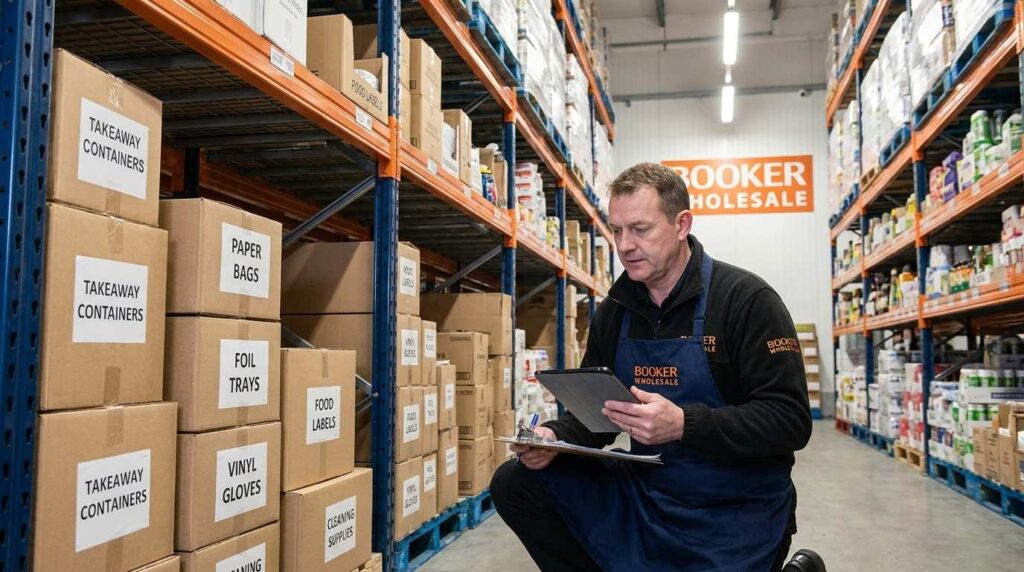
For a new takeaway business or a business switching suppliers, the first bulk order is the most consequential procurement decision in the first year of trading.
Step 1: Calculate Your Weekly Volume
Before ordering, establish your expected weekly cover count by cuisine category. This determines your minimum order quantity for each item. Ordering 1,000 containers when your weekly volume is 100 covers ties up cash and creates storage problems. Ordering 100 when you do 500 covers creates urgent reorders at higher per-unit cost.
Step 2: Order a Sample Pack First
Before committing to volume, order samples of every container format you plan to use. Test them with your actual food. A container that performs perfectly for one dish may be completely wrong for another. This is particularly important for hot, liquid-rich dishes where leak performance under temperature and transit conditions is the key variable.
Step 3: Confirm Compliance Before Ordering
For any plastic packaging, confirm the EPR position and whether the product is affected by DEFRA single-use plastic restrictions. For allergen labelling, confirm whether any of your packaging formats require PPDS labelling under Natasha’s Law.
Step 4: Order Initial Stock at the Right Quantity Tier
Order 4 to 6 weeks of stock on your first bulk order. This gives you enough buffer to identify any performance issues before you reorder and keeps cash tied up in stock to a manageable level while you establish your actual weekly consumption rates.
Browse our complete takeaway supplies range and catering supplies range for the full product portfolio across all categories covered in this guide, with bulk pricing available on all lines.
For a complete checklist of everything a new takeaway business needs to order, see our dedicated guide to starting a takeaway business in the UK: supplies checklist and costs.
FAQs
What supplies does a takeaway business need in the UK?
A UK takeaway business needs food containers matched to its cuisine type, takeaway bags in appropriate sizes, portion pots and deli pots for sauces and sides, disposable cutlery (wooden or CPLA under DEFRA regulations), napkins, aluminium foil containers for hot dishes, and food safety supplies including disposable gloves, date labels, and cleaning products. Most operators underestimate the non-packaging supplies category when setting up for the first time.
What is the cheapest takeaway container option in the UK?
Aluminium foil containers are typically the lowest cost per unit for hot food service at £0.02 to £0.04 per unit at 1,000-unit volume. Microwaveable plastic containers are similar in cost. Kraft paper boxes cost £0.03 to £0.05 per unit at volume. The cheapest option depends on the food type; choosing the cheapest container for the wrong food type generates customer complaints that cost more than the savings.
Does Natasha’s Law apply to my takeaway?
Natasha’s Law applies to any food that is prepacked for direct sale on the same premises, or food packaged before the customer orders. If your takeaway prepares food to order in response to a direct customer request, Natasha’s Law does not require a label on every container. However, any pre-packaged grab-and-go items, pre-portioned sauces, or pre-made meals require full allergen labelling. Confirm your specific circumstances with the FSA guidance.
Are plastic takeaway containers banned in the UK?
Not entirely. DEFRA banned specific single-use plastic items in England in 2023: plastic plates, cutlery, balloon sticks, and polystyrene food containers. Standard plastic takeaway containers (rPET, PP, and similar formats) are legal. Foamed polystyrene containers are banned. Plastic cutlery (forks, knives, spoons) is banned. Single-use plastic bags carry a mandatory minimum 10p charge.
How much does packaging cost per takeaway order?
At bulk pricing (1,000 units), packaging for a standard single meal order (one container, one side pot, one bag, one set of cutlery, one napkin) costs approximately £0.14 to £0.22 for a standard kraft and paper specification, or £0.22 to £0.38 for a premium eco specification. This represents 1 to 3% of a typical £12 to £18 order value.
What containers are best for curry delivery?
Aluminium foil containers with card lids provide the best heat retention for curry delivery, are oven-safe for reheating, and are fully recyclable. Microwaveable plastic containers are the alternative where customer microwave convenience is the priority. Avoid uncoated kraft paper containers for liquid-rich dishes; they absorb moisture and fail structurally within minutes of hot liquid contact.
What is the minimum order quantity for takeaway packaging in the UK?
Most UK suppliers supply in quantities of 25, 50, 100, 250, 500, 1,000, or 5,000 units. There is typically no formal minimum order, but per-unit pricing improves significantly above 500 units. For a new takeaway, ordering at the 500 to 1,000 unit tier balances price efficiency with cash flow and storage practicality.
References
- ▸ Food Standards Agency: PPDS labelling guidance via food.gov.uk
- ▸ DEFRA: Single-use plastics regulations 2023 via gov.uk
- ▸ DEFRA: Extended Producer Responsibility for packaging via gov.uk
- ▸ Food Safety (General Food Hygiene) Regulations 1995 via legislation.gov.uk
- ▸ Food Safety Act 1990 via legislation.gov.uk