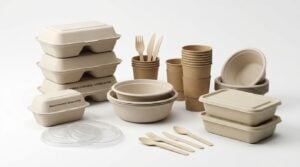
Quick Summary for UK Food Businesses
If you are short on time, here is what you need to know before reading further.
Key facts for 2026:
- ▸ A significant proportion of compostable packaging used in the UK currently ends up in general waste or landfill due to limited composting infrastructure.
- ▸ Compostable packaging is treated as non-recyclable under the UK EPR scheme, attracting higher fees.
- ▸ PLA (the most common compostable plastic) is still subject to the Plastic Packaging Tax at £228.82 per tonne.
- ▸ Bagasse, kraft paper, and moulded fibre avoid the Plastic Packaging Tax entirely.
- ▸ Vague claims like “eco-friendly” or “biodegradable” now carry real legal risk under CMA enforcement.
- ▸ Compostable packaging typically costs 20 to 60% more per unit than conventional plastic alternatives.
These are not opinions. They reflect current HMRC guidance on PPT, DEFRA’s EPR scheme documentation, and CMA enforcement priorities for 2026. The rest of this guide explains each point in full.
What Compostable Food Packaging Actually Means
Compostable food packaging is made from organic materials designed to break down into carbon dioxide, water, and nutrient-rich biomass under specific composting conditions.
The critical phrase is “specific conditions.” This is where the marketing diverges sharply from operational reality.
Compostable packaging is not packaging that disappears naturally. It requires a defined composting environment, specific temperatures, and a defined timeframe. Whether those conditions exist at the end of your packaging’s life in the UK is a separate question entirely.
For UK food businesses in 2026, compostable food packaging sits at the centre of three converging pressures: consumer demand for visible sustainability action, tightening regulations that carry real financial consequences, and growing enforcement risk around environmental claims.
Understanding the full picture before you switch is not optional. This guide gives you that picture.
Compostable vs Biodegradable: Why the Difference Matters
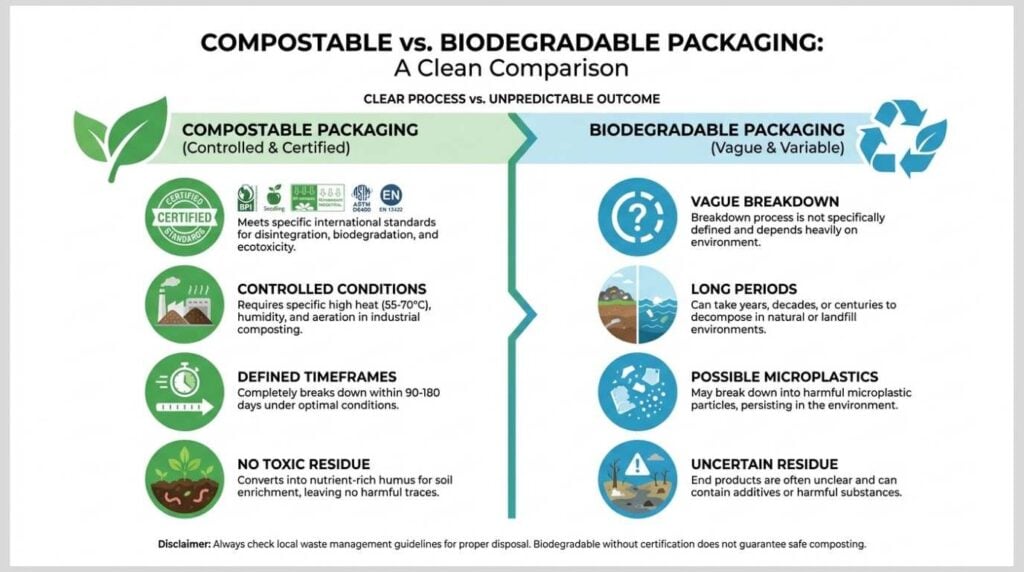
These two terms appear on supplier websites, product catalogues, and packaging labels as though they are interchangeable. They are not, and in 2026, confusing them carries legal risk.
Biodegradable means capable of being broken down by bacteria or other living organisms. The definition says nothing about timeframe, conditions, or residues. A plastic bag can be technically biodegradable if it fragments into microplastics over 50 years.
Compostable means the material meets a defined standard for breaking down into compost within a set timeframe under specific temperature and humidity conditions. Certified compostable packaging has been tested against that standard.
The practical difference for your business: “biodegradable” is an unregulated marketing term with no legal definition in UK packaging law. Printing it on your packaging is among the highest-risk claims you can make under the CMA Green Claims Code, which we cover in the greenwashing section below.
If you cannot point to a specific certification that defines what “biodegradable” means for that product, do not use the word anywhere.
Compostable Does Not Mean Litter-Safe
One of the biggest misconceptions around compostable packaging is that it can safely be discarded into the environment. It cannot. Even certified compostable packaging requires specific composting conditions to break down correctly.
In rivers, streets, parks, or landfills, decomposition may be incomplete, extremely slow, or environmentally harmful. Avoid any messaging that implies your packaging can be littered safely or will naturally disappear without managed disposal conditions.
The Uncomfortable Truth About Disposal in the UK
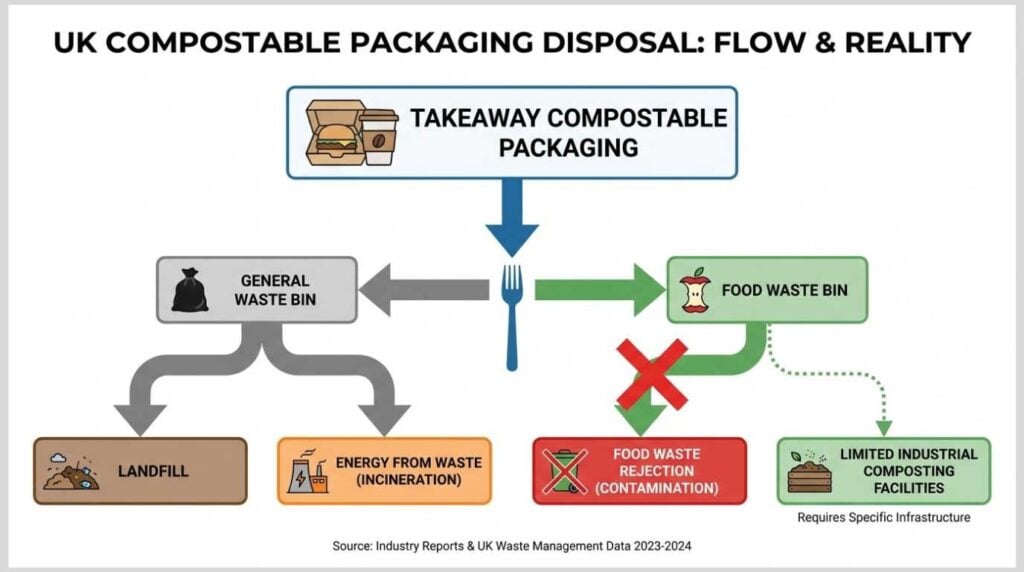
Most compostable food packaging used in the UK does not get composted. This is not a fringe concern. It is the default outcome for the vast majority of compostable packaging sold to UK food businesses today.
Why the Infrastructure Is Not There
Industrial composting requires sustained temperatures of 55 to 60 degrees Celsius over several weeks. This is what breaks down EN13432-certified packaging within the standard’s 12-week window.
According to DEFRA, the UK has a limited network of In-Vessel Composting (IVC) and Anaerobic Digestion (AD) facilities, and fewer still accept compostable food packaging separately from food waste. Most councils explicitly advise against putting compostable packaging in food waste or garden waste bins.
The reason is that food and garden waste is processed on a six-week cycle, while compostable packaging takes far longer to break down in the same conditions, contaminating the compost output and causing it to be rejected by end markets.
What Actually Happens to Compostable Packaging in the UK
| Disposal Route | What Happens | Environmental Outcome |
| General waste bin | Energy-from-waste or landfill | No composting benefit |
| Food or garden waste bin | Rejected as a contaminant | Returned to general waste |
| Landfill without air | Slow anaerobic breakdown | Methane release |
| Energy-from-waste | Incinerated with heat recovery | No composting benefit |
| Certified industrial composter | Proper composting | Intended outcome |
| Home compost heap (HOME certified only) | Breaks down over 12 months | Intended outcome |
The seedling logo is not a guarantee that your packaging will be composted. It is a guarantee it can be composted under industrial conditions. Whether those conditions exist in your customers’ disposal chain is a separate and often negative answer.
What You Can Actually Do About It
Partner with a certified industrial composter in your region. Check with local licensed composting and waste contractors to confirm accepted materials and collection availability.
For events and catering operations, arrange a separate compostable packaging collection through a licensed waste contractor before and during the event.
Add a QR code to your packaging linking to postcode-specific disposal guidance. Simple to implement and demonstrates genuine intent to both customers and regulators.
Consider whether home compostable certification (OK Compost HOME) is more honest for your customers than industrial certification alone.
Choosing compostable packaging without addressing disposal is primarily a branding exercise. Choosing it with a real end-of-life plan is genuine sustainability.
Certifications Explained: EN13432, OK Compost, TÜV and More
Every supplier guide says look for the seedling logo. Few explain what the certification schemes actually test or how they differ.
Certification Comparison Table
| Certification | Body | Standard Type | Temperature | Timeframe | UK Practicality |
| EN13432 | European Committee for Standardisation | Industrial | 58°C | 12 weeks of disintegration, 6 months of biodegradation | Low – few facilities accept packaging |
| OK Compost INDUSTRIAL | TÜV Austria | Industrial | 58°C | Same as EN13432 | Low – same infrastructure constraints |
| OK Compost HOME | TÜV Austria | Home | Ambient 20 to 30°C | 12 months | Higher – no industrial facility needed |
| AS5810 | Standards Australia | Home | Ambient | 12 months | Not a UK standard; treat with caution |
What EN13432 Requires
A product bearing the EN13432 seedling logo has been shown to disintegrate by at least 90% within 12 weeks at 58°C, biodegrade by at least 90% within six months, leave no ecotoxic residues above defined thresholds, and leave no more than 10% of original dry weight as residue above 2mm. This is an industrial standard only. It says nothing about home composting.
OK Compost HOME: The More Honest Claim
Issued by TÜV Austria, OK Compost HOME testing is conducted at ambient temperatures of 20 to 30 degrees Celsius over 12 months. A product with this mark will break down in a functioning home compost heap. This is considerably more useful for many UK food businesses because it does not rely on industrial infrastructure that most customers cannot access.
What Certification Does NOT Guarantee
- ▸ That your local authority accepts it in food or garden waste collections
- ▸ That it is recyclable (under UK EPR rules, it is classified as non-recyclable)
- ▸ That it avoids the Plastic Packaging Tax (PLA-based certified products remain taxable)
- ▸ That it will compost in landfill conditions
Material Guide: Which Compostable Packaging Works for Which Food
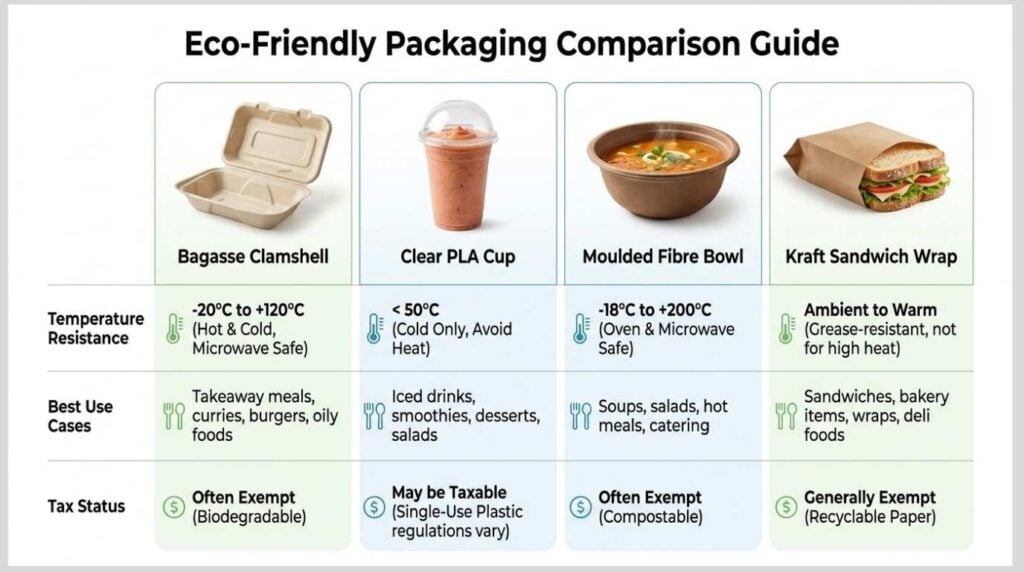
Choosing the wrong compostable material for your food type is one of the most costly mistakes food operators make. The key variables are temperature, grease content, moisture, and hold time.
Material Comparison Table
| Material | PPT Liability | Compostable Cert | Max Temp | Best For | Avoid For |
| Bagasse | None | EN13432 | 120°C | Hot food boxes, bowls | Liquids (needs specific grade) |
| PLA | Yes (taxable) | EN13432 / OK HOME | 40 to 45°C | Cold drinks, salad containers | Hot food, heated displays |
| CPLA | Yes (taxable) | EN13432 | 85°C | Hot drink lids, cutlery | Food containers |
| TPLA | Yes (taxable) | EN13432 | 85°C | Cutlery sets | Containers |
| Kraft with aqueous coating | None | EN13432 | 90°C | Sandwiches, wraps, bags | Heavily sauced or wet food |
| Moulded fibre | None | EN13432 | 120°C | Premium trays, salad bowls | Clear or transparent applications |
| Kraft with PE lining | None for paper | Not compostable | N/A | Do not buy for compostable claims | Everything |
Watch out: Kraft paper products with polyethene (PE) lining are widely sold as sustainable but are not compostable. Always confirm the coating type before purchasing.
Material Notes
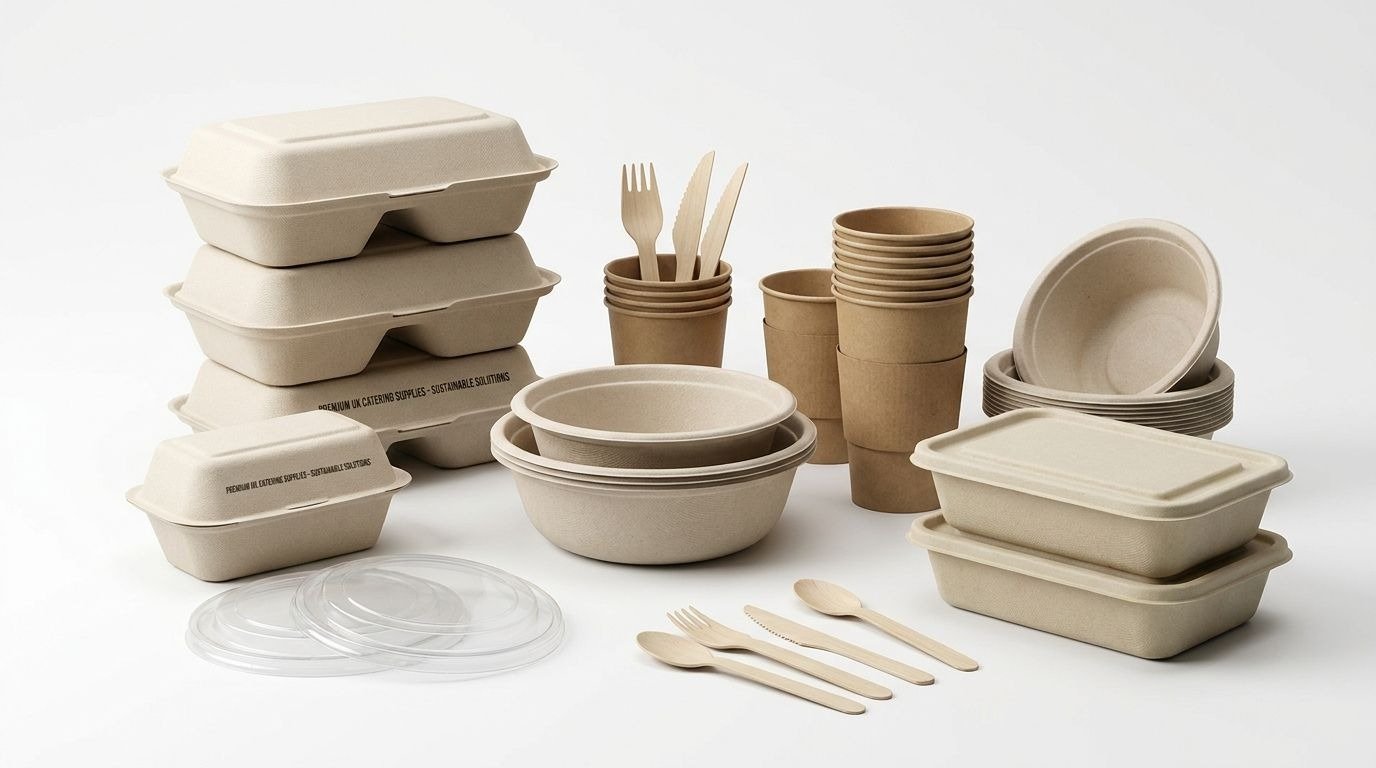
Bagasse is sugarcane pulp, the fibrous residue left after juice extraction. It handles up to 120 degrees Celsius, is naturally grease-resistant, microwave-safe, and carries EN13432 certification as standard. It is the strongest-performing compostable material for hot food across the UK market. If you are looking to trial bagasse before committing to volume, our bagasse clamshell takeaway boxes are available in multiple sizes with full EN13432 documentation.
PLA (Polylactic Acid) is made from fermented plant starch, typically corn. Visually similar to conventional clear plastic. Critical limitation: PLA begins to deform above 40 to 45 degrees Celsius. Do not use for hot food or heated displays, and note that it remains taxable under the Plastic Packaging Tax.
CPLA (Crystallised PLA) has improved temperature resistance up to approximately 85 degrees Celsius. Used primarily for lids on hot drink cups and cutlery. For compostable hot drink lid options that pair with paper cups, see our coffee cup lids range.
Moulded Fibre (also called moulded pulp) is made from recycled paper pulp or virgin agricultural fibre. Premium appearance, excellent leak resistance in the right grade, and suitable for both hot and cold food. The preferred choice for premium food retail and meal kit applications.
Kraft with aqueous coating performs well for sandwiches, wraps, and counter service packaging. For hot drinks, our compostable plastic-free paper cups use a water-based barrier coating rather than a plastic or PLA lining, making them a genuinely compostable option for cafes and takeaways.
For cutlery, birchwood is a strong PPT-free alternative to TPLA at most volumes. Browse our wooden cutlery for event and takeaway formats.
Seaweed and mycelium materials are emerging and not yet at a commercial scale for most UK food operators in 2026.
Quick Decision Matrix by Food Type
| Food Type | Recommended Material | PPT Applies? |
| Hot food boxes (burgers, chips, chicken) | Bagasse | No |
| Cold salads and deli pots | PLA or moulded fibre | PLA: Yes / Fibre: No |
| Hot drinks | Paper cup with CPLA lid | Yes (CPLA lid) |
| Cold drinks | PLA cup | Yes |
| Sandwiches and wraps | Kraft with aqueous coating | No |
| Cutlery sets | TPLA or birchwood | TPLA: Yes / Birchwood: No |
| Soup and noodle pots | Bagasse or moulded fibre | No |
| Premium food retail | Moulded fibre | No |
UK Regulations in 2026: EPR Fees, Plastic Packaging Tax and What They Mean for You
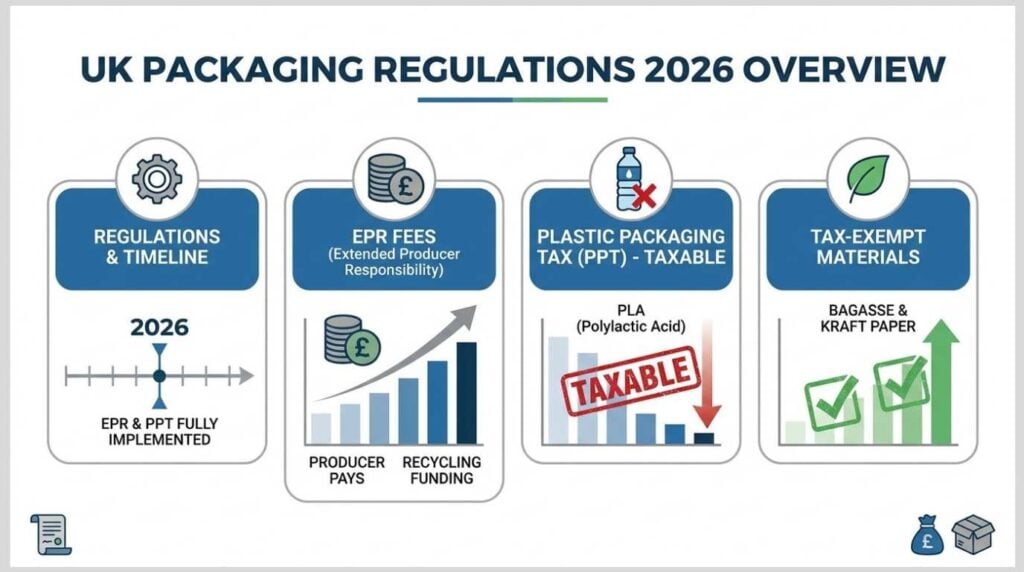
This is the most financially consequential section of this guide, and the one most supplier websites avoid. Two specific regulations create significant cost implications for food businesses using compostable packaging in 2026.
Extended Producer Responsibility (EPR) and Compostable Packaging
The UK’s Extended Producer Responsibility (EPR) for packaging scheme began issuing invoices to producers from October 2025. From 2026 to 2027, fees are modulated using the Recyclability Assessment Methodology (RAM), rating packaging green, amber, or red based on recyclability.
Most compostable packaging is currently treated as non-recyclable within the UK EPR framework because it is not widely collected or reprocessed through existing UK recycling systems. This means it falls into higher fee bands, not the reduced fees that genuinely recyclable mono-material packaging attracts. Full EPR scheme documentation is published by DEFRA at gov.uk.
Compliance alert: Compostable packaging equals non-recyclable under UK EPR. Non-recyclable packaging equals higher EPR fees under RAM modulation from 2026 to 2027 onwards. Switching from recyclable plastic to compostable PLA may increase your EPR liability, not reduce it.
EPR Fee Structure Overview
| Packaging Type | EPR Classification | Fee Tier (RAM) | Notes |
| Recyclable mono-material plastic | Recyclable | Green (lower fee) | e.g. PET bottles, HDPE pots |
| Compostable PLA | Non-recyclable | Red (higher fee) | Despite being plant-based |
| Bagasse or moulded fibre | Non-recyclable | Amber or Red | Paper-based but not recyclable via kerbside |
| Paper-based with PE lining | Non-recyclable | Red | Lining prevents recycling |
| Recyclable paper (uncoated) | Recyclable | Green | Depends on format and coating |
The base EPR fee for plastic in Year 1 is £423 per tonne. Under RAM modulation from 2026 to 2027, red-rated materials will attract fees above this base. Businesses handling 25 tonnes or more of packaging annually may have reporting obligations under EPR. Full disposal fee obligations generally apply to larger producers with turnover above £2 million and packaging volumes above 50 tonnes per year.
Before switching to compostable packaging on regulatory grounds, model the EPR impact on your packaging portfolio. The fees are material enough to change the decision.
The Plastic Packaging Tax and PLA: What HMRC Says
The UK Plastic Packaging Tax (PPT) applies to plastic packaging manufactured in or imported into the UK containing less than 30% recycled plastic content. According to HMRC’s published guidance at gov.uk, the rate increased to approximately £228.82 per tonne from April 2026.
Here is the trap that catches out many food operators: PLA is classified as plastic under PPT. The fact that it is plant-derived and EN13432-certified compostable does not exempt it. Unless your PLA packaging contains at least 30% recycled plastic content, which virtually no compostable PLA product does, it is subject to the full Plastic Packaging Tax.
Key PPT facts: “Biodegradable” is not a recognised PPT category and does not affect tax liability. PLA equals plastic under PPT equals taxable at £228.82 per tonne. Bagasse, kraft paper, and moulded fibre are not plastic and not subject to PPT. The tax applies regardless of composting certification status.
Regulatory Impact by Material
| Material | Plastic Packaging Tax | EPR Classification | Action Required |
| Bagasse | Not applicable | Non-recyclable (higher EPR) | Confirm EPR registration |
| PLA | Taxable (no recycled content) | Non-recyclable (higher EPR) | Register for PPT; model EPR |
| CPLA | Taxable | Non-recyclable (higher EPR) | Same as PLA |
| TPLA | Taxable | Non-recyclable (higher EPR) | Same as PLA |
| Kraft (uncoated) | Not applicable | Recyclable (lower EPR) | Best regulatory position |
| Kraft with aqueous coating | Not applicable | Check RAM rating | Confirm with the EPR scheme |
| Moulded fibre | Not applicable | Check RAM rating | Usually non-recyclable |
The Real Cost: Does Compostable Packaging Actually Save You Money?
Switching to compostable food packaging typically increases unit packaging costs by 20 to 60% compared with equivalent conventional plastic. The range depends on the material, format, supplier, and volumes.
The figures below are illustrative estimates based on typical UK wholesale pricing in 2026 and will vary by supplier, volume, certification, and product specification.
Cost Comparison: 400 Covers Per Day, 6 Days Per Week
| Item | Conventional Plastic | Compostable Equivalent | Premium Per Unit |
| 9-inch clamshell box | £0.08 | £0.14 (bagasse) | +£0.06 |
| Cold drinks cup 16oz | £0.06 | £0.11 (PLA) | +£0.05 |
| Cutlery set | £0.04 | £0.09 (TPLA) | +£0.05 |
| Weekly unit cost (2,400 covers) | approx. £432 | approx. £816 | +£384 per week |
| Annual packaging cost | approx. £22,500 | approx. £42,400 | +£19,900 per year |
The annual premium for this operation is approximately £19,900 before accounting for regulatory costs.
If the operation places more than 25 tonnes of packaging on the market annually and includes PLA, EPR fees on non-recyclable packaging are higher than on recyclable alternatives, and PLA packaging attracts PPT at £228.82 per tonne unless it contains 30% or more recycled content, which it almost certainly does not.
Where Compostable Packaging Can Reduce Costs
Switching from plastic to non-plastic compostable materials removes PPT liability on those components. A business paying PPT on plastic cups and containers could reduce that liability by switching to paper or bagasse alternatives. This is a genuine financial benefit, but it requires switching to non-PLA compostable formats. The EPR cost remains higher than for fully recyclable packaging, regardless of material.
The bottom line is that compostable food packaging is not a cost-saving measure. Budget for it as a premium investment. The financial value comes from brand positioning, customer preference, and where disposal infrastructure supports it, a genuine environmental benefit.
Greenwashing Risks in 2026: What You Can and Cannot Say
This section could save your business a significant financial penalty in 2026.
The Competition and Markets Authority (CMA) published its Green Claims Code in 2021, available at gov.uk/cma. Under the Digital Markets, Competition and Consumers Act 2024, the CMA now has direct enforcement powers to impose fines of up to 10% of global annual turnover for misleading environmental claims, without needing to take a business to court. Enforcement is intensifying across all sectors.
High-Risk vs Low-Risk Claims
| Claim | Risk Level | Why |
| “Biodegradable packaging” | Very High | No legal definition; unqualified, vague claim |
| “Eco-friendly packaging” | High | No measurable basis; cannot be substantiated |
| “Sustainable packaging” | High | Undefined; CMA flags this as typical greenwashing |
| “Better for the planet” | High | Comparative claim requires evidence against a baseline |
| “100% compostable” without disposal guidance | Medium-High | Misleading if the packaging goes to the landfill in practice |
| “EN13432 certified compostable at industrial facilities” | Low | Specific, verifiable, honest about conditions |
| “Home compostable. Certified OK Compost HOME.” | Low | Specific certification, honest about what it means |
| “Made from sugarcane. No plastic.” | Low | Factual material claim; easily verified |
| “Plastic Packaging Tax exempt” for bagasse or kraft | Low | Factually accurate for non-plastic materials |
The CMA’s Six Green Claims Principles
According to the CMA Green Claims Code, all environmental claims must be truthful and accurate, clear and unambiguous, not omitting material information, based on fair and meaningful comparisons, considerate of the full product life cycle, and substantiated with robust evidence.
Printing “compostable” on packaging that you know will end up in general waste because your customers have no access to industrial composting facilities is a life-cycle claim that may fall short of principle five. It is not necessarily illegal, but it is exactly the type of claim the CMA is examining closely in 2026.
How to Communicate Your Packaging Choices to Customers Safely
Once you have chosen certified packaging and understand its actual disposal pathway, customer communication is an opportunity, not just a compliance requirement.
On-Pack Messaging That Works
Safe and effective examples:
- ▸ “Industrially compostable. EN13432 certified. Check local facilities at [link or QR code].”
- ▸ “Home compostable in your garden compost bin. OK Compost HOME certified.”
- ▸ “Made from sugarcane. No plastic.” (for bagasse, where accurate)
- ▸ “Paper-based packaging. Please recycle.” (for uncoated kraft)
What to avoid: “Our packaging is kinder to the planet” without a specific, evidence-based basis. “Fully sustainable packaging” with no certification or data behind it. Any implication that customers can put the packaging in their food caddy unless it is OK Compost HOME certified and locally accepted.
QR Code Disposal Guidance
A QR code on your packaging linking to postcode-specific disposal guidance is one of the most effective and low-cost communication tools available. It demonstrates genuine intent, helps customers act correctly, and provides a defensible record that you communicated disposal requirements clearly.
Staff Briefing Points
Brief your team on the difference between compostable and recyclable (they are not the same and the bins are different), which bin is appropriate for each item you use (be honest if the current answer is general waste), and what the certification marks on your packaging mean in plain language.
Supplier Due Diligence: What to Ask Before You Buy
Not all compostable packaging sold in the UK is certified to the standard it claims. Certification marks are misrepresented, coatings are sometimes undisclosed, and some products have not been tested against any recognised standard.
Certification questions: Can you provide the EN13432 or OK Compost certification for the finished product, not just the base material? Which certification body issued it, and what is the certificate number? Does the certification cover all components, including lids, coatings, printed labels, and adhesives?
Material and food safety questions: What is the base material for each component? Is any plastic lining or coating used, and if so, what type? Do the products carry UK food contact compliance under Food Standards Agency requirements? Are the products free from PFAS (per- and polyfluoroalkyl substances)? PFAS-containing food packaging is under increasing regulatory scrutiny in the UK following EU bans in 2026.
Regulatory compliance questions: Are you EPR registered as a packaging producer in the UK? Which of your products are classified as plastic under the UK Plastic Packaging Tax? Can you provide a material data sheet or written compliance declaration for each product line?
Commercial questions: What is the minimum order quantity? Can you guarantee certified products to the same specification consistently for 12 months? Does custom printing affect the compostability certification?
Suppliers who cannot answer certification and compliance questions with documentation should be treated with caution, regardless of how their website presents the products. You can browse our full packaging supplies range for certified formats across all food types and service styles.
Sector-Specific Guidance: Takeaway, Catering, and Food Retail
The right compostable packaging decision for a street food vendor is different from the right decision for a corporate caterer or a premium delicatessen.
High-Volume Takeaways
Cost sensitivity dominates. At 500 or more covers per day, a 10p per cover packaging premium adds more than £18,000 per year to costs. Prioritise non-plastic compostable materials like bagasse and kraft to remove PPT liability on those components. Use EN13432 as the minimum certification standard. If you have eat-in customers, a simple two-bin system makes contracted composting collections more viable.
For pizza-specific guidance, including performance testing through real UK delivery conditions and a cost breakdown by box size, see our dedicated article on compostable pizza boxes for UK takeaways.
Event Catering and Festival Operations
This is where compostable packaging genuinely delivers on its environmental promise, because end-of-life infrastructure can be planned and controlled. Commission a licensed waste contractor to collect compostable packaging separately from general waste at every event.
Use certified products consistently and do not mix compostable and non-compostable formats in the same waste stream. For outdoor events in warm weather, avoid PLA for hot food. Bagasse performs reliably at elevated temperatures. Our catering supplies range includes certified compostable formats suited to event and festival operations.
Food Retail and Delicatessens
Shelf appeal matters alongside performance. Clear PLA containers work well for salads and deli items where product visibility drives sales, noting the PPT liability. Use kraft paper with aqueous coating for counter wrapping and confirm the coating type with your supplier.
Ensure any labels, stickers, or date stamps applied to compostable packaging are also compostable. A single non-compostable adhesive can technically remove the product from EN13432 compliance. PLA deforms in warm or heated display cases; switch to bagasse or moulded fibre for any product held in heated conditions.
For hot drinks service, our paper coffee cups are available in compostable formats and pair with our compostable coffee cup lids for a fully certified hot drinks solution.
Is Compostable Packaging Right for Your Business?
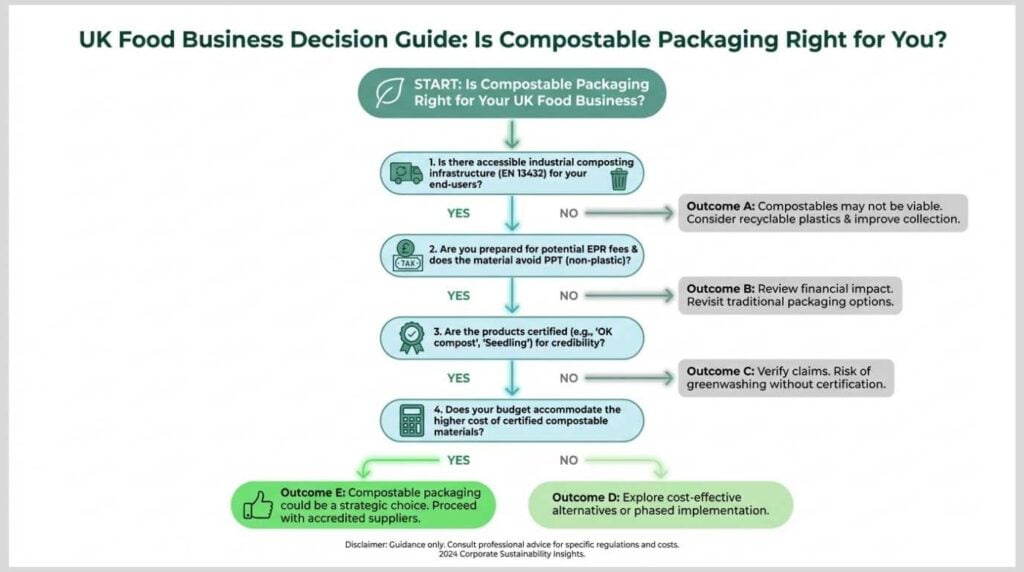
Compostable food packaging is a genuine environmental step forward under the right conditions. In the UK in 2026, those conditions are less common than the marketing suggests, and the regulatory landscape makes the financial case more nuanced than most suppliers present.
When Compostable Packaging Is the Right Choice
- ▸ You can arrange a genuine end-of-life composting pathway, whether on-site, contracted, or event-based.
- ▸ You are switching from plastic components and want to remove PPT liability on those specific items.
- ▸ You are committed to communicating honestly and specifically about what your packaging can and cannot do.
- ▸ You view it as a brand and values investment, not a cost-reduction measure
When Compostable Packaging Is the Wrong Choice
- ▸ You are switching from recyclable plastic to compostable PLA, expecting lower EPR fees. You will likely pay more.
- ▸ You plan to make unqualified claims like “eco-friendly” or “sustainable” without substantiation or certification.
- ▸ You have not modelled the full unit cost and regulatory cost impact for your packaging volumes.
- ▸ Your customers have no realistic disposal route to an industrial or home composting facility.
Your Practical Next Steps for 2026
Start with your highest-volume items: cups, takeaway containers, and cutlery. Small specification changes in these three categories create the highest cost and compliance impact.
Audit your current packaging. List each item, its material, and whether it carries a compostability certification. Identify which items are subject to PPT. PLA components almost certainly are. Model your EPR liability under the current RAM ratings for each material. Identify your end-of-life disposal options by contacting a certified industrial composter in your region. Update your claims by removing any vague environmental language and replacing it with certified, specific statements.
If you are ready to source certified compostable food packaging for your takeaway, cafe, catering business, or food service operation, We Can Source It supplies a wide range of UK-compliant solutions designed for different food types, service styles, and budgets.
FAQs
Will switching to compostable packaging improve my EPR fees?
Not automatically, and in many cases, the opposite is true. Most compostable packaging, including PLA, bagasse, and moulded fibre, is currently classified as non-recyclable under the UK EPR Recyclability Assessment Methodology. Non-recyclable packaging attracts higher fee bands than genuinely recyclable mono-material plastic. If you are switching from recyclable plastic to compostable PLA specifically to reduce regulatory costs, model your EPR liability first. The financial outcome may surprise you.
What happens if my supplier’s certification does not cover the lid, label, or coating?
The entire product loses its compostability claim in practice. EN13432 certification must cover every component of the finished item, including lids, adhesive labels, printed inks, and any coating applied to the base material. A single non-certified component means the packaging cannot honestly be described as fully compostable. Always ask your supplier for a certificate that covers the complete finished product, not just the base material, and get it in writing.
Can I get in trouble for printing “compostable” on my packaging?
Yes, if the claim is misleading in context. Under the CMA Green Claims Code and the Digital Markets, Competition and Consumers Act 2024, printing “compostable” on packaging that your customers have no realistic way to compost could be considered a misleading environmental claim. The safer approach is to be specific: state the certification, name the conditions required, and include disposal guidance via a QR code or printed instruction. Vague is risky. Specific and honest is defensible.
Does compostable packaging avoid the Plastic Packaging Tax?
Only if the material is not classified as plastic under HMRC rules. Bagasse, uncoated kraft paper, and moulded fibre are outside the scope of the Plastic Packaging Tax. PLA, CPLA, and TPLA are all treated as plastic by HMRC regardless of their plant-based origin or composting certification, and remain taxable at £228.82 per tonne unless they contain at least 30% recycled plastic content, which most certified compostable PLA products do not.
What is the difference between EN13432 and OK Compost HOME, and does it matter which one my packaging has?
It matters significantly. EN13432 certifies that packaging will break down under industrial composting conditions at around 58 degrees Celsius over 12 weeks. OK Compost HOME certifies breakdown at ambient temperatures over 12 months, meaning it works in a functioning garden compost heap. For most UK food businesses whose customers cannot access industrial composting facilities, OK Compost HOME is the more honest and practical claim. EN13432 is the right choice if you have a contracted industrial composting collection in place.
Is compostable packaging litter-safe or environmentally harmless if disposed of incorrectly?
No. Even certified compostable materials require specific managed conditions to break down correctly. In rivers, streets, or landfills, decomposition may be incomplete, extremely slow, or produce harmful residues. Compostable packaging is not a solution to littering and should never be communicated as such. Any messaging that implies it will safely disappear in the environment is both factually wrong and a greenwashing risk under CMA guidelines.
Author
We Can Source It, Team
The We Can Source It Team supplies catering products, food packaging, cleaning supplies, and hospitality essentials to businesses across the UK. Our content is written to help food service operators make practical, compliant, and cost-effective purchasing decisions.
Related Articles in This Series
References and further reading:
- ▸ HMRC: Plastic Packaging Tax – who must register and charge the tax (gov.uk)
- ▸ DEFRA: Extended Producer Responsibility for packaging – scheme documentation (gov.uk)
- ▸ CMA: Green Claims Code – making environmental claims (gov.uk/cma)
- ▸ TÜV Austria: OK Compost HOME and INDUSTRIAL certification standards (tuv-at.com)
- ▸ WRAP UK: Guidance on compostable packaging in the UK waste system (wrap.org.uk)