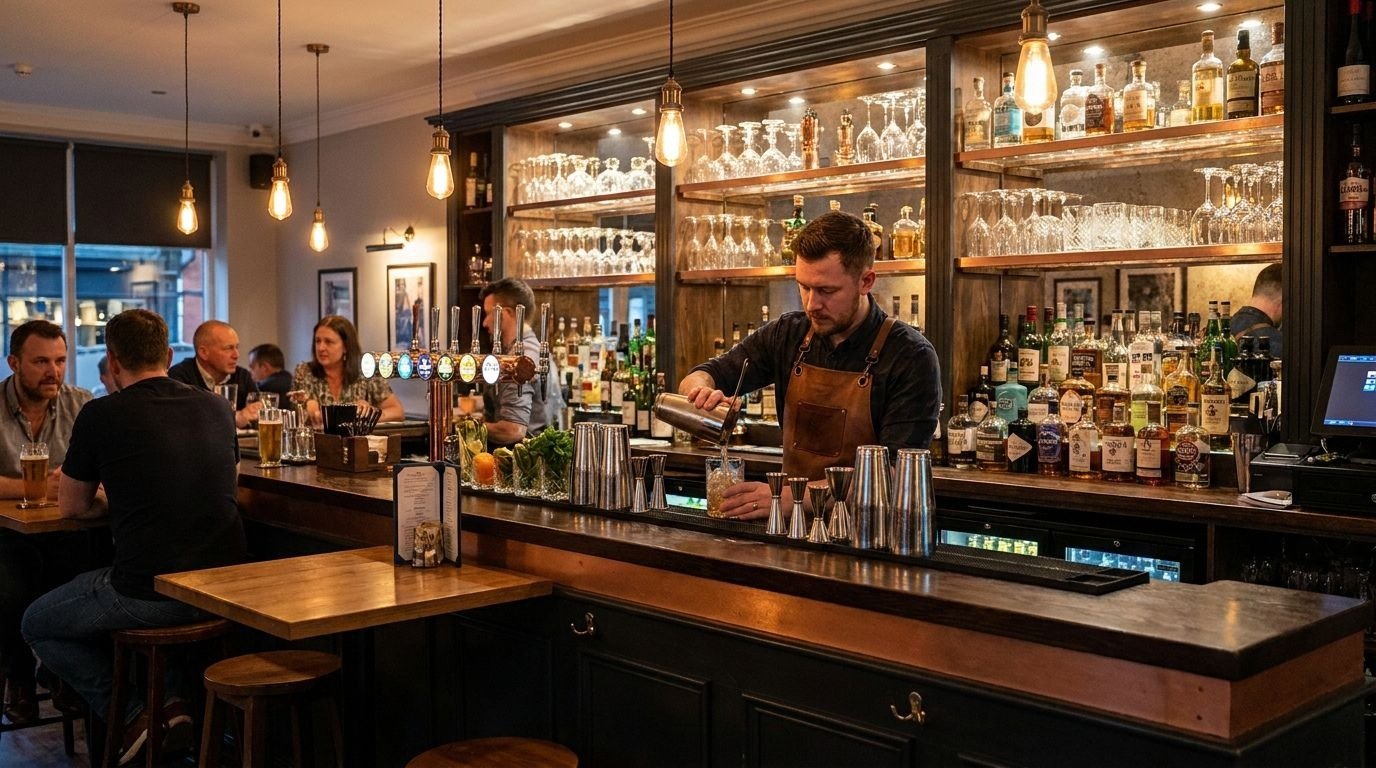
The UK pub and bar market was worth about £24 billion in 2025. The industry faces pressures like energy costs, staffing challenges, and changing consumer habits. Even so, well-run operations can still be highly profitable.
The average wet-sales margin for a licensed bar sits between 60 and 70 per cent. But capturing that margin requires more than a good drink selection. It requires the right equipment, properly maintained and intelligently deployed.
Bar supplies are the infrastructure of your drinks service. A bar can lose money on every sale. This can happen if it runs out of ice during service. It can also happen if it uses uncalibrated measuring tools. Uneven pours can also cause losses.
Using the wrong tools can lead to losses, too. Conversely, a bar that is well-stocked, legally compliant, and efficiently organised delivers faster service, lower waste, and a better customer experience on every shift.
This guide covers all bar equipment and supplies that UK pub and bar operators need. It offers practical guidance, legal context, and clear decision-making throughout. Whether you are opening a new bar, updating your current setup, or filling stock gaps, this is the complete guide.
What Are Bar Supplies? The Full Scope for UK Operators
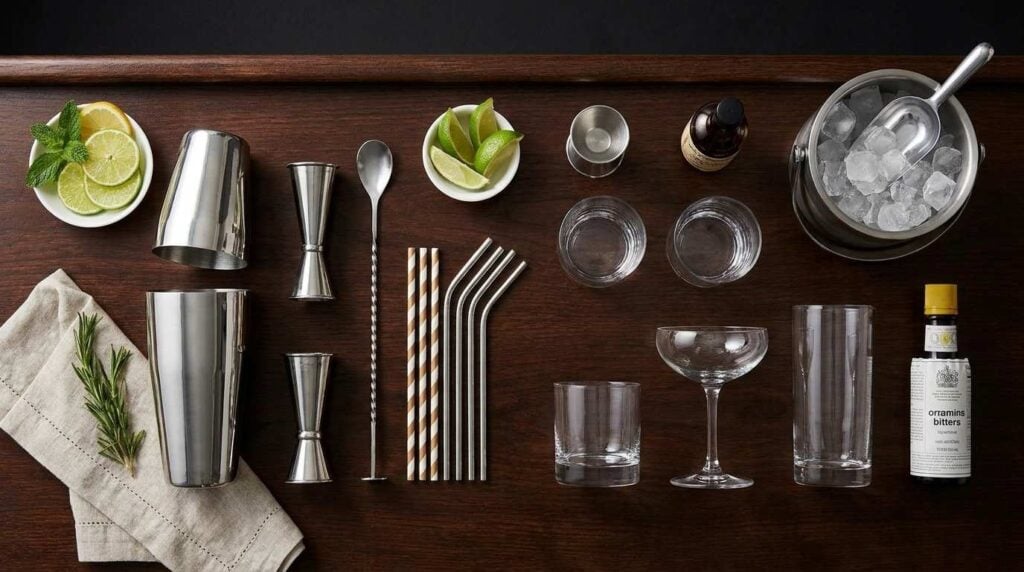
Bar supplies are the collective term for every piece of equipment, tool, accessory, and consumable that a licensed bar needs to pour, serve, and present drinks.
The category includes everything. It ranges from the government-approved spirit measures behind your bar to the paper straws in front of customers. It also includes the cocktail shaker on the service station and the CO2 cylinders in your cellar.
For UK operators, bar supplies carry a legal dimension that does not apply in every country. The Weights and Measures Act 1985 and the Weights and Measures (Intoxicating Liquor) Order 1988 govern how spirits are measured and served.
The Environmental Protection (Plastic Straws, Cotton Buds and Stirrers) Regulations 2020 set rules for single-use items. Bars can and cannot supply certain items.
CO2 cylinders in cellars are covered by health and safety legislation. Understanding which supplies carry compliance obligations is the foundation of a professionally run bar.
Bar supplies fall into six core categories:
- ▸ Measuring and dispensing equipment: spirit optics, thimble measures, speed pourers, jiggers
- ▸ Cocktail tools: shakers, strainers, muddlers, bar spoons, pourers
- ▸ Drinkware: glassware, polycarbonate, disposable cups
- ▸ Ice and temperature management: ice buckets, tongs, scoops, wine coolers, chillers
- ▸ Bar organisation accessories: bar mats, speed rails, bottle skips, caddies, trays
- ▸ Cellar equipment: gas cylinders, line cleaning kit, keg skids, cellar boards
Measuring and Dispensing: The Legal Foundation of Every UK Bar
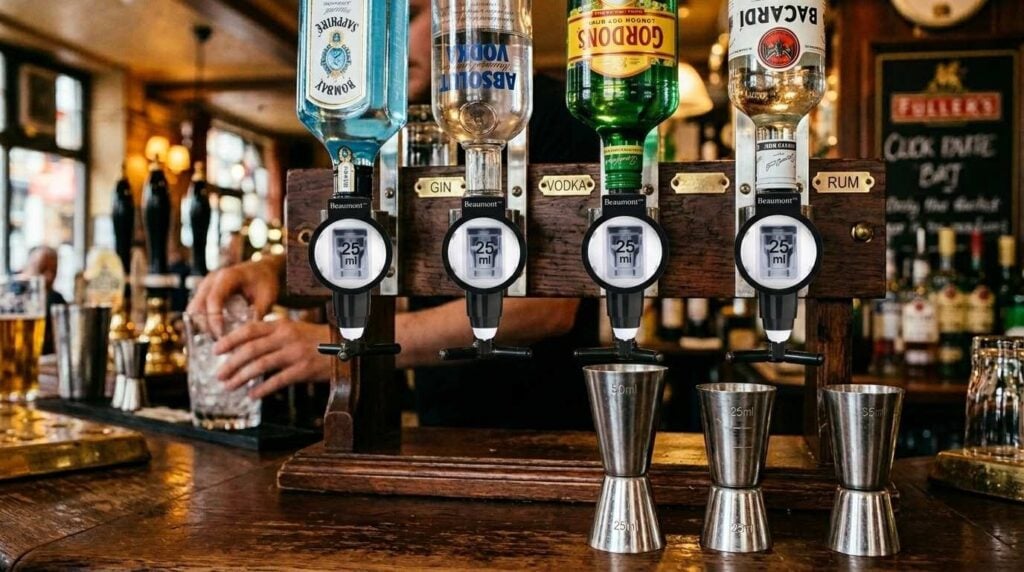
This is the most legally consequential category of bar supplies in the UK, and it is where Trading Standards officers focus their attention during inspections. Getting it wrong is not just an operational inconvenience; it is a criminal offence.
Spirit Measures: What the Law Requires
Under the Weights and Measures (Intoxicating Liquor) Order 1988, gin, rum, vodka, and whisky must be sold in measures of exactly 25ml or 35ml or multiples thereof when served by the glass on licensed premises. No other standard is legal. A venue must choose one measure size and apply it consistently across all bars within the premises. You cannot use 25ml at one bar and 35ml at another within the same building.
The measuring devices used, whether optics or thimble jiggers, must carry a government crown stamp that confirms they dispense the stated volume.
Bottle top pourers and free-pour speed spouts are not legally acceptable as primary measuring devices for the four regulated spirits. Bars must also display a notice visible to customers stating which measure size is in use.
There is one notable exception: cocktails containing three or more liquids are exempt from the measured serving requirement. Water does not count as a liquid for this purpose. A bartender making a Negroni gin, sweet vermouth, and Campari can free-pour those ingredients.
A bartender serving a straight gin and tonic cannot. The line matters legally, and it matters financially, because under-measuring costs customer trust and over-pouring costs margin.
Optics vs Thimble Measures: Which Is Right for Your Bar?
Bar optics are the push-up dispensers mounted on bottles, most commonly seen in traditional pubs. They dispense a precise amount with each pull of the lever. They work well in a classic pub bar. This is best when spirits are served as singles or doubles. They are often served over ice or with a mixer. Their main advantage is speed. Their limitation is flexibility; they are designed for one bottle and one pour size.
Thimble measures and jiggers give a bartender greater flexibility, particularly in cocktail environments where multiple spirits are combined and where different pour sizes may be needed for different products. A well-equipped cocktail bar will typically stock stamped thimbles in 25ml, 35ml, and 50ml sizes as a minimum.
Speed pourers, the rubber-and-metal pourers inserted into the bottle neck, are widely used as a practical tool for dispensing into a thimble during cocktail preparation, and for free-pouring spirits exempt from measure requirements, such as tequila, brandy, and most liqueurs. They are not a substitute for stamped measures when serving the four regulated spirits.
Essential Bar Tools Every UK Pub Needs Behind the Counter
There is a meaningful difference between the tools a pub bar needs and those a dedicated cocktail bar requires. Both need commercial durability. The specific items differ considerably. Getting this right matters because the wrong tools slow service, increase waste, and frustrate staff — all of which have direct revenue impacts.
The Core Tool Set
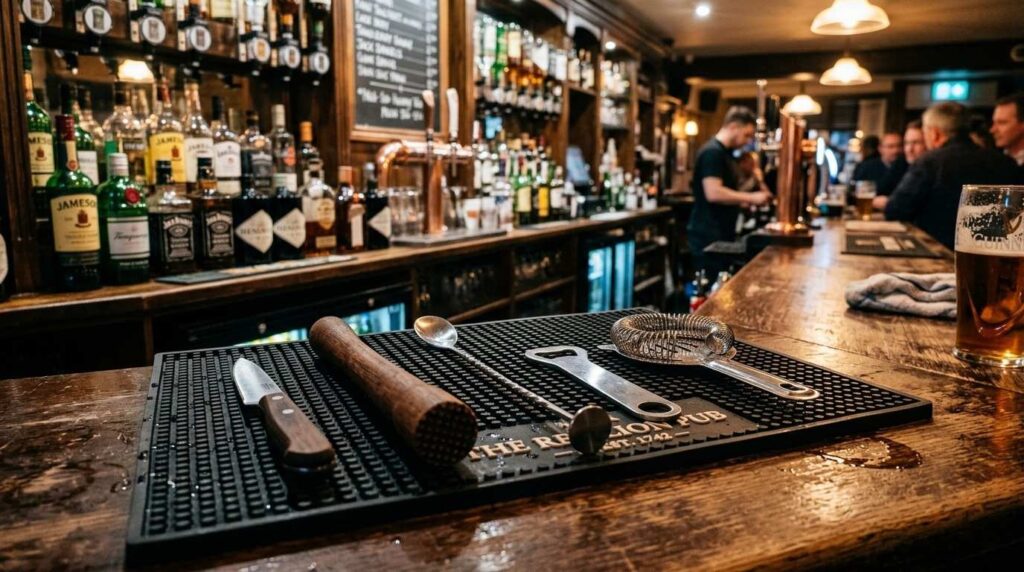
Bottle opener and bar knife. Every bar needs multiple bottle openers, at least one per bar section,n and a sharp bar knife for garnishes. These are the most frequently used tools on any bar and should be commercial grade. Cheap bottle openers bend and fail under volume.
Bar spoon. The long-handled, twisted-stem bar spoon is used for stirring cocktails in mixing glasses, building layered drinks, and measuring small amounts of liquid. A standard bar spoon holds approximately 5ml. Choose stainless steel — plastic handles crack under regular cleaning.
Muddler. Used to release oils and juices from herbs and fruits. Essential for mojitos, old fashioneds, and any drink built around fresh botanicals. Stainless steel muddlers are more durable than wooden ones in a commercial setting. Wooden muddlers absorb flavours over time and are harder to sanitise.
Strainer. Hawthorne strainers (the spring-rimmed disc style) and julep strainers (the perforated bowl style) serve different purposes. Hawthorne strainers fit Boston and cobbler shakers. Julep strainers are used with mixing glasses. For double-straining fine cocktails, a fine mesh tea strainer is also useful.
Ice scoop and tongs. Under food safety regulations, ice must not be handled with bare hands. A dedicated ice scoop and tongs for serving individual cubes are both required. Store the scoop in a holder beside the ice well, not resting in the ice itself.
Bar mats. Service mats behind the bar absorb drips and spills, reducing mess and improving safety on the bar surface. Drain mats allow liquid to pass through and are preferable to solid rubber mats for high-volume service stations.
Cutting board and fruit caddy. A small, dedicated cutting board for bar use — separate from kitchen prep boards and a condiment holder or fruit caddy keep garnishes organised and accessible during service.
What You Should Not Compromise On
Bar knives blunt quickly in a commercial setting. A blunt knife is a safety hazard and slows service. Replace or sharpen them regularly. Ice scoops should be made of stainless steel or heavy-duty plastic; flimsy plastic scoops crack, creating a contamination risk. Bar spoons should be long enough to reach the bottom of your tallest mixing glass. Standard 30cm bar spoons work for most applications.
Cocktail Shakers and Professional Cocktail Equipment
The UK cocktail market has grown a lot over the past decade. Cocktail service now drives meaningful revenue in pubs and bars of all types. It is not limited to dedicated cocktail venues. A well-made cocktail at £10–£15 brings a higher margin than a £6 pint. Customers also expect cocktails, even in traditional pubs. The right equipment is what makes consistent, efficient cocktail service possible at volume.
The Three Types of Cocktail Shaker
The Boston Shaker. The professional bartender’s standard. It consists of two pieces, a large metal tin and either a second smaller tin or a glass mixing vessel, that seal together under pressure when shaken. Boston shakers chill and combine drinks quickly, are easy to clean, and are durable in a commercial environment. The limitation is that they require a separate strainer to pour. For a high-volume cocktail bar or a pub that does significant cocktail numbers at weekends, Boston shakers are the right choice.
The Cobbler Shaker. The three-piece design has a built-in strainer cap. More intuitive for less experienced bartenders and appropriate for venues where cocktail service is occasional rather than central to the offer. The built-in strainer is convenient, but the cap can seal under suction during shaking. This happens most often in cold conditions. It can frustrate staff and slow service in a busy environment.
The Parisian or French Shaker. A two-piece metal shaker with a cap rather than a separate tin. It has aesthetic appeal and is popular in more formal bar environments. It functions similarly to the Boston shaker but is less common in UK pub settings and has fewer compatible accessories available.
Additional Cocktail Equipment Worth Stocking
Mixing glass. A heavy, tall glass with a poured lip used for stirred cocktails, Martinis, Negronis, Old Fashioned, etc., where shaking would over-dilute or cloud the drink.
Jigger set. Even in a cocktail bar using free pour for exempt spirits, calibrated jiggers are used for syrups, juices, and modifiers. A 25ml/50ml double-ended jigger and a 15ml/30ml jigger cover the standard range.
Channel knife and zester. For citrus twists and garnishes. A channel knife cuts a clean spiral; a Microplane grater produces fine zest for finishing cocktails.
Cocktail picks and skewers. For garnishes, olives, cherries, and citrus wheels. Customers notice the detail in the drink presentation, and it affects their perceived value of the drink.
Lewis bag and mallet. For crushing ice. Crushed ice is essential for juleps, cobblers, mai tais, and many summer cocktails. A Lewis bag absorbs the water released during crushing, keeping the ice dry and the drink correctly diluted.
Paper Straws, Stirrers, and the UK Single-Use Plastics Law

This is an area where many UK bars still operate with a misunderstanding of the law. Some also have stock that does not comply. Getting it right matters: Trading Standards officers do visit licensed premises, and the consequences of non-compliance include fixed monetary penalties.
What Is Banned and What Is Not
The Environmental Protection (Plastic Straws, Cotton Buds and Stirrers) (England) Regulations 2020 came into force on 1 October 2020. The law prohibits the supply, meaning the sale, offer of sale, or free provision of single-use plastic straws, plastic-stemmed cotton buds, and plastic drink stirrers to end-users in England.
Plastic stirrers are banned outright. There are no exemptions. Serving a drink with a plastic stirrer is a direct breach of the regulations, regardless of whether the customer asked for it.
Plastic straws are restricted, not banned outright. Pubs and bars (listed as catering establishments under the rules) may give a customer a single-use plastic straw. They may do so only if the straw is not visible to customers. It must not be in a place where customers can help themselves.
It must not be offered to customers, either verbally or in writing. In practice, plastic straws must be kept in a drawer or a hidden area. They are given only when a customer asks for one. This is usually for medical or accessibility reasons.
Compliant alternatives include paper straws, bamboo straws, pasta straws, and reusable metal straws. Paper and wooden stirrers are fully compliant replacements for plastic stirrers.
Choosing the Right Paper Straws for Your Bar
Not all paper straws are equal, and this matters in a bar environment. The common complaints about paper straws, that they go soggy too quickly or affect the taste of the drink, are largely problems of specification.
Ply thickness matters. Single-ply paper straws disintegrate faster than 3-ply versions. For cocktails and long drinks where the customer will drink for 15–20 minutes, a 3-ply paper straw provides meaningfully better performance.
Diameter affects usability. A 6mm straw suits most cocktails and mixed drinks. Wider 8mm straws are better for smoothies and thicker drinks. A bar should stock at least two sizes.
Straight vs flexible. Straight straws look cleaner in drink presentations and are standard for bar service. Flexible straws with the accordion bend are important for customers who need to drink without tilting a glass for accessibility reasons. A bar should stock both.
Ice Buckets, Stands, and Temperature Management
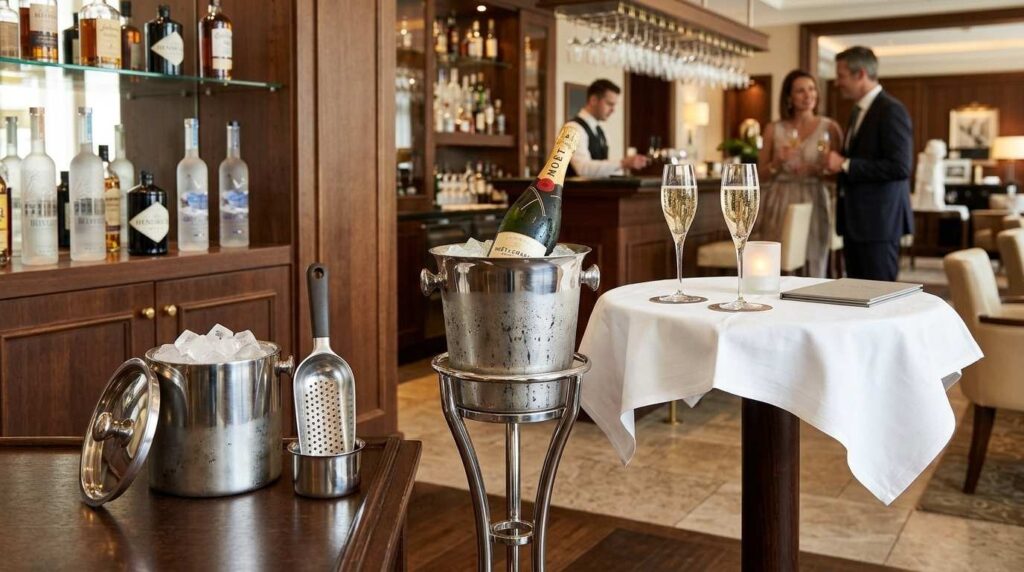
Ice is one of the most important and most frequently mismanaged ingredients in a bar. It affects the temperature, dilution, appearance, and texture of almost every drink served. The equipment used to handle, store, and present ice deserves the same consideration as the spirits and mixers it accompanies.
Ice Buckets and Stands
Ice buckets serve two distinct purposes in a bar: chilling bottles for tableside service, and holding ice at the bar service station. These are different requirements and benefit from different products.
For tableside wine and champagne service, a stainless steel or silver-plated ice bucket on a stand is both functional and presentational. The bucket should hold at least 3 litres, enough to submerge a 750ml bottle in ice and cold water. Wine chills most efficiently when submerged in a mixture of ice and cold water rather than ice alone. Stands should be stable on both carpeted and tiled surfaces.
For bar service station ice, an insulated ice caddy or ice well is the practical choice. These are designed to keep ice at service temperature during a session without constant replenishment. Dedicated ice caddies with lids reduce contamination risk and keep ice usable for longer than open gastronorm containers.
Ice Handling: Food Safety Requirements
Ice is classified as a food under UK food safety law. The practical implications for bar service:
- ▸ Ice must not be handled with bare hands. A dedicated ice scoop or tongs is required at all times.
- ▸ Ice scoops must not be stored resting in the ice; they should be stored in a clean, dry holder beside the ice well.
- ▸ Never use glassware to scoop ice. A glass pressed into an ice bin can chip or shatter, contaminating the ice with glass fragments. This is one of the leading causes of glass contamination incidents in bars.
- ▸ Ice machines should be cleaned and descaled regularly. Weekly inspection is best practice.
- ▸ The ice storage area should be protected from contamination by other products.
How to Set Up a Fully Stocked Bar on a Budget
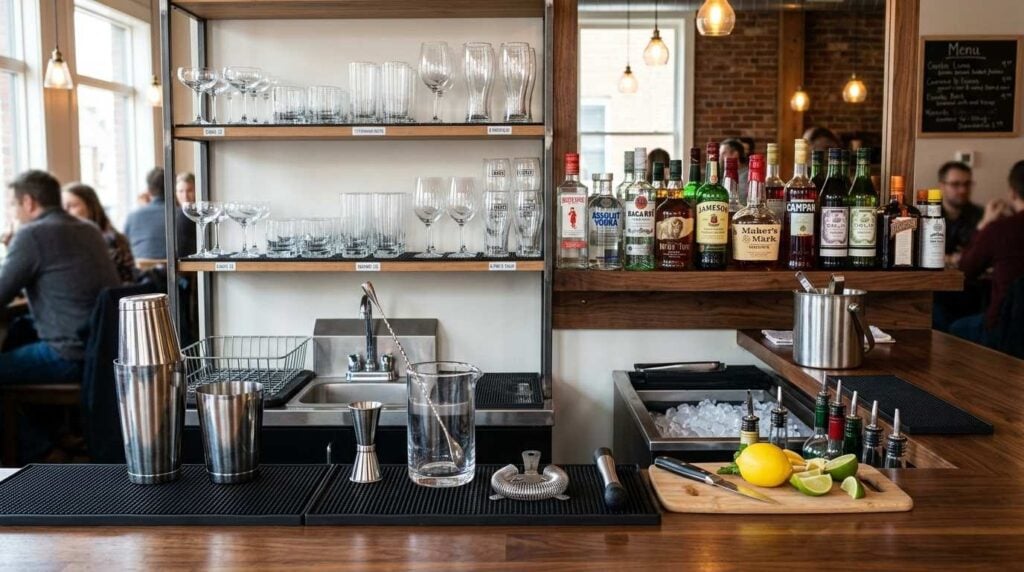
Setting up a bar from scratch is expensive. The temptation is to cut costs across all categories. Some of those cuts are reasonable. Others create operational problems that cost more to fix than the original savings justified. The key is knowing which categories cannot be compromised.
The Non-Negotiables
Stamped spirit measures. These are a legal requirement and are inexpensive. A set of quality stamped thimbles costs £20–£50. This is not an area for budget decisions.
Glassware. Glasses are the most visible item in your service and the most frequently replaced. Commercial-grade, glasswasher-safe glasses bought once are cheaper over a 12-month period than replacing cheap glasses repeatedly. Budget for at least 2.5 times your cover count.
Bar mats and drain mats. A damp, unprotected bar surface is a safety hazard. A small but non-negotiable category.
CO2 gas alarm. If your bar has a cellar with CO2 cylinders, a gas detection alarm is a health and safety requirement. This cannot be deferred.
Where Sensible Savings Are Possible
Cocktail shakers. A mid-range commercial Boston shaker set performs identically to a premium version. The difference is primarily aesthetic.
Small bar tools. Bar spoons, muddlers, and strainers are not expensive. A reliable mid-range set gives good durability without unnecessary cost.
Ice buckets. For most pub environments, a standard stainless steel ice bucket and stand does the job identically to a higher-specification version.
Speed pourers. A functional speed pourer costs £1–£4. The performance difference between the budget and premium versions at this end of the market is minimal.
Phasing Your Bar Investment
For a new bar or a pub adding cocktail capability, a phased approach avoids the mistake of attempting to purchase everything at once.
Phase 1 Launch: Stamped measures, glasswasher-safe glassware, ice scoop, bar mats, bottle openers, speed pourers, paper straws. Budget: approximately £200–£500. Purpose: legal compliance and functional service from day one.
Phase 2 Consolidation: Full cocktail tool set, Boston shakers, bar spoons, muddlers, mixing glass, and additional ice management. Budget: approximately £150–£400. Purpose: cocktail capability and service efficiency.
Phase 3 Optimisation: Wine stands, premium glassware, bar caddies, cocktail picks, garnish tools, spirit chillers. Budget: approximately £200–£600. Purpose: customer experience and margin improvement.
Bar Cellar Management: Equipment, Safety, and Best Practice
The cellar is the foundation of every pub’s draught beer offering. What happens in the cellar determines the quality of every pint pulled at the bar. Yet cellar management remains one of the most inconsistent practices in UK hospitality. The consequences include beer waste, customer complaints, and lost trade.
The Correct Cellar Temperature and Why It Matters
The correct temperature for a UK pub or bar cellar is 11–13°C, with 12°C as the standard target.
This specific range exists for three interconnected reasons. First, cask ales need a stable temperature in this range to condition well. If it is too warm, the ale turns acidic. If it is too cool, it gets a chill haze. This haze makes the beer look cloudy.
Second, keg beers have their gas pressures set by the brewery engineer based on a fixed cellar temperature. If that temperature changes a lot, the gas balance is disrupted, and the result is too much foam or flat beer. Third, the line coolers that carry beer from the cellar to the bar tap are calibrated to work with beer pre-cooled to this temperature range.
Cellar temperature should be monitored daily and logged. If the temperature drifts above 13°C, beer quality deteriorates, and foam complaints at the bar typically follow within hours.
Beer Line Cleaning: The Legal and Commercial Case
Beer lines must be cleaned at least once every seven days. This is a hygiene requirement under the Food Safety Regulations, which classify beer as an open food product and apply kitchen-level hygiene standards to its dispensing equipment. Higher-volume venues or those rotating many products may benefit from twice-weekly cleaning.
Unclean lines allow bacteria, yeast, and mould to build up within the dispensing tubing. The result is off-flavours in the beer, excessive foam at the tap, and, in more serious cases, a product that makes customers ill. The average pub wastes approximately 20 pints per week from inefficient line cleaning alone; poor cleaning causes excess foaming, and fobbing beer is beer that cannot be served.
Line cleaning must be done with dedicated beer line cleaning chemicals. General-purpose cleaning products from cash-and-carry suppliers damage line materials and leave residue that affects beer flavour. Every cleaning should be recorded in the cellar board log.
CO2 Safety in the Bar Cellar
Carbon dioxide is used to pressurise keg beers and drive them from the cellar to the bar tap. CO2 is colourless, odourless, and heavier than air. It accumulates at floor level in confined spaces and at elevated concentrations displaces oxygen, causing unconsciousness rapidly and death within minutes without warning.
UK health and safety rules require CO2 cellars to have a CO2 gas alarm.
The alarm must trigger visual and audible alerts before CO2 levels become dangerous. These alarms must be tested regularly and must not be disabled. Staff must be trained to leave the cellar immediately if the alarm triggers, not to investigate the cause.
Additional CO2 safety requirements:
- ▸ Store CO2 cylinders secured upright and chained to the wall to prevent tipping.
- ▸ Turn off gas supply to service areas between trading sessions to prevent over-carbonation and gas waste.
- ▸ Ensure adequate ventilation in the cellar at all times.
- ▸ Only trained staff should connect and disconnect gas cylinders.
Essential Cellar Equipment
Cellar thermometer. A calibrated thermometer with a continuous readout of cellar temperature. Digital units with alarm functions that alert staff if the temperature goes outside 11–13°C are recommended for busy operations.
Keg skids and pallets. Kegs should be stored on pallets or skids, off the floor. Full kegs must never be stacked on top of each other. Walking on top of kegs is prohibited under manual handling guidance.
Beer line cleaning kit. A dedicated hand-pump barrel cleaning unit, appropriate chemicals, and clean collection vessels for waste chemicals.
Fob detector. A device that stops beer flow to the bar when a keg empties, preventing air from getting into the line, which causes foaming and wastage when the next keg is connected. Standard on professional keg installations.
Cellar board. A record board mounted in the cellar tracking beers on sale, best-before dates, line cleaning records, and keg rotation. A basic accountability tool and a compliance record, if inspected.
CO2 gas alarm. Non-negotiable for any cellar with gas cylinders.
Common Mistakes UK Bar Operators Make with Bar Supplies
Using unverified measures for spirits. The government crown stamp on optics and thimbles matters. If you buy bar equipment second-hand, always verify that measuring devices carry the stamp before putting them into service. An unstamped measure used for gin, rum, vodka, or whisky is non-compliant regardless of its actual accuracy.
Scooping ice with glasses. A practice that is widespread and dangerous. A glass pressed into ice is likely to chip. A glass chip in an ice bin contaminates every drink served from it until the bin is emptied and cleaned. This is an absolute prohibition in any professionally run bar.
Skipping line cleaning. One missed clean does not immediately show up in the beer. Two or three missed cleans produce off-flavours that customers notice without being able to identify the cause. They assume the beer is off, they stop ordering it, and they may not return. The cost of a weekly line clean is a fraction of the cost of lost trade.
Ignoring the single-use plastics regulations. A significant number of UK bars are still providing plastic stirrers, typically out of habit or remaining stock held before the ban. Trading Standards can and do issue penalties for non-compliance. The compliant alternatives are inexpensive.
Buying bar supplies based on price alone. A speed pourer that drips costs money on every pour. A bar spoon that bends after three weeks costs more to replace repeatedly than a quality version bought once. In a high-volume bar environment, the durability of consumable tools has a direct impact on operational cost.
What UK Bar Operators Should Be Watching in 2026
Low- and no-alcohol service is growing fast. Industry research consistently shows growth in the low-and no-category. Bars need to consider their dispense and glassware strategy for low-alcohol products; many non-alcoholic spirits and wines require specific presentation to feel like a premium offer rather than an afterthought.
Sustainable bar accessories are becoming a differentiator. Beyond paper straws, operators are moving to reusable metal straws, wooden cocktail picks, and sustainable garnish presentation. This is particularly relevant to venues targeting a younger demographic where environmental awareness influences purchasing decisions.
Craft beer diversity requires cellar flexibility. The continued growth of craft brewing means more operators are rotating more products through their taps. A cellar set up for two or three permanent lines needs to be adapted for eight or ten rotating products. Modular cellar layouts and organised keg management are increasingly important.
Allergen awareness is extending to bar service. Sulphites in wine, gluten in certain beers, and nut-derived liqueurs all carry allergen implications. Bar operators increasingly need to be able to advise customers on allergen content in cocktails, particularly those using house-made syrups or unusual liqueurs.
Final thoughts
The difference between a bar that runs well and one that does not is rarely the quality of the spirits on the back bar. It is almost always the quality and organisation of the equipment supporting service. Government-stamped measures, consistently cleaned beer lines, compliant straw and stirrer policies, properly managed ice, and a cellar held at the correct temperature are the foundations on which profitable, reputable bar operations are built.
None of these requirements is complicated. Most of the compliance elements are straightforward once understood. The operational disciplines, line cleaning schedules, cellar temperature logging, and ice handling protocols become habits quickly when embedded into staff training and daily routines.
We Can Source It supplies the full range of bar equipment and accessories covered in this guide, from stamped spirit measures and professional cocktail tools to paper straws, bar organisation accessories, ice equipment, and cellar supplies.
Frequently Asked Questions
What spirit measures are required in UK pubs?
In the UK, spirits like gin, rum, vodka, and whisky must be served in fixed measures—usually 25ml or 35ml, or multiples of those. These rules come from the Weights and Measures (Intoxicating Liquor) Order 1988.
All measuring tools must have a government crown stamp, and bars must clearly display which measure they use. Failing to follow these rules isn’t just a small issue—it’s a legal offence and can be enforced by Trading Standards.
Are plastic straws banned in UK pubs and bars?
Plastic stirrers are fully banned in England. Plastic straws are not completely banned, but they are restricted. Bars can only provide them if a customer specifically asks. They must not be displayed, offered freely, or left out for general use.
Most pubs now use paper straws as standard. Any plastic straws are usually kept behind the bar for accessibility or medical needs.
How often should beer lines be cleaned?
Beer lines should be cleaned at least once every seven days. This is a hygiene requirement under UK food safety regulations, as beer is treated as a consumable product. Regular cleaning helps maintain taste and prevents contamination. It’s also important to keep a record of each cleaning in the cellar log.
What is the ideal temperature for a pub cellar?
The recommended cellar temperature is between 11°C and 13°C, with 12°C being the ideal target.
This range helps:
- ▸ Keep cask ale in good condition
- ▸ Maintain proper gas pressure for kegs
- ▸ Ensure beer reaches the tap at the right temperature
Cellar temperatures should be checked and recorded daily to avoid issues.
What type of cocktail shaker is best for busy bars?
For fast-paced environments, the Boston shaker is the preferred choice. It’s durable, quick to use, and easy to clean, making it ideal during busy service periods.
Cobbler shakers are better suited to smaller venues or places where cocktails are made less frequently.
Can you use a glass to scoop ice behind the bar?
No, this should never be done. Using a glass to scoop ice is a safety risk. Glass can chip or break, which may leave small fragments in the ice.
Always use a proper ice scoop, stored in a clean holder near the ice bin. This follows UK food safety standards and helps prevent contamination.
Supporting Articles in This Series
- ▸ Essential Bar and Pub Equipment Behind the Counter
- ▸ Best cocktail shakers & accessories for professional bars (UK)
- ▸ Paper Straws vs Plastic Straws: UK Single-Use Plastics Law for Bars and Pubs
- ▸ How to set up a fully stocked bar on a budget: UK guide
- ▸ Ice Buckets and Stands for Bars: What to Choose and Why It Matters (2026)
- ▸ Bar Cellar Management: Equipment, Organisation & Best Practices