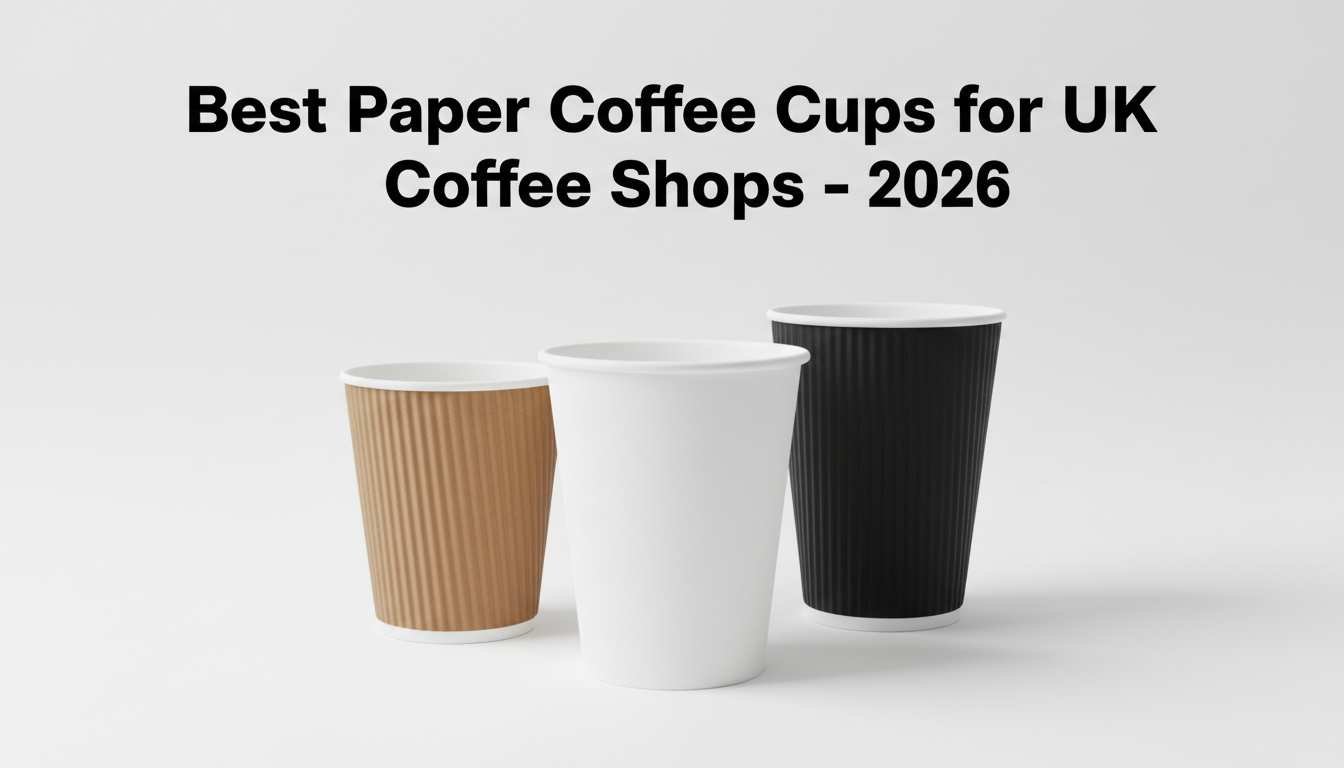
For most UK coffee shops, paper coffee cups are the most visible piece of packaging customers take away. These disposable coffee cups carry your brand, protect your drink, and directly shape the customer experience from the first sip to the last.
Despite their importance, many coffee shop owners in the UK treat paper coffee cup selection as an afterthought — choosing cups based purely on price or availability rather than performance, fit, or sustainability.
This approach often costs more than it saves. Poor-quality paper coffee cups can cause heat complaints, lid fit issues, leaking seams, unprofessional branding, and sustainability claims that fail to meet UK consumer expectations. In a market where margins are tight and environmental standards matter, choosing the right disposable coffee cups has a real financial and reputational impact.
This guide is a comprehensive resource for UK coffee shop owners, managers, and procurement teams choosing paper coffee cups for 2026 and beyond. It covers cup materials, wall construction, popular sizes such as 12 oz coffee cups, sustainability standards, UK regulations, and how to evaluate paper cup suppliers.
Whether you’re opening your first café or reviewing an existing supplier, this guide provides practical, UK-specific guidance to help you choose paper coffee cups that perform well, reflect your brand, and meet modern expectations.
Understanding Paper Coffee Cup Construction
Before comparing specific cups, you need to understand how paper coffee cups are made and why construction details directly affect performance, cost, and environmental impact.
Basic Anatomy of a Paper Coffee Cup
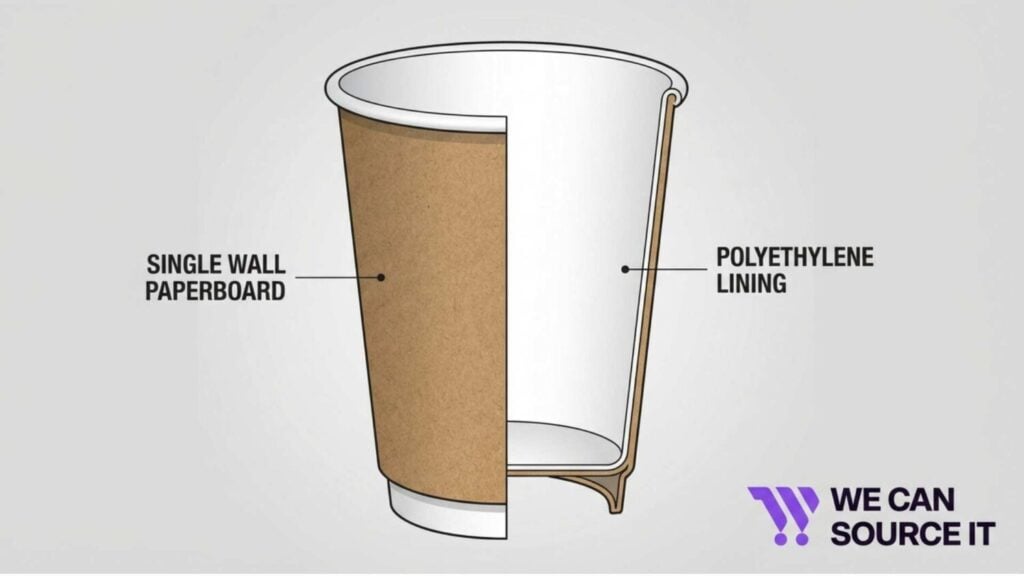
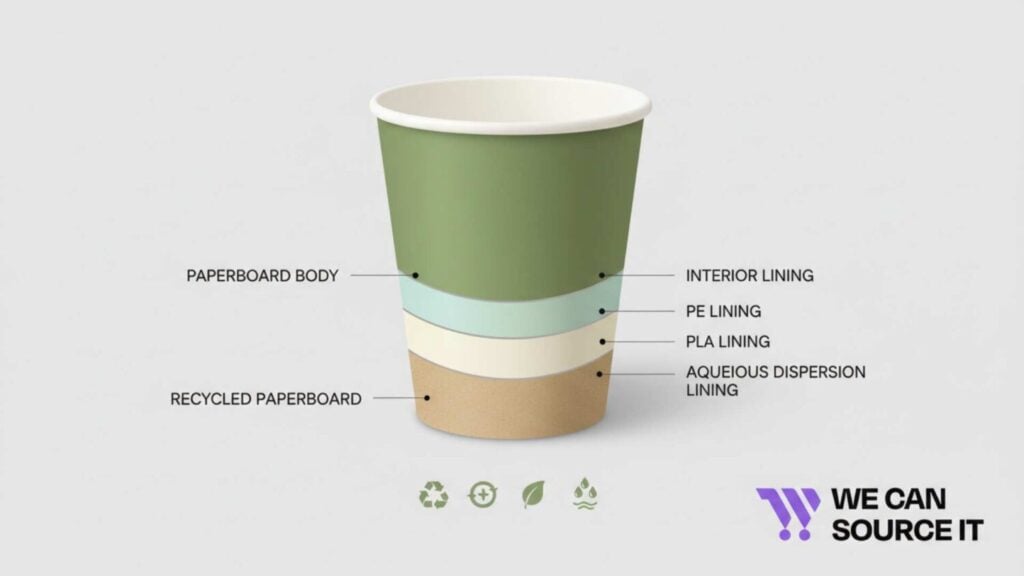
Every paper coffee cup consists of the same fundamental components:
-
- ▸ Paperboard body: The structural shell of the cup, made from virgin or recycled cardboard
-
-
- ▸ Interior lining: A thin coating (traditionally polyethene, increasingly PLA or aqueous) that prevents liquid from soaking into the paperboard
-
- ▸ Side seam: Where the flat paperboard blank is joined to form the cup shape
-
- ▸ Base: A separate disc of lined paperboard sealed to the bottom
-
- ▸ Rim: The rolled top edge, designed to provide rigidity and create a seal with a lid
Each of these elements affects how the cup performs in real-world conditions, how it feels in the hand, how long it holds heat, whether it leaks, and whether it can be recycled.
Wall Types: Single, Double, and Ripple
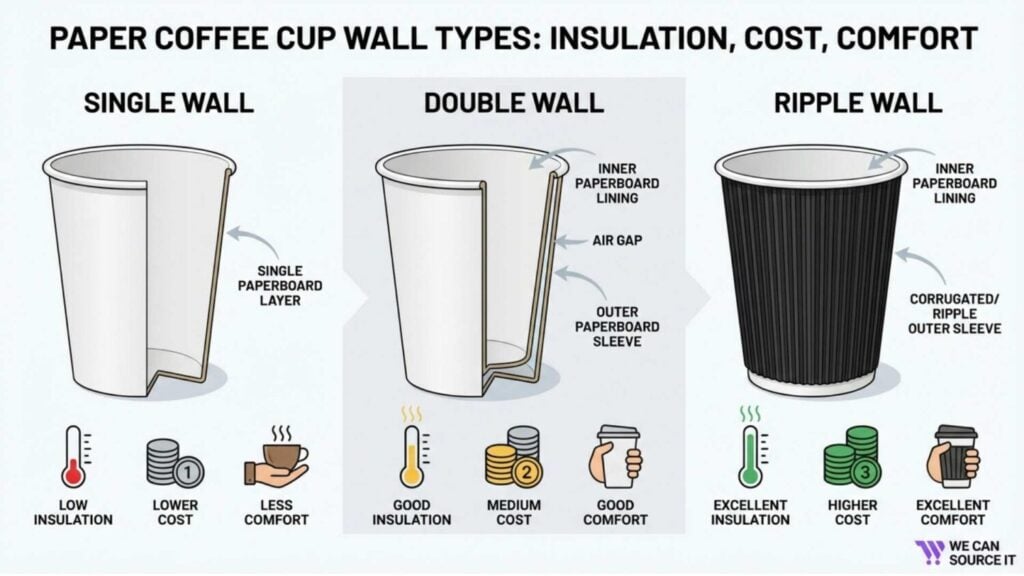
The wall construction is the most important structural difference between paper coffee cups. It determines heat insulation, hand comfort, material cost, and perceived quality.
-
- ▸ Construction: One layer of lined paperboard
-
-
- ▸ Heat insulation: Minimal. Requires a separate cardboard sleeve or clutch for hot drinks
-
- ▸ Cost: Lowest per unit
-
- ▸ Best for: Cold drinks, or hot drinks when paired with a sleeve
-
- ▸ Consideration: The total cost of cup + sleeve can approach or exceed the cost of a double-wall cup, while creating additional waste
-
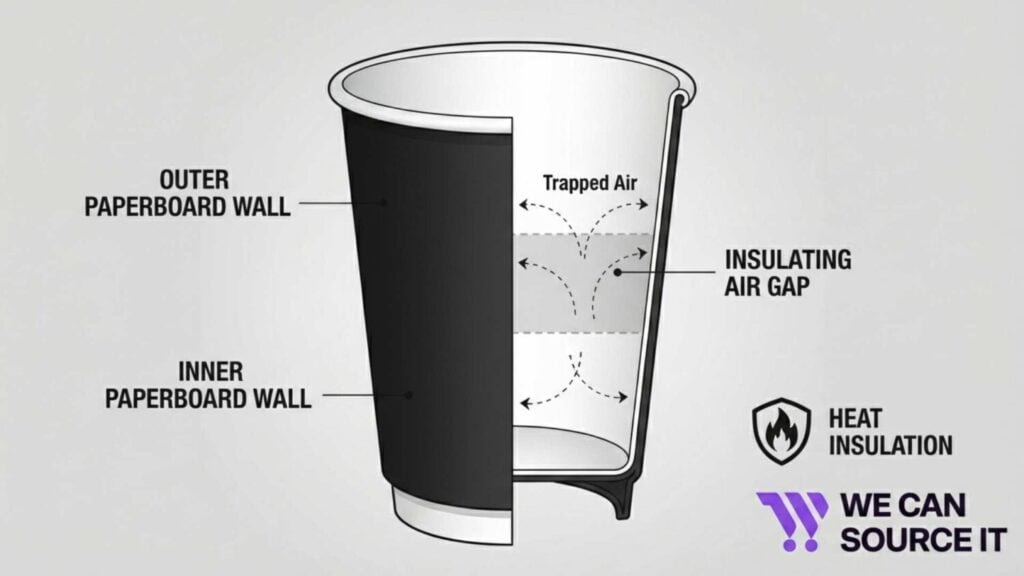
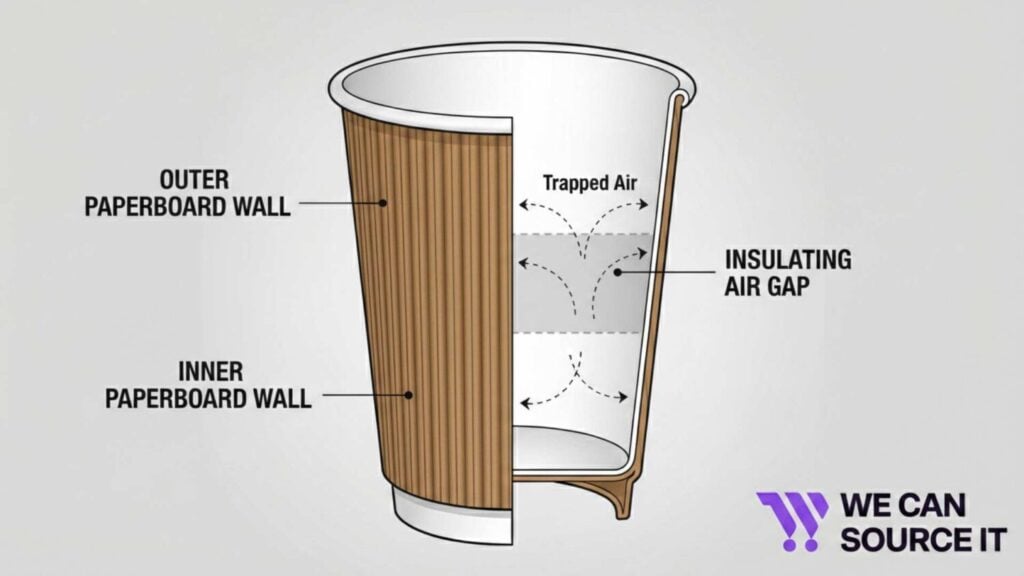
- ▸ Construction: Two layers of paperboard bonded together with an air gap between them
-
-
- ▸ Heat insulation: Good. The air gap acts as insulation, eliminating the need for a sleeve.
-
- ▸ Cost: Higher per unit than single wall, but no sleeve cost
-
- ▸ Best for: Hot drinks where hand comfort and a clean presentation matter
-
- ▸ Consideration: Heavier than single-wall, which affects shipping costs and storage space
Ripple Wall Cups
-
- ▸ Construction: An inner wall of lined paperboard with an outer layer of corrugated (ridged) paperboard
-
-
- ▸ Heat insulation: Excellent. The corrugated outer layer traps air and creates additional insulation.
-
- ▸ Cost: Similar to or slightly higher than double wall
-
- ▸ Best for: Speciality coffee shops, high-volume takeaway operations, and any setting where customers hold cups for extended periods
-
- ▸ Consideration: The ripple texture provides a tactile grip that many customers prefer. The distinctive corrugated exterior also provides a premium visual impression without requiring a sleeve.
Practical note: For most UK coffee shops serving primarily hot drinks, ripple wall and double wall cups offer the best balance of insulation, presentation, and total cost when you factor in the elimination of separate sleeves. Single-wall cups remain practical for cold drinks and for operations with very high volume and tight margins.
Why 12 oz Paper Cups Are the UK Standard
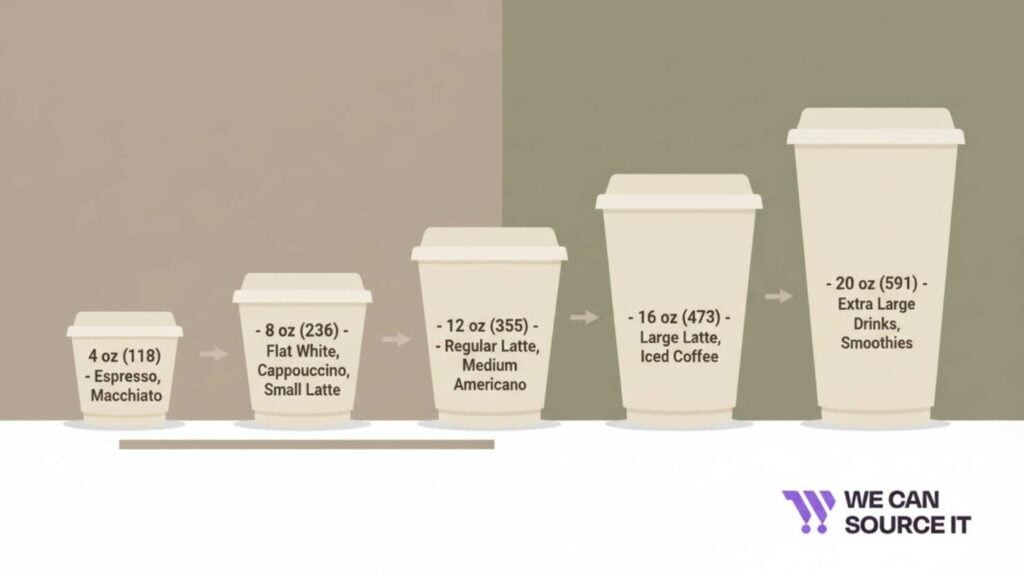
Cup sizing directly affects customer satisfaction, portion control, and cost management. While paper coffee cups come in sizes ranging from 4 oz espresso cups to 20 oz large cups, 12 oz paper cups have become the dominant size in the UK coffee shop market.
Understanding UK Coffee Cup Sizes
| Size | Capacity | Common Name | Typical Use |
| 4 oz | 120 ml | Espresso | Espresso, cortado, macchiato |
| 8 oz | 227 ml | Small / Regular | Small latte, flat white, filter coffee |
| 12 oz | 340 ml | Medium / Regular | Standard latte, cappuccino, americano |
| 16 oz | 454 ml | Large | Large latte, iced coffee, speciality drinks |
| 20 oz | 568 ml | Extra Large | Iced drinks, blended drinks |
Why 12 oz Dominates
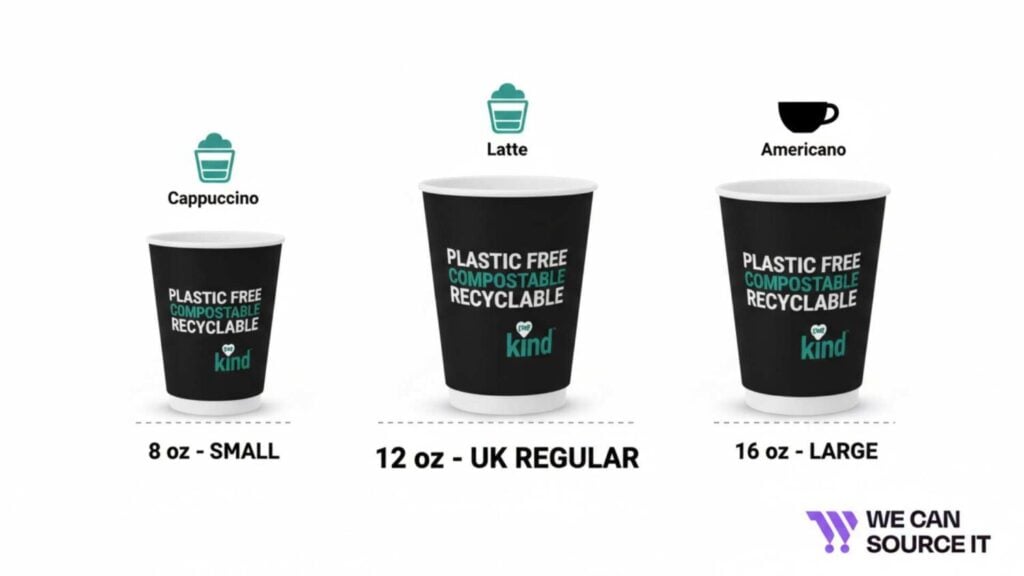
The 12 oz size has become the default “regular” in most UK coffee shops for several practical reasons:
-
- ▸ Portion alignment: A 12 oz cup accommodates a standard double-shot latte or cappuccino with appropriate milk volume and a comfortable headspace for foam
-
-
- ▸ Customer expectation: UK consumers have been conditioned by major chains to associate a medium coffee with approximately 12 oz
-
- ▸ Cost efficiency: 12 oz cups represent the best balance between material cost and perceived value. Smaller cups can feel insufficient; larger cups increase milk and ingredient costs per serve
-
- ▸ Lid compatibility: 12 oz is a widely standardised size, meaning lids from multiple suppliers are typically interchangeable
-
- ▸ Menu simplification: Many independent shops offer only two sizes (8 oz and 12 oz, or 12 oz and 16 oz), reducing inventory complexity
Choosing the Right Cup Size: 12 oz vs Other Coffee Cup Sizes
Your size selection should match your menu and customer profile:
-
- ▸ Espresso-focused menu (cortados, flat whites, short drinks): Stock 8 oz as your primary size, 12 oz as your large
-
-
- ▸ Standard coffee shop menu (lattes, cappuccinos, americanos): Stock 12 oz as your primary size, 8 oz and 16 oz as secondary
-
- ▸ High-volume takeaway operation: Stock 12 oz and 16 oz. The 16 oz serves customers who want extra volume and allows for a price premium.
-
- ▸ Speciality or third-wave shop: Consider 8 oz as standard (to showcase smaller, flavour-focused drinks) with 12 oz as an option
For most UK coffee shops, 12 oz coffee cups will represent 50–70% of total cup usage. Plan your ordering quantities accordingly.
Paper Cup Materials and Linings: What You Need to Know
The materials used in paper coffee cups affect recyclability, compostability, food safety, and performance. Understanding these materials is essential for making informed procurement decisions, especially as UK regulations around packaging waste tighten.
Paperboard
The body of every paper coffee cup is made from paperboard, a thick, rigid form of paper.
Virgin paperboard:
-
- ▸ Made from fresh wood pulp
-
-
- ▸ Stronger, cleaner, and more consistent
-
- ▸ Required for food-contact applications in most cases
-
- ▸ Typically sourced from managed forests (look for FSC or PEFC certification)
Recycled content paperboard:
-
- ▸ Contains some proportion of recycled fibre
-
-
- ▸ Lower environmental footprint in terms of raw material use
-
- ▸ Must meet food-contact safety standards (some recycled fibres can contain contaminants)
-
- ▸ Increasingly available from reputable manufacturers
What to look for: FSC (Forest Stewardship Council) or PEFC (Programme for the Endorsement of Forest Certification) certification on the paperboard. This confirms responsible sourcing.
Interior Linings
The lining prevents liquid from saturating the paperboard. This is the component that most affects recyclability.
Polyethene (PE) Lining — Traditional
-
- ▸ Thin plastic film (typically 5–10% of total cup weight) bonded to the interior.
-
-
- ▸ Excellent waterproofing and heat resistance
-
- ▸ Widely used and well-proven
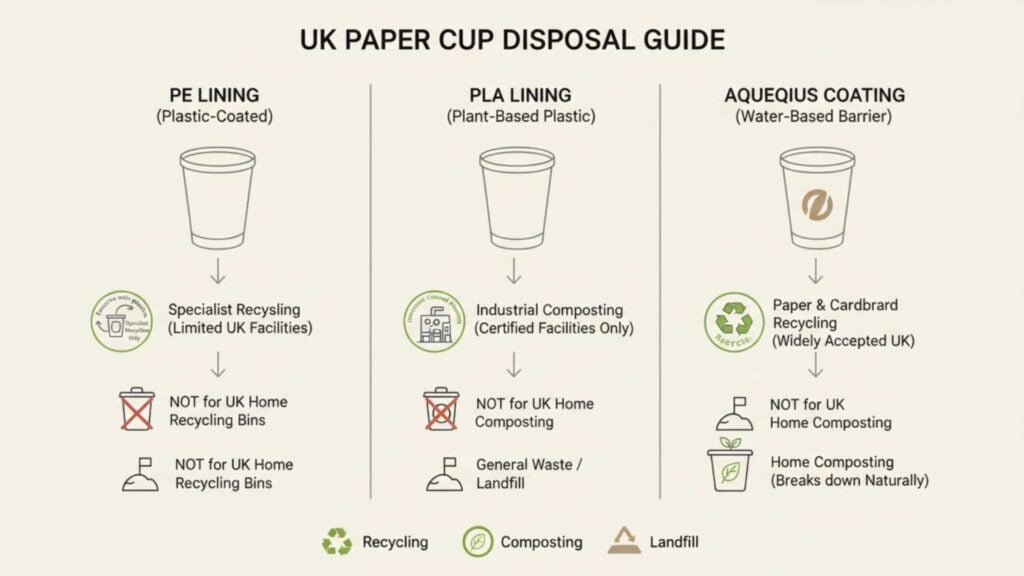
- Recycling challenge: PE lining must be separated from the paper fibre for recycling. Most standard UK council kerbside recycling cannot process PE-lined paper cups. Dedicated cup recycling streams exist, but are not universal.
PLA (Polylactic Acid) Lining — Plant-Based
-
- ▸ Made from plant starches (typically corn)
-
-
- ▸ Biodegradable and compostable under industrial composting conditions
-
- ▸ Not suitable for home composting requires temperatures of 55–60°C sustained over weeks
-
- ▸ Not recyclable in standard paper streams, PLA contaminates paper recycling just as PE does
- Performance is generally comparable to PE for hot drinks, though some PLA -lined cups can soften at very high temperatures
Aqueous (Water-Based) Coating — Emerging
-
- ▸ A mineral or polymer-based coating applied as a liquid and dried
-
-
- ▸ Designed to be recyclable in standard paper recycling streams
-
- ▸ Increasingly adopted by forward-thinking suppliers
Important: Verify claims. Some aqueous coatings are genuinely recyclable in standard infrastructure; others require specialised facilities. Ask suppliers for independent recyclability certification.
Choosing the Right Lining for Your Operation
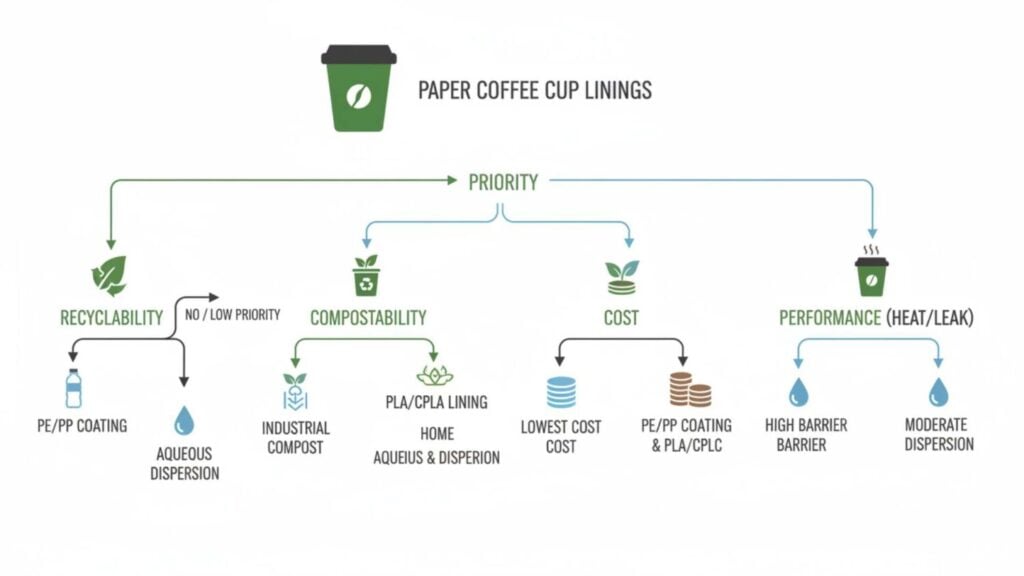
| Priority | Best Lining Choice | Notes |
| Recyclability in the standard UK infrastructure | Aqueous coating | Verify with specific recycling certifications |
| Compostability (with industrial composting access) | PLA | Only viable if your waste goes to industrial composting |
| Proven performance and lowest cost | PE (polyethene) | Standard option, limited recyclability |
| Balanced approach | PE with dedicated cup recycling | Use PE cups and partner with a cup recycling collection service |
Sustainability Standards and UK Regulations
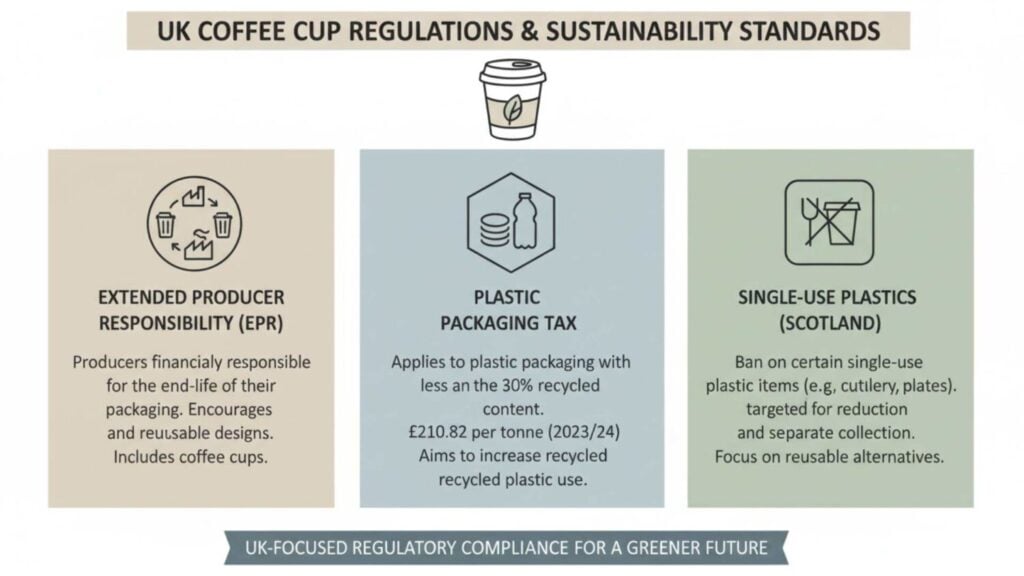
Sustainability is no longer optional for UK coffee shops. Customer expectations, government regulation, and industry standards all drive the need for responsible cup procurement. Understanding the regulatory landscape helps you make choices that are both compliant and genuinely beneficial.
Current UK Packaging Regulations
Extended Producer Responsibility (EPR):
The UK’s EPR scheme makes businesses financially responsible for the packaging they place on the market. For coffee shops, this means the cups you purchase and distribute to customers create a financial obligation. Fees are based on the recyclability and environmental impact of the packaging — more recyclable packaging costs less under EPR.
Plastic Packaging Tax:
Introduced in April 2022, this tax applies to plastic packaging manufactured in or imported into the UK that does not contain at least 30% recycled plastic. PE-lined paper cups can fall under this tax depending on their classification. Check with your supplier whether their cups are subject to the tax and how it affects pricing.
Single-Use Plastics Directive (retained EU law):
While the UK is no longer bound by EU directives, many of the principles have been retained or adapted in UK law. Monitoring upcoming policy changes is important for medium-term planning.
Sustainability Certifications to Look For
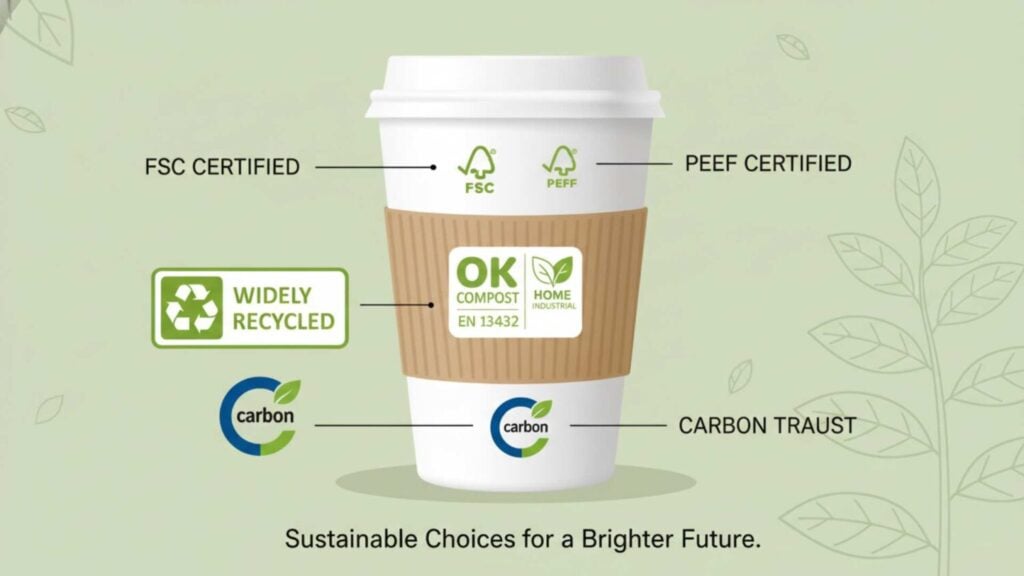
When evaluating paper coffee cups, the following certifications provide verified assurance:
-
- ▸ FSC (Forest Stewardship Council): Confirms the paperboard comes from responsibly managed forests
-
-
- ▸ PEFC: Similar to FSC, an alternative forest certification scheme
-
- ▸ OK Compost / EN 13432: Confirms the cup is industrially compostable (relevant for PLA-lined cups)
-
- ▸ Recyclability certification: Look for independent testing confirming the cup can be recycled in UK infrastructure (e.g., OPRL “Widely Recycled” label)
-
- ▸ Carbon Trust certification: Some manufacturers certify the carbon footprint of their cups
Common Sustainability Misconceptions
Misconception: “Compostable cups are always better than recyclable cups.”
Reality: Compostable cups (PLA-lined) require industrial composting facilities operating at 55–60°C. If your cups end up in general waste or standard recycling, the compostable lining provides no environmental benefit and may actually contaminate recycling streams. A recyclable cup that is actually recycled is better than a compostable cup that goes to landfill.
Misconception: “Paper cups are easily recyclable.”
Reality: The lining (PE or PLA) makes standard paper cups difficult to recycle in normal paper recycling streams. Dedicated cup recycling infrastructure exists in the UK (through companies like Simply Cups and DS Smith), but it requires separate collection. Only aqueous-coated cups are beginning to be accepted in standard paper recycling.
Misconception: “Biodegradable means it breaks down anywhere.”
Reality: “Biodegradable” is not a regulated term in the same way as “compostable.” A cup labelled biodegradable may take years to break down in landfill conditions where oxygen and moisture are limited. Always look for specific certifications (EN 13432, OK Compost) rather than unverified claims.
Misconception: “Bamboo cups are more sustainable than paper cups.”
Reality: Bamboo fibre cups still require a lining (typically PLA or PE) and face the same recyclability challenges as paper cups. The sustainability advantage of the raw material (bamboo grows faster than trees) is often offset by longer supply chains and limited end-of-life infrastructure.
How to Evaluate Paper Coffee Cup Quality
Not all paper coffee cups perform equally, even within the same size and wall type. Understanding paper coffee cup quality indicators helps you avoid cups that leak, collapse, lose heat too quickly, or create a poor customer experience.
Key Quality Factors
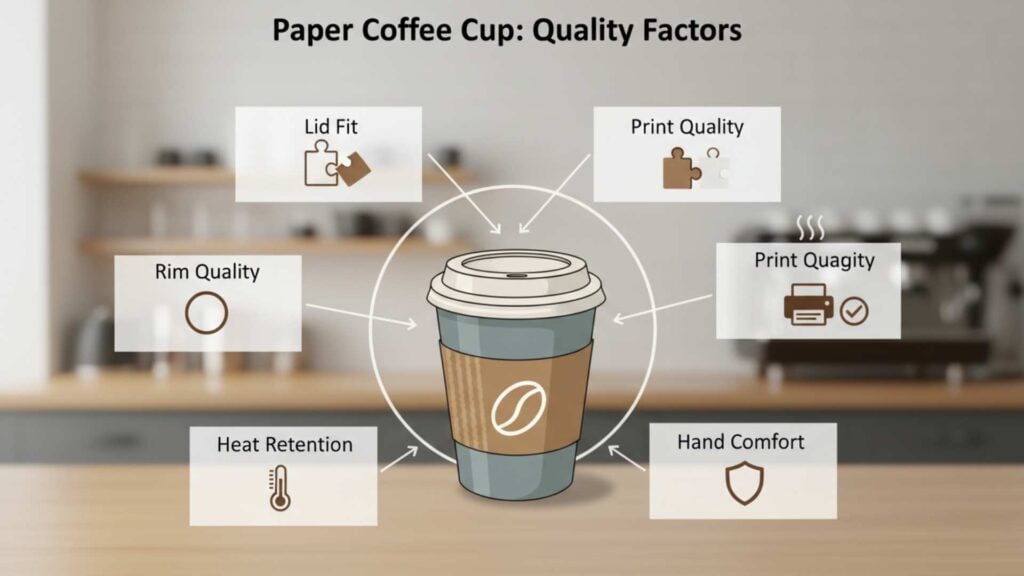
Seam Integrity
The side seam is the most common failure point on a paper cup. A poorly bonded seam can:
-
- ▸ Leak liquid, especially at higher temperatures
-
-
- ▸ Separate under pressure (such as when a customer squeezes the cup)
-
- ▸ Create an uneven surface that affects the lid fit
What to check: Request samples and fill them with boiling water. Leave for 30 minutes. Inspect the seam for any moisture, bubbling, or separation. A quality cup should show no seam degradation.
Rim Quality
The rolled rim at the top of the cup serves three functions:
-
- ▸ Provides structural rigidity
-
-
- ▸ Creates a drinking surface
-
- ▸ Forms the seal point with the lid
What to check: The rim should be smooth, evenly rolled, and consistent around the entire circumference. An uneven rim causes lid misalignment and potential leaking.
Heat Retention and Hand Comfort
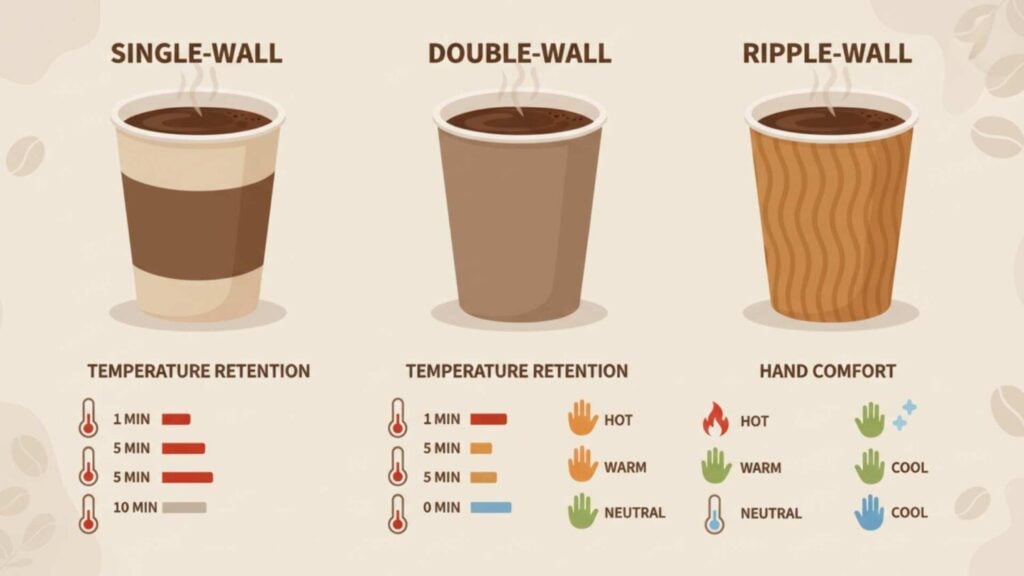
For hot drinks, the cup must retain heat long enough for the customer to finish their drink while remaining comfortable to hold.
Practical test: Fill sample cups with water at 90°C (typical serving temperature for a latte).
Measure:
-
- ▸ How long the drink stays above 60°C (the minimum enjoyable drinking temperature for most consumers)
-
-
- ▸ How the exterior surface feels after 1 minute, 5 minutes, and 10 minutes
Ripple wall cups should remain comfortable to hold throughout. Double-wall cups should be comfortable for the first 5–10 minutes. Single-wall cups without a sleeve will become uncomfortable within 1–2 minutes.
Lid Fit
Cup and lid compatibility is critical. A poorly fitting lid results in spills, drips, and customer frustration.
What to check:
-
- ▸ The lid should snap securely onto the rim with a clear, audible, or tactile click
-
-
- ▸ Once attached, the lid should not rotate freely (slight rotation is acceptable; full spinning indicates a poor fit)
-
- ▸ Tilt the cup to 45 degrees with the lid on. There should be no leaking from the rim-lid junction
-
- ▸ Test with lids from your current supplier, as rim diameters can vary slightly between cup manufacturers
Print Quality (for Branded Cups)
If you use custom-printed cups, evaluate:
-
- ▸ Colour accuracy and consistency across a batch
-
-
- ▸ Print alignment (text and graphics should be properly centred and level)
-
- ▸ Ink adhesion (rub the printed surface firmly with a damp finger — ink should not transfer)
-
- ▸ Food-safe ink certification (mandatory for any ink used on food-contact packaging)
Ripple Wall Cups: A Closer Look at the UK’s Preferred Option
Ripple wall cups have become the preferred choice for many UK coffee shops, particularly independent and speciality shops. Their combination of insulation, aesthetics, and functionality makes them worth examining in detail.
How Ripple Wall Construction Works
A ripple wall cup consists of:
Inner wall: Standard lined paperboard forming the liquid-contact surface
Outer wall: Corrugated (ridged) paperboard wrapped around the inner wall
Air pockets: The corrugations create small air channels between the inner and outer walls
These air channels provide insulation through the same principle used in double-glazed windows. Trapped air is a poor conductor of heat, slowing the transfer of heat from the drink to the exterior surface.
Advantages of Ripple Wall for UK Coffee Shops
-
- ▸ No sleeve required: Eliminates a separate SKU, reduces waste, and simplifies operations at the counter
-
-
- ▸ Superior grip: The textured surface is easier to hold, especially with wet or cold hands
-
- ▸ Professional appearance: The corrugated exterior conveys quality and is available in various colours, including kraft (natural brown) and black
-
- ▸ Consistent branding surface: Custom printing on the outer ripple layer can be striking and distinctive
-
- ▸ Structural rigidity: The double-layer construction resists crushing and deformation better than single wall cups
Popular Ripple Wall Options in the UK Market
Two of the most widely used paper coffee cups in UK coffee shops are kraft and black ripple wall cups in the 12 oz size. Both provide the same functional benefits but serve different aesthetic purposes.
Kraft Ripple Cups
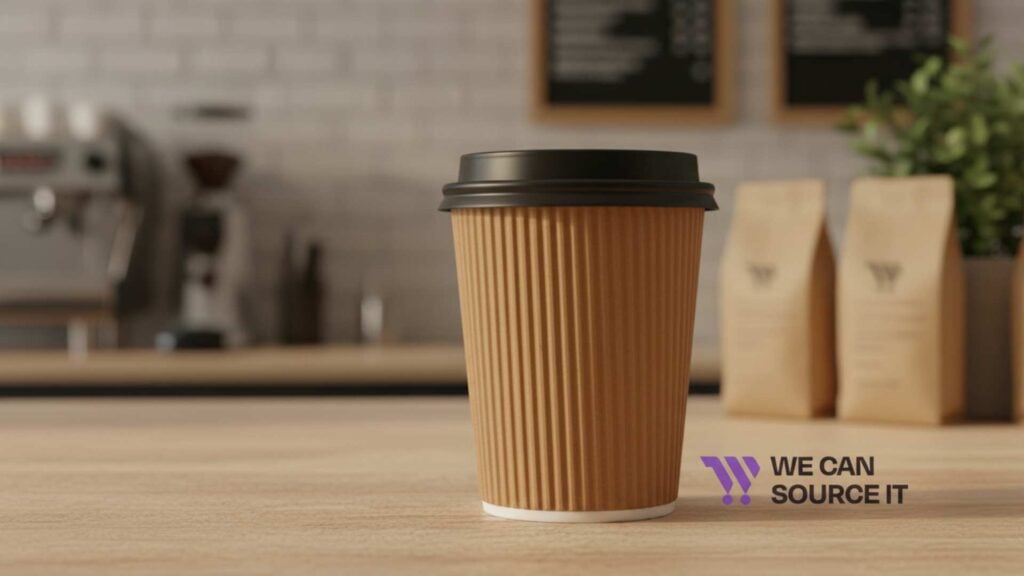
The 12 oz kraft ripple coffee cup features a natural brown corrugated exterior made from 3-ply virgin kraft paper. The Kraft colour signals an earthy, natural, and eco-conscious aesthetic, while the ripple wall provides strong insulation and comfortable handling without the need for sleeves. Many independent coffee shops choose kraft because it aligns with a handcrafted, artisan brand identity.
-
- ▸ Natural brown corrugated outer wall with ripple insulation
-
-
- ▸ 3-ply virgin kraft paper for strength and heat retention
-
- ▸ Comfortable grip that protects hands from hot drinks
-
- ▸ Clean, warm visual appearance suited to cafés and takeaway brands
-
- ▸ Works well with simple stamp or sticker branding
-
- ▸ Pairs visually with both white and black lids, commonly used for hot cups
-
- ▸ Sustainably sourced kraft paper supporting responsible operations
-
- ▸ Durable, leak-resistant structure for busy foodservice use
Black Ripple Cups
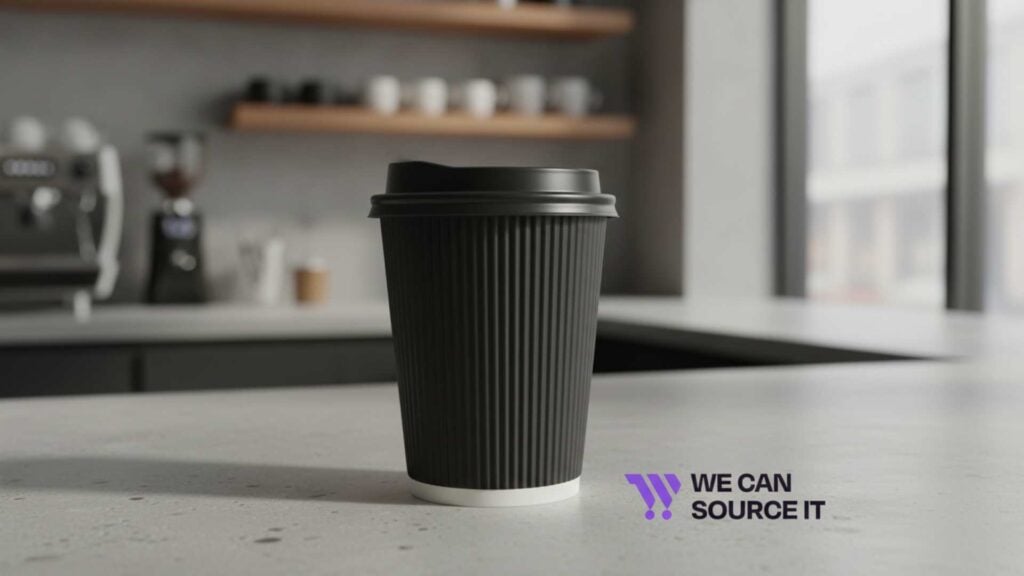
The 12 oz black ripple coffee cup features a black corrugated exterior. Black cups create a bold, modern, premium visual impression. They are commonly chosen by speciality coffee shops, urban cafés, and brands targeting a contemporary, design-conscious audience.
- ▸ Black corrugated ripple wall provides excellent insulation, keeping drinks hotter while protecting hands from heat.
- Stylish black finish enhances drink presentation and pairs well with black lids for a sleek, monochrome look.
- ▸ Durable paper structure supports reliable hot beverage service without compromising cup integrity.
- ▸ Eliminates the need for separate sleeves or double cupping, reducing material use and costs.
- ▸ Excellent contrast for white or metallic custom printing, ideal for branded cups.
- ▸ Manufactured using responsibly sourced materials, supporting sustainable business practices.
- ▸ Suitable for cafés, takeaway outlets, restaurants, and corporate beverage service.
- ▸ Consistent quality manufacturing ensures dependable performance across high-volume operations.
Choosing Between Kraft and Black
The choice between kraft and black ripple cups is primarily an aesthetic and branding decision — the functional performance is identical. Consider:
| Factor | Kraft | Black |
| Brand personality | Natural, earthy, artisan, eco-focused | Modern, premium, urban, sleek |
| Custom print visibility | Good with dark inks | Excellent with white or metallic inks |
| Customer perception | Casual, welcoming, sustainable | Sophisticated, design-forward |
| Lid pairing | Flexible (white, black, or kraft lids) | Best with black lids |
| Sticker/stamp branding | Works well | Works well (use light-coloured stickers) |
There is no wrong choice. The best option is the one that aligns with your shop’s visual identity and the experience you want customers to associate with your brand.
Cost Analysis: Understanding the True Price of Paper Cups
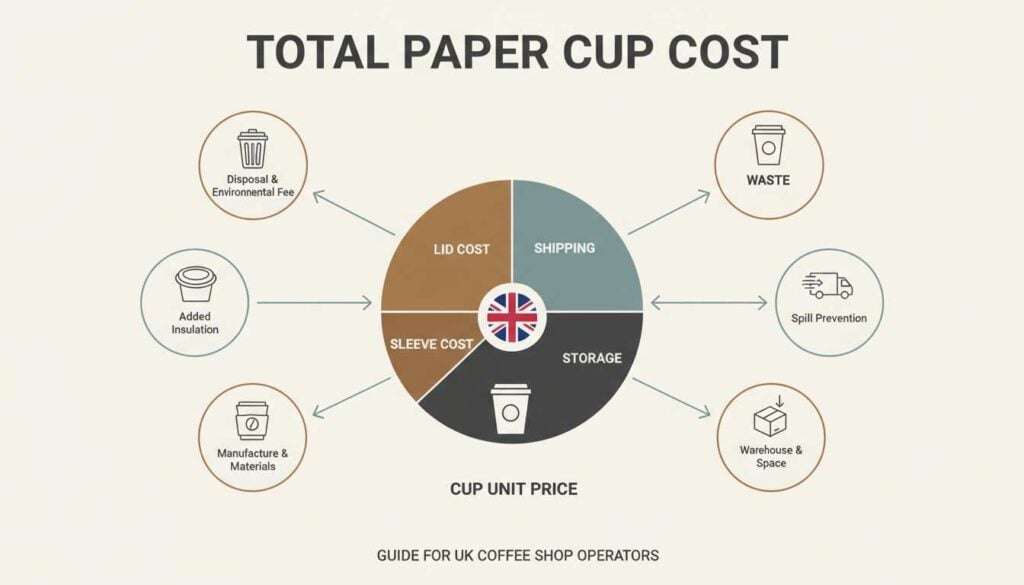
Cup cost is not just the unit price printed on a supplier’s price list. The true cost of paper cups includes several factors that affect your per-serve packaging expense.
Components of Total Cup Cost
1. Cup unit price
The base cost per cup, which varies by:
-
- ▸ Wall type (single < double < ripple, generally)
-
-
- ▸ Size (larger cups cost more)
-
- ▸ Order volume (higher quantities reduce per-unit cost)
-
- ▸ Customisation (printed cups cost more than stock cups)
-
- ▸ Lining material (PE is typically cheapest; aqueous coatings may carry a premium)
2. Sleeve cost (single wall only)
If using single wall cups, you need separate cardboard sleeves. A sleeve typically costs £0.02–£0.04 per unit. When added to the single wall cup cost, the total often approaches or exceeds that of a ripple wall cup.
3. Lid cost
Lids are a separate purchase. Standard PS (polystyrene) and PP (polypropylene) lids range from £0.02 to £0.05 per unit. Bagasse (sugarcane fibre) or PLA lids cost more but may align with sustainability goals.
4. Storage cost
Bulkier cups (ripple wall, double wall) take up more storage space. For shops with limited back-of-house space, this is a real consideration. A case of ripple wall cups occupies roughly 40–60% more shelf space than the same quantity of single-wall cups.
5. Shipping cost
Heavier, bulkier cups cost more to ship. Many suppliers offer free delivery above a minimum order value, but the threshold varies.
6. Waste and breakage
Damaged cups in transit, cups that fail quality checks, and cups wasted during busy periods all add to effective cost. Higher-quality cups from reliable suppliers have lower waste rates.
Cost Comparison Framework
| Cost Element | Single Wall + Sleeve | Double Wall | Ripple Wall |
| Cup unit cost | Lowest | Medium | Medium-High |
| Sleeve cost | £0.02–0.04 | None | None |
| Total per-serve cost | Medium | Medium | Medium-High |
| Labour (applying sleeves) | Additional time | None | None |
| Storage footprint | Medium (cups + sleeves) | Medium-High | Higher |
| Customer experience | Adequate | Good | Excellent |
Key insight for small and medium coffee shops: When you factor in sleeve costs and the labour time spent applying sleeves during a busy morning rush, ripple wall cups are often cost-neutral compared to single wall + sleeve combinations, while delivering a noticeably better customer experience.
Volume-Based Pricing
Most UK paper cup suppliers offer tiered pricing based on order volume:
-
- ▸ Small orders (250–500 cups): Highest per-unit cost. Suitable for testing new cups or very low-volume operations.
-
-
- ▸ Standard orders (1,000–2,500 cups): Moderate per-unit cost. Typical for small independent shops.
-
- ▸ Bulk orders (5,000+): Lowest per-unit cost. Appropriate for multi-site operators or shops with high takeaway volume.
-
- ▸ Custom print orders: Usually require minimum orders of 1,000–5,000 cups, depending on the supplier and printing method.
Planning tip: Estimate your weekly cup usage across all sizes. Multiply by 12–16 weeks to determine a quarterly order volume. Ordering quarterly at higher volumes typically reduces per-unit cost compared to monthly small orders, provided you have the storage space.
Lid Selection and Compatibility
Lids are often purchased separately from cups, and choosing the right lid is as important as choosing the right cup. A Lid Fit that’s too loose or too tight undermines even the highest-quality cup, leading to potential spills or poor user experience.
Lid Materials
Polystyrene (PS):
-
- ▸ Most common lid material
-
-
- ▸ Rigid, provides a good seal
-
- ▸ Recyclable in some UK facilities but not universally accepted
-
- ▸ Available in flat and dome styles
Polypropylene (PP):
-
- ▸ More durable and heat-resistant than PS
-
-
- ▸ Increasingly preferred for its recyclability
-
- ▸ Slightly higher cost
-
- ▸ Better resistance to cracking
CPLA (Crystallised PLA):
-
- ▸ Plant-based, compostable under industrial conditions
-
-
- ▸ Similar performance to PS
-
- ▸ Higher cost
-
- ▸ Aligns with compostable cup strategies
Bagasse (Sugarcane Fibre):
-
- ▸ Fully compostable
-
-
- ▸ Distinctive natural appearance
-
- ▸ Can feel less rigid than plastic lids
-
- ▸ Suitable for shops with a strong sustainability focus
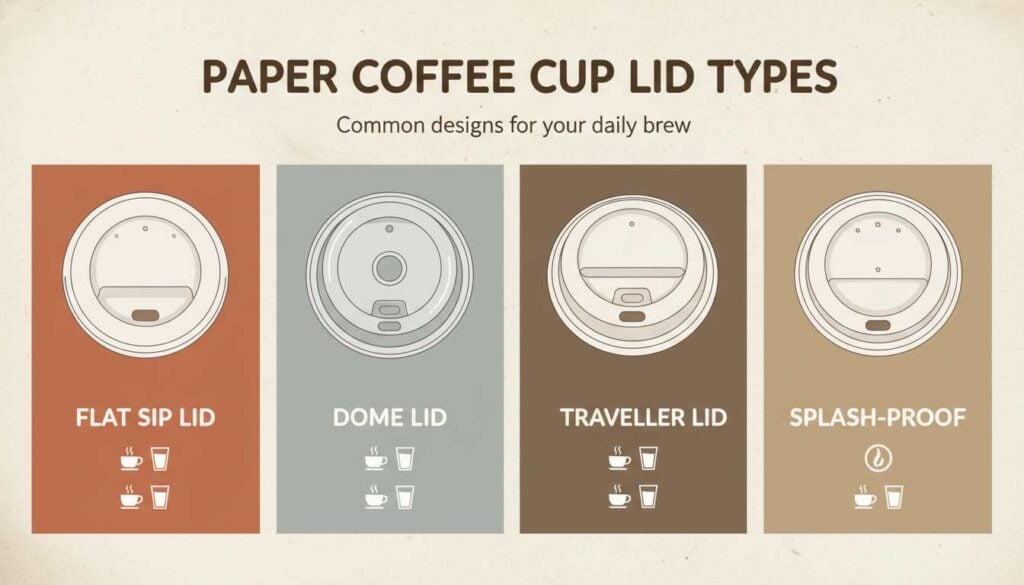
Lid Styles
-
- ▸ Flat sip lids: Most common for hot drinks. Features a small opening for drinking.
-
-
- ▸ Dome lids: Allow space for whipped cream or domed beverages. Common for cold speciality drinks.
-
- ▸ Traveller lids: Flat lids with a fold-back tab for the drink opening. Common in North American-style operations.
-
- ▸ Splash-proof lids: Feature a recessed drink hole to reduce splashing. Increasingly popular for takeaway-heavy operations.
Ensuring Compatibility
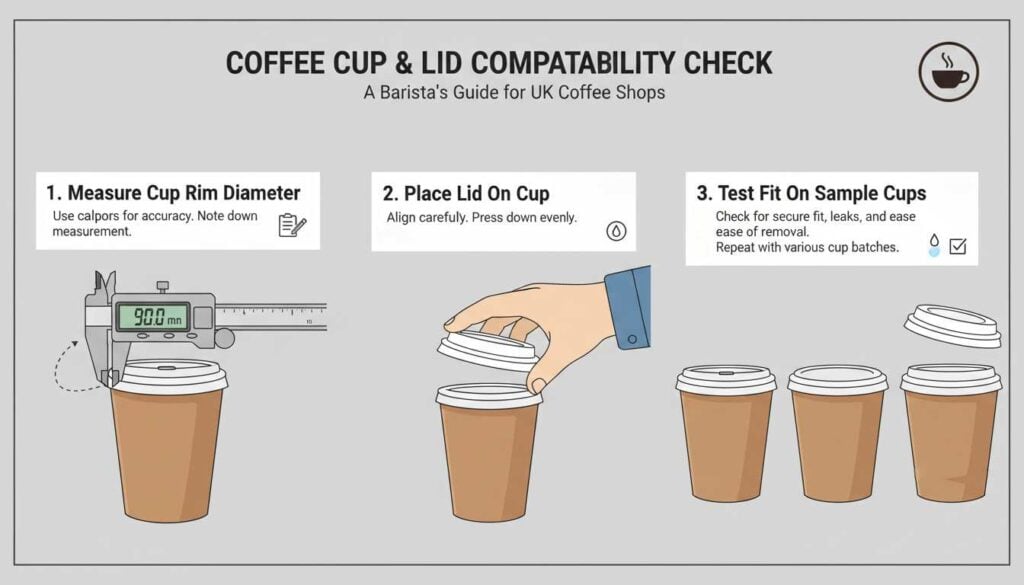
The critical measurement is the rim diameter of the cup, measured in millimetres. Standard 12 oz cups typically have a rim diameter of 89–90 mm, but this can vary by manufacturer.
Always verify:
-
- ▸ Order sample cups and sample lids before committing to a bulk purchase
-
-
- ▸ Test fit across at least 10 cups (rim diameter can vary slightly within a manufacturing run)
-
- ▸ Test with cups from the same production batch you will be ordering
A lid that fits perfectly on one manufacturer’s 12 oz cup may not fit another’s. Never assume cross-brand compatibility.
Branding and Custom Printing Options
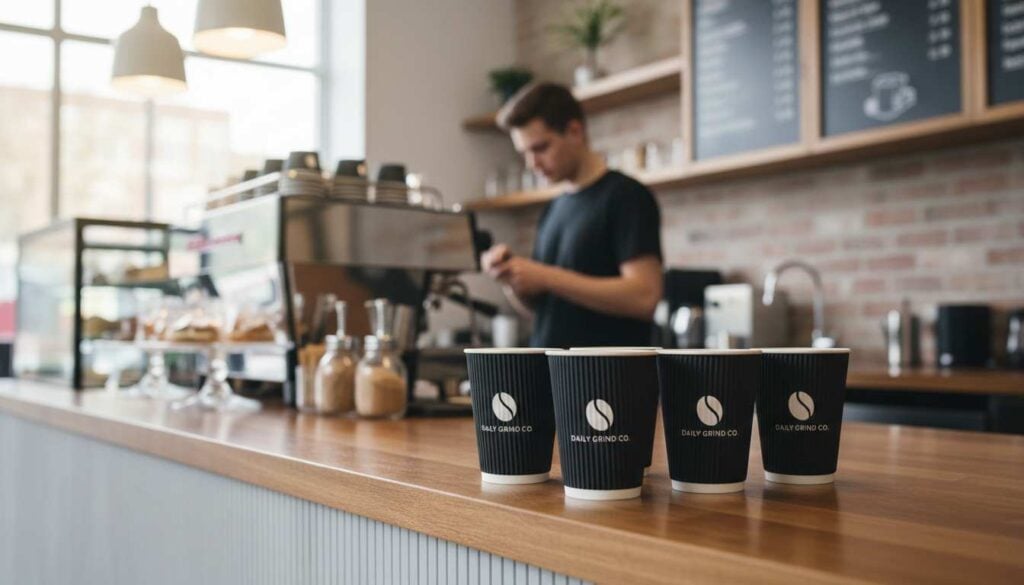
Custom-printed paper coffee cups are a powerful branding tool for coffee shops. Every cup that leaves your shop is a mobile advertisement. However, custom printing adds cost and complexity, so understanding your options helps you make the right decision.
Printing Methods
Flexographic printing:
-
- ▸ The most common method for paper cup printing
-
-
- ▸ Good for simple logos, text, and solid colours
-
- ▸ Cost-effective at high volumes (5,000+ cups)
-
- ▸ Limited detail for complex images or photographs
-
- ▸ Typically 1–4 colour printing
Digital printing:
-
- ▸ Higher detail and colour accuracy
-
-
- ▸ Cost-effective at lower volumes (1,000–3,000 cups)
-
- ▸ Supports full-colour, photographic-quality images
-
- ▸ Higher per-unit cost at large volumes compared to flexographic
Offset printing:
-
- ▸ Highest quality for detailed, multi-colour designs
-
-
- ▸ Most expensive setup costs
-
- ▸ Economical only at very high volumes (25,000+)
-
- ▸ Typically used by major chains
Custom Printing Considerations
-
- Minimum order quantities: Most UK suppliers require 1,000–5,000 cups minimum for custom printing. Some offer lower minimums (as low as 250–500) at a premium per-unit cost.
-
-
- ▸ Lead times: Custom printed cups typically require 4–8 weeks from artwork approval to delivery. Plan ahead, especially for seasonal designs.
-
- ▸ Artwork requirements: Suppliers will provide a template showing the printable area, bleed zones, and seam location. Ensure your designer uses the correct template.
-
- ▸ Food-safe inks: All inks used on coffee cups must be food-safe. Reputable suppliers use only certified inks, but verify this in writing.
-
- ▸ Proof approval: Always request a printed proof (physical or digital) before approving a full production run.
Alternatives to Custom Printing
For shops that do not want the cost or commitment of custom printing:
-
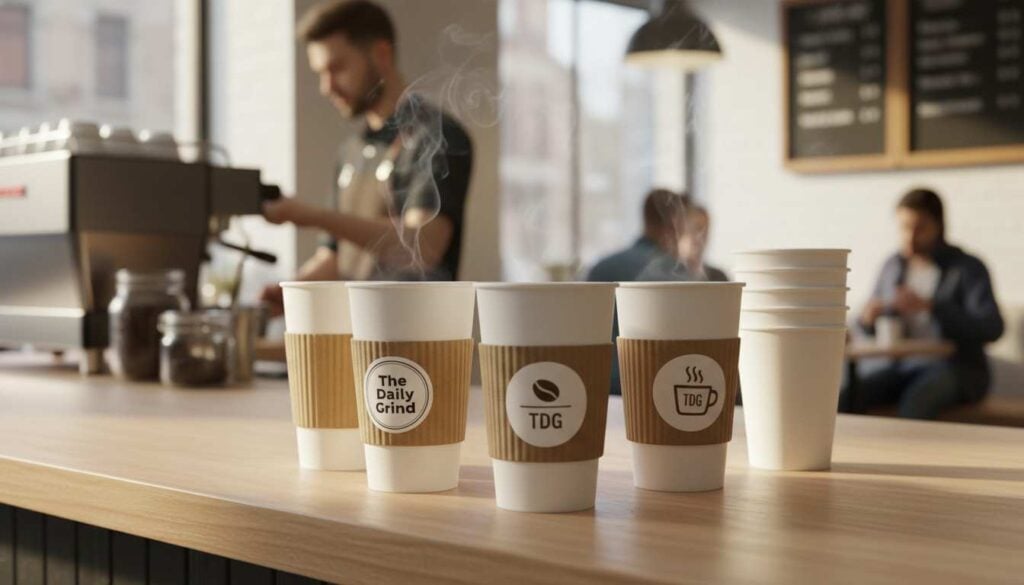
- ▸ Branded sleeves: Use stock cups with a custom-printed sleeve. Lower minimum quantities and easier to change designs.
-
-
- ▸ Stamp branding: Use a custom rubber or silicone stamp with food-safe ink to brand stock cups. Very low cost, flexible, and adds an artisan touch.
-
- ▸ Branded stickers: Apply a branded sticker to stock cups. Simple and cost-effective for low volumes.
-
- ▸ Stock cups with branded lids: Some suppliers offer custom-printed lids at lower minimum quantities than cups.
Ordering, Storage, and Inventory Management

Efficient procurement and storage of paper coffee cups directly affect your operating costs and day-to-day workflow. A structured approach to ordering, storage and inventory management helps cafés avoid shortages, reduce waste, and maintain consistent service during busy periods.
Estimating Cup Requirements
Calculate your weekly cup usage by size:
Track the number of takeaway drinks sold per day over a typical week (separate hot and cold if different cups are used)
Multiply the daily average by 7 for weekly usage
Add 10–15% buffer for waste, damage, and demand fluctuations
Multiply weekly usage by your desired order cycle (monthly, quarterly)
Example calculation:
| Metric | Value |
| Average takeaway drinks per day | 80 |
| Percentage served in 12 oz cups | 65% |
| 12 oz cups per day | 52 |
| 12 oz cups per week | 364 |
| Monthly requirement (4.3 weeks) | 1,565 |
| Plus 15% buffer | 1,800 |
| Quarterly order | 5,400 |
Storage Best Practices
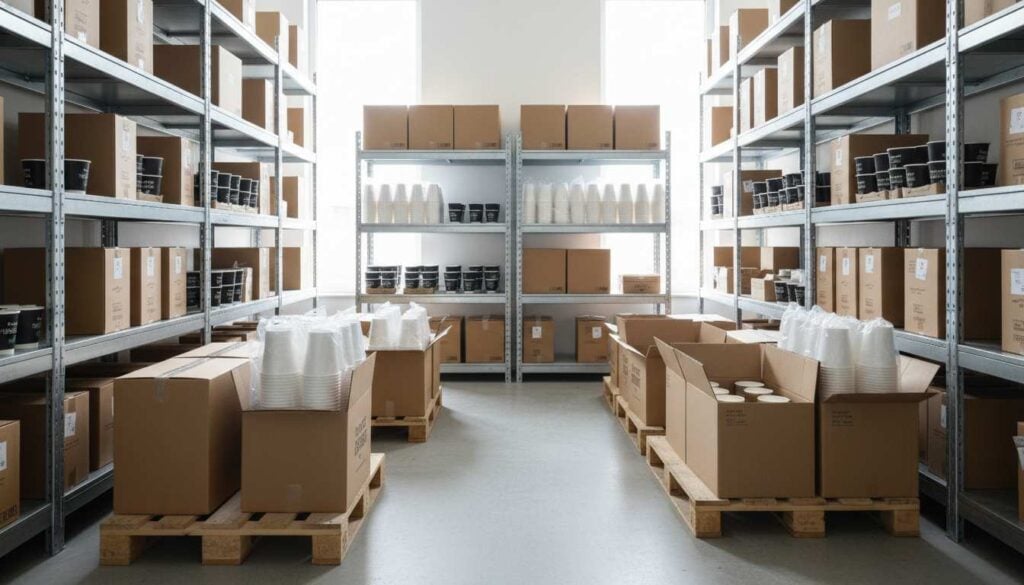
Paper coffee cups require proper storage to maintain quality:
-
- ▸ Store in a dry environment: Moisture weakens paperboard and can compromise the lining
-
-
- ▸ Keep off the floor: Use shelving or pallets to prevent moisture absorption from concrete floors
-
- ▸ Maintain consistent temperature: Avoid locations with extreme heat (near ovens) or cold (unheated storage rooms in winter)
-
- ▸ Store in original packaging: Sealed sleeves or cases protect cups from dust, pests, and contamination
-
- ▸ First in, first out (FIFO): Use older stock before newer deliveries to prevent cups from sitting in storage indefinitely
-
- ▸ Avoid stacking heavy items on top of cup cases: This can crush cups, damage rims, and cause lid fit problems
Supplier Relationship Management
For consistent quality and reliable supply:
-
- ▸ Work with a reputable UK-based supplier: Shorter supply chains mean faster delivery, lower shipping costs, and easier communication
-
-
- ▸ Request samples before placing large orders: Test cup quality, lid fit, and print quality with real drinks in your shop
-
- ▸ Negotiate pricing based on annual volume: If you can commit to a quarterly or annual volume, many suppliers offer better rates.
-
- ▸ Maintain a backup supplier: Supply chain disruptions happen. Having a secondary supplier ensures you are never without cups.
-
- ▸ Order well ahead of peak periods: Christmas, summer, and bank holiday weekends can strain supplier capacity.
Matching Cups to Your Coffee Shop Type
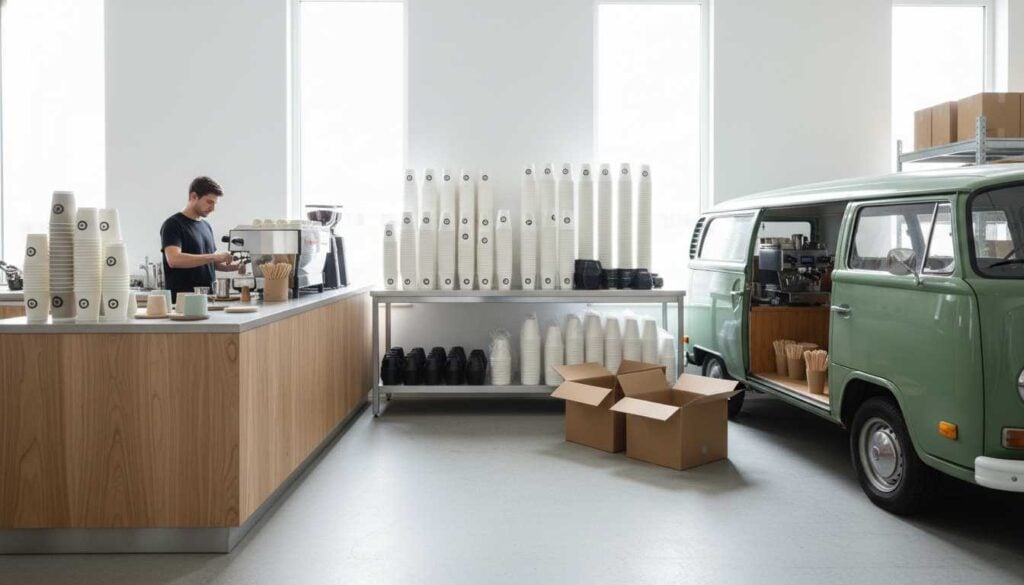
Different types of coffee operations have different cup requirements. Here is a practical guide to matching your cup selection to your business model.
Independent Speciality Coffee Shop
Typical profile:
-
- ▸ Emphasis on coffee quality and customer experience
-
-
- ▸ Moderate takeaway volume (30–80 cups per day)
-
- ▸ Brand identity is important
-
- ▸ Customers tend to notice and appreciate packaging details
Recommended cup strategy:
-
- ▸ 12 oz ripple wall cups as primary size (kraft or black, depending on brand aesthetic)
-
-
- ▸ 8 oz cups for smaller drinks
-
- ▸ Custom printed cups or branded stamp on stock cups
-
- ▸ PLA or aqueous-lined cups if sustainability is a core brand value
-
- ▸ Quality lids that seal securely for customers at speciality shops are often particular about spill prevention
High-Volume Takeaway or Drive-Through
Typical profile:
-
- ▸ Speed and efficiency are critical
-
-
- ▸ High daily cup volume (200+ cups per day)
-
- ▸ Cost per unit is a significant concern
-
- ▸ Branding is typically established and consistent
Recommended cup strategy:
-
- ▸ 12 oz and 16 oz as primary sizes
-
-
- ▸ Double wall or ripple wall to eliminate sleeve application time (a meaningful time saving at high volume)
-
- ▸ PE-lined cups for the lowest cost, with dedicated cup recycling if environmentally conscious
-
- ▸ Bulk ordering (5,000–10,000+) to minimise per-unit cost
-
- ▸ Splash-proof lids to reduce complaints during drive-through handoffs
Café Within Another Business (Bakery, Bookshop, Gym)
Typical profile:
-
- ▸ Coffee is a secondary offering
-
-
- ▸ Lower daily cup volume (10–30 cups per day)
-
- ▸ Simpler menu, typically focused on espresso-based drinks
-
- ▸ Limited storage space
Recommended cup strategy:
-
- ▸ 12 oz as the single cup size (simplifies inventory)
-
-
- ▸ Stock cups (unbranded) with a branded sticker or stamp
-
- ▸ Ripple wall for convenience (no sleeves to manage)
-
- ▸ Smaller, more frequent orders due to storage constraints
-
- ▸ Standard PE lining (sustainability may be a lower priority than simplicity)
Mobile Coffee Van or Market Stall
Typical profile:
-
- ▸ Limited storage and prep space
-
-
- ▸ Variable daily volume depending on events and weather
-
- ▸ Strong need for branding (cups are the primary brand touchpoint)
-
- ▸ Environmental awareness is often important to the customer demographic
Recommended cup strategy:
-
- ▸ 12 oz as the primary size, with a small stock of 8 oz
-
-
- ▸ Ripple wall for insulation (no room to store separate sleeves)
-
- ▸ Custom printed or stamped cups for brand visibility
-
- ▸ Compact, stackable cup designs to maximise limited storage
-
- ▸ Compostable or recyclable cups if operating at eco-conscious markets or events
Environmental End-of-Life Options for Paper Cups
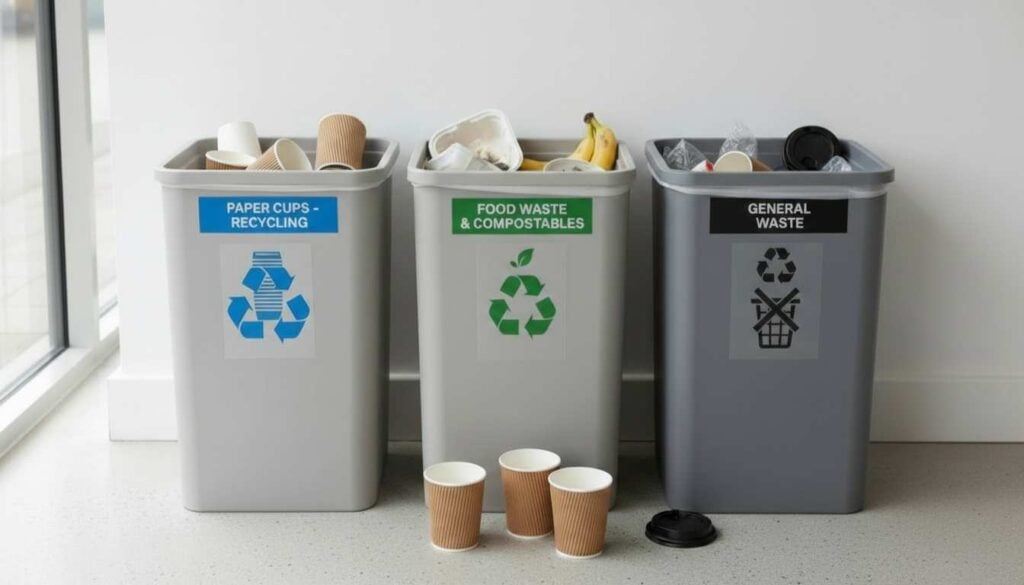
Understanding what happens to paper coffee cups after use is essential for making honest sustainability claims and choosing the right cups for your operation.
Current End-of-Life Pathways in the UK
1. General waste (landfill or incineration)
The default destination for the most used paper cups in the UK. Lined cups do not decompose quickly in a landfill. Incineration recovers some energy but produces emissions.
2. Dedicated cup recycling
Specialised recycling programmes (such as those operated by DS Smith, Simply Cups, and others) can process PE-lined paper cups by separating the plastic lining from the paper fibre. This requires a separate collection stream; cups must not be mixed with standard recycling.
How to set it up:
-
- ▸ Partner with a dedicated cup recycling service
-
-
- ▸ Provide a separate, clearly labelled bin for used cups in your shop
-
- ▸ Arrange collection or drop-off with the recycling partner
-
- ▸ Communicate the programme to customers
3. Industrial composting
PLA-lined cups can be processed in industrial composting facilities that maintain the required temperatures (55–60°C) for the required duration. Not all UK waste management providers offer this. Verify availability in your area before choosing compostable cups.
4. Standard paper recycling
Currently only viable for cups with aqueous coatings that are certified as compatible with standard paper recycling streams. This is the most convenient pathway for customers (they can put the cup in their normal paper recycling), but it requires specific cup materials.
What You Can Honestly Tell Customers
Based on the cups you use, here is what you can and cannot claim:
| Cup Type | Honest Claim | Cannot Claim |
| PE-lined with dedicated cup recycling | “This cup is recyclable through our in-store cup recycling programme” | “This cup is recyclable” (without context, customers will assume kerbside) |
| PLA-lined | “This cup is industrially compostable. Please use our compost bin” | “This cup is compostable” (without specifying industrial composting) |
| Aqueous-coated with recyclability certification | “This cup is widely recyclable. Please recycle with paper” | N/A, this is the most straightforward claim |
| Any cup without a recycling programme | Nothing about recyclability | Any recycling or environmental claims |
Honest, specific claims build customer trust. Vague or misleading claims risk greenwashing accusations and damage your reputation.
UK-Specific Sourcing Considerations
Sourcing paper coffee cups in the UK involves considerations that differ from other markets.
Supply Chain Factors
-
- ▸ UK-based suppliers reduce shipping distances, delivery times, and carbon footprint compared to importing directly from overseas manufacturers
-
-
- ▸ Brexit-related customs apply to cups imported from EU manufacturers. Factor in potential delays and additional costs
-
- ▸ VAT applies to paper coffee cups at the standard rate (20%). Some suppliers quote prices ex-VAT; always confirm whether quoted prices include VAT
-
- ▸ Delivery logistics. Most UK suppliers offer next-day or 2–3 day delivery for stock items. Custom printed cups have longer lead times (typically 4–8 weeks)
What to Ask a Potential Supplier
Before committing to a paper coffee cup supplier, ask:
What certifications do your cups hold? (FSC, PEFC, food safety, compostability, recyclability)
What is the rim diameter for your 12 oz cups? (Critical for lid compatibility)
What is the minimum order quantity for stock cups? For custom printed cups?
Can you provide samples before I place an order?
What is your delivery lead time and cost?
Do you offer volume-based pricing?
What is your cup’s lining material?
Can you provide food safety certification and data sheets for your products?
Where are the cups manufactured?
What is your return policy for damaged or defective goods?
A reputable supplier will answer all of these questions readily and provide documentation to support their claims.
How to Test Paper Cups Before Committing

Never commit to a large order based solely on a supplier’s description or product photos. To ensure you are choosing the right cups, it’s essential to test paper cups before committing to a bulk order. Testing cups with real drinks in real conditions is the only reliable way to evaluate quality and suitability.
A Practical Testing Protocol
Step 1: Order samples of 2–3 cup options
Most suppliers provide free or low-cost samples. Order from multiple suppliers to compare.
Step 2: Test with your actual drinks
Fill cups with your standard drinks (latte, americano, filter coffee) at your normal serving temperatures. Use your actual lids.
Step 3: Evaluate the following over 30 minutes:
| Test | What to Check | Pass Criteria |
| Seam integrity | Any leaking or moisture on the seam? | Completely dry after 30 minutes |
| Heat comfort | Can you hold the cup comfortably? | Comfortable to hold for at least 5 minutes (ripple/double wall) |
| Lid fit | Does the lid snap securely? Does it spin? | Secure snap, no spinning, no leaking when tilted |
| Structural rigidity | Does the cup flex or deform when gripped? | Maintains shape under normal hand pressure |
| Rim quality | Is the rim smooth and even? | No rough spots, consistent roll |
| Drink experience | Does the cup affect the drink’s taste or smell? | No paper or chemical taste or odour |
| Print quality (if custom) | Is the print clear, aligned, and smudge-free? | Clean, legible, no ink transfer to hands |
Step 4: Staff feedback
Have your baristas use the test cups during a normal service period. They will identify practical issues (stacking, speed of grabbing from dispensers, ease of writing on with markers) that you might miss.
Step 5: Customer feedback
If possible, use test cups for a day or two and note any customer comments, positive or negative.
Frequently Asked Questions
What size paper coffee cup is most popular in UK coffee shops?
The 12 oz (340 ml) paper cup is the most widely used size in UK coffee shops. It accommodates standard lattes, cappuccinos, and Americanos with appropriate headspace for foam. Most shops use 12 oz cups for 50–70% of their takeaway drinks.
Are ripple wall cups better than double wall cups?
Both provide good heat insulation and eliminate the need for a separate sleeve. Ripple wall cups offer slightly better grip due to the corrugated texture and are often perceived as more premium. Double wall cups have a smoother exterior, which some customers prefer. Functionally, both perform well. The choice depends on brand aesthetics and personal preference.
Can paper coffee cups be recycled in the UK?
Standard PE-lined paper cups cannot be recycled in most UK kerbside recycling programmes. They require dedicated cup recycling streams, which are available through specialist recycling services. Cups with aqueous coatings are increasingly accepted in standard paper recycling. Always verify the recyclability of your specific cups with your supplier and local waste management provider.
How many paper cups should a coffee shop order at a time?
This depends on your daily takeaway volume and storage capacity. A general guideline is to order a 3-month (quarterly) supply to benefit from volume pricing. For a shop selling 50 takeaway drinks per day, this would be approximately 4,500–5,000 cups per quarter (including buffer for waste).
What is the difference between PLA-lined and PE-lined paper cups?
PE (polyethene) is a traditional plastic lining that provides excellent waterproofing and is the most cost-effective option. PLA (polylactic acid) is a plant-based lining that is industrially compostable but not recyclable in standard streams. PE-lined cups can be recycled through dedicated cup recycling services. The choice depends on your sustainability priorities and the waste disposal infrastructure available to you.
Do I need custom printed cups, or are stock cups sufficient?
Stock cups are perfectly functional and are the most cost-effective option, especially for new or low-volume shops. Custom printed cups become worthwhile when your daily takeaway volume justifies the minimum order quantities (typically 1,000–5,000 cups) and when brand visibility is a strategic priority. Alternatives like branded stamps, stickers, or sleeves offer branding at lower volumes.
How can I tell if a paper cup is good quality?
Test with real drinks. Key indicators of quality include: no seam leaking after 30 minutes with hot liquid, a smooth, evenly rolled rim, a secure lid fit without gaps, a comfortable hand feel with hot drinks, and consistent print quality (if applicable). Request samples and test before ordering in bulk.
Summary: Making the Right Paper Cup Decision for Your UK Coffee Shop
Choosing paper coffee cups is a decision that touches every part of your coffee shop operation, customer experience, brand perception, operating costs, environmental impact, and daily workflow efficiency.
Here are the key principles to guide your decision:
Start with Your Priorities
Identify what matters most to your specific operation:
-
- ▸ Cost minimisation: Single wall cups with sleeves or basic double wall cups in standard designs
-
-
- ▸ Customer experience: Ripple wall cups (kraft or black) with secure, splash-proof lids
-
- ▸ Sustainability leadership: Aqueous-coated cups with verified recyclability, or PLA-lined cups with confirmed access to industrial composting
-
- ▸ Brand visibility: Custom printed ripple or double wall cups in your brand colours
-
- ▸ Operational simplicity: One size (12 oz), one wall type (ripple), one lid type — minimal SKUs to manage
Use the 12-oz size as Your Foundation
For most UK coffee shops, 12 oz paper cups will be your highest-volume item. Get this cup right first. Choose the wall type, lining, and supplier that best serve your needs at this size, then build out to secondary sizes.
Test Before You Commit
Always order samples from at least two suppliers. Test with real drinks, real lids, and real service conditions. Involve your staff in the evaluation. This prevents costly mistakes and ensures the cups you choose work in practice, not just on paper.