Coffee shop owners in the UK increasingly need to verify sustainability standards before purchasing paper coffee cups. Having worked closely with hospitality suppliers and packaging procurement teams, I’ve seen how confusing sustainability claims can be for café owners trying to choose compliant cups.
The key sustainability standards UK coffee shops should check are FSC or PEFC certification for paper sourcing, EN 13432 or OK Compost certification for compostable cups, and verified recyclability labels such as OPRL. These certifications confirm whether a cup’s materials are responsibly sourced, recyclable, or suitable for industrial composting under UK waste systems.
Understanding these standards helps coffee shops avoid misleading supplier claims, meet UK packaging regulations, and communicate accurate sustainability messaging to customers.
Why Do Sustainability Standards Matter for Paper Coffee Cups?
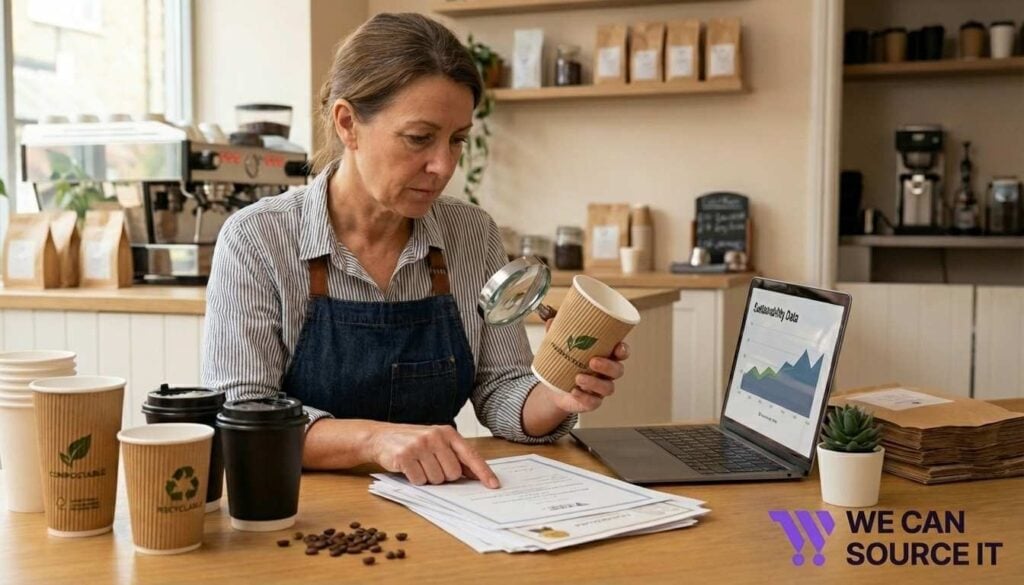
Sustainability standards ensure that paper coffee cups meet verified environmental and regulatory requirements, rather than relying on vague marketing claims.
For UK coffee shops, this matters for three main reasons:
Regulatory compliance
- Packaging choices can affect Extended Producer Responsibility (EPR) fees
- Certain materials may fall under the Plastic Packaging Tax
- Businesses must avoid misleading environmental claims
Customer expectations
UK consumers increasingly expect cafés to use responsibly sourced and recyclable packaging. Incorrect sustainability claims can damage brand trust.
Operational decisions
Standards help determine whether cups are:
- Recyclable in the UK infrastructure
- Industrially compostable
- Responsibly sourced
Key takeaway: Sustainability certifications are the easiest way to verify supplier claims and ensure packaging decisions align with UK environmental systems.
What Sustainability Certifications Should UK Coffee Shops Look For?
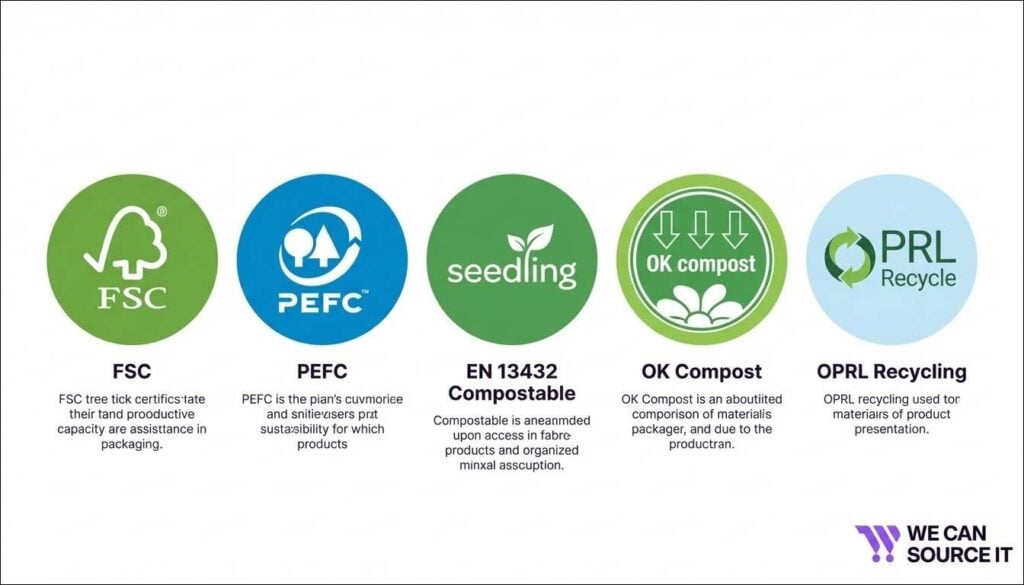
Several internationally recognised certifications apply to paper coffee cups.
Each certification verifies a different part of the cup’s environmental impact.
Core Certifications for Paper Coffee Cups
| Certification | What It Verifies | Why It Matters |
| FSC | Paper sourced from responsibly managed forests | Ensures sustainable forestry |
| PEFC | Alternative global forest certification | Confirms responsible sourcing |
| EN 13432 | Industrial compostability standard | Required for compostable cups |
| OK Compost | Independent compostability certification | Verifies composting performance |
| OPRL Label | UK recycling classification | Indicates if packaging is widely recyclable |
A reputable supplier should provide documentation or certification numbers confirming compliance.
What Does FSC Certification Mean for Coffee Cups?

FSC certification confirms that the paperboard used in a coffee cup comes from responsibly managed forests.
The Forest Stewardship Council (FSC) sets global standards for sustainable forestry.
For coffee cups, FSC certification ensures:
- Forests are harvested responsibly
- Biodiversity and ecosystems are protected
- Workers’ rights are respected
- Supply chains are traceable
Many UK cafés now prioritise FSC-certified packaging because it allows them to communicate credible environmental sourcing to customers.
Key takeaway: FSC certification verifies responsible paper sourcing but does not guarantee recyclability or compostability.
Are Compostable Paper Cups Actually Compostable?
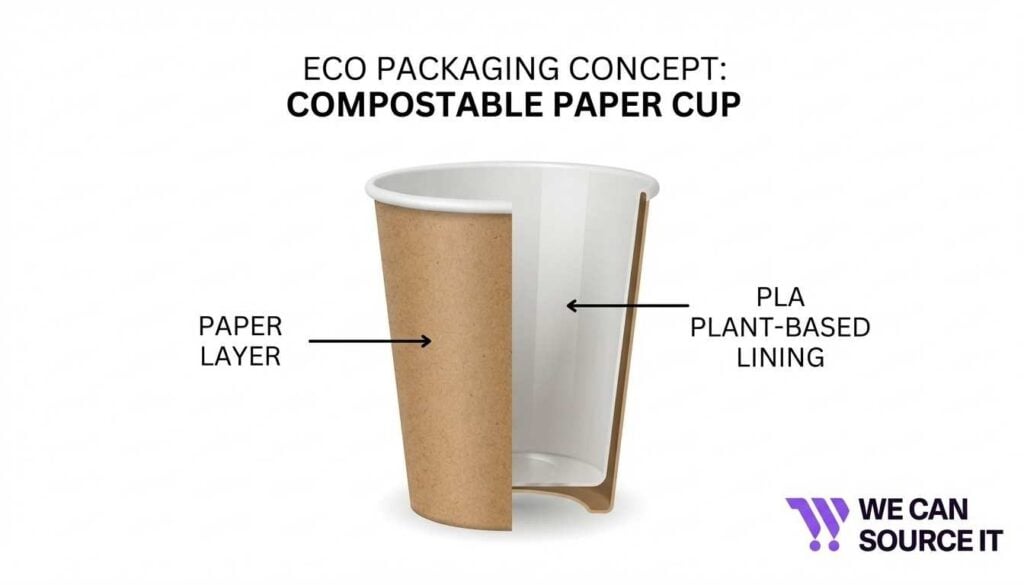
Compostable paper cups are only compostable under industrial composting conditions.
Most compostable cups use a PLA (polylactic acid) lining, made from plant-based materials such as corn starch.
For a cup to be genuinely compostable, it must meet the EN 13432 standard, which confirms:
- The material breaks down within a specific timeframe
- It leaves no harmful residues
- It decomposes under controlled composting conditions
However, compostable cups require:
- Industrial composting facilities
- Waste streams that separate compostable packaging
Many UK regions do not currently offer widespread industrial composting for food packaging.
Key takeaway: A compostable cup is only environmentally beneficial if it is actually sent to an industrial composting facility.
Are Paper Coffee Cups Recyclable in the UK?
Standard paper coffee cups are not widely recyclable through household kerbside recycling because they contain a plastic lining.
Most cups include a thin polyethylene (PE) layer that prevents liquid from soaking into the paperboard.
This lining must be separated from the fibre during recycling, which requires specialist facilities.
Dedicated recycling programmes in the UK include:
- Cup recycling collection schemes
- Specialist paper cup recycling facilities
- Closed-loop recycling initiatives
Some newer cup designs use aqueous coatings that are designed to be recycled in standard paper recycling streams.
Key takeaway: Always verify recyclability claims with supplier documentation and UK recycling labels such as OPRL.
What Is the OPRL Label and Why Does It Matter?
The On-Pack Recycling Label (OPRL) is the UK’s standard recycling guidance label for packaging.
It helps businesses and consumers understand whether packaging can be recycled through common UK waste systems.
OPRL classifications typically include:
- Widely Recycled
- Check Local Recycling
- Not Currently Recycled
For coffee cups, OPRL labels may apply to:
- Cup bodies
- Lids
- Sleeves
Using packaging with accurate OPRL labelling helps coffee shops:
- Communicate clear disposal instructions
- Avoid misleading recycling claims
- Align with UK packaging guidance
Key takeaway: OPRL labels help translate complex recycling rules into simple instructions customers can follow.
How Can Coffee Shops Verify Sustainability Claims from Suppliers?
Not all environmental claims made by packaging suppliers are verified.
Coffee shops should request evidence-based documentation before purchasing cups marketed as sustainable.
Ask suppliers for:
- FSC or PEFC certification numbers
- EN 13432 compostability certification
- OPRL recycling classification
- Food-contact safety documentation
- Independent recyclability testing
You should also confirm:
- Where cups are manufactured
- What lining material is used
- Whether recycling or composting infrastructure exists locally
Key takeaway: A legitimate supplier will provide written certification and technical data sheets for their products.
What Are the Most Common Greenwashing Claims in Coffee Cup Packaging?
Packaging marketing can sometimes exaggerate environmental benefits.
Common misleading claims include:
“Biodegradable cups”
Biodegradable is not a regulated claim and does not guarantee environmental benefit.
“Eco-friendly cups”
This term has no formal standard or certification.
“Compostable anywhere”
True compostable cups require industrial composting conditions.
“Recyclable cups” without clarification
Most paper cups require specialist recycling streams, not household recycling.
Key takeaway: Look for verified certifications rather than general environmental claims.
Practical Sustainability Checklist for UK Coffee Shops
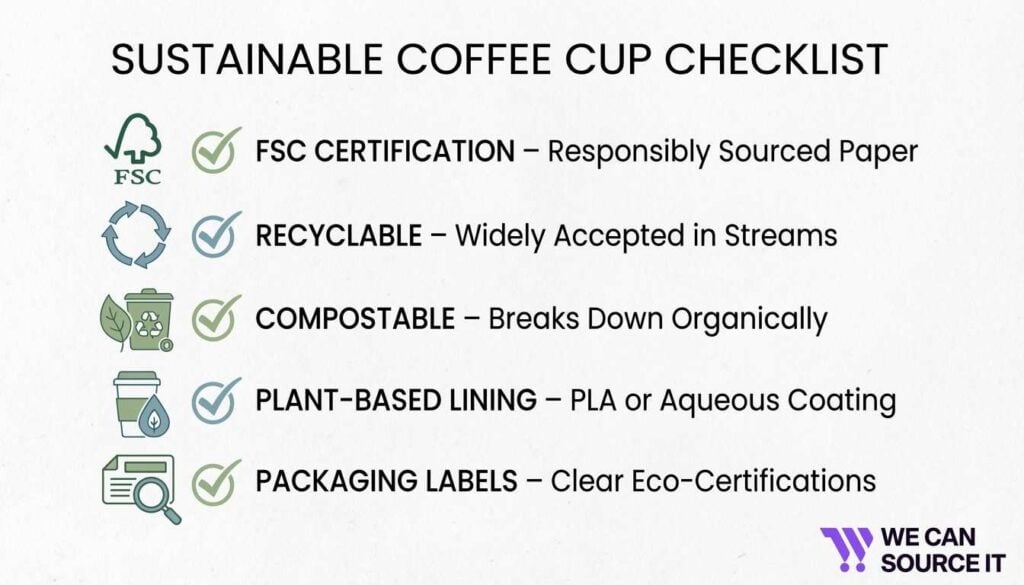
Before ordering paper coffee cups, check the following:
Material sourcing
- FSC or PEFC certification
Lining type
- PE, PLA, or aqueous coating
Recycling pathway
- Standard recycling or dedicated cup recycling
Compostability certification
- EN 13432 or OK Compost (if applicable)
Recycling labelling
- OPRL label classification
Supplier transparency
- Documentation and test data available
Using this checklist helps coffee shops choose packaging that is both environmentally responsible and compliant with UK regulations.
Frequently Asked Questions
What sustainability certification is most important for paper coffee cups?
FSC certification is the most widely recognised standard for sustainable paper sourcing. It confirms the paperboard comes from responsibly managed forests.
Are compostable coffee cups better than recyclable cups?
Not always. Compostable cups only provide environmental benefits if they are processed in industrial composting facilities, which are not universally available in the UK.
Can UK coffee shops claim their cups are recyclable?
Only if the cups are compatible with UK recycling systems or part of a verified cup recycling programme. Vague recycling claims should be avoided.