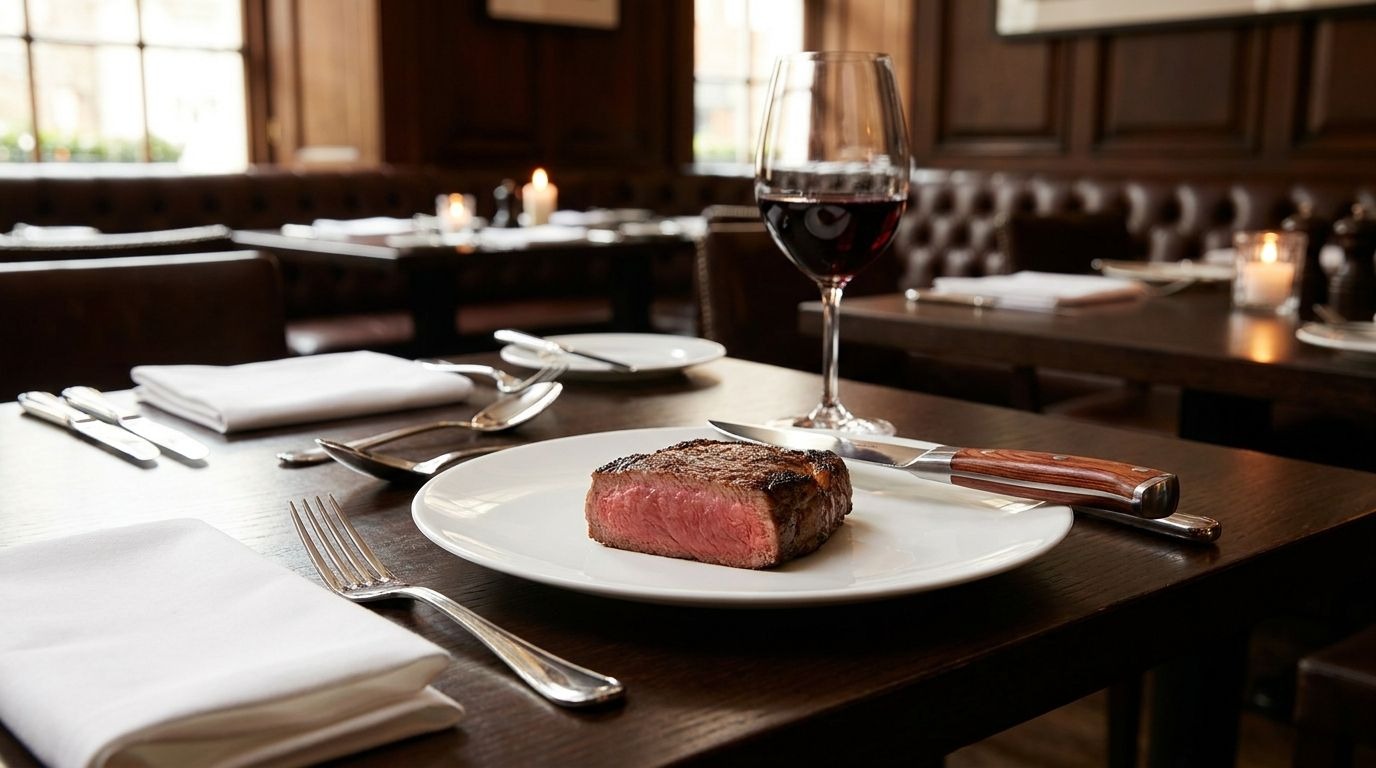
Steak knives get less attention than the rest of the cutlery order, right up until a table sends one back because it won’t cut through a medium-rare sirloin cleanly, or a serrated edge shreds a delicate fillet instead of slicing it.
This is the one piece of cutlery where the wrong choice is immediately, visibly obvious to a guest mid-meal, and where commercial reality (dishwasher cycles, staff handling, reorder cost) genuinely conflicts with the hand-wash, once-a-year sharpening advice most consumer buying guides give.
This UK buyer’s guide explains how to choose the right steak knives for restaurants, covering blade type, handle material, tang construction, dishwasher safety and realistic commercial maintenance schedules. It connects to our Commercial Cutlery & Flatware buyer’s guide and our piece on economy vs premium restaurant cutlery, since steak knives sit at an unusual intersection of both grade and specialist function.
Quick Answer
For most UK restaurants, serrated steak knives in stainless steel are the practical commercial choice, since they hold a working edge far longer between sharpenings than a straight edge, which matters when professional sharpening isn’t happening weekly. Straight-edge knives give a cleaner cut and suit fine dining where staff can maintain them more closely, but need more frequent, more skilled sharpening to stay effective. Handle material should match your table setting: stainless steel for linen-clothed formal tables, wood or resin for wooden or laminate tabletops. Full tang construction (where the blade extends the full length of the handle) is worth the extra cost for durability under repeated commercial use.
Serrated vs Straight Edge: The Real Commercial Trade-off
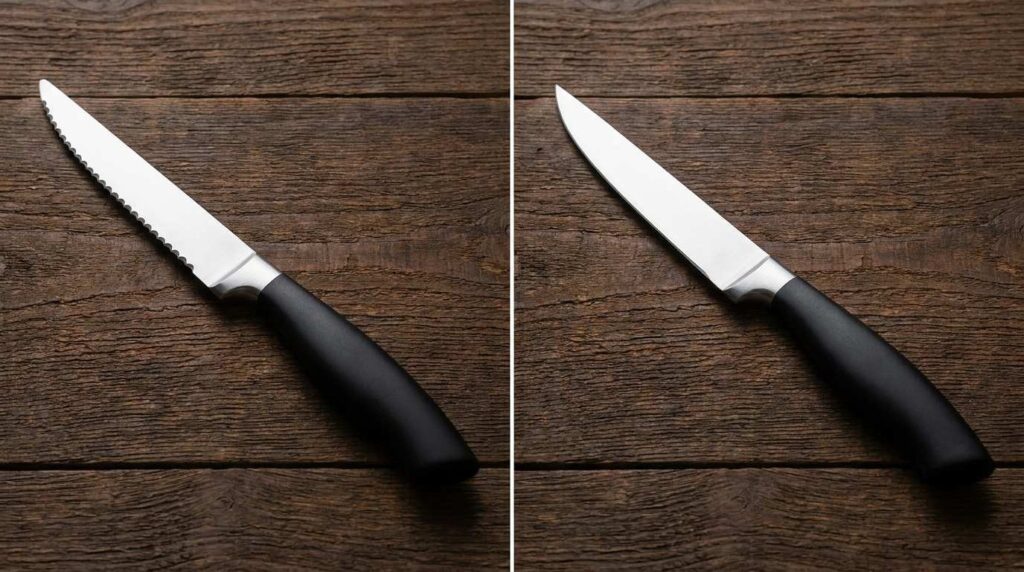
This is the single biggest decision in the entire steak knife category, and most consumer guides present it as pure personal preference. In a commercial setting, it’s actually a maintenance and labour cost decision as much as a cutting-performance one.
| Edge type | Cutting performance | Maintenance in commercial use | Best suited to |
| Serrated | Saw-like action, grips and tears through a crusty exterior without excessive downward pressure | Holds a usable edge far longer between sharpenings, but is harder to professionally resharpen when it eventually does dull | High-turnover restaurants, steakhouses, venues without a dedicated in-house sharpening routine |
| Straight (smooth) edge | Clean, precise slice with no sawing motion, better preserves a delicate cut’s texture and presentation | Dulls faster under heavy use and needs more frequent, more skilled sharpening to stay effective | Fine dining, venues with an established sharpening schedule or an on-site sharpening service |
Serrated blades are the practical default for most UK restaurants specifically because they tolerate inconsistent maintenance far better than a straight edge. A straight-edge knife left unsharpened for months becomes genuinely difficult to cut through meat with, forcing guests to saw rather than slice, which undermines the entire point of specialist steak cutlery.
A serrated blade in the same scenario still performs reasonably well past the point a straight edge would have failed. The trade-off is that serrated blades preserve a slightly rougher cut texture and are harder to bring back to full sharpness once they do eventually dull, since sharpening the individual serrations requires more specialist equipment than a standard straight edge.
Blade Material: What Actually Matters for Commercial Durability
Nearly all commercial steak knives use some grade of stainless steel, but there’s a genuine quality range worth understanding before you order.
-
- ▸ Standard stainless steel (often 18/0, the same grade covered in our 18/10 vs 18/0 guide) gives reliable corrosion resistance and holds up well to commercial dishwashing, making it the sensible default for most restaurants.
-
- ▸ High-carbon stainless steel blades, sometimes used specifically for the cutting edge while the rest of the piece uses standard stainless, hold a sharper edge for longer under repeated use, at a higher cost.
-
- ▸ Blade hardness affects how long an edge lasts between sharpenings regardless of edge type, and it’s worth asking a supplier about this specifically if you’re comparing similarly priced options, since two knives that look identical can perform very differently after six months of daily service.
For most restaurants, standard stainless steel steak knives paired with a serrated edge give the best balance of cost, durability and low-maintenance performance. High-carbon options are worth the premium specifically for venues with a genuine, consistent in-house sharpening routine that can actually take advantage of the harder edge’s longer working life.
Full Tang vs Partial Tang Construction
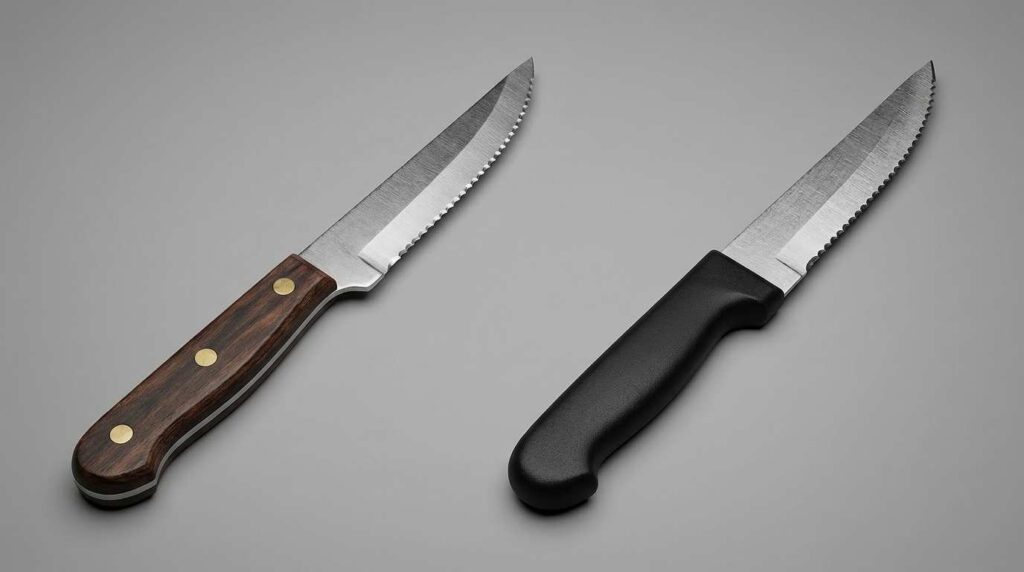
Tang refers to how far the blade’s metal extends into the handle, and it’s one of the clearest indicators of a knife’s structural durability.
-
- ▸ Full tang construction means the blade metal runs the complete length of the handle, giving a solid, single-piece feel with excellent resistance to loosening or breaking at the joint between blade and handle over years of commercial use.
-
- ▸ Partial tang construction has the blade metal extending only partway into the handle, which is more affordable to manufacture but more prone to developing looseness or weakness at the joint under the repeated stress of commercial handling and dishwashing.
For a genuinely commercial environment, full tang construction is worth the extra cost specifically because steak knives see more direct cutting pressure than standard table cutlery, and a joint failure mid-service, a blade separating from its handle while a guest is cutting, is both a safety issue and a poor guest experience. This is a detail worth checking on a spec sheet or asking a supplier directly, since it’s not always obvious from a product photo alone.
Handle Materials and Matching to Your Table Setting
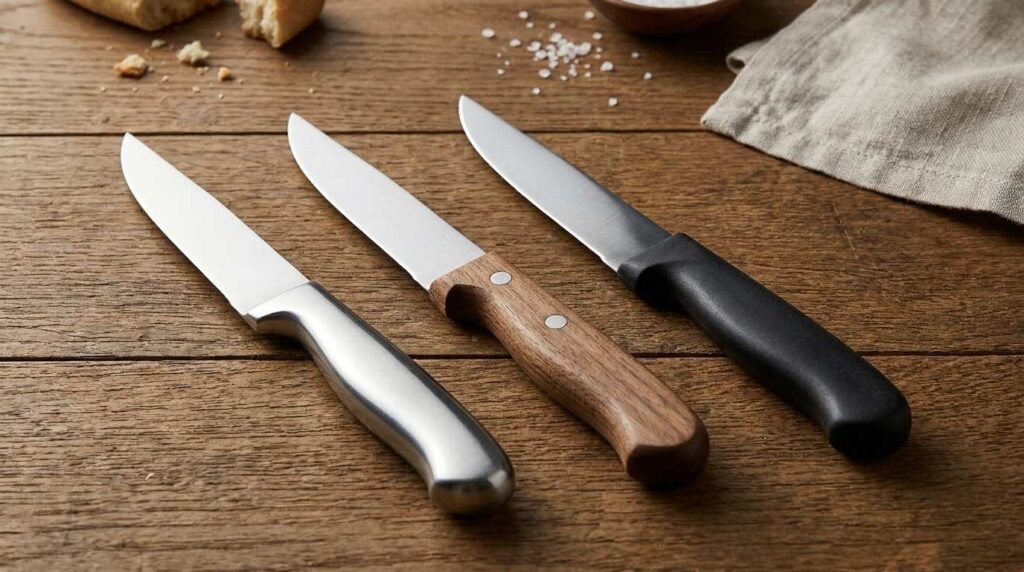
Handle material affects grip, feel, dishwasher compatibility and how the piece visually sits against your table setting, all of which matter for a genuinely commercial decision.
| Handle material | Feel | Dishwasher safe | Best suited to |
| Stainless steel | Sleek, modern, matches standard cutlery patterns exactly | Yes | Linen-clothed formal tables, venues wanting a fully coordinated steel place setting |
| Wood | Warm, traditional feel, distinct visual contrast against steel cutlery | Often not recommended for repeated dishwasher cycles | Wooden or laminate tabletops, rustic or traditional dining rooms |
| Resin or composite | Durable, consistent finish, wide range of colours available | Usually yes | High-turnover venues wanting durability without the maintenance concerns of real wood |
As a general rule, an all-stainless-steel steak knife suits a formal table with linen cloth, since it matches the rest of your cutlery pattern and avoids any visual clash. Wood or laminate-topped tables, common in more casual or rustic dining rooms, often suit a wood or resin handle better, both aesthetically and because a wooden handle can feel more at home against a natural wood tabletop than a cold steel one. Our Steak Collection with wood handles and Steak Collection with black handles cover both ends of this decision, letting you match handle finish to your specific table setting rather than defaulting to whichever option happens to be available.
Dishwasher Safety: The Commercial Reality vs Domestic Advice

Here’s a genuine conflict worth addressing directly, since almost every consumer-facing steak knife guide recommends hand washing only, advice that simply doesn’t work for a commercial kitchen running dozens of covers a service. In a domestic setting, hand washing protects a wooden handle from moisture damage and keeps a serrated edge from dulling against other cutlery in a crowded dishwasher basket. In a commercial kitchen, hand washing every steak knife after every use isn’t realistic given wash-up volume and staff time constraints.
The practical resolution: choose steak knives specifically manufactured and rated for commercial dishwasher use, rather than assuming standard consumer advice applies. Stainless steel handles and properly sealed resin handles are generally dishwasher safe at commercial volume, while genuine wood handles are the one component worth checking carefully, since repeated commercial dishwasher cycles, hot water, harsh detergent and constant moisture exposure will degrade an untreated or poorly sealed wooden handle far faster than occasional domestic hand washing ever would.
-
- ▸ Confirm dishwasher-safe rating specifically for commercial use when ordering, not just general consumer dishwasher safety, since the two environments differ significantly in cycle frequency, water temperature and detergent strength.
-
- ▸ Water hardness affects blade finish over time, as covered in our pillar guide’s hard water section, so venues in hard water regions should pay particular attention to rinse aid dosing for steak knives just as they would for standard cutlery.
-
- ▸ If running genuine wood-handled knives commercially, budget for more frequent replacement or a hand-wash routine specifically for that piece type, rather than assuming they’ll survive the same dishwasher cycle as your standard cutlery indefinitely
Sharpening and Maintenance Schedule for Commercial Use
A realistic maintenance schedule matters more than a one-off quality purchase, since even the best steak knife dulls with enough commercial use.
-
- ▸ Professional sharpening once a year is a commonly recommended baseline for restaurant steak knives, though genuinely high-volume steakhouses running these knives daily may need this more frequently. Visual and feel checks periodically during service: if staff notice a knife struggling to cut cleanly rather than gliding through, that’s the signal to pull it from service rather than waiting for the next scheduled sharpening
-
- ▸ Rotate stock rather than running every knife until it fails, since a set that’s sharpened and maintained in rotation performs more consistently across the whole service than one where pieces are used until they visibly underperform
-
- ▸ Store knives properly between services, blade protected and not left loose in a drawer where the edge can be damaged by contact with other cutlery, which both preserves sharpness and reduces handling risk for staff
Blade Length and Size Guide
Most commercial steak knives fall in a fairly narrow length range, but the right choice depends on your typical cut thickness and portion size.
| Blade length | Best suited to |
| Shorter blades (around 4 to 5 inches) | Easier control, popular for standard portion sizes, and generally preferred where precision matters more than reach |
| Longer blades (around 5 to 6 inches) | Larger or thicker cuts, steakhouse-style bone-in or larger sharing cuts |
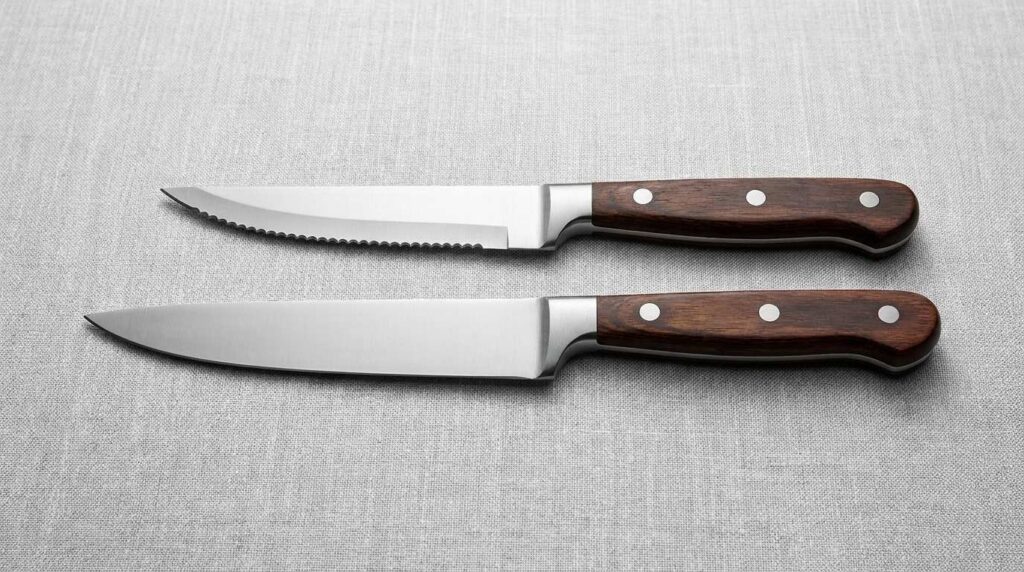
Shorter blades are often the more practical commercial choice, since they’re easier for guests to control confidently and work well across the widest range of menu items, while longer blades earn their place specifically in venues serving consistently larger cuts where the extra length and cutting leverage genuinely help.
How Many Steak Knives Does Your Restaurant Need
Steak knife quantity doesn’t scale the same way as standard cutlery, since it’s tied to menu structure rather than total cover count. As covered in our guide on how much cutlery a restaurant actually needs, the standard 2.5 to 3x cover multiplier applies to cutlery used by every diner, but steak knives should be calculated against the realistic proportion of your menu that’s actually steak or a similarly firm cut, not your full cover count.
-
- ▸ For a dedicated steakhouse where the large majority of covers order steak, apply close to the standard full multiplier
-
- ▸ For a general restaurant with steak as one menu option among several, estimate the realistic proportion of covers ordering steak on a typical night, then apply the standard multiplier to that smaller number rather than your total cover count.
-
- ▸ Always keep a reasonable spare allowance beyond your calculated figure, since steak knives are specialist items and running short mid-service, with a guest waiting for a replacement, is more visible and awkward than running short of a standard table knife.
Guest and Staff Safety Considerations
Steak knives are sharper than standard table cutlery by design, which raises genuine safety points worth building into your service and clearing procedures. HSE guidance on knife safety in catering environments emphasises safe storage, safe carrying and proper training as the core controls for any sharp-bladed equipment in a hospitality setting, and the same underlying principles apply directly to steak knives on the floor, not just prep knives in the kitchen.
-
- ▸ Train front-of-house staff on safe clearing, carrying steak knives blade-down and close to the body rather than extended outward, mirroring the same safe carrying principle used for kitchen knives
-
- ▸ Never allow steak knives to be stacked loosely in a bus tub with blades exposed upward, both for staff safety during clearing and to avoid unnecessary edge damage.
-
- ▸ Store cleaned steak knives properly between services, sorted and blade-protected, rather than loose in a drawer alongside standard cutlery.
-
- ▸ Brief new staff specifically on steak knife handling during onboarding, since it’s easy to assume general cutlery training covers this adequately when the sharper edge genuinely changes the risk profile
Matching Steak Knives to Your Wider Cutlery Pattern
A mismatched steak knife against an otherwise coordinated table setting is one of the more noticeable presentation inconsistencies a guest can spot, particularly at a table where every other piece matches.
If your standard cutlery is Contemporary 18/10, a steak knife with a wildly different finish or handle style will stand out for the wrong reasons. Where possible, choose a steak knife finish that complements rather than clashes with your core pattern, even if it’s not an exact match, since steak knives are rarely sold within the same named pattern range as standard cutlery.
A simple, understated stainless-steel handle generally coordinates well with most standard patterns. In contrast, a wood or resin handle works better when your standard cutlery is visually warmer or more traditional in style.
Common Mistakes
-
- ▸ Choosing straight-edge knives without a realistic sharpening plan, leading to a set that becomes genuinely difficult to cut with within months
-
- ▸ Assuming domestic hand-wash advice applies to commercial volume, then being surprised when hand washing every steak knife after every service isn’t sustainable.
-
- ▸ Buying wood-handled knives without checking commercial dishwasher compatibility, risking premature handle damage under repeated hot cycles
-
- ▸ Ignoring tang construction, choosing a cheaper partial tang option that develops looseness far sooner than a full tang equivalent under genuine commercial use
-
- ▸ Calculating steak knife quantity against total cover count rather than the realistic proportion of covers actually ordering steak, leading to significant over-ordering
-
- ▸ Treating steak knife safety as covered by general kitchen knife training, without specifically briefing front-of-house staff on safe carrying and clearing
FAQs
Should restaurants use serrated or straight-edge steak knives?
Serrated is the practical default for most UK restaurants, since it holds a usable edge far longer between sharpenings, which matters without a consistent professional sharpening routine. Straight edge gives a cleaner cut but needs more frequent, skilled maintenance to stay effective.
Are steak knives dishwasher safe in a commercial kitchen?
Stainless steel and properly sealed resin handles generally are, at a commercial dishwasher-safe rating rather than a domestic one. Genuine wood handles are the component to check most carefully, since repeated commercial cycles can degrade them faster than occasional domestic hand washing.
How often should restaurant steak knives be professionally sharpened?
Once a year is a commonly recommended baseline, though high-volume steakhouses using these knives daily may need more frequent sharpening to keep pace with wear.
What’s the difference between full tang and partial tang steak knives?
Full tang means the blade metal runs the complete length of the handle, giving better long-term structural durability under commercial use. Partial tang extends only partway into the handle and is more prone to developing looseness at the joint over time.
What handle material should I choose for steak knives?
Match it to your table setting. Stainless steel suits formal, linen-clothed tables and coordinates with standard steel cutlery. Wood or resin suits wooden or laminate tabletops and more casual or traditional dining rooms.
How many steak knives does a restaurant need?
Calculate against the realistic proportion of covers actually ordering steak, not your total cover count, then apply the same 2.5 to 3x multiplier used for standard cutlery, with a reasonable spare allowance on top.
Do steak knives need special safety training for staff?
Yes. HSE guidance on knife safety in catering environments recommends safe storage, safe carrying and proper training for any sharp-bladed equipment, and front-of-house staff should be specifically briefed on carrying and clearing steak knives safely, not just assumed to be covered by general kitchen knife training.

Making the Right Steak Knife Investment
The right steak knife for your restaurant comes down to matching blade type, construction and handle material to how your venue actually operates, not simply picking whichever set looks most premium in a product photo. Serrated blades suit the realistic maintenance schedule of most UK restaurants, full tang construction earns its price under commercial use, and handle material should coordinate with both your table setting and your dishwasher routine. Get the maintenance plan right alongside the initial purchase, and steak knives become a genuine asset to the dining experience rather than the one piece of cutlery guests notice for the wrong reasons.
For the wider cutlery decision beyond steak knives specifically, see our Commercial Cutlery & Flatware buyer’s guide, or browse our full Steak Collection to compare handle finishes directly against your existing table setting.
References
-
- ▸ Health and Safety Executive, Safe use of knives in the kitchen


