Café owners and foodservice operators quickly discover that paper cup supply management is an operational task, not just a purchasing decision. From analysing café packaging workflows and stock management systems, it is clear that poor ordering or storage practices can lead to unnecessary costs and service disruptions.
Effective ordering, storage, and inventory management for paper coffee cups means forecasting demand accurately, maintaining organised storage space, and monitoring stock levels to avoid both shortages and excess inventory.
This guide explains practical strategies for ordering, storing, and managing the inventory of paper coffee cups for coffee shops and takeaway businesses in the UK.
Why is ordering, storage, and inventory management important for coffee cups?

Managing cup inventory properly ensures cafés never run out of essential takeaway packaging while avoiding unnecessary storage costs.
Coffee cups are high-volume consumables. A busy café may use hundreds or thousands of cups each week, making inventory control essential.
Without proper management, businesses often experience:
- Running out of cups during busy periods
- Overstocking cartons that occupy valuable space
- Ordering incompatible lids or accessories
- Increased packaging waste
Key takeaway: Efficient inventory management keeps coffee service running smoothly and prevents operational disruptions.
How should coffee shops plan paper cup ordering?

Paper cup ordering should be based on realistic demand forecasting rather than guesswork.
A simple forecasting approach is to estimate weekly cup usage and maintain a safety buffer.
Step-by-step ordering method
- Calculate average weekly cup usage.
- Multiply by the expected lead time from the supplier.
- Add a safety buffer of 10–20%.
Example:
| Factor | Example Calculation |
| Weekly cup usage | 1,000 cups |
| Supplier lead time | 2 weeks |
| Minimum stock required | 2,000 cups |
| Safety buffer | 200–400 cups |
Key takeaway: Always order cups based on supplier lead times and real usage data.
How often should cafés reorder paper cups?
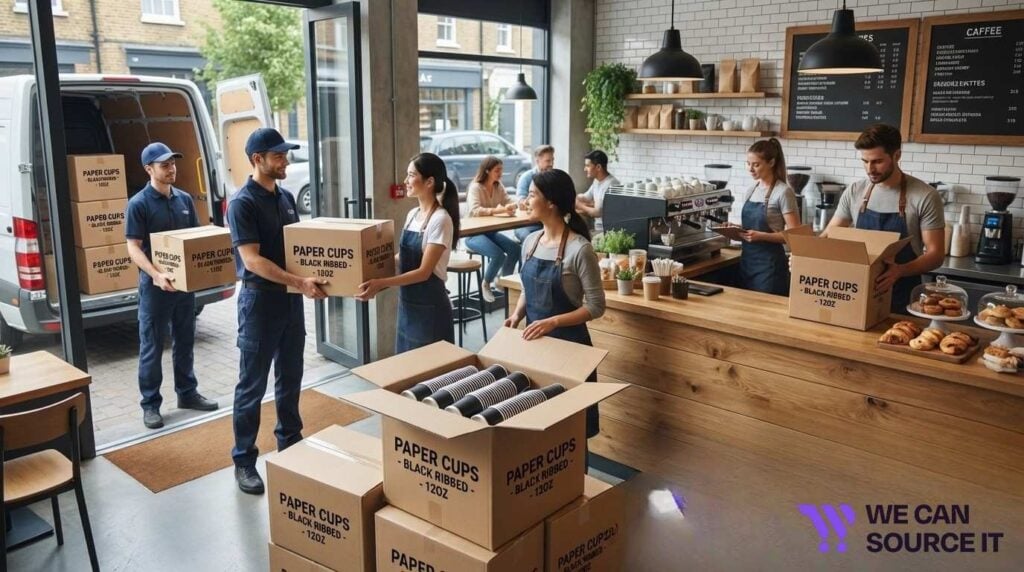
Most cafés reorder cups weekly or bi-weekly, depending on sales volume and storage space.
The ideal reorder frequency depends on:
- Cup usage volume
- Supplier delivery schedules
- Available storage space
- Order minimums from suppliers
Typical ordering patterns in UK cafés include:
| Café Type | Typical Ordering Frequency |
| Small independent café | Weekly |
| Medium takeaway café | Every 1–2 weeks |
| High-volume chain outlet | Weekly or automated |
Key takeaway: Frequent smaller orders often improve storage efficiency and reduce excess stock.
What is the best way to store paper coffee cups?
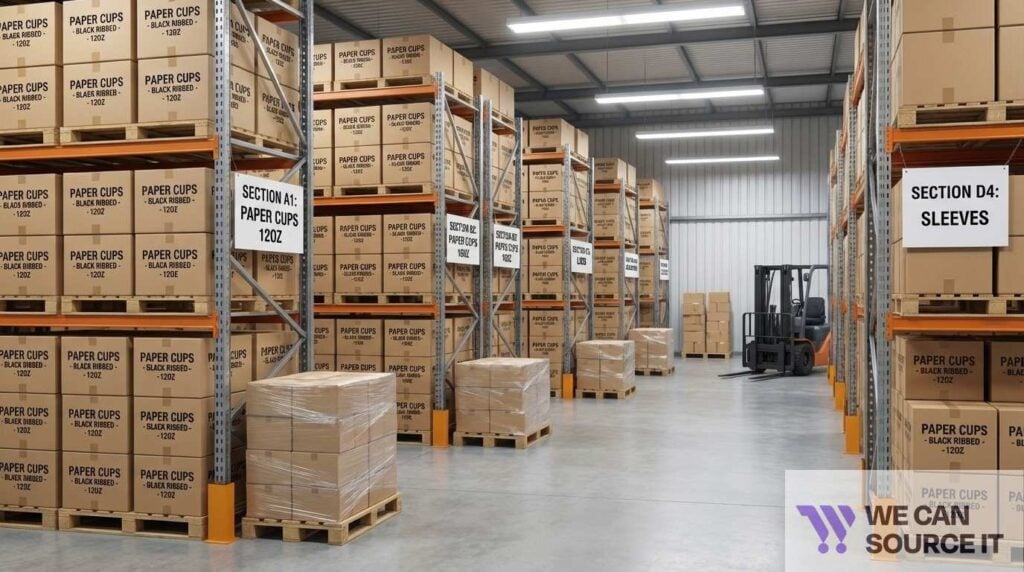
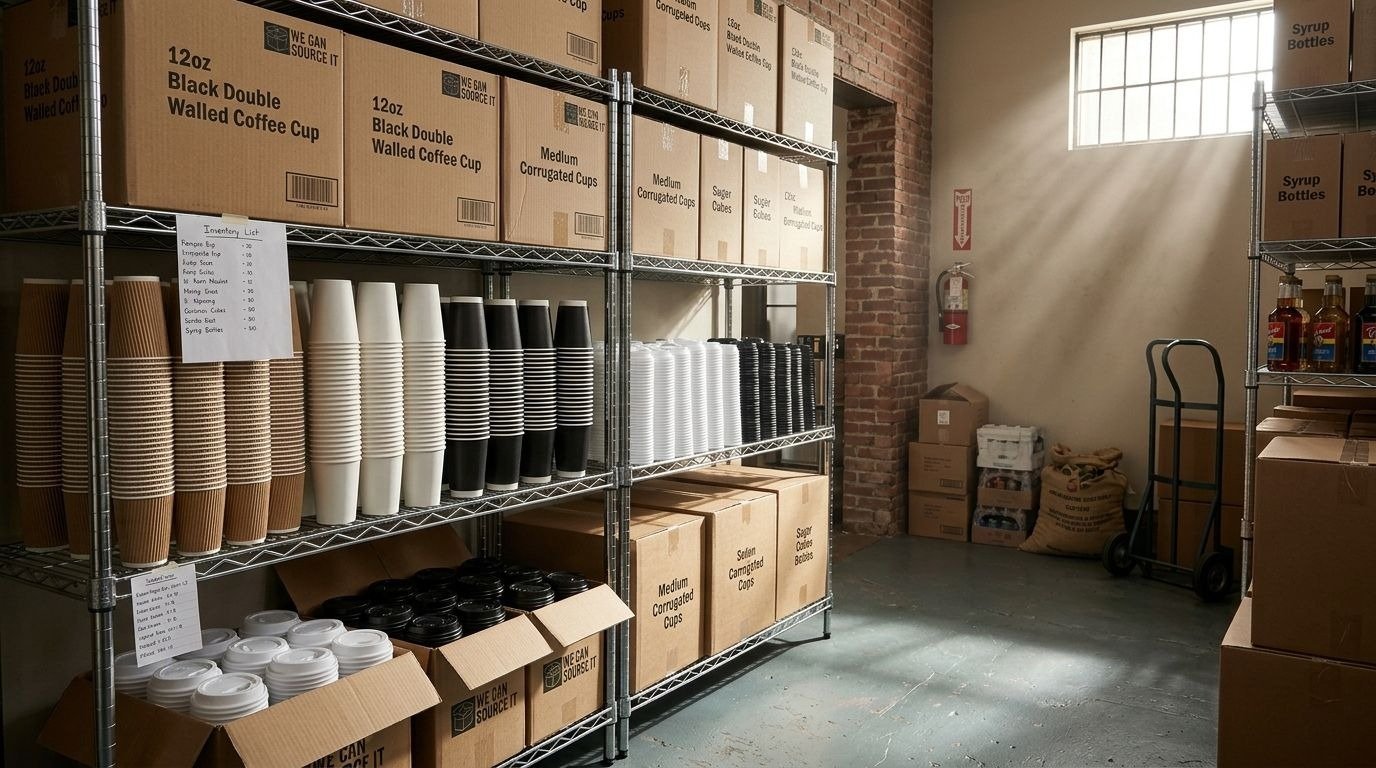
Paper coffee cups should be stored in a clean, dry, temperature-stable environment.
Improper storage can damage cups or contaminate packaging.
Recommended storage conditions include:
- Dry environment with low humidity
- Away from direct sunlight
- Protected from food spills or grease
- Stored in original cartons until use
Storage checklist
- Keep cartons elevated from the floor
- Avoid stacking too high to prevent crushing
- Separate cup sizes clearly
- Store lids in sealed boxes
Key takeaway: Proper storage preserves cup quality and prevents packaging waste.
How much storage space do paper cups require?
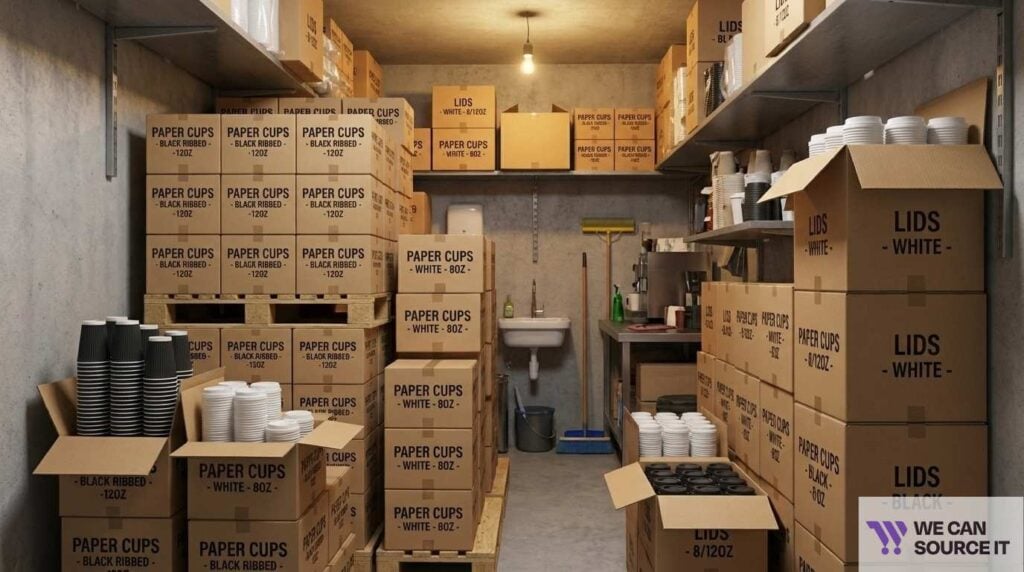
Paper cups are lightweight but take up significant storage space because they are delivered in large cartons.
A typical carton may contain 500 to 1,000 cups, depending on size and design.
For cafés with multiple cup sizes (for example, 8oz, 12oz, and 16oz), storage requirements increase.
Example packaging storage:
| Item | Typical Carton Volume |
| 8oz cups | Medium carton |
| 12oz cups | Large carton |
| 16oz cups | Larger carton |
| Lids | Separate cartons |
Space planning is particularly important for urban cafés with limited back-of-house storage.
Key takeaway: Packaging storage should be considered when deciding how much stock to order.
How can coffee shops organise cup inventory efficiently?
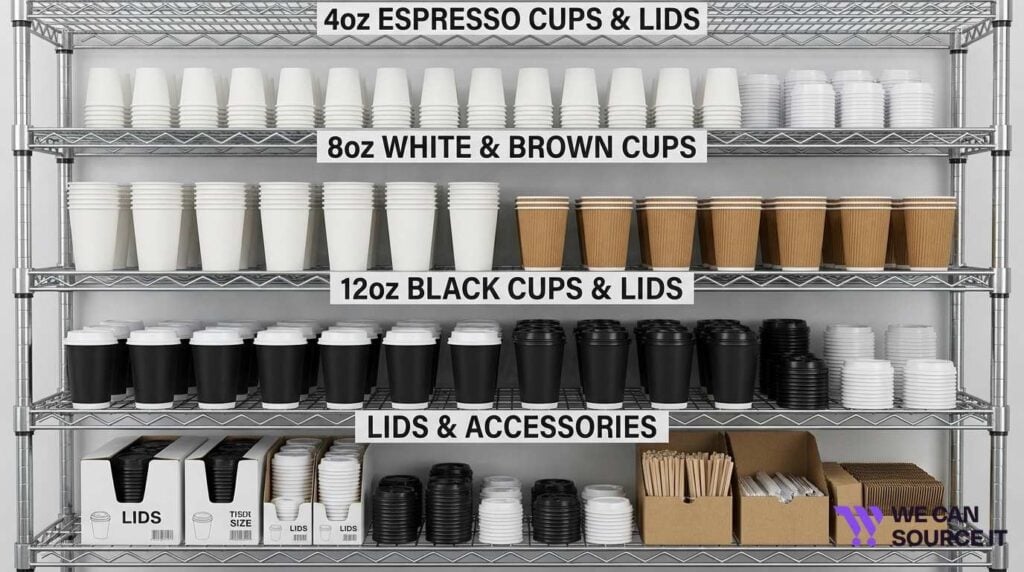
Organising cup inventory by size and usage frequency improves operational efficiency.
A simple inventory layout can speed up restocking and reduce staff errors.
Recommended organisation method
Arrange stock using these principles:
- Most frequently used cups at the front
- Larger cup cartons at lower shelving levels
- Clearly labelled shelves for each size
Example organisation:
| Shelf Level | Contents |
| Top shelf | Spare backup stock |
| Middle shelf | Daily use cups |
| Lower shelf | Large cartons |
Key takeaway: Clear organisation prevents confusion during busy service periods.
What inventory system works best for cafés?
Simple inventory tracking systems are usually sufficient for paper cup management.
Cafés often use one of three methods:
Manual inventory tracking
Staff count stock weekly and record usage.
Pros:
- Simple to implement
- No software required
Cons:
- Time-consuming
- Prone to human error
Spreadsheet tracking
Weekly usage and stock levels are recorded digitally.
Pros:
- Better data visibility
- Simple forecasting
Cons:
- Requires consistent updates
POS-linked inventory systems
Some point-of-sale systems automatically track packaging consumption.
Pros:
- Real-time tracking
- Better demand forecasting
Cons:
- More complex setup
Key takeaway: Even simple inventory tracking can prevent supply shortages.
How can cafés reduce cup waste through inventory management?
Efficient stock management reduces packaging waste and unnecessary spending.
Common causes of cup waste include:
- Overstocking seasonal packaging
- Damaged cartons during storage
- Ordering incorrect lid sizes
- Expired promotional designs
Strategies to reduce waste:
- Use standardised cup sizes
- Rotate stock using first-in-first-out (FIFO)
- Avoid over-ordering promotional packaging
Key takeaway: Good inventory control reduces both costs and environmental impact.
FAQ
How many paper cups should a café keep in stock?
Most cafés keep 2–3 weeks’ supply of cups to cover demand and supplier lead times.
Can paper coffee cups expire?
Paper cups do not technically expire, but long-term storage can weaken the material or compromise hygiene.
What is the best way to track cup inventory?
Many cafés use simple spreadsheets or weekly manual stock counts to monitor cup usage and reorder levels.