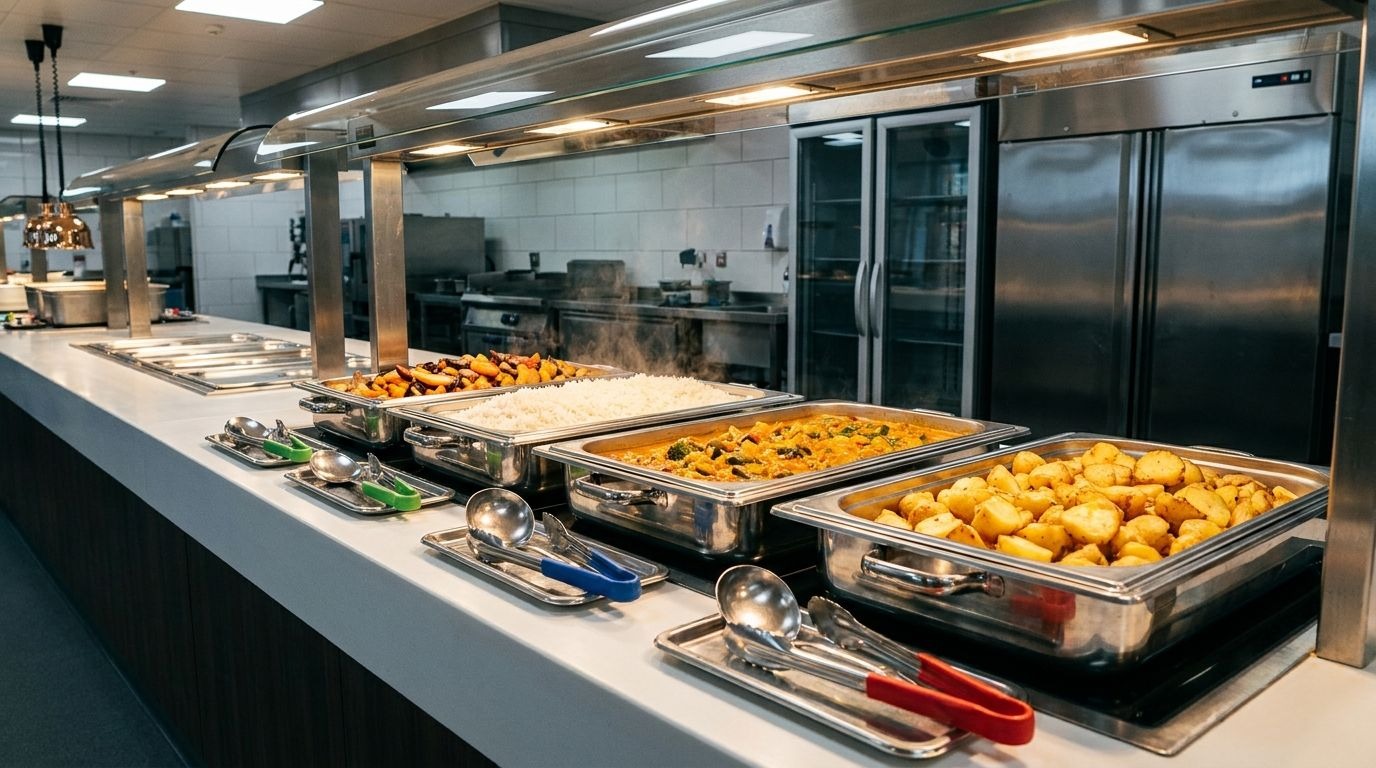
If you’re looking for catering spoodles UK buyers can rely on, understanding how these portion-control utensils work is the first step to improving consistency, reducing food waste and running a more efficient buffet service. Ask most kitchen teams what a spoodle is, and you’ll get a shrug, even from staff who use one every single service. It’s the unglamorous half-spoon, half-ladle sitting in every buffet tray and portion station in the country, and it does more for food cost control and consistency than almost any other single piece of kitchen equipment. This guide covers what spoodles actually are, the colour-coding system that makes portion control genuinely fast rather than guesswork, and what buffet and catering operations need beyond the spoodle itself. It sits alongside our Commercial Cutlery & Flatware buyer’s guide and our guide to how much cutlery a caterer actually needs, extended here specifically for buffet and serving equipment.
Quick Answer
A spoodle is a portion-control serving utensil combining the shape of a spoon with the accuracy of a ladle, typically colour-coded by size from 1oz to 8oz so kitchen staff can identify the correct portion size at a glance rather than reading a stamped capacity mark under service pressure. Caterers running any form of buffet, self-service or portioned plating need a small set of spoodles matched to their actual menu portions, alongside solid serving spoons for chunkier foods, ladles for liquids and sauces, and one dedicated serving piece per dish to prevent allergen cross-contact. Colour-coding isn’t just convenient; it’s a genuine tool for consistent portioning, reduced food waste and faster staff training.
What Is a Spoodle, and Why Do Caterers Use Them?
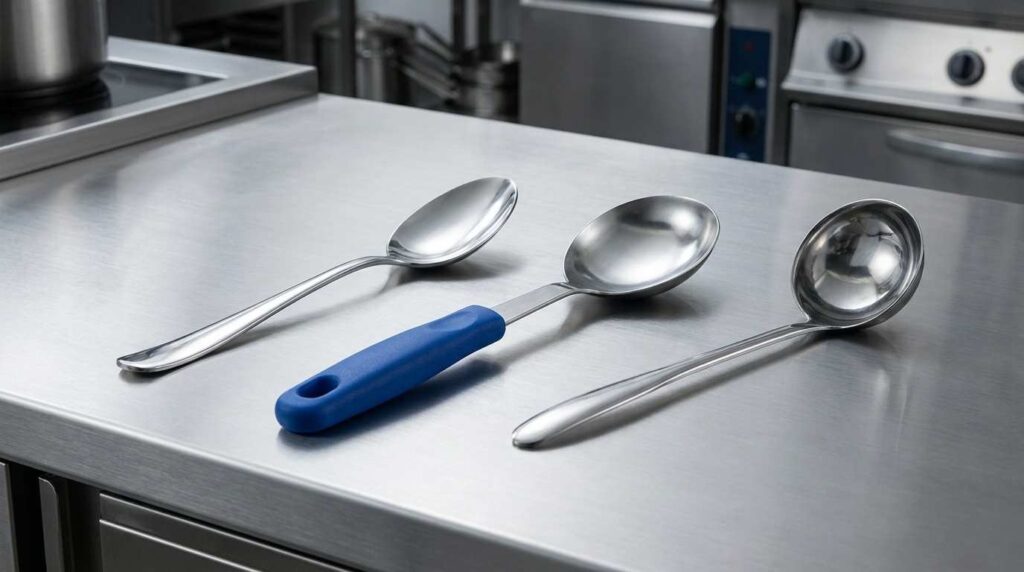
A spoodle sits deliberately between two familiar tools: it has the flatter, wider bowl of a serving spoon, but the fixed, known capacity of a ladle. The name itself is a blend of “spoon” and “ladle,” and the tool exists specifically to solve a problem neither a standard spoon nor a deep ladle handles well on its own, serving a consistent, known portion of solid or semi-solid food quickly, without weighing or measuring each serving individually.
This matters far more in commercial catering than it does at home, since consistency across dozens or hundreds of servings is genuinely part of the product being delivered. A guest served a noticeably smaller portion than the table next to them notices, and a kitchen serving wildly inconsistent portions is quietly losing money on every oversized serving while risking complaints on every undersized one. Our spoodles range, available in sizes from 2oz to 8oz, covers the core sizes most catering menus actually need.
The Colour-Coding System Explained
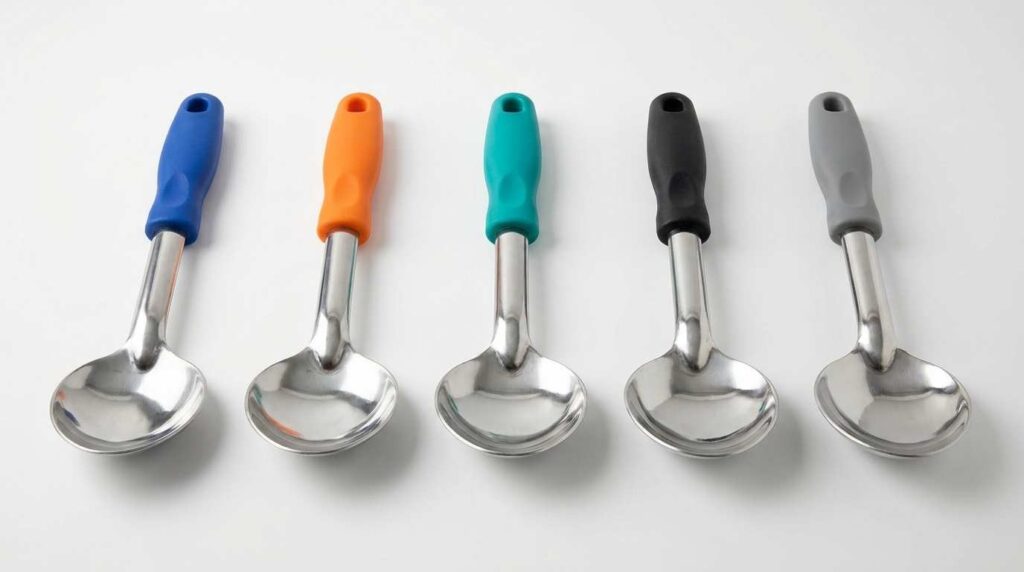
Colour-coded portion control utensils were popularised by Vollrath, a major US foodservice equipment manufacturer whose colour system has become a widely recognised convention across commercial kitchens, including in the UK trade. The underlying idea is simple and genuinely effective: rather than reading a small stamped ounce measurement on a handle mid-service, staff learn a colour and reach for the matching spoodle without breaking stride.
A commonly used version of the colour convention looks roughly like this, though it’s worth checking the specific manufacturer’s chart, since exact colour assignments can vary slightly between suppliers:
| Size | Commonly used handle colour |
| 1oz | Black or grey |
| 2oz | Blue |
| 4oz | Black or ivory, depending on manufacturer |
| 6oz | Teal |
| 8oz | Orange |
The specific colours matter less than the principle: pick one system, apply it consistently across your kitchen, and train every member of staff on it during onboarding rather than assuming it’s self-explanatory. A kitchen that mixes spoodles from several different manufacturers without checking whether their colour conventions actually match risks the opposite of the intended benefit: staff grabbing the wrong size confidently because the colour they associate with 4oz from one supplier means something different on another brand’s handle.
Solid vs Perforated Bowls
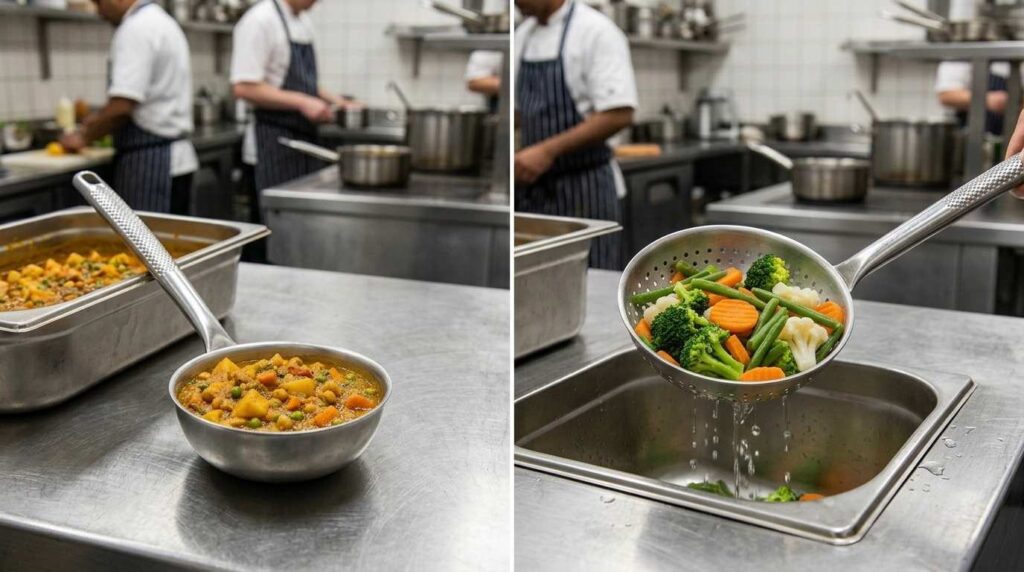
Spoodle bowls come in two basic styles, and choosing the right one for each dish matters as much as choosing the right size.
-
- ▸ Solid bowls hold the full contents without drainage, suited to dishes where you want to serve everything scooped, including any sauce or liquid, such as stews, curries or rice dishes served with their cooking liquid
-
- ▸ Perforated bowls allow liquid to drain away as the portion is served, suited to vegetables, pasta or any food where excess water, oil or sauce needs to be left behind rather than served alongside the solid portion
Stocking both styles in your core sizes gives kitchen staff the flexibility to match the tool to the dish rather than compromising with a single bowl style across every station. It’s worth thinking through your actual menu before ordering, since a buffet running mostly saucy, wet dishes needs proportionally more solid bowls, while one built around vegetables and drier sides needs more perforated stock.
Spoodles vs Serving Spoons vs Ladles
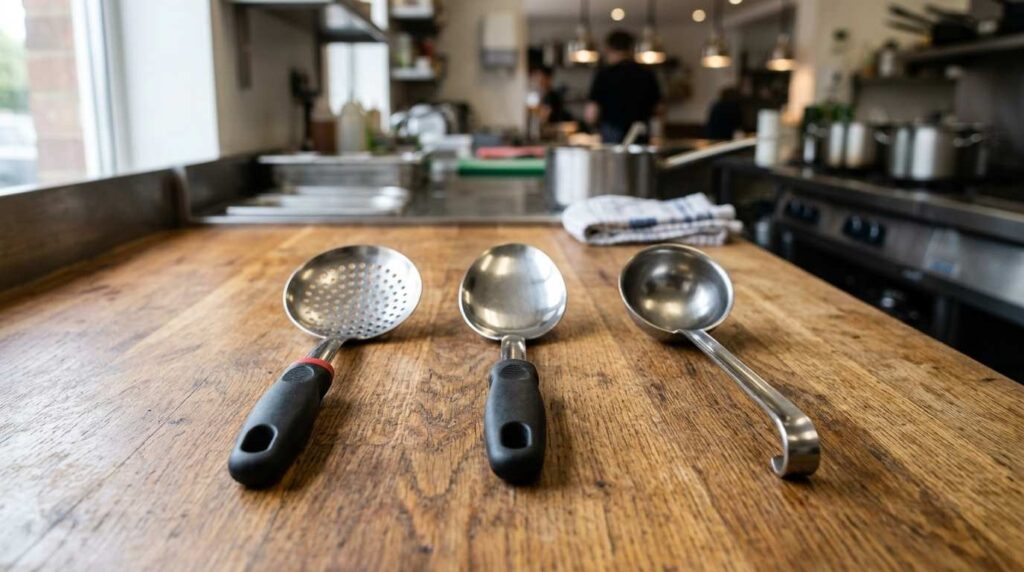
These three tools overlap in purpose but suit genuinely different serving situations, and a well-equipped buffet station needs more than one of them.
| Tool | Best suited to | Portion consistency |
| Spoodle | Solid or semi-solid foods needing a known, repeatable portion size | High, size is fixed by design |
| Standard serving spoon | Chunky or irregularly shaped foods (roast potatoes, whole vegetables) where a fixed-capacity bowl doesn’t scoop cleanly | Lower, relies on staff judgement |
| Ladle | Liquids, soups, sauces, gravies | High for liquid volume, though ladle capacities vary more between manufacturers than spoodle sizes typically do |
A genuinely well-equipped buffet or catering operation stocks all three, rather than trying to make one tool do every job. Standard serving spoons remain essential for foods that simply don’t scoop consistently in a fixed-capacity bowl, roast potatoes and whole green beans being classic examples, while spoodles handle anything that benefits from genuine portion consistency, and ladles cover liquid service specifically.
Portion Control and Food Cost: Why This Actually Matters

Portion control isn’t just an operational nicety; it’s directly tied to food cost management, and this is where spoodles earn their keep far beyond simple convenience.
-
- ▸ Over-portioning silently erodes margin on every serving, and without a fixed-capacity tool, staff naturally vary portion size based on how generous they’re feeling, how busy service is, or simply inconsistent scooping technique
-
- ▸ Under-portioning creates a different problem, risking guest complaints and repeat servings that cost more in goodwill and staff time than the food itself
-
- ▸ Consistent portioning supports accurate menu costing, since a dish costed against a specific portion size only holds that costing if the portion actually served matches it, service after service
-
- ▸ Colour-coded spoodles reduce staff training time, since a new starter can be shown “use the blue one for the rice” far faster than being trained to judge weight or volume by eye
For any operation running a buffet, self-service station or plated service with standard portion sizes, spoodles are one of the lowest-cost, highest-return pieces of kitchen equipment available, precisely because the saving compounds across every single serving for as long as the equipment is in use.
Handle Length and Material for Buffet Use
Buffet service has its own practical requirements that differ from standard kitchen prep tools.
-
- ▸ Longer handles, generally suited to deep chafing dishes and buffet containers, keep staff hands further from hot food and hot surfaces during busy service
-
- ▸ Heat-resistant handle materials, typically nylon or similar heat-resistant plastic rated to a specific temperature, matter directly for buffet use given how long a spoodle may sit in or near a heated chafing dish during a long service
-
- ▸ A built-in stopper notch, a small design feature on most quality spoodles, prevents the handle from sliding fully into the food container when left resting between uses, which both keeps the handle accessible and cleaner for the next member of staff to use
If your buffet setup uses chafing dishes to keep food at a safe serving temperature, it’s worth checking spoodle handle length against your specific dish depth, since a handle that’s too short leaves staff reaching uncomfortably close to a heated surface, while pairing correctly sized serving tools with your buffet risers and chafing setup makes for noticeably smoother service overall.
Allergen Safety: One Utensil per Dish
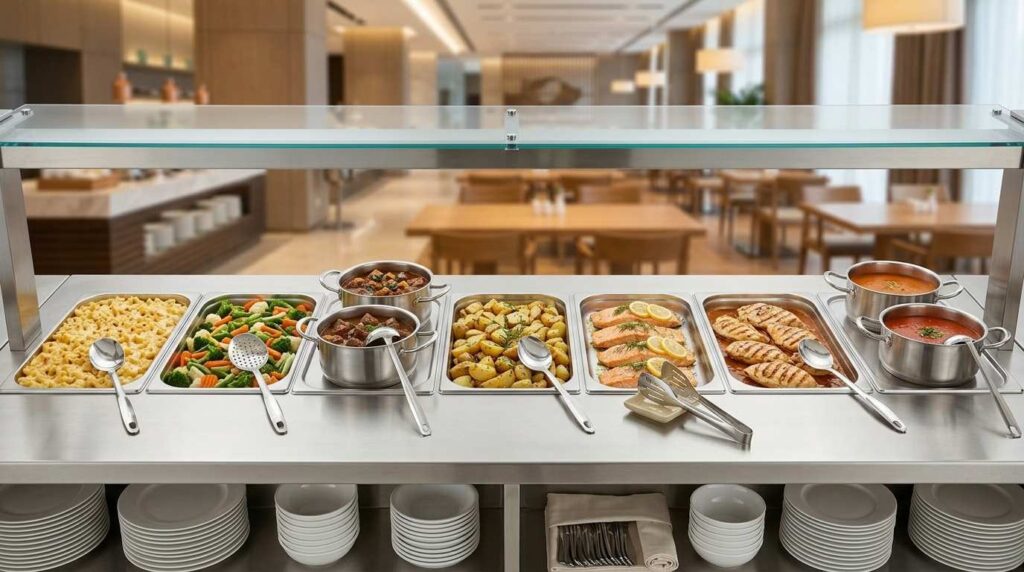
This is a genuine food safety point, not just good practice advice. Under UK food allergen law, caterers must be able to identify the 14 legally recognised allergens present in each dish, and this responsibility extends directly to how buffet and self-service food is handled, not just how it’s labelled. According to Food Standards Agency guidance, preventing cross-contact between allergens is a core part of managing allergen risk, and a shared serving spoon moved between an allergen-containing dish and an allergen-free one is a straightforward, entirely avoidable way for cross-contact to happen at a self-service buffet.
Practical steps this implies for buffet cutlery:
-
- ▸ Dedicate one serving utensil per dish, and don’t let staff or guests move a spoodle or serving spoon between different dishes, even briefly
-
- ▸ Colour-coding by portion size can be extended informally to also signal “this utensil stays with this dish” if that helps reinforce the practice among staff
-
- ▸ Clearly label dishes containing common allergens, particularly at self-service stations where guests are serving themselves without a staff member talking them through each dish
-
- ▸ Replace or wash a utensil immediately if it’s accidentally used in the wrong dish, rather than assuming a brief dip is harmless
Building a Buffet Cutlery Set: What You Actually Need
A genuinely complete buffet cutlery setup goes beyond spoodles alone. Here’s the fuller picture:
-
- ▸ Spoodles in your core portion sizes, matched to your actual menu rather than bought as a generic assortment
-
- ▸ Standard serving spoons and forks, for foods that don’t suit a fixed-capacity bowl
-
- ▸ Ladles, for soups, sauces and gravies
-
- ▸ Tongs, for bread, salad leaves and similar items best served without a spoon
-
- ▸ Cake and dessert servers, if your buffet extends to a dessert or cake table
-
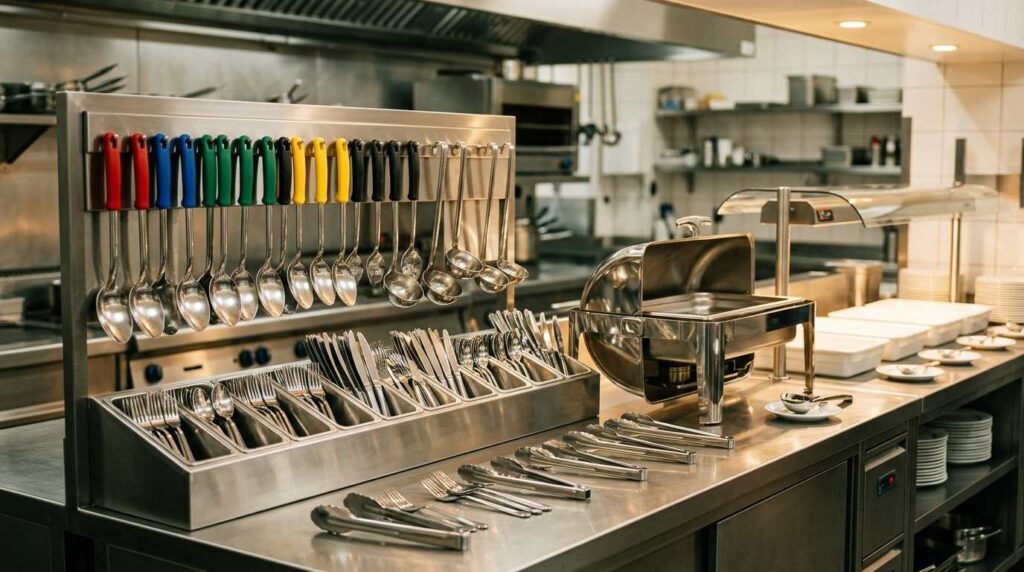
- ▸ Cutlery holders, to keep serving utensils sorted and accessible rather than mixed loosely at the buffet station, which both speeds up replenishment and keeps the station looking organised throughout service
Our cutlery holders range is worth considering specifically for buffet stations, since sorted, visible storage helps both staff replenishing dishes mid-service and guests looking for the right serving tool at a self-service spread.
Dishwasher Safety and Colour Retention
Most quality spoodles are fully dishwasher safe, but a few practical points affect how long the colour-coding itself stays clearly readable under repeated commercial washing:
-
- ▸ Nylon handles generally hold their colour better than cheaper painted or coated alternatives, which can fade or chip after repeated high-temperature commercial cycles
-
- ▸ Check the capacity stamp is embossed rather than printed, since an embossed measurement stays legible even if surface colour does fade over years of use, giving you a reliable fallback beyond the colour alone
-
- ▸ Hard water regions can accelerate surface wear on handles just as they affect standard cutlery finish, so rinse aid dosing matters here too, not just for forks and knives
How Many Spoodles and Serving Pieces Do You Need?
Unlike standard place-setting cutlery, spoodle and serving utensil quantity ties to your menu structure rather than your cover count, following the same logic covered in our cutlery stock calculation guide.
-
- ▸ One serving utensil per dish on the buffet, plus one spare of each size in reserve, since running out mid-service on a popular dish is a visible service failure
-
- ▸ A small spread of sizes covering your actual portion range; most catering menus need no more than three or four spoodle sizes to cover starters, mains and sides comfortably
-
- ▸ Extra stock for high-volume events, weddings, banqueting and large corporate events running multiple simultaneous buffet lines needs duplicate sets per line rather than sharing a single set across several serving points
Sector-Specific Considerations
Different catering sectors lean on spoodles and buffet cutlery differently, echoing the sector guidance in our pillar buyer’s guide.
-
- ▸ Schools and education catering benefit enormously from strict portion consistency, both for cost control across very high volume service and for nutritional standards where consistent serving sizes matter for menu compliance
-
- ▸ Care homes and healthcare catering need portion consistency for dietary and nutritional tracking, particularly where residents have specific calorie or portion requirements as part of their care plan
-
- ▸ Weddings and event catering typically need duplicate sets across multiple buffet lines and a slightly wider size range to cover more varied, occasion-specific menus
-
- ▸ Contract catering and staff restaurants benefit from the food cost control angle most directly, since portion consistency across a very high volume of daily servings compounds into a meaningful cost difference over a full year
Training Staff on Portion Control Equipment
Buying the right spoodles and serving cutlery only pays off if staff actually use the system consistently, and this is worth building into onboarding rather than assuming it’s self-explanatory.
-
- ▸ Show new staff the colour system on their first shift, rather than expecting them to work it out from the stamped measurement alone under service pressure
-
- ▸ Post a simple reference chart near the pass or buffet station, showing which colour matches which dish or portion size, particularly useful during a busy service when a quick visual check saves time
-
- ▸ Reinforce during quieter service periods, since portion discipline tends to slip first when a kitchen is under pressure, exactly when consistency matters most for both cost control and allergen safety
-
- ▸ Review portion consistency periodically, spot-checking that staff are actually using the correct spoodle size for each dish rather than assuming the system is working simply because the equipment is in place
-
- ▸ Involve kitchen management in menu changes, since a new dish added to the buffet needs a spoodle size assigned to it before service starts, not worked out ad hoc on the first night it’s served
A well-trained team using a consistent colour system turns portion control from a piece of equipment sitting in a drawer into a genuine operational habit, which is where the food cost and consistency benefits actually get realised rather than just theoretically available.
Common Mistakes
-
- ▸ Buying a generic assortment of spoodle sizes without checking them against actual menu portions, leaving some sizes unused and others constantly in short supply
-
- ▸ Mixing spoodles from multiple manufacturers with different colour conventions, undermining the entire point of the colour-coding system
-
- ▸ Using the same serving utensil across multiple dishes, creating a genuine allergen cross-contact risk at self-service buffets
-
- ▸ Choosing perforated bowls for saucy dishes, unintentionally draining away sauce guests expect to be served with their portion
-
- ▸ Under-stocking for large events, sharing a single buffet cutlery set across multiple simultaneous serving lines rather than duplicating stock
-
- ▸ Ignoring handle length against dish depth, leaving staff reaching uncomfortably into deep chafing dishes during service
FAQs
What is a spoodle used for?
A spoodle is a portion-control serving utensil combining a spoon-like bowl with a fixed, known capacity, used to serve consistent portions of solid or semi-solid food quickly and reliably in commercial kitchens and buffet service.
Why are spoodles colour-coded?
Colour-coding lets kitchen staff identify the correct portion size instantly during service, without needing to read a small stamped measurement on the handle, which speeds up service and reduces training time for new staff.
What’s the difference between a spoodle and a ladle?
A spoodle has a flatter, spoon-like bowl suited to solid or semi-solid foods, while a ladle has a deeper, rounder bowl suited specifically to liquids like soups, sauces and gravies.
Should I choose solid or perforated spoodle bowls?
Solid bowls suit dishes where you want to serve everything scooped, including any liquid or sauce. Perforated bowls suit foods where excess liquid should drain away before serving, such as vegetables or pasta.
Do I need a different serving utensil for every dish on a buffet?
Yes, for allergen safety. UK food allergen guidance requires caterers to prevent cross-contact between allergens, and using a shared utensil across multiple dishes is a straightforward, avoidable way for this to happen.
How many spoodles does a caterer need?
Enough to cover one dedicated utensil per dish on the buffet, plus a spare of each size, with most menus needing no more than three or four sizes to cover starters, mains and sides.
Are spoodles dishwasher safe?
Yes, most quality spoodles with nylon handles are fully dishwasher safe. Checking that the capacity measurement is embossed rather than just printed helps keep it legible even after the surface colour eventually fades with repeated commercial washing.
Choosing the Right Spoodles & Buffet Cutlery
Spoodles and buffet cutlery rarely get the attention that grade, pattern and place-setting cutlery do, but they carry a genuine, measurable effect on food cost, service speed and allergen safety that’s easy to underestimate. Match your spoodle sizes to your actual menu, keep the colour system consistent across your whole kitchen, dedicate one serving utensil per dish for allergen safety, and stock enough spares that a busy service never runs short on a popular dish.
For the wider cutlery picture beyond buffet and serving equipment, see our Commercial Cutlery & Flatware buyer’s guide, or browse our full Spoodles range to build a set matched to your menu.
References
-
- ▸ Food Standards Agency, Allergen guidance for food businesses
-
- ▸ Vollrath Foodservice, Portion control utensils and colour-coding system


