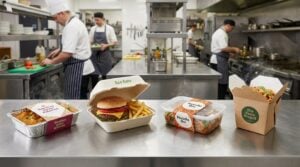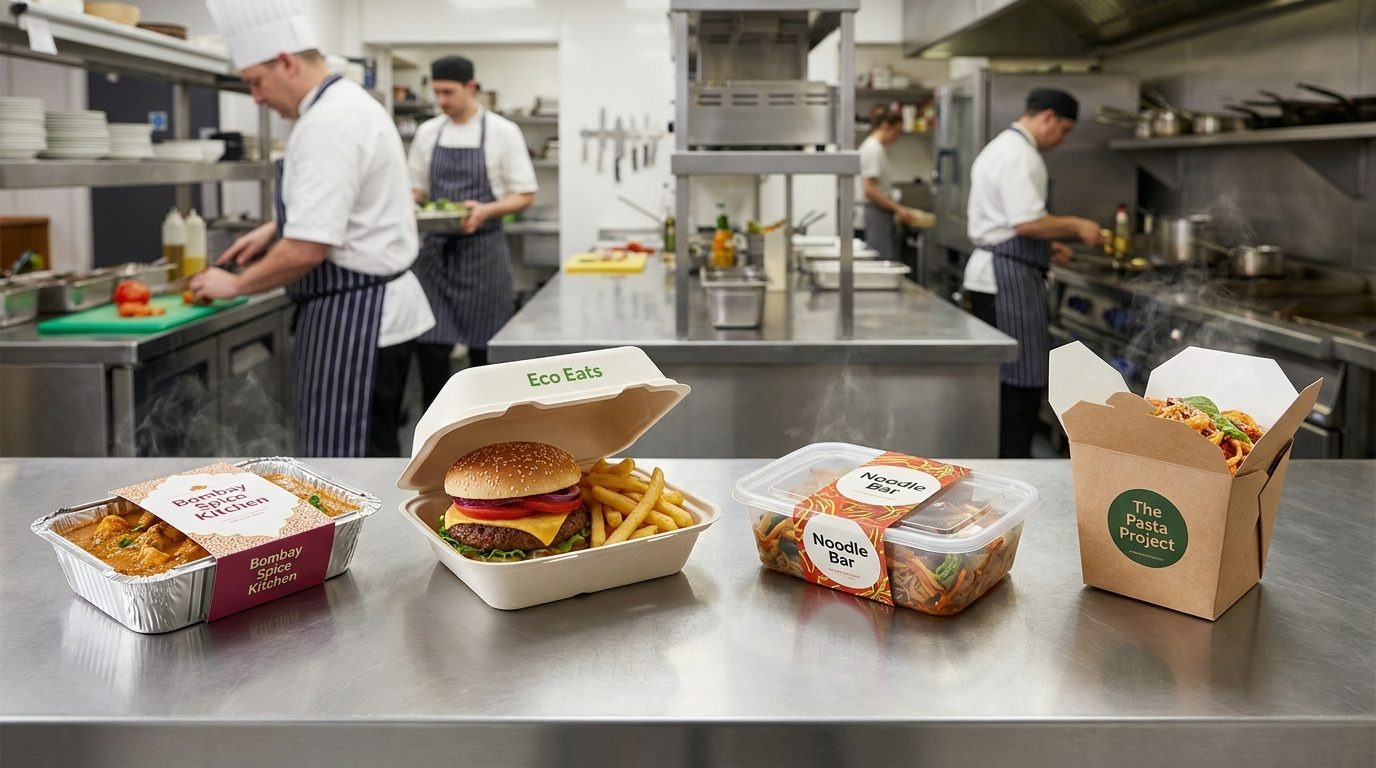
Every UK takeaway operator knows the scenario. The food leaves the kitchen perfect. It arrives soggy, cold, or scattered. The one-star review mentions “terrible packaging,” and the rating drops. Reorders from that customer stop.
Bad packaging is not an aesthetic problem. It is a revenue problem that compounds every week you do not fix it.
This guide covers the actual science of why hot food quality degrades in a delivery container, what a 35-minute delivery window does to different materials at different temperatures, how to match your container to your food type, what bad packaging is costing you in platform ratings, and a self-audit protocol you can run this week with five dishes and a timer.
Quick Decision Guide: Container by Food Type
| Food Type | Best Container for Delivery | Key Reason |
| Curry/thick sauce | Foil container with a card lid | Best heat retention; liquid-proof card lid |
| Rice/noodles/ pasta | PP microwaveable snap-lid container | Microwave-safe; secure seal; no steam build-up issue |
| Fried chicken/chips | Vented bagasse clamshell | Steam must escape; sealed container = soggy food |
| Burger | Burger clamshell box | Holds shape; minimal ventilation for bun integrity |
| Soup/broth | Round PP snap-lid container | A circular seal handles liquid movement in transit |
| Salad / cold food | Kraft or rPET container with separate dressing pot | Cold performance; dressing separately prevents sogginess |
| Multi-component meal | 3-compartment bagasse clamshell | Keeps wet and dry components physically separated |
| Pizza | Corrugated pizza box | Structural integrity; vented; no alternative performs comparably |
The Steam Science: Why Hot Food Loses Quality in a Delivery Container
Understanding why hot food degrades in a container is the foundation of choosing the right packaging. Most operators skip this and jump straight to “which container should I buy?” That ordering mistake leads to the wrong purchase.
What Steam Actually Does Inside a Sealed Container
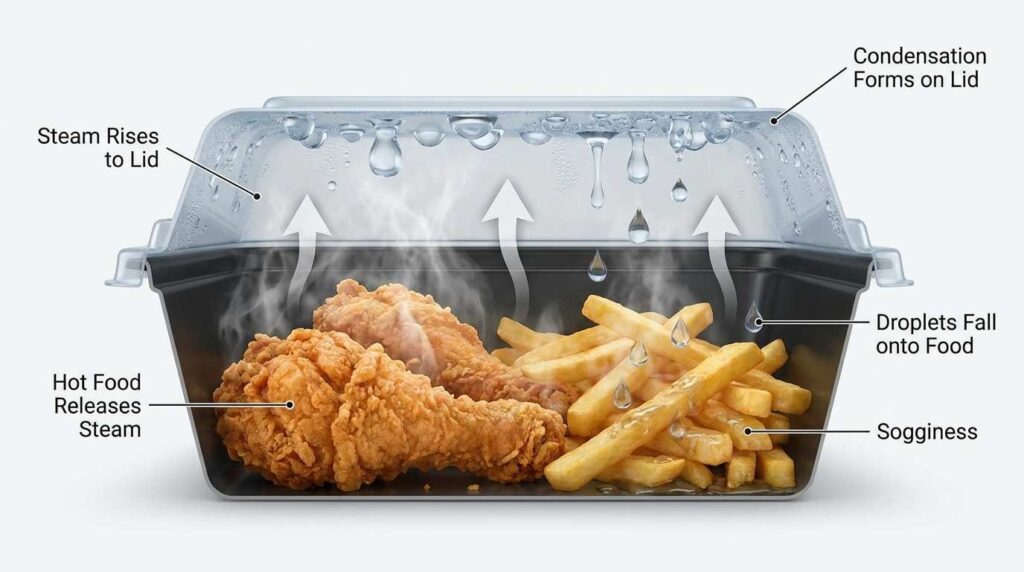
When hot food is placed inside a sealed container, it continues releasing steam as it cools. That steam has nowhere to go. It rises, hits the cooler inner surface of the lid, and condenses back into water droplets. Those droplets fall back onto the food.
This process, evaporation, condensation, and re-deposition, is the primary mechanism behind soggy delivery food. It is not caused by the container being wet. It is caused by the container trapping the food’s own moisture and cycling it back as liquid water onto the surface of the food.
For fried and battered food, this process is catastrophic. The crispy outer coating of fried chicken, chips, or battered fish is a dehydrated starch layer. Once liquid water is deposited on it, the starch rehydrates, and the crispness is gone within minutes. A fried chicken portion in a fully sealed container will be noticeably softer within 10 to 15 minutes of packing, regardless of how hot it is.
For rice, noodles, and pasta, the effect is different but still negative. Steam condensation on the lid drips back into the food, causing clumping and waterlogging of the top layer of rice or pasta. The food looks and tastes as though it has been overcooked.
For curries and sauces, the steam condensation effect is less damaging because the food is already liquid. The primary quality degradation for liquid-rich dishes is temperature loss, not moisture cycling.
The Two Failure Modes
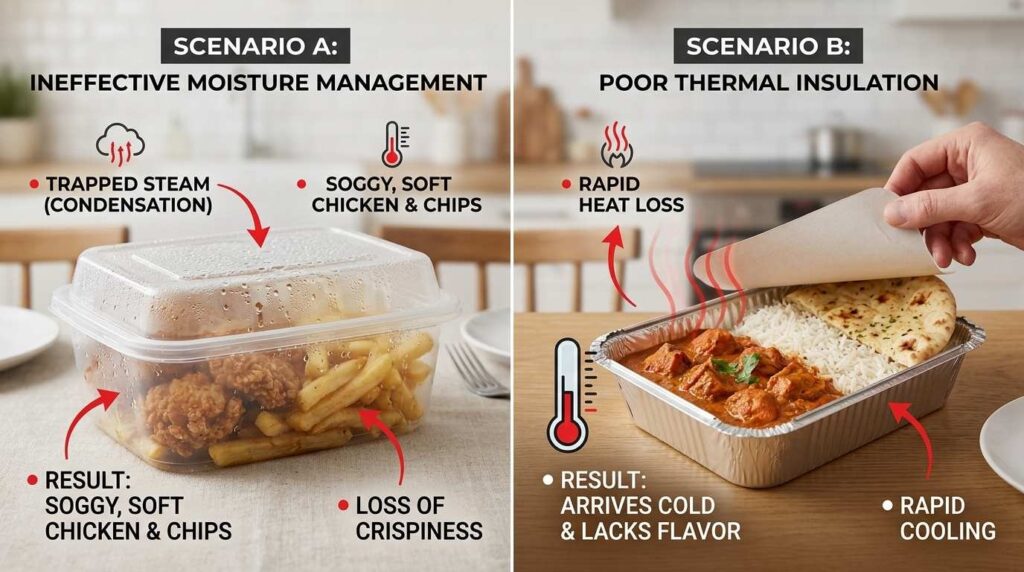
Every delivery packaging problem falls into one of two categories:
Failure Mode 1: Too much moisture (sealed containers with hot dry food).
Cause: Steam cannot escape, condenses, and re-deposits as liquid onto fried or dry food. Solution: A vented or semi-open container that allows steam to escape.
Failure Mode 2: Too little heat retention (open or poorly insulated containers with liquid food).
Cause: Heat escapes faster than the delivery window allows, and curry or soup arrives below a palatable temperature. Solution: A sealed, insulating container, foil or double-walled PP, that retains heat across the delivery journey.
Key takeaway: The two failure modes require opposite packaging solutions. A container that fixes soggy chips makes cold curry worse. A container that keeps curry hot makes fried chicken soggy. Matching the container to the specific failure mode of your food type is the entire discipline of delivery packaging done correctly.
What a 35-Minute UK Delivery Window Does to Your Food
The Indian manufacturer Pakka has published technical content on delivery packaging that cites real temperature drop data. No UK-focused content has ever translated this into a UK delivery context. Here it is.
A typical UK Deliveroo or Just Eat delivery window from kitchen to customer door runs approximately 20 to 45 minutes, depending on platform, distance, and restaurant preparation time. For planning purposes, 35 minutes is a reasonable mid-range assumption for a UK urban delivery.
Temperature Drop by Material Over 35 Minutes (No Insulated Bag)
Based on typical thermal performance data for commercial packaging materials at ambient UK temperatures (approximately 15 to 20 degrees Celsius outdoors):
| Container Material | Food Packed At | Approx. Temp After 35 Minutes | Key Variable |
| Aluminium foil with a card lid | 75°C | 64 to 68°C | Best heat retention of all formats |
| Bagasse clamshell | 75°C | 62 to 66°C | Natural fibre insulation is better than PP |
| PP snap-lid container | 75°C | 58 to 63°C | Thin walls; faster heat loss |
| Kraft paper container | 75°C | 57 to 62°C | Similar to PP, paper has low thermal mass |
These are approximate ranges based on material thermal conductivity and industry-level packaging testing data. Actual temperatures will vary with ambient conditions, food type, container volume, and whether an insulated bag is used.
What These Numbers Mean in Practice
UK food safety guidance from the Food Standards Agency advises food businesses to follow appropriate temperature control measures during transport and service. Businesses should consult current FSA guidance for their specific operations.
From a quality perspective, independent of regulatory minimums, food that arrives below approximately 60 degrees Celsius is noticeably less palatable for most hot dishes. A curry arriving at 65 degrees is noticeably better than one arriving at 55 degrees, even if both are technically within safety parameters.
For standard 35-minute UK delivery windows, foil containers in an insulated bag provide the most reliable combination for maintaining temperature at the customer’s door.
The Platform Delivery Time Variable
Deliveroo, Just Eat, and Uber Eats all have variable delivery windows depending on driver availability and distance. A restaurant that consistently receives orders during peak Friday evening demand will experience longer actual delivery windows than the platform’s estimated time suggests.
Build your packaging decision around the upper end of your realistic delivery window, not the average. If your delivery radius generates 45-minute deliveries on busy nights, test your containers at 45 minutes, not 25.
Container Materials and Heat Retention: The Technical Comparison
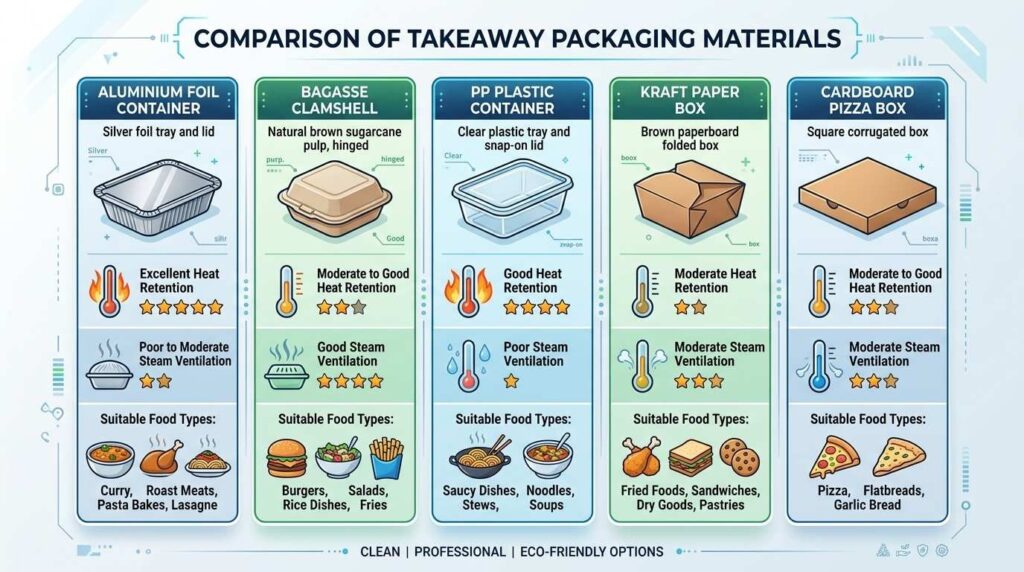
| Material | Insulation Mechanism | Heat Retention | Steam Ventilation | Best Food Types |
| Aluminium foil | Reflects radiant heat; the card lid provides an insulation layer | Best | None (sealed) | Curry, rice, hot liquid dishes |
| Bagasse (sugarcane fibre) | Natural fibre provides thermal mass | Good | Micro-ventilation through fibre structure | Fried food, mixed dishes, burgers |
| PP plastic (thin wall) | Minimal | Moderate | None (sealed) | Rice, pasta, noodles, cold food |
| Kraft paper | Minimal | Moderate | Partial (paper breathes slightly) | Dry dishes, sandwiches, light meals |
| Corrugated cardboard | Air pockets in corrugation provide insulation | Good | Partial | Pizza, baked goods |
Why Foil Wins for Liquid Dishes
Aluminium reflects radiant heat toward the food rather than allowing it to conduct through the container wall. This is the same principle used in survival blankets and oven liners. For a curry or stew at 75 degrees Celsius in a foil container, the food’s own radiant energy is partially reflected back onto itself rather than lost through the container wall. No other common commercial packaging material replicates this mechanism.
Our No 2 aluminium foil containers with card lids are the standard format for UK curry and hot sauce delivery. The card lid provides an additional insulation layer that a bare foil lid does not. Available in bulk to 2,000 units with card lids included.
Why Bagasse Works for Fried Food
Bagasse’s natural micro-ventilation, tiny gaps in the sugarcane fibre structure, allows steam to escape gradually rather than building up and condensing. It is not fully vented like a punched-hole container, but it releases enough steam to prevent the rapid moisture cycling that causes sogginess in sealed formats. Combined with its moderate insulation from the fibre thermal mass, it outperforms PP for fried food delivery.
Our biodegradable sugarcane clamshell takeaway box, 7×5 inches, is fully compostable, handles food up to 120 degrees Celsius, and requires no separate lid.
Matching Container to Food Type for Quality Delivery
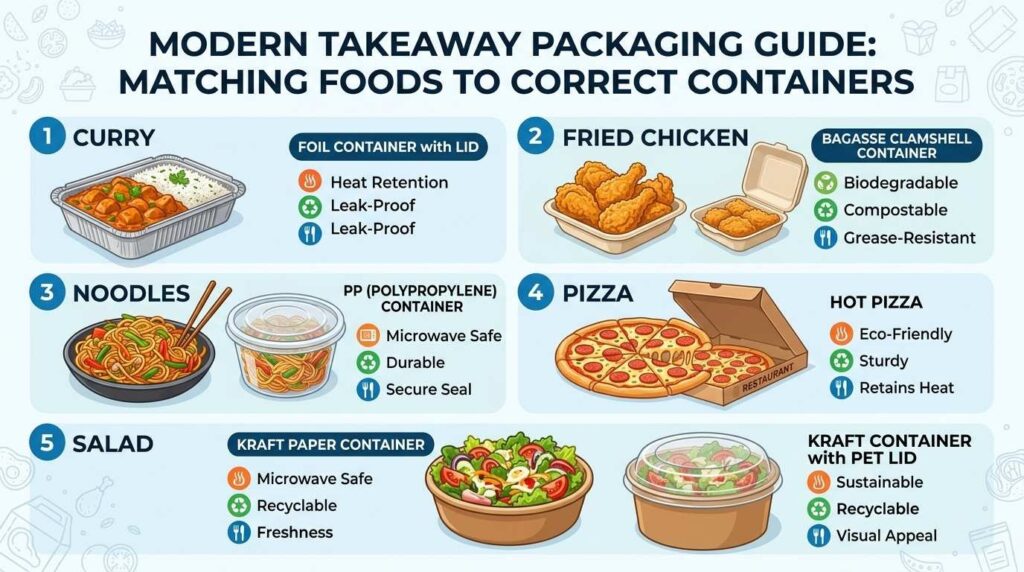
Fried and Battered Food: Solve the Steam Problem First
For fish and chips, fried chicken, onion rings, and all battered products, the steam condensation problem is the dominant quality issue. Temperature loss is secondary because the customer eats this food quickly.
What to use: A vented clamshell or a bagasse container. Do not use a sealed PP container. Do not use a fully airtight foil container. Both trap steam and destroy the texture of fried food within 15 minutes.
If you are currently using a sealed plastic container for fried food and receiving complaints about a soggy texture, this is the direct cause. Switching to a bagasse clamshell is the single most impactful packaging change available for this food category.
Curry and Liquid-Rich Dishes: Solve the Heat Retention Problem First
For curry, stew, gravy-based dishes, and soups, the steam condensation problem is irrelevant; the food is already liquid. The dominant quality issue is heat loss over the delivery window.
What to use: Foil container with a card lid, sealed. The foil reflects radiant heat. The card lid provides an insulation layer. The sealed format prevents convective heat loss through the lid gap.
For larger portions, our No 9 aluminium foil containers suit family-sized curry portions at 22.8 cm x 22.8 cm.
Rice, Noodles, and Pasta: Balance Both Problems
Rice and noodle dishes face both problems in partial form. Some steam condensation causes clumping. Some heat loss makes them unpalatable on arrival. The correct container is a PP snap-lid format that holds heat better than kraft or open formats while providing a secure enough seal to prevent the worst condensation effects.
The customer microwave benefit of PP is an additional advantage; the customer can reheat directly in the container if needed.
Our 650ml microwaveable PP containers and 750ml formats cover standard portion sizes for rice and noodle dishes.
Multi-Component Meals: Separation Is the Priority
For meals with a wet main and a dry side, or with a sauce that should not contact the main until the customer opens the container, physical separation is more important than either steam management or heat retention.
What to use: A multi-compartment container. Our 3-compartment 9×9-inch bagasse clamshell physically separates components across the delivery journey, is microwave-safe, and is fully compostable.
The Delivery Bag: The Variable Most Operators Ignore
The container determines the starting conditions. The delivery bag determines how much heat those conditions change across the journey.
An insulated delivery bag keeps food approximately 10 to 15 degrees Celsius warmer over a 35-minute journey compared to a non-insulated bag. For a curry packed at 75 degrees Celsius, the difference between arriving at 65 degrees and arriving at 52 degrees is the difference between a satisfied customer and a complaint.
Most UK delivery platforms provide branded insulated bags to restaurant partners. If your platform has provided an insulated bag, use it for every order. If you are supplying your own bags, invest in a proper insulated thermal delivery bag rather than a standard carrier bag.
The combination of the right container and an insulated delivery bag is the complete hot food delivery system. Neither element alone is sufficient for the upper end of typical UK delivery windows.
What Bad Packaging Is Costing You on Deliveroo and Just Eat
This is the framing that makes packaging feel urgent rather than optional. Most UK independent takeaway owners track their star rating obsessively. Few have calculated what a rating change is actually worth in revenue terms.
How Platform Ratings Affect Order Volume
On Deliveroo and Just Eat, restaurants with ratings below 4.0 stars receive lower algorithmic visibility in search results and category listings. The platforms’ own data suggests that moving from 3.5 stars to 4.2 stars can increase order volume by 20 to 40% on equivalent days, depending on market and cuisine category.
For a restaurant doing £5,000 per week in delivery revenue, a 25% volume improvement from a rating increase represents approximately £1,250 per week, over £65,000 per year.
Packaging Reviews Are Disproportionately Visible
A review that mentions “soggy chips,” “cold curry,” “leaking container,” or “missing sauce” is more descriptively memorable than a generic negative review. These reviews stay visible in the platform profile, affect future customer decisions, and are harder to address through responses because the physical product failure is documented.
The Three Packaging Fixes That Improve Platform Ratings Fastest
Based on consistent patterns across UK delivery operator feedback:
Fix 1: Switch fried food to vented containers.
Soggy texture complaints are almost entirely container-related and almost entirely preventable. This is the fastest rating-improvement intervention available.
Fix 2: Add portion pots for all sauces and dressings.
Missing or leaking sauce is the second most common packaging complaint on UK delivery platforms. A 2oz hinged pot costs approximately £0.01 to £0.02. The cost of a one-star review is not calculable in unit terms.
Fix 3: Add a tamper-evident seal.
Customers who suspect their food has been tampered with in transit leave negative reviews. A tamper-evident seal label on the bag eliminates this concern entirely at a cost of approximately £0.01 per order.
Key takeaway: The packaging spend that moves your rating from 3.8 to 4.3 stars on a delivery platform is not a cost. It is an investment with a measurable revenue return that typically exceeds the packaging cost increase by a significant multiple.
The 35-Minute Self-Audit: Pack Your Top 5 Dishes and Assess
This is the most practically useful section in this guide, and it is completely absent from every competitor page. You can run it this week with no equipment beyond a timer and the containers you currently use.
The Protocol
Step 1: Select your top 5 dishes by order volume.
These are the dishes most likely to generate packaging-related reviews. For most UK takeaways, this will be a curry, a rice dish, a fried item, a burger or wrap, and a cold dish.
Step 2: Pack each dish exactly as you would for a delivery order.
Use your actual containers, your actual portions, and your actual packing process. Do not pack differently because it is a test.
Step 3: Place each packed dish in a delivery bag as you would for dispatch.
Use the same bag you use for real orders. If you use an insulated bag, use it. If you do not, note that for the assessment.
Step 4: Wait exactly 35 minutes.
Do not open the containers early. Set a timer and wait.
Step 5: Open each container and assess against these criteria:
| Assessment Criteria | What You Are Looking For |
| Temperature | Is it still hot enough to eat comfortably? |
| Texture (fried food) | Is the crust still crisp or has it softened? |
| Texture (rice/pasta) | Is it clumped, waterlogged, or separated? |
| Liquid containment (curries, soups) | Has any liquid leaked around the lid? |
| Presentation | Does it look appetising when opened? |
| Component separation | Are wet and dry components still separate? |
Step 6: Write down the results for each dish.
Be honest. If the fried chicken is soft, it is soft. If the curry is cold, it is cold.
Step 7: For any dish that failed the assessment, identify the specific failure mode.
Is it a steam condensation problem (switch to a vented container)? Is it a heat retention problem (switch to foil or add an insulated bag)? Is it a liquid leak problem (switch container or add portion pot for sauce)?
Step 8: Order the correct alternative container, run the same test, and compare.
Most container changes can be tested within a week of ordering samples.
Key takeaway: The 35-minute self-audit tells you exactly which dishes are arriving in poor condition and exactly which failure mode is causing it. It takes 40 minutes to run and generates more useful packaging information than any amount of reading competitor guides or supplier catalogues.
Tamper-Evident Seals and Platform Requirements
All three major UK delivery platforms, Deliveroo, Just Eat, and Uber Eats, recommend tamper-evident seals on delivery packaging. The recommendation has moved increasingly toward an expectation as customer trust in food delivery has become a platform-level concern.
A tamper-evident seal is a sticker label that bridges the bag opening or container lid. Once broken, it cannot be resealed without visible damage. The seal communicates to the customer that the food has not been interfered with in transit.
For packaging hot food for delivery, a tamper-evident label on the bag is the standard approach. Apply it across the folded top of the SOS bag after packing. A plain kraft or branded label applied consistently signals professionalism and reduces the category of complaints related to food trust.
Where to Buy Hot Food Packaging for UK Delivery
We Can Source It supplies commercial hot food packaging across all the container formats recommended in this guide, with bulk pricing available from 25 units and 3 to 5 working days for standard delivery.
Key products for hot food delivery:
- ▸ No 2 aluminium foil containers with card lids, for curry, thick sauces, and heat-sensitive liquid dishes
- ▸ No 9 aluminium foil containers, for larger portions and family-size dishes
- ▸ Biodegradable sugarcane clamshell, 7×5 inch, for fried and battered food; natural micro-ventilation prevents sogginess
- ▸ 650ml microwaveable PP containers, for rice, noodles, and pasta dishes
- ▸ 750ml PP containers, for larger rice and noodle portions
- ▸ 3-compartment 9×9-inch bagasse clamshell, for multi-component meals
- ▸ Full takeaway supplies range, complete range with bulk pricing
For the full context of takeaway packaging selection across all categories, see our complete UK takeaway supplies buying guide.
FAQs
Why does hot food go soggy in delivery containers?
Soggy delivery food is caused by steam condensation cycling. Hot food releases steam inside a sealed container. The steam hits the cooler lid surface, condenses back into liquid water, and drips back onto the food. For fried and battered food, this liquid re-deposits onto the crispy starch coating and destroys it. The solution is a vented or micro-ventilated container that allows steam to escape rather than cycling it back onto the food.
What is the best container for keeping curry hot during delivery?
Aluminium foil containers with card lids provide the best heat retention for curry delivery. Aluminium reflects radiant heat back toward the food rather than allowing it to conduct through the container wall. The card lid provides an additional insulation layer. For standard UK delivery windows of 20 to 45 minutes, foil containers in an insulated bag maintain temperature more effectively than any other common commercial format.
How long can hot food stay hot in a delivery container?
Temperature retention depends on the container material, the food type, ambient temperature, and whether an insulated delivery bag is used. Approximate guidance based on typical material performance: foil containers in an insulated bag maintain food above 63 degrees Celsius for approximately 40 to 50 minutes in standard UK ambient conditions. PP containers without an insulated bag may drop below this level within 25 to 35 minutes. These are indicative ranges; actual performance varies with specific products and conditions.
Does the delivery bag matter as much as the container?
Yes. An insulated delivery bag paired with any commercial container maintains food approximately 10 to 15 degrees Celsius warmer over a 35-minute delivery window compared to a non-insulated bag with the same container. The container and the delivery bag work together as a system. Investing in one without the other leaves a significant gap in delivery quality management.
How do I know if my current packaging is causing bad delivery reviews?
Run the 35-minute self-audit described in Section 7 of this guide. Pack your top 5 dishes exactly as you would for delivery, leave them for 35 minutes in a delivery bag, then open and assess temperature, texture, containment, and presentation. The results will tell you precisely which dishes are arriving in poor condition and which failure mode is responsible.
What packaging do Deliveroo and Just Eat recommend?
Both platforms recommend tamper-evident seals on all delivery orders. Both platforms also have sustainability guidelines that favour recyclable and compostable packaging over single-use plastic. Beyond these points, the specific container choice is determined by food type and operator preference. Neither platform mandates a specific container format.
Is bagasse good for hot food delivery?
Yes, particularly for fried and battered food. Bagasse’s natural micro-ventilation allows steam to escape gradually, preventing the moisture cycling that causes sogginess in sealed containers. It is also oven-safe up to approximately 120 degrees Celsius, microwave-safe, and fully compostable. For liquid-rich dishes where heat retention is the priority, foil containers outperform bagasse.
References
- ▸ Food Standards Agency: Temperature control guidance — https://www.food.gov.uk/business-guidance/chilling-food-correctly-in-your-business
- ▸ Food Standards Agency: Food delivery guidance for businesses — https://www.food.gov.uk/business-guidance/food-safety-for-food-delivery
- ▸ DEFRA: Single-use plastics regulations 2023 — https://www.gov.uk/guidance/single-use-plastics-bans-and-restrictions