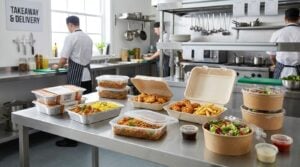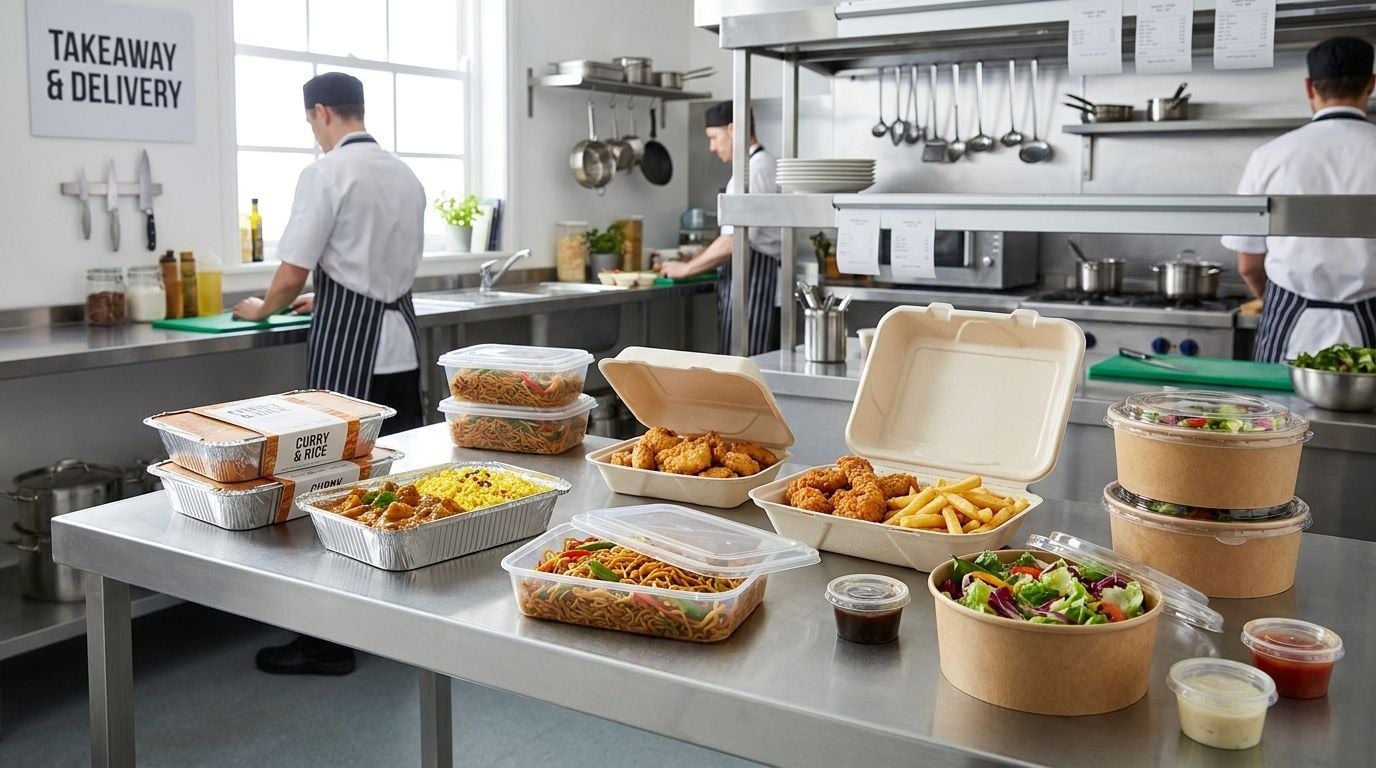
Every search for takeaway food containers leads to the same results: BBC Good Food testing Sistema boxes, Which? Shaking water in an OXO container, home storage reviews written for people organising their fridges. None of that is useful if you are a takeaway business owner choosing commercial packaging for dishes that need to survive a 30 to 45-minute delivery journey and land on a customer’s doorstep without having leaked, collapsed, or turned the food into a soggy mess.
Finding the best food containers for takeaways requires more than comparing prices. The right container must match the food type, retain heat during delivery, prevent leaks, and meet customer expectations for convenience and sustainability.
This guide is written specifically for UK food businesses. It covers the material differences that matter for commercial use, which containers are genuinely microwave-safe at the temperatures customers encounter, how leak performance maps to the food types that actually cause leaks, how containers perform on heat retention over a delivery window, and a direct pick for each cuisine type.
Quick Recommendation (If You Don’t Want to Read Everything)
| Food Type | Best Container |
| Curry / liquid-rich dishes | No 2 aluminium foil container with a card lid |
| Rice, noodles, pasta | 650ml–1,000ml PP snap-lid container |
| Fried chicken / battered food | Bagasse clamshell 7×5 |
| Multi-component meal | 3-compartment bagasse clamshell 9×9 |
| Soup/broth | 8oz or 12oz round PP with snap lid |
| Salad / cold food | Kraft round container with clear lid |
Commercial vs Home Storage Containers: Why the Distinction Matters
Home storage containers and commercial takeaway containers are not the same product category. Buying the wrong type for a food business creates operational problems that affect every order you send out.
| Feature | Home Storage Container | Commercial Takeaway Container |
| Design purpose | Store leftovers in the fridge, reheat when needed | Pack freshly cooked hot food, transport 20 to 45 minutes, customer reheats if needed |
| Temperature at point of use | Cold or ambient at packing | Hot at packing, typically 60 to 85 degrees Celsius |
| Lid mechanism | Clip lock or screw top for an airtight seal | Snap lid or hinged lid for fast packing under service pressure |
| Reuse expectation | Many uses over months or years | Single use or limited commercial reuse |
| Material standard | BPA-free food-safe plastic | Food-contact compliant, tested for hot-fill performance |
| Cost basis | Per unit, packs of 5 to 20 | Per unit at volume, cases of 25 to 5,000 |
The most common mistake new takeaway businesses make is ordering containers from Amazon or a general retailer designed for home food storage. These are not tested for hot-fill performance, do not perform consistently under the heat of freshly cooked food, and are priced for retail sale rather than commercial bulk purchasing.
For commercial food businesses, the correct product category is single-use or commercial-grade disposable food containers specified for takeaway and delivery use. Polypropylene microwaveable takeaway containers are among the most popular formats for hot food delivery because they combine microwave convenience with secure snap-lid sealing. Browse our 650ml microwaveable PP containers to see current trade pricing.
Key takeaway: The container that keeps your leftovers fresh for three days in the fridge is not necessarily the right container for packing a hot curry for a 40-minute delivery journey. Commercial and domestic containers serve different purposes and are not interchangeable.
Microwave-Safe Materials: What the Labels Actually Mean for Takeaway Use
Competitors tick “microwave safe: yes” as a product feature without explaining what that means in practice for a food business owner. Here is what the material science actually says, and why the specific product rating always takes precedence over the general material rule.
Polypropylene (PP)
PP is the most widely used material for commercial microwaveable takeaway containers. It is BPA-free, food-safe, and tolerates microwave reheating as standard.
Temperature ratings vary by product. Our 500ml PP containers, 650ml, 750ml, and 1,000ml formats are rated to 80 degrees Celsius as stated in their product specifications. PP as a material can tolerate higher temperatures in other formulations, but always follow the manufacturer’s stated temperature rating for the specific product you are purchasing rather than relying on a general material assumption.
One thing to communicate to customers: when microwaving PP containers, the lid should be slightly loosened or vented to allow steam to escape. A fully sealed container in a microwave builds pressure that can pop the lid.
Aluminium Foil
Aluminium containers are the best choice for heat retention during delivery and are oven-safe for reheating. They cannot be used in a microwave because metal reflects microwave energy. Customers reheating food from an aluminium container must transfer it to a microwave-safe dish or use the oven.
For curry houses, Indian and Middle Eastern takeaways, and any operation where customers are more likely to reheat in an oven, aluminium is the superior container material. For operations where customer microwave convenience is the primary expectation, PP is the better fit. Browse our No 2 aluminium foil containers with card lids for the standard single-portion curry format.
Bagasse (Sugarcane Fibre)
Bagasse containers are microwave-safe and oven-safe up to approximately 120 degrees Celsius. The natural sugarcane fibre structure does not release harmful chemicals under microwave heat. For solid and semi-solid food, bagasse performs reliably in the microwave. For very liquid dishes, extended microwave use can cause the base edges to absorb moisture gradually.
Kraft Paper (Coated vs Uncoated)
Kraft paper containers with an aqueous (water-based) coating are microwave-safe. Uncoated kraft is also microwave-safe but absorbs moisture from food over time. Kraft containers with a PE (polyethene) lining are microwave-safe but not recyclable, a trade-off worth confirming before ordering if recyclability matters to your customers.
CPET (Crystalline Polyethene Terephthalate)
CPET containers, the dark or black trays commonly used in ready meals, are oven-safe up to approximately 220 degrees Celsius. Some CPET formats are microwave-safe, but suitability varies by manufacturer and must always be confirmed per product. Always check the specific product’s manufacturer rating before advising customers, as microwave suitability varies between CPET products. CPET is most commonly used for cook-from-chilled and ready meal formats rather than standard hot takeaway delivery.
Material Microwave Compatibility Summary
| Material | Microwave Safe? | Oven Safe? | Notes |
| Polypropylene (PP) | Yes | No | Check the product-specific temperature rating |
| Aluminium foil | No | Yes | Transfer to a microwave-safe dish for microwave reheating |
| Bagasse | Yes | Yes, to approx. 120°C | Best for solid and semi-solid food |
| Kraft paper (coated) | Yes | Limited | Check lining type; PE lining affects recyclability |
| CPET (black plastic) | Check product spec | Yes, to approx. 220°C | Many formats dual oven and microwave; confirm per product |
| Crystal polystyrene | No | No | Neither microwave nor oven safe |
Key takeaway: The material type gives you a starting point, but the product-specific manufacturer rating is what governs safe use. Always confirm temperature ratings on the specific product listing before advising customers or making operational decisions.
Leak-Proof Performance by Food Type
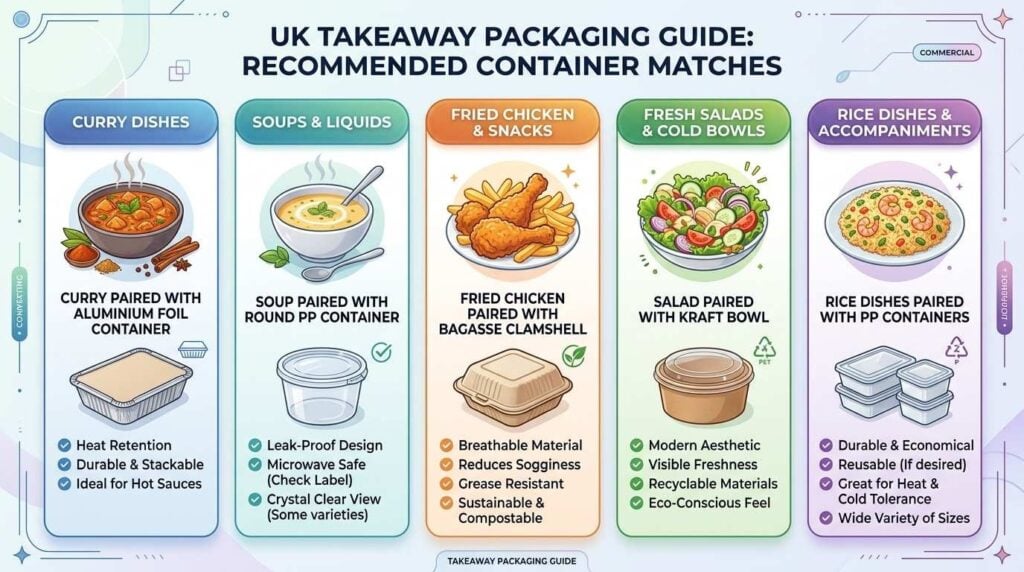
The relevant leak test for a takeaway business is not shaking water in a container. It is whether a dish survives a delivery driver’s insulated bag for 35 minutes with a thin curry sauce, a noodle broth, or a dressed salad.
The leak risk varies substantially by food type. Here is how to match the container to the dish.
Thin Sauces and Broths: The Highest Leak Risk
Thin Asian sauces, soups, ramen broth, and low-viscosity curry sauce find the smallest gap in a lid seal and exploit it under delivery movement. These are the most demanding applications for any takeaway container.
What fails: Snap lids with uneven seating, containers with warped bases from hot-fill, and clamshell boxes not rated for liquid food.
What works: PP rectangular containers with a positive snap-lock lid that seats evenly around the entire perimeter. Our 650ml PP containers and 750ml formats have BPA-free snap-on lids that create an airtight seal. For soups specifically, a round container with a deeper profile performs better than a shallow rectangular format because the liquid-to-air ratio is higher and circular movement distributes lid stress more evenly.
Thick Sauces and Curries: Medium Leak Risk
Thick curries, stews, and paste-consistency sauces are less prone to leaking than thin broths, but still require a properly sealed container. The primary failure mode is the lid unseating during delivery.
What works: PP containers with snap lids, or aluminium foil containers with fitted card lids pressed firmly at packing. The No 2 aluminium foil containers with card lids perform reliably for thick curry service because the card lid sits flush and is pressed down at packing.
Fried and Oily Food: Low Leak Risk, High Sogginess Risk
Fried chicken, chips, fish, and battered food do not present a liquid leak risk. The challenge is steam condensation causing sogginess inside a sealed container. A PP snap-lid container will make fried food soft and limp within 15 minutes of packing.
What works: Vented clamshell containers or paper-based formats that allow steam to escape. Our biodegradable clamshell takeaway box 7×5 inch, provides natural micro-ventilation through its bagasse fibre structure, preventing steam build-up while maintaining food temperature.
Multi-Component Meals: Compartment Separation
For meals with a wet main and a dry side, rice with curry sauce, salad with dressing, and a main with a separate accompaniment, the biggest performance issue is cross-contamination between components during delivery.
What works: Multi-compartment containers that physically separate components. Our 3-compartment 9×9 inch bagasse clamshell food box keeps wet and dry components separated across a full delivery journey, is microwave-safe, and is fully compostable.
Snap Lid vs Clip Lid vs Hinged Lid vs Card Lid
| Lid Type | Leak Performance | Pack Speed | Best For |
| Snap-on lid (PP) | Good for medium to thick food | Fast, one-handed | Standard hot food delivery |
| Hinged clamshell lid | Good for solid and semi-solid food | Very fast, no separate lid | Fried food, burgers, solid meals |
| Card lid (foil container) | Good for thick sauces and curries | Moderate, requires pressing flat | Curry, rice, hot meal portions |
| Clip lock lid | Best for thin soups and broths | Slower, requires two-handed operation | Soups, broths, liquid dishes |
Key takeaway: Match the lid mechanism to the viscosity of the food. A container that prevents leaks for a thick curry is not the same as the one that keeps fried food crisp, which is not the same as the one that contains a thin ramen broth across a 40-minute journey.
Heat Retention Over a Delivery Window
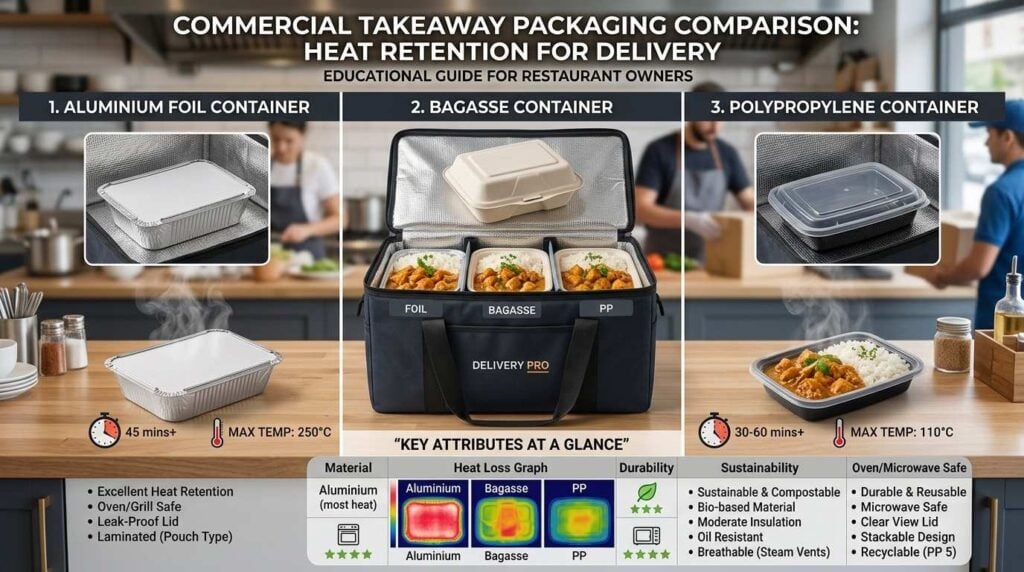
The relevant performance window for a takeaway container is the delivery journey: typically 20 to 45 minutes from packing to the customer’s door.
UK food safety guidance from the Food Standards Agency advises businesses to keep hot food at safe temperatures during transport and service. Businesses should follow current FSA guidance on temperature control for their specific operations and delivery model. The container alone is rarely sufficient to maintain safe temperatures across a long delivery window; the delivery bag is equally critical.
Heat Retention by Material
| Material | Heat Retention Performance | Notes |
| Aluminium foil with a card lid | Best | Foil reflects radiant heat; the card lid adds an insulation layer |
| Bagasse | Good | Natural fibre provides moderate insulation |
| PP plastic with snap lid | Moderate | Thin walls; an insulated bag increases performance significantly |
| Kraft paper | Moderate | Similar to PP; best paired with an insulated delivery bag |
The Practical Guidance
For hot food delivery, an insulated delivery bag paired with any of the above containers maintains food temperature better than an uninsulated bag with the best foil container. For short-distance delivery under 20 minutes, the container material is less critical, and PP or bagasse formats are perfectly adequate. For longer delivery windows or operations on platforms with variable delivery times, aluminium foil containers in an insulated bag provide the most reliable heat retention performance.
Key takeaway: No container keeps food indefinitely hot on its own. The container material and the insulated bag work together. For longer delivery journeys, prioritise foil containers and always use an insulated bag.
Container Picks by Cuisine and Food Type
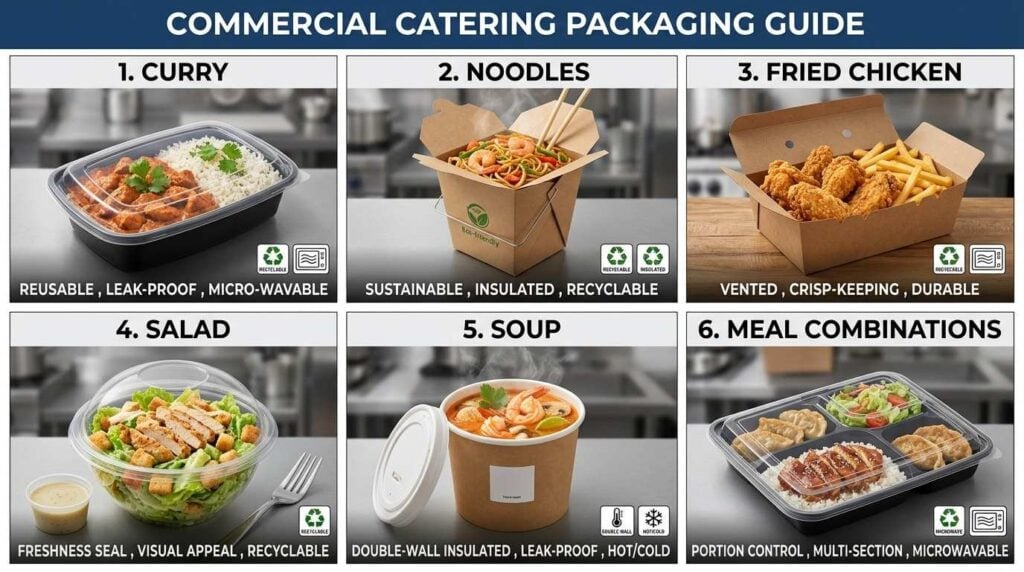
Best for Curry and Liquid-Rich Dishes
No 2 aluminium foil containers with card lids
Best heat retention of all formats. The card lid fits flush and resists leaks. Oven-safe for customer reheating. Fully recyclable. Available in bulk to 2,000 units. For larger portions, the No 9 aluminium foil container at 22.8cm x 22.8cm x 5.2cm handles full meal portions.
Best for Rice, Noodles, and Pasta
650ml PP microwaveable container with snap lid
Microwave-safe to the product’s rated specification for direct customer reheating. Snap-on lid creates a secure seal. BPA-free PP construction. Clear for delivery accuracy checks. Stackable for kitchen organisation. Also available in 750ml and 1,000ml for larger portions.
Best for Fried Chicken and Battered Food
Biodegradable clamshell box 7×5 inch
Natural micro-ventilation prevents steam build-up. Grease-proof and cut-proof. Handles food at up to 120 degrees Celsius without deformation. Fully compostable. No separate lid to lose at service.
Best for Multi-Component Meals
3-compartment 9×9 inch bagasse clamshell food box
Three compartments physically separate wet and dry components. Microwave and freezer safe. Fully compostable. The hinged lid seals the entire meal in one unit.
Best for Soups and Broths
8oz round PP microwave container or 12oz format
Round containers with airtight snap-close lids perform better than rectangular formats for liquid dishes because the circular shape distributes movement stress evenly around the lid seal.
Best for Salads and Cold Food
Kraft disposable round container with clear lid
Clear lid provides visibility of contents. Kerbside recyclable when rinsed. Cold food does not stress the container with heat or steam, making a lightweight kraft format entirely adequate.
Container Quick Reference
| Food Type | Recommended Container | Key Feature |
| Curry / thick sauce | No 2 aluminium foil with a card lid | Heat retention, oven-safe |
| Rice/noodles/pasta | 650ml to 1,000ml PP snap-lid | Microwave-safe, secure seal |
| Fried chicken / battered food | Bagasse clamshell 7×5 | Ventilation, grease-proof |
| Multi-component meal | 3-compartment bagasse clamshell 9×9 | Separation, microwave-safe |
| Soup/broth | 8oz or 12oz round PP with snap lid | Circular seal for liquids |
| Salad / cold food | Kraft round container with clear lid | Recyclable, cold performance |
| Sides and sauces | 2oz to 6oz portion pots | Prevents sogginess by separating wet and dry |
Compostable vs Recyclable: The Sustainability Decision for 2026
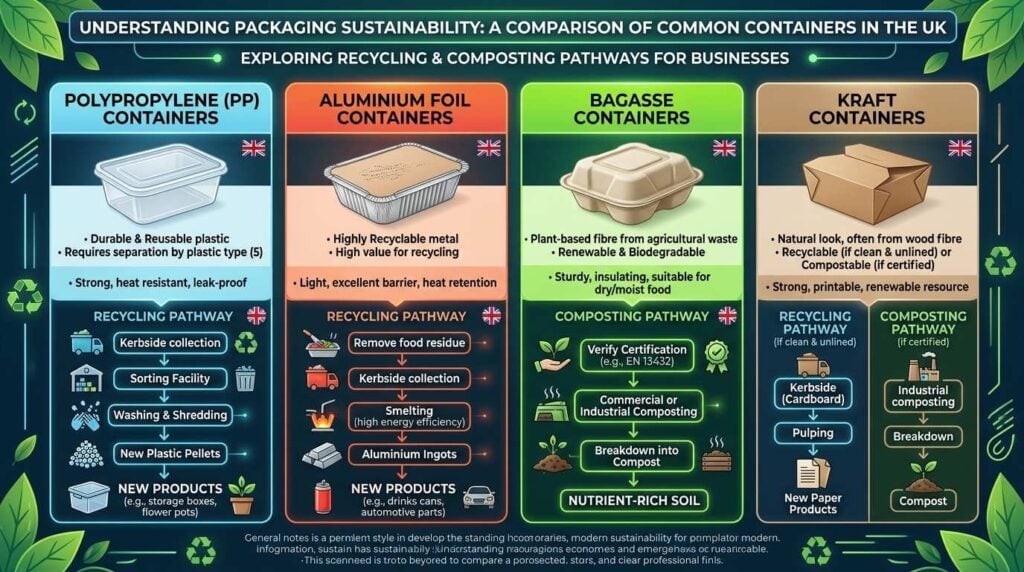
Eco-packaging is no longer a differentiator for UK takeaways; it is an increasingly standard customer expectation. But the sustainability claims around packaging materials vary significantly in what they actually mean at the end of life.
| Material | Kerbside Recyclable? | Compostable? | Notes |
| Polypropylene (PP) | Yes, if clean and rinsed | No | Widely accepted in the UK kerbside recycling |
| Aluminium foil containers | Yes, if rinsed | No | One of the most recycled materials in the UK |
| Bagasse | Sometimes (council-dependent) | Yes, industrially and some home composting | EN13432-certified formats confirm compostability |
| Kraft paper (uncoated) | Yes | Yes, if uncoated | PE-lined kraft is not recyclable |
| Kraft paper (PE-lined) | No | No | Lining contaminates both recycling and composting streams |
| Crystal polystyrene | No | No | General waste only |
| PLA (compostable plastic) | No | Yes, industrial only | Not home compostable; not kerbside recyclable |
What to Tell Your Customers
If you use PP containers: They can go in the household recycling if rinsed clean. Do not claim they are eco-friendly; they are recyclable plastic.
If you use aluminium foil containers: Recyclable and one of the most recycled materials in the UK. Customers should rinse before recycling.
If you use bagasse: Certified compostable. EN13432-certified formats can go to industrial composting facilities. Some councils accept certified compostable packaging in food waste collections; customers can check their local authority. Do not describe non-certified bagasse as compostable.
If you use kraft (uncoated): Recyclable and compostable. The most straightforward end-of-life story available for takeaway containers.
Key takeaway: Recyclable and compostable are not the same thing. Recyclable means the material can re-enter a production stream. Compostable means it breaks down into organic matter. Some materials are both, some are neither. Use accurate language with customers and avoid vague terms like eco-friendly or biodegradable without specifying what that means in practice.
How Many Containers Should Your Takeaway Keep in Stock?
This is a commercial search that most packaging guides never answer. Here is a practical stock guide by business size.
The Formula
Weekly stock requirement = Daily orders x containers per order x 7 days x 1.2 buffer factor.
The 1.2 buffer accounts for over-ordering on busy days, dropped or damaged containers, and the time lag between placing a reorder and receiving delivery.
Stock Guide by Operation Size
| Operation Size | Weekly Orders | Containers Per Order | Weekly Requirement | Recommended Stock Level |
| Small (new or part-time) | Up to 100 orders | 2 to 3 containers | 200 to 300 per week | 4 to 6-week supply: 800 to 1,800 units |
| Medium (established local takeaway) | 100 to 500 orders | 2 to 4 containers | 400 to 2,000 per week | 4-week supply: 1,600 to 8,000 units |
| Large (high-volume or multi-platform) | 500 or more orders | 3 to 5 containers | 1,500 or more per week | 3 to 4-week supply: 4,500 units or more |
Practical Notes
Order 4 to 6 weeks of stock at a time for smaller operations. This balances the per-unit pricing benefit of bulk ordering against the cash flow and storage cost of holding large stock.
Order 3 to 4 weeks for larger operations where storage space is limited or where menu changes are frequent, and you do not want large quantities of a specific format becoming redundant.
Always maintain a safety stock level, the amount of stock you would need to keep trading for one week if your supplier experienced a delivery delay. For most UK suppliers, standard lead times are 3 to 5 working days. A one-week safety stock covers most scenarios.
Review and adjust quarterly. Takeaway order volumes are seasonal in most UK markets. Summer outdoor dining affects delivery volumes; the Christmas trading period spikes orders. Build these patterns into your stock planning after your first full year of trading.
UK Pricing by Material and Quantity
| Container Type | 50 Units | 250 Units | 1,000 Units | Per Unit at 1,000 |
| No 2 aluminium foil with lid | £4 to £6 | £14 to £20 | £22 to £35 | £0.02 to £0.04 |
| 650ml PP snap-lid | £2 to £4 | £8 to £14 | £14 to £22 | £0.01 to £0.02 |
| Bagasse clamshell 7×5 | £4 to £7 | £16 to £26 | £30 to £50 | £0.03 to £0.05 |
| 3-compartment bagasse 9×9 | £6 to £10 | £22 to £36 | £40 to £65 | £0.04 to £0.07 |
| 8oz round PP microwave | £2 to £3 | £6 to £10 | £10 to £16 | £0.01 to £0.02 |
| Kraft round container | £3 to £5 | £10 to £18 | £18 to £30 | £0.02 to £0.03 |
All prices are indicative of UK trade pricing in 2026 and vary by supplier and specification. Browse our full takeaway supplies range and meal and food containers category for current pricing across all formats, with bulk pricing available on all lines.
For the full context of takeaway packaging across all supply categories, see our complete UK takeaway supplies buying guide. For guidance specifically on packaging hot food for delivery without losing quality, see our dedicated guide to hot food packaging for UK delivery.
FAQs
What is the best food container for takeaway delivery in the UK?
There is no single best container; the correct choice depends on the food type. For curry and liquid-rich dishes, aluminium foil containers with card lids provide the best heat retention and leak performance. For rice, noodles, and pasta, PP microwaveable containers with snap lids offer the best balance of microwave convenience and secure sealing. For fried food, a vented bagasse clamshell prevents sogginess. Match the container to the food type.
Are plastic food containers microwave-safe for takeaway use?
Polypropylene (PP) plastic containers are microwave-safe. Always check the product-specific temperature rating for the exact container you purchase, as ratings vary between products. Our PP container range is rated to 80 degrees Celsius as stated in the product specifications. Aluminium foil containers are not microwave-safe. CPET containers vary; many are rated for both oven and microwave use; check the manufacturer’s specification. Crystal polystyrene is neither microwave nor oven safe.
Which takeaway containers are best for preventing leaks?
For thin soups and broths, round PP containers with snap-close lids perform best because the circular seal distributes pressure evenly. For thick curries, PP rectangular snap-lid containers or aluminium foil containers with pressed card lids both perform reliably. For fried food, the challenge is preventing sogginess rather than liquid leaks; vented clamshell containers are the correct format.
How should hot food containers be managed during delivery for food safety?
UK food businesses should follow current Food Standards Agency guidance on temperature control during food transport and service. Insulated delivery bags are an important part of maintaining food at appropriate temperatures during delivery, working alongside the container choice rather than relying on the container alone.
Are bagasse food containers microwave-safe?
Yes. Bagasse containers tolerate microwave use and are oven-safe up to approximately 120 degrees Celsius. They are simultaneously compostable, microwave-safe, and suitable for packing hot food at service temperatures, making them one of the most versatile formats available for eco-conscious takeaway businesses.
Are CPET containers microwave-safe?
It depends on the specific product. Many CPET formats are rated for both oven and microwave use. Others are oven-only. Always check the manufacturer’s specification for the specific CPET product before advising customers. CPET is most commonly used for ready meals and cook-from-chilled formats rather than standard hot takeaway delivery.
What is the difference between recyclable and compostable packaging?
Recyclable packaging can be processed back into a usable material through a recycling stream; PP and aluminium are examples. Compostable packaging breaks down into organic matter under composting conditions; bagasse and uncoated kraft are examples. These are not interchangeable. Some materials are both recyclable and compostable; some are neither. For customer communication, use accurate, specific claims rather than general terms like eco-friendly or biodegradable without evidence.
How many containers should a small takeaway keep in stock?
A small takeaway handling up to 100 orders per week with 2 to 3 containers per order needs approximately 200 to 300 containers per week. Order a 4 to 6-week supply on each bulk order, typically 800 to 1,800 units, to balance per-unit pricing with storage practicality. Always maintain a one-week safety stock above your normal working level to cover supplier delivery delays.
References