If you run a pub, bar, café, or restaurant in England, it is essential to understand exactly where the law stands on straws and stirrers. Not just a rough idea, but the precise details.
The rules treat plastic straws and plastic stirrers differently. Many hospitality operators do not realise this distinction exists. That gap in understanding is where Trading Standards compliance failures most often happen.
This article explains the current UK single-use plastics law for bars and pubs, including:
-
- ▸ What is banned outright
-
- ▸ What is restricted with conditions
-
- ▸ How to choose paper straws that hold up in commercial use
The Two Laws That Apply to UK Bars and Pubs
Environmental Protection (Plastic Plates etc. and Polystyrene Containers etc.) (England) Regulations 2023
-
- ▸ Came into force on 1 October 2023
- ▸ Covers plastic plates, bowls, trays, cutlery, balloon sticks, and polystyrene food and drink containers
-
- Together, these regulations define what bars, pubs, and other catering establishments can and cannot supply to customers.
Important: The October 2023 ban applies even to items made from biodegradable, compostable, or recycled plastic. If it contains plastic, it is in scope. Material environmental credentials do not create an exemption.
Plastic Stirrers: Fully Banned with No Exceptions
This is the clearest part of the law, yet it is often ignored in practice.
Key points:
-
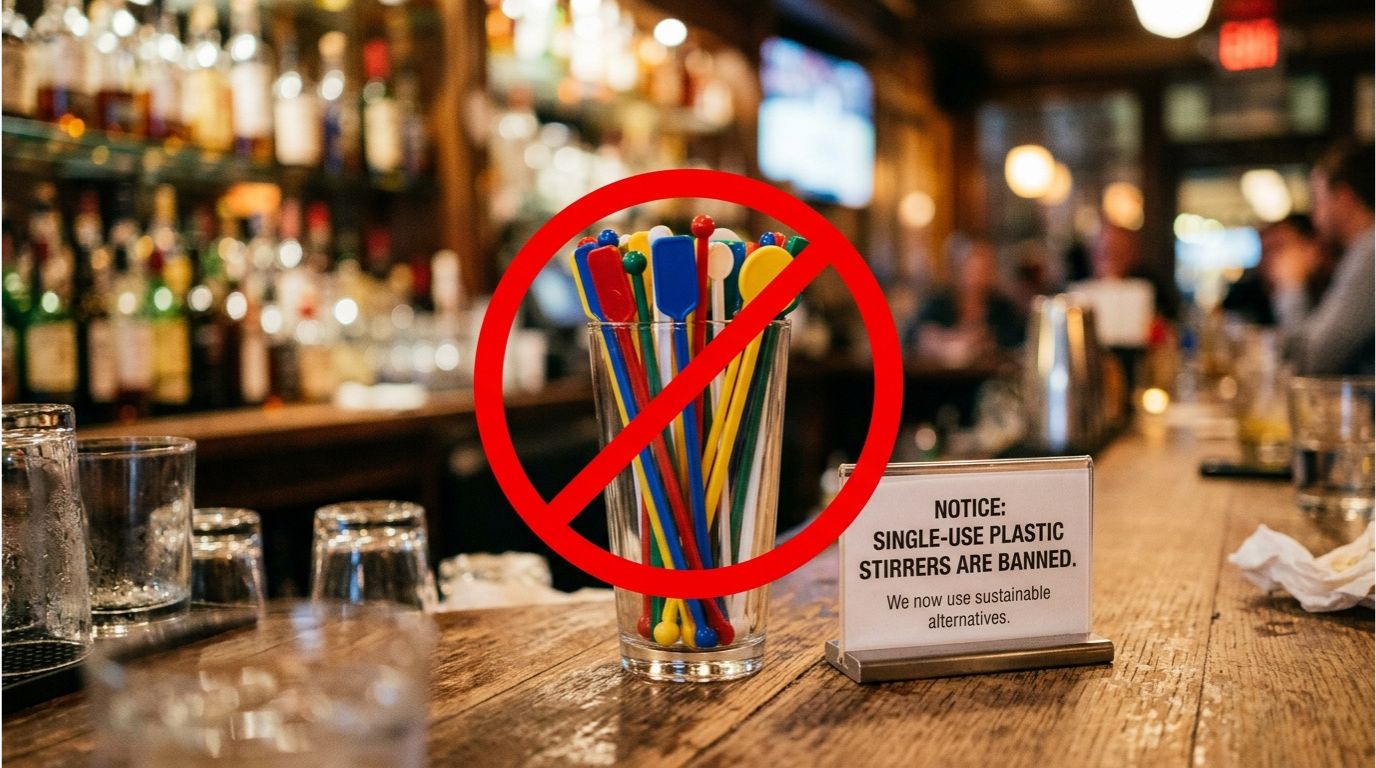
- ▸ Plastic drink stirrers are completely banned
-
- ▸ No exemptions exist for catering establishments, medical needs, or customer requests
If you supply a drink to a customer with a plastic stirrer, you are breaking the regulations.
The ban applies regardless of:
-
- ▸ Whether a customer asked for it
-
- ▸ Whether you have old stock from before the ban
-
- ▸ Whether the stirrer is biodegradable or compostable
-
- ▸ Whether it is called a “garnish pick” instead of a stirrer
The ban covers supply to end users, including providing them free as part of a drink service.
Compliant alternatives include:
-
- ▸ Wooden stirrers
-
- ▸ Paper stirrers
-
- ▸ Reusable metal bar spoons
Plastic Straws vs Paper Straws: The Restricted Category Explained
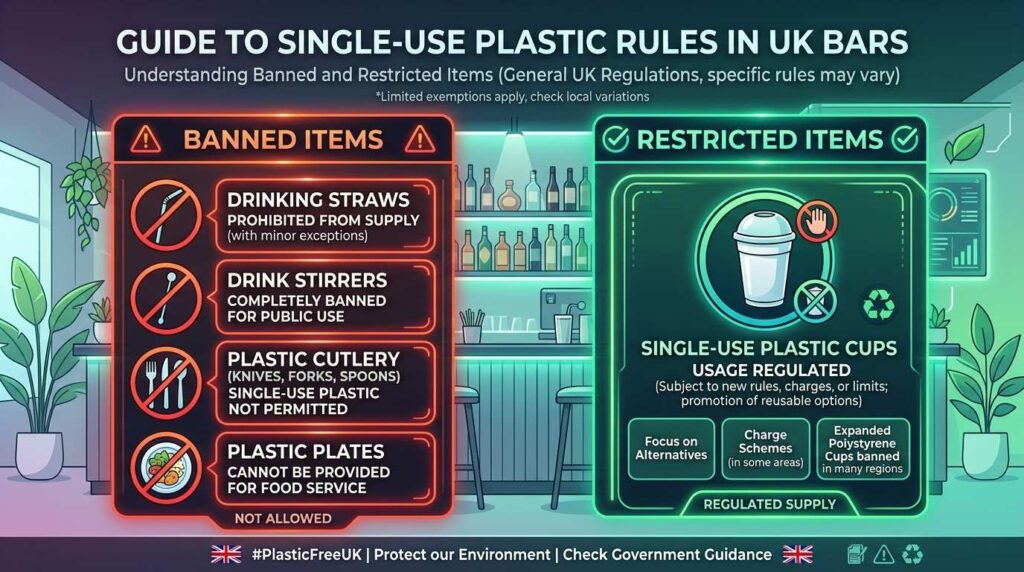
Plastic straws are treated differently from stirrers under UK law. They are restricted, not banned outright, for catering establishments.
Under the 2020 Regulations, it is an offence to supply plastic straws to end users in England. However, there is a specific exemption for catering establishments. This includes:
-
- ▸ Pubs and bars
-
- ▸ Restaurants and cafés
-
- ▸ Hotel dining rooms
-
- ▸ Any business supplying food or drink for immediate consumption
A catering establishment may supply a single-use plastic straw to a customer only if all three of the following conditions are met:
- The straws are not kept in a place where customers can see them
- The straws are not in a location where customers can help themselves
- The straws are not offered or provided unless the customer specifically requests one
This means:
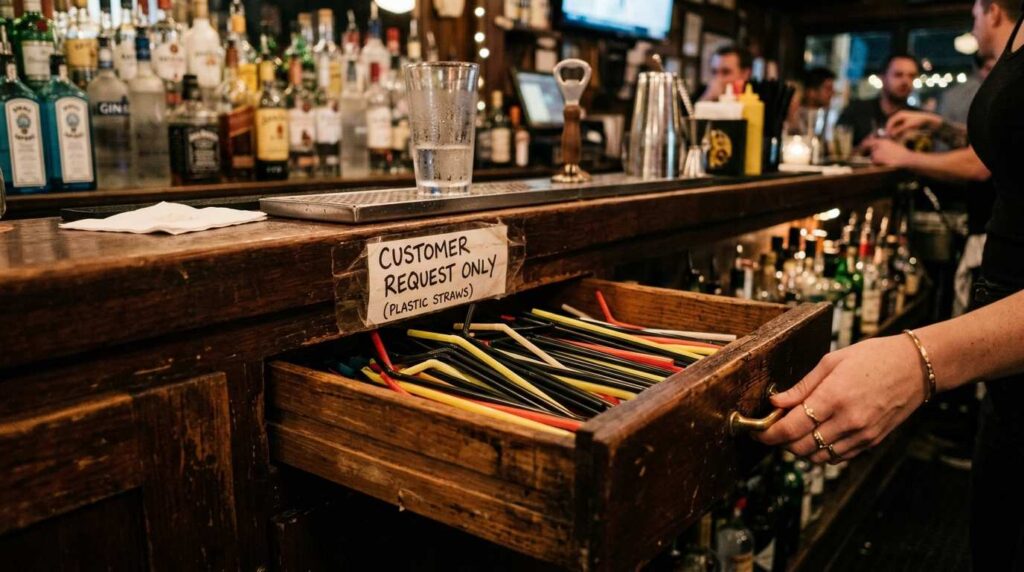
- ▸ Plastic straws must be stored in a closed drawer or cabinet behind the bar
- ▸ They cannot be in a jar on the counter or in a holder that customers cannot reach
- ▸ Staff cannot verbally offer straws or mention them on a menu or drinks list
- ▸ Straws cannot be added to drinks as standard
The only compliant scenario is a customer who actively asks for a plastic straw and receives it from a concealed location.
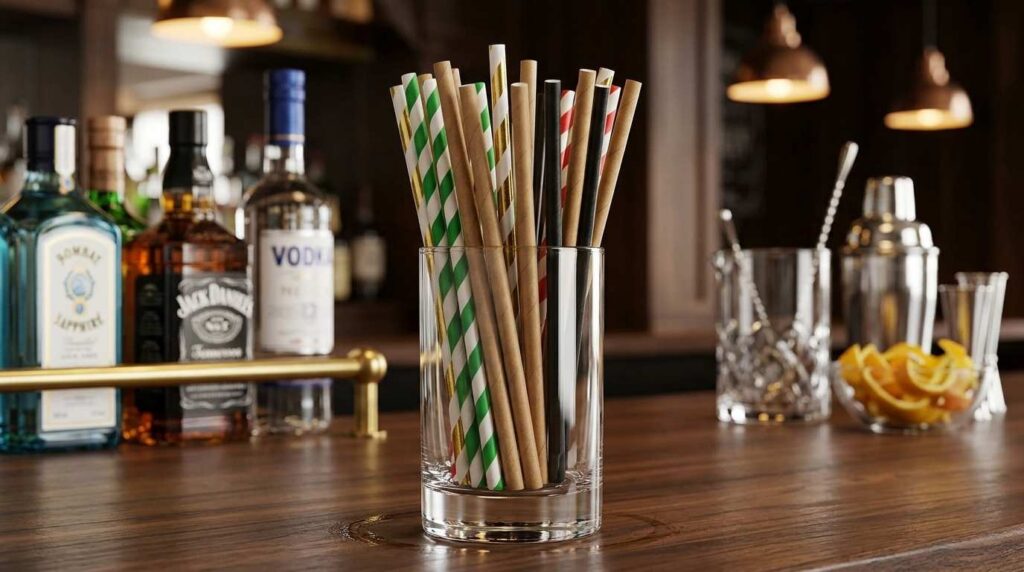
In practice, most UK bars and pubs have switched to paper straws as standard. Managing concealed plastic straws, training staff, and maintaining compliance during busy service is more complicated than simply using paper.
The Catering Establishment Exemption: What It Actually Means
There is a common misunderstanding that the catering establishment exemption allows bars and pubs more freedom with plastic straws than it actually does.
The exemption does not mean plastic straws can be kept available for general use. It allows staff to respond to a specific customer request with a plastic straw if necessary.
The primary compliant position for all licensed premises is:
-
- ▸ Use paper straws, or
-
- ▸ Provide no straws unless requested
The main reason the exemption exists is accessibility. Some customers with disabilities or medical conditions need a flexible plastic straw. They cannot use rigid paper or metal alternatives.
If you maintain a small, concealed supply for this purpose, document it. A staff note detailing where the straws are kept and when they can be provided helps ensure a clear compliance record if Trading Standards inspect your premises.
What Is Banned Beyond Straws and Stirrers
Since October 2023, the following items have also been banned for supply to end users in England:
-
- ▸ Single-use plastic cutlery (forks, knives, spoons, chopsticks)
-
- ▸ Single-use plastic plates, bowls, and trays
-
- ▸ Polystyrene food containers and cups (expanded and extruded)
-
- ▸ Plastic balloon sticks
-
- ▸ Drinks cartons or products with an attached plastic straw
The ban applies to all types of plastic, including recycled, compostable, and biodegradable. If an item is made wholly or partly from plastic and falls into one of the above categories, it is banned.
Two practical points for bar and pub operators:
- Plastic cocktail garnish picks that function as stirrers fall within the stirrer ban. If the item is used to stir a drink at any point, it is in scope, regardless of what it is called on the packaging.
- Business-to-business sales are still permitted. A supplier can sell you prohibited items if they are not supplied to end users. However, you cannot provide them to your customers. Compliance responsibility sits at the point of customer service.
Paper Straws vs Plastic Straws: Choosing the Right Option for Your Bar
When switching from plastic to paper straws, the most common complaint is that paper straws go soggy too quickly or fall apart in carbonated drinks.
This problem is almost always a specification issue, not a limitation of paper straws themselves.
What to look for when selecting paper straws for commercial bar use:
1. Ply thickness
-
- ▸ Single-ply paper straws deteriorate quickly in liquid.
-
- ▸ For cocktails, spirits, and any drink where customers sip for over 15 to 20 minutes, choose 3-ply paper straws. The performance difference is significant.
2. Diameter for the drink type
-
- ▸ 6mm diameter: standard for most cocktails and mixed drinks
-
- ▸ 8mm diameter: better for smoothies, thicker drinks, and milkshakes
-
- ▸ 10mm (jumbo): used for boba-style drinks and thick shakes
3. Straight vs flexible
-
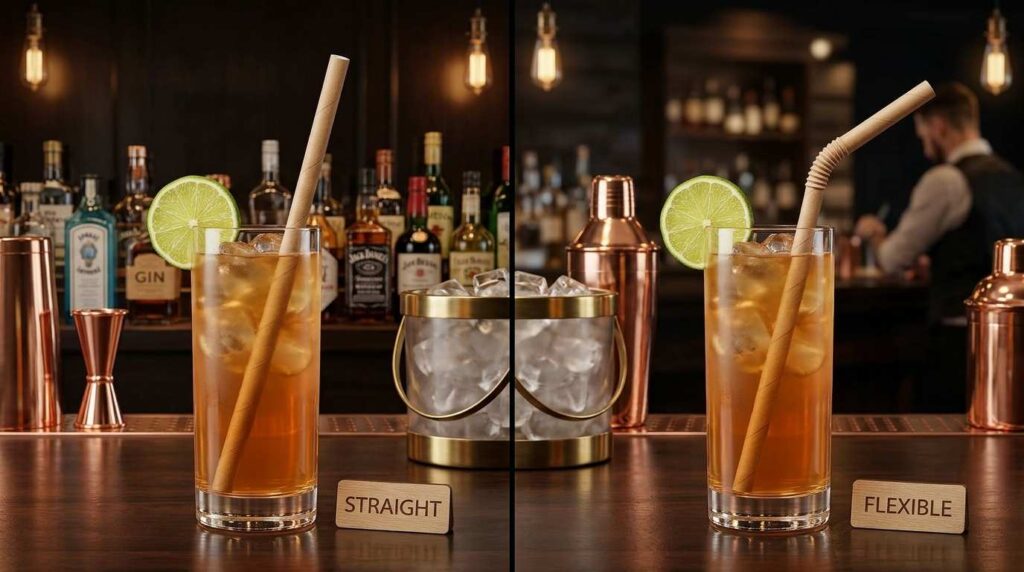
- ▸ Straight straws are standard for most bar service and look neat in the glass
-
- ▸ Flexible straws with the accordion bend are important for accessibility. Customers who cannot tilt a glass need a flexible straw. A compliant bar should keep both types available.
4. Printed and branded options
-
- ▸ Branded or printed paper straws are widely available.
-
- ▸ For venues where presentation matters, a branded straw adds value to the drink experience and costs very little more than a plain straw.
5. Buying tip for volume
-
- ▸ Purchase paper straws in larger case quantities.
-
- ▸ Buying a case of 500 or 1,000 usually reduces the per-unit cost by 20 to 30 per cent.
-
- ▸ Paper straws have a long shelf life when stored in a dry location.
Reusable and Alternative Straw Options
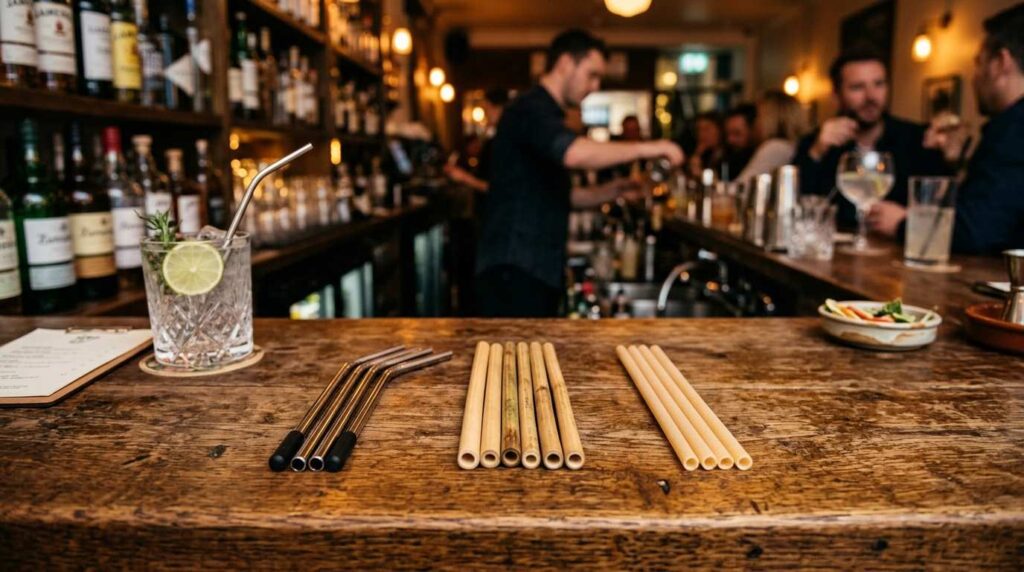
Beyond paper straws, there are three other compliant options used in UK bar environments:
1. Reusable metal straws
-
- ▸ Fully compliant and very durable
-
- ▸ Works well in venues where presentation is premium and staff can manage washing.g
-
- ▸ Most practical in slow-service environments like cocktail bars or hotel bars, where drinks are served to seated customers
-
- ▸ In fast-paced pubs or event bars, managing reusable straws hygienically adds operational complexity.
2. Bamboo straws
-
- ▸ Single-use and compostable
-
- ▸ Perform similarly to 3-ply paper straws
-
- ▸ Popular in venues with a strong sustainability positioning
3. Pasta straws
-
- ▸ Edible and novelty straws
-
- ▸ Functional for short-duration drinks
-
- ▸ Not suited for long cocktail service,as they soften over time
-
- ▸ Ideal for events or occasions where the unusual format adds to the customer experience
What Happens If You Get It Wrong

The 2020 and 2023 Regulations are enforced by local authority Trading Standards teams. Enforcement powers include:
-
- ▸ Visiting premises, making test purchases, speaking to staff, and reviewing records
-
- ▸ Issuing compliance notices requiring corrective action
-
- ▸ Civil monetary penalties for ongoing non-compliance
-
- ▸ Requiring businesses to cover investigation costs if found in breach
Non-compliance is not theoretical. Local authorities actively use these powers, especially following complaints. A competitor or customer can report a non-compliant premise directly to their local council.
The risk of having plastic stirrers behind the bar or a box of plastic straws accessible to customers is low-cost to fix but high-cost to ignore.
Where to Get Compliant Straws and Stirrer Alternatives
We Can Source It stocks a full range of compliant bar straws and stirrer alternatives, including:
-
- ▸ 3-ply paper straws in multiple sizes
-
- ▸ Flexible accessible straws
-
- ▸ Bamboo straws
-
- ▸ Wooden stirrers
Browse the full range at Bar Equipment & Supplies
👉 For everything your bar needs, from spirit measures to cocktail equipment to cellar management, see our complete guide to Bar Equipment & Supplies
Frequently Asked Questions
Are plastic straws banned in UK pubs and bars?
Plastic straws are restricted, not fully banned, for catering establishments in England. A pub or bar may supply a plastic straw only if it is kept out of sight, not accessible to customers, and provided only when a customer specifically requests one.
Plastic stirrers are fully banned with no exemptions.
What is the difference between a banned and a restricted item under the UK single-use plastics law?
-
- A banned item cannot be supplied to customers under any circumstances. Plastic stirrers are banned.
-
- A restricted item can be supplied only under specific conditions. Plastic straws for catering establishments fall into this category. They can only be provided if concealed, not offered, and requested by the customer.
What paper straws are best for a busy UK bar?
-
- 3-ply paper straws in 6mm diameter are standard for most bar applications. Single-ply straws deteriorate too quickly under commercial conditions.
-
- For smoothies and thicker drinks, an 8mm diameter is more practical.
-
- Always stock both straight and flexible options to cover accessibility needs.
Can you still buy plastic straws in the UK?
Retailers cannot supply plastic straws directly to consumers. Suppliers can sell them to catering businesses, who may then provide them to customers only under the restricted conditions set out in the 2020 Regulations. For practical purposes, most UK bars now use paper straws as standard.
Do the single-use plastic bans apply to Scotland and Wales?
Scotland and Wales have their own equivalent legislation. The regulations referenced in this article apply to England only. If you operate in Scotland, Wales, or Northern Ireland, check the devolved regulations for your location, as items and exemption conditions may differ slightly.
Author
We Can Source It, Team
We Can Source It is a UK-based specialist supplier of catering and hospitality supplies for bars, pubs, restaurants, hotels, and event operators across the United Kingdom.
- ▸ Came into force on 1 October 2020
- ▸ Covers plastic straws, plastic drink stirrers, and plastic-stemmed cotton buds
Environmental Protection (Plastic Plates etc. and Polystyrene Containers etc.) (England) Regulations 2023
-
- ▸ Came into force on 1 October 2023
- ▸ Covers plastic plates, bowls, trays, cutlery, balloon sticks, and polystyrene food and drink containers
-
- Together, these regulations define what bars, pubs, and other catering establishments can and cannot supply to customers.
Important: The October 2023 ban applies even to items made from biodegradable, compostable, or recycled plastic. If it contains plastic, it is in scope. Material environmental credentials do not create an exemption.
Plastic Stirrers: Fully Banned with No Exceptions
This is the clearest part of the law, yet it is often ignored in practice.
Key points:
-
- ▸ Plastic drink stirrers are completely banned
-
- ▸ No exemptions exist for catering establishments, medical needs, or customer requests
If you supply a drink to a customer with a plastic stirrer, you are breaking the regulations.
The ban applies regardless of:
-
- ▸ Whether a customer asked for it
-
- ▸ Whether you have old stock from before the ban
-
- ▸ Whether the stirrer is biodegradable or compostable
-
- ▸ Whether it is called a “garnish pick” instead of a stirrer
The ban covers supply to end users, including providing them free as part of a drink service.
Compliant alternatives include:
-
- ▸ Wooden stirrers
-
- ▸ Paper stirrers
-
- ▸ Reusable metal bar spoons
Plastic Straws vs Paper Straws: The Restricted Category Explained
Plastic straws are treated differently from stirrers under UK law. They are restricted, not banned outright, for catering establishments.
Under the 2020 Regulations, it is an offence to supply plastic straws to end users in England. However, there is a specific exemption for catering establishments. This includes:
-
- ▸ Pubs and bars
-
- ▸ Restaurants and cafés
-
- ▸ Hotel dining rooms
-
- ▸ Any business supplying food or drink for immediate consumption
A catering establishment may supply a single-use plastic straw to a customer only if all three of the following conditions are met:
- The straws are not kept in a place where customers can see them
- The straws are not in a location where customers can help themselves
- The straws are not offered or provided unless the customer specifically requests one
This means:
- ▸ Plastic straws must be stored in a closed drawer or cabinet behind the bar
- ▸ They cannot be in a jar on the counter or in a holder that customers cannot reach
- ▸ Staff cannot verbally offer straws or mention them on a menu or drinks list
- ▸ Straws cannot be added to drinks as standard
The only compliant scenario is a customer who actively asks for a plastic straw and receives it from a concealed location.
In practice, most UK bars and pubs have switched to paper straws as standard. Managing concealed plastic straws, training staff, and maintaining compliance during busy service is more complicated than simply using paper.
The Catering Establishment Exemption: What It Actually Means
There is a common misunderstanding that the catering establishment exemption allows bars and pubs more freedom with plastic straws than it actually does.
The exemption does not mean plastic straws can be kept available for general use. It allows staff to respond to a specific customer request with a plastic straw if necessary.
The primary compliant position for all licensed premises is:
-
- ▸ Use paper straws, or
-
- ▸ Provide no straws unless requested
The main reason the exemption exists is accessibility. Some customers with disabilities or medical conditions need a flexible plastic straw. They cannot use rigid paper or metal alternatives.
If you maintain a small, concealed supply for this purpose, document it. A staff note detailing where the straws are kept and when they can be provided helps ensure a clear compliance record if Trading Standards inspect your premises.
What Is Banned Beyond Straws and Stirrers
Since October 2023, the following items have also been banned for supply to end users in England:
-
- ▸ Single-use plastic cutlery (forks, knives, spoons, chopsticks)
-
- ▸ Single-use plastic plates, bowls, and trays
-
- ▸ Polystyrene food containers and cups (expanded and extruded)
-
- ▸ Plastic balloon sticks
-
- ▸ Drinks cartons or products with an attached plastic straw
The ban applies to all types of plastic, including recycled, compostable, and biodegradable. If an item is made wholly or partly from plastic and falls into one of the above categories, it is banned.
Two practical points for bar and pub operators:
- Plastic cocktail garnish picks that function as stirrers fall within the stirrer ban. If the item is used to stir a drink at any point, it is in scope, regardless of what it is called on the packaging.
- Business-to-business sales are still permitted. A supplier can sell you prohibited items if they are not supplied to end users. However, you cannot provide them to your customers. Compliance responsibility sits at the point of customer service.
Paper Straws vs Plastic Straws: Choosing the Right Option for Your Bar
When switching from plastic to paper straws, the most common complaint is that paper straws go soggy too quickly or fall apart in carbonated drinks.
This problem is almost always a specification issue, not a limitation of paper straws themselves.
What to look for when selecting paper straws for commercial bar use:
1. Ply thickness
-
- ▸ Single-ply paper straws deteriorate quickly in liquid.
-
- ▸ For cocktails, spirits, and any drink where customers sip for over 15 to 20 minutes, choose 3-ply paper straws. The performance difference is significant.
2. Diameter for the drink type
-
- ▸ 6mm diameter: standard for most cocktails and mixed drinks
-
- ▸ 8mm diameter: better for smoothies, thicker drinks, and milkshakes
-
- ▸ 10mm (jumbo): used for boba-style drinks and thick shakes
3. Straight vs flexible
-
- ▸ Straight straws are standard for most bar service and look neat in the glass
-
- ▸ Flexible straws with the accordion bend are important for accessibility. Customers who cannot tilt a glass need a flexible straw. A compliant bar should keep both types available.
4. Printed and branded options
-
- ▸ Branded or printed paper straws are widely available.
-
- ▸ For venues where presentation matters, a branded straw adds value to the drink experience and costs very little more than a plain straw.
5. Buying tip for volume
-
- ▸ Purchase paper straws in larger case quantities.
-
- ▸ Buying a case of 500 or 1,000 usually reduces the per-unit cost by 20 to 30 per cent.
-
- ▸ Paper straws have a long shelf life when stored in a dry location.
Reusable and Alternative Straw Options
Beyond paper straws, there are three other compliant options used in UK bar environments:
1. Reusable metal straws
-
- ▸ Fully compliant and very durable
-
- ▸ Works well in venues where presentation is premium and staff can manage washing.g
-
- ▸ Most practical in slow-service environments like cocktail bars or hotel bars, where drinks are served to seated customers
-
- ▸ In fast-paced pubs or event bars, managing reusable straws hygienically adds operational complexity.
2. Bamboo straws
-
- ▸ Single-use and compostable
-
- ▸ Perform similarly to 3-ply paper straws
-
- ▸ Popular in venues with a strong sustainability positioning
3. Pasta straws
-
- ▸ Edible and novelty straws
-
- ▸ Functional for short-duration drinks
-
- ▸ Not suited for long cocktail service,as they soften over time
-
- ▸ Ideal for events or occasions where the unusual format adds to the customer experience
What Happens If You Get It Wrong
The 2020 and 2023 Regulations are enforced by local authority Trading Standards teams. Enforcement powers include:
-
- ▸ Visiting premises, making test purchases, speaking to staff, and reviewing records
-
- ▸ Issuing compliance notices requiring corrective action
-
- ▸ Civil monetary penalties for ongoing non-compliance
-
- ▸ Requiring businesses to cover investigation costs if found in breach
Non-compliance is not theoretical. Local authorities actively use these powers, especially following complaints. A competitor or customer can report a non-compliant premise directly to their local council.
The risk of having plastic stirrers behind the bar or a box of plastic straws accessible to customers is low-cost to fix but high-cost to ignore.
Where to Get Compliant Straws and Stirrer Alternatives
We Can Source It stocks a full range of compliant bar straws and stirrer alternatives, including:
-
- ▸ 3-ply paper straws in multiple sizes
-
- ▸ Flexible accessible straws
-
- ▸ Bamboo straws
-
- ▸ Wooden stirrers
Browse the full range at Bar Equipment & Supplies
👉 For everything your bar needs, from spirit measures to cocktail equipment to cellar management, see our complete guide to Bar Equipment & Supplies
Frequently Asked Questions
Are plastic straws banned in UK pubs and bars?
Plastic straws are restricted, not fully banned, for catering establishments in England. A pub or bar may supply a plastic straw only if it is kept out of sight, not accessible to customers, and provided only when a customer specifically requests one.
Plastic stirrers are fully banned with no exemptions.
What is the difference between a banned and a restricted item under the UK single-use plastics law?
-
- A banned item cannot be supplied to customers under any circumstances. Plastic stirrers are banned.
-
- A restricted item can be supplied only under specific conditions. Plastic straws for catering establishments fall into this category. They can only be provided if concealed, not offered, and requested by the customer.
What paper straws are best for a busy UK bar?
-
- 3-ply paper straws in 6mm diameter are standard for most bar applications. Single-ply straws deteriorate too quickly under commercial conditions.
-
- For smoothies and thicker drinks, an 8mm diameter is more practical.
-
- Always stock both straight and flexible options to cover accessibility needs.
Can you still buy plastic straws in the UK?
Retailers cannot supply plastic straws directly to consumers. Suppliers can sell them to catering businesses, who may then provide them to customers only under the restricted conditions set out in the 2020 Regulations. For practical purposes, most UK bars now use paper straws as standard.
Do the single-use plastic bans apply to Scotland and Wales?
Scotland and Wales have their own equivalent legislation. The regulations referenced in this article apply to England only. If you operate in Scotland, Wales, or Northern Ireland, check the devolved regulations for your location, as items and exemption conditions may differ slightly.
Author
We Can Source It, Team
We Can Source It is a UK-based specialist supplier of catering and hospitality supplies for bars, pubs, restaurants, hotels, and event operators across the United Kingdom.